
Cold Continuation
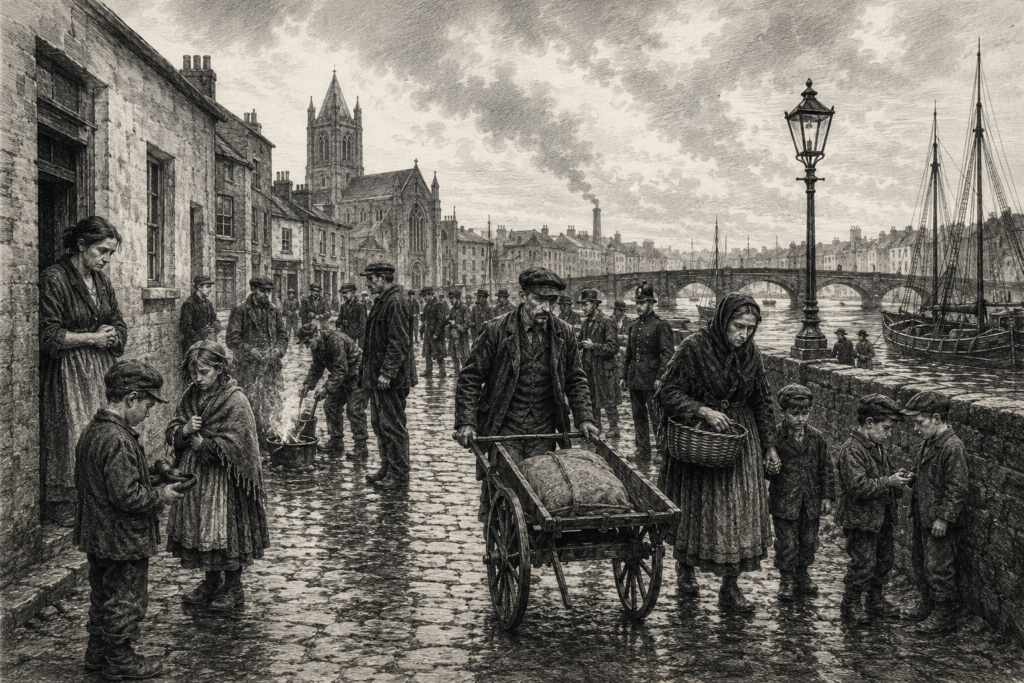
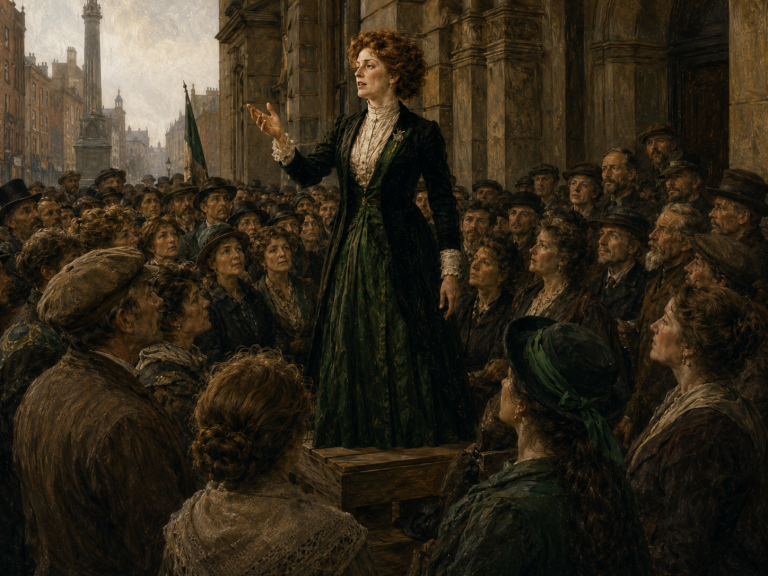
January came into Limerick without ceremony for most of the people who had to live through it. The arrival of a new century did not lift rent from a labourer’s door, provide sound boots for a schoolchild, warm a damp room, settle a shop debt, clear a fevered lane or make an uncertain wage secure. Across the city and county, families entered the year carrying the same burdens that had shaped the closing decades of the nineteenth century. Public celebration meant little where survival continued to depend upon bread, coal, credit, employment and the health of children.
The city awoke around its quays, bridges, churches, markets, barracks, schools, convents, courts, public houses and municipal offices. Traders opened their shutters, labourers searched for work, dockers watched the river and small shopkeepers calculated what could be sold before another bill became due. In poorer districts, overcrowded houses and damp rooms offered little protection against winter illness. Newspapers carried reports of political affairs and events overseas, but domestic attention remained fixed upon rent, food prices and the possibility that sickness or unemployment might unsettle an already fragile household.
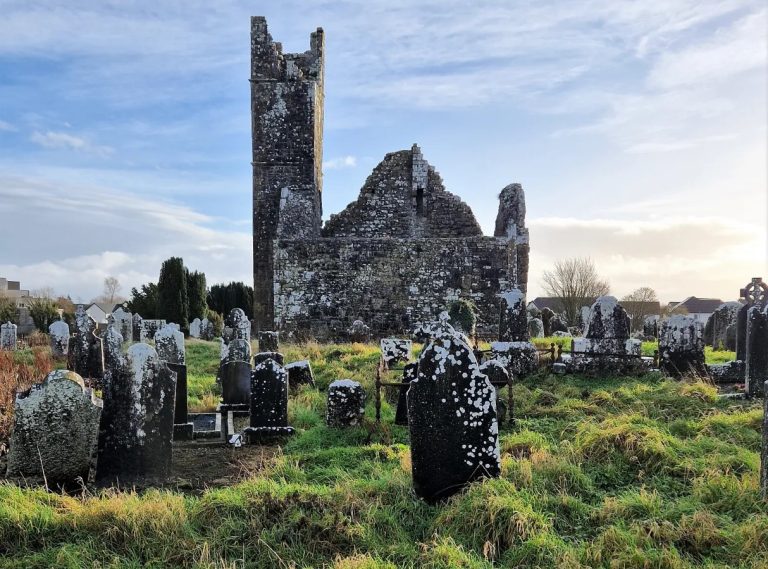
Beyond the city, County Limerick entered January through roads, townlands, farms, market towns and scattered cottages shaped by land, weather and agricultural prices. Tenant farmers considered rents, livestock and the condition of winter fields, while labourers depended upon irregular employment and the willingness of local farmers to hire. Parish schools, police barracks, fairs and chapels connected rural communities, but distance and poor roads could leave families isolated during severe weather. The new century reached such households not as a dramatic beginning, but as another season requiring careful management of food, fuel, animals and money.
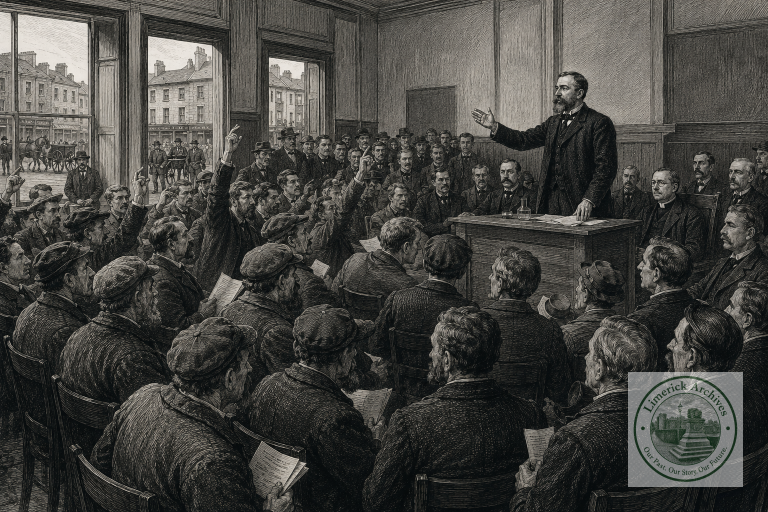
Public institutions continued their ordinary work. Limerick Corporation dealt with streets, sanitation, markets and local administration, while Poor Law guardians confronted sickness, poverty and dependence within the workhouse system. Schools received children whose ability to learn could be weakened by hunger, cold or inadequate clothing. Barracks and police stations reflected the continuing presence of British authority, while churches and charitable bodies attempted to relieve hardship that public provision often failed to address. Each institution recorded the city through minutes, notices and statistics, yet the full weight of poverty remained most visible inside homes.
For many people, January offered no sense of a clean historical beginning. The year’s first notices, accounts and newspaper editions appeared beside the same private arithmetic of survival that had governed December: how much coal remained, whether credit would be extended, whether work could be found and whether illness might be avoided. Limerick entered the twentieth century through continuity rather than transformation. Its people carried inherited pressures into the new year, measuring time not by ceremony but by wages, rent, bread, weather and the daily effort to preserve dignity.
Primary Sources
- Census of Ireland, 1901, General Report and County and City Tables for Limerick, recording population, housing, occupations and household conditions. Exact table and page should be confirmed before formal citation.
- Thom’s Official Directory of the United Kingdom of Great Britain and Ireland, 1900 edition, entries for Limerick institutions, streets, public offices, businesses and civic administration. Exact pages should be confirmed before formal citation.
- Limerick Chronicle, January 1900, local reporting on municipal affairs, markets, weather, employment, public health and daily life. Exact issue, page and column should be confirmed before formal citation.
- Limerick Board of Guardians minutes and Poor Law records, January 1900, concerning poverty, workhouse administration, illness and relief. Exact volume, meeting date and archival reference should be confirmed before formal citation.
- Limerick Corporation minutes, January 1900, concerning streets, sanitation, markets, public health and municipal administration. Exact volume, meeting date and archival reference should be confirmed before formal citation.