Shannon Heartland
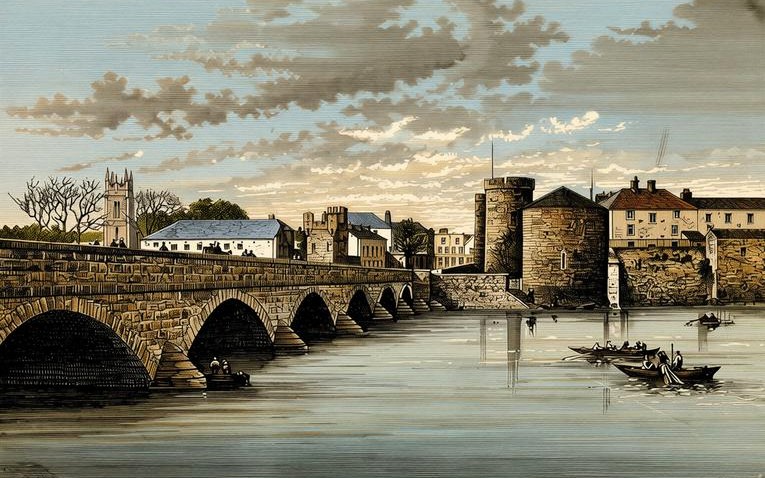
Limerick City stands as the beating heart of the great Shannon valley, commanding the river’s course and serving as the natural maritime centre of western Ireland. The city’s historic docks, capable of hosting vessels of significant size, enabled Limerick to act as a gateway between the Atlantic world and the fertile hinterland, fostering a diverse range of industries and trade networks. While nineteenth-century commentators occasionally described Limerick’s commercial output as modest compared to Cork or Dublin, the city’s economic life was rich and varied, supporting glove-making, lace production, snuff manufacturing, army cloth weaving, and a substantial provisions trade that fed local and regional markets.
The city’s topography and architecture reflected its deep historical roots. King John’s Castle dominated the left bank of the Shannon, its Norman walls and towers bearing witness to centuries of military and civic history. Surrounding the castle, the medieval streets of English Town preserved echoes of the city’s earliest days, while bridges and quays connected this quarter to Irish Town and the elegant Georgian terraces of Newtown Pery. The city’s bridges—vital for commerce and communication—stood as enduring symbols of Limerick’s strategic importance, linking communities and shaping the cityscape.
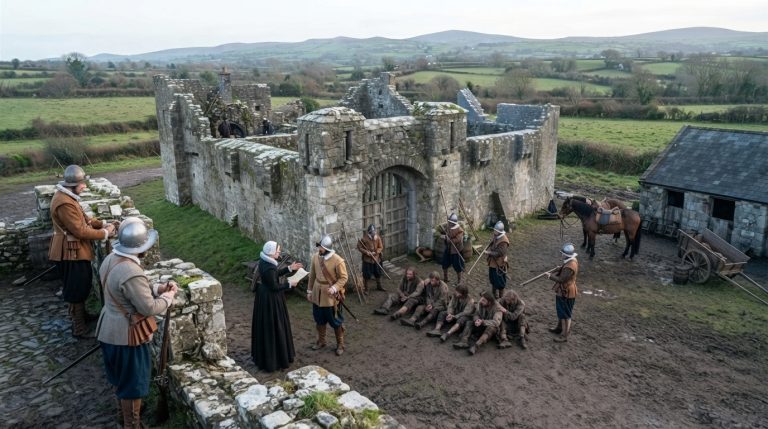
County Limerick’s network of historic towns and settlements radiated from the city, each contributing its own chapter to the region’s story. Castleconnell, lying beside the Shannon near the famed Falls of Doonass, was renowned for its scenic beauty and strategic location. The fertile Maigue valley hosted Adare with its picturesque abbey and thatched cottages, the market town of Croom, the medieval stronghold of Kilmallock, and Kilfinane, set amid rolling hills. Kilmallock, in particular, boasted some of the best-preserved medieval architecture in Ireland, with substantial remains of its walls and ancient buildings. Nearby, the ruins at Ardpatrick recalled the area’s early Christian and monastic heritage.
Further west, the Deel valley encompassed Askeaton—once a formidable fortress town—and Rathkeale, a centre of settlement and trade. These towns, together with Limerick City, formed a cohesive region bound by the Shannon’s waters, agricultural prosperity, and centuries of shared history. The city’s castle, quays, bridges, and industrial districts were both a backdrop and a driving force for the county’s wider development.
In sum, Limerick’s role as the political, commercial, and historical centre of the Shannon heartland is unmistakable. Its influence extended beyond its ancient walls to the valleys, towns, and rural communities that looked to the city for leadership, opportunity, and connection. From medieval strongholds to Georgian avenues, from river docks to fertile fields, Limerick’s legacy is woven into the very fabric of western Ireland.
Primary Sources
- Samuel Lewis, “A Topographical Dictionary of Ireland,” London, 1837.
- Parliamentary Gazetteer of Ireland, entries on Limerick City and County, 1840s.
- “Industries of Limerick,” Limerick Chronicle, assorted issues, 19th century.
- Ordnance Survey maps and memoirs, Limerick and Shannon valley, 1830s–1840s.
- Archaeological Survey of County Limerick, National Monuments Service.