
Century Threshold(c.1900s)
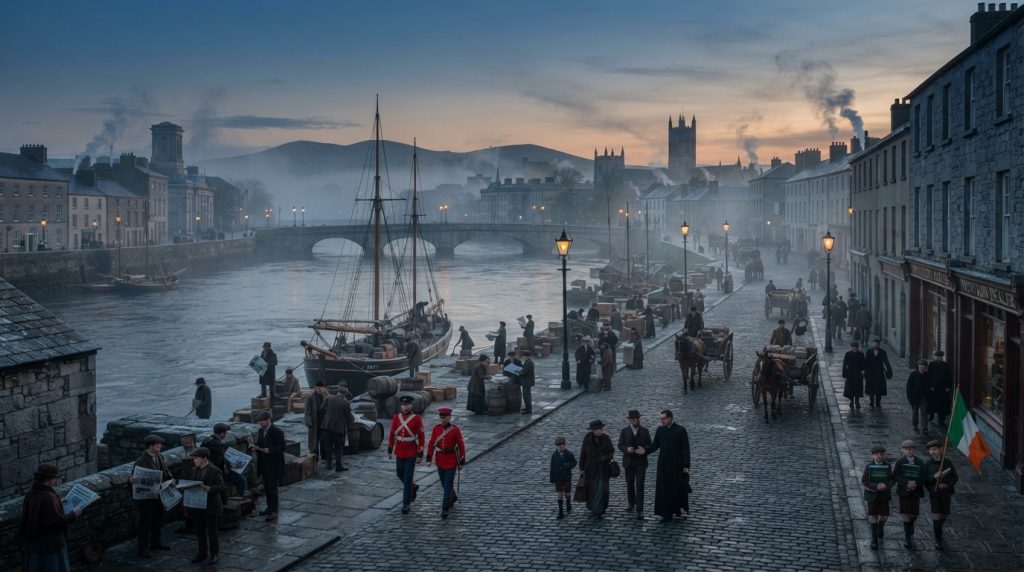
On Monday, 1 January 1900, Limerick entered a year widely described as the threshold of a new age, although strict calendar reckoning made it the final year of the nineteenth century. Newspapers carried New Year reflections beside war telegrams, political reports, advertisements and ordinary notices. Across Ireland, people considered what the approaching century might bring to a country still governed from Westminster. In Limerick, the change was observed among merchants, dockers, soldiers, clergy, labourers, farmers, teachers and families. Midnight itself altered nothing immediately, yet the date encouraged citizens to measure inherited problems against hopes for national renewal and shared progress.
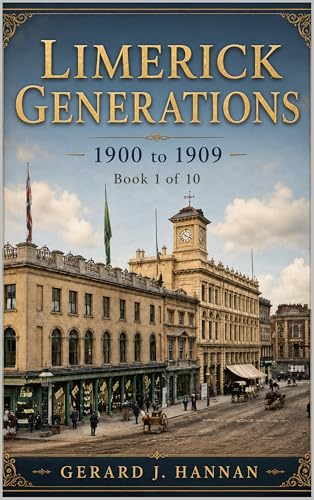
The setting was a city shaped by the River Shannon, its quays, markets, railway stations, churches, barracks and crowded residential streets. Gas lamps illuminated central thoroughfares, while horse-drawn vehicles moved goods between shops, warehouses and the docks. Beyond the city, County Limerick remained overwhelmingly agricultural, with tenant farmers and labourers depending upon land, livestock, weather and market prices. Winter hardship accompanied the celebrations. Poor families still faced uncertain employment, inadequate housing and illness. The New Year therefore arrived differently according to class: some marked it socially or religiously, while others simply calculated whether wages, food and fuel could be stretched.
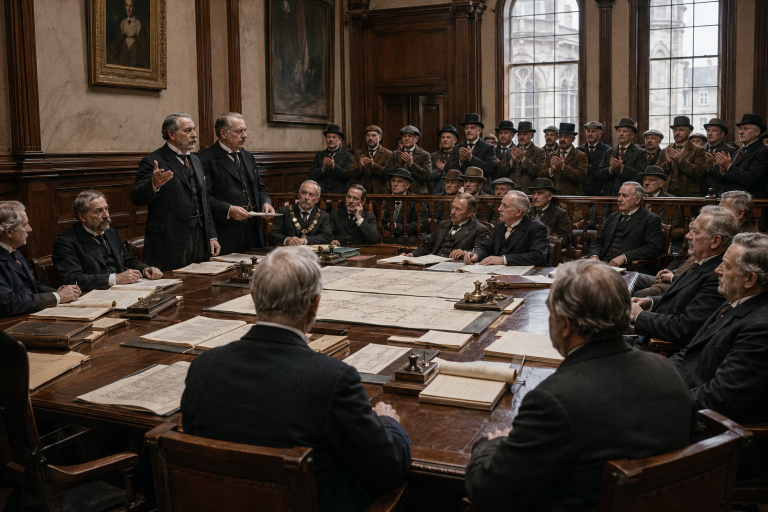
Nationally, Ireland began 1900 within the United Kingdom, represented at Westminster but without the Home Rule parliament sought by constitutional nationalists. The Irish Parliamentary Party remained divided after the fall of Charles Stewart Parnell, although pressure for reunion was increasing. William O’Brien’s United Irish League had expanded through rural Ireland by connecting political organisation with demands for land reform. Limerick supporters watched these developments closely because tenancy, rents and agricultural opportunity affected the county directly. The recently elected county and district councils also offered a new experience of local democracy, transferring administrative responsibilities from traditional grand-jury control to elected representatives.
Cultural renewal provided confidence. The Gaelic League promoted the Irish language, traditional music and a national identity extending beyond parliamentary politics. The Gaelic Athletic Association had already established clubs and competitions through which communities celebrated Irish games. In Limerick, schools, reading rooms, newspapers, literary societies and sporting organisations helped circulate arguments about language, history and nationality. Such movements asked how Ireland might modernise without surrendering its distinct culture. Their work was gradual rather than spectacular, but it influenced teachers, writers, athletes and younger activists who would later reshape Irish politics. Cultural recovery became a practical preparation for collective national self-belief.
International events also entered Limerick homes on New Year’s Day. The South African War dominated newspaper columns, producing anxiety for Irish soldiers serving in British regiments and sympathy among many nationalists for the Boer republics. Limerick’s association with the Royal Munster Fusiliers made the conflict personally significant, while reports travelled rapidly by telegraph, railway and print. Emigration gave the date another international dimension. Families throughout city and county had relatives in Britain, the United States, Canada and Australia, linking local hopes to a global Irish diaspora. Letters, remittances and newspapers carried ideas in both directions across distant oceans and generations.
The importance of 1 January 1900 lies less in a single dramatic occurrence than in the position from which Ireland faced its future. Limerick stood between inherited Victorian structures and emerging political, cultural and social organisation. The city’s people could not know that the coming decades would bring land reform, labour conflict, revolution, independence, partition and civil war. They did know that old arrangements were being questioned. Through elected councils, nationalist organisation, cultural revival, journalism, education and migration, change advanced. New Year’s Day offered a pause in which ordinary people could freely imagine how Ireland might enter the twentieth century.
Primary Sources
- Limerick Leader, Monday, 1 January 1900, New Year reports, editorials, advertisements and local notices.
- Irish Times, Monday, 1 January 1900, Irish political news, international telegrams and New Year commentary.
- Freeman’s Journal, Monday, 1 January 1900, nationalist politics, land agitation and South African War coverage.
- Cork Examiner, Monday, 1 January 1900, Irish provincial news and reflections upon the arrival of 1900.
- Limerick County Council, Minute Book, 22 April 1899–11 March 1903, council proceedings surrounding December 1899 and January 1900.
- Local Government (Ireland) Act 1898, 61 & 62 Victoria, chapter 37, establishing elected county and district councils.
- Census of Ireland, 1901, General Report and County and City Tables for Limerick, recording population, housing and occupations.
- Thom’s Official Directory of the United Kingdom of Great Britain and Ireland, 1900 edition, entries for Limerick institutions, businesses and public offices.
- An Claidheamh Soluis agus Fáinne an Lae, January 1900 editions, Gaelic League language, cultural and national reporting.
- Sydney Morning Herald, Monday, 1 January 1900, New Year editorial identifying 1900 as the final year of the nineteenth century.