
Dublin Stage(c.1740s)
On Friday, 5 January 1753, Dubliners who opened George Faulkner’s Dublin Journal could find an advertisement for an evening performance at the Theatre Royal in Smock Alley: Benjamin Hoadly’s comedy The Suspicious Husband. The notice anchors a precise cultural event to this particular day. More unusually, it also told anyone wishing to obtain tickets before the doors opened that they could purchase them from Mr Esdall, bookseller on Blind Quay. This apparently modest announcement provides a revealing glimpse of Dublin’s developing entertainment industry, in which theatre, newspapers, bookselling and increasingly organised advance ticket sales were becoming closely connected.
Smock Alley was already one of the most important theatrical addresses in Ireland. A theatre had occupied the site since the Restoration, while the building used in 1753 had been reconstructed in 1735. Thomas Sheridan had taken over management during the 1740s and worked to improve both the theatre and its reputation. Sheridan was an actor as well as a manager and sought to attract respectable audiences while maintaining a professional company capable of presenting major drama and comedy. His efforts helped make theatre a central feature of Dublin urban culture, drawing aristocrats, merchants, professionals, students, servants and visitors into the same building.
The play advertised for 5 January was already familiar to theatre audiences. Physician and dramatist Benjamin Hoadly had written The Suspicious Husband, first performed at Covent Garden in London in 1747. Printed editions followed quickly that same year. Its comedy revolves around jealousy, mistaken assumptions, romantic manoeuvring and the exposure of unwarranted suspicion. Sheridan became associated in Dublin with the lively character Ranger, while Irish-born actor Charles Macklin was associated with Strictland. The surviving evidence confirms the play for 5 January, although the complete cast of this particular evening should not be reconstructed where firm documentation is lacking.
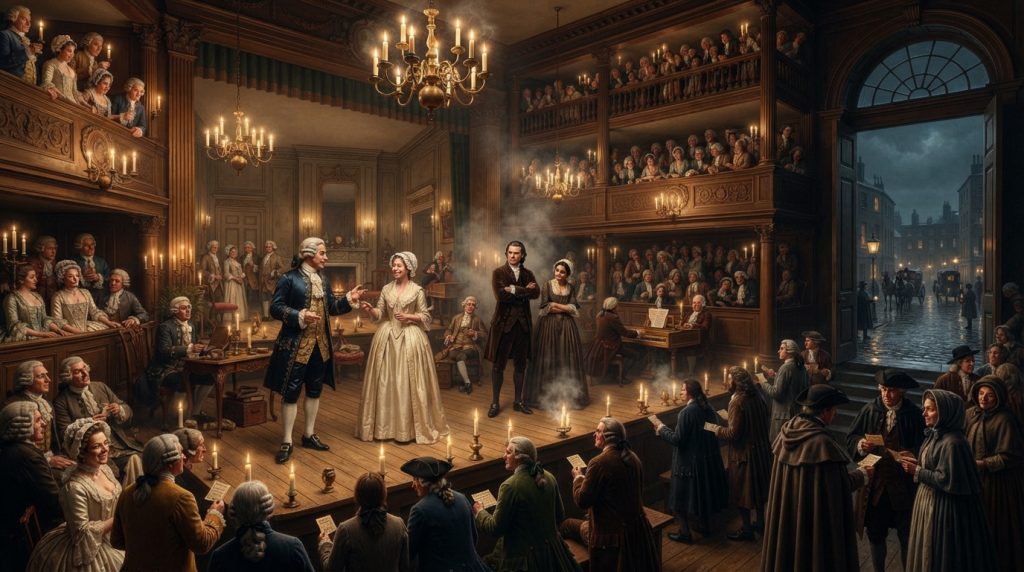
An evening at Smock Alley involved more than simply watching the main play. Music commonly preceded performances, while farces, songs, dances and other entertainments could accompany or follow them. The audience itself contributed heavily to the atmosphere. Boxes accommodated wealthier patrons, while the pit and galleries contained different mixtures of Dublin society. The house could be noisy, sociable and occasionally unruly. Sheridan had previously become involved in serious conflict over audience access to the stage and backstage areas, culminating in disturbances during 1747. Theatre management could consequently involve questions of privilege, class, public behaviour and masculine ideas of honour as much as artistic judgement.
The ticket notice attached to the 5 January advertisement is especially significant. Sheridan had previously arranged advance reservations for boxes and special occasions, but during the 1752–53 season he extended advance ticket purchasing to every part of the theatre. Anyone wanting admission before the doors opened was directed specifically to Esdall’s bookshop on Blind Quay. A bookseller had therefore become part of the theatre’s commercial machinery. Advance sales could help management estimate demand, regulate admission and reduce dependence upon last-minute purchases at the theatre door. The practice appears to have continued later in 1753, suggesting that this was more than a temporary experiment.
Location was an important part of the experience. Smock Alley stood close to the River Liffey amid a dense network of streets, quays, shops, taverns and lodging houses. Reaching the theatre after dark was not necessarily comfortable. Contemporary Dublin suffered from imperfect paving, poor lighting and street crime, and Sheridan had previously issued instructions intended to reduce congestion created by coaches approaching and leaving his theatre. Inside, spectators entered a brightly illuminated social world of stage scenery, costumes, candles and conversation. Outside remained the darker winter streets of an eighteenth-century city still struggling with the practical consequences of rapid growth and increasing traffic.
The theatre also depended heavily upon Dublin’s expanding newspaper culture. Faulkner’s Dublin Journal regularly carried theatrical advertisements and announcements, placing the stage within the same printed marketplace as commercial advertisements and public news. The official Dublin Gazette was simultaneously circulating an issue covering 2 to 6 January 1753. Newspapers connected Dublin readers with government notices, property transactions, foreign reports, shipping intelligence and entertainment. The advertisement for The Suspicious Husband therefore belonged to something larger than theatrical history. It represents a developing Irish information economy in which printers, booksellers, newspapers, performers and paying customers increasingly depended upon one another.
Outside this theatre-going world, most people in Ireland experienced a markedly different daily existence. The country remained predominantly agricultural, while landholding, rents and seasonal work strongly influenced family security. Religious inequalities were embedded within the political and legal system. Catholics remained affected by penal legislation that restricted important aspects of property and public life, while the established Church of Ireland enjoyed institutional privilege. Dublin’s theatrical audiences therefore represented only one section of Irish society. Nevertheless, their existence reveals the growing concentration of commerce, printing, administration and consumption within the capital during a period when Ireland’s population was beginning a prolonged expansion.
The day also falls within an unusually valuable surviving meteorological record. James Simon, secretary of the Incorporated Society in Dublin and a Fellow of the Royal Society, maintained observations of barometric conditions and weather encompassing January 1753. These records demonstrate the increasing eighteenth-century interest in systematically measuring Ireland’s environment. Weather mattered profoundly in an agricultural society because prolonged cold, excessive rain or violent storms could damage roads, interrupt shipping and threaten food supplies. Ireland remained within living memory of the catastrophic subsistence crisis of 1740–41. Scientific observations therefore recorded conditions that had immediate practical consequences for trade, transport, farming and household survival.
For a day-by-day history of Ireland, 5 January 1753 is valuable precisely because its surviving evidence captures cultural life rather than catastrophe. Dubliners were being invited to Smock Alley to see a popular comedy, while those planning ahead could purchase their tickets from a bookseller before the theatre opened. Behind that small advertisement lies a broader story involving actors, audiences, newspapers, retailing, class and the professionalisation of entertainment. Irish history was not created solely in parliaments, castles and battlefields. It was also created in theatres and bookshops, where people exchanged news, spent money, encountered new commercial practices and gathered together to laugh at familiar characters on a winter evening.
Primary Sources
Primary Sources
- George Faulkner — The Dublin Journal — 2–6 January 1753.
The most important primary source for this date. It advertised The Suspicious Husband for 5 January and directed advance ticket buyers to Mr Esdall, bookseller on Blind Quay. The National Library of Ireland records surviving access to Faulkner’s Dublin Journal through historic newspaper collections. - Irish Executive — The Dublin Gazette, No. 246 — 2–6 January 1753.
Official Irish government newspaper covering the exact target date and providing contemporary administrative and news context. Repository: Houses of the Oireachtas Library / Virtual Treasury of Ireland. - James Simon — An Account of the Barometer, and the State of the Weather, at Dublin, from the 7 of March 1752 to the 28 of February 1753 — observations covering 5 January 1753.
Contemporary scientific observations directly encompassing the target date. Source: Royal Society, Philosophical Transactions. - Benjamin Hoadly — The Suspicious Husband: A Comedy — 1747.
Contemporary printed text of the comedy advertised at Smock Alley on the target date. A surviving second edition was published in 1747 and is digitised from the British Library copy. - Smock Alley Theatre — Playbill for The Stratagem — 5 October 1753.
Surviving original Smock Alley playbill showing Thomas Sheridan performing Archer and Margaret Woffington as Mrs Sullen. Useful evidence for the theatre’s cast, advertising and performance practices later in the same year. National Library of Ireland, Department of Ephemera. - Smock Alley Theatre — Playbill for Phaedra and Hippolitus — 8 October 1753.
Contemporary Smock Alley advertisement naming Sheridan and other performers and documenting the theatre’s programme during the same year. National Library of Ireland. - Smock Alley Theatre — Playbill for The Way of the World — 19 October 1753.
Original playbill documenting actors, singing and other entertainments at Smock Alley. National Library of Ireland, Playbills Collection. - Smock Alley Theatre — Playbill for Oedipus — 26 October 1753.
Contemporary evidence of Sheridan’s acting company, theatrical repertoire and supplementary entertainment during 1753. National Library of Ireland. - Smock Alley Theatre — Playbill for The Committee, or The Faithful Irishman — 8 November 1753.
Original theatrical advertisement showing Mrs Woffington and other members of the company. National Library of Ireland. - Smock Alley Theatre — Playbill for The Old Batchelor — 22 November 1753.
Surviving primary evidence for Sheridan, Sowdon, Woffington and Smock Alley’s regular performance arrangements. National Library of Ireland. - Smock Alley Theatre — Playbill for The Lady’s Last Stake, or The Wife’s Resentment — 1 December 1753.
Original performance advertisement from the same theatrical season. National Library of Ireland, Department of Ephemera. - Smock Alley Theatre — Playbill for The Provoked Wife — 6 December 1753.
Contemporary playbill naming Sheridan, Woffington and supplementary performers, illustrating how Smock Alley productions were advertised. National Library of Ireland. - Smock Alley Theatre — Playbill for The Recruiting Officer — 19 December 1753.
Original broadside showing the theatre combining a principal comedy with an epilogue, dancing and a farce. National Library of Ireland. - Smock Alley Theatre — Playbill for The Non Juror — 22 December 1753.
Original advertisement naming Sheridan and Woffington and documenting the company near the close of 1753. National Library of Ireland. - Irish Executive — The Dublin Gazette, No. 247 — 6–9 January 1753.
The first official Gazette issue immediately following the target date. Repository: Houses of the Oireachtas Library / Virtual Treasury of Ireland. - Irish Executive — The Dublin Gazette, No. 248 — 9–13 January 1753.
Contemporary official newspaper from the following week, useful for establishing the wider Dublin environment immediately after the performance. - Thomas Sheridan — A Full Vindication of the Conduct of the Manager of the Theatre-Royal. Written by Himself — Dublin, 1747.
Sheridan’s own contemporary account defending his management of Smock Alley and explaining disputes concerning theatrical authority and audience behaviour. Surviving copy: Huntington Library; digital edition through ECCO/Wellcome holdings. - Thomas Sheridan — A Faithful Narrative of What Happen’d at the Theatre on Monday the 19th Instant — Dublin, 1747.
Sheridan’s contemporary account of the events that produced the celebrated Smock Alley disturbances. Valuable for understanding management, audiences and backstage privileges still relevant to the theatre of 1753. - Benjamin Victor — The History of the Theatres of London and Dublin, from the Year 1730 to the Present Time — 1761.
Written by Sheridan’s deputy manager and treasurer, who had direct personal knowledge of Smock Alley during the 1752–53 season. It is a contemporary participant’s record of Dublin theatrical life. - Benjamin Victor — Original Letters, Dramatic Pieces, and Poems — London, 1776.
Victor’s surviving correspondence and recollections preserve material relating to his years working with Sheridan and the Dublin theatre. Although published later, the underlying letters were written by a contemporary participant. Folger Shakespeare Library / Huntington Library / ECCO.