Jesuit Journey(c.1690s)

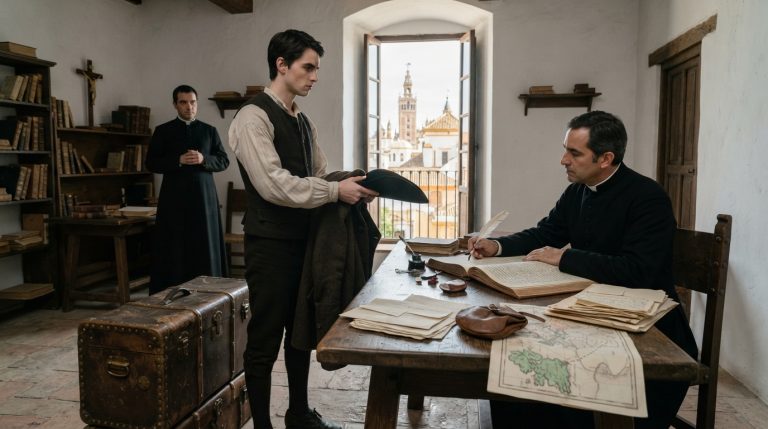
On Monday, 15 January 1753, a twenty-four-year-old Dubliner named Richard O’Callaghan entered the Society of Jesus in Seville, Spain. The Irish Jesuit Archives record that O’Callaghan had been born in Dublin on 25 September 1728 and entered the Jesuits at Seville on this exact date, joining the Baetica Province with the intention of serving the Philippine mission. His decision might appear far removed from Ireland, yet it belonged directly to the religious circumstances of eighteenth-century Irish Catholicism, when many Irishmen seeking Catholic religious education or formation travelled to continental Europe because opportunities at home were severely constrained.
O’Callaghan had grown up in an Ireland still governed by the Penal Laws, which placed severe restrictions upon Catholic political participation, property, education and religious organisation. Irish Jesuits continued to operate despite these restrictions, but continental houses remained essential for recruiting and educating members of the Irish mission. Spain had particularly long connections with Irish Catholic education. Irish religious students could be found in centres such as Salamanca, Santiago and Seville, where they entered institutions that connected Ireland with the wider Catholic world. O’Callaghan’s arrival at Seville therefore followed an established path by which Irish Catholic clerics sought formation abroad before undertaking ministry at home or overseas.
Entry into the Society of Jesus was not simply enrolment in a college. O’Callaghan was beginning a disciplined religious formation involving prayer, obedience, study and preparation for whatever mission his superiors might eventually assign. Jesuit education traditionally placed great emphasis upon languages, philosophy, theology and teaching. For an Irish Catholic entering in Spain, the experience also meant leaving familiar surroundings and adapting to a multinational religious organisation whose members could be dispatched across Europe or the Spanish Empire. The archival record identifies O’Callaghan specifically with the Philippine Province, indicating that his vocation was expected to carry him considerably farther from Dublin than Seville itself.
That journey soon became reality. Irish Jesuit archival records state that O’Callaghan arrived in Manila in 1755, only about two years after entering the Society. The distance between Dublin and the Philippines was immense. Reaching Manila from Europe involved lengthy travel through the Spanish imperial system and dangerous ocean passages. O’Callaghan consequently became part of a small but fascinating tradition of Irish Jesuits whose religious careers carried them far beyond Europe. The Irish Jesuit Archives identify him among Irish members connected with the Philippine Islands, placing a Dublin-born priest within one of the most geographically distant fields of eighteenth-century Catholic missionary activity.
His Asian mission unfolded during an increasingly dangerous period for the Jesuit order. Across Catholic Europe, governments were becoming hostile to the Society of Jesus because of political, economic and ecclesiastical disputes. Portugal expelled the Jesuits in 1759, France moved against them during the 1760s, and Charles III expelled them from the Spanish dominions in 1767. In the Philippines the Spanish authorities implemented the expulsion in 1768. O’Callaghan, who had begun his Jesuit life under Spanish protection in Seville, therefore witnessed an extraordinary reversal: the same imperial system that had enabled his missionary career now ordered the Society removed from its territories.
The crisis culminated in 1773, when Pope Clement XIV formally suppressed the Society of Jesus throughout most of the Catholic world. O’Callaghan survived this institutional destruction and eventually returned to Ireland. The Irish Jesuit Archives state that he came home shortly before the suppression. There he joined a remarkable remnant of former Jesuits who continued their priestly work despite the disappearance of the order to which they had dedicated their lives. Archival material lists seventeen Jesuits in Ireland at the suppression, including Richard O’Callaghan and Thomas Betagh. They would become important links between the old Society and its eventual restoration.
Their situation was unusual. Officially the Society of Jesus no longer existed, yet its former Irish members retained memories, relationships and financial resources associated with the old mission. The surviving Jesuits believed that restoration might eventually occur and carefully preserved resources that could be passed to successors. O’Callaghan and Thomas Betagh became particularly important in maintaining this continuity. Betagh later became one of Dublin’s best-known Catholic educators, while the older O’Callaghan represented a living connection with a Jesuit world stretching back before the suppression. The decision O’Callaghan had made in Seville on 15 January 1753 consequently acquired significance that nobody could have anticipated when he first entered the novitiate.
Hope for restoration strengthened around the beginning of the nineteenth century because the Society had survived legally in parts of the Russian Empire. In 1803, O’Callaghan renewed his Jesuit vows at Stonyhurst in Lancashire, reconnecting himself formally with the partially restored Society. He was by then about seventy-four years old and had lived through missionary service, expulsion and suppression. His renewed profession demonstrated an extraordinary persistence of religious identity across half a century. Irish Jesuit historical records specifically remember O’Callaghan and Betagh as men who preserved continuity and helped prepare the conditions from which a restored Jesuit presence in Ireland could eventually develop.
O’Callaghan did not live to see the universal restoration of the Society by Pope Pius VII in 1814. He died on 15 June 1807 at Upper Church Street in Dublin, aged seventy-eight, and was buried in Ireland. Yet the work of men such as O’Callaghan and Betagh helped bridge the otherwise enormous institutional gap created in 1773. A younger generation, notably the Dublin-born Peter Kenney, would carry that continuity forward and become instrumental in rebuilding the Society in Ireland. Thus the religious choice made by O’Callaghan in Spain eventually fed back into the history of Catholic education and Jesuit organisation in his native city.
The significance of 15 January 1753 is therefore much greater than the simple entry of one Irishman into a religious order abroad. Richard O’Callaghan’s decision connects Penal-era Dublin with Catholic Europe, Spanish Seville, the Philippine Islands, the global expulsion of the Jesuits, their suppression in 1773 and their gradual revival. His life demonstrates how Irish history frequently extended beyond Ireland’s shores, particularly when religious restrictions compelled education and formation overseas. On that January day in Seville, a young Dubliner began a vocation that would survive missionary exile and the destruction of his order itself. More than fifty years later, he died in Dublin still helping preserve the tradition he had entered in 1753.
Primary Sources
Primary Sources
- Society of Jesus — Entrance record for Richard O’Callaghan — Seville, 15 January 1753.
The fundamental exact-date primary record documenting the Dublin-born O’Callaghan’s entry into the Society of Jesus in the Baetica Province for the Philippine mission. The biographical record derived from the Jesuit archives preserves the exact date. Irish Jesuit Archives / Jesuit personnel records. - Society of Jesus — Provincial catalogue of the Baetica Province — 1753.
Contemporary Jesuit personnel catalogues identify members, houses, studies and assignments within the Spanish province into which O’Callaghan entered. Relevant originals survive within Jesuit archival collections in Spain and Rome. - Society of Jesus — Novitiate records, Seville — 1753.
Contemporary institutional records relating to candidates entering Jesuit formation at Seville during the year O’Callaghan joined. - Society of Jesus — Philippine Province catalogues — 1755.
Contemporary Jesuit personnel records associated with the Philippine mission. Irish Jesuit archival material records O’Callaghan’s arrival in Manila in 1755. - Society of Jesus — Manila mission records — 1755–1768.
Contemporary records of Jesuit personnel and missionary activities in the Philippines during O’Callaghan’s period of association with the mission. Jesuit archives, Philippine Province / Archivum Romanum Societatis Iesu. - Irish Mission of the Society of Jesus — Mission records and catalogues — eighteenth century.
Contemporary records documenting the Irish Jesuit mission from which men were recruited and to which some returned. Irish Jesuit Archives, Jesuits in Ireland pre-1773 collection. - Parliament of Ireland — An Act to Restrain Foreign Education — 1695.
Primary legislation directed against Catholics seeking education abroad, illustrating the legal environment that encouraged clandestine or overseas Catholic educational networks. - Parliament of Ireland — An Act for Banishing All Papists Exercising Any Ecclesiastical Jurisdiction and All Regulars of the Popish Clergy — 1697.
Contemporary statute restricting Catholic regular clergy, including members of religious orders, and essential background to the conditions faced by Jesuits in Ireland. - Parliament of Ireland — An Act to Prevent the Further Growth of Popery — 1704.
One of the central pieces of Penal legislation governing Catholic property and status during the society into which O’Callaghan was born. - Irish Jesuit Mission — Letters and reports concerning Jesuits working under the Penal Laws — late seventeenth and eighteenth centuries.
Contemporary correspondence records imprisonment, concealment, education and missionary activity among Irish Jesuits during the period preceding O’Callaghan’s entry. Irish Jesuit Archives / Stonyhurst manuscript tradition. - George Faulkner — Faulkner’s Dublin Journal — January 1753 issues.
Contemporary Dublin newspaper providing political, commercial and social evidence for the city O’Callaghan had left and for Ireland during the month of his Jesuit entry. - Richard James and John Butler — The Dublin Gazette, No. 249 — 13–16 January 1753.
The official Irish government newspaper circulating on 15 January 1753, supplying direct contemporary context for Ireland on the target date. Houses of the Oireachtas Library / Virtual Treasury of Ireland. - Charles III of Spain — Royal decree ordering the expulsion of the Society of Jesus from the Spanish dominions — 1767.
Primary royal legislation that transformed the circumstances of Jesuits throughout the Spanish Empire and directly affected the Philippine mission. - Spanish colonial authorities in the Philippines — Orders implementing the expulsion of the Jesuits — 1768.
Primary administrative records documenting the removal of the Society from the Philippines. Irish Jesuit archival material records the Spanish government’s expulsion order in the islands. - Pope Clement XIV — Dominus ac Redemptor — 21 July 1773.
The papal brief suppressing the Society of Jesus, the central primary document that formally dissolved the organisation to which O’Callaghan had belonged since 1753. - Irish Jesuit Mission — Records of the seventeen Jesuits remaining in Ireland at the suppression — 1773.
Contemporary or near-contemporary mission documentation identifies Richard O’Callaghan among the Jesuits present in Ireland when the Society was suppressed. - Richard O’Callaghan and associated trustees — Financial records of the surviving Irish Jesuit mission — late eighteenth and early nineteenth centuries.
Financial papers show how former members preserved resources for a possible restoration of the Society. - Richard O’Callaghan — The Fund Fr. Callaghan II, account book.
Surviving financial record associated with O’Callaghan and the property or funds maintained through the transitional period. Irish Jesuit Archives. - Society of Jesus / Stonyhurst — Record of Richard O’Callaghan’s renewed vows — 1803.
Primary institutional evidence of O’Callaghan formally renewing his Jesuit commitment within the partially restored Society at Stonyhurst. - Dublin Catholic ecclesiastical records — Death and burial records concerning Richard O’Callaghan — June 1807.
Contemporary evidence for the end of O’Callaghan’s life. Irish Jesuit archival records state that he died at Upper Church Street, Dublin, on 15 June 1807.