
Castle Rebuilding(c.1400s)
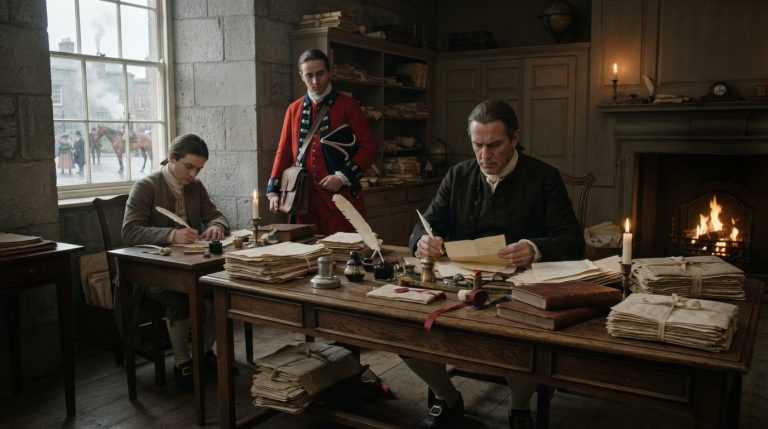
On Saturday, 13 January 1753, two surviving letters reveal that rebuilding work at Dublin Castle was moving from estimates and discussion towards physical construction. Thomas Eyre, recently appointed Surveyor General of Ireland, wrote from Dublin to Sir Robert Wilmot stating that he had already given directions for the work to begin. On the same date, Dublin Castle under-secretary Thomas Waite informed Wilmot that the Surveyor General’s estimates for rebuilding the Round and Square Closets had been placed before the Lords Justices. These closely related documents provide an unusually precise record of public building work beginning on an exact day.
The word “closet” can be misleading to a modern reader. In eighteenth-century architecture it could describe a relatively small private chamber or withdrawing room rather than a lavatory. This interpretation is particularly clear at Dublin Castle because surviving architectural accounts distinguish the Round Closet, Square Closet and Water Closets as separate elements. The work under consideration in January therefore concerned important rooms within the Castle complex. Later correspondence specifically discussed alterations to the Round Closet’s windows and chimney, together with substantial foundation work. These were architectural rooms requiring rebuilding, masonry and structural intervention, not simply sanitary facilities.
Thomas Eyre was particularly suited to such responsibilities. A member of an established County Galway family, he had begun his career as a military engineer, serving in the colony of Georgia and later in the Caribbean. In 1752 he became Surveyor General of Ireland, succeeding Arthur Jones-Nevill. The office placed him in charge of important aspects of government surveying, construction and maintenance. Dublin Castle was among his most significant responsibilities. Eyre would remain Surveyor General until the office was abolished in 1763, subsequently becoming Chief Engineer of the Ordnance. His January 1753 correspondence therefore belongs to the opening months of an important Irish architectural career.
Dublin Castle itself was much more than a medieval fortress by this period. It was the administrative centre of British government in Ireland and the official residence of the lord lieutenant. Government departments, officers, servants and military personnel worked within a complex that had been repeatedly altered since the catastrophic fire of 1684. By the eighteenth century the Castle was gradually being transformed from an irregular fortified complex into a more ordered governmental and ceremonial residence. Work on the State Apartments and the ranges surrounding the Upper Castle Yard formed part of this long rebuilding programme, with Eyre becoming one of the principal figures responsible for its continuation.
The correspondence of 13 January shows that even apparently straightforward building projects required several layers of authority. Eyre could prepare estimates and direct practical operations, but expenditure had to move through administrative channels. Waite’s letter specifically records that the estimates had been placed before the Lords Justices, senior figures capable of exercising executive authority when required. Sir Robert Wilmot in England formed another link in the chain. From 1737 much Irish government business communicated with Britain passed through Wilmot, while Thomas Waite served as his increasingly important counterpart in Dublin. Architecture at Dublin Castle was therefore simultaneously a matter of bricks and mortar, government finance and trans-Irish-Sea administration.
What happened after 13 January confirms that the work was substantial. On 30 January, Eyre wrote that approved alterations were to be made to the windows and chimney of the Round Closet and stated that work on the foundations was ready to begin, with completion then hoped for by the end of April. This later letter allows the January sequence to be followed almost like a modern construction diary. Estimates were considered, instructions issued, details approved and foundations prepared. Such surviving administrative correspondence is particularly valuable because buildings often outlive the paperwork explaining precisely when individual portions were rebuilt and why particular structural decisions were taken.
The builders soon encountered difficulties. On 20 February 1753, Eyre reported problems associated with weather, unexpectedly soft ground and previously unknown sewers beneath the site. During excavation, a skull, bones and two coins were also discovered while foundations connected with the Round Closet were being pulled down. The discovery offers an extraordinary glimpse beneath eighteenth-century Dublin Castle, where successive centuries of occupation had left buried structures and human remains beneath later government buildings. Again, these events occurred after 13 January and should not be presented as happening that day, but they demonstrate what followed from the decision to commence the work documented in the January correspondence.
By 2 March, Eyre could report that the Round Closet foundation had been taken down to a depth of eleven feet and that the new work had risen two feet above ground level. This reveals how extensive the rebuilding had become. The project was not a superficial redecorating exercise. Deep foundations were necessary, particularly after the discovery of soft ground and existing underground structures. The correspondence gives historians something approaching a staged record of Georgian construction practice: estimates in January, preparation of foundations later that month, unforeseen site problems in February and measurable progress by early March. Few ordinary building projects of the period can be followed with such precise surviving dates.
Meanwhile, another exact-date source was appearing in print. The Dublin Gazette, Number 249, was issued on 13 January 1753, covering the period through 16 January. The official newspaper was published “by authority” and carried proclamations, appointments, legal information and domestic and international news. Number 248 had ended on 13 January, so both issues meet directly on the target date. While Eyre and Waite exchanged manuscript correspondence about Castle construction, printers were simultaneously producing the government’s public newspaper. Together these sources reveal two sides of the same administrative world: private working correspondence and information intended for wider circulation.
The importance of 13 January 1753 therefore lies in the survival of two modest but highly revealing letters. Thomas Eyre had already ordered work to begin, while Thomas Waite confirmed that estimates for rebuilding the Round and Square Closets had reached the Lords Justices. The decisions recorded that day led directly into a sequence of construction, excavation and architectural alteration at the governmental heart of Ireland. Dublin Castle would continue to change dramatically during Eyre’s tenure, eventually acquiring some of the Georgian character still associated with it. A daily history allows this transformation to be seen not merely as an architectural period, but as something constructed decision by decision, letter by letter and day by day.
Primary Sources
Primary Sources
- Thomas Eyre, Surveyor General of Ireland — Letter to Sir Robert Wilmot — 13 January 1753.
Eyre states that he has already given directions for the work to begin. This is one of the two principal exact-date sources. Derbyshire Record Office, D3155/C/H/1409. - Thomas Waite — Letter to Sir Robert Wilmot — 13 January 1753.
Records that the Surveyor General’s estimates for rebuilding the Round and Square Closets had been placed before the Lords Justices. This identifies the construction project connected with Eyre’s correspondence. Derbyshire Record Office, D3155/C/H/1410. - Richard James and John Butler — The Dublin Gazette, No. 249 — 13–16 January 1753.
Official Irish government newspaper beginning on the exact target date. Houses of the Oireachtas Library and Research Service / Virtual Treasury of Ireland.
https://www.virtualtreasury.ie/item/DGZ-1753-249 - Richard James and John Butler — The Dublin Gazette, No. 248 — 9–13 January 1753.
Official Gazette issue ending on the exact target date and providing the immediate public and governmental context.
https://www.virtualtreasury.ie/item/DGZ-1753-248 - Thomas Eyre — Letter to Sir Robert Wilmot — 30 January 1753.
Records approved alterations to the windows and chimney of the Round Closet and states that foundation work was ready to begin. Derbyshire Record Office, D3155/C/H/1439. - Thomas Eyre — Letter to Sir Robert Wilmot — 20 February 1753.
Reports problems caused by weather, soft ground and unexpected sewers during work on the Round Closet. It also records the discovery of a skull, bones and two coins during excavation. Derbyshire Record Office, D3155/C/H/1471. - Thomas Eyre — Letter to Sir Robert Wilmot — 2 March 1753.
Reports that the Round Closet foundation had reached a depth of eleven feet and that rebuilding had risen two feet above the surface. Derbyshire Record Office, D3155/C/H/1480. - Thomas Eyre / Irish administration — Estimates and financial papers for repair of the Round, Square and Water Closets — 1753.
Treasury material documenting requests for money for the Dublin Castle works. The National Archives, Kew, T1/354/48–49; copies/references in Irish Architectural Archive. - Thomas Eyre — Letter Book — 1750s.
Original working correspondence of the Surveyor General recording Dublin Castle construction and other public works. Irish Architectural Archive, Acc. 86/149. - Thomas Eyre — Account Book — 1750s.
Contemporary accounts documenting payments to craftsmen, builders and suppliers employed on government construction. Irish Architectural Archive, Acc. 86/149. - Thomas Waite — Letter concerning the Dublin garrison — 8 January 1753.
Records arrangements for reviewing the Dublin garrison immediately before the construction correspondence, illustrating the wider range of business handled by Dublin Castle. Derbyshire Record Office, D3155/C/H/1402. - Thomas Waite — Letter concerning Cornet Nugent — 9 January 1753.
Orders a court martial to proceed with Nugent’s trial, documenting Dublin Castle administration in the same week. Derbyshire Record Office, D3155/C/H/1404. - Thomas Waite — Letter concerning Ensign Harriott — 9 January 1753.
Orders a court martial to reassemble and reconsider its sentence. Derbyshire Record Office, D3155/C/H/1405. - Irish administration — Order concerning Captain Roger Pedley — 10 January 1753.
Records the removal of cheques standing against Pedley and demonstrates the routine administrative work surrounding the Castle building correspondence. Derbyshire Record Office, D3155/C/H/1408. - Richard James and John Butler — The Dublin Gazette, No. 250 — 16–20 January 1753.
The next official newspaper issue following Number 249, useful for continuing the documentary sequence through the same week. Houses of the Oireachtas Library / Virtual Treasury of Ireland. - Richard James and John Butler — The Dublin Gazette, No. 251 — 20–23 January 1753.
Contemporary official newspaper covering Irish government and public information later in the same month. Virtual Treasury of Ireland. - Richard James and John Butler — The Dublin Gazette, No. 252 — 23–27 January 1753.
Official contemporary newspaper continuing the January 1753 sequence. Houses of the Oireachtas Library / Virtual Treasury of Ireland. - Ireland, Parliament, House of Commons — Journals of the House of Commons of the Kingdom of Ireland — proceedings for 1753.
Official parliamentary record documenting expenditure, government business and the political system within which public works were funded and supervised. - Lionel Sackville, Duke of Dorset — His Speech to Both Houses of Parliament at Dublin — 9 October 1753.
The lord lieutenant’s contemporary address provides direct evidence of the administration governing Ireland while the Dublin Castle works proceeded. - Parliament of Great Britain — Calendar (New Style) Act 1750, 24 Geo. II c.23 — implemented in 1752.
The original statutory authority establishing the calendar under which 13 January 1753 was officially recorded.