Archived: 8 October 2026
Abstract
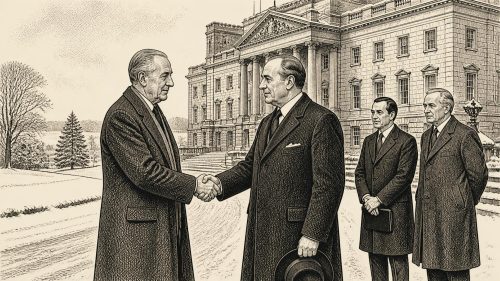
In 1965, Ireland cautiously embraced modernisation while enduring emigration, rural decline and cultural conservatism. Taoiseach Seán Lemass’s unprecedented Stormont meeting with Terence O’Neill opened limited North–South co-operation, followed by O’Neill’s Dublin visit. Casement’s repatriation symbolised improving Anglo-Irish relations. Fianna Fáil retained power in a television-covered election, while the Anglo-Irish Free Trade Area Agreement signalled departure from protectionism despite fears over employment. Legal reforms addressed land and inheritance; vernacular Mass and Galway Cathedral reflected changing Catholic life. Eurovision, the Young Scientist Exhibition and literary events demonstrated wider connections, although a newspaper strike and GAA restrictions exposed persistent constraints within Irish society.
Read Article

Archived: 8 October 2026
Abstract
In 1964, Lemass’s government pursued industrial growth, exports and European integration, while emigration, rural change and dependence on British markets persisted. Ireland committed a voluntary battalion to the United Nations peacekeeping force in Cyprus, extending its international role after the Congo without abandoning neutrality. Domestic legislation addressed adoption, welfare, financial institutions, industry and regional development. Britain’s import charge exposed economic vulnerability, prompting talks between Lemass and Harold Wilson. Belfast’s Divis Street disturbances over an Irish tricolour revealed sectarian inequalities and policing grievances in Northern Ireland. Cultural life marked Seán O’Casey’s death and notable work by Brian Friel and Flann O’Brien.
Read Article
Archived: 8 October 2026
Abstract
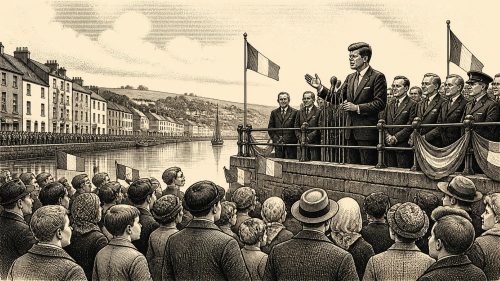
1963 marked Ireland’s uneven transition towards economic modernisation, planning and international engagement. France’s rejection of Britain’s EEC bid stalled Dublin’s linked application, while growth, industrial change and reduced yet persistent emigration exposed continuing dependence on Britain. A controversial turnover tax highlighted social costs. In Northern Ireland, Terence O’Neill became prime minister amid unemployment and unresolved nationalist grievances. President Kennedy’s celebrated June visit connected statehood, diaspora and American links, before his assassination prompted national mourning. The Planning Act created development controls; cultural and religious life remained influential. Ireland also pursued disarmament at the United Nations, while constitutional division and inequality endured.
Read Article

Archived: 8 October 2026
Abstract
In 1962, Seán Lemass advanced Ireland’s application to join the European Economic Community, arguing that economic modernisation required wider markets despite dependence on Britain. Growth after 1958 tempered, but did not end, emigration, rural decline and weak infrastructure; new housing, sanitation and welfare measures addressed domestic needs. The IRA ended Operation Harvest, while Ireland continued demanding UN service in the Congo. Television expanded national culture through Radharc and The Late Late Show, as the Theatre Royal closed and The Chieftains formed. Catholic influence remained strong, yet Vatican II signalled change. Ireland balanced European ambition, international engagement, tradition and unresolved partition.
Read Article
Archived: 8 October 2026
Abstract
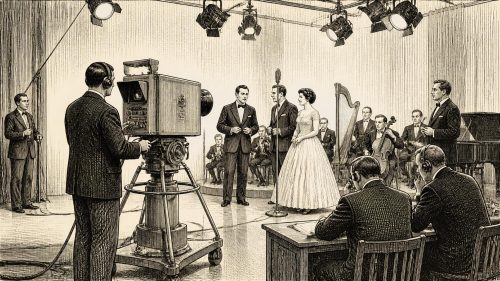
In 1961, Ireland remained rural, economically dependent on Britain and affected by emigration, as the census population fell to 2,818,341. Seán Lemass's government pursued modernisation through legislation, industrial development and outward-looking trade policy. Fianna Fáil retained office after October's general election but lacked a majority, leaving Lemass dependent on a narrow Dáil vote. Ireland applied to join the European Economic Community, chiefly to protect trade links and agricultural exports amid Britain's application. In Katanga, Commandant Pat Quinlan's A Company fought at Jadotville, surrendered after isolation, and returned from captivity. Telefís Éireann's inaugural broadcast on 31 December marked a new medium.
Read Article

Archived: 8 October 2026
Abstract
1960 marked Ireland’s transition towards modernisation amid emigration, low incomes and rural decline. Seán Lemass’s government advanced the Programme for Economic Expansion, promoting investment, exports, infrastructure and overseas industry, while extending state institutions through legislation. The Broadcasting Authority Act established the basis for national television, conceived as both modern medium and cultural instrument. Ireland’s international role expanded when troops joined the UN Congo mission and Frederick Boland became General Assembly president; nine soldiers’ deaths at Niemba exposed peacekeeping’s dangers. Partition remained unresolved, while disasters at Shannon and the Plassy rescue highlighted transport risks and resilience. The year set uncertain directions.
Read Article

Archived: 8 October 2026
Abstract
In 1959 Éamon de Valera left the Taoiseachship to become Ireland’s third president after defeating Seán Mac Eoin, while Seán Lemass succeeded him without an election. A simultaneous referendum to replace proportional representation was rejected. Lemass inherited emigration, unemployment and rural decline, but advanced economic expansion, industrial exports, infrastructure and skills training, including the Apprenticeship Act. Trade unions reunited as the all-island Irish Congress of Trade Unions. The IRA Border Campaign continued amid weak republican electoral support. Cultural life featured John B. Keane’s Sive and George Morrison’s Mise Éire. The year combined revolutionary memory and partition with tentative social modernisation.
Read Article

Archived: 8 October 2026
Abstract
In 1958, Ireland faced unemployment, low output and severe emigration, prompting T. K. Whitaker’s Economic Development, or Grey Book, and the Government’s November Programme for Economic Expansion. These rejected reliance on protectionism alone, advocating productivity, exports, investment and planning, though recovery remained uncertain. Lemass promoted outward-facing industry, symbolised by Ardmore Studios. Political debate included a proposed replacement of proportional representation and partial relaxation of the marriage bar for national teachers. Transport reorganisation divided the Great Northern Railway and closed Dublin’s Harcourt Street line. Amid the IRA Border Campaign, Ireland began United Nations service in Lebanon. Sporting events provided international connections.
Read Article
Archived: 8 October 2026
Abstract
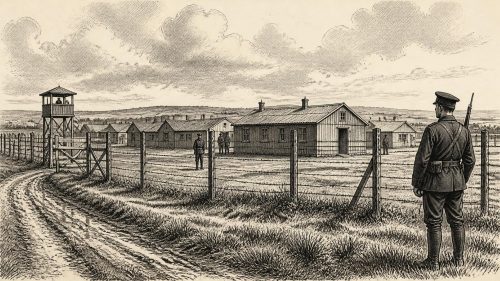
In 1957, Ireland faced economic decline, emigration and renewed border violence. The IRA’s failed Brookeborough attack killed Seán South and Fergal O’Hanlon, while subsequent violence prompted de Valera’s Fianna Fáil government, elected in March, to intern republicans at the Curragh. Despite constitutional commitment to unity, Dublin prioritised state authority. T. K. Whitaker’s analysis of protectionism, weak exports and unemployment initiated preparation for economic reform, alongside IMF and World Bank membership. Social legislation addressed health insurance, mental treatment, married women’s legal status and Gaeltacht employment. The Fethard-on-Sea boycott exposed religious intolerance, while theatre censorship and railway closures reflected rural contraction nationwide.
Read Article

Archived: 8 October 2026
Abstract
In 1956, Ireland confronted population decline, unemployment and record emigration despite democratic stability and international involvement. The April census confirmed losses, while rural electrification expanded unevenly. Government created the Department of the Gaeltacht, defining language areas and linking Irish preservation with economic and social development. New citizenship legislation reflected continuing constitutional claims regarding Northern Ireland. The IRA’s Border Campaign began in December; Costello’s administration opposed violence while disputing British sovereignty claims. Ireland engaged with UN responses to Suez and Hungary, accepting Hungarian refugee families. T. K. Whitaker became Finance Secretary, and Olympic medals, led by Ronnie Delany, provided national celebration.
Read Article

Archived: 8 October 2026
Abstract
In 1955, Ireland faced emigration, unemployment and rural decline under John A. Costello’s coalition government, despite claims of economic improvement. Farmers established the National Farmers’ Association in Dublin, seeking stronger influence over agricultural policy. Ireland joined the United Nations on 14 December, gaining an independent diplomatic platform while retaining neutrality and confronting partition. The BBC’s Divis transmitter introduced television broadcasting to Northern Ireland, extending media connections across the island. Radio Éireann launched its first soap opera, theatre provoked controversy and presented Beckett, and fire destroyed Cork Opera House. The year balanced domestic insecurity, institutional development, cultural change and international assertion.
Read Article

Archived: 8 October 2026
Abstract
Ireland in 1954 experienced political change, economic pressure, religious mass devotion and cultural innovation. Fine Gael’s John A. Costello led a minority inter-party government after Fianna Fáil’s electoral losses, amid concerns over employment, emigration, farming and housing. New legislation addressed development, land, housing and health, while Tayto and the Evening Press began trading. Marian Year pilgrimages made Knock a major national destination. The Gough Barracks arms raid signalled renewed republican militancy. Michael Manning’s execution at Mountjoy became the state’s last. Brendan Behan’s The Quare Fellow, Christy Brown’s My Left Foot and the first modern Bloomsday reflected increasingly challenging cultural voices.
Read Article

Archived: 8 October 2026
Abstract
In 1953, the Republic introduced adoption through An Bord Uchtála, formalising arrangements previously governed by families, churches and voluntary agencies. The Health Act extended a means-tested, graded system of medical provision rather than universal care. Fianna Fáil pursued restraint amid unemployment, rural insecurity and emigration. Dublin and Belfast jointly assumed control of the Great Northern Railway, demonstrating practical cross-border co-operation despite partition. An Tóstal promoted tourism and cultural confidence, while Samuel Beckett’s Paris première of En attendant Godot marked a literary milestone. In Northern Ireland, coronation television broadcasts reinforced British connections. Institutional change unfolded amid economic, religious and political divisions.
Read Article

Archived: 8 October 2026
Abstract
Ireland in 1952 combined political continuity with economic and social change. De Valera’s government, facing balance-of-payments difficulties, unemployment and emigration, imposed austerity while pursuing regional development, consolidated social welfare, protected agricultural workers and reorganised tourism. The Foyle Fisheries Act created cross-border machinery for managing shared waters, while Northern Ireland expanded Belfast’s water supply despite joblessness. The Adoption Act established the Republic’s first legal adoption framework, though its eligibility and religious rules reflected contemporary values. Public life included an Aer Lingus disaster, sporting and cultural achievements, and O’Kelly’s uncontested re-election. The year produced institutions without resolving partition, poverty or population loss.
Read Article

Archived: 8 October 2026
Abstract
In 1951, Noel Browne’s resignation over the Mother and Child Scheme exposed conflicts between social reform, Catholic authority, medical interests and governmental caution. The inter-party government then fell amid agricultural disputes; May’s election returned Fianna Fáil as largest party, enabling Éamon de Valera to lead a minority administration. The census recorded 2,960,593 people, as emigration largely offset natural increase amid economic insecurity. Welfare pensions rose, agricultural workers gained half-holidays, and electrification and peat development continued. The Arts Act established An Chomhairle Ealaíon. In Northern Ireland’s Westminster poll, Unionists retained dominance despite Nationalist victories and a narrowly contested West Belfast seat.
Read Article
Archived: 8 October 2026
Abstract
In 1950, Ireland combined republican independence with economic dependence on Britain, persistent poverty, emigration and partition. Dr Noël Browne’s June memorandum proposing free healthcare for mothers and children exposed conflict between universal welfare, medical interests, Catholic authority and parental rights, foreshadowing his 1951 resignation. Tuberculosis remained severe despite expanded State treatment. Legislation reorganised social welfare, improved agricultural workers’ rights, addressed housing, and strengthened transport and industrial development. Ireland appointed its first ambassador to London and signed the European Convention on Human Rights. Cultural events included Alfred Chester Beatty’s arrival and George Bernard Shaw’s death. Social and economic problems remained unresolved.
Read Article
Archived: 8 October 2026
Abstract
In 1949 Ireland became a republic, ending the Crown’s remaining external role, while Britain’s Ireland Act reinforced Northern Ireland’s constitutional position within the United Kingdom. Southern political leaders united publicly against partition, but efforts to link reunification with NATO membership failed. Post-war recovery remained uneven, with shortages, emigration, rural poverty and extensive state regulation continuing alongside electrification, statistical development and welfare administration. Housing, health and public services expanded gradually. Douglas Hyde’s funeral honoured a founder of cultural nationalism whilst exposing denominational divisions in public ceremony. The year combined republican assertion with enduring partition, social constraints, institutional growth and cultural ambition.
Read Article

Archived: 8 October 2026
Abstract
In 1948, Fianna Fáil lost its Dáil majority after sixteen years, enabling John A. Costello to lead the First Inter-Party Government, supported by Clann na Poblachta, Labour and others. The coalition addressed post-war housing, welfare, health, employment and agricultural trade, while Ireland joined European recovery co-operation and concluded a British trade agreement. Costello’s September Canadian announcement preceded the Republic of Ireland Act, enacted in December. Although effective only in 1949, it repealed the External Relations Act, ended the Crown’s remaining external role and authorised presidential functions. Partition remained unchanged, while An Taisce’s foundation and Olympic return suggested national civic renewal.
Read Article

Archived: 8 October 2026
Abstract
In 1947, severe winter weather, poor harvests and continuing rationing exposed Ireland’s dependence on imported coal, disrupted transport and worsened rural fodder shortages. Food controls deepened hardship for households. Against this hardship, Oldtown became the first Irish village publicly connected under the Rural Electrification Scheme, signalling gradual modernisation. The Health Act reorganised public-health administration, while James Larkin’s death recalled labour struggles. Clann na Poblachta’s by-election successes challenged Fianna Fáil. Shannon gained customs-free status, the Enterprise Express linked Belfast and Dublin, and UN membership was vetoed. Cultural landmarks included Cork Ballet Group’s debut and Cavan’s All-Ireland football victory in New York.
Read Article

Archived: 8 October 2026
Abstract
In 1946, post-Emergency Ireland faced continuing shortages, emigration and uneven development despite the war’s end. The census recorded 2,955,107 people, with growth in Leinster but decline elsewhere, highlighting housing and employment pressures. Emergency powers formally expired, though temporary controls remained amid rationing and a poor harvest. The Turf Development Act created Bord na Móna to exploit peat as a strategic fuel resource, while forestry legislation promoted timber security. The Industrial Relations Act established the Labour Court. Clann na Poblachta emerged under Seán MacBride, challenging Fianna Fáil. Ireland’s UN application was vetoed by the Soviet Union, exposing limits to its standing.
Read Article
Archived: 8 October 2026
Abstract
In 1945, Ireland emerged cautiously from wartime neutrality, retaining rationing, shortages and emergency powers despite Europe’s liberation. De Valera’s condolences on Hitler’s death provoked international condemnation, while VE Day renewed disputes over neutrality, partition and Allied relations. Censorship ended, but wartime administration unwound gradually. Seán T. Ó Ceallaigh became the second President after defeating Seán MacEoin, symbolising continuity and change. Legislation addressed drainage, tuberculosis and mental treatment, while supply functions returned to Industry and Commerce. Northern Ireland elections confirmed Unionist dominance, though Labour and nationalist representation exposed political divisions. Ireland entered peace facing economic constraint, institutional transition and diplomatic isolation.
Read Article
Archived: 8 October 2026
Abstract
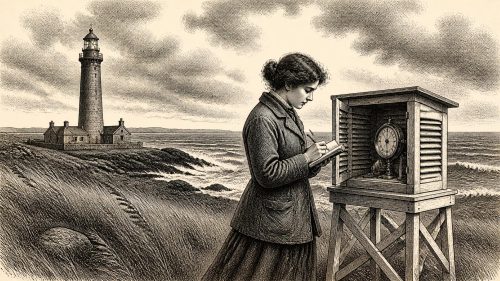
During 1944, neutral Ireland endured Emergency shortages, rationing and transport disruption while remaining strategically entangled in the war. At Blacksod Point, Maureen Flavin’s weather observations assisted Allied forecasting before the Normandy landings, illustrating neutrality’s limits. De Valera rejected Allied demands to expel Axis diplomats, defending sovereignty amid espionage concerns and partition. Fianna Fáil won a Dáil majority in May. Children’s allowances began in August, easing family pressures. December’s Transport Act prepared Córas Iompair Éireann, while the Abbey staged Joseph Tomelty’s Belfast-set play, The End House. The year combined democratic continuity, cautious social reform and preparations for postwar reconstruction across Ireland.
Read Article

Archived: 8 October 2026
Abstract
In 1943, neutral Ireland faced the Second World War’s political, economic and human pressures. A wartime election left Éamon de Valera’s Fianna Fáil governing without a majority, while Labour advanced and Oliver Flanagan’s antisemitic maiden speech exposed prejudice. Emergency legislation, censorship and diplomacy defended neutrality amid Allied pressure and partition. War reached Donegal when a mine killed eighteen at Ballymanus, and U-607 sank the marked Irish Oak, though its crew survived. Rationing, compulsory tillage and fuel shortages burdened households and commerce. In December, the coaster Kerlogue rescued 168 German sailors in the Bay of Biscay, clearly demonstrating neutrality’s humanitarian responsibilities.
Read Article

Archived: 8 October 2026
Abstract
In 1942, neutral Ireland endured the Emergency while Northern Ireland became an Allied base after American troops arrived in Belfast. De Valera’s government maintained neutrality, emergency controls and censorship, while creating the Central Bank and confronting extremist politics. Shortages of fuel, rubber, food and consumer goods reshaped work, travel and household life; labour migration to Britain remained significant. Irish merchant ships risked Atlantic attack while rescuing survivors, until the Irish Pine was torpedoed with all thirty-three crew lost. Cultural life persisted through Cavan Cathedral, Kavanagh’s The Great Hunger and folklore scholarship, alongside censorship disputes. Ireland faced constraint, danger and change.
Read Article
Archived: 8 October 2026
Abstract
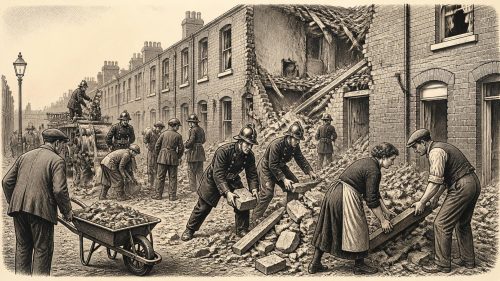
In 1941, neutral Éire faced the Second World War’s consequences despite preserving its Emergency policy. German raids devastated Belfast, a British industrial centre, killing hundreds and prompting fire brigades from Dublin and other southern towns to assist. On 31 May, German bombs killed twenty-eight people, injured over ninety and destroyed about 300 homes in Dublin’s North Strand. The attack demonstrated neutrality’s limits amid diplomatic tension over Northern Irish conscription and Churchill’s appeals for Irish participation. Shortages of food, fuel and imports led to rationing, expanded turf supplies and Irish Shipping’s creation. Maritime dangers and cross-border relief underscored Ireland’s wartime vulnerability.
Read Article

Archived: 8 October 2026
Abstract
In 1940, neutral Éire faced danger as German victories transformed its strategic position. De Valera defended neutrality, expanded emergency powers and rejected Britain’s unity proposal, judging it insecure and incompatible with sovereignty. The government suppressed IRA activity, while Seán Russell died during an abortive German-backed mission. On 26 August, German bombs killed three women at Campile creamery, Ireland’s first fatal Luftwaffe raid. Shortages prompted censorship, restrictions and compulsory tillage to strengthen food security. Northern Ireland mobilised for Britain, with Belfast industry expanding and John Miller Andrews succeeding Craigavon. The Bell appeared, while in December John Charles McQuaid became Dublin’s archbishop.
Read Article

Archived: 9 October 2026
Abstract
In 1939, Ireland faced both European war and republican militancy. The Government strengthened internal security through the Offences Against the State Act, while air-raid precautions reflected fears of attack. Following Germany’s invasion of Poland, constitutional amendments and the Emergency Powers Act enabled neutral Ireland to regulate security, supplies and communications. Dublin denied belligerents use of its territory and ports, despite British pressure, asserting sovereignty after the Treaty Ports’ return. Northern Ireland entered the war with Britain, underscoring partition’s consequences. Refugee appeals highlighted Nazi persecution. The December IRA raid on Dublin’s Magazine Fort demonstrated that armed challenges to State authority persisted.
Read Article
Archived: 9 October 2026
Abstract
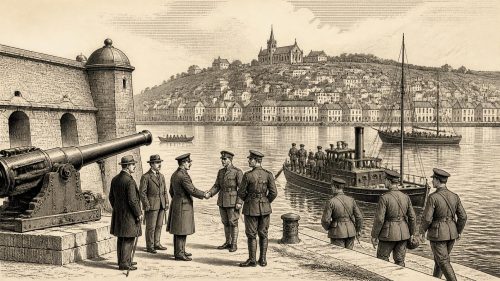
In 1938, the new Constitution acquired practical force as Ireland developed its institutions and position. Douglas Hyde, cultural revivalist and Church of Ireland scholar, became first President, symbolising an inclusive national identity, though disputes persisted. April agreements ended the Economic War: Ireland paid £10 million, Britain removed special duties, and the Treaty Ports at Cork Harbour, Berehaven and Lough Swilly returned to Irish control. Fianna Fáil then won an overall majority. Labour legislation addressed shop workers’ conditions, but poverty, emigration and agricultural dependence continued. Partition remained unchanged despite discussions with Britain and Northern Ireland, while port recovery strengthened future neutrality.
Read Article
Archived: 9 October 2026
Abstract
In 1937, Éamon de Valera’s government drafted, debated and submitted a Constitution to voters, replacing much of the Irish Free State’s imperial framework. Approved by the Dáil and endorsed in the 1 July plebiscite by 685,105 votes to 526,945, it came into force on 29 December, naming the State Éire/Ireland. It established the presidency, Taoiseach, reconstituted Seanad and Supreme Court, while asserting an all-island claim. Its Catholic-inflected provisions on religion and family prompted criticism. Fianna Fáil retained power without a majority. Amid poverty, emigration and dependence on Britain, legislation addressed housing and welfare, while Spain and insecurity shaped foreign policy.
Read Article

Archived: 9 October 2026
Abstract
In 1936, the Irish Free State accelerated constitutional change under de Valera. Abolition of the Seanad created a unicameral Oireachtas, while Edward VIII’s abdication enabled removal of the Crown and governor-general from domestic government, retaining limited royal functions abroad. Economic War pressures, despite a coal-cattle agreement, sustained hardship and arguments over protectionism, while the census documented social conditions. The Spanish Civil War polarised opinion, although government maintained non-intervention. Catholic confidence appeared in Mullingar’s new cathedral; Peig and Ireland To-day reflected cultural life. Aer Lingus’s Iolar inaugurated Bristol flights. Partition endured, but 1936 anticipated the 1937 constitution and its future direction.
Read Article




