
Schomberg Invades(c.1680s)
For Limerick, Schomberg’s invasion of Ireland in 1689 was another decisive stage in the war that would eventually make the city the last great Jacobite stronghold. His landing opened the way for a full Williamite conquest, while the failure to destroy his army during its first vulnerable winter allowed the conflict to continue towards the Shannon. The hesitation shown by both commanders would later place increasing pressure on Limerick’s walls, bridges and surrounding countryside.
After the relief of Derry and the defeat of Jacobite forces near Enniskillen, William of Orange prepared a major expedition against Ireland. Parliament granted money for an army of approximately twenty thousand men, composed largely of continental troops. Command was given to Frederick Schomberg, an experienced soldier accompanied by Count Solmes.
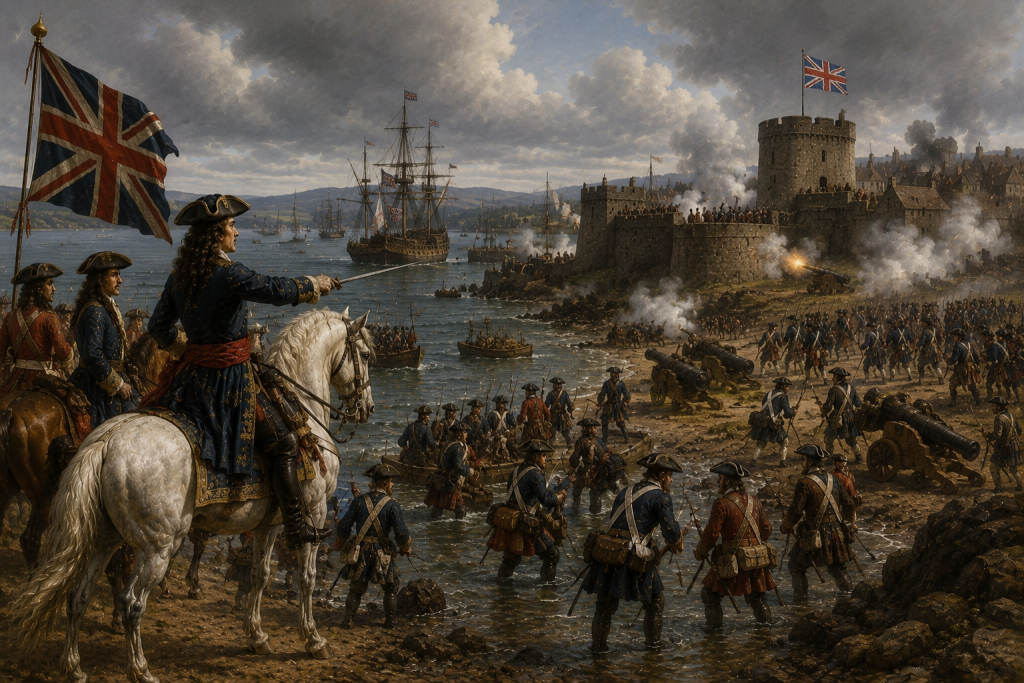
Schomberg’s fleet entered Belfast Lough in August 1689 and landed at Bangor. Belfast was occupied, and the army advanced against Carrickfergus Castle. Its garrison, numbering roughly eight hundred men under Colonel McCarthy-More and Colonel Cormac O’Neill, resisted a sustained bombardment from land and sea. When cannon fire breached the walls, the defenders filled the opening with slaughtered cattle, stones and earth. After their ammunition was exhausted, they surrendered on honourable terms, although violence followed the evacuation.
Schomberg then reorganised the Enniskillen forces and began moving south. Despite facing little immediate opposition, he advanced cautiously. Reports exaggerated the size of the Jacobite army near Newry, while the Duke of Berwick used hills, cavalry patrols and trumpet signals to create the appearance of a much larger force. Believing a major army stood before him, Schomberg halted and prepared for battle. Berwick withdrew during the night and joined Tyrconnell at Drogheda.
James II gathered approximately twenty thousand men, although many were poorly trained, badly clothed and inadequately armed. He advanced towards Dundalk, where Schomberg occupied a fortified camp. The Jacobites repeatedly attempted to draw him into battle, but Schomberg refused to leave his entrenchments. French commanders urged James to attack, yet James believed disease, hunger and winter weather would weaken the Williamite army without risking a direct assault.
James returned to Dublin, while his troops withdrew to winter quarters at Drogheda. Schomberg remained near Dundalk, where disease spread through his camp. Thousands died, desertion increased and the surviving army became seriously weakened. Jacobite commanders again urged James to attack, arguing that the opportunity to destroy the invading force might never return.
James refused. He believed time was defeating Schomberg more effectively than battle could. This decision allowed the Williamites to survive their disastrous winter and prepare for a stronger campaign in 1690.
The opportunity lost at Dundalk had lasting consequences. William himself would soon arrive with reinforcements, defeat James at the Boyne and drive the Jacobite army westward. Limerick would then inherit the struggle that indecision had prolonged, becoming the centre of resistance against a recovered and increasingly powerful Williamite army.
What might have ended near Dundalk instead continued through the Boyne, Athlone and Aughrim, until the war finally reached its decisive conclusion at Limerick itself in 1691.
Primary Sources
These five contemporary records support the article’s account of Schomberg’s landing, the capture of Carrickfergus, the advance towards Dundalk and the sickness that weakened his army. The supplied text describes the invasion and the prolonged military standoff in detail.
- George Story, A Continuation of the Impartial History of the Wars of Ireland — 1693.
Story served as a chaplain with the Williamite army and observed much of the campaign personally. His narrative covers Schomberg’s arrival, Carrickfergus, the march south, the Dundalk encampment and the army’s losses through disease. Despite its claim to impartiality, it presents a strongly Williamite interpretation. (Quod) - An Account of the Joining of Major-General Kirke’s Forces with Duke Schomberg’s and the Taking of the Town and Castle of Carrickfergus — 1689.
Published while the campaign was still unfolding, this pamphlet records the union of Kirke’s and Schomberg’s forces and the siege and surrender of Carrickfergus. It is particularly valuable for examining how the victory was reported immediately in England. (LingPhil) - Frederick Schomberg, proclamations issued from Belfast and Dundalk — September 1689.
These official proclamations attempted to prevent robbery and plunder, protect civilians bringing provisions to the army and regulate conduct in Williamite-controlled territory. They provide direct evidence of Schomberg’s difficulties maintaining discipline and supplying his multinational army. (Folger Catalog) - A Full and True Account of All the Remarkable Actions and Things That Have Happened in the North of Ireland — December 1689.
Presented as a letter from Lisburn, this contemporary publication reports events around Dundalk, Newry, Sligo and Charlemont. It discusses Schomberg’s orders for accurate returns of healthy, sick and dead soldiers, revealing the deteriorating condition of his army. (Quod) - Plan of Dundalk and Schomberg’s Encampment — 1689.
This contemporary military map shows Dundalk, the Williamite encampments, artillery positions, roads, trenches and surrounding marshland. It provides valuable visual evidence of the low-lying and unhealthy terrain occupied by Schomberg’s army during the autumn and winter campaign. (Military Maps)
The first four sources largely reflect the Williamite viewpoint. They should therefore be compared with Jacobite participant accounts when assessing responsibility for military decisions, civilian suffering and the failure to force a decisive engagement.