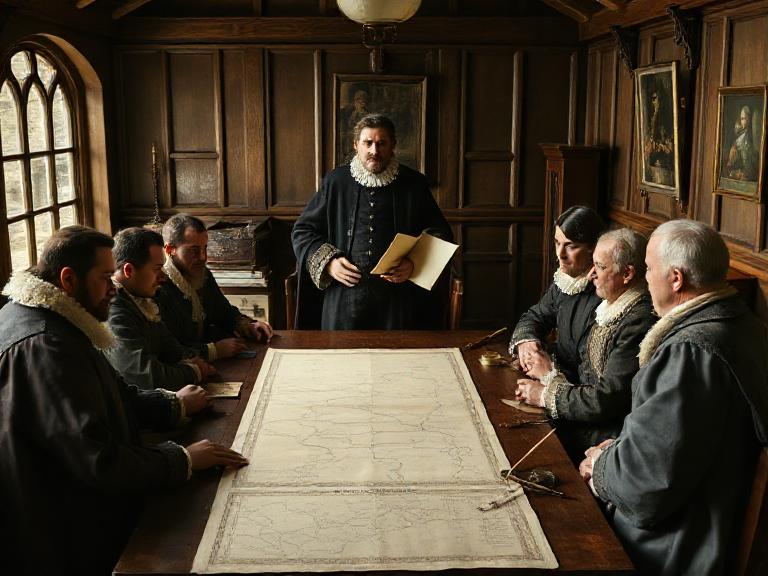

Military Justice(c.1750s)
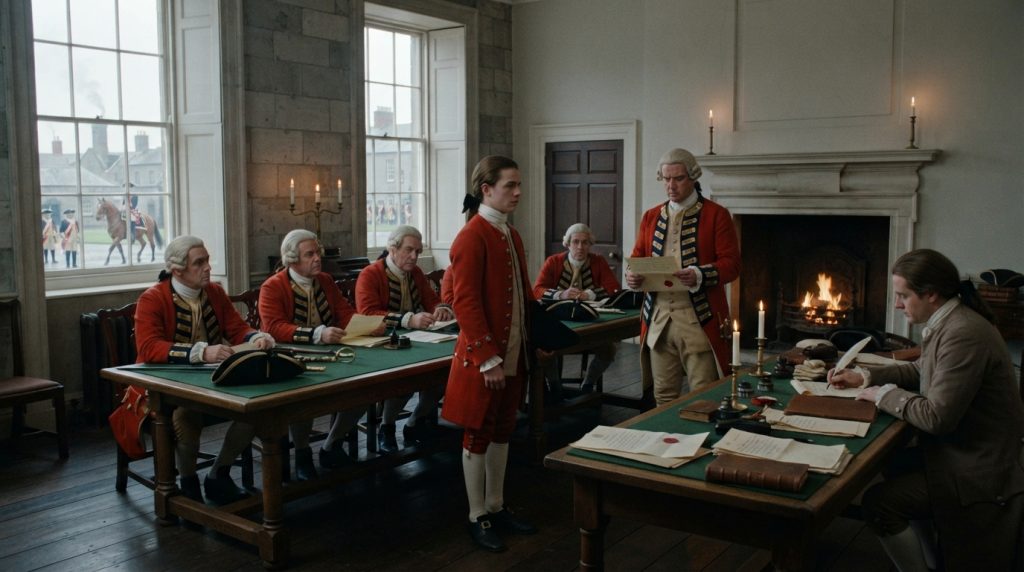
On Tuesday, 9 January 1753, Dublin Castle dealt with two separate cases of military justice involving junior army officers. Under-secretary Thomas Waite wrote to Lord George Sackville confirming that a court martial was to proceed with the trial of Cornet Nugent. On the same day, Waite issued another communication ordering a court martial to reassemble and reconsider the sentence imposed upon Ensign Harriott. The surviving correspondence does not tell us enough to reconstruct their alleged offences, and those details should not be invented. What survives instead is direct evidence of the machinery through which military discipline operated in Ireland.
Cornet and ensign were junior commissioned ranks, placing both men near the beginning of an officer’s military career. Their cases nevertheless reached administrative attention at Dublin Castle. Nugent’s trial had apparently reached the point where authority was required for proceedings to continue, while Harriott’s case had already produced a sentence that officials wanted reconsidered. The distinction is important. The two surviving documents do not describe one combined incident but separate judicial matters being managed on the same day. Together they reveal a government closely involved in maintaining discipline among the army stationed in Ireland and willing to intervene in the conduct of courts martial.
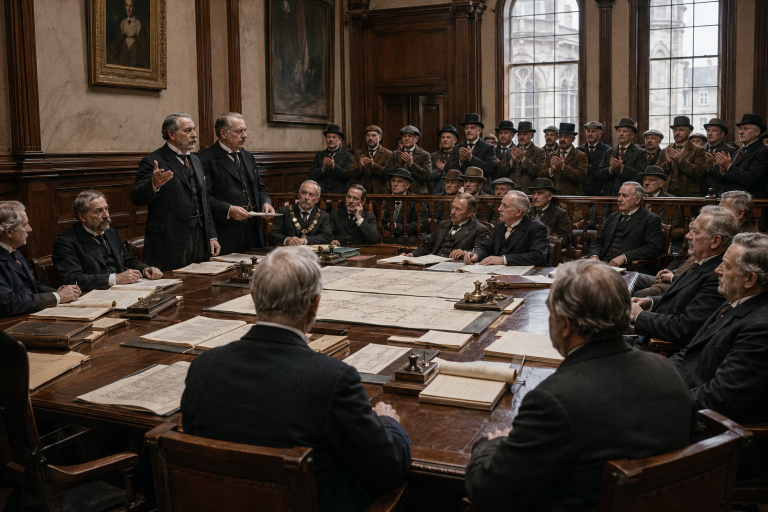
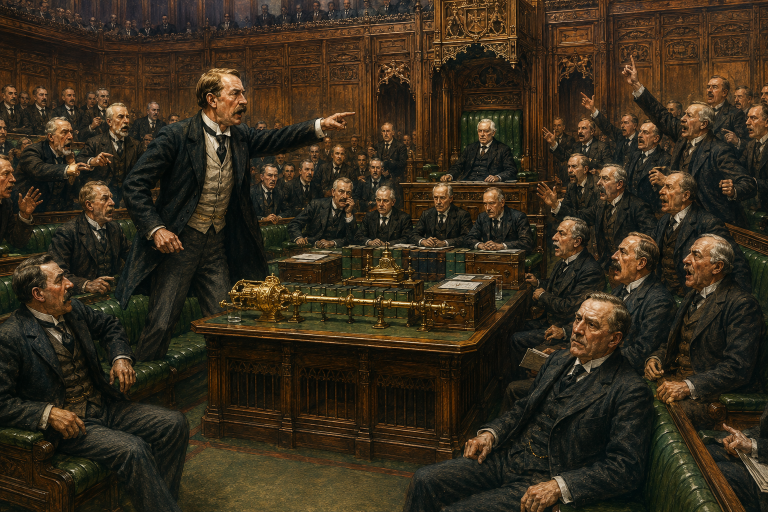
Military justice formed an essential part of the eighteenth-century British Army. Courts martial tried offences against military discipline and could operate at different levels depending upon the seriousness of the accusation. Soldiers and officers lived under regulations distinct in important respects from ordinary civilian life, with obedience, absence, insubordination and conduct subject to military authority. The system derived its legal basis from successive Mutiny Acts and the crown’s Articles of War. Ireland was explicitly within this military framework. Consequently, the letters written by Waite were not exceptional improvisations but surviving fragments of an established legal structure governing troops stationed throughout the kingdom.
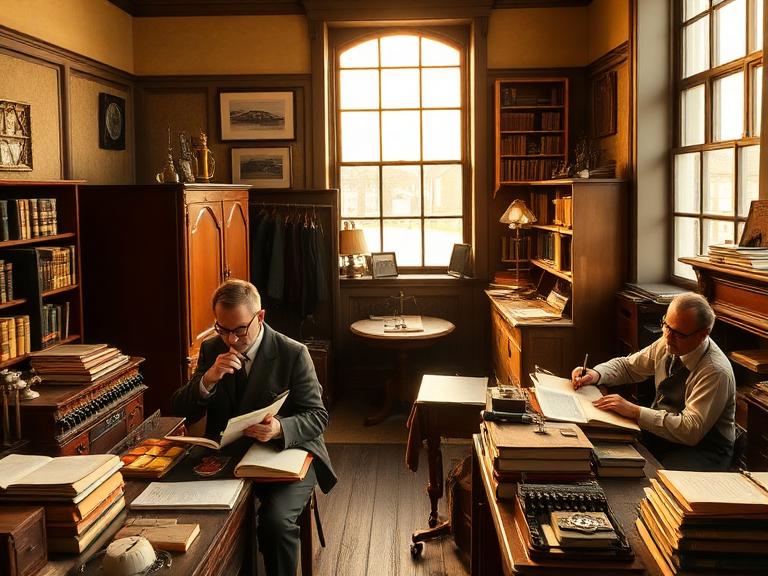
The cases were not the only military matters occupying officials that week. On 8 January, Waite had informed Sir Robert Wilmot that the Dublin garrison was to be reviewed before its tours began. Another letter dated 9 January concerned the proposed discharge of a man named Amos Cornish from his regiment. A further administrative order concerned financial cheques standing against the late Ensign Robert Fairholme. Seen together, these surviving papers show an office simultaneously dealing with inspections, discipline, discharge, military accounts and judicial proceedings. Dublin Castle’s involvement with the army was therefore continuous and highly administrative, extending far beyond preparations for war.
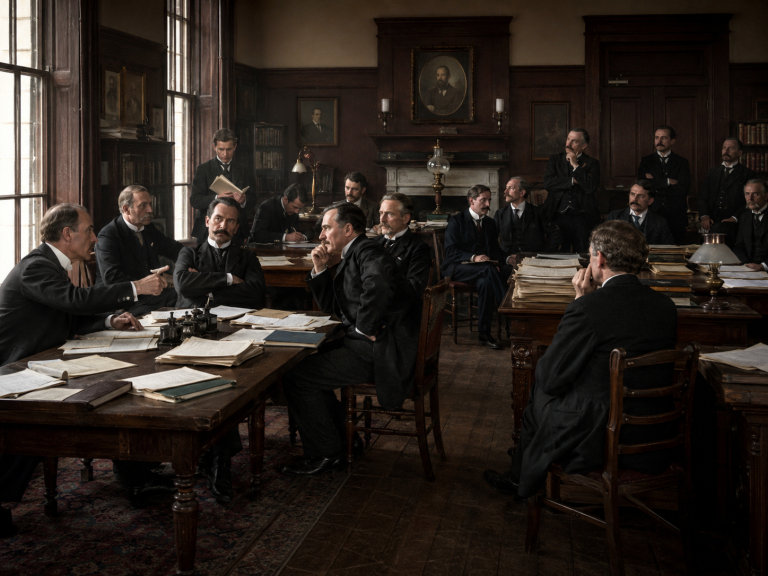
Thomas Waite occupied a position ideally suited to this paperwork. As under-secretary at Dublin Castle, he handled government correspondence and maintained contact with officials including Sir Robert Wilmot, resident secretary in London. From 1737 a large proportion of Irish government business passing between Ireland and Britain travelled through Wilmot’s hands, while Waite became his regular Dublin correspondent. The surviving Wilmot-Horton archive consequently preserves an extraordinary documentary trail of Irish administration. Letters concerning Cornet Nugent and Ensign Harriott survived because they formed part of this bureaucratic system, giving modern researchers access to decisions that might otherwise have vanished completely from the historical record.
Ireland was governed in 1753 by Lionel Sackville, first Duke of Dorset, during his second period as lord lieutenant. His son Lord George Sackville served as chief secretary and was the recipient of Waite’s court-martial correspondence. Dublin Castle formed the executive centre of this administration. The Irish Parliament was not sitting in January, but government continued regardless: military instructions were issued, appointments considered, correspondence answered and patronage managed. Later in 1753 Dorset’s administration would face a major political confrontation over the Irish revenue surplus, yet on 9 January the documentary record presents a government preoccupied with the smaller but indispensable tasks required to administer the kingdom.
Military administration was not the only business recorded on this exact date. Robert Downes, bishop of Down and Connor, wrote to George Stone, archbishop of Armagh, concerning the vacant church living of Carrickens near Derry. The letter, preserved within the same broad administrative archive, reminds us how closely ecclesiastical patronage, political influence and government networks could intersect. On one January day the surviving papers therefore include courts martial, military personnel and a vacant clerical living. These records reveal eighteenth-century government as a constant procession of individual decisions rather than an institution concerned exclusively with legislation and great matters of state.
Print provides another exact-date witness. The Dublin Gazette, Number 248, appeared on 9 January 1753 and covered the period through 13 January. Published by authority, its four surviving pages formed part of the official information network of the Irish executive. Number 247 had covered 6 to 9 January, meaning that the two Gazette issues meet directly on our target date. Newspapers provided one public face of administration while confidential or specialist matters such as court-martial instructions travelled through manuscript correspondence. The combination of surviving newspapers and letters allows the workings of eighteenth-century Ireland to be reconstructed with a precision that the participants themselves could scarcely have anticipated.
The physical setting of the day can also be approached through contemporary observation. James Simon recorded Dublin weather during the period extending from March 1752 through February 1753, and subsequently compiled a journal covering the whole of 1753. His work places the administrative activities of 9 January inside a measurable winter environment. Weather affected military movement just as it affected civilian travel, shipping and agriculture. Soldiers on guard or parade experienced the January elements directly, while messengers carrying Waite’s letters depended upon roads, horses and sea crossings. In an age when communication itself was physical, weather could influence how quickly an instruction became an action.
The importance of 9 January 1753 lies in the unusual clarity with which surviving records reveal government at work. Cornet Nugent awaited the continuation of his court martial; Ensign Harriott’s sentence was ordered back for reconsideration; other officials dealt with military discharge, accounts and church patronage; and a fresh Dublin Gazette entered circulation. None of these events transformed Ireland by itself. Together, however, they expose the structures beneath eighteenth-century political history: authority expressed through orders, letters, courts, clerks and printed notices. A complete daily history of Ireland needs precisely these quieter dates, because they show how the institutions behind famous events operated when no famous event occurred.
Primary Sources
Primary Sources
- Thomas Waite — Letter to Lord George Sackville concerning Cornet Nugent — 9 January 1753.
Orders the court martial to proceed with the trial of Cornet Nugent. The strongest exact-date source for the principal story. Derbyshire Record Office, D3155/C/H/1404. - Thomas Waite — Letter to Lord George Sackville concerning Ensign Harriott — 9 January 1753.
Orders the court martial to reassemble and reconsider the sentence in Harriott’s trial. Derbyshire Record Office, D3155/C/H/1405. - Richard James and John Butler — The Dublin Gazette, No. 248 — 9–13 January 1753.
Official Irish government newspaper beginning on the exact target date. Four pages survive in the Houses of the Oireachtas Library and Research Service. Virtual Treasury of Ireland. - Thomas Waite — Correspondence concerning the discharge of Amos Cornish — 9 January 1753.
Records Waite having written to the commanding officer of Cornish’s regiment concerning his discharge. Derbyshire Record Office, Wilmot-Horton papers. - Thomas Waite — Order concerning the late Ensign Robert Fairholme — 9 January 1753.
Administrative order concerning the removal of financial cheques standing against the deceased officer. Derbyshire Record Office, D3155/C/H/1406. - Robert Downes, Bishop of Down and Connor — Letter to George Stone, Archbishop of Armagh — 9 January 1753.
Concerns the vacant living of Carrickens near Derry and provides an additional exact-date record of Irish administrative and ecclesiastical affairs. Derbyshire Record Office, D3155/C/H/1407. - Richard James and John Butler — The Dublin Gazette, No. 247 — 6–9 January 1753.
Official newspaper whose publication period ends on the exact target date. Houses of the Oireachtas Library / Virtual Treasury of Ireland. - Thomas Waite — Letter to Sir Robert Wilmot — 8 January 1753.
Reports that the Dublin garrison was to be reviewed before its tours began, providing direct military context from the preceding day. Derbyshire Record Office, D3155/C/H/1402. - Captain Robert Dobson — Letter to Lord Cadogan — 6 January 1753.
Written in Dublin concerning Dobson’s role in administering Major Douglas’s will and illustrating the wider military correspondence of the same week. Derbyshire Record Office, D3155/C/H/1440. - Thomas Waite — Letter to Lord George Sackville — 4 January 1753.
Contemporary Dublin Castle correspondence concerning communication with the Lords Justices, illustrating the administrative environment immediately preceding the target date. - Richard James and John Butler — The Dublin Gazette, No. 246 — 2–6 January 1753.
Official Irish government newspaper from the opening week of the month. Houses of the Oireachtas Library / Virtual Treasury of Ireland. - Richard James and John Butler — The Dublin Gazette, No. 249 — 13–16 January 1753.
Official newspaper immediately following Number 248 and useful for continuing the administrative record of January 1753. - George Faulkner — Faulkner’s Dublin Journal — January 1753 issues.
Contemporary Dublin newspaper recording advertisements, public notices, commercial activity, entertainment and news during the same month. - Publishers of Pue’s Occurrences — Pue’s Occurrences — January 1753 issues.
Contemporary Dublin newspaper providing additional evidence for the social, commercial and public world surrounding the target date. - James Simon — An Account of the Barometer, and the State of the Weather, at Dublin, from the 7th of March 1752 to the 28th of February 1753.
Contemporary meteorological record directly encompassing 9 January 1753. Royal Society, Philosophical Transactions. - James Simon — A Journal of the Weather in Dublin for the Year 1753.
Contemporary daily meteorological observations for Dublin throughout the target year. Royal Society, Philosophical Transactions. - Crown and Parliament — Mutiny Act 1751, 25 Geo. II c.2 — 19 December 1751.
Contemporary legislation for punishing mutiny and desertion and regulating the army, forming part of the legal framework within which military discipline and courts martial operated during this period. - Crown — Rules and Articles for the Better Government of His Majesty’s Land Forces — Articles of War in force during the early eighteenth century.
Contemporary military regulations governing offences, discipline and military judicial procedure. War Office holdings preserve Articles of War for the period through 1750 and related succeeding material. - Ireland, Parliament, House of Commons — Journals of the House of Commons of the Kingdom of Ireland — 1753 proceedings.
Official parliamentary record providing the broader constitutional and governmental setting of the target year. - Lionel Sackville, Duke of Dorset — His Speech to Both Houses of Parliament at Dublin — 9 October 1753.
The lord lieutenant’s official address when parliament reconvened later in the year, providing direct primary evidence of the administration under which Waite and Lord George Sackville were operating.