Dublin Changes Hands

A Year Seen Through Fragments
The surviving record for this year is brief but unusually revealing. Irish annals preserve no continuous narrative and almost never supply exact dates for the events they list. They were compiled at different churches, drew upon different local traditions and occasionally placed the same death or conflict under neighbouring years. What emerges is therefore not a modern chronicle of twelve complete months, but a series of sharply lit moments: a decisive struggle for Dublin, warfare in Connacht, deaths among royal and ecclesiastical elites, a disputed abbacy and a destructive winter storm.
Ireland had no single ruler whose authority was accepted everywhere. Donnchad mac Briain, son of Brian Bóruma, remained king of Munster and maintained claims to wider supremacy, but his reach had weakened. Áed Ua Conchobair was expanding his power in Connacht, while Niall mac Eochada ruled Ulaid. The most dynamic figure was Diarmait mac Máel na mBó, the Uí Chennselaig king who had secured the overkingship of Leinster during the previous decade. His actions around Dublin became the central development of the year.
The Seizure of Dublin
The Annals of Tigernach, Chronicon Scotorum and the later Annals of the Four Masters describe a raid led by Diarmait into Fine Gall, the coastal territory north of Dublin. His forces burned the country from Dublin towards the River Delvin, although one version names the endpoint as Albene. The annalists add an important and rather unusual detail: Diarmait initially obtained no cattle. That failure may mean that livestock had been driven away before his army arrived, or simply that the expedition did not secure its expected movable wealth.
The raid escalated into fighting around Dublin’s dún, its defended royal stronghold. The sources report major skirmishes and deaths on both sides, but give neither numbers nor an exact date. Echmarcach mac Ragnaill, king of Dublin and a ruler with connections to Man and the Isles, eventually went overseas. Diarmait then assumed the kingship of the town. The Annals of Tigernach emphasise that he took it ‘by force’, while the Annals of Ulster state more simply that Echmarcach was banished and Diarmait obtained the kingship.
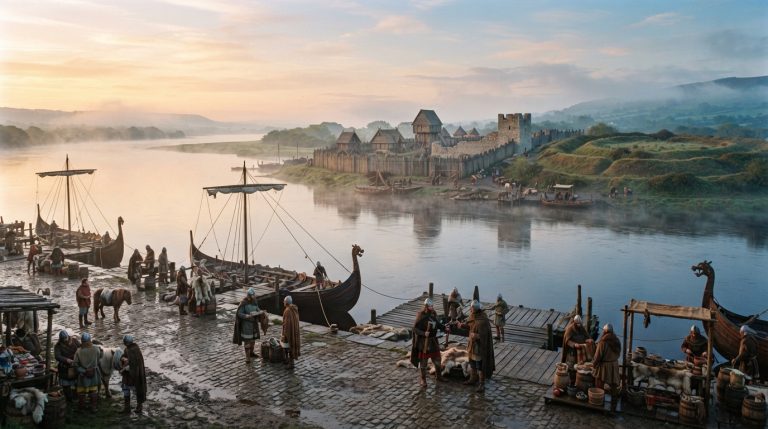
This was more than another cattle raid or temporary submission. Dublin was Ireland’s principal port, a fortified Hiberno-Norse town with ships, skilled craftspeople, merchants and its own tradition of silver coinage. Control of it offered Diarmait access to maritime forces, commercial revenues and diplomatic connections across the Irish Sea. It also gave Leinster a powerful northern base beside the territories of Brega and Mide. Dublin’s resources would soon be used in Diarmait’s wider campaigns, confirming that his authority over the town was practical rather than merely ceremonial.
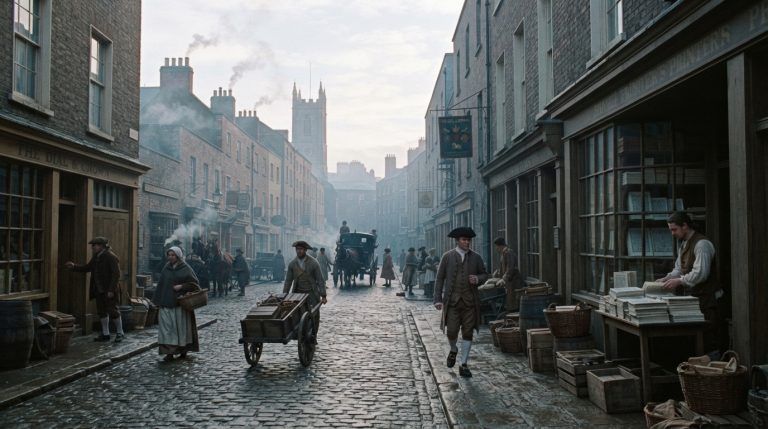
The takeover did not mean that Dublin’s inhabitants disappeared or that its Hiberno-Norse culture was abruptly replaced. Archaeology reveals an established urban community of timber and wattle houses, workshops, lanes, property boundaries and waterfront activity. Woodworkers, smiths, leatherworkers, textile producers and craftspeople using amber, antler and precious metals served local and overseas markets. Diarmait captured this functioning community and placed its wealth and manpower beneath a Gaelic overking. In that sense, the conquest marked a change in political ownership rather than an ethnic cleansing or destruction of urban life.
A Shifting Balance of Power
Diarmait’s success challenged Donnchad mac Briain, whose earlier influence had extended over much of southern Ireland. Family ties did not prevent rivalry: Diarmait’s wife Derbforgaill was Donnchad’s daughter, yet relations between the two kings had long alternated between accommodation and hostility. Echmarcach was also associated with Donnchad’s political circle. By expelling him, Diarmait removed a potentially friendly ruler from Donnchad’s northern flank and acquired what one historian has aptly described as a new weapon in Leinster’s arsenal.
One Annals of Ulster entry adds that Niall mac Eochada, king of Ulaid, came to Osraige during the year. No purpose or outcome is supplied, so it cannot responsibly be turned into a definite alliance or campaign. It nevertheless hints at the long-distance movement of kings and war bands through a political landscape in which Leinster, Osraige, Ulaid, Munster and Dublin were increasingly interconnected.
Munster also lost a significant dynast when Mac Raith Ua Donnchada, king of the Éoganacht of Cashel and, according to the Annals of Tigernach, a royal heir of Munster, died. His death did not immediately overturn Donnchad’s rule, but it removed a senior representative of a dynasty that had ruled Munster before the rise of the Dál Cais. Muiredach Ua Sencháin, described as steward of Munster, also died. Such offices joined household administration, tribute collection and political service; their holders belonged to the working machinery of provincial power.
Violence in Connacht
Far from Dublin, the annals record renewed fighting among the peoples of Connacht and the north-western midlands. Áed Ua Conchobair raided the Conmaicne and extensively ravaged their country. In a separate encounter, the Conmaicne defeated the Calraige and killed their king, identified as Mac Airechtaig. The Annals of Tigernach attributed the victory to the power of St Ciarán’s shrine. This language should not be dismissed as decoration: relics and shrines were understood as active guarantees of justice, protection and collective identity. Their presence could lend sacred authority to armies, agreements or claims of vengeance.
The death of Domnall Bán Ua Briain, a grandson of Brian Bóruma, belongs to the same troubled western setting but illustrates the annals’ chronological difficulties. The Annals of Ulster, Inisfallen and Loch Cé place his killing by the Connachta in this year, whereas Tigernach and the Four Masters enter it under the preceding year. It is safest to say that he was killed around 1051–52, probably by the forces of Áed Ua Conchobair, rather than insist upon a precise calendar date. The killing shows that the contest surrounding Donnchad mac Briain was already costing his wider kindred dearly.
Churches, Pilgrims and Rivalries
Ecclesiastical life was inseparable from politics. At Armagh, Gilla Pátraic son of Domnall, the prior, was treacherously killed according to the Annals of Ulster; the Four Masters merely record his death. A prior at Ireland’s leading Patrician church was a figure of status, and the charge of treachery points towards personal or factional violence within the networks surrounding a wealthy religious centre. The entry does not reveal the motive, and none should be invented.
At Emly, one of Munster’s foremost churches, a son of Carthach seized the abbacy by force and expelled Ua Lígdai, the lector, from the abbot’s seat. The incident demonstrates that an abbacy could command property, dependants, prestige and political influence worth fighting for. It also shows the importance of the lector, the officer associated with teaching and learned activity. Monastic settlements were places of worship, education, hospitality and production, but they could also become arenas in which powerful families competed for office.
Echtigern Ua hAgráin, successor of both Ciarán of Clonmacnoise and Comán, died while on pilgrimage at Clonard. His titles indicate authority within more than one saintly federation, while his journey between major churches reflects the mobility of senior clergy. Clonmacnoise, situated beside the Shannon, remained a celebrated centre of devotion, craftsmanship and learning. The year’s military invocation of Ciarán’s shrine further demonstrates how its influence extended beyond the monastic enclosure.
Another Irish traveller died much farther away. Bran, son of Máel Mórda and a former king of Leinster, died at Cologne, apparently after years in religious retirement. Blinded in 1018 and thereby disqualified from active kingship, he had survived for decades. His presence in Cologne belongs to a broader tradition of Irish pilgrimage and religious settlement on the Continent. It reminds us that eleventh-century Ireland was connected not only to Britain, Man and Scandinavia, but also to ecclesiastical routes reaching deep into Europe.
Work, Wealth and Weather
Most people remained outside annalistic notice. Rural households cultivated grain, kept pigs and sheep, made butter and depended heavily upon cattle. Cows represented food, status, rent and transferable wealth, explaining why armies repeatedly sought them. A raid could strip a district of livestock and captives while burning houses, stores and standing crops. Diarmait’s burning of Fine Gall therefore fell most heavily upon farming families whose names were never recorded.
Dublin offered a different concentration of daily activity. Excavated objects attest fishing, weaving, carpentry, metalworking, leather production and trade in imported pottery, soapstone, amber and silver. Coins circulated there alongside weighed precious metal, while ships connected the Liffey to ports around the Irish Sea and beyond. Capturing the town meant commanding these people and facilities, not simply occupying a royal hall.
The Annals of Inisfallen close their record with a firmly dated natural event. On 21 December, the feast of St Thomas, a violent wind brought down houses and woods. Its geographical extent is unknown, and no casualty figure survives. Yet the notice offers a rare glimpse of environmental danger: timber buildings, winter fodder, woodland resources and communications could all be damaged in a single storm.
The year’s lasting importance lies in Dublin. Diarmait mac Máel na mBó transformed a destructive expedition into possession of Ireland’s richest town and strongest maritime base. Elsewhere, raids, dynastic deaths and struggles over church office continued without decisive resolution. Dublin’s conquest, however, altered the scale on which an Irish provincial king could operate and helped make Diarmait the dominant ruler of the southern half of Ireland during the following two decades.
Primary Sources
- The Annals of Ulster: Year U1052
- Annals of Inisfallen: Annal AI1052
- The Annals of Tigernach: Annal T1052
- Annals of Tigernach: Irish Text, Annal T1052
- Annals of the Four Masters: Annal M1052
- Annals of the Four Masters: Irish Text, Annal M1052
- Chronicon Scotorum
- Chronicon Scotorum: Irish and Latin Text
- Annals of Loch Cé: Annal LC1052
- Book of Leinster, Formerly Lebar na Núachongbála
- Diarmait (Diarmait mac Maíl (Máel) na Mbó)
- Echmarcach
- Bran (Bróen)
- Donnchad
- Donnchad Máel Na Mbó
- Máel-Mórda
- Viking
- 950–1450: Vikings, Normans and Medieval Mints
- Wooden Plank with Viking Ship and Weathervane Graffiti
- Guide to the National Museum of Ireland – Archaeology
- The Archaeological Remains of Viking and Medieval Dublin: A Research Framework
- Queen Gormlaith, Brian Boru and the Northmen of Dublin
- Clonmacnoise Monastic Site
- The Vikings in Ireland
- Medieval Ireland: Territorial, Political and Economic Divisions
- Animals and the Economy of Medieval Ireland: A Zooarchaeological Analysis of the Faunal Remains from Caherconnell Cashel, Co. Clare