Archived: 2 November 2026
Abstract
In 691 CE, the surviving Irish annals preserve a small but revealing cluster of notices: the death of Crónán moccu Cuailne, abbot of Bangor; a raid by Dál Riata upon the Cruithin and Ulaid; the death of Fidchellach son of Flann, king of Uí Maine; and a violent windstorm which drowned about six members of Iona’s community on 16 September. These entries do not amount to a continuous narrative of the year, and they should not be made to do so. Yet, set beside the political and ecclesiastical landscape of the late seventh century, they show an Ireland joined to
Read Article
Archived: 2 November 2026
Abstract
In 690 CE, Ireland’s surviving annalistic tradition places a cluster of violent deaths and ecclesiastical losses within a single, unsettled political landscape. The clearest event is the killing of Congal, son of Máel Dúin and grandson of Áed Bennán, whom the Annals of Ulster call king of Iarmumu, or western Munster. The same annal sequence also records the deaths of Ailill son of Dúngal, associated with Éilne among the Cruthin in the north, and of Dúnchad son of Orc Doith. These terse notices do not supply a battlefield, motive or victor. Yet their concentration is revealing: authority in Ireland rested
Read Article
Archived: 2 November 2026
Abstract
In 689 CE, Ireland’s surviving annalistic record preserves a compact but revealing cluster of political, ecclesiastical and celestial notices. It must, however, be read with unusual care. The material conventionally grouped under the annal-heading 689 is not securely tied to the modern calendar year: the Annals of Ulster label their corresponding entry “AD 688”, and a modern synchronism identifies the reported solar eclipse with 3 July 688. This article therefore treats the events as the evidence traditionally associated with 689 CE, while distinguishing that association from a firm modern date. The clearest political event is the killing of Diarmait, king
Read Article
Archived: 2 November 2026
Abstract
In 685 CE, Ireland’s surviving record is unusually sparse, but it is not empty. The year is best approached through a small, difficult cluster of annalistic notices: the death of Banbán ‘Os Cach’, described as a learned man and, in the fuller notice of the Annals of Tigernach, lector of Kildare; the repose of Forcrann, abbot of Clonmacnoise; and events in northern Britain recorded by Irish writers, above all the defeat and death of the Northumbrian king Ecgfrith at Dún Nechtain on 20 May. These sources do not preserve a single narrative of Ireland in 685. Their differing chronological systems
Read Article
Archived: 2 November 2026
Abstract
In 683 CE, Ireland’s surviving annalistic record places political violence, contested provincial authority and the first reported onset of a grave mortality within the same year. The entries are terse, but their conjunction is striking: Dúnchad Muirisce, king of Connacht, was killed; Colgu, son of the former Tara ruler Blathmac, fell in the battle of Corann alongside Fergus, king of Cenél Cairpri; two strongholds were besieged; and, in October, a disease described as the “mortality of children” began. For a society whose history was usually recorded through the fates of rulers, clerics and religious houses, this last notice points beyond
Read Article
Archived: 2 November 2026
Abstract
In 682 CE, the clearest Irish event is the killing of Cenn Fáelad son of Colgú, styled king of Connacht in the annals. The Annals of Ulster preserve the event in a terse entry; the related Annals of Tigernach and Chronicon Scotorum name his killer as Ulcha Derg, grandson of Caillide, of the Conmaicne Cúile. Tigernach adds the vivid but limited detail that Cenn Fáelad was slain after the Conmaicne had stormed his house. It is the year’s central fact: a provincial king died violently in his own residence, not in a named pitched battle. The sources provide neither a
Read Article
Archived: 2 November 2026
Abstract
In 681 CE, Ireland’s surviving annalistic record preserves three securely associated notices: the killing of Cenn Fáelad, described as king of Connacht; a battle at Ráith Mór in Mag Line against Britons, in which Cathasach, king of the Cruithin, was killed; and the death of Suibne, superior of Corcach. These are short entries, but they reveal a political world in which royal authority remained precarious, conflict crossed the narrow seas, and ecclesiastical communities were led by figures important enough to be entered beside kings and battles. The evidence must be handled carefully. The Annals of Ulster place these items under
Read Article
Archived: 2 November 2026
Abstract
In 680 CE, Ireland’s surviving annalistic record brings together a striking mixture of dynastic violence, ecclesiastical change and a grave outbreak of illness. The entries are brief, and the manuscripts that preserve them were written much later, so their calendar headings require care. This account follows modern chronological synchronisation rather than simply repeating the sometimes displaced year-numbers in individual annals. On that basis, several developments can responsibly be assigned to 680: the death of Colmán, abbot of Bennchor (Bangor); the killing of Fíanamail mac Máel Tuile, king of Leinster; deaths and fighting in several regions; and, most memorably, the report
Read Article
Archived: 2 November 2026
Abstract
In 679 CE, Ireland’s annalists record a year defined less by a single island-wide crisis than by the passing and testing of influential people and institutions. The securely dated core consists of the death of Fáilbe, abbot of Í or Iona; the death of Cenn Fáelad, styled “the learned”; and a clash in which Fínnechta Fledach, the dominant Uí Néill king of Tara, defeated Bécc Bairrche. These concise notices are unusually revealing. Together they show a country of many competing dynasties, in which armed expeditions, ecclesiastical leadership and learned reputation all carried political weight. A Year in Difficult Calendars The
Read Article
Archived: 2 November 2026
Abstract
In 678 CE, the most consequential Irish event securely associated with the year was a victory by Uí Cheinnselaig over Osraige in which Tuaim Snáma, king of Osraige, died. The annals are terse, but a fuller annalistic tradition identifies the victor as Fáelán Senchustul of Uí Cheinnselaig and preserves a verse claiming that Osraige gave hostages ‘from Áth Buana to Comar’. This was not a clash between modern counties or nations. It was a contest between neighbouring dynasties in south-eastern Ireland, conducted through armed followings, negotiated submission and the transfer of persons whose custody guaranteed an agreement. The same annalistic
Read Article
Archived: 2 November 2026
Abstract
In 674 CE, the annals place Ireland’s most consequential recorded development in a struggle within the Síl nÁedo Sláine, an important branch of the Southern Uí Néill. Cenn Fáelad, son of Blathmac and styled king of Tara in later historical reckoning, was killed in battle; his kinsman Fínnechta Fledach emerged as victor and began to rule. The terse report offers neither battlefield narrative nor a reliable location. Yet it marks a real change in the leadership of the midlands, where claims to the kingship of Tara depended less on a unitary national state than on kinship, military following, tribute, alliances
Read Article
Archived: 2 November 2026
Abstract
In 673 CE, the Irish annals conventionally group together a small but revealing set of notices: the killing of Domangart, king of Dál Riata; the burning of Mag Luinge; the capture of two named men; the death of Cormac son of Máel Fothartaig; and the voyage to Ireland of Fáilbe, abbot of Iona. None is supplied with a month, day or full narrative. Even the year requires care: the Annals of Ulster preserve these entries under their annal 673 while displaying an Anno Domini equivalent of 672, whereas the Annals of Tigernach place the closely corresponding material under 673. Modern
Read Article
Archived: 2 November 2026
Abstract
In 672 CE, Ireland’s annalistic record places a local northern battle, a royal succession, a destructive fire at Armagh and an unusually plentiful woodland harvest within the same year. None of these notices offers a full narrative, and none is dated to a particular month or day. They are brief entries preserved in chronicles copied much later, whose year-numbering is not perfectly uniform: the Annals of Ulster’s entry conventionally assigned to 672 even carries an internal AD 671 heading. The safest conclusion is therefore that these events belong to the annalistic year 672, rather than that their exact modern calendar
Read Article
Archived: 2 November 2026
Abstract
In 671 CE, the most consequential recorded Irish event was the killing of Sechnassach mac Blathmaic, king of Tara, at the beginning of winter. The terse notice in the Irish annals is unusually revealing despite its brevity: it names his killer, Dub Dúin of Cenél Cairpri, and preserves a four-line verse remembering the king’s household as rich in bridles, horse-switches and surplus. The same annalistic year also records a battle at Druim Cepais, the death of Fergus son of Crunnmael, the death of Bran Finn of the Déisi in one source, and Máel Ruba’s sea-voyage from Ireland to Britain. Together
Read Article
Archived: 2 November 2026
Abstract
In 670 CE, Ireland’s surviving annalistic record preserves a stark notice: “Great snow fell. A great famine occurred.” The entry, in the Annals of Tigernach, is brief enough to conceal almost everything a modern reader wants to know: how long the snow lay, which districts suffered most, whether harvest stores failed, and how many people died. None of that can responsibly be supplied. Yet the pairing of exceptional snowfall and famine is itself important. In an overwhelmingly agrarian society, winter weather could turn stored food, fodder, livestock and labour into matters of survival. The year is therefore best approached through
Read Article
Archived: 2 November 2026
Abstract
In 668 CE, the surviving Irish record brings together a northern battle, a western monastic foundation and evidence of continuing movement across the Irish Sea. These are not events with securely known days or seasons. They are annalistic notices, preserved in texts copied long after the seventh century and subject to differing chronological systems. The year is nevertheless conventionally associated with the battle of Fertas between the Ulaid and the Cruithin, and with Bishop Colmán’s journey to Inis Bó Finne, where he founded a church. The Annals of Ulster place both under their entry U668, although that manuscript’s calendrical heading
Read Article
Archived: 2 November 2026
Abstract
In 665 CE, Ireland stood in the shadow of a grave mortality while conflict still continued between powerful regional groups. The clearest event placed directly in this calendar year is the battle of Loch Fén, recorded by the Annals of Inisfallen as a fight between the men of Munster and Connacht in which Talamnach, son of Laidcenn, was killed. The notice is stark: it supplies neither a victor nor a cause. Yet its very brevity is revealing. Even amid epidemic loss, kings and war-bands remained able to mobilise, cross regional boundaries and contest territory or political influence. The battle also
Read Article
Archived: 2 November 2026
Abstract
In 664 CE, Ireland entered a year remembered above all for the arrival of a devastating epidemic. The Irish annals place its coming on 1 August, stating with unusual precision that “the plague reached Ireland” and that it first raged at Mag Itha of Fotharta. This is one of the firmest dates attached to an early medieval Irish disease outbreak. Yet the surviving records are terse, copied and rearranged centuries after the events; their year headings do not always coincide exactly with modern chronological conventions. What can responsibly be said is that, during the calendar year 664, mortality reached Ireland,
Read Article
Archived: 2 November 2026
Abstract
In 663 CE, Ireland’s annalistic record is dominated not by a famous battle or a royal inauguration, but by deaths: above all that of Guaire Aidne, remembered as king of Connacht, and by the loss of senior churchmen at Bangor and Ferns. The year is a useful reminder that early Irish history is often preserved in short, retrospective notices rather than continuous narrative. Those notices nonetheless reveal a society in which royal standing, kinship, monasteries and burial places were tightly interwoven. They also require care over dating. The Annals of Ulster preserve these notices under U663, while their internal year-equivalent
Read Article
Archived: 2 November 2026
Abstract
In 662 CE, Irish annalists associated a cluster of political deaths, a battle within the southern Uí Néill and the passing of a celebrated church scholar with this year. The evidence is unusually revealing but not perfectly uniform. The Fragmentary Annals explicitly place the battle of Ogoman, the death of King Máenach of Munster and that of Cummíne Fota in 662; other annalistic compilations place some of the same notices under adjacent year-headings. This is a familiar problem in early Irish chronology, not a reason to discard the events. It does mean that no day, season or sequence within the
Read Article
Archived: 2 November 2026
Abstract
In 661 CE, Ireland’s annals preserve an unusually revealing cluster of deaths, a journey across the Irish Sea, a dynastic battle in the midlands and the passing of a Munster king. None makes a complete national narrative by itself. Together, however, they show how power, learning and religious authority were distributed across a landscape of competing kindreds and ecclesiastical communities. The year is especially associated with Cummian or Cuimíne Fota, ‘Cummian the Tall’, the celebrated scholar linked with Clonfert on the Shannon. His death was commemorated not merely as the loss of a churchman but as the removal of a
Read Article
Archived: 2 November 2026
Abstract
In 660 CE, Ireland’s annals associate the year above all with a battle at Ogaman, at a place called Cenn Corbadáin, and with a striking rupture within the ruling dynasty of the southern Uí Néill. The event is conventionally assigned to 660 by the Annals of the Four Masters and the Annals of Tigernach, but early Irish annalistic chronologies do not align perfectly: the Annals of Ulster place the same fighting under their entry for 661, while the Fragmentary Annals give 662. This is not evidence for several separate battles. Rather, it is a reminder that the modern calendar labels
Read Article
Archived: 2 November 2026
Abstract
In 658 CE, the most securely attested Irish developments were not a single great battle or royal assembly, but a cluster of deaths that reveal how closely political authority, ecclesiastical institutions and regional society were intertwined. The annals record the deaths of Díma Dub, bishop of Condaire or Connor, and Cuiméne, bishop of Nendrum in Strangford Lough. The Annals of the Four Masters, compiled much later but drawing on older annalistic material, also place in this year the death of Sillán, bishop of Daiminis, probably Devenish in Lough Erne, on 17 May. Its same entry calls 658 the second year
Read Article
Archived: 2 November 2026
Abstract
In 657 CE, Ireland’s surviving annalistic record preserves a year of transition, deaths and unsettling signs rather than a single decisive campaign. A later annalistic tradition places the opening of the joint rule of Diarmait and Blathmac, sons of Áed Sláine, in this year. The Annals of Ulster, whose internal year-numbering is offset at this point, explicitly labels its entry U658 as AD 657: it records several deaths, the death of Guret, king of Alt Clut on the Clyde, a violent windstorm, and an extraordinary cow at Láthair Briúin said to have borne four calves. The notices are brief, but
Read Article
Archived: 2 November 2026
Abstract
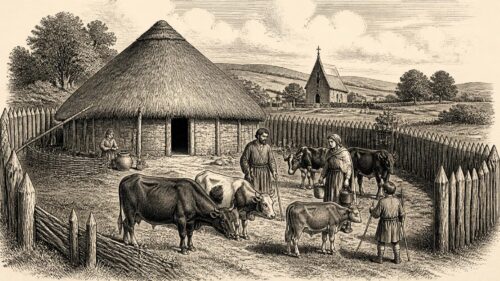
In 656 CE, the surviving Irish annals place a small but revealing cluster of deaths, a battle and an extraordinary report from the countryside within the year. None amounts to a narrative of a united Irish kingdom: Ireland was divided among many dynasties and petty kingdoms, while churches and monasteries exercised influence across political frontiers. Yet the entries for this year illuminate several connected worlds: the Columban community of Iona, the ecclesiastical landscape of Meath and Munster, local violence, cattle-centred rural life, and Ireland’s close relationship with northern Britain. The evidence is terse and must be handled cautiously, but it
Read Article





