
Jacobite Crisis(c.1680s)
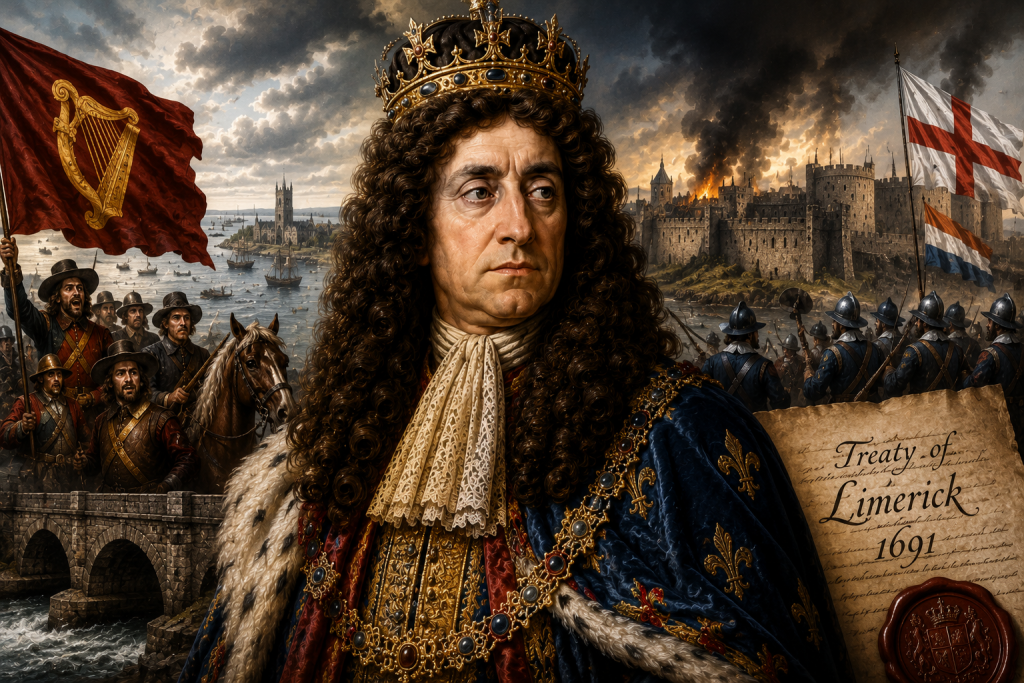
For Limerick, the downfall of James II began the conflict that would define the city as the Treaty City. His removal from the English throne in 1688 drove the Stuart cause towards Ireland, where Catholic loyalty remained strongest. That struggle eventually brought Williamite and Jacobite armies to Limerick, culminating in the sieges of 1690 and 1691. The crisis began, however, with James’s accession in 1685 and his determination to extend civil and religious rights across England, Scotland and Ireland.
James initially faced no open resistance. Celebrations greeted his accession, while Catholic communities welcomed the prospect of relief from decades of persecution. Irish Catholics, despite repeated confiscations and broken promises under earlier Stuart monarchs, remained deeply loyal to the dynasty. They believed that a Catholic king might finally restore religious toleration, permit exiles to return and address long-standing grievances.
James declared that he would preserve the established government, uphold the law and protect the rights of his subjects. He insisted that Catholics and Protestants alike were entitled to liberty of conscience. Thousands of Catholics imprisoned in Ireland for refusing Protestant worship were released, along with Quakers jailed for similar reasons. James also sought to remove penal laws, religious tests and restrictions that excluded Catholics and Nonconformists from public office.
These policies immediately alarmed the Anglican establishment. Bishops resisted royal instructions to proclaim liberty of conscience, while Parliament opposed the appointment of Catholic officers. James believed religious equality would restore social harmony, but his opponents regarded every concession as an attack on Protestant supremacy. His decision to employ Catholics in the army after the Duke of Monmouth’s rebellion intensified suspicion and united his enemies.
Monmouth had landed in England, proclaimed James a usurper and gathered several thousand supporters before being defeated at Sedgemoor. Although the rebellion collapsed, it convinced James that the army and political establishment contained disloyalty. He recalled experienced Catholic officers who had been excluded under the Test Act, arguing that men who had defended the Crown should not be dishonoured when their service remained necessary.
Opposition now turned increasingly towards William of Orange, husband of James’s Protestant daughter Mary. William was already recognised as the military leader of European Protestant resistance to France. When Mary of Modena gave birth to a son in June 1688, the prospect of a continuing Catholic succession destroyed William’s remaining hesitation.
William assembled a multinational army and sailed for England. He landed at Torbay in November 1688, presenting his invasion as a defence of Protestant religion and English liberty. James raised an army, but senior commanders, political allies and members of his family deserted him. His daughter Anne joined his enemies, while Mary supported her husband.
Broken by betrayal and fearing for his queen and infant son, James sent them to France. He was later forced from London and escaped to Saint-Germain. William and Mary were proclaimed joint monarchs in February 1689. James had lost his crown, but Ireland had not abandoned him. Limerick would soon become the final great fortress of his cause.
Primary Sources
These five contemporary documents support the article’s account of James II’s religious policies, Monmouth’s rebellion, William of Orange’s invasion, James’s flight and the later Limerick settlement.
- James II, His Majesty’s Gracious Declaration to All His Loving Subjects for Liberty of Conscience — 4 April 1687.
James’s official declaration suspending religious penalties and promoting freedom of worship for Catholics and Protestant dissenters. It directly supports the article’s discussion of liberty of conscience and opposition to religious tests. (LingPhil) - James II, A Proclamation Declaring the Duke of Monmouth and Lord Grey Traitors — 13 June 1685.
Issued after Monmouth landed at Lyme, this royal proclamation records the Crown’s official response to the rebellion and identifies Monmouth’s forces as traitors. (Folger Catalog) - William of Orange, Declaration of the Reasons Inducing Him to Appear in Arms in England — October 1688.
William’s published justification for invading England claimed that he intended to preserve Protestantism and restore the laws and liberties of England, Scotland and Ireland. (Parliamentary Archives) - James II, His Majesty’s Reasons for Withdrawing Himself from Rochester — 22 December 1688.
Written in James’s own name after his departure, this document explains and defends his decision to leave England following William’s invasion and the desertion of senior supporters. A surviving Dublin edition is preserved by Marsh’s Library. (Folger Catalog) - The Civil and Military Articles of the Treaty of Limerick — 3 October 1691.
The articles record the surrender of Limerick, protections promised to Irish Catholics and the arrangements permitting Jacobite soldiers to leave Ireland. They provide the strongest primary-source connection between James II’s cause and Limerick’s identity as the Treaty City. (celt.ucc.ie)