
Royal Departure(c.1690s)
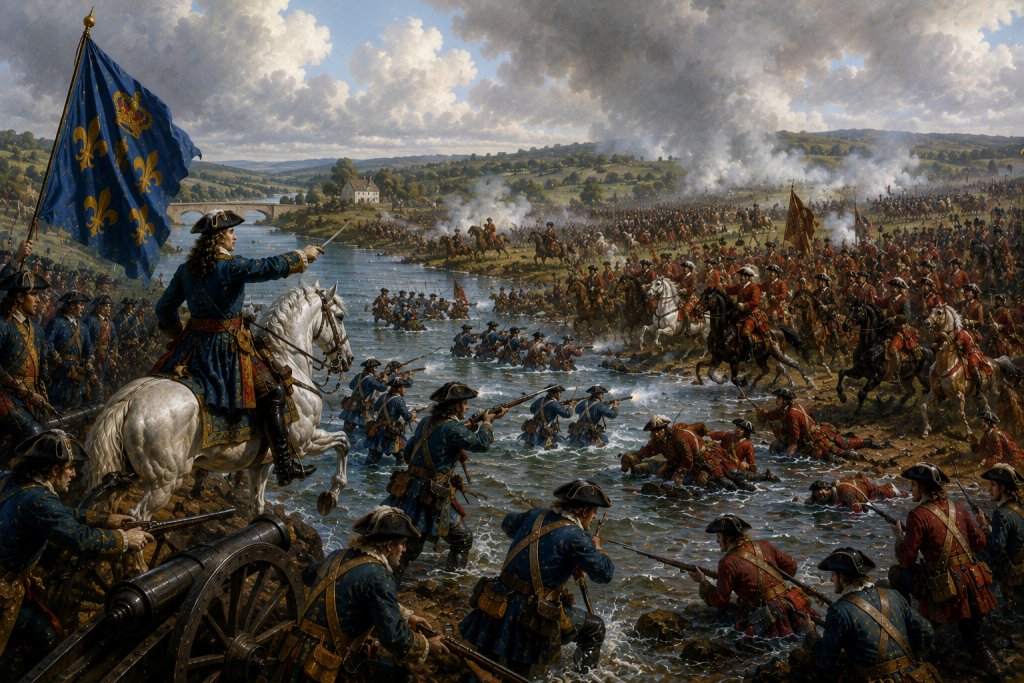
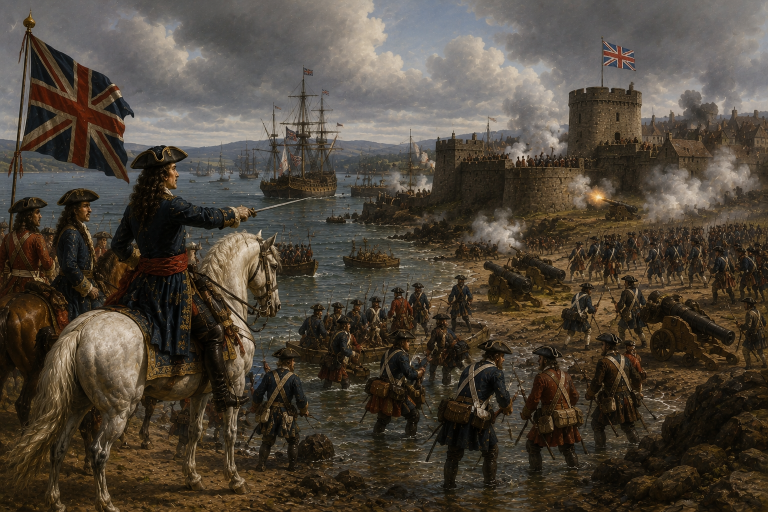
For Limerick, the aftermath of the Boyne transformed the city from an important western stronghold into the principal gathering place of the Jacobite cause. After the defeat, James II ordered the surviving army to rendezvous there, placing Limerick at the centre of Ireland’s continuing resistance. His decision to leave the country, however, meant that the defence of the kingdom would now depend upon Tyrconnell, Sarsfield and the soldiers who remained behind.
The defeat at the Boyne was serious, but it had not destroyed the Jacobite army. Elsewhere in Europe, events had temporarily favoured France and James. The allied fleet had suffered a major defeat at Beachy Head, while French forces defeated William’s continental allies at Fleurus. French ships were also preparing to sail towards Ireland. These developments suggested that William’s position was not yet secure and that determined leadership might still have changed the course of the war.
James nevertheless chose to depart. His critics argued that this decision completed a long sequence of military and political errors. He had previously disrupted negotiations at Derry, declined opportunities to destroy Schomberg’s weakened army at Dundalk and exchanged experienced Irish troops under Mountcashel for an uncertain French contingent. At the Boyne, he had ignored advice to retreat behind the Shannon and failed to commit his reserves when the battle remained undecided.
Returning to Dublin, James summoned his council and announced that he intended to seek further assistance from Louis XIV. He restored Tyrconnell as head of the Irish government and ordered each colonel to bring his regiment to Limerick. There the army could reorganise behind the Shannon, protect the western counties and prepare for the next Williamite advance.
James left Dublin with two regiments of guards and travelled through Bray, Wicklow, Duncannon and Waterford. From Waterford he sailed to Kinsale aboard a French vessel carrying grain and supplies. He then departed Ireland and reached Brest on 9 July 1690. Ironically, he encountered the French fleet that was sailing towards Ireland to threaten William’s transports and strengthen the Jacobite position.
His departure effectively ended his personal reign in Ireland, although the war continued in his name. He spent the remainder of his life in exile at Saint-Germain-en-Laye and died there in September 1701. Later Stuart claimants attempted to recover the crown, but none succeeded.
James remained a complicated figure. His supporters remembered his commitment to Catholic relief and religious toleration, while his military leadership attracted severe criticism. In Ireland, devotion to him survived despite his failures because many believed he had offered rights denied by earlier rulers.
Limerick now inherited both his promises and his unfinished war. As James sailed for France, soldiers, refugees and commanders converged upon the city. Its walls and river would determine whether the Jacobite cause could survive without the king who had summoned them there. The struggle would no longer be directed by a monarch seeking restoration, but by an Irish army defending its remaining territory, its political hopes and the fortified gateway to the River Shannon itself.
Primary Sources
These sources support the article’s account of James II’s decision to leave Ireland, his journey to France and the Jacobite army’s concentration at Limerick. The supplied narrative states that James instructed his colonels to lead their regiments to Limerick before travelling through Wicklow, Waterford and Kinsale.
- James II, The Life of James the Second, Collected Out of Memoirs Writ of His Own Hand.
Compiled from James’s personal memoirs and papers, this is the principal first-person source for his decision to leave Ireland. It records his council following the Boyne, his reasons for seeking French assistance and his journey from Dublin towards Waterford and France. Although published in 1816, its underlying material was written or authorised by James himself. (Google Books) - James FitzJames, Duke of Berwick, Memoirs of the Marshal Duke of Berwick.
Berwick was James II’s son and a senior Jacobite commander in Ireland. His memoirs describe the aftermath of the Boyne, James’s departure, the conduct of the French commanders and the transfer of military responsibility to Tyrconnell and the remaining Irish leadership. (Google Books) - John Stevens, Journal of the War in Ireland, 1689–1691.
Stevens served in the Jacobite army and wrote as an eyewitness. He records the demoralisation after the Boyne, the movement of Jacobite soldiers towards Limerick and their determination to continue resisting. He describes Limerick as the principal city that continued to hold for James. (CELT) - Samuel Mullenaux, A Journal of the Three Months Royal Campaign of His Majesty in Ireland, Together with a True and Perfect Diary of the Siege of Limerick — 1690.
Published during the war, this contemporary Williamite journal follows William’s campaign after the Boyne and records the advance upon Limerick and the unsuccessful siege of 1690. It provides an opposing account of the city’s emergence as the main Jacobite stronghold. (Folger Catalog) - George Story, A True and Impartial History of the Most Material Occurrences in the Kingdom of Ireland — 1691.
Story accompanied the Williamite army as a chaplain. His eyewitness narrative covers the Boyne, James’s withdrawal, the Williamite occupation of Dublin and the advance towards Limerick. Despite its title, it strongly reflects the Williamite viewpoint and should be compared with Stevens and Berwick. (Ask About Ireland)
The first three sources present Jamesite or Jacobite perspectives, while Mullenaux and Story provide contemporary Williamite accounts.