Literary Inheritance(c.1590s)
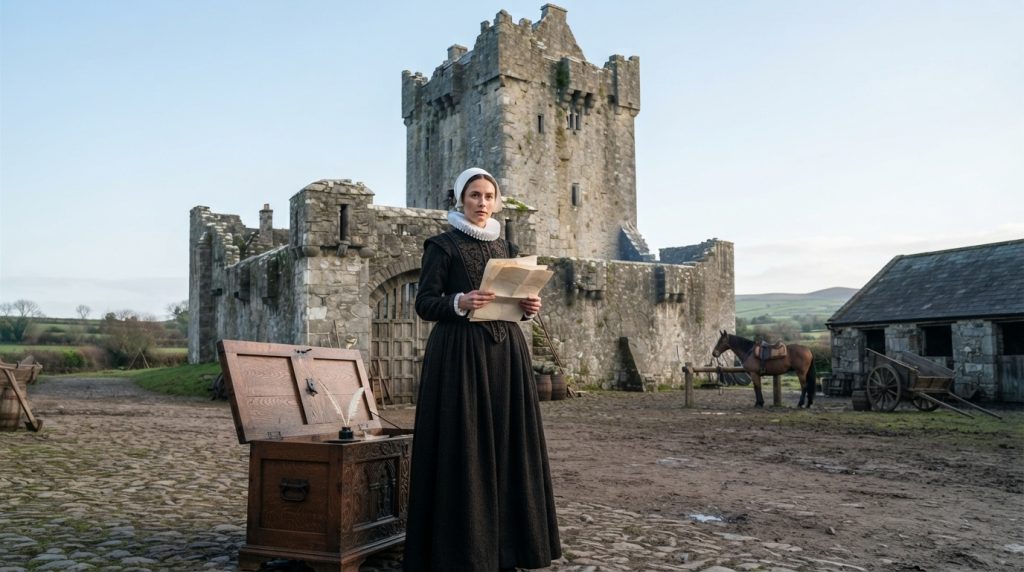
Lady Elizabeth Dowdall’s place in Limerick history was shaped partly by a literary inheritance. Her mother, Anne Southwell, was a poet whose surviving manuscripts contain verse, letters, theological reflections and other writings. Elizabeth later became associated with Kilfinny Castle in County Limerick, where her own account of rebellion would preserve a woman’s perspective on violence and command. The connection between mother and daughter is therefore more than genealogical. It links two generations of women who used manuscript writing to record thought and experience, although their subjects differed and Elizabeth’s surviving work emerged from immediate danger rather than sustained literary activity.
Anne Southwell belonged to the manuscript culture of the late sixteenth and early seventeenth centuries, when many poems and reflections circulated privately rather than through print. Her commonplace book gathered sonnets, religious verse, political material, letters, inventories and notes in several hands. Much of her poetry considered theological questions, revealing an educated woman engaged with scripture, conscience and literary form. One important volume is preserved as Folger Shakespeare Library Manuscript V.b.198, while related writing survives in the British Library. These documents show the intellectual environment surrounding Elizabeth before the Southwell family established itself in Ireland following Sir Thomas Southwell’s advancement.
Elizabeth was born in England during the 1590s, the daughter of Sir Thomas Southwell and Anne Southwell. Sir Thomas was knighted in 1603, and the family later moved to County Cork. After his death in 1626, Anne returned to England, while Elizabeth remained in Ireland and married Sir John Dowdall. Their household became centred upon Kilfinny in County Limerick. Elizabeth and John had five daughters: Anne, Elizabeth, Jane, Bridget and Honora. Although surviving evidence does not establish that Anne directly trained Elizabeth as a writer, the family connection places Elizabeth within a household where women’s manuscript composition was already familiar.
That inheritance acquired importance when rebellion transformed Elizabeth’s Limerick life. Unlike her mother’s varied poetic and devotional writings, Elizabeth is credited only with accounts of Kilfinny Castle’s defence. Her deposition was written by a scribe and signed by her, while a narrative produced three days later survives in her own handwriting. The difference in genre reflects the change in circumstances between generations. Anne assembled and revised texts across many subjects; Elizabeth wrote to document loss, accusation, resistance and leadership. Yet both depended upon manuscript preservation, allowing female voices to survive beyond households that might otherwise have left little written testimony.
The Southwell connection broadens Elizabeth Dowdall’s legacy beyond the familiar image of a castle defender. It places her within a female literary lineage extending from English manuscript culture into seventeenth-century Limerick. None of Elizabeth’s five daughters is known to have followed either their mother or grandmother into writing, making the surviving works of Anne and Elizabeth more striking. Their manuscripts differ in purpose, scale and style, but together they demonstrate how women recorded theology, family affairs, political disturbance and personal authority. For Limerick history, Elizabeth’s writing was not an isolated curiosity: it belonged to a wider inherited culture of words.
Primary Sources
- Anne Southwell and Henry Sibthorpe, The workes of the Lady Ann Southwell, manuscript commonplace book assembled principally between 1626 and 1636, Folger Shakespeare Library, MS V.b.198.
- Manuscript writings attributed to Anne Southwell, British Library, Lansdowne MS 740, folios 143r–155r.
- Dame Elizabeth Dowdall, sworn deposition concerning Kilfinny Castle and losses during the rebellion, 3 October 1642, Trinity College Dublin, 1641 Depositions, IE TCD MS 829, folios 138r–139v, identifier 829138r082.
- Lady Elizabeth Dowdall, handwritten first-person narration of her defence of Kilfeney Castle, County Limerick, 1642. Original manuscript location and archival reference require further verification.
- Parish register of St Clement Danes, London, marriage entry for Thomas Southwell and Anne Harris, 24 June 1594. Precise archival reference requires further verification.