Brian’s Death(c.1010s)

Brian Boru died at the Battle of Clontarf on Good Friday, 23 April 1014, in one of Irish history’s most famous episodes. The king of Munster and high-king of Ireland had spent decades building unprecedented political supremacy. Yet his greatest military victory ended in personal catastrophe. By nightfall his enemies had been defeated, but Brian himself, his son Murchad, his grandson Tairdelbach, his nephew Conaing and many supporters were dead. Victory came at a cost so severe that Brian’s political order would not survive.
Brian was probably in his seventies when the armies gathered outside Dublin. He had risen from the Dál Cais dynasty of north Munster, becoming king of Munster and extending his authority through warfare, alliances and political calculation. By the early eleventh century he had forced the powerful Uí Néill king Máel Sechnaill mac Domnaill to acknowledge his supremacy. The Book of Armagh described Brian during his lifetime in language equivalent to “Emperor of the Irish,” indicating his extraordinary status.
The crisis that produced Clontarf began when Máel Mórda, king of Leinster, rebelled against Brian’s authority. Máel Mórda was connected with Dublin’s Norse rulers and with Brian through marriage alliances. Sitriuc Silkbeard, king of Dublin, became one of the principal figures opposing Brian. Reinforcements came from the Scandinavian world, including warriors from the Orkneys and Irish Sea. Brian answered by assembling forces from Munster and allied territories. The struggle was therefore not simply “Irish against Vikings.” Irish and Norse warriors fought on both sides.
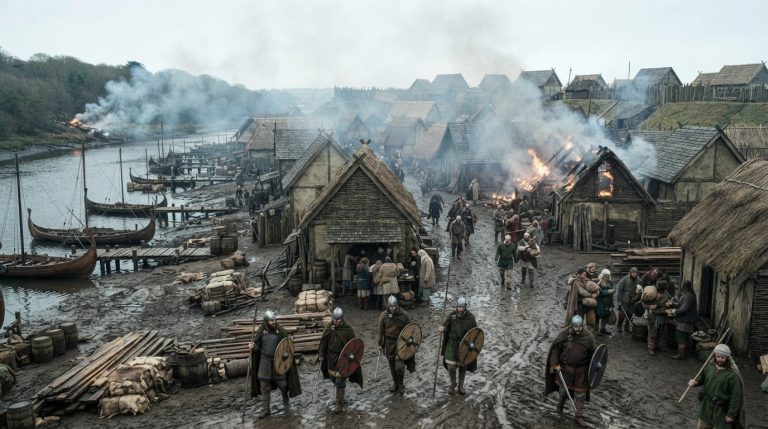
The battle took place on Good Friday, 23 April 1014, probably north of the River Liffey near Clontarf and the mouth of the Tolka. Medieval annals portray the fighting as an extraordinary slaughter. Brian’s army eventually gained the advantage, and the forces of Leinster and their Norse allies were routed. Many fleeing warriors were killed or drowned trying to reach ships near Dublin Bay. Among the dead were Máel Mórda of Leinster and Sigurðr, earl of Orkney. Brian’s army had achieved a decisive battlefield victory.
Brian himself apparently did not take an active part in the fighting. Early tradition places him behind the battle lines, praying in his tent or enclosure while younger commanders led the army. This became central to Brian’s legend: the aged Christian king kneeling in prayer while his followers fought a Good Friday battle. Although later writers embellished the scene, the tradition that Brian was killed away from the main fighting is an old one.
The identity of Brian’s killer is less certain than popular tradition suggests. Later Irish and Norse narratives name a Viking leader usually called Brodir or Brodar. In these accounts Brodir, fleeing from the defeated army, discovered Brian in his tent and killed him. Some versions describe Brian being struck with a sword; others are more dramatic. Norse saga tradition transformed the killing into a legendary episode in which Brodir subsequently suffered a terrible death at the hands of Brian’s followers. These narratives were written long after 1014 and combine history with storytelling.
What can be stated with greater confidence is that Brian was killed during or immediately after the battle, most probably while separated from the main body of his army. The Annals of Ulster, among the most important sources, record Brian’s death and praise him in exceptional terms. Later texts, especially Cogadh Gáedhel re Gallaibh, turned his last hours into a heroic Christian martyr narrative. Because the battle fell on Good Friday, writers could compare Brian’s sacrifice with Christ’s death, portraying the king as one who gave his life for his people.
The tragedy extended through Brian’s family. His son Murchad died in the fighting. Murchad’s young son Tairdelbach was also killed, traditionally said to have drowned while pursuing the enemy. Brian’s nephew Conaing fell as well. The destruction of several generations of the ruling family at once was politically disastrous. Had Brian or Murchad survived, the Dál Cais might have had a stronger chance of preserving the political structure Brian had created. Instead, the succession became fragmented.
After the battle, Brian’s remains were treated with honour. His body was carried north. The funeral party travelled through Swords and was received by clergy connected with Armagh. Brian had cultivated a close relationship with the church of Armagh and his burial there carried religious and political significance. The dead king was reportedly buried with solemn ceremony, reinforcing the image of a ruler whose authority had extended far beyond Munster.
Yet Clontarf did not bring Viking Ireland to an end. Dublin remained a Norse-Gaelic city, and Sitriuc continued to rule there after the battle. Norse communities were already deeply integrated into Irish political, commercial and cultural life. The conflict was a struggle over kingship, tribute, regional independence and control of Dublin as much as a clash between ethnic groups. Brian’s enemies included Irish rulers, while his own alliances crossed cultural boundaries.
Brian’s death marks both the height and collapse of an extraordinary experiment in Irish kingship. He had come closer than any earlier ruler to establishing effective supremacy over the island, but his system depended heavily upon his military reputation, personal alliances and ability to compel rival kings into submission. When he died, no successor possessed the same authority. Máel Sechnaill returned to the high-kingship, while Brian’s descendants remained powerful in Munster but could not immediately recreate his island-wide dominance.
Over the centuries, the historical Brian gradually became the legendary Brian Boru: warrior king, defender of Ireland, destroyer of Viking power and martyr of Clontarf. The reality was more complicated, but perhaps more remarkable. He was an ambitious medieval ruler operating within a web of Irish and Scandinavian kingdoms, marriages, rivalries and alliances. His final victory destroyed the coalition that had challenged him, yet it also destroyed much of the leadership that might have preserved his achievement. On 23 April 1014, Brian Boru won his last battle and lost his life. That contradiction—triumph and catastrophe on the same day—has ensured that his death at Clontarf remains one of the defining moments of medieval Irish history.
Primary Sources
- The Annals of Ulster, AD 1014 — one of the most important surviving accounts. It records the battle, Brian’s death, Murchad and Tairdelbach’s deaths, the killing of Brian by Brotor, and Brian’s subsequent burial at Armagh. (CELT)
- The Annals of Inisfallen, AD 1014 — particularly valuable because of its Munster perspective. It records Brian’s campaign, his death and the deaths of members of his family and leading supporters. (CELT)
- Chronicon Scotorum, AD 1014 — gives an important account of Clontarf and identifies Brian as over-king of Ireland, the foreigners and the Britons. (CELT)
- Annals of the Four Masters, AD 1014 — a much later compilation, but one drawing upon earlier annalistic material and useful for comparing traditions surrounding the battle. (CELT)
- Cogadh Gáedhel re Gallaibh — The War of the Irish with the Foreigners — the great medieval narrative associated with Brian Boru. Extremely important, but it must be used carefully because it presents a highly heroic and politically motivated account of Brian. (National Library of Ireland Catalogue)
- James Henthorn Todd, ed. and trans., Cogadh Gaedhel re Gallaibh: The War of the Gaedhil with the Gaill (London, 1867) — the classic published Irish-text-and-English-translation edition. (National Library of Ireland Catalogue)
- The Book of Leinster — preserves important medieval material connected with the Cogadh tradition and the development of the Brian Boru narrative. (CELT)
- The Book of Armagh — especially important for Brian’s status during his lifetime. An inscription associated with his visit to Armagh in 1005 describes him as Imperator Scotorum, generally translated as “Emperor of the Gaels.” (Trinity College Dublin)
- Leabhar Oiris — contains another Irish narrative tradition concerning Clontarf and is useful for tracing how the story of the battle developed. (CELT)
- Njáls Saga (Brennu-Njáls saga) — Icelandic saga containing the Scandinavian tradition of Clontarf, including Brodir, Sigurd of Orkney and supernatural elements associated with the battle. It is valuable comparatively but was written considerably later than 1014.
- Orkneyinga Saga — provides important Norse tradition concerning Earl Sigurd of Orkney and Scandinavian participation in the Irish Sea world surrounding Clontarf.
- Seán Duffy, Brian Boru and the Battle of Clontarf (Gill & Macmillan, 2013) — one of the principal modern scholarly studies of Brian, his rise to power and the meaning of Clontarf. (Genealogical Society of Ireland)
- Darren McGettigan, The Battle of Clontarf: Good Friday 1014 (Four Courts Press, 2013) — a detailed modern reconstruction of the political background, participants and battle itself. (Genealogical Society of Ireland)
- Trinity College Dublin, “The Battle of Clontarf: The Combat” — scholarly overview drawing upon Trinity’s medieval manuscript collection and the surviving annals. (Trinity College Dublin)
- Trinity College Dublin, “Brian’s Funeral and Legacy” — particularly useful for Brian’s body being taken to Swords and then Armagh for burial. (Trinity College Dublin)
- Trinity College Dublin, “The World of Brian Boru” — provides historical background on Dál Cais, Viking Ireland, Limerick and Brian’s rise to power. (Trinity College Dublin)
- Trinity College Dublin, Clontarf 1014–2014 Conference material — useful scholarly material concerning the surviving manuscript evidence and modern reassessment of the battle. (Trinity College Dublin)
- Seán Duffy, “Brian Boru — Rewriting the History of Ireland’s Greatest High-King,” Trinity College Dublin — discusses the historiography of Brian, the Vikings and the creation of the later Brian Boru legend. (TARA)
- History Ireland, Vol. 22, No. 2, March/April 2014 — a special issue containing scholarly articles on Brian’s origins, Clontarf, the Book of Armagh, Brian’s political legacy and the mythology surrounding him. (JSTOR)
- University College Cork, CELT — Corpus of Electronic Texts — the most useful online scholarly repository for consulting the Irish annals themselves, including the Annals of Ulster, Annals of Inisfallen and Chronicon Scotorum. (CELT)