Editorial — Sliab Tuath
Welcome to the Emerald Archives Gazette. In today’s issue we look back at the latest additions to the archive. Saint Ita of Killeedy — Saint Ita, also known as Ita of Killeedy, remains one of the most venerated figures in early Irish Christianity. Born in County Waterford during the sixth century, tradition identifies her as the daughter of Cenn-fáelad of the Déissi, suggesting she originated from a noble background. Her life is characterised by a transition from her native Waterford to the plains of Limerick, where she established a lasting spiritual legacy.
Dateline
The Day in Irish History
Welcome to the Emerald Archives Gazette. In today’s issue we look back at the latest additions to the archive.
Saint Ita of Killeedy — Saint Ita, also known as Ita of Killeedy, remains one of the most venerated figures in early Irish Christianity. Born in County Waterford during the sixth century, tradition identifies her as the daughter of Cenn-fáelad of the Déissi, suggesting she originated from a noble background. Her life is characterised by a transition from her native Waterford to the plains of Limerick, where she established a lasting spiritual legacy. Religious Foundation Ita is most renowned for founding a significant church and school at Killeedy in West Limerick. The location, known in Irish as Cell Ídde, literally translates to the church of…
Earthquake Notices — Year ScopeThe surviving notices for 619 CE are brief and uneven, but they are not empty. Across the excerpts, the year is represented by deaths, a destruction notice, and an earthquake, rather than by a connected narrative. The safest reading stays close to the wording of each annal and resists turning the material into a fuller account than the passages allow.The witnesses also show that chronology must be handled separately for each annal. Inisfallen and Ulster place material under their 619 entries, while Tigernach places some comparable notices under T618 and others in its T619 sequence. That visible mismatch matters,…
Record Traces — Record ContextThe visible material places Johanna Leonard within a research setting rather than within a completed biographical narrative. One source is a large women’s-history index, another is an edited annals corpus with manuscript description, and a third is a family-history page that gathers local names and memorial notes. Taken together, these excerpts show three different kinds of record. In the passages shown, however, no direct biographical statement for Johanna Leonard appears.The women’s-history database presents itself as a searchable index with many repository entries, while the annals edition identifies manuscript witnesses and editorial decisions. The family-history page, by contrast, mixes poem…
Saint Gobnait — Early LifeSaint Gobnait is a figure of significant devotion within the religious landscape of Ireland, particularly within the county of Cork. While her precise historical origins are shrouded in the passage of time, tradition suggests she may have lived during the seventh century. Because her life is documented primarily through hagiography and local lore rather than contemporary administrative records, the specific dates of her birth and death remain uncertain. She is traditionally remembered as a woman of spiritual strength and leadership, eventually establishing herself as a focal point of monastic life in the region of Ballyvourney.Monastic FoundationAccording to tradition, Saint…
Eilenn Conflict — Year FrameThe annal compilers mark 618 CE as a distinct year inside their own chronological sequences. In the Annals of Ulster, the year opens with the Kalends of January and then gives notices under U618. Tigernach and Chronicon Scotorum also place their material under annual headings. That shared framing lets the year be identified securely, but it does not authorize adding events that the entries do not actually name.The year headings also show that 618 is part of a continuing sequence rather than a stand-alone story. Ulster’s notices are arranged after earlier annual items and then continue into later ones,…
Bangor Burning — Year MarkersThe surviving notices for 617 CE are brief and uneven. In the Annals of Inisfallen, the year is represented by the burning of Bennchor of Ulaid and by associated death notices. In Chronicon Scotorum, the year opens with the burning of Donnán of Aig on 17 April, the laying waste of Torach, and a death notice for Fergus son of Colmán Mór. The excerpts preserve only these named entries.The year is also visible through cross-reference, but not in a single uniform pattern. One Inisfallen notice for Bennchor points to AU 616, while the separate Donnán notice is cross-referenced to…
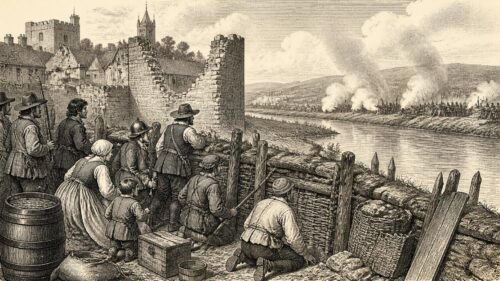
Armagh Ravaging — Year FrameThe surviving annalistic evidence for 616 CE is brief, but it is not empty. In Tigernach the year is entered as a cluster of deaths, a murder, the ravaging of Armagh, and an earthquake in Gaul. The format is plainly enumerative: the notices stand together without connective explanation, and the text gives no narrative sequence that would let the reader reconstruct cause, order, or relationship among the separate items.Other annals place nearby material in different ways. Inisfallen assigns the battle of Sliab Tuath to 616 and notes that Suibne reigned after Mael Coba's fall. The Four Masters place the…
Storm Floods — Weather NoticesThe annalistic notices are extremely compressed. One entry records a rainy summer, followed immediately by a great sea-flood in October, while another gives violent thunder and wind and lightning on the eve of Saint Patrick's day, with many deaths. The language is bare and cumulative: weather condition first, then effect. These notices do not pause to explain causes, and they do not elaborate on duration beyond the season or the night named.A different pattern appears in the entry that calls the year a storm of great war in Ireland. The wording places the storm image beside political and clerical…
Irish Regulation — Legal FrameworkOfficial Irish guidance places AI regulation within a wider legal setting shaped by the EU AI Act and data protection law. The AI Office of Ireland says it coordinates implementation of the EU AI Act, while departmental material explains that GDPR applies across the European Union and that Ireland has enacted the Data Protection Act 2018. In these materials, AI oversight is presented as part of a broader compliance environment rather than as a standalone regime. The same materials also show how ordinary public administration and private-sector use are both brought into view. The AI Office describes support for…
Beef Passage — Trade AccessIn June 2018, six meat processing plants in Ireland were approved by Chinese authorities to begin exporting frozen products to the Chinese market. The approval list included three beef plants in Tipperary, Meath, and Cork, together with three pork plants in Tipperary, Laois, and Cavan. The same notice says that the total number of Irish meat producers approved for beef and pork exports to China then rose to thirteen. That marks the clearest documented opening in this sequence.A different account of the same period says that Ireland was the first beef-producing country in the European Union to regain access…
Memory Making — Private PapersOne institutional description presents UCD Archives as a place that acquires private paper collections associated with the history and development of the modern Irish state. It also says these holdings are complemented by papers of public figures, staff who served in high public office, and records of political parties, trade unions, professional bodies, cultural associations, and sporting bodies. The passage is a broad catalogue rather than a narrative, but it clearly places private papers within a wider documentary setting for research.The same page gives a specific exhibition example. It lists a diary of a civil servant, Ernie O’Malley’s interview…
Donnán’s Martyrdom — Year MarkersThe surviving record for 615 must begin with chronology, because the relevant annals do not present the year in exactly the same way. In the Annals of Ulster, the notices grouped here appear after a heading that reads AD 614, followed by the year marker and then the brief entries. In the Annals of Tigernach, the comparable material appears under T615. The difference is plain in the text and requires caution in any modern summary.That caution is strengthened by Inisfallen, which does not simply repeat the same wording but cross-references the battle of Sliab Tuath to AU 615. Its…
Institutional Apology — State ResponseOn 11 May 1999 the Taoiseach issued an apology on behalf of the State and its citizens to victims of child abuse. The report states that he made the apology while announcing a package of measures intended to address the issue. The same account says the Government described the apology as sincere and long overdue, and that the statement was tied directly to the announcement of a Commission to inquire into child abuse.A later RTÉ archive summary repeats the apology in similar terms but places it more explicitly within institutional child abuse. It says the Taoiseach apologized on behalf…
Migration Opinion — Press FramingA study of Irish newspaper discourse on immigration says the Irish Times was used as the source base for opinion and editorial writing between 1996 and 2004. The abstract states that the analysis examined how Irish national identity was constructed against demographic, social, and economic change brought by immigration. It also identifies two recurring cultural resources, a historical duty argument and the myth of Saint Patrick, as part of the newspaper’s treatment of immigration.The same abstract says one might have expected an exclusive ethnic response because of Ireland’s emigration experience, imperial involvement, and treatment of indigenous minorities. Instead, it…
Irish Journalism — Collection ScopeThe National Library of Ireland describes its newspaper holdings as the largest in the country, with coverage extending from the late seventeenth century to the present day. It also states that it collects national, regional, Northern Irish, and selected international newspapers of Irish interest, while aiming to be as comprehensive as possible. That description presents Irish journalism as something preserved through a broad and continuing collecting policy rather than through a single title or period.The same institution explains that titles may be searched in its online catalogue and consulted in microfilm or digital form in reading rooms, with hard…
Minimum Wages — Legal FrameworkThe National Minimum Wage Act 2000 created a formal statutory scheme rather than a single wage figure alone. Its contents show parts on interpretation, non-application, and the voiding of agreements that pay less than the national minimum hourly rate. The Act also set out working hours, pay reference periods, records, and dispute procedures, indicating a system built for calculation, enforcement, and challenge rather than a simple declaration of pay. [2]The same Act also provided for entitlement, sub-minimum rates, and procedures for enforcement. Its table of contents includes minimum hourly entitlement, lower rates during the first two years after entering…
Omagh Justice — Town BombingThe records place the bombing in Omagh on 15 August 1998 and describe it as a car bomb that killed 29 people and injured more than 200. One account gives the time as 3.04 pm, while another notes that local health and social care services mobilised a comprehensive response. The same set of passages presents the event as occurring seven weeks after the Good Friday Agreement was endorsed, fixing it within that immediate post-agreement moment.A museum account adds details of the victims by name and age and notes that a Spanish exchange group had visited the Ulster American Folk…
Bennchor Ablaze — Year BoundsThe evidence for 614 CE is narrow, and the surviving notices do not create a continuous narrative. In one annalistic sequence, the year marker for 614 is followed only by the burning of Bennchor. In another tradition, a 614 entry concerns a battle in Britain. A fragmentary sequence also places a star sighting under 614. These notices are separate, brief, and differently framed, so any account of the year has to stay close to each entry’s own wording.The immediate surrounding years help define the limits of the record, but they do not enlarge 614 itself. In the same Tigernach…
Rent Security — Land CustomThe earliest legal frame visible here treats tenant security as a matter of custom and compensation. The Landlord and Tenant (Ireland) Act 1870 declares the Ulster tenant-right custom legal and extends similar treatment to other usages that correspond in essential particulars. Where a tenant is disturbed by the landlord, the act allows compensation, while deductions may still be made for rent and certain other sums. Security therefore appears as a regulated right, not as an absolute possession.The same act distinguishes between holdings within and outside Ulster, but it uses parallel language in both cases: recognised custom, court enforcement, and…
Galway Ringroad — Project SettingOfficial notices describe the N6 Galway City Ring Road as a major transport project for Galway City and County. In April 2026, Galway City Council reported that Galway County Council, Galway City Council, and Transport Infrastructure Ireland welcomed approval from An Coimisiún Pleanála. The same notice places the scheme inside a wider transport solution for the city and county, alongside BusConnects, rail enhancements, active travel, and other initiatives under the Galway Transport Strategy.The same update states that the project had already been through a prolonged planning process and that this had been difficult for home and property owners affected…
Legacy Law — Commission Design — Statute ScopeThe 2023 Act defines the Troubles as events and conduct related to Northern Ireland affairs occurring between 1 January 1966 and 10 April 1998. It also includes conduct connected with preventing, investigating, or dealing with the consequences of other Northern Ireland-related events during that span. The same section defines Troubles-related offences and distinguishes serious offences by reference to murder, manslaughter, culpable homicide, death-causing conduct, and other bodily harm categories.The statutory preamble states that the Act is meant to address the legacy of the Troubles and promote reconciliation through a new commission, limits on criminal investigations, legal proceedings, inquests, and…
Connolly Records — Chronology OutlineThe chronology presents James Connolly as a figure whose life can be traced in dated milestones rather than in extended commentary. It records his birth in Edinburgh, early employment at printing works, and later military service with the Royal Scots Regiment. It also notes his marriage, his move to Dublin for paid socialist organizing, and the publication of Erin's Hope. The sequence is compact and factual, giving names, places, and years without interpretive framing.Later entries show a continuing movement between politics, writing, and travel. Connolly is recorded as taking part in a demonstration commemorating 1798, being arrested, and then…
Patrick Address — Patrician VoiceThe Confession opens with Patrick identifying himself in humble terms and placing his early life in captivity. He says he was about sixteen when he was taken to Ireland and that he did not know the true God at that time. The passage also links his later writing to remembrance and praise rather than display. His voice is personal, retrospective, and restrained, with authority grounded in what he says happened to him and how he later understood it.The same opening sequence moves from personal loss to a declaration of obligation. Patrick says he cannot remain silent about the benefits…
Mael Coba’s Defeat — Year NoticeThe notices linked to 613 CE are brief and strictly annalistic. In one Irish chronicle, the year is introduced with a calendar heading and then records the death of Mael Coba son of Aed in the battle of Toa with the Luighne, followed by the statement that Suibne Menn killed him. The same entry also notes the rest of Diarmaid, third abbot of Clonard, and the battle of Fidnach. Sources 2 and 1 preserve parallel year-marked material, but only the explicit 613 notices belong securely to that year.A second chronicle, in contrast, places 613 among a sequence of short…
Mercosur Farming — Trade TimelineThe EU’s Mercosur file shows a clear sequence. The European Union and four Mercosur countries reached a political agreement on 6 December 2024, the Commission later proposed signature and conclusion of parallel legal instruments on 3 September 2025, and the Council authorised signature on 9 January 2026. The EU and Mercosur signed the partnership agreement and interim trade agreement on 17 January 2026, with provisional application of the interim agreement from 1 May 2026.The Commission’s own pages also distinguish between the partnership agreement and the interim trade agreement. They state that the interim trade agreement will be repealed and…
Living Costs — Official Inquiry — Official InquiryThe report was issued by the Ministry of Economic Affairs in Dublin in 1922 and printed by authority of the Stationery Office. Its preface says the Provisional Government had been told it was desirable to calculate an official figure for Ireland showing the change in the cost of living from 1914 to the present. It also says a committee was appointed on 10 June 1922, with representatives from Agriculture, Finance, Economic Affairs, and Labour. The report therefore records a formal state inquiry rather than a private estimate.The document gives a clear timeline for the work. It says the committee…
DEIS Policy — Policy OriginsThe records place DEIS within a sequence of state responses to educational disadvantage. A 2005 report says the Educational Disadvantage Committee had examined disadvantage in school and broader social contexts, and notes that many earlier recommendations were incorporated into the DEIS action plan for educational inclusion. It also says the report added to that plan by integrating school-based responses within a coordinated strategy for educational equality.The same report says its purpose was to inform future policy and actions on educational disadvantage by the Department of Education and Science, other government departments, state agencies, and the independent sector. The wording…
Private Trust — Private AsylumsThe clearest statement in these materials is that private asylums formed part of a wider Irish mental health system in the nineteenth century. One account places their expansion in the period 1820 to 1860 and says the network served a distinct socioeconomic cohort. It also notes that the 1842 Private Asylums Act was the first law directed specifically at the system, giving licensing and regulation a formal place in the record.The same source says historians had largely focused on the pauper insane, while this study shifted attention to private patients. It further states that private institutions catered primarily for…
Saint Colman of Cloyne — Colmán of Cloyne, also known as Colmán mac Léníne, was a sixth-century monk and the founder of the monastic settlement of Cluain Uama, which is the modern town of Cloyne in County Cork. While historical records from the early medieval period are often sparse, Colmán is recognised as an important figure in the early Irish church and is the patron saint of the Diocese of Cloyne. His life and work bridge the transition from the secular courts of Munster to the establishment of enduring ecclesiastical centres in East Cork. Early Life The dates of Colmán's life vary across different sources,…
Saint Fintan of Clonenagh — Early FormationSaint Fintan of Clonenagh was a sixth-century monk born in the province of Leinster. His early religious development took place in Terryglass, County Tipperary, where he received formation under the guidance of the abbot Colum. This period of education was pivotal, as Colum was known for a rigorous Rule and stringent penitential practices. The severity of this discipline left a lasting impression on Fintan, shaping his personal spiritual outlook and his subsequent approach to monastic leadership. He internalised the virtues of asceticism and self-denial, which would later define the character of the community he established.Monastic FoundationFintan eventually founded his…
OConnell Commemorations — Library CommemorationThe National Library of Ireland presents Daniel OConnell through a commemorative framework tied to the 250th anniversary of his birth. Its notice names him as a major political figure and states that a commemorative programme was launched to mark that anniversary. The same notice also says the library invites the public to rediscover his life and legacy through its collections, linking commemoration to access rather than to a single display item.The Irish-language version repeats the same commemorative framing and confirms that the programme is connected to the 250th anniversary of OConnell’s birth. It also describes his campaigns for Catholic…
Traveller Recognition — Archive ContextThe evidence places Traveller recognition inside institutional description rather than a single legal moment. One university collection is presented as a resource on Irish Travelling People and says it covers the community’s way of life, values, and customs. Another archive describes itself as a growing collection focused on Irish Travellers and on the social changes from the 1960s onward. These records show recognition through cataloguing, subject selection, and naming practices rather than through one uniform definition.The same institutional pages also show that Traveller-related holdings are mixed in date and form. Ulster University says its collection includes books, pamphlets, newspaper…
Irish Making — Craft MaterialsMuseum descriptions of Irish craft stress that everyday objects were often made by hand from locally available materials. In that account, householders could make baskets, wooden furniture, and clay vessels, and similar objects varied by region in both material and design. The differences are attributed to available materials, maker skill, and local traditions. The emphasis is practical rather than ornamental, although the objects could still be beautiful in form. The same description says traditional craft workers usually relied on skill and accuracy developed through apprenticeship and experience, rather than written measurements or patterns. It also notes that their skills…
Annalistic Arthur — Archive ScopeThe digital archive of Irish annals brings together several medieval historical texts in translation. One project description states that these annals record events in medieval Ireland across a span running from pre-history into the seventeenth century, and that they preserve many thousands of events. The same description says the archive includes entries from the Annals of Ulster for 603 to 604 CE, showing a very narrow excerpt from a much larger textual field.The surrounding catalogue also shows that the CELT list groups annalistic texts among historical, legal, and genealogical works. It names the Annals of Ulster, Tigernach, Inisfallen, the…
Coastguard Structures — Archive ContextThe archival material places coast guard infrastructure inside a broader public works record. The National Archives description of the Office of Public Works collections says the archive runs back to 1831 and includes records on harbours, civil buildings, and working papers. It also identifies a Coastguard Stations category within OPW secretarial records, showing that coast guard buildings were documented alongside roads, piers, harbours, and other infrastructure in the same administrative corpus.The same guide also shows that coast guard material sits among multiple record forms. It mentions correspondence, reports, plans, and engineered drawings, and it lists a series devoted to…
Labour Rights — Labour ClaimsConnolly repeatedly treated labour as a subject that history had neglected. In Labour in Irish History he says labour should be central to the record of the past, and he links his purpose to the position of Irish workers, their wrongs, and the lessons drawn from them. He also states that Irish history has often been written from the standpoint of the master class, not workers. That is his declared frame, rather than a neutral summary.The same opening argument sets labour rights within a longer Irish setting. Connolly says Ireland had long been under English control, that before 1649…
Cathedral Sites — Churches SitesThe evidence available here frames cathedral history through churches, sees, and texts rather than through a single architectural definition. One historical summary of Irish church history lists annals, saints' lives, and other chronicles among its sources, and a modern university page identifies CELT as a major digital resource for Irish studies. Together, these passages show that work on cathedral sites relies on a broad textual base, even though they do not name any one building as a cathedral.A separate scholarly note says research on three churches, including Temple Kelly and Temple Ciarán, is based primarily on documentary sources rather…
French Ireland — French ContextThe evidence places Ireland’s French connection within a wider late eighteenth-century effort by the French Directory to destabilize British rule and support unrest in Ireland. One account states that the Directory made numerous plans to send landing parties to the British Isles and that, with encouragement from Wolfe Tone and the United Irishmen, it agreed to an invasion of Ireland to assist a general uprising. Another source preserves instructions addressed to Ireland with explicit calls to rise and rally around French forces.The surviving passages do not describe a French revolution in Ireland as an abstract ideological event; instead, they…
Theobald Tone — Early LifeThe surviving descriptions place Theobald Wolfe Tone in Dublin at birth, on 20 June 1763, and identify him as a United Irishman, political publicist, diarist, and French army officer. They also state that he was born at 27 St Bride's Street, near Dublin Castle, and that his family soon moved to Stafford Street, later renamed Wolfe Tone Street. One account adds that he came from a modest Protestant middle-class family and was the eldest of sixteen children.The same record says he studied law at Trinity College Dublin and graduated in 1786 before turning toward politics. A separate Trinity College…
Thank you for reading today’s Gazette. Follow any of the links above to read the full article and explore its sources.