
Woodland Resources(c.1000s)

No surviving Irish chronicle records an event occurring specifically on 13 March 1000. The annals describe deaths, campaigns and political changes during that year, but they cannot be securely assigned to this day. A historically grounded view of Ireland in early spring can instead examine its woodlands. Trees and managed woodland supplied fuel, building material, tools, food and shelter, making them essential to rural settlements, monasteries, royal residences and coastal towns.
Ireland in the year 1000 was neither entirely forested nor largely treeless. Centuries of farming had created a complex landscape of cultivated fields, pasture, bog, scrub, managed woodland and surviving forest. The balance differed considerably between regions. Productive lowlands around long-established settlements had often been cleared, while extensive woodland remained in less accessible districts, on steep ground and along territorial boundaries.
Woodland was economically valuable and legally protected. Early Irish law distinguished different categories of trees and assigned compensation according to their usefulness and status. Unauthorised cutting could result in a substantial penalty, especially when a mature tree supplied fruit, timber or other valuable products. These rules demonstrate that trees were recognised as property and productive resources rather than treated as an unlimited wilderness available to everyone.
The legal tract Bretha Comaithchesa classified important trees traditionally described as the nobles of the wood. Oak, hazel, holly, yew, ash, Scots pine and apple were included because of their practical or symbolic value. Other groups contained common and lower-ranking trees and shrubs. The classifications were legal arrangements rather than a modern scientific system, but they reveal close observation of the qualities and economic uses of different species.
Oak supplied exceptionally strong timber for buildings, doors, vessels and heavy structural work. Its durability made mature oak particularly valuable, although shaping it required good tools and considerable labour. Oak woodland also produced acorns upon which pigs could feed. The right to release animals into woodland during the mast season could therefore be economically important. A forest offered not only timber but a renewable source of food converted into pork.
Ash combined strength with flexibility and was suitable for tool handles, spear shafts, agricultural implements and components subjected to repeated strain. Hazel provided straight rods for wattle walls, fences, baskets and fish traps. Its nuts supplied valuable autumn food that could be gathered and stored. Willow and alder flourished in damp ground and provided workable timber, rods, charcoal and materials suitable for structures near rivers or wetlands.
Yew was dense, durable and flexible, making it valuable for specialised wooden objects and bows. Holly supplied hard timber and evergreen foliage, while its presence could provide shelter. Apple trees produced food as well as timber. Birch bark, twigs and wood had numerous household uses. The diversity of available species allowed skilled workers to choose material according to the object being made rather than regarding all wood as interchangeable.
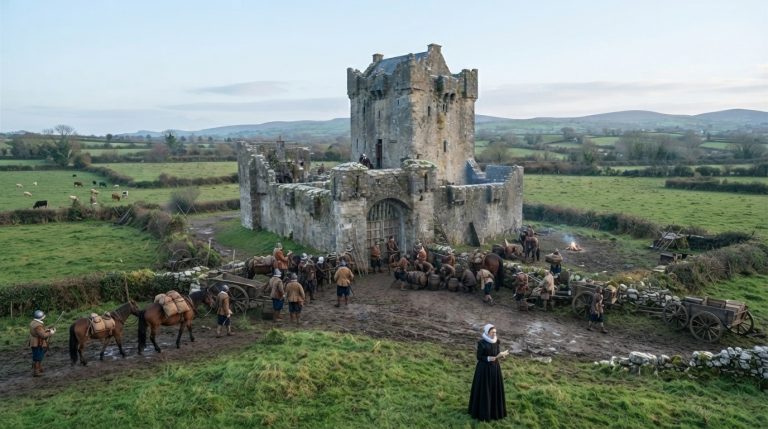
Most buildings were constructed principally from timber, wattle, earth and thatch. A ringfort might contain a substantial timber dwelling surrounded by smaller structures, fences and livestock enclosures. Upright posts carried roofs, while woven hazel rods could be coated with clay to create walls. Such buildings required maintenance because posts decayed, thatch deteriorated and weather damaged exposed surfaces. Woodland management was therefore connected directly to the continued survival of a settlement.
Churches were not necessarily built of stone. Many early Irish ecclesiastical buildings were constructed from timber, and larger monastic settlements contained workshops, guesthouses, kitchens, barns and boundary structures requiring constant supplies. Even where a stone church existed, timber remained necessary for roofs, doors, scaffolding, furniture and fittings. Monasteries consequently needed recognised access to woods as carefully as they needed fields, mills and grazing land.
Firewood was among the most frequently consumed woodland products. Every household needed fuel for warmth, cooking, brewing, metalworking and light. Freshly cut timber burned poorly, so wood had to be collected, divided and seasoned where circumstances allowed. Fallen branches, coppiced rods, peat and charcoal supplemented large split logs. Demand increased during cold and wet weather, making the management of winter fuel supplies an essential household responsibility.
Charcoal was particularly important to craftspeople. It produced a concentrated and controllable heat useful for working iron and certain non-ferrous metals. Charcoal burning required carefully stacking wood and restricting the oxygen reaching it so that it carbonised rather than burning completely. The process consumed substantial quantities of timber. Smithing was therefore dependent upon woodland labour even when the forge itself stood within a settlement or trading town.
Woodworking demanded specialised knowledge. Felling a mature tree with iron axes was strenuous and potentially dangerous. The trunk then had to be trimmed, divided and transported. Craftspeople worked timber while considering its grain, seasoning and tendency to split. Axes, adzes, knives, drills and other tools transformed raw wood into houses, bowls, chests, looms, carts, agricultural equipment, boats and religious objects. Few areas of daily life were untouched by their work.
Coopers and vessel-makers produced containers for water, ale, grain, butter and other goods. Turners used lathes to create bowls, cups and handles. Carpenters constructed doors, roofs, mills and bridges. Wattle workers made walls, screens and fencing from flexible rods. Many farming households probably performed ordinary repairs themselves, while more demanding projects required experienced specialists. The quality of surviving archaeological woodwork shows that early medieval craftspeople could achieve considerable precision.
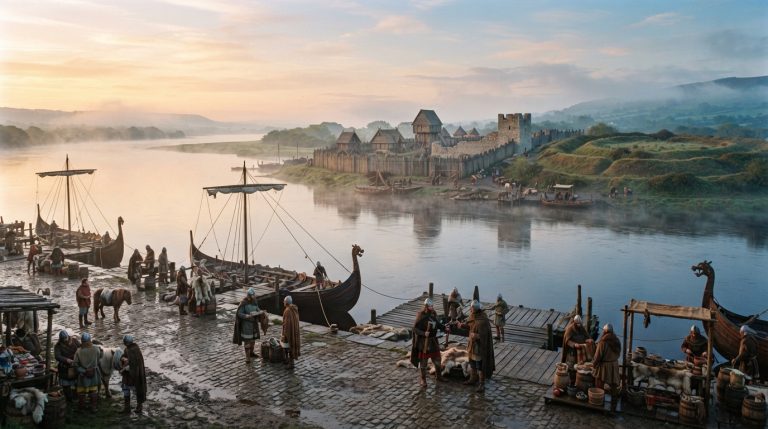
Boats placed especially heavy demands upon selected timber. Dugout canoes could be fashioned from large trunks, while more complex vessels required planks, framing and wooden fastenings. Hiberno-Norse shipbuilders in Dublin used Scandinavian and Irish traditions to construct and repair seagoing craft. Irish boats serving rivers, lakes and coasts also depended upon woodland resources. Maritime commerce was therefore linked to forests far beyond the harbour.
Woodland provided shelter and concealment as well as materials. Pigs, cattle and horses could use wooded ground, although uncontrolled grazing might prevent regeneration. Hunters pursued deer, wild boar and smaller animals where they survived. Birds, berries, fungi and medicinal plants widened the range of usable resources. These activities were regulated by property, rank and local custom; not everyone enjoyed an unrestricted right to hunt or cut timber.
Forests could influence warfare. Dense or boggy woodland restricted the movement of mounted troops and large armies, while providing concealment for smaller forces. Felled trees could obstruct routes, and timber was needed for shields, spear shafts, fortifications and temporary encampments. Campaigning armies also consumed firewood and damaged local resources. Political control of a territory consequently included access to its woods and the ability to protect them.
The exploitation of woodland did not always result in complete clearance. Coppicing allowed certain trees to produce repeated crops of rods and poles. Selective cutting preserved useful mature trees, while grazing and gathering could occur beneath the canopy. Nevertheless, expanding cultivation, construction, fuel consumption and shipbuilding placed pressure on accessible woods. The landscape surrounding major settlements was likely more intensively managed than remote forest.
On 13 March 1000, adult workers across Ireland would have been felling selected trees, gathering fuel, splitting timber and repairing winter-damaged buildings. Their labour rarely entered the chronicles, yet it sustained homes, churches, workshops, farms and fleets. Woodland was not merely scenery surrounding medieval society. It was a legally valued and carefully exploited foundation of Irish life.
Primary Sources
1. Annals of Ulster — medieval chronicle containing notices of settlements, churches, fleets, warfare and environmental conditions during the year 1000.
2. Annals of Inisfallen — Munster-centred annals preserving evidence for military activity, ecclesiastical settlements and territorial resources.
3. Chronicon Scotorum — annalistic compilation containing accounts of storms, warfare, fires and environmental disasters.
4. Annals of Tigernach — medieval chronicle recording settlement destruction, severe weather, campaigns and changing territorial control.
5. Annals of the Four Masters — later compilation drawing upon earlier sources and containing references to forests, timber structures and clearances.
6. Bretha Comaithchesa — early Irish legal tract concerning neighbourhood law and the classification, ownership and unlawful damage of trees.
7. Críth Gablach — early Irish status tract describing houses, agricultural equipment and property appropriate to different social ranks.
8. Uraicecht Becc — early Irish legal tract connecting honour-price with occupation, property and recognised social status.
9. Di Chetharslicht Athgabála — early Irish law of distraint, providing evidence for the enforcement of rights over valuable property.
10. Senchas Már — major corpus of early Irish law containing provisions governing land, trees, boundaries, damage and compensation.
11. Córus Bésgnai — early Irish tract addressing customary relationships among churches, communities and productive estates.
12. Collectio Canonum Hibernensis — Irish canonical collection containing material concerning church property, labour and natural resources.
13. Adomnán, Vita Columbae — seventh-century Life of Columba containing descriptions of timber buildings, boats, wooden objects and woodland journeys.
14. Tírechán, Collectanea — seventh-century Patrician traditions describing territories, churches, roads and grants of productive land.
15. Muirchú, Vita Sancti Patricii — seventh-century Life of Patrick containing accounts of journeys through the Irish landscape and the construction of churches.
16. The Rule of Saint Carthage — Irish monastic rule reflecting organised labour, maintenance and resource management within religious communities.
17. The Rule of Ailbe — medieval Irish monastic rule containing instructions concerning work, possessions and communal discipline.
18. Táin Bó Cúailnge — medieval Irish narrative preserving descriptions of forests, timber objects, chariots, weapons and travel through varied terrain.
19. Acallam na Senórach — later medieval narrative preserving extensive traditions concerning Irish woods, hunting grounds, routes and named landscapes.
20. Metrical Dindshenchas — medieval place-lore collection preserving cultural traditions associated with trees, forests, territories and natural landmarks.