Editorial — Elizabeth — Death
Welcome to the Emerald Archives Gazette. In today’s issue we look back at the latest additions to the archive. Ulster Plantation — In 1610, Ireland was not at peace in any simple or settled sense. The great war in Ulster had ended seven years earlier, the leading Gaelic earls had departed in 1607, and Sir Cahir O’Doherty’s rising had been suppressed in 1608. Yet the aftermath was still being made, surveyed, argued over and built into the landscape. Under James I and his lord deputy, Sir Arthur Chichester, the Crown turned confiscated land in the north into a planned political settlement: the Plantation of Ulster.
Dateline
The Day in Irish History
Welcome to the Emerald Archives Gazette. In today’s issue we look back at the latest additions to the archive.
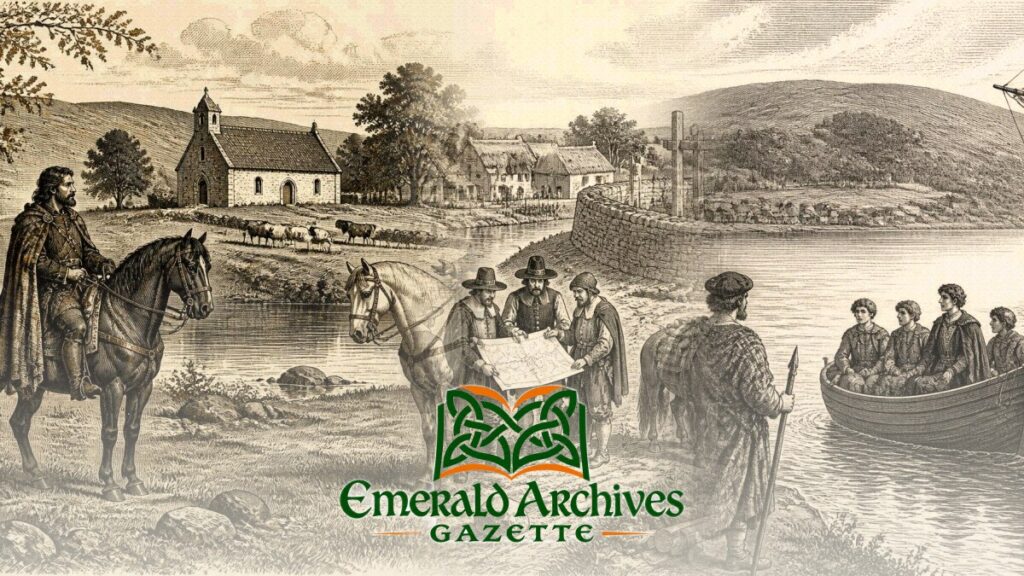
Ulster Plantation — In 1610, Ireland was not at peace in any simple or settled sense. The great war in Ulster had ended seven years earlier, the leading Gaelic earls had departed in 1607, and Sir Cahir O’Doherty’s rising had been suppressed in 1608. Yet the aftermath was still being made, surveyed, argued over and built into the landscape. Under James I and his lord deputy, Sir Arthur Chichester, the Crown turned confiscated land in the north into a planned political settlement: the Plantation of Ulster. In this year, the scheme moved decisively from paper design towards grants, settlers, fortified houses and new…
Bodley’s Survey — In 1609 the Irish kingdom did not experience a single decisive battle or a spectacular change of ruler. Instead, it underwent a quieter but exceptionally consequential exercise of state power: the measurement, classification and planned redistribution of much of Ulster. In the wake of the Flight of the Earls in 1607 and Sir Cahir O’Doherty’s rising in 1608, King James I’s government moved from military conquest towards a far-reaching scheme of colonisation. The year was principally one of planning, survey, legal preparation and coercive rearrangement. Its effects would reshape landholding, settlement, religion and political allegiance in the north for generations.A…
O’Doherty’s Rising — The most consequential Irish events of 1608 unfolded in Ulster, where an uprising led by Sir Cahir O’Doherty briefly overturned the Crown’s foothold at Derry and accelerated a far larger transformation of landholding and power. The year should not be treated simply as the beginning of the Ulster Plantation: the great organised settlement generally associated with that name was implemented later. But 1608 was the year in which rebellion, confiscatory investigation and administrative planning made a new colonial settlement appear practicable to government in Dublin and London.A Crown Ally Turned RebelCahir O’Doherty was not an obvious enemy of the English…
Earls’ Flight — In 1607, the most consequential Irish event was neither a battle nor a parliament but a departure. In September, Hugh O’Neill, earl of Tyrone, Ruaidhrí O’Donnell, earl of Tyrconnell, and Cúchonnacht Maguire of Fermanagh left Ulster for continental Europe with members of their families, households and following. Their journey from Rathmullan on Lough Swilly became known as the Flight of the Earls. It was not, however, the instant disappearance of Gaelic Ireland, nor did the later Plantation of Ulster begin that year. Rather, it exposed how precarious the settlement after the Nine Years’ War had become, and created the political…
Wicklow Shire — In 1606, the Irish kingdom was being remade less by one spectacular battle than by a series of administrative, legal and social interventions. Three years had passed since the end of the Nine Years’ War, but the settlement that followed remained insecure. Sir Arthur Chichester’s Dublin administration sought to make royal authority visible in places where it had been thin, contested or dependent on military force. A new county was set out in the Wicklow uplands; Scots began arriving in north Down under private landlords; courts travelled through Munster; Catholic townspeople met new pressure to attend Protestant worship; and Gaelic…
Chichester’s Proclamation — In 1605, Ireland was not at war in the manner it had been only two years earlier, but peace was neither simple nor settled. The Nine Years’ War had ended with the treaty at Mellifont in 1603, bringing the great Ulster lords, including Hugh O’Neill, earl of Tyrone, into formal submission to King James I. Yet the end of campaigning did not resolve the central question that faced the new Stuart regime: how could a crown that had conquered the island make its authority routine in communities accustomed to powerful local lordships, Gaelic legal custom and overwhelmingly Catholic religious life?The…
Derry Charter — In 1604, Ireland was emerging from the devastation of the Nine Years’ War, not into a settled peace but into a testing period of reconstruction, negotiation and official redesign. The conflict had ended only in 1603, after years in which armies had moved across much of the island, crops and livestock had been destroyed, and famine had accompanied military campaigning. James VI of Scotland, now also James I of England and king of Ireland, inherited a kingdom whose formal submission to the crown was more complete than ever before. Yet the means by which that authority would work in local…
Mellifont Submission — In 1603, Ireland passed abruptly from exhausting war into an uncertain peace. The submission of Hugh O’Neill, earl of Tyrone, at Mellifont in County Louth brought the Nine Years’ War to its formal close, while the death of Elizabeth I and accession of James VI of Scotland as James I joined Ireland more closely to a monarchy now ruling England, Scotland and Ireland. Yet peace did not mean settlement. Ulster had been devastated, the authority of Gaelic lordship was being converted into Crown-recognised title, and Catholic towns in the south and west tested whether a new king might permit a…
Dunboy Siege — In 1602, the Nine Years’ War entered its last, devastating Irish phase. The previous winter’s crisis at Kinsale had not ended neatly with a single battle: its consequences travelled from the harbour towns of west Cork to the grainlands of Ulster, through Gaelic lordships already strained by campaigning, and across the sea to the court of Philip III of Spain. This was a year in which forts, ships, cattle, crops and routes through difficult country mattered as much as grand declarations. It was also a year in which the crown’s victory was secured not simply by battlefield success but by…
Kinsale Siege — In 1601, the Nine Years’ War was transformed by a landing at Kinsale. What had begun as a struggle in Ulster and spread through much of Ireland became, in its closing months, an international siege on the south-coast harbour of Cork. The arrival of Spanish troops gave Hugh O’Neill, earl of Tyrone, and Hugh Roe O’Donnell of Tyrconnell the foreign assistance for which they had long appealed. Yet the location was awkwardly distant from their northern power bases, while the English crown’s army under Lord Deputy Charles Blount, Lord Mountjoy, moved rapidly to contain the newcomers. By year’s end, the…
Docwra’s Landing — In 1600, Ireland stood at a turning point in the Nine Years’ War. Hugh O’Neill, earl of Tyrone, and Hugh Roe O’Donnell had brought the English administration close to collapse after the crown’s disasters of 1598 and 1599. Yet the year did not produce a decisive battle or settlement. Instead, it changed the geography of the conflict. The crown placed more capable commanders in office, recovered much of Munster, established an exposed but consequential foothold on Lough Foyle, and tested O’Neill’s elaborate northern defences. The Irish confederacy remained formidable at year’s end, but its leaders now had to defend several…
Essex’s Truce — In 1599 the Nine Years’ War made Ireland the most demanding military and political problem in Elizabeth I’s kingdoms. The crown responded by sending Robert Devereux, second earl of Essex, as lord lieutenant with the largest English expedition yet assembled for Ireland. Its scale promised a decisive reversal after the government’s disasters of the previous year. Instead, the campaign exposed the limits of an army dependent on long supply lines, insecure garrisons and the co-operation of local powers whose loyalties could not safely be assumed. By autumn, Essex was negotiating face to face with Hugh O’Neill, earl of Tyrone, rather…
Yellow Ford — A Crisis at the BlackwaterIn 1598 the Nine Years’ War ceased to look like a difficult northern rebellion and became a crisis for English government across Ireland. The year’s decisive episode was the Battle of the Yellow Ford, fought on 14 August beside the River Blackwater in County Armagh. Its importance lay not merely in the destruction inflicted on a crown field army, but in what followed: the abandonment of forward positions in Ulster, renewed confidence among the confederates led by Hugh O’Neill, earl of Tyrone, and Hugh Roe O’Donnell of Tír Chonaill, and a rapid widening of revolt into…
Dundalk Cessation — In 1597, Ireland’s war was not decided by one great battle. Instead, a succession of shocks exposed the weaknesses of Tudor government and the reach of the confederacy led by Hugh O’Neill, earl of Tyrone, and Hugh Roe O’Donnell. A disastrous explosion tore through Dublin; the Crown eliminated its most durable Leinster enemy, Fiach MacHugh O’Byrne; Red Hugh carried war and plunder deep into Connacht; and a renewed royal offensive stalled in Ulster. By Christmas, the government was bargaining with O’Neill outside Dundalk because it lacked the strength to impose terms. The resulting cessation was a pause born of necessity,…
Spanish Diplomacy — In 1596, the war centred on Ulster did not yet look like the island-wide struggle it would become. It was, however, moving decisively in that direction. Hugh O’Neill, earl of Tyrone, and Hugh Roe O’Donnell of Tyrconnell had already made the English administration’s authority in the north and north-west precarious. During this year, negotiations which might have contained the conflict were overtaken by Spanish diplomacy, while O’Donnell’s intervention in Connacht displayed the reach of the northern alliance. The year also exposed how contested lordship, religion, food supply and local succession were bound together in late Tudor Ireland.A Negotiated Peace That…
Clontibret Battle — A War Becomes Open In 1595 the struggle that would become known as the Nine Years’ War ceased to be a conflict conducted through intermediaries and became an unmistakable challenge to Elizabeth I’s government in Ireland. Its centre of gravity was Ulster, but its repercussions travelled quickly through Connacht, the midlands, the Pale and Wicklow. Hugh O’Neill, earl of Tyrone, had for years balanced service to the Crown with the construction of formidable power within and beyond Tír Eoghain. In February, after the seizure of the Crown’s Blackwater fort by his brother Art MacBaron O’Neill, that ambiguity could no longer…
Enniskillen Conflict — In 1594, a struggle centred on Enniskillen turned a dispute over crown authority in Fermanagh into a warning of a wider Irish war. The year is conventionally treated as the opening of the Nine Years’ War, though that label should not obscure how local its immediate stakes were. Hugh Maguire, lord of Fermanagh, was defending a lordship threatened by sheriffs, garrisons and the prospect of a Monaghan-style land settlement. Yet his allies included Hugh Roe O’Donnell of Tír Chonaill and men connected to Hugh O’Neill, earl of Tyrone. Their success on the Arney River showed that the English administration could…
Maguire’s Rising — In 1593, the political map of northern Ireland did not suddenly become a battlefield divided into two neat sides. Yet the year unmistakably altered the balance of power. A dispute over the imposition of an English sheriff in Fermanagh expanded into raiding, regional alliance and a major crown expedition to the River Erne. At the same time Hugh O’Neill, earl of Tyrone, tightened his command within Tír Eoghain, while Hugh Roe O’Donnell strengthened the position of Tyrconnell. The connected disturbances of 1593 are therefore reasonably treated as the opening phase of the Nine Years’ War, though the fully developed conflict…
O’Donnell’s Escape — Two developments made 1592 a consequential year in Ireland, though they unfolded in sharply different settings. In the north-west, Hugh Roe O’Donnell escaped Dublin Castle, returned to Tír Chonaill and became the effective head of one of Ulster’s greatest lordships. In Dublin, Queen Elizabeth I granted the charter for the College of the Holy and Undivided Trinity near Dublin, later Trinity College. One event exposed the limits of crown coercion beyond the Pale; the other created an institution intended to strengthen the English Protestant state within it. Neither, by itself, settled Ireland’s future. Together, they reveal a kingdom in which…
O’Rourke’s Execution — In 1591 Ireland’s political weather was unsettled without yet becoming general war. The Tudor state had extended its reach unevenly through sheriffs, garrisons, grants and legal process, but powerful Gaelic lordships still governed wide territories through kinship, clientage and customary law. The year’s most dramatic Irish event occurred outside Ireland: Brian na Múrtha O’Rourke, lord of West Bréifne, was carried from Scottish refuge to an English courtroom and then to execution at Tyburn. His fate made a formidable warning. It also showed how deeply Irish affairs now involved the neighbouring kingdoms, continental Catholic networks and the institutions of the Elizabethan…
MacMahon’s Execution — In 1590 the most consequential Irish event was not a large pitched battle but an execution at Monaghan. Hugh Roe MacMahon, head of a Gaelic lordship in Airgíalla, was tried and put to death under the authority of Sir William Fitzwilliam, Elizabeth I’s lord deputy. The exact day is not securely established, but the execution belongs firmly to the autumn. It made a powerful statement about how the Tudor administration intended to rule in Ulster: not simply through alliances with local dynasties, but through sheriffs, courts, garrisons and a new understanding of landholding. Elsewhere, campaigns in Connacht and Breifne, a…
Maguire Succession — In 1589, Ireland’s politics could turn on a lakeshore, a disputed inheritance and the speed with which armed kinsmen answered a summons. The death on 17 June of Cú Chonnacht Óg Maguire, lord of Fermanagh, created precisely such a moment. His successor was not determined by a simple rule of eldest-son inheritance. Instead, rival claims were argued through seniority, descent, alliance and the ability to command support. At Sciath Ghabhra, on the shores of Lough Erne, Donnell O’Donnell intervened in favour of the dead lord’s son Hugh. The installation of the young Hugh Maguire was an event local to Fermanagh,…
Spanish Armada — In 1588 Ireland became the unintended western graveyard of the Spanish Armada. The Armada had been sent by Philip II of Spain against Elizabeth I’s England, but after its fighting in the Channel and the North Sea it was forced into a hazardous return route around Scotland and across the North Atlantic. Ireland was not the planned theatre of the expedition. Yet in September and the following weeks its exposed Atlantic, northern and western coasts received wrecks, men, cargoes, rumours and armed anxiety on an extraordinary scale. It is important not to turn the year into a simple story of…
O’Donnell’s Captivity — A Seizure at Lough SwillyIn 1587 the most consequential Irish event was not a battle or a parliament, but the taking of a boy from the shore of Lough Swilly. Hugh Roe O’Donnell, eldest son and heir of Sir Hugh O’Donnell of Tír Chonaill, was seized after being lured aboard a vessel anchored opposite Rathmullan. The episode later acquired the shape of a famous political kidnapping: merchants offered wine and ale, local people came to trade, and Hugh Roe was persuaded to visit the ship. Once aboard, he and his companions were shut below deck, disarmed and carried to Dublin.The…
Ardnaree Battle — The most sharply dated Irish event of 1586 occurred on 23 September beside the River Moy at Ardnaree, near modern Ballina. There Sir Richard Bingham, the crown’s governor of Connacht, surprised and defeated a force of Scottish mercenaries and Irish allies. The engagement was one episode in the Tudor crown’s long attempt to turn claims of sovereignty over Ireland into regular authority: authority expressed through sheriffs, courts, rents, surveys and, when those failed, armed force. Its consequence was not merely a military reverse for Bingham’s opponents. Ardnaree exposed how closely local Connacht rivalries, Gaelic lordship, Scottish migration and the English…
Perrot’s Parliament — In 1585, Ireland was not remade by one battle or one proclamation. Instead, Sir John Perrot, Elizabeth I’s lord deputy, attempted something more difficult: to draw the island’s competing lordships, towns and provincial elites into a system of crown government. The year’s landmarks were a parliament in Dublin, a far-reaching revenue settlement in Connacht and Thomond, and negotiations in Ulster. Yet each achievement depended on agreement with people whose power did not derive simply from the queen. The year therefore reveals Tudor rule at once ambitious, adaptable and fragile.A Parliament of Lords and TownsThe Irish parliament met in Dublin on…
Dunluce Campaign — In 1584 the Elizabethan administration in Ireland changed hands, but its underlying aims did not. The immediate aftermath of the second Desmond rebellion left Munster devastated, land titles unsettled and crown officials intent on turning military victory into a permanent political settlement. In Connacht, Ulster and the borderlands, Dublin Castle sought the same end by other means: provincial presidencies, fixed rents, sheriffs, garrisons and agreements that translated older lordships into recognisable units of English government. Sir John Perrot’s arrival as lord deputy gave this programme new force. Yet the year also showed its limits. A castle could be taken, a…
Desmond’s Death — A War Narrowed to KerryIn 1583 the long Second Desmond Rebellion reached its decisive end. The conflict had begun in 1579 amid resistance to the expanding authority of Elizabeth I’s government, but by this year it had become, above all, a struggle for survival in the ravaged south-west. Gerald FitzGerald, earl of Desmond, once lord of a vast and politically influential Munster inheritance, was no longer able to command a province. Royal garrisons, allied Irish lords, informers and mobile troops had broken up the networks of lordship on which he depended. His remaining followers moved through the wooded and mountainous…
Ardfert Hostages — In 1582, the Second Desmond Rebellion did not end so much as contract into a ruinous war of movement. The great armies and foreign expedition that had marked the opening years were gone, but Gerald Fitzgerald, fifteenth earl of Desmond, remained at large in Munster. His followers could still raid, take cattle and exploit the weakness of scattered garrisons. Crown officers, meanwhile, could burn crops, seize provisions and execute martial law, yet could not turn military occupation into secure civil government. For ordinary people, particularly in Munster, the year was defined less by any single battle than by hunger, displacement,…
Ballinacor Pardon — In 1581, the Tudor government regained ground in Ireland without achieving the settled obedience it claimed to seek. The previous year’s rebel victory at Glenmalure had shown how vulnerable Crown forces could be in the Wicklow mountains; now Arthur Grey, Lord Deputy of Ireland, replied with mobile garrisons, punitive expeditions, negotiated submissions and a readiness to convert rebellion into forfeited land. The year was therefore not a single turning point but a hard, uneven contraction of revolt. In Leinster, Fiach MacHugh O’Byrne and James Eustace, Viscount Baltinglass, still had followers, local knowledge and Catholic allies. In Munster, the Desmond rebellion…
Smerwick Massacre — A War Enlarged In 1580, conflict in Ireland ceased to look like a contained rising in Munster and became a crisis spanning several provinces, political communities and seas. The Second Desmond Rebellion had begun in 1579, but this calendar year brought a succession of events that demonstrated both the Crown’s capacity for destructive military intervention and the continuing ability of its opponents to exploit Ireland’s terrain, kinship networks and Catholic connections abroad. The taking of Carrigafoyle in Munster, the revolt of James Eustace, Viscount Baltinglass, in Leinster, the English defeat at Glenmalure, and the landing and destruction of a papal…
Smerwick Landing — In 1579 a small landing on the Kerry coast turned Munster into the centre of a new and far more dangerous phase of resistance to Elizabeth I’s government in Ireland. The immediate military force was tiny. Its significance lay instead in the connections it represented: an Irish exile returned from Europe, Spanish and Italian soldiers, papal money and religious encouragement, and the possibility that local discontent might join an international Catholic war against the English crown. By the end of the year, the hesitant Earl of Desmond had himself crossed into open rebellion. What began at Smerwick harbour became the…
O’More’s Death — In 1578, the contest over Ireland’s political future was felt most sharply not in a single national battle, but in a series of local confrontations, submissions, killings and bargains. The Tudor government in Dublin sought to turn military pressure into regular authority: fixed payments, provincial presidencies, courts, sheriffs and obedience to the crown. Gaelic and Old English lords, meanwhile, defended inheritances, clients and armed followings whose security depended on older forms of lordship. The year was especially consequential in Leinster, where the killing of Rory Óg O’More removed one of the most persistent opponents of the crown’s advance into Laois,…
Naas Burning — In 1577, the Tudor government’s reach in Ireland was expanding, but its authority was neither settled nor inexpensive. Sir Henry Sidney, lord deputy for Elizabeth I, governed through a small English administration in Dublin, garrisons, compliant lords and negotiated agreements. Beyond the Pale, however, power still depended on local alliances, armed followings and control of land. The year exposed a central contradiction of Tudor policy: the Crown wanted regular obedience and revenue, yet the methods used to obtain them—military exactions, plantation and punitive warfare—created fresh resistance. Nowhere was this clearer than in Leinster, where Rory Óg Ó Mórdha made the…
Athenry Defences — In 1576, the Tudor government’s reach in Ireland expanded most visibly not through a single decisive battle but through journeys, courts, hostages, garrisons and building works. Sir Henry Sidney, lord deputy for Elizabeth I, moved through Munster and Connacht trying to turn negotiated obedience into a more durable system of counties, officials and enforceable agreements. Yet the same year showed how precarious that programme was. Athenry, a walled town already scarred by warfare, became a particularly vivid emblem: its repair was ordered, its perimeter was to be reduced and strengthened, but political reconciliation broke down before the work could secure…
Rathlin Massacre — In 1575, Ireland was not governed as a single settled political space. Elizabeth I’s administration held the fortified towns, the Pale and selected garrisons, but beyond them authority was negotiated, resisted and repeatedly remade. The most consequential events of the year unfolded in Ulster, where Walter Devereux, first earl of Essex, tried to salvage an expensive private colonising enterprise. Its final campaign culminated in the killing of hundreds of MacDonnell refugees on Rathlin Island. At the same time, a severe summer drought and subsequent disease placed an altogether different burden on communities in Leinster and around Dublin. The year also…
Derrinlaur Castle — In 1574 Ireland was not at peace, though no single island-wide war defined the year. Instead, political authority was being tested in several regions at once: in Munster, where the Geraldine earldom of Desmond resisted closer crown control; in Ulster, where the earl of Essex’s private colonial venture was failing amid local alliances and violence; and in the Pale, where the government’s own unpaid soldiers burdened the communities meant to sustain them. The taking of Derrinlaur Castle in August and Gerald FitzGerald, fifteenth earl of Desmond’s submission at Cork on 2 September were the year’s clearest southern landmarks. Yet the…
Clandeboye Colony — In 1573, two apparently separate crises revealed the changing shape of power in Ireland. In Munster, the submission of James fitz Maurice Fitzgerald appeared to end four years of Desmond revolt. In north-east Ulster, meanwhile, Queen Elizabeth’s government authorised a new colonial venture under Walter Devereux, earl of Essex, which helped turn Carrickfergus and Clandeboye into a contested military frontier. Neither development brought the durable settlement its promoters claimed to seek. The year instead showed how quickly an agreement, pardon or royal grant could become another source of war.A Submission at KilmallockOn 23 February, James fitz Maurice Fitzgerald submitted to…
Burke Rebellion — In 1572 the most consequential Irish fighting did not occur in a single set-piece battle. It unfolded across Connacht in the wake of a summons to Galway, as local rivalries, crown intervention and hired military service combined to wreck towns, castles and livelihoods. The year also saw the long first Desmond rebellion driven towards its close in Munster, where Castlemaine Castle finally fell after a prolonged siege. These connected crises showed how limited the Dublin government’s authority remained beyond its strongest centres: an official court, an arrest or a garrison could provoke as much resistance as it commanded obedience. A…
Kilmallock Sack — In 1571, Ireland’s political fractures were made visible in a market town before dawn, in a battered Munster fortress, in disputed lordships across Connacht, and on a Dublin press producing a small book in Irish type. The year did not bring a single nationwide turning point. Rather, it exposed the limits of Elizabeth I’s government: it could appoint presidents, grant vast prospective colonies and commission religious reform, yet its authority beyond the Pale and selected towns depended on alliances, military supply, local knowledge and the uncertain obedience of magnates. Dating a Town’s Disaster The sack of Kilmallock is the best-known…
Shrule Battle — In 1570, the most revealing Irish conflict did not occur in the better-known war zone of Munster, but around Shrule, on the borderlands of Connacht. There, the government’s new provincial machinery collided with the military networks, lordly rivalries and local loyalties of the Burkes and their allies. The fighting was neither a simple English victory nor a straightforward Gaelic resistance: the army of Sir Edward Fitton, president of Connacht, included Irish allies, gallowglass companies and Galway’s forces, while those opposing him were led by another branch of the long-established Burke kindred. The year also brought a sharp confrontation in Thomond,…
Desmond Rebellion — In 1569 the political map of Ireland was tested by a connected series of confrontations rather than by one simple national rising. In Dublin, Sir Henry Sidney’s government used parliament, military force and new provincial institutions to extend the reach of Elizabeth I’s crown. In Munster and south Leinster, lords whose authority rested on land, armed followings, kinship and Catholic allegiance answered with a confederacy and open war. The year is conventionally treated as the opening of the first Desmond rebellion, but its participants had varied aims: defence of local rights, hostility to particular officials and settlers, dynastic calculation, religious…
Lixnaw Siege — In 1568, Ireland’s political map looked unsettled not because one great war had yet engulfed the island, but because several older disputes were beginning to connect. The imprisonment in England of Gerald Fitzgerald, fifteenth earl of Desmond, and of his brother Sir John had left a dangerous vacancy in Munster. In Ulster, the death of Shane O’Neill the previous year had not brought a durable settlement. In Leinster, the crown’s willingness to revive old land claims created fresh alarm among powerful families. The year therefore matters less as the opening of a fully formed rebellion than as a year in…
Farsetmore Defeat — In 1567 the political map of Ulster was abruptly redrawn. The year is best remembered for the collapse and death of Shane O’Neill, whose formidable authority had dominated much of the province and repeatedly frustrated the government of Elizabeth I. Yet it was not simply a story of an English administration defeating an Irish opponent. Shane fell because the peoples and lordships around him – especially the O’Donnells of Tír Chonaill and the Scottish MacDonnells of north-east Ulster – acted for their own survival and advantage. The decisive events occurred at Farsetmore on 8 May and at Cushendun on 2…
Foyle Garrison — A northern crisis becomes a war In 1566, Ireland’s most dangerous political contest lay in Ulster. Shane O’Neill, lord of Tír Eoghain, had spent years building a power that troubled both neighbouring Gaelic rulers and Elizabeth I’s government in Dublin. He was not simply a local rebel against a settled state. His authority rested on the military following, client families, tribute and cattle wealth of an exceptionally powerful Gaelic lordship, enlarged through hard campaigning and alliances with Scottish mercenaries. Yet it also rested on an unstable balance: O’Neill had enemies in Tír Chonaill, Fermanagh, Oriel and the Scottish-settled districts of…
Magnate Warfare — In 1565, Ireland’s political map was still made and remade by lordships rather than by any uniform public authority. The Tudor administration based in Dublin claimed the island for Elizabeth I, but its effective reach varied sharply. Great Gaelic and Old English dynasties governed extensive territories, raised fighting men, levied food and services, made marriages and alliances, and treated local rights as matters to be defended by force. Two clashes that year, at Affane in Munster and Glentaisie in Ulster, exposed this fragmented order with unusual clarity. Neither was simply a local quarrel. Each altered the calculations of the Dublin…
Shane O’Neill — In 1564 Ireland’s most consequential struggle was not a single war between two neatly defined sides, but a series of connected contests over lordship, tribute, castles and allegiance. In Ulster, Shane O’Neill sought to turn the influence he had recovered after his visit to Elizabeth I’s court into durable regional supremacy. His opponents included the Scottish MacDonnells of the Antrim coast, the O’Donnells of Tír Chonaill, rival branches of his own wider kindred and neighbouring dynasties whose submission he expected. The Dublin government, meanwhile, was too weak, divided and financially constrained to dictate events. It could encourage one power against…
Drumcree Compact — In 1563, Ireland’s most consequential contest was not settled by a great pitched battle. It turned instead on the failure of a royal army in Ulster and on a negotiated settlement at Drumcree, County Meath. Shane O’Neill, the dominant Gaelic lord of Tír Eoghain, had already shown that he could not be treated simply as a rebel to be summoned, punished or replaced. Thomas Radcliffe, third earl of Sussex and Elizabeth I’s lord lieutenant, wished to break his power by force. By autumn, however, the crown’s representative, Sir Thomas Cusack, was agreeing terms which publicly acknowledged O’Neill’s standing as “the…
Thank you for reading today’s Gazette. Follow any of the links above to read the full article and explore its sources.