Broken Kingship

The victory of the Tuatha Dé Danann over the Fir Bolg brought a crisis. Their king, Nuada, had lost his arm to the champion Sreng during the First Battle of Mag Tuired. Custom demanded that a ruler remain physically unblemished, because the king’s body symbolised the health and completeness of his kingdom. Although Nuada had led his people to victory, his wound made him ineligible to continue ruling. The Tuatha Dé Danann therefore selected Bres, a young man celebrated for extraordinary beauty. His elevation seemed promising, but appearance would soon prove a dangerously inadequate measure of royal character and ability.
Bres united two supernatural peoples through his parentage. His mother, Ériu, belonged to the Tuatha Dé Danann, while his father was Elatha, a prince of the formidable Fomorians. Ériu had encountered Elatha when he arrived across the sea in a vessel described as silver. Before departing, he gave her a ring that would identify their future son. Bres initially knew little of this inheritance, but his divided ancestry became central to his reign. Instead of protecting his mother’s people, he permitted the Fomorians to dominate them. His kingship consequently became an image of compromised sovereignty, foreign tribute, and divided loyalty.
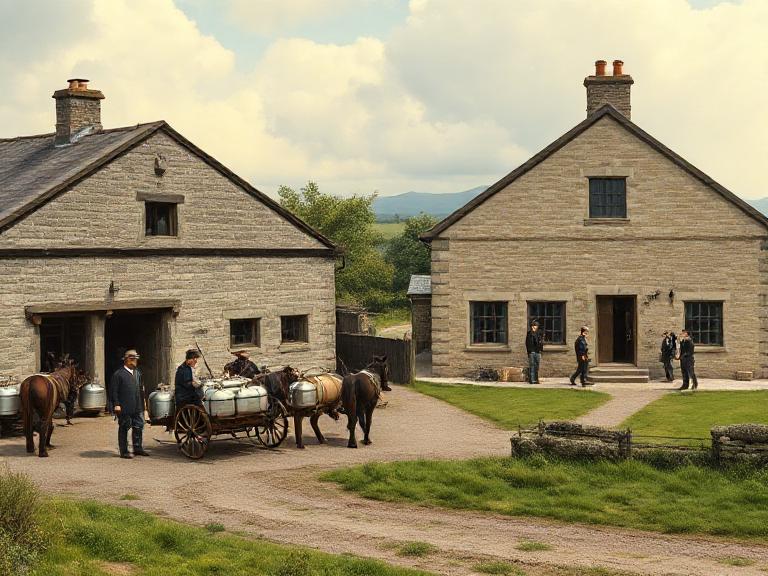
The Fomorians demanded a tribute from Ireland: portions of corn, milk, and even children. Bres did not resist their exactions. He imposed burdens of his own, demanding quantities of milk from cows of specified colours. The Tuatha Dé Danann answered some demands through cunning, disguising cattle with ashes and constructing wooden cows whose artificial udders contained dark bog water. Bres was deceived into drinking the substance as milk. Beneath the humour lies a serious political accusation. A king who should have guaranteed nourishment and prosperity instead drained the resources of every household, transforming abundance into anxiety, resentment, and organised resistance.
Bres also failed the defining test of royal hospitality. A worthy Irish king was expected to maintain a generous household where visitors received food, drink, warmth, entertainment, and rewards. Under Bres, noble knives remained ungreased because meat was absent, and guests carried no scent of ale upon their breath. Poets, musicians, storytellers, and performers found neither welcome nor patronage. His court was joyless, silent, and mean. Medieval Irish literature connects generosity with legitimate sovereignty because a ruler redistributed wealth and sustained relationships. Bres hoarded resources instead, breaking the reciprocal bonds that should have united king, household, artists, warriors, and community.
His treatment of the Tuatha Dé Danann’s figures deepened the disgrace. Ogma, renowned for eloquence and writing, was compelled to carry firewood while weakened by hunger. The Dagda, a figure associated with abundance, wisdom, and skilled craftsmanship, was reduced to digging defensive earthworks. Even his food was diminished when the satirist Cridenbél demanded the three finest portions each evening. With advice from his son Aengus, the Dagda concealed three gold pieces inside those portions. Cridenbél swallowed them and died, but an examination proved that the Dagda had fulfilled the greedy man’s demand literally, exposing manipulation through wit rather than violence.
The decisive challenge came when Cairpre, poet of the Tuatha Dé Danann, sought hospitality at Bres’s residence. He received a cramped, dark chamber without fire, furnishing, or bedding. His meal consisted of three small dry cakes, and no entertainment or respectful payment accompanied them. On leaving, Cairpre pronounced a satire wishing Bres continual want: no prompt food, sufficient milk, shelter after darkness, or reward for storytellers. The poem was not merely an insult. In medieval Irish thought, a trained poet’s satire could damage reputation, reveal injustice, blemish a ruler, and undermine authority. From that moment, Bres’s prosperity and legitimacy collapsed.
Cairpre’s words expose the principles by which Bres should be judged. Beauty had secured his election, yet beauty without generosity, justice, and protection could not sustain kingship. The failed feast represented a failed political order. When a royal household withheld food, warmth, light, and payment, it denied the obligations holding society together. Satire became a form of accountability, speaking where warriors and labourers could not. The tale therefore grants poetry political force. Cairpre defeats Bres without spear or sword by naming the truth of his rule. Once articulated, the king’s meanness becomes a judgement that neither appearance nor ancestry can conceal.
Meanwhile, the possibility of Nuada’s return developed through supernatural medicine. Dian Cécht, the physician, fashioned him an articulated silver arm with assistance from the craftsman Credne. The moving prosthesis earned Nuada the name Airgetlám, meaning Silver-Hand. Dian Cécht’s son Miach achieved a greater cure, restoring flesh and joining sinew to sinew. In the logic of the story, Nuada was now physically whole and qualified to rule again. The episode celebrates healing and craftsmanship, but it also reveals rivalry. Dian Cécht became jealous that his son had surpassed him, attacking Miach until he inflicted a wound that no physician could heal.
After Miach’s death, three hundred and sixty-five healing herbs sprang from his grave, corresponding symbolically to his joints and sinews. His sister Airmed arranged them upon her cloak according to their properties, creating a treasury of medicinal knowledge. Dian Cécht scattered the herbs, leaving humanity unable to recognise all their powers. This tragic episode explains why healing knowledge remains incomplete, while condemning jealousy between generations. Miach’s achievement restores a king, but costs the healer his life. Airmed preserves the possibility of ordered knowledge, only to see it dispersed. Medicine, like kingship and poetry, carries both sacred power and moral responsibility.
Once Nuada was restored, the Tuatha Dé Danann assembled and required Bres to surrender the throne. Bres admitted to Elatha that injustice, taxation, and seizure of wealth had caused his downfall. His father offered the tale’s clearest judgement: a king must value his people’s prosperity above office, and their goodwill is worth more than their curses. Nevertheless, Bres sought assistance from the Fomorians and was directed towards Balor of the Evil Eye. His refusal to accept removal prepared the Second Battle of Mag Tuired. The legend thus moves from failed government towards rebellion, invasion, and a greater struggle for Ireland.
Primary Sources
- University College Cork, CELT: Cath Maige Tuired
https://celt.ucc.ie/published/T300010.html - CODECS, Cath Maige Tuired
https://codecs.vanhamel.nl/Cath_Maige_Tuired - Lady Augusta Gregory, Gods and Fighting Men
https://www.gutenberg.org/ebooks/14465 - Whitley Stokes, “The Second Battle of Moytura,” Revue Celtique
https://archive.org/details/revueceltiqu12pari - Elizabeth A. Gray, Cath Maige Tuired: The Second Battle of Mag Tuired
https://archive.org/details/cathmaigetuiredt0000unse - Maynooth University, “Satire and Medieval Irish Poetry”
https://www.maynoothuniversity.ie/research/spotlight-research/satire-and-medieval-irish-poetry - Vernam E. Hull, “Cairpre Mac Edaine’s Satire upon Bres Mac Eladain”
https://archive.org/details/zeitschriftfrc18meyeuoft - John Carey, “Myth and Mythography in Cath Maige Tuired”
https://www.jstor.org/stable/30070824 - Kim McCone, “A Tale of Two Ditties: Poet and Satirist in Cath Maige Tuired”
https://archive.org/details/sagessaintsstory0000unse - R. A. Stewart Macalister, Lebor Gabála Érenn: The Book of the Taking of Ireland
https://archive.org/details/leborgablare04macauoft