Editorial — Late Pleistocene an
Welcome to the Emerald Archives Gazette. In today’s issue we look back at the latest additions to the archive. Fermanagh Entomology — Modern calendar-year precision is not available for Ireland at this depth of time. “30,264 BCE” is a useful modern label, equivalent to roughly 32,214 years before the conventional radiocarbon reference year of AD 1950, not a date that anyone then recorded or could have recognised. No Irish written record, named community, settlement layer or event can be tied to this particular year.
Dateline
The Day in Irish History
Welcome to the Emerald Archives Gazette. In today’s issue we look back at the latest additions to the archive.
Fermanagh Entomology — Modern calendar-year precision is not available for Ireland at this depth of time. “30,264 BCE” is a useful modern label, equivalent to roughly 32,214 years before the conventional radiocarbon reference year of AD 1950, not a date that anyone then recorded or could have recognised. No Irish written record, named community, settlement layer or event can be tied to this particular year. The responsible subject is therefore Ireland during the later part of the Late Pleistocene, within Marine Isotope Stage 3 (MIS 3), rather than a conventional annual history.What can be said rests on stratigraphy, fossils, palaeoecology and calibrated scientific…
Derryvree Cryptogams — 30,263 BCE is a useful modern filing label, not a date at which an event in Ireland can be placed. No written chronology, settlement sequence or annually resolved archaeological record exists for this part of the Late Pleistocene. In calendar terms it lies roughly 32,200 years before 1950, but the relevant evidence is dated in broad radiocarbon and calibrated ranges, often with substantial uncertainty. The responsible history of Ireland at this point is therefore not a story of named people or happenings in a particular year. It is a reconstruction of changing ice, water, plants and animals, with only a…
Castlepook Cervids — 30,262 BCE is a modern calendar label, not a date at which Ireland’s archaeological record can identify a particular event, individual or season. No written calendar, settlement layer or historical tradition reaches remotely this far back. The most responsible approach is to place the notional year within a wider Late Pleistocene window: roughly 32,211 years before AD 1950, during Marine Isotope Stage 3, a climatically unstable part of the last Ice Age. Calendar precision is especially misleading at this depth in time. Radiocarbon results are reported in radiocarbon years before present, where “present” conventionally means AD 1950, and then calibrated…
Midlandian Advance — Modern calendar-year precision is not available for Ireland around 30,261 BCE. The numbered year is a useful point on a modern timeline, not the date of a recorded occurrence. In conventional before-present terms it lies at roughly 32.2 thousand calendar years ago, but the evidence is dated in broad calibrated ranges, often with substantial uncertainty. The responsible picture is therefore of a changing Late Pleistocene landscape during Marine Isotope Stage 3, not of an Irish event, ruler, community or expedition that can be assigned to one year. A Landscape on the Edge of Glaciation This was the Late Midlandian, Ireland’s…
Hyena Assemblage — The label 30,260 BCE is a modern point on a deep-prehistoric timeline, not a date at which Ireland can be described through annals, rulers or events. No calendar-year precision is available. In the archaeological convention of years before AD 1950, it lies roughly 32,200 years before present; the useful evidence instead consists of calibrated age ranges, cave-bone dates, glacier reconstructions and environmental deposits whose uncertainties are usually measured in centuries or millennia. The responsible setting is later Marine Isotope Stage 3 (MIS 3), within the Midlandian, or last, glacial cycle.Ireland at this point was not the familiar green island of…
Derryvree Hydrophytes — Modern calendar-year precision is not available for Ireland in 30,259 BCE. No inhabitants left a written date, no settlement layer can be assigned to that numbered year, and even the scientific dates nearest to it carry substantial uncertainty. The useful historical frame is therefore the Late Pleistocene, specifically Marine Isotope Stage 3, a climatically unstable part of the last glacial cycle. In calendar terms, 30,259 BCE corresponds approximately to 32,200 calibrated years before present. It falls within a broad interval represented by one of Ireland’s most informative environmental archives: the buried freshwater deposits at Derryvree, near Maguiresbridge in County Fermanagh.…
Juniper Willow — 30,258 BCE is not a year that can be recovered as an event in Irish history. It is a modern calendar label, roughly 32,207 years before AD 1950, the conventional reference point for radiocarbon chronology. No written record, seasonal diary, named community or securely dated occupation layer permits a narrative for that single year. The responsible approach is to place it within a much broader Late Pleistocene horizon: Marine Isotope Stage 3, during the Midlandian cold stage and before the greatest expansion of the last British–Irish Ice Sheet.The closest relevant Irish evidence is environmental rather than historical. It comes from…
Derryvree Biome — “30,257 BCE” is a modern chronological label, not a date that can be recovered from an Irish event, ruler or settlement. No calendar, written record, monument or securely dated occupation surface allows history at annual resolution this far back. The responsible frame is the Late Pleistocene, broadly Marine Isotope Stage 3 (MIS 3), when Ireland’s landscapes were repeatedly altered by cold, ice and shifting sea levels. The nominal year falls within a broad calibrated range associated with a remarkable buried wetland at Derryvree near Maguiresbridge, County Fermanagh. Its organic sediments have a conventional radiocarbon determination of 30,500 +1,170/−1,030 radiocarbon years…
Derryvree Menyanthes — 30,256 BCE is a modern chronological label, not a year that can be recovered from an Irish calendar, chronicle or archaeological event. At this depth of time, modern calendar-year precision is unavailable. The useful comparison is approximately 32,200 calibrated years before present, where “present” in radiocarbon practice is AD 1950. Evidence can illuminate a broad interval around this point, but cannot tell us what happened during one named year, who was alive, or whether people crossed any particular valley. A Cold-Stage Landscape This was the Late Pleistocene, within Marine Isotope Stage 3 and the long Midlandian cold stage in Ireland.…
Fermanagh Coleoptera — A Modern Year in Deep Time 30,255 BCE is a modern label applied to a time far beyond the reach of Irish annals, calendars or year-by-year archaeology. It is approximately 32,204 years before AD 1950, the conventional reference point used in radiocarbon dating, but that arithmetic conversion must not be mistaken for a date recorded by people living in Ireland. No excavated settlement, grave, hearth, tool-making floor or written source allows scholars to identify an event in this particular year. The responsible frame is a broader one: later Marine Isotope Stage 3, part of the Late Pleistocene, when north-west Europe…
Intertill Horizon — Modern calendar-year precision is not available for Ireland in 30,254 BCE. The label is useful for arranging deep time, but it cannot identify an event, season, individual or community in an Irish record. In archaeological usage it falls about 32,204 years before AD 1950, the conventional ‘present’ of radiocarbon dating: broadly 32.2 thousand calibrated years before present (cal BP), in the Late Pleistocene and Marine Isotope Stage 3. Evidence survives as sediments, fossils, landforms and laboratory measurements whose ranges commonly span centuries or millennia. The responsible history of this moment is therefore not an annal, but a cautiously reconstructed Ice-Age…
Juniper Shrubs — The label 30,253 BCE is a modern chronological convenience, not a recoverable year in Irish history. It falls roughly 32,200 calendar years before AD 1950, within the Late Pleistocene and Marine Isotope Stage 3. No Irish community then kept calendars, and no excavated layer can be assigned to this numbered year. The responsible approach is therefore to set it within dated ranges. The strongest nearby evidence is a buried freshwater deposit at Derryvree, near Maguiresbridge in County Fermanagh, whose radiocarbon result calibrates broadly to about 36,900–31,700 cal BP. This date falls near the younger end of that wide interval, but…
Lemming Remains — “30,252 BCE” is a modern chronological label, not a year that anybody in Ireland could have named, recorded or experienced within a calendar. At this depth of time, archaeological and environmental evidence cannot identify a particular season, let alone a day or a political event. In simple chronological terms the label falls about 32,200 years before AD 1950, the conventional reference point for “before present” dating. It belongs to the Late Pleistocene, broadly Marine Isotope Stage 3, an unstable interval of the last Ice Age that preceded the fullest expansion of the Last Glacial Maximum. The responsible history of Ireland…
Putative Striations — 30,251 BCE is a modern calendar label, not a date that can be recovered from Ireland’s archaeological record with year-by-year precision. In the conventional “before present” system, whose present is AD 1950, it falls roughly 32,200 calendar years ago. At that depth of time, radiocarbon results must be calibrated and expressed as wide ranges, while sediments and fossils often record episodes lasting generations or longer. The responsible subject is therefore not an event in a particular year, but Ireland during the later part of Marine Isotope Stage 3: a fluctuating interval of the last Ice Age, before the fullest expansion…
Moss Sedges — The label “30,250 BCE” offers a useful point of orientation but not a date at which Irish history can be narrated year by year. It is a modern calendar conversion, roughly 32,200 years before the radiocarbon reference year of AD 1950. No people in Ireland then used a calendar of this kind; no written record, dated settlement surface or annual environmental sequence identifies an event in that particular year. The responsible subject is therefore Late Pleistocene Ireland within the long, climatically unstable interval known as Marine Isotope Stage 3, rather than an imagined episode on a single day.Even the best…
Interstadial Waterlogging — Modern calendar-year precision is not available for Ireland in 30,249 BCE. This number is a useful modern label, not a year for which archaeology can identify a season, an event or an individual life. It falls roughly 32,199 years before AD 1950, the reference date used in ‘BP’ chronology, within the Late Pleistocene and Marine Isotope Stage 3 (MIS 3), a fluctuating interval of the last Ice Age. The closest Irish environmental evidence is dated in wide ranges, not single calendar years. Its value is considerable nonetheless: sediments, fossil plants, insects, landforms and animal bones show parts of the island’s…
Ecological Threshold — 30,248 BCE is not a recoverable Irish calendar year. No written record, settlement sequence or archaeological layer can identify what happened in those twelve months, and the modern BCE label is only a point on a retrospective timescale. In archaeological terms it falls about 32,197 years before AD 1950, during the Late Pleistocene and broadly within Marine Isotope Stage 3, an unstable phase of the last Ice Age. The responsible evidence is therefore regional and ranged, not annual: dated sediments, plant and insect remains, cave faunas, glacial landforms and a very small number of contested traces of possible human action.…
Clubmoss Flora — The label 30,247 BCE gives a useful point of orientation, but it cannot identify an event in Ireland in the way that a later historical year can. No calendar, written record, ruler, settlement sequence or securely dated human activity permits year-by-year history at this depth of time. In archaeological terms, this notional date falls about 32,200 calibrated years before present, within the later part of Marine Isotope Stage 3, a highly variable phase of the last Ice Age. The responsible history of Ireland at this point is therefore an environmental one: a cold northern landscape, changing ice margins, freshwater habitats…
Waterford Herbivores — 30,246 BCE is a useful modern label, not a year that can be recovered from Irish evidence. It falls roughly 32,200 calibrated years before AD 1950, during the Late Pleistocene and Marine Isotope Stage 3 of the last Ice Age. No writing, calendar, named people, settlement sequence or historical event allows an annual narrative. Even radiocarbon results of this antiquity commonly translate into wide calibrated ranges. The responsible approach is therefore to ask what archaeological and environmental records can illuminate Ireland around this horizon, and to keep direct evidence separate from interpretation. A Changing Ice-Age Island Ireland then occupied the…
Giant Deer — The label 30,245 BCE is useful for arranging a long historical timeline, but it cannot identify an event that happened in one recoverable Irish calendar year. There were no calendars, written records or dated settlements in Ireland from which such precision could be drawn. The responsible historical setting is the Late Pleistocene, during Marine Isotope Stage 3: a volatile phase of the last Ice Age, long before the Last Glacial Maximum. The nearest relevant evidence is expressed in broad scientific ranges, not anniversaries. It points to a cold, open and changing Irish landscape, locally free of ice at some times,…
Castlepook Foodwebs — 30,244 BCE is not a year to which Irish prehistory can be pinned. It is a modern calendar label, roughly equivalent to 32,200 years before 1950, but neither an excavation layer nor an animal bone can normally be dated to that degree of precision. The responsible approach is therefore to place this notional point within wider, calibrated ranges. Ireland lay in the Late Pleistocene, during Marine Isotope Stage 3 and the later part of the Midlandian glacial cycle. The global Last Glacial Maximum is conventionally placed at about 26,500–19,000 years ago, while the British–Irish Ice Sheet was growing through the…
Derryvree Fauna — The label 30,243 BCE cannot identify a year in the ordinary historical sense. It is a modern back-calculation, roughly 32,200 years before AD 1950, applied to a time long before written calendars, named polities or recoverable annual records in Ireland. The responsible setting is the later part of Marine Isotope Stage 3 (MIS 3), within the Late Pleistocene or Ice Age. Dates from this depth of time are normally expressed as radiocarbon determinations and calibrated probability ranges, often spanning centuries or millennia. They can illuminate a changing landscape, but they cannot tell us what happened in Ireland in one particular…
Bogbean Refuge — The label 30,242 BCE supplies a convenient modern marker, not a date that people or events in prehistoric Ireland could have recognised. It corresponds arithmetically to about 32,191 years before AD 1950, the reference point used for “before present” dating. Yet the evidence cannot resolve an Irish story to a single year, or even to a single human generation. Around this point, Ireland belonged to the later part of the Pleistocene cold stage, conventionally called the Midlandian in Irish geology and broadly within Marine Isotope Stage 3. Its recoverable history is chiefly one of ice, water, plants, animals and shifting…
Shifting Tills — The label 30,241 BCE is useful for filing a long chronology, but it cannot identify an Irish event that occurred in a single modern-style year. It corresponds approximately to 32,190 calendar years before present, where “present” is conventionally AD 1950. At this depth of time, the evidence comes from radiocarbon measurements with substantial error ranges, sediments accumulated over generations or centuries, and fossil assemblages whose members were not necessarily contemporaries. The responsible history of Ireland at this point is therefore one of Late Pleistocene environments and possibilities, not named rulers, battles or dates.It falls within Marine Isotope Stage 3, a…
Tundra Archive — 30,240 BCE cannot be treated as a recoverable year in Ireland’s past. It is a modern numerical label applied to a point roughly 32,189 years before AD 1950, not a date that anyone living then recorded or could have recognised. No Irish deposit can presently be assigned to that single calendar year. The responsible history of this moment therefore lies in dated ranges, layers of sediment and fossil assemblages. The most informative evidence comes from the later part of Marine Isotope Stage 3, within the Midlandian cold stage: a long and climatically unstable phase of the last Ice Age. For…
Mammalian Mosaic — 30,239 BCE is a modern label imposed on a time far beyond any Irish calendar, chronicle or named generation. It cannot responsibly be treated as a date on which a recorded event occurred. In radiocarbon and palaeoenvironmental scholarship, it falls broadly around 32,000 calibrated years before present, within Marine Isotope Stage 3 of the Late Pleistocene. Even that conversion must be used cautiously: radiocarbon results are measurements with margins of error, calibration curves are periodically revised, and deposits accumulated across spans of time rather than in a single year. For Ireland, the evidence nearest to this point is not an…
Brief Thaw — 30,238 BCE is not a year for which Ireland can be given an event, ruler, battle or settlement history. It is a modern calendar label applied to a far deeper prehistoric interval: roughly 32,187 years before AD 1950, the conventional reference point for “before present” dating. No annual chronology exists at this depth. The evidence is instead stratified, scattered and often difficult to date: sediments beneath later ice, fossil plants and insects, animal remains from caves, landforms, and radiocarbon measurements with substantial margins of uncertainty.The most responsible way to illuminate Ireland around this nominal date is through the Late Pleistocene…
Maguiresbridge Flora — The label 30,237 BCE is a modern way of locating an immensely remote point in time; it is not a year that anyone in Ireland could have recorded, named or remembered in a calendar. At this depth, calendar-year precision is not archaeologically available. In conventional terms it falls roughly 32,200 years before AD 1950, but that arithmetic must not be confused with a radiocarbon determination. The evidence relevant to Ireland consists of dated bones, cave deposits, pollen and plant remains, and glacial sediments. Their uncertainties are measured in centuries or millennia. The responsible story is therefore one of overlapping calibrated…
Bogbean Lowland — The label 30,236 BCE gives a useful filing point, not a recoverable year in Irish history. It falls about 32,185 years before AD 1950, the reference date used for “before present” (BP), within the Late Pleistocene and Marine Isotope Stage 3 (MIS 3). No calendar, written record, annually resolved archaeological layer or known Irish community can be assigned to this notional year. Radiocarbon determinations at this depth have statistical margins and must be calibrated; deposits also form over seasons, centuries or longer. The responsible question is therefore what evidence can illuminate Ireland in the broad climatic interval around it.The answer…
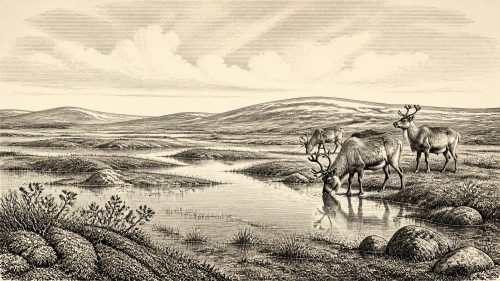
Debated Reindeer — 30,235 BCE cannot be treated as a date in the annalistic sense. No Irish inscription, settlement layer or event can be fixed to this individual calendar year. In fact, modern calendar-year precision is unavailable at this depth of time. The responsible question is what evidence illuminates Ireland around this point: a world in the later part of the last glacial period, where ice, tundra wetlands and mobile animal populations mattered far more than states, borders or named communities. The most useful Irish evidence comes from two very different places. At Derryvree near Maguiresbridge in County Fermanagh, organic freshwater deposits trapped…
Saturated Tundra — Modern calendar-year precision is not available for Ireland in 30,234 BCE. The number is a retrospective label, not a date known to any contemporary people, and no Irish settlement, person, political event or artefact can be assigned to that individual year. The responsible approach is to place it within the later part of the Pleistocene, broadly Marine Isotope Stage 3, and to use dated deposits as wide chronological windows. In that sense, the most important Irish evidence is not a monument or a settlement but a buried freshwater deposit exposed at Derryvree, near Maguiresbridge in County Fermanagh. The requested year…
Freshwater Interval — “30,233 BCE” is a modern label, not a recoverable year in Irish history. No calendar, written record, ruler, settlement sequence or dated event allows Ireland’s past at this depth of time to be resolved to a particular season, let alone a day. In radiocarbon convention the label falls about 32,182 years before AD 1950, within the Late Pleistocene and Marine Isotope Stage 3, an unstable phase of the last Ice Age. The responsible account is therefore not a conventional annual chronicle. It is an account of what sediment, fossils, landforms and cautiously interpreted dates can say about Ireland around this…
Dubious Femur — The label 30,232 BCE is a modern way of placing a point in deep time, not a date that can be recovered from an Irish calendar, document or human memory. No year-specific event, ruler, community or expedition can responsibly be assigned to it. In archaeological terms, it falls within the Late Pleistocene, during Marine Isotope Stage 3 (MIS 3), part of the Midlandian cold stage in Ireland. The most useful evidence consists of radiocarbon-dated animal bone, cave deposits, fossil plants and insects, and glacial sediments. Such evidence normally provides ranges measured in thousands of years, not an annual narrative. In…
Unsettled Evidence — A Date Without a Dated Event30,231 BCE is a modern chronological label, not a year that can be isolated in Ireland’s archaeological record. It falls roughly 32,180 calendar years before AD 1950, the conventional reference point for radiocarbon dating, in the later Pleistocene and broadly within Marine Isotope Stage 3. No Irish document, settlement layer, burial or individual artefact can be assigned to this particular calendar year. The responsible history of Ireland at this distance is therefore a history of deposits, bones, pollen, seeds, insects, cave sediments and ice-made landforms. These sources can illuminate conditions across long intervals; they cannot…
Imprecise Dating — “30,230 BCE” is a useful modern filing date, not a year that can be observed in Ireland’s archaeological record. No written calendar existed, and the evidence cannot isolate a particular season, event or generation. The responsible setting is the later Middle Midlandian cold phase of the Late Pleistocene, within Marine Isotope Stage 3. Ireland was then undergoing profound climatic instability long before the Last Glacial Maximum. The strongest Irish evidence relevant to this point comes not from houses, graves or tools, but from a buried freshwater deposit at Derryvree near Maguiresbridge, County Fermanagh, and from scattered animal remains in caves,…
Dubious Marking — 30,229 BCE is a modern chronological label, not a year that can be recovered from an Irish record. There was no writing, calendar, named polity or securely dated settlement from which to build an annal. In the archaeological convention of years before present, counted from AD 1950, the label falls about 32,200 calibrated years ago. It belongs to the Late Pleistocene, within Marine Isotope Stage 3: a long, unstable interval of the last Ice Age, well before the fullest expansion of the last British–Irish Ice Sheet.The evidence nearest to this point is environmental rather than historical in the ordinary sense.…
Castlepook Fossil — The label 30,228 BCE is useful for organising a modern chronology, but it cannot describe a recoverable Irish “year”. Nobody in Ireland recorded dates, names or events at this depth in time, and archaeological science cannot assign a particular political decision, migration or season to that calendar number. In radiocarbon convention it lies roughly 32,178 years before AD 1950, within the Late Pleistocene and Marine Isotope Stage 3 (MIS 3), an unstable middle phase of the last glacial cycle. The responsible history of Ireland at this point is therefore a history of deposits, bones, plants, ice and uncertainty. Calibrated ranges,…
Derryvree Chronometry — The label 30,227 BCE does not identify a recorded Irish year. No calendar, writing system, ruler, settlement or named community can be assigned to it, and modern calendar-year precision is unavailable at this depth of time. By the convention that “before present” is counted from AD 1950, the label falls roughly 32,176 years before present. It belongs to the Late Pleistocene, within Marine Isotope Stage 3, a long and climatically unstable part of the last Ice Age. The responsible history of Ireland at this point is therefore not an annal of events but a reconstruction from sediments, fossil plants and…
Derryvree Junipers — “30,226 BCE” is a modern calendar label, not a date that people in prehistoric Ireland could have recognised. In the usual archaeological convention it falls about 32,175 years before AD 1950, or roughly 32.2 thousand calibrated years before present (cal BP). That apparent precision is misleading. No Irish site provides an event, settlement or human life history that can responsibly be assigned to this single year. Radiocarbon results carry statistical uncertainty, calibration converts them into often broad ranges, and deposits can be disturbed or reworked. The responsible subject is therefore Ireland during the later part of Marine Isotope Stage 3:…
Derryvree Hydrography — Modern calendar-year precision is not available for Ireland in 30,225 BCE. The label is useful only as a point on a modern chronological grid: it corresponds roughly to 32,174 years before AD 1950, but no Irish deposit can be assigned responsibly to that individual year, season or generation. The appropriate setting is the later Pleistocene, within Marine Isotope Stage 3, when climate, ice cover and habitable ground changed markedly over long timescales. The best evidence relevant to this date is therefore archaeological and environmental rather than historical: buried sediments, fossil plants and animals, cave deposits, glacial landforms, and radiocarbon measurements…
Castlepook Ecosystems — The label 30,224 BCE is useful only as a modern organising device. It does not identify a recorded Irish year, season, ruler or event. In archaeological terms it lies roughly 32,173 years before the conventional radiocarbon present of 1950, within the Late Pleistocene and broadly within Marine Isotope Stage 3 (MIS 3). No evidence from Ireland can be dated with calendar-year precision at this depth of time. Radiocarbon results must be calibrated, carry statistical ranges, and are often associated with individual animal bones rather than with a single, intact landscape or occupation. The responsible question is therefore not what happened…
Fermanagh Thaws — The label 30,223 BCE is a modern point on a chronological scale, not a recoverable Irish calendar year. No written record, named community, excavation layer or securely dated human occupation can be pinned to it. In radiocarbon convention it lies roughly 32,172 years before AD 1950, but radiocarbon ages of this antiquity calibrate to wide calendar ranges. The responsible subject is therefore Ireland around this point: Late Pleistocene Ireland in Marine Isotope Stage 3 (MIS 3), during the last glacial cycle but before the fullest expansion of the last Irish Ice Sheet. The evidence is geological, palaeobotanical and faunal, and…
Doneraile Assemblage — The label 30,222 BCE gives a useful position in a modern timeline, but it cannot identify a recoverable Irish year. No written calendar, annual settlement layer, named individual or datable event survives from this depth of time. In proleptic calendar arithmetic it lies about 32,171 years before AD 1950, the reference year used for “BP” dating; archaeologically, however, it belongs to a broad Late Pleistocene interval within Marine Isotope Stage 3, not to a particular season or generation. Radiocarbon ages must be calibrated because atmospheric carbon-14 has varied, and calibration produces probability ranges rather than a single modern calendar equivalent.Ireland…
Pleistocene Zoology — “30,221 BCE” is a useful modern label for this entry, not a date that people in prehistoric Ireland could have recognised. No event can responsibly be assigned to that individual year. At this depth of time, archaeologists and Quaternary scientists work with radiocarbon determinations, stratigraphy, animal remains, pollen, sediments and ice-sheet landforms. A mechanical conversion places the label broadly around 32,200 calibrated years before present (cal BP, where “present” is AD 1950), but even that should not be mistaken for calendar-year precision. The appropriate setting is the later part of Marine Isotope Stage 3, a climatically unstable stretch of the…
Castlepook Faunistics — “30,220 BCE” is a modern calendar label, not a date that can be recovered from an Irish Ice Age deposit with year-by-year precision. In a simple conversion it falls roughly 32,170 years before AD 1950, the reference point used for “BP” dating, but that does not make it a securely dated moment in the archaeological record. Radiocarbon ages must be calibrated, samples carry uncertainties, and the evidence from Ireland is usually separated by centuries or millennia. The responsible setting is therefore the later part of Marine Isotope Stage 3 (MIS 3), before the Last Glacial Maximum, rather than an imagined…
Maguiresbridge Organics — 30,219 BCE is not a year that can be recovered from Ireland’s prehistoric record in the manner of a later annalistic date. No Irish event, ruler, battle, journey or settlement can responsibly be assigned to it. The appropriate setting is the Late Pleistocene, within Marine Isotope Stage 3, when climate in north-west Europe shifted repeatedly between severe cold phases and less extreme intervals. The closest important Irish evidence is environmental rather than historical: a buried freshwater deposit at Derryvree, near Maguiresbridge in County Fermanagh.Even that evidence cannot deliver calendar-year precision. Organic material from the Derryvree beds produced the radiocarbon determination…
Derryvree Buckbean — Modern calendar-year precision is not available for Ireland in 30,218 BCE. Nobody on the island recorded a year, and the surviving evidence cannot be tied to a particular season, generation or event. The label is best understood as a modern point approximately 32,167 years before AD 1950, within the Late Pleistocene and Marine Isotope Stage 3. The closest Irish evidence is not an annal of people or politics but a buried environmental archive at Derryvree, near Maguiresbridge in County Fermanagh. There, freshwater sediments preserve a short-lived world of cold water, low vegetation and animal life that existed between episodes of…
Thank you for reading today’s Gazette. Follow any of the links above to read the full article and explore its sources.