Celtic Beginnings(c.1000s)
No surviving record identifies a year when the first Celts entered Limerick, and modern archaeology no longer supports the old picture of one great Celtic invasion. The term Celtic describes related languages, artistic traditions and cultural practices rather than a single people arriving together. Communities had lived around the Shannon and across present-day County Limerick for thousands of years before ironworking and continental influences appeared. Their society probably changed gradually through trade, intermarriage, travel and limited migration. Celtic Limerick should therefore be understood as a long cultural development, not as a sudden conquest by foreign newcomers on one identifiable date.
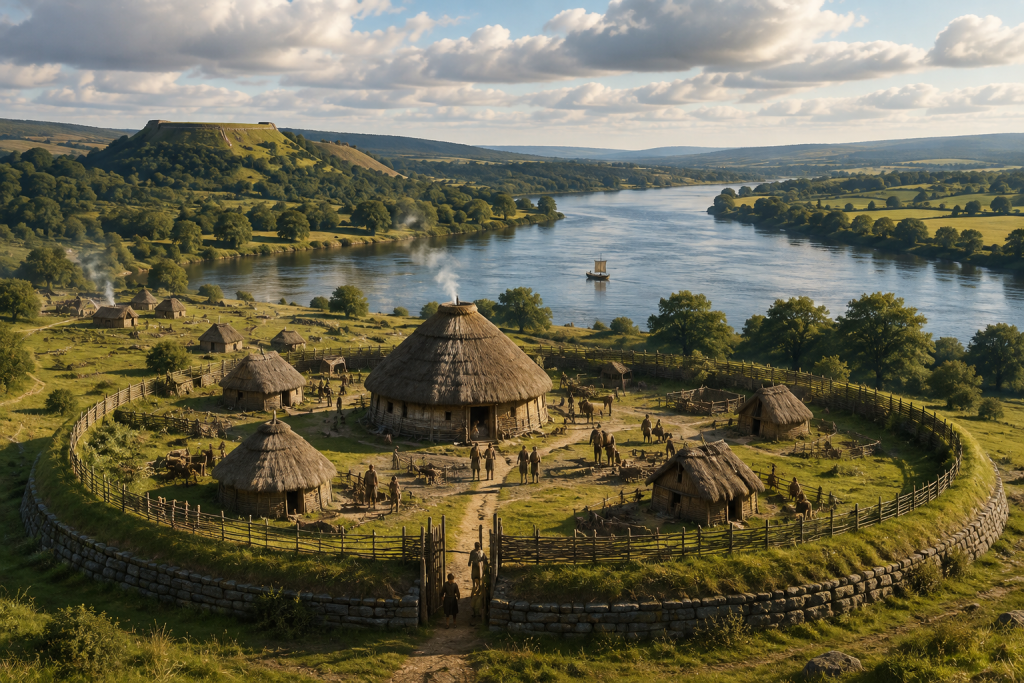
The strongest local evidence comes from Cush, near Kilfinane, where excavations revealed fields, enclosures, houses, cremation burials, rotary querns, glass beads and large quantities of iron slag. Occupation began around 1000 BC and continued into the early centuries AD. The earliest phases belong to the Late Bronze Age, while later remains reflect an established Iron Age farming community. Cush demonstrates continuity rather than replacement: people remained on the same landscape while their tools, agriculture and customs evolved. Nothing discovered at the site proves that an invading Celtic army suddenly seized or colonised the territory now known as southern County Limerick.
Ironworking reached parts of Ireland during the first millennium BC, but its adoption was gradual and uneven. A recognisable Irish Iron Age culture becomes visible around the third century BC, when objects influenced by the continental La Tène artistic tradition appeared. Because La Tène decoration was associated with Celtic-speaking societies in Europe, earlier historians treated such finds as proof of invasion. Archaeologists now exercise caution. Imported objects, travelling craftspeople, exchanged ideas and changing local fashions could spread artistic styles without mass migration. Limerick’s communities may therefore have become culturally Celtic while remaining largely descended from the region’s Bronze Age population.
Written evidence appears centuries after these archaeological changes. Around AD 150, the geographer Claudius Ptolemy described Ireland, naming coasts, rivers, settlements and peoples from information collected through traders and travellers. His account confirms that Ireland contained organised territorial communities, but it neither mentions Limerick by its modern name nor explains when Celtic speech arrived. Early Irish remained unwritten until ogham inscriptions appeared during the medieval period. These inscriptions preserve personal names in an early form of Irish, proving that a Celtic language was firmly established. They reveal the outcome of a long cultural transformation, rather than its beginning in Limerick.
The most responsible conclusion is that no exact first appearance can be dated. People in the Limerick region were participating in an Irish Iron Age culture by approximately 300 BC, although Celtic language and influences may have arrived earlier. The transition probably unfolded over generations rather than through one dramatic landing or invasion. Cush provides evidence for communities adapting across the Bronze and Iron Ages, while artefacts and written records reveal Ireland’s developing Celtic character. The first Celts of Limerick were probably not strangers arriving suddenly, but local people adopting the language, art and customs historians now describe as Celtic.
Primary Sources
- Ó Ríordáin, Seán P. “Excavations at Cush, Co. Limerick, 1934 and 1935.” Proceedings of the Royal Irish Academy, Section C, Volume 45, 1940, pages 83–181.
- Cush Earthworks, Kilfinane, County Limerick. Archaeological remains include settlement enclosures, dwellings, cremation burials, ironworking material, rotary querns, glass beads and agricultural evidence.
- Claudius Ptolemy. Geography, Book II, Chapter 1: “The Location of Hibernia.” Written during the second century AD.
- Cornelius Tacitus. Agricola, Chapter 24. Written around AD 98 and containing an early classical description of Ireland, its approaches, harbours and trading connections.
- The surviving ogham inscriptions of Ireland, dating mainly from the fourth to seventh centuries AD and preserving personal names in the earliest recorded form of the Irish language.