
Winter Occupation(c.1000s)
On 3 January 1000, a Wednesday in the calendrical reckoning preserved by Irish annals, no surviving source records an event securely assigned to that exact day. Dublin, however, stood in the immediate aftermath of one of the most important military reversals of its tenth-century history. On 30 December 999, Brian son of Cennétig and Máel Sechnaill son of Domnall had defeated the allied forces of Dublin and Leinster at Glenn Máma. The Annals of Inisfallen records that Munster forces invaded and burned Áth Cliath on 1 January. Thus 3 January fell within the unsettled days following the city’s capture.
Later annalistic traditions describe Brian’s forces as remaining in Dublin for a week, carrying away gold, silver and captives and expelling Sitriuc son of Amlaíb, the Hiberno-Norse ruler known as Sigtrygg Silkbeard. These accounts do not provide a diary of each day, so it would be wrong to invent a particular action for 3 January. What can safely be said is that the date lay within a period when Dublin’s political order had been violently disrupted. The settlement had been burned and plundered, its ruler had fled, and Brian was temporarily able to dictate terms to Ireland’s important Scandinavian-founded town.
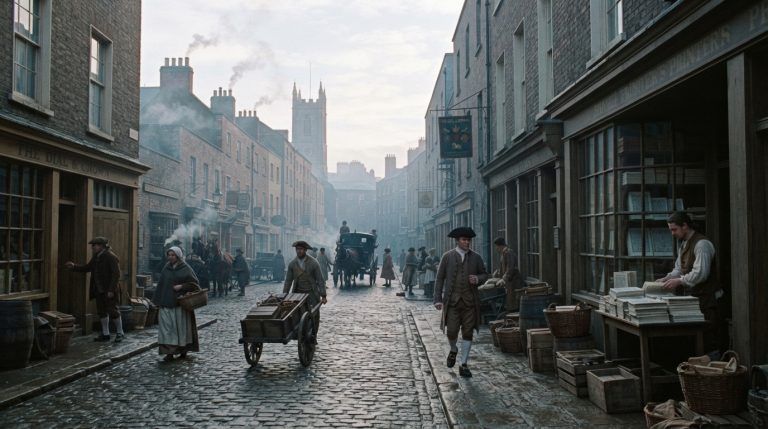
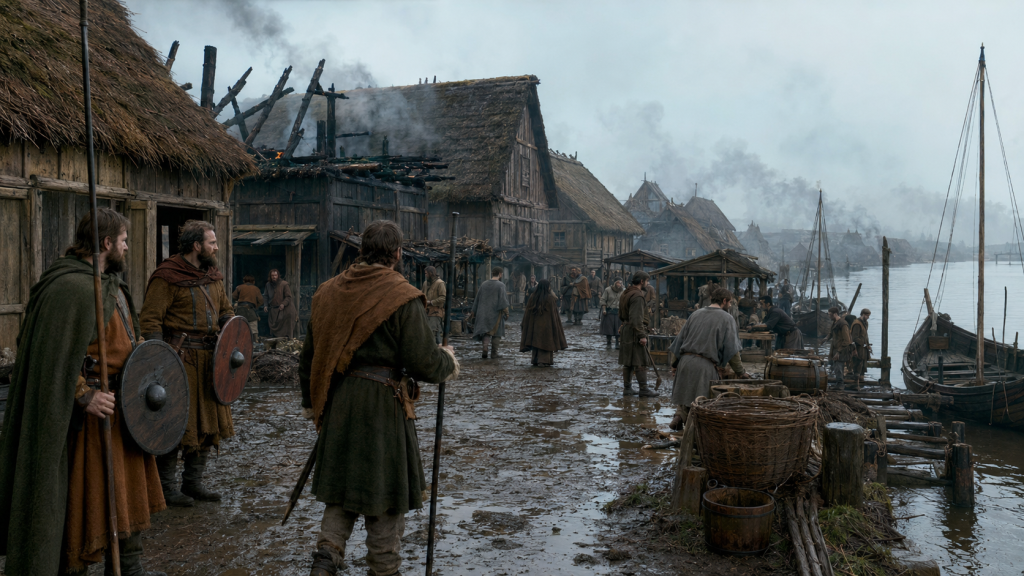
Dublin was already far more than a raiding base. Archaeological discoveries from the Viking-age town reveal closely packed timber houses, fenced plots, workshops, lanes and a busy waterfront economy. Craftspeople worked wood, bone, leather, textiles and metals, while merchants connected the town with Britain, Scandinavia and wider trading networks. Under Sitriuc, Dublin also began producing silver pennies modelled on the coinage of Æthelred II of England. These were among the first coins struck in Ireland. A city capable of minting coin, maintaining ships and attracting foreign trade offered a prize that could strengthen any ruler able to control its allegiance.
Brian’s success arose from a political system based upon dynastic kingship rather than a unified Irish state. Ireland contained kingdoms whose rulers competed through warfare, tribute, fosterage, marriage alliances and hostage-taking. Brian, king of Munster, had risen from the Dál Cais dynasty and extended his influence beyond Thomond. Máel Sechnaill, ruler of Mide and king of Tara, remained a powerful figure. In 997 the two reached an accommodation dividing spheres of authority. Leinster and Dublin were placed within Brian’s sphere, but the arrangement did not remove competing ambitions. Resistance by Dublin and Leinster produced the confrontation at Glenn Máma two years later.
For Dublin’s inhabitants, the first days of January must have brought uncertainty, although surviving chronicles tell us little about ordinary people. Burning and plunder are explicitly recorded, and some sources mention captives being carried away. Beyond that, individual experiences cannot be reconstructed confidently. Houses may have been damaged, stores disturbed and commercial activity interrupted, but historians must resist turning possibilities into documented facts. The physical town was predominantly wooden, making fire especially destructive. Yet Dublin was not annihilated. Its political restoration shows that enough of the settlement, population and economic machinery survived for the town to resume its role quickly.
Sitriuc’s position was precarious. The Annals of Inisfallen says he fled north to the Ulaid after the defeat but found no lasting protection until he handed hostages to Brian. Other annals record that the foreigners later returned to Dublin and gave hostages to Brian. Hostages were not symbolic guests: they were guarantees of obedience and instruments through which kings enforced agreements. Brian’s willingness to allow the Dubliners back into their fort demonstrates a practical policy. A functioning Dublin under submission was more valuable than an abandoned ruin. Its ships, warriors, merchants and silver could become resources within Brian’s expanding network of power.
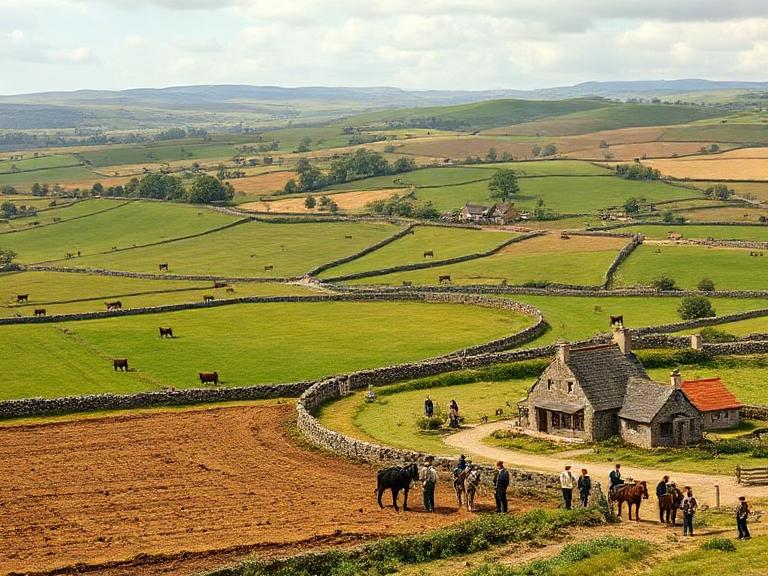
Away from the east coast, most inhabitants of Ireland on 3 January lived in a predominantly rural society. Cattle were fundamental to wealth, tribute and food production, but communities also cultivated cereals, kept pigs and sheep, made butter and cheese, and relied upon local crafts. Ringforts, enclosed farmsteads, monasteries and small settlements characterised much of the landscape. Midwinter meant short daylight, wet or cold conditions and dependence upon stored provisions. Travel was slow, using footpaths, trackways, horses, rivers and coastal vessels. News of Glenn Máma and Dublin’s capture spread unevenly through royal messengers, ecclesiastical networks, markets, assemblies and travelling households.
Christian institutions were central to this world. Monasteries and churches served as centres of worship, learning, landholding and political influence, while clerics produced the written culture through which the year is known. The Annals of Ulster marked 1000 as the thousandth year since the Incarnation of Christ and supplied calendrical information for January. That notation demonstrates chronological learning, but it does not prove that ordinary people regarded the millennium with modern expectations of a great anniversary. Latin functioned within religious scholarship, while Irish remained the spoken language across much of the island, alongside Scandinavian speech within communities such as Dublin.
The rest of the annalistic year shows that power remained unstable. Sources record the death of Ímar, king of Waterford, the killing of Flaithbertach ua Canannáin of Cenél Conaill, and the death of Cellach ua Maelcorgais, chief poet of Connacht. They also record Dublin’s foreigners restored to their town and giving hostages to Brian. Later Brian’s relationship with Máel Sechnaill deteriorated, and a coalition including Dublin and Leinster moved towards Tara before a Dublin cavalry force was caught and heavily defeated in Mag Breg. These developments cannot be assigned to 3 January, but they reveal the volatile environment surrounding it.
The significance of 3 January 1000 therefore lies not in an invented event but in its position inside a political transformation. Dublin had just been defeated, entered, burned and subjected to Brian’s authority, while its displaced ruler faced submission. The city would recover, Sitriuc would return, and Brian’s ambitions would continue until he challenged Máel Sechnaill for supremacy. The day captures Ireland at a threshold: still a landscape of competing dynasties and powerful churches, yet increasingly shaped by urban trade, Scandinavian-Irish interaction and rulers capable of mobilising alliances across provincial boundaries. Its quiet documentary footprint makes the surrounding evidence especially important.
Primary Sources
- Unknown Munster annalist — Annals of Inisfallen, AI1000.1 — 1 January 1000 — Records the Kalends of January as Monday and provides the lunar calculation, helping establish the chronology of the opening days of the year. Digital source: CELT, University College Cork.
- Unknown Munster annalist — Annals of Inisfallen, AI1000.2 — 1 January 1000 — The closest surviving narrative evidence to the requested date. It records the Munster invasion and burning of Dublin, the investment of the settlement, the burning of Caill Tomair, Sitriuc’s flight and his eventual surrender of hostages to Brian. Digital source: CELT, University College Cork.
- Unknown annalist — Annals of Ulster, U1000.0–U1000.1 — 1 January 1000 — Records the calendrical opening of the year and identifies it as the thousandth year since the Incarnation of Christ, providing chronological context for 3 January. Digital source: CELT, University College Cork.
- Unknown annalist — Annals of Ulster, U999.8 — 30 December 999 — Precisely dates the Battle of Glenn Máma to Thursday, 30 December and records Brian’s subsequent entry into and plundering of Dublin. This establishes the military crisis immediately preceding 3 January. Digital source: CELT, University College Cork.
- Unknown compiler — Chronicon Scotorum, CS999.4 — annalistic year 999; exact day not supplied — Records the defeat at Glenn Máma and states that Brian and Máel Sechnaill went to Dublin, remained there for a week and carried away gold, silver and captives. The reported week encompasses the opening days of January. Digital source: CELT, University College Cork.
- Unknown annalist — Annals of Tigernach, T999.3 — annalistic year 999; exact day not supplied — States that Brian went to Dublin, remained for a whole week, carried away gold, silver and captives, burned the fortress and expelled Sitriuc. The surviving entry does not assign individual actions to 3 January. Digital source: CELT, University College Cork.
- Mícheál Ó Cléirigh and fellow compilers — Annals of the Kingdom of Ireland by the Four Masters, M998.11 — compiled 1632–1636 from earlier annalistic material — Preserves a later version of the Glenn Máma campaign, including a week in Dublin, seizure of treasure and captives, burning of the fort and Sitriuc’s expulsion. Its chronology is offset and it is not a contemporary manuscript. Digital source: CELT, University College Cork.
- Unknown Munster annalist — Annals of Inisfallen, AI999.4 — annalistic year 999 — Records Brian’s victory over the foreigners of Dublin at Glenn Máma and heavy losses among their leading warriors. It provides the immediate military background to Dublin’s capture. Digital source: CELT, University College Cork.
- Unknown annalist — Annals of Ulster, U999.3 — annalistic year 999 — Records Donnchad, king of Leinster, being held by Sitriuc and Máel Mórda and the subsequent political upheaval in Leinster, illuminating the Dublin-Leinster alliance before Glenn Máma. Digital source: CELT, University College Cork.
- Unknown compiler — Chronicon Scotorum, CS999.3 — annalistic year 999 — Records the plundering of Kildare by the foreigners of Dublin, demonstrating the military activity and political tensions that preceded Brian’s campaign. Digital source: CELT, University College Cork.
- Unknown annalist — Annals of Ulster, U1000.3 — annalistic year 1000; exact day not supplied — Records the death of Ímar, king of Port Láirge, or Waterford, showing the continuing importance of another Scandinavian-founded Irish port during the same year. Digital source: CELT, University College Cork.
- Unknown annalist — Annals of Ulster, U1000.4 — annalistic year 1000; exact day not supplied — Records the foreigners returning to Dublin and giving hostages to Brian. This is essential evidence for the political settlement following the sack, although it cannot be assigned specifically to 3 January. Digital source: CELT, University College Cork.
- Unknown compiler — Chronicon Scotorum, CS1000.2 — annalistic year 1000; exact day not supplied — Independently records the foreigners again established in Dublin and their hostages being given to Brian. It corroborates the restoration of the town under Brian’s overlordship. Digital source: CELT, University College Cork.
- Unknown annalist — Annals of Tigernach, T1000.3 — annalistic year 1000; exact day not supplied — Records the foreigners again in Dublin and their hostages surrendered to Brian, providing another annalistic tradition for Dublin’s post-Glenn Máma submission. Digital source: CELT, University College Cork.
- Unknown annalist — Annals of Ulster, U1000.5 — annalistic year 1000; exact day not supplied — Records the killing of Flaithbertach ua Canannáin, king of Cenél Conaill, illustrating the wider instability of dynastic politics in Ireland during the year. Digital source: CELT, University College Cork.
- Unknown annalist — Annals of Tigernach, T1000.4 — annalistic year 1000; exact day not supplied — Records the death of Cellach ua Maelcorgais, chief poet of Connacht, providing evidence for the recognised status of Ireland’s professional learned and poetic classes. Digital source: CELT, University College Cork.
- Unknown annalist — Annals of Ulster, U1000.7 — annalistic year 1000; exact day not supplied — Records Brian’s hosting to Ferta Nime in Mag Breg, the advance of Dublin and Leinster horsemen and their severe defeat by Máel Sechnaill, demonstrating how rapidly alliances changed during the year. Digital source: CELT, University College Cork.
- Mícheál Ó Cléirigh and fellow compilers — Annals of the Kingdom of Ireland by the Four Masters, M999.10 — compiled 1632–1636 from earlier material — Preserves a detailed account of Brian advancing towards Tara with forces from southern Connacht, Osraige, Leinster and Dublin, followed by Máel Sechnaill’s defeat of Dublin cavalry. It is a later compilation and must be used with chronological caution. Digital source: CELT, University College Cork.
- Sitriuc III of Dublin and moneyer Fastolf — Hiberno-Norse silver penny, Crux type — late tenth or very early eleventh century — A surviving silver penny minted in Dublin under Sitriuc. It is direct material evidence for royal authority, monetary production and Dublin’s commercial sophistication around the year 1000. Surviving example: British Museum, registration 1838,0919.8.
- Irish ecclesiastical scribes — Liber Hymnorum, Trinity College Dublin MS 1441 — c. 1000/eleventh century — A manuscript collection containing devotional material in Latin and Irish, providing material evidence for the bilingual Christian literary culture surrounding the period. Trinity College Dublin Library.