Divine Arrival

The Tuatha Dé Danann occupy the most mysterious ground in Ireland’s Mythological Cycle. Medieval tradition describes them arriving from northern islands or cities, hidden by cloud, smoke, and supernatural mist. Their name is commonly understood as the people or tribe of the goddess Danu, although its precise meaning remains debated. They are not historical immigrants whose arrival can be dated through archaeology. Rather, they are Ireland’s pre-Christian divine powers reshaped by Christian scribes into extraordinary kings, warriors, poets, healers, and craftsmen. Their story preserves distant religious memories while presenting a magnificent legend about knowledge, sovereignty, conflict, and Ireland’s imagined beginnings.
Before reaching Ireland, the Tuatha Dé Danann supposedly inhabited four marvellous cities: Falias, Gorias, Finias, and Murias. Each was governed by wisdom and associated with a learned master who instructed the people in arts, magic, and perfect knowledge. From these cities came four celebrated treasures. Falias supplied the Lia Fáil, the Stone of Destiny; Gorias provided an irresistible sword; Finias yielded a victorious spear; and Murias sent the Dagda’s inexhaustible cauldron. Later literature connected these objects with rightful kingship, military power, protection, and abundance. Together they expressed the qualities an ideal supernatural people needed to claim and govern Ireland successfully.
Their company contained many of the best-known figures in Irish mythology. Nuada served as king, while the Dagda embodied power, plenty, wisdom, and mastery. Ogma was associated with eloquence and writing; Dian Cécht with healing; Goibniu with smithcraft; and Brigid with poetry, medicine, and skilled work. The Morrígan, Badb, and Macha represented terrifying aspects of battle and sovereignty. Ériu, Banba, and Fódla became poetic names for Ireland itself. These figures probably preserve transformed memories of earlier deities, yet medieval storytellers treated them as a richly organised society whose specialists demonstrated the prestige of learning, craftsmanship, courage, inspired speech, and achievement.
The mythology surrounds the Tuatha Dé Danann with symbols of inspired knowledge. Sacred hazels grow beside a well of wisdom, dropping nuts into waters inhabited by salmon. Whoever tastes such a salmon receives poetry and understanding. The image belongs to a wider Irish reverence for wells, trees, rivers, and inspired speech. The plough, sun, and hazel likewise unite cultivation, cosmic order, and wisdom. These motifs reveal that power in the tradition was never merely physical. A legitimate people required farmers, poets, judges, healers, and makers. Knowledge nourished society as surely as the Dagda’s cauldron fed every company always without fail.
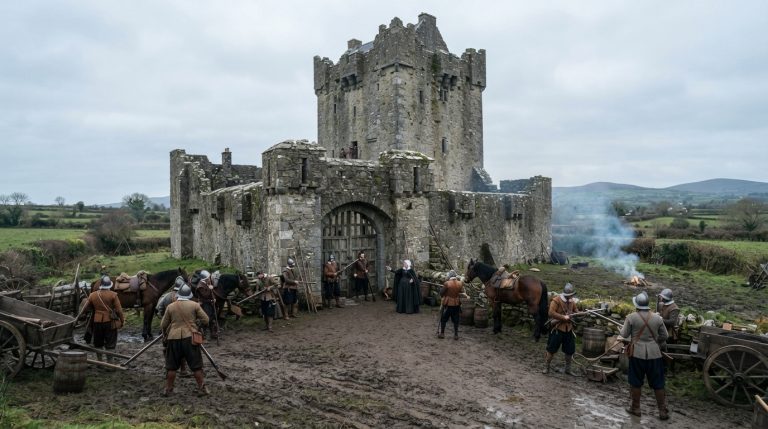
Tradition places their arrival on Beltaine, the opening of summer, when seasonal renewal made an appropriate setting for a new order. They descended upon north-western Connacht beneath a concealing mist, alarming the Fir Bolg, the people already possessing Ireland. Eochaid son of Erc, king of the Fir Bolg, learned at Tara that strangers had settled in the west. A warning dream had prepared him for danger. Although these details belong to literature rather than recoverable history, they create a contrast: an established earthly kingdom confronts newcomers whose origin, abilities, and intentions remain uncertain, while Ireland becomes the prize between them.
Both peoples first attempted diplomacy. The Fir Bolg sent their champion Sreng, while the Tuatha Dé Danann dispatched Bres. The warriors approached cautiously, shields raised, studying unfamiliar weapons before discovering that they shared a language. Sreng carried heavy, broad-bladed spears capable of crushing shields and bodies; Bres bore lighter, sharply pointed weapons. They exchanged spears so each army could examine the other’s equipment, and they parted as friends despite the approaching conflict. Bres offered peace if the Fir Bolg surrendered half of Ireland. Sreng advised acceptance, but Eochaid and his nobles refused, fearing that yielding half would cost them everything.
The opposing armies moved towards Mag Tuired, associated in the first battle with the region of Cong in County Mayo. Before combat, the Tuatha Dé Danann renewed their proposal for a division of Ireland. Again the Fir Bolg rejected it, but both sides agreed to delay hostilities while preparing weapons. The tale thereby presents war as a formal contest shaped by negotiation, honour, and reciprocal rules, rather than slaughter. Magical attacks, dark clouds, and showers of fire or blood heighten the supernatural atmosphere. Fir Bolg druids counter these enchantments, ensuring that skill and knowledge operate on both sides of the dispute.
Battle began at midsummer and continued for four days. Equal numbers were chosen for each day’s fighting, despite the Fir Bolg having the larger army. Champions performed feats, hurlers met in deadly contests, and physicians prepared herbal baths to restore wounded warriors overnight. Such healing emphasises the Tuatha Dé Danann’s command of medicine, though the Fir Bolg also possess healers and courage. The narrative does not portray the defeated people as contemptible. Their resistance is heroic, and Sreng especially commands respect. Through repeated combat, the legend tests not only strength but leadership, loyalty, endurance, technical skill, and obedience to conditions.
On the fourth day, the Tuatha Dé Danann gained the advantage. Eochaid, overcome by thirst, left the field under guard and was pursued to the shore, where he fell in combat. With only a remnant of the Fir Bolg surviving, Nuada offered peace and allowed them to choose an Irish province. Sreng selected Connacht, preserving a place for his people in the island’s legendary geography. Nuada, however, lost an arm to Sreng and was temporarily disqualified from kingship because a ruler was expected to be physically complete. Dian Cécht’s silver replacement later gave him the name Nuada Airgetlám, or Silver-Hand.
Victory established the Tuatha Dé Danann at Tara, the symbolic centre of Irish kingship. Their Lia Fáil was said to cry beneath the rightful sovereign’s feet, binding supernatural approval to political authority. Yet their triumph over the Fir Bolg was not the end of their struggles; conflict with the Fomorians and the Second Battle of Mag Tuired awaited them. These stories should be read as mythology preserved and layered across centuries, not as literal chronicles of ancient invasions. Their importance lies in how they imagine Ireland: a land where sovereignty depends upon courage, generosity, artistry, wisdom, and accommodation with defeated rivals.
Primary Sources
- Lady Augusta Gregory, Gods and Fighting Men
https://www.gutenberg.org/ebooks/14465 - R. A. Stewart Macalister, Lebor Gabála Érenn: The Book of the Taking of Ireland, Part IV
https://archive.org/details/leborgablare04macauoft - CODECS, “Gabáil Tuath nDé”
https://codecs.vanhamel.nl/Lebor_gab%C3%A1la_%C3%89renn/2G%281%29._Gab%C3%A1il_Tuath_nD%C3%A9 - CODECS, “Cath Maige Tuired”
https://codecs.vanhamel.nl/Cath_Maige_Tuired - Elizabeth A. Gray, Cath Maige Tuired: The Second Battle of Mag Tuired
https://archive.org/details/cathmaigetuiredt0000unse - John Carey, “Myth and Mythography in Cath Maige Tuired”
https://www.jstor.org/stable/30070824 - James Fraser, “The First Battle of Moytura”
https://archive.org/details/firstbattleofmoy00fras - University of Galway, “The Medieval Perception of the Tuatha Dé Danann”
https://researchrepository.universityofgalway.ie/bitstreams/cc7cdc46-bdff-4294-9b60-4640a379748d/download - Vernam Hull, “The Four Jewels of the Tuatha Dé Danann”
https://archive.org/details/zeitschriftfrc15meyeuoft - Dáithí Ó hÓgáin, The Lore of Ireland: An Encyclopaedia of Myth, Legend and Romance
https://books.google.com/books?id=ZcYwAAAAYAAJ