
Cork Infirmary(c.1400s)
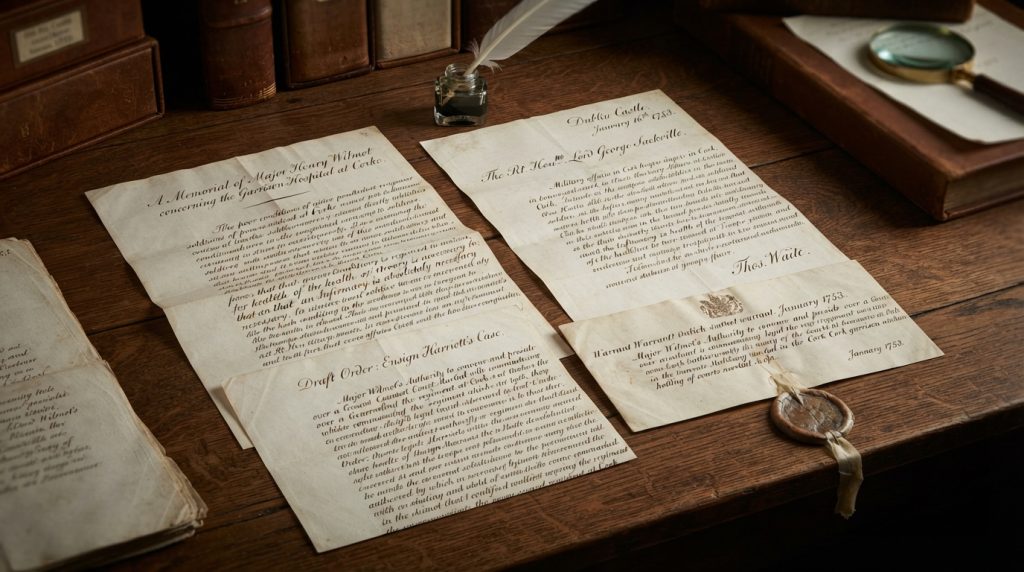
On Tuesday, 16 January 1753, a surviving Dublin Castle letter turned official attention towards conditions among the military stationed in Cork. Under-secretary Thomas Waite wrote to Lord George Sackville enclosing a memorial from a Major Wilmot who argued that an infirmary was needed at Cork. The same correspondence also raised a separate military-justice question concerning Major Wilmot’s authority to preside over the court martial of Ensign Harriott. Accompanying papers included a warrant authorising courts martial at Cork and a draft order dealing with Harriott’s case. The documents provide an unusually detailed snapshot of military administration on one exact Irish day.
Cork’s importance made the question of medical provision more than a local matter. By the eighteenth century the city had become a major Atlantic port and commercial centre. Its prosperity increasingly rested on the provisions trade, particularly salted beef, pork and butter supplied to ships and overseas markets. The harbour was also strategically important to Britain’s naval and military system. Soldiers, sailors, merchants and labourers consequently moved through Cork in considerable numbers. Military personnel stationed there faced the ordinary hazards of illness, injury and infectious disease in an age when treatment remained limited. A request for an infirmary therefore belonged naturally within the administration of a substantial garrison town.
There was already an important medical development under way in Cork. The Cork Infirmary Act, passed by the Irish Parliament and receiving royal assent on 1 May 1752, had legally established an infirmary in the city. The Act vested an existing infirmary house and adjoining yard near St Mary Shandon, or St Anne’s, in trustees and empowered them to maintain and enlarge an institution for sick and infirm people. The legislation was therefore less than a year old when Major Wilmot’s January 1753 memorial was considered. The surviving military correspondence does not establish that his proposed infirmary was identical with this civic institution, so the two should not automatically be treated as the same establishment.
That distinction is historically important. Military medical arrangements frequently had requirements different from civilian charitable medicine. Soldiers lived collectively in barracks, marched, trained and performed guards and patrols, making disease capable of spreading rapidly through crowded quarters. Officers responsible for a garrison consequently had practical reasons for wanting somewhere suitable to isolate and treat sick men. Major Wilmot’s memorial is valuable because it shows such concerns reaching the administrative centre of government. It also demonstrates how apparently local questions in Cork could move through a chain of command extending from an officer in Munster to officials at Dublin Castle and ultimately to senior political authorities.
The same packet of papers reveals another aspect of military government: courts martial. Major Wilmot questioned whether he possessed the right to serve as president of the court trying Ensign Harriott. A surviving copy warrant concerned the holding of courts martial at Cork, while an accompanying draft order instructed a military court to reassemble and reconsider its decision. These were not casual proceedings. Military justice operated through formal warrants, commissioned officers, written orders and established rules. The preservation of these papers means that on 16 January 1753 historians can see not only concern for soldiers’ health but also the legal machinery intended to regulate their conduct.
Harriott’s case had already occupied Dublin Castle. On 9 January, one week earlier, Waite had ordered the court martial to reassemble and reconsider the sentence reached in the ensign’s trial. On the same date another court martial was instructed to proceed against Cornet Nugent. The recurrence of Harriott’s name on 16 January suggests that questions surrounding the proceedings had not been completely resolved. Importantly, the surviving catalogue evidence does not establish the offence for which Harriott was tried, and it would be wrong to invent one. What the records demonstrate securely is the administrative attention devoted to ensuring that the military court itself operated under proper authority.
Another exact-date military document shows how varied Waite’s workload could be. On 16 January, he also sent Lord George Sackville a discharge relating to Amos Cornish, whose case had appeared in the correspondence earlier in the month. Thus within a single day papers could concern military medicine, courts martial, an officer’s authority and the discharge of an individual soldier. Such documents expose the routine bureaucracy beneath the visible presence of the army. Every regiment produced questions involving discipline, personnel, money, health and appointments, all of which generated written records passing between commanding officers and government secretaries.
The public information world of Ireland was active that day as well. The Dublin Gazette, Number 250, appeared on 16 January 1753, beginning a new issue that ran to 20 January. The immediately preceding Number 249 also ended on the target date. Published “by authority”, the Gazette carried official notices and news while private governmental correspondence remained largely invisible to ordinary readers. The contrast is instructive. A Dublin reader could purchase or encounter printed government information without knowing that elsewhere clerks were handling the intimate details of a Cork infirmary proposal or debating who possessed authority to preside over a court martial.
Cork itself was a city undergoing economic expansion. Its harbour and provisioning industries placed it within a widening Atlantic economy, while institutions concerned with medicine, charity and urban government were gradually developing alongside commerce. The 1752 Infirmary Act explicitly permitted trustees to acquire property and financial resources for enlarging the institution and supporting the sick, maimed and infirm. That legislation and Major Wilmot’s memorial, although representing potentially different medical needs, reveal the same underlying reality: eighteenth-century Cork was becoming sufficiently large and important that organised provision for sickness could no longer be left entirely to households, regiments, religious charity or individual physicians.
The significance of 16 January 1753 therefore lies not in one spectacular event but in the unusual concentration of surviving evidence concerning health, discipline and administration. A military officer sought better medical provision at Cork; questions persisted over Ensign Harriott’s court martial; formal warrants and orders accompanied the correspondence; a soldier’s discharge passed through Dublin Castle; and a new Dublin Gazette entered circulation. Together these records reveal an Ireland governed through paper as much as through soldiers and politicians. They also preserve an important lesson for a day-by-day history: ordinary administrative documents can recover the practical problems of Irish life with a precision that famous national narratives often cannot.
Primary Sources
- Thomas Waite to Lord George Sackville — 16 January 1753 — Derbyshire Record Office, D3155/C/1411. Memorial from Major Wilmot concerning the need for an infirmary at Cork and his authority to preside at Ensign Harriott’s court martial. This is the principal exact-date source.
- Irish military administration — Copy warrant for holding courts martial at Cork — 1753 — D3155/C/1412. Enclosed with Waite’s 16 January correspondence and directly relevant to the dispute over military judicial authority.
- Irish military administration — Draft order for a court martial to reassemble and revise its sentence — 16 January 1753 — D3155/C/1413. Directly connected with the Harriott proceedings.
- Thomas Waite to Lord George Sackville — 16 January 1753 — D3155/C/1414. Enclosed a discharge for Amos Cornish, documenting another exact-date piece of military personnel administration.
- P. Donnellan to Lord George Sackville — Dublin Castle, 16 January 1753 — D3155/C/1416. Exact-date administrative correspondence concerning authority for the presentation of Robert Baillie to an ecclesiastical living.
- Richard James and John Butler — The Dublin Gazette, No. 250 — 16–20 January 1753. Official Irish government newspaper beginning on the exact target date. Houses of the Oireachtas Library / Virtual Treasury of Ireland.
- Richard James and John Butler — The Dublin Gazette, No. 249 — 13–16 January 1753. Official issue ending on the target date and providing the immediate printed context.
- Parliament of Ireland — Cork Infirmary Act 1751, 25 Geo. II c.23 — royal assent 1 May 1752. Established an infirmary in Cork and vested the infirmary house near St Mary Shandon or St Anne’s in trustees.
- Trustees of Cork Infirmary — Powers under Section 5 of the Cork Infirmary Act — 1752. Authorised acquisition of property and personal estate for enlarging the institution and supporting sick, maimed and infirm patients.
- Thomas Waite to Sir Robert Wilmot — 8 January 1753. Reports that the Dublin garrison was to be reviewed before its tours began, providing military administrative context from the same month.
- Thomas Waite to Lord George Sackville — 9 January 1753 — D3155/C/1404. Ordered the court martial to proceed with the trial of Cornet Nugent.
- Thomas Waite to Lord George Sackville — 9 January 1753 — D3155/C/1405. Ordered the court martial in Ensign Harriott’s case to reassemble and reconsider its sentence.
- Captain Robert Dobson to Lord Cadogan — Dublin, 6 January 1753. Contemporary military correspondence concerning the execution of Major Douglas’s will, illustrating the broader military paperwork circulating during the same period.
- Major Wilmot — Follow-up correspondence concerning the Cork proceedings — 19 January 1753. A direct continuation of the matters raised in the 16 January packet.
- Thomas Waite / Major Wilmot — Correspondence concerning the Cork court martial — 20 February 1753. Waite enclosed another letter from Major Wilmot together with a report on proceedings at Cork.
- Military court at Cork — Report of proceedings — February 1753 — D3155/C/1469. Contemporary report associated with the continuing Cork court-martial dispute.
- George Faulkner — Faulkner’s Dublin Journal — January 1753 issues. Contemporary newspaper providing advertisements, military notices, commercial information and news during the target month.
- Publishers of Pue’s Occurrences — January 1753 issues. Contemporary Dublin newspaper providing an independent record of Irish social, commercial and public affairs.
- James Simon — An Account of the Barometer, and the State of the Weather, at Dublin, from March 1752 to February 1753. Contemporary meteorological observations encompassing 16 January 1753.
- Ireland, Parliament, House of Commons — Journals of the House of Commons of the Kingdom of Ireland — proceedings for 1751–53. Official parliamentary record containing the legislative environment in which the Cork Infirmary Act and other public measures were enacted.