Editorial — Stoke
Welcome to the Emerald Archives Gazette. In today’s issue we look back at the latest additions to the archive. Cavan Castle — In 1514 Ireland was not governed from a single centre, nor did political power stop at the edge of the English lordship. The young Gerald FitzGerald, ninth earl of Kildare and the king’s deputy, sought to demonstrate that he had inherited his father’s authority. Yet his forces encountered rival lordships whose leaders could raise their own military followings, command castles, make agreements and settle disputes by hostage-taking, compensation and war.
Dateline
The Day in Irish History
Welcome to the Emerald Archives Gazette. In today’s issue we look back at the latest additions to the archive.
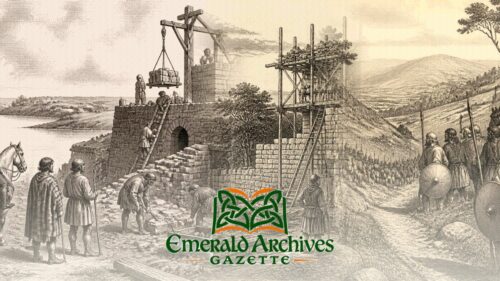
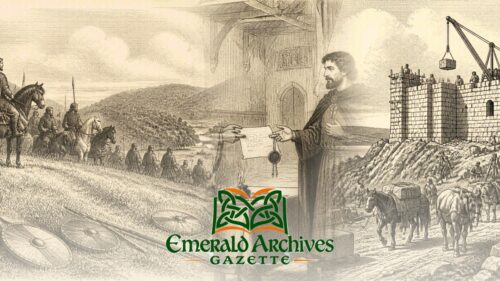
Cavan Castle — In 1514 Ireland was not governed from a single centre, nor did political power stop at the edge of the English lordship. The young Gerald FitzGerald, ninth earl of Kildare and the king’s deputy, sought to demonstrate that he had inherited his father’s authority. Yet his forces encountered rival lordships whose leaders could raise their own military followings, command castles, make agreements and settle disputes by hostage-taking, compensation and war. The Irish annals record campaigns in Laois, Breifne, Munster and Ulster; a contemporary churchman writing to England described a country rich in foodstuffs but insecure by land and sea. Taken…
Kildare Succession — In 1513, Irish politics was shaped less by a single national event than by simultaneous struggles for lordship, territory and legitimacy. The death of Gearóid Mór FitzGerald, eighth earl of Kildare, removed the most powerful magnate in the English lordship. In Ulster, the O’Neill succession was contested and then settled through a mixture of inauguration, force and outside support. Aodh Dubh O’Donnell campaigned from Sligo to Scotland, while the death of James IV at Flodden abruptly altered the political weather across the North Channel. Yet the annals also preserve a different Ireland: Franciscan scholarship, aristocratic patronage, coastal raiding, local vengeance…
Omagh Castle — In 1512, power in Ireland was displayed not principally through proclamations or fixed frontiers, but through the ability to move armed followers, take castles, exact hostages, feed retainers and make opponents accept terms. The year is unusually well illuminated by the Irish annals. Their notices concern the northern and western lordships most closely, while also recording the actions of Gerald FitzGerald, eighth earl of Kildare and justiciar of Ireland. Together they reveal an island of overlapping jurisdictions: the English crown’s lordship, administered from Dublin but dependent on Kildare’s local strength; Gaelic lordships with their own dynastic claims; and church institutions…
Offaly Succession — In 1511, the killing of Cathair Ó Conchobair Fáilghe—usually rendered Cahir or Charles O’Conor Faly—gave the Irish midlands one of its most consequential changes of lordship. The annals do not supply a day or month, but they are unusually clear about the essentials: Cathair, lord of the O’Conor Faly territory, was slain near Mainistir-Feorais by kinsmen from rival branches of his own dynasty. His death was more than a private murder. In the borderland between Gaelic Offaly and the English lordship, control of a leading kindred affected raiding, tribute, alliances, the security of roads and settlements, and the precarious balance…
Monabraher Campaign — In 1510 the most consequential Irish event recorded by the annals was a major expedition into Munster led by Gerald FitzGerald, eighth earl of Kildare. Gerald, often called Gearóid Mór or ‘the Great Earl’, was justiciar of Ireland: the chief governor acting for Henry VIII, who had succeeded to the English throne in 1509. Yet the campaign shows why this office cannot be understood simply as an extension of royal government from Dublin. Kildare’s authority rested on his own estates, affinities and bargains with lords across the island. His army was a coalition, and the resistance that checked it was…
Omagh Campaign — In 1509, the death of Henry VII and the accession of his son Henry VIII did not produce a sudden remaking of Ireland. The lordship remained a patchwork of jurisdictions, alliances and rival lordships: the Dublin administration governed most directly within and around the Pale, while powerful Gaelic and Gaelicised dynasties exercised authority across much of the island. Yet the change of monarch created a moment of uncertainty. In Dublin, the leading men of the lordship moved quickly to preserve continuity by retaining Gerald FitzGerald, eighth earl of Kildare, at the centre of government. In Tyrone, meanwhile, a struggle within…
Enniskillen Coup — In 1508, the most consequential recorded Irish action was fought not on a great open battlefield but across the waters of Lough Erne. Aodh Óg Ó Domhnaill, lord of Tír Chonaill, travelled with boats against the castle at Inis Ceithleann, now Enniskillen, seized it from Ruaidhrí Mag Uidhir and redistributed power within Fermanagh. The episode shows how readily lordship in late medieval Ireland could be won through control of a crossing, a castle, hostages and the allegiance of competing kin-groups. Yet the same year also records a dramatic defence of a church on St Patrick’s feast, the creation of a…
Carrickfergus Hostages — In 1507 Ireland was not governed from a single, evenly effective centre. Henry VII was lord of Ireland, and Gerald FitzGerald, eighth earl of Kildare, remained his deputy; but the reach of Dublin government varied sharply by region. In Ulster especially, lordship rested on kinship, cattle, military followings, negotiated submission and the capacity to hold a castle or compel pledges. The year’s best contemporary narrative, the Annals of Ulster, is consequently not a record of royal proclamations or parliamentary statute. It is a compact sequence of deaths, burnings, captives, hostages and learned men. Read together, its entries show a society…
Shannon Bridge — In 1506 a new bridge crossed the Shannon at Port Croise, the crossing later associated with O’Brien’s Bridge. The annals credit its erection to Turlough O’Brien, lord of Thomond, his brother Donnell, and the bishops of Killaloe and Kilfenora. It was an unusually tangible achievement in a year more often recorded through raids, killings and deaths. A bridge could make a river crossing more dependable for travellers, livestock, messengers and armed companies; at this point it also had political force. The Shannon was not merely a geographical feature dividing regions. It was a major route, barrier and frontier beside the…
Donegal Succession — In 1505, the death of Aodh Ruadh Ó Domhnaill—Hugh Roe O’Donnell—ended one of the longest and most forceful lordships in late medieval Ireland. His passing at Donegal was not simply an obituary for a powerful regional ruler. It set in motion a carefully staged transfer of authority in Tír Chonaill, the north-western lordship centred on modern County Donegal, while persistent rain damaged crops across much of Ireland and local rivalries continued to bring violence into churches, lordly households and farming districts. The evidence for the year is unusually rich in northern annals, though it must be handled with care: some…
Knockdoe Battle — In 1504, a dispute in south Connacht drew together one of the largest armies seen in Ireland for generations. Its climax was the Battle of Knockdoe, fought near Galway on 19 August. The encounter was not a simple contest between an English government and an Irish resistance. Gerald FitzGerald, eighth earl of Kildare and the king’s deputy in Ireland, led an alliance made up of lords and fighting men from the English Pale, Leinster, Ulster and Connacht. His principal opponent, Uilleag Fionn Burke, lord of Clanricard, was himself the head of a family of Anglo-Norman descent long embedded in Gaelic…
Maguire’s Death — The surviving record for 1503 presents no single ‘national’ story. Ireland was governed through overlapping lordships, kin-groups, towns, church jurisdictions and the English crown’s limited administration. Yet the year’s annals illuminate a striking pattern: authority was secured and contested through fortified places, marriage, fosterage, military followings, church patronage and control of routes between regions. The most precisely dated event was the death of Seaán Mag Uidhir, lord of Fir Manach, at Enniskillen. Around it stand a northern campaign by the earl of Kildare, warfare among O’Neills and O’Donnells, conflict in Connacht, and deaths that altered political calculations from Fermanagh to…
Cavan Observance — The surviving record for 1502 does not offer a single national event or a clear calendar of kings and parliaments. Instead, it presents an Ireland of intensely local politics, in which raids, killings, church disputes and weather bound distant regions together. The fullest contemporary notices come from the northern and midland annals. They must be read with care: entries are assigned to the year, but normally not to a day or month, and their concentrated attention to lordly families does not mean that only lords experienced the year’s shocks. On the contrary, the annalists’ terse reports of burned settlements, fleeing…
Sligo Capture — For Ireland, 1501 is best approached not as a year of one national event but as a sequence of sharply local struggles. The annals record fighting in Oriel, Slieve Beagh, Sligo and Thomond; deaths among ruling families; the capture and ransom of a returning pilgrim; and the passing of churchmen and learned men. Taken together, these notices reveal an island in which authority was intensely regional. The English crown’s lordship survived, and Gerald FitzGerald, eighth earl of Kildare, was serving as lord deputy, but its effective reach was uneven. Beyond the Pale and the larger Anglo-Irish lordships, political power rested…
Galway Fire — The surviving record for 1500 does not offer a single, island-wide drama. Instead, it preserves a sequence of local shocks: a succession disputed in Breifne, killings and castle-building around Fermanagh, a destructive incursion into Tír Eógain, a major fire in Galway, violence among Munster magnates, and a season of exceptional wetness that damaged wheat. Taken together, these firmly dated annalistic notices show an Ireland governed through many competing lordships and jurisdictions, where political authority depended on kinship, military followings, fortified places, cattle and horses, and the capacity to protect cultivation. A Year Recorded from Ulster The principal contemporary-style narrative source…
Athleague Recovery — The Irish annals make 1499 a year of movement rather than settlement: armies crossed provincial frontiers, castles changed hands more than once, hostages were redistributed, and established lordships faced abrupt successions. The best-recorded theatre was Connacht, where Gerald FitzGerald, eighth earl of Kildare and the English king’s deputy in Ireland, led an expedition west of the Shannon. Yet the year also illuminates the limits of his authority. Kildare could seize strongholds and compel submissions, but local alliances rapidly recovered ground. Elsewhere, contests within the O’Donnell and Maguire worlds of the north-west, a succession in Thomond, and an O’Brien victory over…
Dungannon Artillery — In 1498, the taking of Dungannon Castle made a local Tyrone succession struggle into an island-wide demonstration of political power. Gerald FitzGerald, eighth earl of Kildare and the king’s deputy in Ireland, led an expedition north with a coalition that included Aodh Ruadh O’Donnell of Tír Chonaill, John Maguire of Fermanagh and Turlough O’Neill. The castle fell to artillery. That fact matters: the guns were not merely instruments of destruction, but a visible statement that the deputy could bring costly, organised force into the heartland of the O’Neills. Yet the campaign also shows the limits of any simple picture of…
Conn O’Donnell — In 1497, Ireland’s political map was not governed from any single centre. Henry VII was lord of Ireland, and the Dublin administration had recently returned to the hands of Gerald FitzGerald, eighth earl of Kildare, but royal authority was strongest in and around the English lordship. Beyond it, great Gaelic and Anglo-Irish dynasties defended, extended and disputed their own lordships. The year’s records therefore do not describe one national story. They reveal several connected worlds: a failed Yorkist claimant at Cork, a lethal Butler rivalry in the south-east, a dramatic succession crisis in Tír Chonaill, reforming friars in Ulster, and…
Kildare Return — In 1496 the most conspicuous political change in Ireland was the return of Gerald FitzGerald, eighth earl of Kildare, to royal office. Yet the year cannot responsibly be reduced to a Dublin-centred restoration. The Irish annals record a country in which lordship was contested in many places, harvests failed, cattle perished, fortresses changed hands and learned people, musicians and patrons still mattered enough to be remembered by name. Kildare’s arrival at Howth was significant because it settled a crisis in the English lordship; it did not make Ireland politically uniform, peaceful or secure.A Deputy ReturnsThe firmly dated turning point came…
Waterford Defence — In 1495 Ireland stood at the meeting point of a Tudor succession crisis, local lordship and maritime warfare. The year is most clearly remembered for the attempted capture of Waterford by Perkin Warbeck, the Yorkist pretender who claimed to be Richard, duke of York, the younger son of Edward IV. Yet the same calendar year also brought the removal of the powerful eighth earl of Kildare, a decisive phase in the parliament convened at Drogheda by Sir Edward Poynings, a Scottish journey by Aodh Ruadh Ó Domhnaill of Tír Chonaill, and hard fighting from Breifne to Sligo. Ireland was not…
Poynings Mission — In 1494, Ireland became a crucial theatre in Henry VII’s struggle to secure the Tudor monarchy. The king’s authority as lord of Ireland was strongest in and around Dublin, yet even there it depended on the cooperation of great local magnates, above all Gerald FitzGerald, eighth earl of Kildare. Beyond that zone, often later called the Pale, Gaelic lordships and Gaelicised Anglo-Irish powers made war, negotiated settlements and exercised lordship on their own terms. The year’s record therefore combines a new English-led intervention at Drogheda with local conflicts from Sligo to Fermanagh and Cavan. It was not a moment when…
Glasdromainn Succession — The most consequential Irish events securely assigned to 1493 unfolded in Ulster, where the killing of Conn Ó Néill fractured the leading dynasty of Tír Eóghain. What followed was not a simple change of ruler but a contested succession involving brothers, collateral kindreds, hostages, professional soldiers and the intervention of Aodh Ruadh Ó Domhnaill of Tír Chonaill. A firmly dated battle at Glasdromainn on 28 June showed how quickly a family dispute could turn into a regional war. Elsewhere, raids, assassinations and changes of lordship ran from Kildare and Offaly to Breifne and Connacht, while Gerald FitzGerald, eighth earl of…
Fitzsimons Deputation — In 1492 Ireland faced a convergence of hunger, sickness and political instability. The year is unusually vivid in the Irish annals: they record a “great famine in Ireland”, a notably hot summer, the recent arrival of a sweating plague, local war from East Breifne to Ulster, and the weakening of the authority exercised from Dublin. At the same time Henry VII of England attempted a major remaking of the administration of the English lordship of Ireland. The replacement of Gerald FitzGerald, eighth earl of Kildare, by Archbishop Walter Fitzsimons and Sir James Ormond was intended to curb a magnate whom…
Kildare Arbitration — The clearest national event recorded for 1491 was not a battle with a fixed battlefield and date, but an unsuccessful attempt to prevent one. During the harvest season, Conn Ó Néill, lord of Tír Eógain, and Aodh Ruadh Ó Domhnaill of Tír Chonaill brought their dispute before Gerald FitzGerald, eighth earl of Kildare, then governing the English lordship of Ireland as deputy and described in the Irish annals as justiciar. They left without a dependable peace or truce. The failure mattered well beyond the meeting itself. It confirmed that two of Ulster’s greatest lordships were again at war, and that…
Croghan Succession — In 1490 Ireland was not governed from a single political centre. Henry VII was lord of Ireland, and Gerald FitzGerald, eighth earl of Kildare, exercised the office of deputy governor; yet the reach of Dublin government was limited and negotiated. Across much of the island, Gaelic and Gaelicised lordships controlled land, people, castles and military followings. The annals for this year are especially rich in Connacht and Ulster. They record a sequence of raids, contested successions, killings and captivities which show politics being conducted at local level, but with consequences reaching far beyond individual territories.The year’s most consequential western development…
Dublin Pestilence — For Ireland, 1489 is remembered above all through two sharply different but connected images: a devastating outbreak of plague, and the taking and demolition of the castle at Belfast by Aodh Ruadh Ó Domhnaill of Tír Chonaill. One speaks to vulnerability in households, religious houses and towns; the other to the hard military politics of late-medieval Ulster. A royal order concerning Dublin’s filthy streets, issued on 14 November, adds a third image: civic government attempting to protect life, trade and authority through the removal of dung, pigs and refuse. These were not isolated curiosities. Together they reveal an island in…
Edgecombe Oaths — In 1488, Ireland felt the aftershock of a failed attempt to alter the English succession. The previous year, leading figures of the English lordship in Ireland had backed Lambert Simnel, the Yorkist pretender crowned in Dublin as Edward VI. His cause was destroyed at the battle of Stoke on 16 June 1487, where many Irish soldiers fought and Gerald FitzGerald, eighth earl of Kildare’s brother Thomas was killed. Yet the settlement of 1488 was not simply a punishment imposed from England. It was a negotiated restoration of allegiance, conducted in churches, guild halls, monasteries and lordly residences, while conflict, lordship…
Simnel Coronation — In 1487 Ireland became the launching ground for one of the most serious early challenges to the new Tudor monarchy in England. At Dublin, a boy presented as Edward, earl of Warwick – but now known as Lambert Simnel – was accepted by leading figures of the English lordship, ceremonially crowned, supplied with an army and sent across the Irish Sea. The enterprise ended in defeat at Stoke in England on 16 June, with grave losses among the Irish troops who had crossed with it. Yet this was not a year whose significance can be reduced to Dublin and the…
Drogheda Synod — In 1486 Ireland was not governed by one settled political rhythm. The lordship claimed by the English crown was strongest in and around Dublin, where Gerald FitzGerald, eighth earl of Kildare, remained the decisive figure in government. Beyond the Pale, Gaelic lordships and old English powers negotiated, raided, succeeded and fell according to their own local balances of kinship, military force and patronage. The annals for this year, especially those compiled in Ulster and Connacht, preserve a crowded record of killings, captures, burnings, church business, lordship transfers and shortages. Their density is itself revealing: Ireland’s political life was intensely local,…
Tudor Accession — In 1485, Ireland was not a single political arena waiting for orders from England. It was a country of overlapping lordships, ecclesiastical jurisdictions, chartered towns and frontier districts, in which the authority of the English crown was strongest around Dublin and weakest where local dynasties and military followings set the terms of power. Yet news from across the Irish Sea mattered profoundly. Richard III’s death and Henry Tudor’s accession altered the political calculations of the lordship of Ireland just as warfare, succession and disease were affecting communities from Connacht to Ulster.The surviving evidence gives an unusually textured view of the…
Galway Mayoralty — In 1484 Ireland was not a single political arena but a set of overlapping worlds: the English lordship, most securely organised around Dublin and the Pale; powerful Anglo-Irish lordships; Gaelic kingdoms and client networks; and self-governing towns tied to seaborne commerce. The year’s surviving evidence is uneven. Government records illuminate legislation, offices and urban privileges in the lordship, while the Irish annals preserve sharply local accounts of killings, captivities, churches and successions. Taken together, they show a country in which royal authority, civic ambition and regional violence operated side by side. Richard III and Kildare’s Government Richard III was lord…
O’Donnell Campaign — In 1483, Ireland’s most consequential recorded events were not the decisions taken in London, though the English crown changed hands twice. They were the release and inauguration of Conn O’Neill in Tír Eógain, the resulting war with Aodh Ruadh O’Donnell of Tír Chonaill, and a destructive expedition that reached the Dundalk district. The Irish annals provide unusually vivid particulars: a force made up of several lordships, a defeated pursuit by Gerald FitzGerald, eighth earl of Kildare, the burning of settlements, payments for protection, woodland felled to open a route, and a temporary wicker bridge floated away after an army had…
Conn O’Neill — For Ireland, 1482 is not a year of one decisive battle or a single national settlement. Its surviving notices instead cluster around lordship, kinship, religious authority and learning, chiefly in Ulster, Breifne and Connacht. They reveal a political landscape in which power was personal and local: it depended on the ability to protect dependants, raid enemies, uphold or break agreements, maintain hospitality and reward men of learning. The year’s best-attested events must therefore be treated as regional episodes, not as evidence that all Ireland moved in one direction. The Death of a Northern Patron The most resonant death recorded in…
Maguire Murder — A Year Recorded in FracturesThe surviving Irish annals make 1481 feel at once unusually intimate and stubbornly incomplete. They preserve several deaths, a precise killing, raids and captures, but rarely the wider deliberations that brought people to violence. The clearest date belongs to a Fermanagh catastrophe: on 5 October, the day after the feast of St Francis, Toirdelbach Mag Uidhir was killed by kinsmen in his own castle. Around that event stand other signs of a politically divided island: open war within Tír Eógain, retaliatory killings in Ulster, a Cavanagh death in Wexford, and legislative business in the English lordship…
Castlefinn Peace — The surviving Irish annals make 1480 look less like a single national story than a chain of hard local reckonings: raids and counter-raids in Ulster, a failed siege involving the Earl of Kildare, a settlement at Castlefinn, deaths that reshaped networks of lordship and hospitality, and conflict extending from Fermanagh to Connacht. The year is unusually well illuminated by the Annals of Ulster and the later Annals of the Four Masters. Their entries must nevertheless be read with care. They record events under the year 1480, but rarely give a day, and their praise of lords, clerics and poets follows…
Meelick Observance — For Ireland, 1479 is most clearly illuminated not by a single island-wide crisis but by a cluster of records from very different worlds: a Franciscan house beside the Shannon, a destructive war in Ulster, ecclesiastical deaths around Lough Erne, and the restoration of a young earl to royal office in Dublin. These should not be forced into one story. They reveal instead an island of overlapping jurisdictions, in which Gaelic lordships, Anglo-Irish magnates, towns, religious communities and the English crown all exercised authority in particular places.The surviving annals attach several developments firmly to this year, though they were compiled or…
Assaroe Pestilence — Ireland’s annalists remembered 1478 as a year when hazards arrived by wind, water and armed force. Their entries do not amount to a complete national chronicle: they preserve what particular learned communities considered worth recording, with a strong concern for dynasties, churches and notable deaths. Yet, read together, they reveal an island shaken by an exceptional early-year storm, an epidemic associated with a ship at Assaroe, and concentrated struggles for castles and lordship in Connacht. In Dublin and the lordship centred on the Pale, the death of the seventh earl of Kildare also brought Gerald FitzGerald, later called Gearóid Mór,…
Tírhugh Burning — For Ireland, 1477 is unusually well illuminated by several annalistic traditions, though their evidence has limits. The Annals of Ulster, Annals of Connacht and the later Annals of the Four Masters all place a cluster of killings, a northern campaign, a Munster succession struggle and a destructive wind within this calendar year. They rarely supply the motives, numbers or experiences of ordinary people behind their compressed notices. Yet, read together, they show a country in which power was intensely local: lordships were defended through kinship, military followings, hostage-taking, religious patronage and control of land and produce.Ireland was not governed as…
Belfast Castle — In 1476, Ireland was not governed by a single political rhythm. The lordship of the English king, Edward IV, retained its institutions in Dublin, Meath, Louth and the port towns, but royal authority depended heavily on local magnates and was far from an island-wide power. Beyond and across those jurisdictions, Gaelic and Gaelicised lordships negotiated, raided, fostered allies, defended castles and competed for succession. The year’s annals preserve a strikingly broad picture: an O’Neill army broke the castle at Bel-Feirste; the Maguires of Fermanagh lost two important potential leaders; factions seized and immediately lost Roscommon castle; armies faced one another…
O’Donnell’s Circuit — In 1475 the most conspicuous movement in Irish politics was a long military and diplomatic circuit led by Aodh Ruadh O’Donnell, lord of Tír Chonaill. The annals place his progress firmly in this year, though they differ in emphasis and in the precise order of some stages. What is clear is that O’Donnell travelled with a substantial host from the north-west through Breifne, Meath, Offaly and Connacht, resolving disputes where it suited him, fighting where agreement failed, and returning home with his standing enhanced. His expedition offers an unusually vivid view of a late-medieval Ireland governed not from one centre…
Donegal Friary — For Ireland, 1474 is remembered above all for a building begun at the mouth of the River Eske: the Franciscan friary of Donegal. The entry in the Annals of the Four Masters is unusually direct. It says that Aodh Ruadh Ó Domhnaill, lord of Tír Chonaill, and his wife Fionnghuala or Finola, daughter of Conor na Srón Ó Briain, commenced the monastery and granted it to God and the friars of St Francis. They intended it to serve both their souls and their descendants, as a dynastic burial place, and added further gifts.That record gives the year a focal point,…
Galway Lightning — The annals for 1473 preserve a year of striking contrasts: a walled port abruptly burned by lightning, a recorded eclipse, a serious mortality among cattle, executions and raids, and repeated deaths among men positioned to inherit lordships. The fullest surviving notices come from Connacht and the midlands, while the Annals of Ulster add important testimony from Fermanagh and Muintir Eolais. They should not be mistaken for a complete national chronicle or an eyewitness diary. Yet, read together, they show how intimately weather, animal health, warfare, lordship, commerce and religious expectation could be connected in late medieval Ireland. A Friday Fire…
Royal Camel — In 1472, Ireland was not a kingdom directed from a single centre but a landscape of competing lordships, jurisdictions and alliances. Thomas FitzGerald, seventh earl of Kildare, governed the English lordship as justiciar for Edward IV, yet his effective reach was concentrated around Dublin and the counties usually described as the Pale. Beyond and across those limits, Gaelic and Anglo-Irish rulers made war, took hostages, negotiated settlements and pursued family rivalries according to local balances of power. The year’s surviving record is unusually vivid: it includes killings and campaigns from Ulster to Connacht, an uneasy political struggle in the lordship,…
Oghmagh Siege — In 1471, Irish political life was shaped less by a single national crisis than by a succession of local contests in which castles, cattle, hostages, kinship and negotiated submission mattered greatly. The surviving annals place several developments firmly within this calendar year. Taken together, they show a country of powerful but competing lordships, where authority was asserted through campaigns and alliances, yet also by the protection of churches, scholars and dependants.The year’s clearest northern episode was the capture of the castle of Oghmagh by Henry O’Neill, son of Eóghan. The annalist’s account is unusually full. Fighting had begun at the…
Sligo Manuscripts — The surviving record for 1470 is uneven, but it is unusually revealing. Irish annals preserve hard, year-specific notices of campaigns, killings, a disease outbreak, a parliamentary programme and a new Franciscan house. Read together, they show an island with no single effective political centre. The English lordship remained institutionally present around Dublin and the eastern counties, while Gaelic and Gaelicised dynasties exercised power across most of Ireland through alliances, hostage-taking, tribute, cattle-raiding, castles and local inaugurations. The year’s most striking episode came at Sligo, where Aodh Ruadh Ó Domhnaill’s capture of a castle also brought the recovery of celebrated Irish…
Claregalway Hostages — In 1469, the most consequential Irish campaign recorded by the surviving annals began far from Dublin, in the north-west, and ended amid fire in County Galway. Aodh Ruadh Ó Domhnaill of Tír Chonaill gathered a major hosting, took hostages in Lower Connacht, and marched south with the newly installed Mac William Burke against the rival Burke lordship of Clanricarde. The burning of Baile an Chláir, identified by the annals as Mac William’s town and generally understood as Claregalway, was not an isolated raid. It was a display of alliance, coercion and regional ambition in a landscape where power rested on…
Desmond’s Execution — In 1468, an execution at Drogheda became the year’s defining Irish political shock. Thomas fitz James FitzGerald, earl of Desmond and former deputy of Ireland, was beheaded after appearing before the king’s administration. The killing reverberated far beyond the walled town on the Boyne. Irish annals written in different regions treated it not as an ordinary aristocratic fall, but as an outrage which exposed the precariousness of government in late medieval Ireland.That response matters. Ireland was not governed as one unified political realm in practice. The English crown’s officials and law had their strongest footing in Dublin, the Pale and…
Worcester’s Parliament — In 1467, Ireland’s political landscape was shaped less by a single national turning-point than by several simultaneous contests for authority. The English lordship centred on Dublin was being recast under a new deputy, John Tiptoft, earl of Worcester; Gaelic and Gaelicised dynasties continued to fight, bargain and replace one another across Ulster, Connacht and the midlands; and the annals recorded the deaths of rulers, clerics, poets and household leaders whose standing rested on lordship, learning and hospitality. The year is therefore best understood as one in which formal government tried to assert itself while power on the ground remained dispersed…
Thank you for reading today’s Gazette. Follow any of the links above to read the full article and explore its sources.