Cheering Crowds

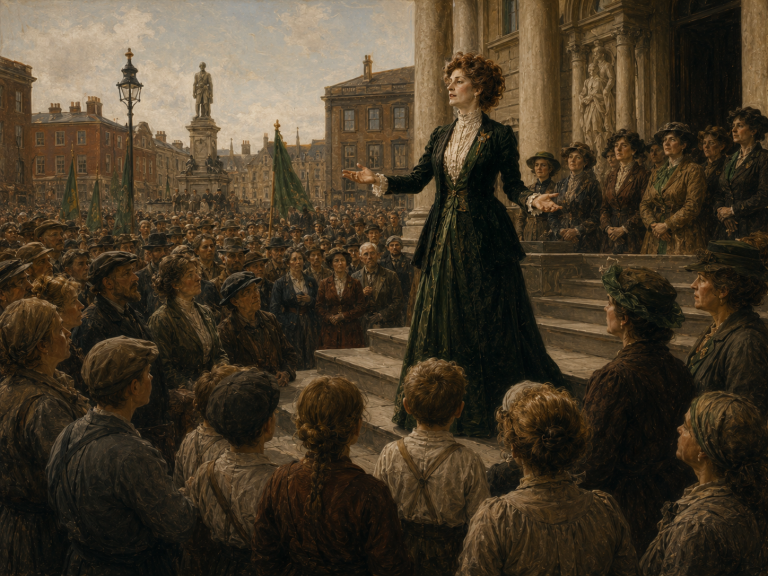
Large crowds have lined the route of Queen Victoria’s procession from Kingstown towards Dublin, creating one of the most striking public spectacles witnessed during her final visit to Ireland. The royal carriage passed through heavily decorated streets while spectators filled pavements, windows and temporary viewing places. Reports reaching Limerick describe sustained cheering as the procession moved towards the capital and the Viceregal Lodge in Phoenix Park. The gathering revealed more than official organisation alone. Public curiosity drew thousands outdoors, while loyalist residents and supporters of the Union treated the Queen’s arrival as an opportunity to demonstrate attachment to the Crown and British Empire.
The Queen recorded that the entire road from Kingstown was crowded and that the people cheered loudly as her carriage passed. She travelled with a military escort in a procession of four carriages, accompanied by members of the royal family and senior officials. Decorative arches, greenery, garlands and imperial emblems marked the route, transforming the approach to Dublin into a carefully arranged ceremonial landscape. Contemporary photographs and moving pictures preserved the density of the gathering and the scale of the preparations. For many spectators, the occasion offered a rare chance to see the elderly monarch whose reign had shaped Irish public life for more than sixty years.
The enthusiasm visible along the procession route should not be mistaken for unanimous Irish approval of British government. Dublin contained substantial loyalist, Protestant, military, commercial and administrative communities, while many constitutional nationalists sought Home Rule without necessarily rejecting the monarchy. Others may have attended from simple curiosity, drawn by the holiday atmosphere, decorations, music, soldiers and unusual movement through the streets. Railway and tram services carried additional visitors into the capital. The crowds therefore represented several impulses at once: sincere royal loyalty, imperial patriotism, fascination with ceremony, commercial opportunity and the ordinary human desire to witness an event that might never be repeated.
Opposition remained active beyond the cheering streets. Advanced nationalists condemned the visit as imperial propaganda during the South African War, while Maud Gonne and her associates invoked memories of famine, eviction and emigration in their protests. The Catholic hierarchy also maintained a cautious distance from some of the official celebrations. Such hostility did not prevent large numbers from attending, but it complicated claims that the procession proved complete Irish devotion to the Crown. In Limerick, where nationalist politics remained powerful but British military connections were deeply established, residents could recognise the same mixture of loyalties, resentments and personal curiosity displayed in Dublin.
The procession consequently revealed an Ireland more politically varied than either loyalist celebration or nationalist protest alone could suggest. The cheering was genuine, as were the decorations and the public excitement, yet attendance did not necessarily amount to approval of British rule. Some spectators honoured the Queen, others admired the display, and still others simply wished to observe history passing before them. For Limerick readers, the scene offers a reminder that imperial attachment and Irish nationalism could exist beside one another within the same city, family or individual. The royal carriage travelled through a crowd united briefly by spectacle, though divided profoundly over what the spectacle represented.
Primary Sources
- Queen Victoria, journal entry, 4 April 1900, Royal Archives, Windsor Castle; the Queen described the route from Kingstown to Dublin as heavily crowded, with loud cheering and extensive decoration. Exact archival volume and folio should be confirmed before formal citation.
- The Irish Times, 5 April 1900, contemporary report on Queen Victoria’s arrival, the decorated procession route and the crowds gathered throughout Dublin. Exact page and column should be confirmed before formal citation.
- Freeman’s Journal, 5 April 1900, contemporary nationalist newspaper coverage of the royal arrival, public attendance and political reactions. Exact page and column should be confirmed before formal citation.
- British Mutoscope and Biograph Company, Queen Victoria in Dublin, 4 April 1900, surviving actuality film showing the royal carriage, procession and spectators; preserved by the Irish Film Institute.
- Robert Augustus Henry L’Estrange, photographic series of Queen Victoria’s royal visit to Dublin, 4–26 April 1900, Queensland University of Technology Digital Collections, Robert Augustus Henry L’Estrange Collection.