Women’s Lives(c.1000s)

On 2 March AD 1000, no surviving Irish source records an event involving a woman that can be assigned securely to that exact day. Women nevertheless sustained every part of Irish society, although the written record rarely allows their individual experiences to be recovered. Annals concentrated upon kings, clerics, battles and dynastic deaths, while most legal and religious texts were composed or copied by learned men. Women consequently appear unevenly, most often when their marriages, property, sanctity or family relationships affected powerful institutions. Archaeology and legal material help reveal a much broader history than narrative sources alone provide.
A woman’s position depended upon rank, age, kinship, wealth and marital circumstances. Ireland was hierarchically organised, and there was no single experience shared by all women. The wife or daughter of a provincial king possessed opportunities and protections unavailable to an enslaved woman, dependent labourer or member of a poor household. Legal capacity also varied. Some women could hold property, make particular agreements and pursue claims, but their actions were frequently subject to the authority or support of fathers, husbands, sons or other male relatives. These restrictions should not be mistaken for complete economic or social inactivity.
Marriage connected households and could create political alliances between dynasties. Cáin Lánamna, the early Irish Law of the Couple, describes several recognised forms of union and relates property rights to the contributions made by each partner. A marriage in which both partners contributed substantial resources differed legally from one dominated by the property of either spouse. The tract also discusses separation and the division of assets. Its categories represent learned legal principles rather than a statistical account of actual marriages in AD 1000, but they demonstrate that women’s property and labour were acknowledged within a carefully differentiated legal framework.
Elite marriages could alter political relationships between kingdoms. Women born into ruling families might connect their birth kindred with a husband’s dynasty and become mothers of possible successors. Their importance did not necessarily give them independent political power, but some exercised influence through property, patronage and family connections. Gormlaith, associated with the royal families of Leinster, Dublin, Mide and later Brian mac Cennétig, is an especially prominent example from the period. Much written about her comes from later and politically shaped traditions, however, so confident claims concerning her motives or personal role must be treated cautiously.
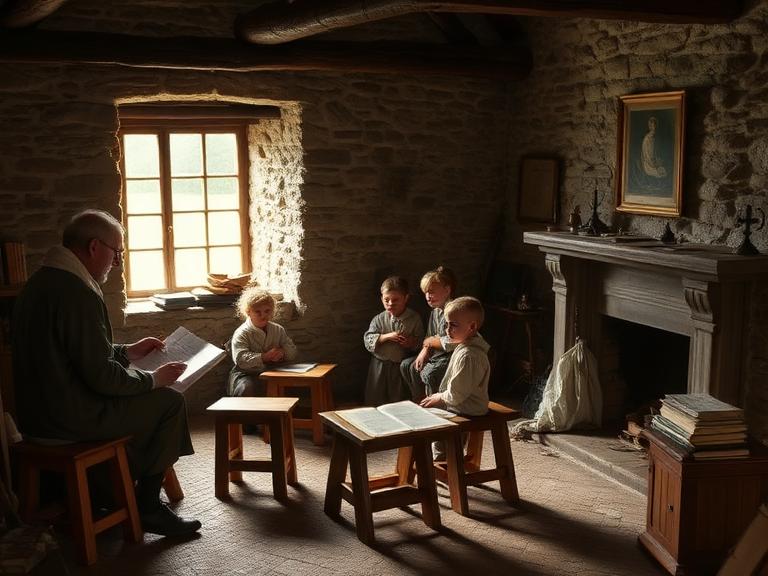
Most women were occupied with the demanding work of sustaining households. They participated in food preparation, dairying, textile production, animal care and other agricultural tasks, although duties varied among communities. Spindle whorls, loom equipment, needles and textile fragments provide physical evidence for spinning, weaving and sewing. Producing clothing required cleaning and preparing fibres, spinning thread, weaving fabric and assembling or repairing garments. These skills represented substantial economic value. Woollen clothing, bedding, containers and food stores did not appear automatically within households; they resulted from repeated labour that formal chronicles almost never recorded.
Women also participated in exchange and production within Ireland’s towns. Dublin, Waterford, Cork, Limerick and Wexford contained mixed Hiberno-Norse populations connected with maritime commerce. Archaeological finds from Dublin reveal textile working, craft production and domestic activity within densely occupied properties. Some women may have arrived through marriage or migration, while others were brought as captives. The evidence cannot always identify the status or ethnicity of an artefact’s user. It nevertheless demonstrates that urban life depended upon women as household managers, workers, traders and consumers, even when written sources name principally male rulers and merchants.
Motherhood involved considerable danger. Pregnancy and childbirth carried risks that cannot be measured precisely for AD 1000, while infant and childhood mortality placed further strain upon families. Children might be fostered by another household, creating bonds between birth parents and foster parents. Women participated in these arrangements as mothers and foster-mothers, although legal texts frequently describe obligations through male-controlled property. Nursing, feeding, healing and early instruction formed part of household survival. Women also preserved songs, prayers, practical knowledge and family memory through oral transmission, leaving contributions that are difficult to identify in surviving manuscripts.
Religious life offered women additional identities. Ireland had communities and churches associated with female saints, most famously Brigit of Kildare. Women could become religious, serve churches and participate in the veneration of saints and relics. By AD 1000, some earlier female religious institutions had changed substantially, and leadership at major churches was often controlled by powerful dynasties. Hagiographical accounts of holy women emphasised miracles and exemplary conduct rather than ordinary experience. Even so, their preservation demonstrates that female sanctity held an established place within Irish Christianity and provided influential models of authority, generosity and devotion.
Women were also vulnerable to warfare, raiding and enslavement. Annalistic references to captives rarely supply names or describe what followed removal from a settlement. Raids targeted people as well as cattle, silver and other portable wealth. Captured women could be transported within Ireland or sold through maritime trading networks. Cáin Adomnáin, promulgated in AD 697, claimed special protection for women, children and clerics, but the need for such provisions demonstrates the violence they faced. The existence of a protective law did not guarantee safety, particularly when political authority was divided and enforcement depended upon rulers and communities.
The Ireland of 2 March AD 1000 cannot be understood through kings and battles alone. Women created food and textiles, managed property, formed political and domestic partnerships, raised and fostered children, supported churches and transmitted knowledge. Their opportunities and hardships differed sharply according to rank and freedom. Most remain unnamed because the sources valued certain public events above everyday labour. A responsible reconstruction must neither portray women as powerless spectators nor grant them freedoms unsupported by evidence. Their lives were constrained by a patriarchal and hierarchical order, yet their work, relationships and expertise were indispensable to every Irish household, kingdom and religious community.
Primary Sources
1. Unknown annalist — Annals of Ulster, entries surrounding AD 1000 — Events recorded during the late tenth and early eleventh centuries — Survives principally in Trinity College Dublin MS 1282 — CELT: https://celt.ucc.ie/document/T100001A/ — Provides annalistic notices concerning dynasties, captives and the political world in which women lived.
2. Unknown annalist — Annals of Inisfallen, entries surrounding AD 1000 — Events recorded during the period — Survives in Oxford, Bodleian Library, MS Rawlinson B 503 — CELT: https://celt.ucc.ie/published/T100004.html — Preserves references to royal families, marriage connections and women of political significance.
3. Unknown annalist — Annals of Tigernach, entries surrounding AD 1000 — Events recorded during the period — Relevant text survives in Oxford, Bodleian Library, MS Rawlinson B 488 — CELT: https://celt.ucc.ie/published/T100002A.html — Supplies comparative evidence for dynastic relationships, violence and captivity.
4. Unknown legal scholars — Cáin Lánamna, or Law of the Couple — Early medieval legal tract probably composed before AD 1000 — Complete text survives in Trinity College Dublin MS 1316 — CELT: https://celt.ucc.ie/document/T102030/ — Describes forms of marriage, property contributions, separation and responsibilities between partners.
5. Adomnán of Iona and supporting authorities — Cáin Adomnáin, or Law of the Innocents — Promulgated at Birr in AD 697 — Survives in later manuscript copies — CELT: https://celt.ucc.ie/published/G102030.html — Establishes protections for women, children and clerics while revealing the violence from which protection was sought.
6. Unknown legal scholars — Cáin Iarraith — Early medieval tract concerning fosterage — Preserved in later legal manuscripts — Corpus Iuris Hibernici, Dublin Institute for Advanced Studies — Provides evidence for foster-mothers, maintenance and obligations between households.
7. Unknown legal scholars — Bretha Crólige — Early medieval tract concerning sick maintenance — Survives in later manuscript witnesses — Corpus Iuris Hibernici — Discusses care obligations, injury and the maintenance owed to people of differing status.
8. Unknown legal scholars — Uraicecht Becc — Early medieval status tract — Preserved in later manuscripts — Corpus Iuris Hibernici — Illuminates the hierarchical framework determining women’s and men’s legal standing.
9. Unknown legal compilers — Senchas Már — Core material probably composed during the seventh and eighth centuries — Survives in later manuscripts including Trinity College Dublin MS 1316 — Corpus Iuris Hibernici — Preserves rules involving family, property, status and compensation.
10. Cogitosus — Vita Sanctae Brigitae — Composed during the seventh century — Survives in later continental manuscripts — Scholarly editions and translations — Presents Brigit as the sacred founder and patron of Kildare and provides evidence for traditions of female religious authority.
11. Unknown author — Bethu Brigte, or Life of Brigit — Early Irish hagiographical text surviving in later manuscripts — CELT: https://celt.ucc.ie/document/T201002/ — Preserves Irish-language traditions concerning Brigit, women, households and religious devotion.
12. Unknown author — Vita Sanctae Samthann — Medieval Latin life of the female saint Samthann — Preserved in the Codex Salmanticensis and related manuscript traditions — Scholarly editions — Supplies evidence for ideals of female religious life and authority.
13. Unknown author — Life of Monenna — Medieval hagiographical tradition concerning an Irish female saint — Survives in later Latin manuscripts — Scholarly editions — Demonstrates the commemoration and reshaping of female religious leadership.
14. Unknown compiler — Martyrology of Tallaght — Probably compiled during the eighth or ninth century — Survives principally in the Book of Leinster, Trinity College Dublin MS 1339 — Trinity College Dublin — Records the liturgical commemoration of female as well as male saints.
15. Óengus of Tallaght, traditionally attributed — Félire Óengusso — Probably composed around AD 800 — Survives in later manuscripts including the Leabhar Breac, Royal Irish Academy MS 23 P 16 — CELT: https://celt.ucc.ie/published/G200001.html — Preserves poetic commemorations of women recognised as saints.
16. Multiple compilers — Genealogical tracts preserved in the Book of Leinster — Material transmitted from the early medieval period — Trinity College Dublin MS 1339, written during the twelfth century — Trinity College Dublin — Record dynastic descent and occasionally identify women whose marriages connected ruling families.
17. Occupants of Viking-age Dublin — Spindle whorls, needles, loom equipment, textile fragments and domestic artefacts from Wood Quay and Fishamble Street — Ninth to eleventh centuries — National Museum of Ireland archaeological collections — Provide direct material evidence for textile production and household labour.
18. Occupants of Deer Park Farms — Preserved buildings, wooden vessels, textile equipment and organic remains from an early medieval ringfort — First-millennium occupation — Archaeological collections from County Antrim — Supply evidence for domestic work within a rural household.
19. Women and communities represented in early medieval burials — Human remains and grave assemblages from excavated Irish cemeteries — Early medieval period — National Museum of Ireland and archaeological repositories — Provide direct evidence concerning health, diet, injury and mortality among women.
20. Makers and wearers of early medieval Irish dress fittings — Brooches, pins, beads and personal ornaments recovered from settlements, hoards and burials — Principally seventh to eleventh centuries — National Museum of Ireland collections — Demonstrate clothing practices, skilled production, personal display and differences in status.