Archived: 1 November 2026
Abstract
In 705 CE, Ireland’s surviving annalistic record presents a small but unusually revealing cluster of deaths, violence and political change. The notices are terse: the abbot Cenn Faelad of Bangor died; a battle was fought in Corcu Modruad, where Céilechair son of Comán fell; Cellach son of Rogallach, king of Connacht, died after entering clerical life; Conamail son of Canu was killed; and Congal Cenn Magair, son of Fergus of Fána, “begins to reign”. No contemporary narrative tells how these events unfolded. Yet, read alongside the preceding and following annals, they illuminate an Ireland in which monasteries, dynasties and local
Read Article
Archived: 1 November 2026
Abstract
In 704, Ireland witnessed major political reversals and the death of Adomnán, abbot of Iona. On 12 July, Cellach mac Rogallaig of Connacht defeated and killed Loingsech mac Óengusso, king of Tara, with three sons, at Corann; Congal Cennmagair succeeded him. Later, Cellach Cualann of Leinster repelled a southern Uí Néill force at Clóenad, while instability affected neighbouring dynasties. Annals also note Dál Riata's destruction at Glen Leven. Adomnán died on 23 September, leaving widely influential writings, diplomatic achievements and Cáin Adomnáin. These events reveal interconnected Irish, Scottish and Northumbrian worlds, though annalistic dating remains uncertain and their social consequences.
Read Article
Archived: 1 November 2026
Abstract
In 703, Connacht defeated an invading northern Uí Néill coalition at Corann or Claenfhinn, killing Loingsech son of Óengus, styled king of Ireland, his three sons and numerous allied rulers. The battle, probably in south-central Sligo, checked Loingsech’s claim to wider supremacy and preserved Connacht’s autonomy under Cellach son of Rogallach. Annals also record the Ulaid’s victory over Britons at Mag Cuilinn, though details remain uncertain. Colmán, abbot of Lismore, died, while notices mention Ailén Daingen’s construction and Rithe’s siege. These events reveal a rural, contested Ireland where kings, churches and fortified communities managed warfare, resources, mobility and insecure authority.
Read Article
Archived: 1 November 2026
Abstract
In 702, although annalistic dating varies between 701 and 702, Irish records note political and ecclesiastical deaths. Muiredach Muillethan, king of Connacht and ancestor of Síl Muiredaig, died, potentially affecting regional succession. Írgalach of Brega, grandson of Conaing, was killed by Britons at Inis Mac Nesáin, modern Ireland’s Eye, demonstrating dangerous Irish Sea connections without proving an invasion. Faeldobar of Clogher, other kings, an abbot and scholars also died. These notices reveal interdependence between rulers, churches and learning. Most people remained unrecorded, sustaining rural communities whose labour, farming, tribute and seaborne travel underpinned early medieval Irish society amid dynastic instability.
Read Article
Archived: 1 November 2026
Abstract
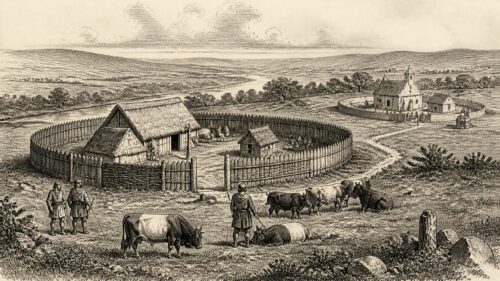
In 701, Niall son of Cernach was killed at the uncertain site of Drumain Ua Casáin by Írgalach, intensifying rivalry between branches of the southern Uí Néill in Brega. Later Columban tradition portrayed the killing as a violation of sanctuary linked to Kells and Írgalach’s death as retribution, though contemporary annals give no details. The year also recorded cattle mortality, threatening wealth, food production, tribute and rural livelihoods. In Munster, Ailill, king of Mumu, and Conall of Uí Fidgente died, prompting uncertain political transitions. Colmán ua hOrc, abbot of Clonard, also died, highlighting ecclesiastical institutions’ religious, economic and political influence.
Read Article
Archived: 1 November 2026
Abstract
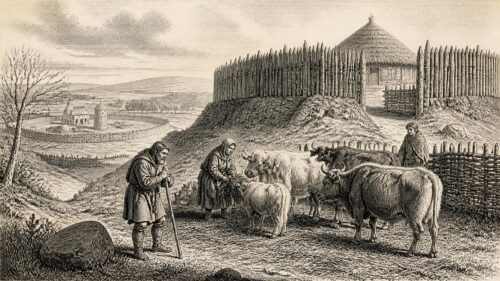
In 700, Irish annals recorded a cattle mortality beginning on 1 February at Mag Trega in Tethba, an event of major significance in a rural economy dependent on livestock for food, labour, wealth and tribute. Sources differ slightly in chronology and detail, but associate the outbreak with Ireland-wide loss and memories of famine and pestilence. Chronicon Scotorum also reports exceptional frost, without proving a causal link. Political instability continued: Fiannamail of Dál Riata was killed and Aurthuile of Cenél nÉogain expelled to Britain. Ecclesiastical institutions remained influential, while later narratives framed crisis through Christian ideas of protection, providence and judgement.
Read Article
Archived: 1 November 2026
Abstract
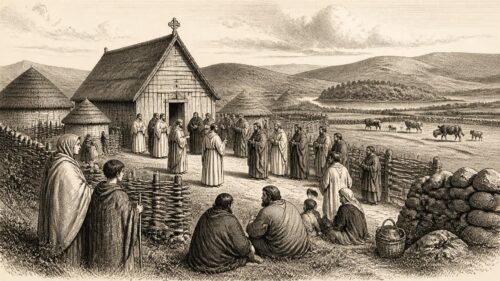
In 699, the Annals of the Four Masters record the death on 30 March of Colmán of Linn Ua Chaille, though his office remains unknown. They also assign deaths of Ailill, king of Munster, and Conall of Uí Fhidgeinte, and Írgalach’s killing of Niall Ua Cernach in Brega. Parallel annals date these political events shortly later, demonstrating chronological divergence in transmitted records. The notices illuminate ecclesiastical commemoration, unstable dynastic authority and aristocratic violence. Set after the synod of Birr, they also evoke a rural society where churches, kinship, cattle, agricultural production and local kingship shaped everyday life and political power.
Read Article
Archived: 1 November 2026
Abstract
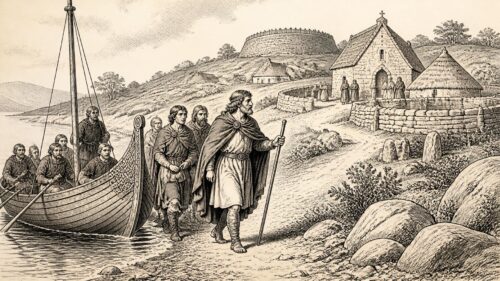
In 698, Irish annals record Tarachin’s journey to Ireland and an unexplained battle associated with Fiannamail son of Oiséne. Chronological variation requires caution: Tarachin may have been connected with the deposed Pictish ruler Taran, but neither identity nor motives are certain. His crossing nevertheless illustrates Ireland’s maritime links with Dál Riata, Pictland and western Britain, and its potential role as refuge for displaced elites. Fiannamail’s battle reflects localised violence within a fragmented political landscape under Loingsech’s influence. Churches, rural production and literate communities supported authority and preserved selective memories. Ireland was connected, decentralised, and politically active, not unified or isolated.
Read Article
Archived: 1 November 2026
Abstract
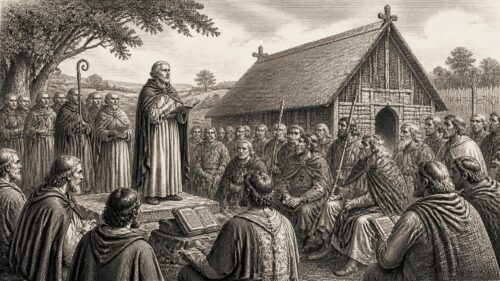
In 697 CE, the most consequential Irish development securely associated with the year was Adomnán of Iona’s promulgation of the Cáin Adomnáin, the ‘Law of Adomnán’, at Birr in what is now County Offaly. The Irish annals record tersely that Adomnán came to Ireland and gave the Lex Innocentium, or Law of Innocents, to the people. Behind that spare notice lies an unusually ambitious attempt to regulate the conduct of war across a politically divided island and, in principle, across the Irish Sea. A Year with a Chronological Caveat Early Irish annals do not always align neatly with modern calendar
Read Article
Archived: 1 November 2026
Abstract
In 696 CE, Irish annalists recorded a striking concentration of deaths and killings among rulers, ecclesiastics and men of high rank. The fullest contemporary-looking notices name the killing of Lóchéne Menn, the learned abbot of Cell Dara (Kildare); the deaths of Finguine, king of Munster, Fergal of Aidhne, and Congalach of Brega; and the killing of Domnall son of Conall Crandomna. The notices are brief, often frustratingly so, but they reveal a year in which power changed hands across several regions and in which a leading monastery suffered the violent loss of its head. Dating a Sparse Year The evidence
Read Article
Archived: 2 November 2026
Abstract
In 695 CE, the most securely placed Irish development was the killing of Fínsnechtae Fledach, king of Tara, and of his son Bresal at Grellach Dollaig. The Annals of Tigernach and Chronicon Scotorum assign the event to this year, naming the killers as Áed son of Dlúthach and Congalach son of Conaing. Their terse record calls it a battle, but supplies neither day nor season, nor a narrative of manoeuvres or troop numbers. It nevertheless marked a decisive rupture in the leadership of Brega and in the wider overkingship which Fínsnechtae had exercised for about two decades. An Annalistic Date,
Read Article
Archived: 2 November 2026
Abstract
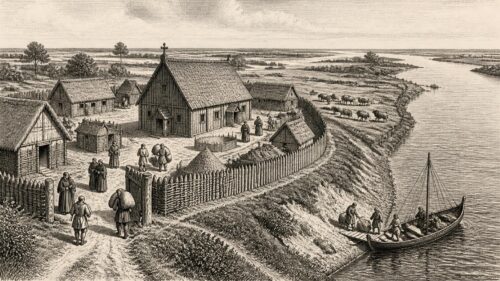
In 694 CE, the clearest securely associated Irish event was the death of Crónán Becc, or Crónán “the Little”, abbot of Cluain Moccu Nóis—Clonmacnoise—on the River Shannon. It is a modest record beside the spectacular battles and royal killings that often dominate the annals, but it offers an unusually useful view of Ireland’s real centres of gravity. An abbot’s death mattered because a major monastery was not simply a retreat for prayer: it was a religious community, a landholder, a place of learning and writing, a destination for visitors, and a point at which regional politics met the wider Irish
Read Article
Archived: 2 November 2026
Abstract
In 693 CE, Ireland’s surviving annalistic record is unusually compact but revealing. The Annals of Ulster, whose annal headed 694 is synchronised to AD 693, record the death of Crón Bec, abbot of Clonmacnoise; the deaths of ecclesiastics at Movilla and Balla; the killing of a layman named Cerball son of Máel Odar; and a siege at Dún Foither. No contemporary narrative explains how these events were connected. Yet together they show an island in which monastic communities, local lordship and fortified places formed the essential framework of public life. The year was not one of a single, island-wide turning
Read Article
Archived: 2 November 2026
Abstract
In 692 CE, Ireland’s surviving annalistic record centres on Leinster and its western neighbour Osraige. The firmest items are terse but consequential: Dirath, bishop of Ferns, died; Bran, grandson of Faelán and king of Leinster, also died; and a battle between the Osraige and the Laigin cost the life of Faelchar, grandson of Máel Odor. These entries occur under the following annal heading in the Annals of Ulster, whose calendrical apparatus explicitly equates that heading with AD 692. The precision is important. Irish annals preserve a sequence of notices copied and reshaped over centuries, and their year numbers do not
Read Article
Archived: 2 November 2026
Abstract
In 691 CE, the surviving Irish annals preserve a small but revealing cluster of notices: the death of Crónán moccu Cuailne, abbot of Bangor; a raid by Dál Riata upon the Cruithin and Ulaid; the death of Fidchellach son of Flann, king of Uí Maine; and a violent windstorm which drowned about six members of Iona’s community on 16 September. These entries do not amount to a continuous narrative of the year, and they should not be made to do so. Yet, set beside the political and ecclesiastical landscape of the late seventh century, they show an Ireland joined to
Read Article
Archived: 2 November 2026
Abstract
In 690 CE, Ireland’s surviving annalistic tradition places a cluster of violent deaths and ecclesiastical losses within a single, unsettled political landscape. The clearest event is the killing of Congal, son of Máel Dúin and grandson of Áed Bennán, whom the Annals of Ulster call king of Iarmumu, or western Munster. The same annal sequence also records the deaths of Ailill son of Dúngal, associated with Éilne among the Cruthin in the north, and of Dúnchad son of Orc Doith. These terse notices do not supply a battlefield, motive or victor. Yet their concentration is revealing: authority in Ireland rested
Read Article
Archived: 2 November 2026
Abstract
In 689 CE, Ireland’s surviving annalistic record preserves a compact but revealing cluster of political, ecclesiastical and celestial notices. It must, however, be read with unusual care. The material conventionally grouped under the annal-heading 689 is not securely tied to the modern calendar year: the Annals of Ulster label their corresponding entry “AD 688”, and a modern synchronism identifies the reported solar eclipse with 3 July 688. This article therefore treats the events as the evidence traditionally associated with 689 CE, while distinguishing that association from a firm modern date. The clearest political event is the killing of Diarmait, king
Read Article
Archived: 2 November 2026
Abstract
In 688 CE, a battle remembered as Imlech Pich exposed the fragility of power in Brega, the politically important plain north of the River Liffey. The early Irish annals agree on the core result: Niall son of Cernach Sotal defeated Congalach son of Conaing; Dub dá Inber, king of Ard Cianachta, and Uarchride, king of Conaille Muirthemne, were killed; Congalach escaped. They also record the death of Ségéne, bishop of Armagh, and state that the high-king Fínnechta Fledach entered clerical life. These are unusually consequential notices for one year, but they require careful handling. No annal supplies a day, a
Read Article
Archived: 2 November 2026
Abstract
In the annalistic sequence for 687, Adomnán, abbot of Iona, returned sixty former captives to Ireland, probably people seized during King Ecgfrith of Northumbria’s raid of 684. Although the precise date and negotiations remain uncertain, Adomnán’s links with King Aldfrith and Northumbrian ecclesiastical networks likely enabled their release. The episode illustrates Irish Sea connections linking warfare, diplomacy and learning; Adomnán’s scholarly exchanges with Aldfrith may have occurred during related visits. The annals also record the deaths of abbots at Glendalough and Cork, and of a bishop attached to an uncertain monastery, alongside the unexplained killing of Feradach son of Congal.
Read Article
Archived: 2 November 2026
Abstract
In 686 CE, the clearest securely dated Irish development was an act of return rather than a battle: Adomnán, abbot of Iona, brought sixty former captives back to Ireland. The notice in the Annals of Ulster is exceptionally brief, naming neither the people released nor their home districts, the port at which they landed, or the terms on which freedom was obtained. Yet its precise number and its place amid notices of deaths and killings make it one of the most human records preserved for this year. It also reveals an Ireland connected, and vulnerable, across the Irish Sea. A
Read Article
Archived: 2 November 2026
Abstract
In 685 CE, Ireland’s surviving record is unusually sparse, but it is not empty. The year is best approached through a small, difficult cluster of annalistic notices: the death of Banbán ‘Os Cach’, described as a learned man and, in the fuller notice of the Annals of Tigernach, lector of Kildare; the repose of Forcrann, abbot of Clonmacnoise; and events in northern Britain recorded by Irish writers, above all the defeat and death of the Northumbrian king Ecgfrith at Dún Nechtain on 20 May. These sources do not preserve a single narrative of Ireland in 685. Their differing chronological systems
Read Article
Archived: 2 November 2026
Abstract
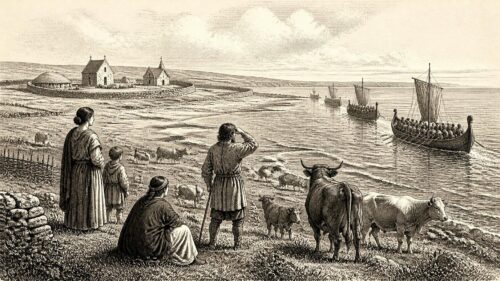
In 684 CE, a Northumbrian force crossed the Irish Sea and devastated Mag Breg, the rich plain of Brega in the eastern midlands. The expedition, sent by Ecgfrith, king of Northumbria, and led by his ealdorman Berht, is the year’s firmly dated Irish event. It was brief in the surviving record, but its targets make it unusually revealing: the raiders struck a politically central region and, according to both Irish and Northumbrian testimony, did not spare churches. For the communities of Brega, June brought not an abstract clash between distant kingdoms but the loss of movable wealth, damaged settlements, disrupted
Read Article
Archived: 2 November 2026
Abstract
In 683 CE, Ireland’s surviving annalistic record places political violence, contested provincial authority and the first reported onset of a grave mortality within the same year. The entries are terse, but their conjunction is striking: Dúnchad Muirisce, king of Connacht, was killed; Colgu, son of the former Tara ruler Blathmac, fell in the battle of Corann alongside Fergus, king of Cenél Cairpri; two strongholds were besieged; and, in October, a disease described as the “mortality of children” began. For a society whose history was usually recorded through the fates of rulers, clerics and religious houses, this last notice points beyond
Read Article
Archived: 2 November 2026
Abstract
In 682 CE, the clearest Irish event is the killing of Cenn Fáelad son of Colgú, styled king of Connacht in the annals. The Annals of Ulster preserve the event in a terse entry; the related Annals of Tigernach and Chronicon Scotorum name his killer as Ulcha Derg, grandson of Caillide, of the Conmaicne Cúile. Tigernach adds the vivid but limited detail that Cenn Fáelad was slain after the Conmaicne had stormed his house. It is the year’s central fact: a provincial king died violently in his own residence, not in a named pitched battle. The sources provide neither a
Read Article
Archived: 2 November 2026
Abstract
In 681 CE, Ireland’s surviving annalistic record preserves three securely associated notices: the killing of Cenn Fáelad, described as king of Connacht; a battle at Ráith Mór in Mag Line against Britons, in which Cathasach, king of the Cruithin, was killed; and the death of Suibne, superior of Corcach. These are short entries, but they reveal a political world in which royal authority remained precarious, conflict crossed the narrow seas, and ecclesiastical communities were led by figures important enough to be entered beside kings and battles. The evidence must be handled carefully. The Annals of Ulster place these items under
Read Article
Archived: 2 November 2026
Abstract
In 680 CE, Ireland’s surviving annalistic record brings together a striking mixture of dynastic violence, ecclesiastical change and a grave outbreak of illness. The entries are brief, and the manuscripts that preserve them were written much later, so their calendar headings require care. This account follows modern chronological synchronisation rather than simply repeating the sometimes displaced year-numbers in individual annals. On that basis, several developments can responsibly be assigned to 680: the death of Colmán, abbot of Bennchor (Bangor); the killing of Fíanamail mac Máel Tuile, king of Leinster; deaths and fighting in several regions; and, most memorably, the report
Read Article
Archived: 2 November 2026
Abstract
In 679 CE, Ireland’s annalists record a year defined less by a single island-wide crisis than by the passing and testing of influential people and institutions. The securely dated core consists of the death of Fáilbe, abbot of Í or Iona; the death of Cenn Fáelad, styled “the learned”; and a clash in which Fínnechta Fledach, the dominant Uí Néill king of Tara, defeated Bécc Bairrche. These concise notices are unusually revealing. Together they show a country of many competing dynasties, in which armed expeditions, ecclesiastical leadership and learned reputation all carried political weight. A Year in Difficult Calendars The
Read Article
Archived: 2 November 2026
Abstract
In 678 CE, the most consequential Irish event securely associated with the year was a victory by Uí Cheinnselaig over Osraige in which Tuaim Snáma, king of Osraige, died. The annals are terse, but a fuller annalistic tradition identifies the victor as Fáelán Senchustul of Uí Cheinnselaig and preserves a verse claiming that Osraige gave hostages ‘from Áth Buana to Comar’. This was not a clash between modern counties or nations. It was a contest between neighbouring dynasties in south-eastern Ireland, conducted through armed followings, negotiated submission and the transfer of persons whose custody guaranteed an agreement. The same annalistic
Read Article
Archived: 2 November 2026
Abstract
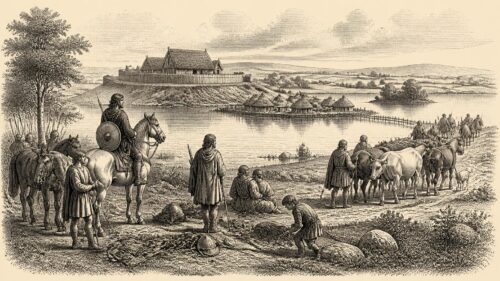
In 677 CE, the most consequential Irish event securely associated with the conventional year was a battle near Loch Gabair, modern Lagore in County Meath, where Fínshnechtae Fledach, king of Tara, defeated the Laigin. It was a victory on the frontier of his own Brega heartland, not a conquest of Leinster, and that distinction matters. The surviving annals are terse, while their chronological headings are not wholly straightforward: the Annals of Ulster place the relevant dossier under an annal numbered 677 but give an equivalent of AD 676, whereas the Fragmentary Annals and modern biographical reference works conventionally date the
Read Article
Archived: 2 November 2026
Abstract
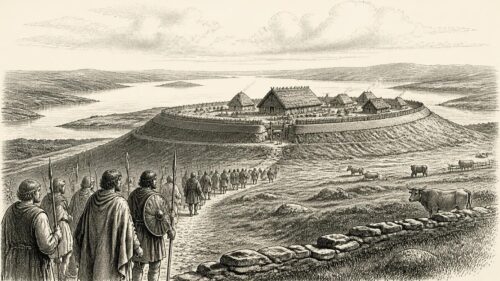
In 676 CE, the most consequential Irish event assigned by the annals to the year was the destruction of Ailech Frigrenn by Fínsnechtae Fledach, king of Tara. The record is brief, but its implications were not. Ailech stood at the heart of the Cenél nÉogain’s northern power, while Fínsnechtae belonged to the southern Uí Néill dynasty of Síl nÁedo Sláine. His attack was therefore not a local raid but a forceful declaration that his newly won supremacy extended beyond Brega and the midlands. Medieval Irish annal chronology is not mechanically exact: the same cluster is placed under 676 in the
Read Article





