Editorial — Late Pleistocene
Welcome to the Emerald Archives Gazette. In today’s issue we look back at the latest additions to the archive. Derryvree Uncertainty — 30,217 BCE is a modern calendar label imposed on a depth of time that no Irish community recorded in years, reigns or named generations. It falls roughly 32,166 years before AD 1950, the reference point conventionally used for “before present” dating, but that arithmetic does not turn the date into an archaeologically precise moment. No excavated Irish sequence can identify the weather, inhabitants or events of this particular year.
Dateline
The Day in Irish History
Welcome to the Emerald Archives Gazette. In today’s issue we look back at the latest additions to the archive.
Derryvree Uncertainty — 30,217 BCE is a modern calendar label imposed on a depth of time that no Irish community recorded in years, reigns or named generations. It falls roughly 32,166 years before AD 1950, the reference point conventionally used for “before present” dating, but that arithmetic does not turn the date into an archaeologically precise moment. No excavated Irish sequence can identify the weather, inhabitants or events of this particular year. The responsible approach is instead to consider a wider Late Pleistocene window: the unstable middle part of the last glacial cycle, usually termed Marine Isotope Stage 3 (MIS 3), when cold…
Fermanagh Twin — The label 30,216 BCE is a modern point on a calendar, not a date that can be recovered from Ireland’s Late Pleistocene record. It corresponds broadly to 32,200 years before present, where “present” in radiocarbon practice is 1950. Neither people nor animals in Ice Age Ireland left written dates, and even the best scientific measurements resolve spans of centuries or millennia rather than a single year. The responsible setting is therefore the later part of Marine Isotope Stage 3, a climatically unsettled interval before the Last Glacial Maximum. For Ireland, the clearest evidence relevant to this broad moment comes from…
Fermanagh Biota — 30,215 BCE is not an anniversary that can be recovered from the Irish archaeological record. It is a modern calendar label for a point roughly 32,164 years before AD 1950, the conventional reference point for calibrated ‘before present’ dating. No written evidence, settlement sequence or securely dated event allows historians to say what happened in Ireland in that individual year. The responsible subject is instead the changing Late Pleistocene world to which the date belongs: a cold, unstable interval of Marine Isotope Stage 3, when the British–Irish Ice Sheet was growing and retreating in different regions, and when Ireland’s landscapes…
Greenagho Interlude — 30,214 BCE is a modern chronological label, not a date that can be recovered as a year in an Irish Ice Age calendar. It corresponds approximately to 32,160 years before the archaeological present of AD 1950. At that depth of time, even good radiocarbon results carry substantial uncertainty and must be calibrated; deposits also accumulate over periods rather than recording a single day or season. The responsible question is therefore not what happened in Ireland in this exact year, but what evidence can illuminate the island during the broad interval into which it falls.The date lies in Marine Isotope Stage…
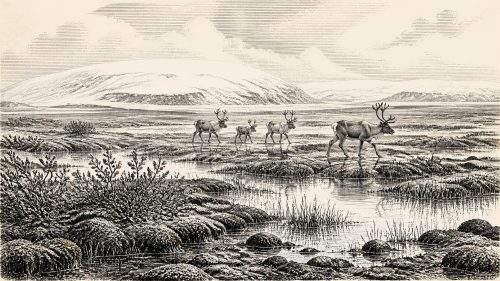
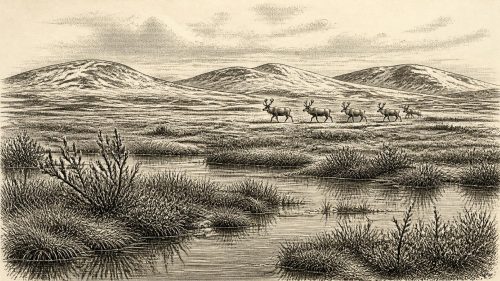
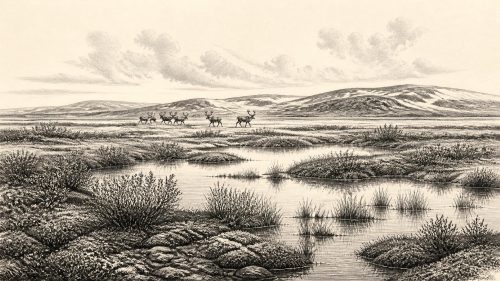
Saturated Muskeg — Modern calendar-year precision cannot be recovered for Ireland in 30,213 BCE. There were no written records, dated settlements or annual environmental sequences from which to identify an event in that particular year. The number is therefore best treated as a modern chronological marker, approximately 32,162 years before AD 1950, rather than as a date contemporary people could have recognised. Ireland was then in the Late Pleistocene, within Marine Isotope Stage 3 and the Irish Midlandian cold stage: a long, unstable part of the last Ice Age before the fullest expansion of the British–Irish Ice Sheet. The evidence appropriate to this…
Temporary Mire — 30,212 BCE is a modern calendar label, not a recoverable year in Irish prehistory. No written record, annual chronology or securely dated event allows historians to say what happened in Ireland in that particular year. The responsible frame is the later part of the Late Pleistocene, during Marine Isotope Stage 3, when climate across the north Atlantic was highly unstable and the British–Irish Ice Sheet was developing unevenly. The nearest useful evidence consists of broad calibrated ranges, sediment sequences and animal remains. These can illuminate landscapes and ecological possibilities around this point, but not a named community, ruler, battle, treaty…
Freshwater Stratum — 30,211 BCE is not a date at which Irish archaeology can identify an event, ruler, battle or calendar day. It is a modern chronological label, projected backwards into a period without writing, local calendars or a continuously dated human record. In archaeological terms it falls roughly 32,160 years before AD 1950, the conventional “present” used for radiocarbon dating. That apparent precision is misleading. The evidence for Ireland at this depth is dated in broad radiocarbon and calibrated ranges, often with uncertainties of centuries or millennia. The responsible subject is therefore not what happened in one numbered year, but what the…
Cold Bryophytes — “30,210 BCE” is a modern point on a retrospective calendar, not a year that can be recovered from an Irish record. Nobody in Ireland left a written date, an annually layered settlement sequence or a named event to which it can be attached. At this depth of time, even scientific dating normally produces probability ranges rather than a particular season, generation or day. The date falls roughly 32,160 years before AD 1950, the conventional reference point for radiocarbon ages. It belongs to the Late Pleistocene, during the Irish Midlandian cold stage and, in broader climatic terminology, late Marine Isotope Stage…
Ecological Passage — A Date Beyond Calendar History30,209 BCE is a modern calendar label, not a year for which Ireland preserves an event, ruler or human community. In archaeological terms it falls about 32,158 years before AD 1950, the reference point used for “cal BP” dating. Even that conversion must not be mistaken for precision: deposits, bones and ice-sheet landforms are dated as ranges with uncertainties, while radiocarbon ages require calibration against changing atmospheric carbon. No excavated Irish evidence can responsibly be assigned to this individual year.The appropriate setting is the later part of Marine Isotope Stage 3, within the Midlandian, Ireland’s last…
Unglaciated Terrain — The label 30,208 BCE cannot be treated as a date in the ordinary historical sense. No one in Ireland kept a calendar, recorded a season or named an event at this depth of time. It is a modern, backward-counted calendar label, corresponding very roughly to 32,150 years before AD 1950, the conventional “present” used in radiocarbon work. The evidence available is measured not in individual years but in deposits, fossils and broad calibrated ranges. For Ireland, the most relevant range is provided by a buried freshwater deposit at Derryvree, near Maguiresbridge in County Fermanagh: its date span, about 36,900–31,700 calibrated…
Derryvree Roadworks — The label 30,207 BCE is a modern point on a retrospective timeline, not a year that can be recovered from the Irish prehistoric record. No community in Ireland then kept calendars, named rulers or left written accounts. Even archaeological dating cannot isolate a single year at this depth of time. The most responsible approach is therefore to place this nominal date within a much wider Late Pleistocene setting: the later part of Marine Isotope Stage 3, before the Last Glacial Maximum, when Ireland’s environments changed sharply and repeatedly. The most relevant Irish evidence is not a settlement, battle or burial,…
Dynamic Environments — The label 30,206 BCE should not be read as a date on which a recorded Irish event occurred. No calendar, written tradition, settlement sequence or archaeological horizon can identify a particular year so deep in prehistory. In simple chronological terms it lies about 32,150 years before the 1950 reference point used for “before present” dating, within the Late Pleistocene and Marine Isotope Stage 3. But that conversion is only a way of locating a modern year-label in deep time. It is not a calibrated date for an Irish occurrence. The evidence instead comes in wide radiocarbon ranges, layers of sediment,…
Herbaceous Tundra — The label 30,205 BCE gives a useful point of reference, but it cannot denote an event in the modern historical sense. No written calendar, settlement sequence or annually resolved archive lets us identify a particular season, person or occurrence in Ireland at this depth of time. In radiocarbon convention, this nominal date is roughly 32,154 calendar years before AD 1950. The responsible approach is therefore to place it within wider calibrated ranges and to describe the Late Pleistocene evidence nearest to it, rather than inventing a year of Irish prehistory. A Date Within Deep Time At this horizon Ireland lay…
Disturbed Cave — 30,204 BCE cannot be treated as a date in the ordinary historical sense. No written record, settlement layer or securely dated event permits a narrative for that particular year. In calibrated terms, it falls roughly 32,150 years before 1950, within the later part of the Pleistocene and Marine Isotope Stage 3. At this depth of time, chronology is expressed in ranges, probabilities and correlations between deposits, rather than annual precision. The responsible question is therefore not what happened in Ireland in one named year, but what the surviving geological, faunal and archaeological evidence can reveal about the island during the…
Episodic Thaw — Modern calendar-year precision is not available for Ireland in 30,203 BCE. Nobody in Ireland recorded a year, and no surviving deposit can responsibly be assigned to a particular twelve-month span at such depth in time. The label is a modern chronological convenience: counted from AD 1950, it falls at roughly 32,152 calendar years before present. It belongs to the Late Pleistocene, within Marine Isotope Stage 3 (MIS 3), a long and climatically unstable part of the last Ice Age. Ireland’s history at this point must therefore be written through calibrated ranges, sediments, fossils, cave mineral deposits and the marks left…
Exposed Permafrost — 30,202 BCE is not a date that can be matched to a recorded Irish event. It is a modern calendar label for a point roughly 32,000 years before the conventional radiocarbon reference year of AD 1950. Neither people nor animals in prehistoric Ireland marked years in this way, and the evidence cannot distinguish one season, let alone one calendar year, from another. The responsible history of Ireland at this depth of time is therefore a history of landscapes, ice, fossils and uncertain traces of human activity. It belongs broadly to the later part of Marine Isotope Stage 3, immediately before…
Interglacial Wetland — “30,201 BCE” is a useful modern label, not a recoverable Irish calendar year. No annal, settlement layer or natural archive can tell us what happened in Ireland in that single year. In archaeological terms it lies roughly 32,150 years before the conventional radiocarbon present of AD 1950, within Marine Isotope Stage 3, an unstable middle phase of the last Ice Age. The responsible way to approach it is through broad, calibrated ranges. The closest exceptional Irish environmental record, from Derryvree near Maguiresbridge in County Fermanagh, has a radiocarbon determination of 30,500 +1,170/−1,030 radiocarbon years BP. Calibrated with modern curves, that…
Fermanagh Frontier — Modern calendar-year precision is not available for Ireland around 30,200 BCE. The numbered year is a useful point of reference, but it cannot be attached to a recorded event, a ruler, or even a precisely dated archaeological horizon. In radiocarbon and environmental scholarship, it lies broadly within Marine Isotope Stage 3 (MIS 3), an unstable middle phase of the last Ice Age. The most responsible account is therefore regional and comparative: it asks what deposits, animal remains and glacial landforms can tell us about Ireland during a wide interval centred on roughly 32,150 years before AD 1950, rather than claiming…
Regional Glaciation — “30,199 BCE” is a modern chronological label, not a year recorded by anyone in Ireland. It falls roughly 32,150 years before the conventional archaeological reference point of 1950, but modern calendar-year precision is not available at this depth of time. Radiocarbon measurements must be calibrated and carry statistical ranges; ice-sheet reconstructions are broader still. The responsible subject is therefore Ireland during the closing part of Marine Isotope Stage 3, around 32,000 calibrated years before present (cal BP), rather than an invented event on a particular day or in a particular season.At that time Ireland stood on the threshold of a…
Tundra Refuges — 30,198 BCE is not a year that can be matched to a recorded Irish event. It is a modern calendar label imposed upon a deep-prehistoric landscape. In the chronological convention used by Quaternary scientists, it falls approximately 32,147 years before AD 1950, or about 32.1 thousand calendar years BP. Neither archaeology nor palaeoenvironmental science can resolve conditions in Ireland to that individual year. What can responsibly be described is a broader Late Pleistocene setting, using dated deposits whose ranges overlap the surrounding millennia and distinguishing their evidence from later interpretation. Ireland at this time belonged to the last cold stage,…
Plant Remains — Modern calendar-year precision is not available for Ireland in 30,197 BCE. No written calendar, settlement sequence, named individual or securely dated event permits an account of that particular year. The number is a modern chronological label, roughly 32,146 years before AD 1950 in the “before present” convention. The responsible historical setting is the Late Pleistocene, within Marine Isotope Stage 3 and the long, cold and highly variable part of the last glacial cycle called the Midlandian in Irish Quaternary studies.The closest important Irish chronological evidence is not an event but a buried wetland at Derryvree, near Maguiresbridge in County Fermanagh.…
Ice Dynamics — Modern calendar-year precision is not available for Ireland in 30,196 BCE. This is a modern backwards count, not a date recorded by people living on the island. No written calendar, named individual, excavated settlement sequence or event can be tied to that particular year. The responsible setting is a broad one: the later part of the Late Pleistocene, within Marine Isotope Stage 3, perhaps around 32,000 years before the conventional present of AD 1950. Dates from this depth of time are normally expressed as radiocarbon determinations and calibrated ranges, often with substantial margins of uncertainty.For Ireland, this was not yet…
Wetland Evidence — 30,195 BCE is a modern chronological label, not a recoverable Irish year. No one in Ireland used a calendar that can be translated into this date; no written record, named person, settlement layer or individual event can be tied to it. The appropriate setting is the Late Pleistocene, within Marine Isotope Stage 3 (MIS 3), a climatically unstable phase of the last Ice Age. Archaeology and Quaternary science can illuminate broad intervals through sediments, fossils and scientific dating, but they cannot furnish a diary for one year more than thirty millennia ago.The closest important Irish chronological evidence comes from Derryvree,…
Bogbean Occurrence — 30,194 BCE is a modern calendar label, not a year that anyone in Ireland could have named, recorded or experienced as a date. It falls about 32,140 years before the conventional radiocarbon reference year of AD 1950, in the later Pleistocene and broadly within Marine Isotope Stage 3. At this depth of time, modern calendar-year precision is unavailable. There are no written records, named communities, rulers, settlements or historical events. The responsible account is therefore one of evidence: deposits, fossils, cave assemblages, laboratory measurements and changing interpretations.The closest chronological anchor is not an event in 30,194 BCE but the organic…
Derryvree Species — Modern calendar-year precision is not available for Ireland in 30,193 BCE. The number is a useful point on a retrospective timeline, roughly 32,142 years before the conventional radiocarbon reference year of AD 1950, but it cannot identify an event, season, community or individual. Ireland was in the Late Pleistocene, within the long and climatically volatile last glacial cycle. The responsible evidence consists not of written records or settlements, but of sediments, fossil plants, insects and animal bones. Its chronological ranges are broad, and its geographical coverage is patchy.The closest Irish environmental archive is the Derryvree sequence near Maguiresbridge, County Fermanagh.…
Castlepook Passage — The label 30,192 BCE cannot denote a recoverable year in Irish history. No calendar, written record, ruler, settlement sequence or human lifetime in Ireland can be fixed to so precise a point in the Late Pleistocene. In archaeological convention it lies roughly 32,000 years before AD 1950, but the evidence is dated in broad radiocarbon and calibrated ranges, often with uncertainties of centuries or millennia. The responsible historical setting is therefore the later part of Marine Isotope Stage 3, before the Last Glacial Maximum, when Ireland lay at the western edge of a cold, changeable north-west European world. The most…
Glacial Deposits — The numbered year 30,191 BCE cannot be recovered as a moment in Ireland’s past in the way that a medieval or modern year can. No written records, named communities, political boundaries or annual calendar survive from this depth of time. It is better understood as an approximate point about 32,140 years before AD 1950, within the later Pleistocene and broadly Marine Isotope Stage 3, a fluctuating phase of the last Ice Age. The responsible evidence is regional and uneven: freshwater deposits sealed beneath later ice in County Fermanagh, cave-fauna collections in County Cork, changing ice-sheet reconstructions, and wider north-west European…
Cork Carnivores — Modern calendar-year precision is not available for Ireland in 30,190 BCE. The label is a retrospective conversion, approximately 32,100 years before AD 1950, rather than a date that prehistoric people could have recognised or recorded. Archaeology and earth science can instead place this point broadly in the later part of Marine Isotope Stage 3 (MIS 3), before the Last Glacial Maximum. The relevant evidence comes from dated cave bones, sediment sequences, marine records, landforms and ice-sheet modelling, each with uncertainties larger than a single year. The responsible picture is therefore not an event in 30,190 BCE, but an Irish landscape…
Fermanagh Reprieve — Modern calendar-year precision is not available for Ireland in 30,189 BCE. The label is a convenient point on a modern timeline, not the date of a recorded event, a reign, a migration or a settlement. In archaeological terms it falls at roughly 32,100 years before AD 1950, during the Late Pleistocene and broadly within Marine Isotope Stage 3. No Irish community then left writing, a calendar, monuments or an excavated settlement sequence from which a single year could be recovered. The responsible history of this moment is therefore one of dated ranges, sediments, animal remains and the limits of interpretation.The…
Glacial Sequence — 30,188 BCE is a modern chronological label, not a year that can be recovered from the Irish archaeological record. There were no calendars, written accounts, named polities or datable events on the island at this depth in time. In calendar terms it is about 32,137 years before AD 1950, the conventional ‘present’ used in radiocarbon dating. That places it in the Late Pleistocene, broadly within Marine Isotope Stage 3 (MIS 3), a climatically unstable part of the last Ice Age. The appropriate subject is therefore Ireland around this point, reconstructed from deposits, fossils and changing ice margins rather than narrated…
Treeless Wetland — 30,187 BCE is a modern chronological label, not a recoverable year in Irish history. It corresponds to roughly 32,136 years before the radiocarbon convention of AD 1950, but no Irish deposit can identify what happened in that particular twelve-month interval. There were no written records, named peoples, rulers or calendar systems from which to construct an annual narrative. The responsible historical setting is the later part of the Late Pleistocene, within Marine Isotope Stage 3 (MIS 3): a long, climatically unstable phase of the last Ice Age.The closest evidence is neither a settlement nor a human grave. It is a…
Doneraile Animals — 30,186 BCE is a useful label in a modern chronological sequence, but it was not a year that anyone in Ireland could have named, counted or recorded. No Irish deposit can presently be tied to that single calendar year. At this depth of time, scientific dating produces probability ranges, and conversion between radiocarbon years, calibrated years before present and BCE notation introduces further uncertainty. The responsible frame is therefore a broad part of the Late Pleistocene, within Marine Isotope Stage 3 and the long approach to the Last Glacial Maximum, rather than an anniversary in an Irish annal. The strongest…
Cave Fossils — 30,185 BCE is not a date that can be recovered from Ireland’s prehistoric record in the ordinary historical sense. No community recorded it, and no excavated Irish layer can presently be assigned to that single calendar year. It is a modern chronological label, corresponding very approximately to 32,100 years before AD 1950, the conventional “present” of radiocarbon dating. At this depth of time, the responsible unit is not a year but a broad calibrated range. The relevant setting is the later part of the Last Glacial Period, conventionally Marine Isotope Stage 3, when climate around the North Atlantic was cold,…
Fermanagh Meltwater — 30,184 BCE is not a date at which Ireland can be described year by year. It is a modern calendar label projected far beyond any written or annually resolved record. In archaeological terms it falls roughly 32,000 years before 1950, during the Late Pleistocene, but no excavated Irish deposit can securely be assigned to this single calendar year. The responsible approach is therefore to examine the much wider calibrated ranges that overlap it, distinguish direct evidence from inference, and acknowledge how incomplete the island’s record remains. A Date Within Broad Ranges The nearest unusually informative Irish environmental sequence comes from…
Freshwater Ponds — 30,183 BCE is not a date to which Irish prehistory can attach a recoverable event. No calendar, written record, settlement sequence or archaeological layer allows historians to identify a particular year, season, leader or encounter. In conventional chronological terms it falls roughly 32,100 calibrated years before present (where “present” is AD 1950), within the Late Pleistocene and Marine Isotope Stage 3. The responsible history of Ireland at this point must therefore be told through dated ranges, buried sediments, fossil remains and the limits of what those traces can demonstrate. A Date Within a Range The closest direct chronological guide is…
Arctic Willows — The label “30,182 BCE” cannot identify a year in the ordinary historical sense. No calendar, written record, named community or dated event survives from Ireland at this depth of time. Converted mechanically to the archaeological convention in which “before present” means before AD 1950, it lies about 32,131 calendar years ago. That conversion is useful only as orientation: modern calendar-year precision is not available. The responsible subject is Ireland during a broad Late Pleistocene interval, within Marine Isotope Stage 3, rather than a recoverable Irish year. The most relevant evidence comes in ranges spanning centuries or millennia. It consists chiefly…
Tundra Respite — Modern calendar-year precision is not available for Ireland at 30,181 BCE. This is a useful modern label for a point roughly 32,131 years before AD 1950, not a recoverable year in which an Irish event can be assigned to a season, a ruler or even a human generation. The responsible setting is the Late Pleistocene, within Marine Isotope Stage 3 and close to the growth of the last British–Irish Ice Sheet. Evidence comes in broad radiocarbon and calibrated ranges, from layers of sediment, fossil plants, insects, bones and glacial landforms. It illuminates an unstable cold-world landscape, rather than a conventional…
Waterford Cervids — The label 30,180 BCE is useful as a modern point of reference, but it cannot identify a particular Irish day, season, event or generation. No written calendar existed, and the available evidence was not deposited as an annual record. In archaeological convention, the date lies about 32,130 years before AD 1950, within the later part of the Pleistocene and close to the transition into the cold conditions conventionally associated with Marine Isotope Stage 2. Radiocarbon determinations must be calibrated and carry substantial ranges at this depth of time. The responsible subject, therefore, is not “Ireland in a year”, but an…
Intertill Mud — “30,179 BCE” is a useful modern label, not a date at which the archaeology of Ireland can identify an event. It is roughly 32,128 years before the radiocarbon convention of AD 1950, but neither people nor natural deposits of this age can be fixed to a particular calendar year. Ireland lay within the Late Pleistocene, in the later part of Marine Isotope Stage 3: a long, unstable cold interval before the Last Glacial Maximum. The responsible approach is therefore to examine dated ranges, layers and fossil assemblages that illuminate the island broadly around this point, while keeping evidence separate from…
Cave Species — The label 30,178 BCE is a modern calendrical convenience, not a year that any community in Ireland recorded or could have recognised. At this depth of time, archaeology cannot responsibly identify an event on a particular day, season or year. In the conventional archaeological system it falls roughly 32,000 years before AD 1950, but the evidence is dated in broad calibrated ranges, not single calendar years. The most useful setting is therefore later Marine Isotope Stage 3, before the Last Glacial Maximum: a time of severe climatic instability, changing ice margins and intermittent animal populations on the western edge of…
Open Tundra — The label 30,177 BCE gives a useful place in a modern chronological sequence, but it must not be mistaken for a year in which an Irish event can be dated. No written record, calendar, named community or annual archaeological horizon exists for Ireland at this depth of time. By simple conversion to the archaeological convention of years before present, where “present” is AD 1950, it lies about 32,126 years before present. That arithmetic is not a precise age for a site or object. At this antiquity, evidence is dated through scientific measurements with substantial uncertainties and, for radiocarbon, calibrated probability…
Kerry Stalagmite — The label “30,176 BCE” does not identify a year that anyone in Ireland could have named, recorded or experienced as a date. It is a modern conversion, corresponding roughly to 32,125 years before AD 1950, the reference point conventionally used for “cal BP” dating. At this depth of time, modern calendar-year precision is unavailable. Radiocarbon ages must be calibrated, carry statistical ranges and can change as methods improve. The responsible historical setting is therefore not an invented event in one numbered year, but Ireland during the later part of Marine Isotope Stage 3 (MIS 3), within the last Ice Age.…
Disturbed Deposits — 30,175 BCE is a modern chronological label, not a date that can be recovered from an Irish diary, settlement layer or historical calendar. At this depth of time, precision measured in individual years is impossible. The responsible frame is the later Pleistocene, broadly within Marine Isotope Stage 3, a long and climatically unstable part of the last Ice Age. Evidence from Ireland is sparse, discontinuous and often recovered from caves disturbed by natural processes and early excavation. Yet it still permits a meaningful account: not of kingdoms or named communities, but of a cold, changing island landscape in which large…
Shallow Wetland — A Calendar Label, Not an Event“30,174 BCE” is a useful modern label, but it cannot identify an event, a ruler, a journey or even a single season in Ireland. At this depth of time there are no written records, no securely dated settlements and no annual chronology. The date corresponds approximately to 32.2 thousand years before AD 2000, within the Late Pleistocene and Marine Isotope Stage 3, a climatically unstable part of the last Ice Age. Greenland ice-core chronology places this broad point close to Greenland Stadial 5.2, following a short warmer interval; that is a valuable North Atlantic comparison,…
Herbaceous Pollen — “30,173 BCE” is a modern calendar label, not a year that can be recovered from Ireland’s archaeological record. No community in Ireland left writing, a calendar, a named leader, a monument or a settlement sequence that can be assigned to this precise point. Modern calendar-year precision is therefore unavailable. The responsible frame is a much longer interval in the Late Pleistocene, broadly the closing part of Marine Isotope Stage 3, about 32,122 years before the conventional radiocarbon reference year of AD 1950. The evidence consists chiefly of glacial layers, freshwater sediments, cave deposits and radiocarbon ranges.The most illuminating Irish evidence…
Kerry Flowstones — 30,172 BCE is a modern chronological label, not a year in which an Irish event can be dated. Counted in the archaeological convention of years before present, with “present” fixed at 1950, it falls around 32,122 years ago: approximately 32.1 thousand calibrated years BP. No Irish calendar, written testimony or annually resolved archaeological sequence reaches this far back. Radiocarbon measurements at such depth carry substantial statistical uncertainty and require calibration; even the best environmental records normally describe intervals of centuries or millennia. The responsible subject, therefore, is Ireland during the later part of the Late Pleistocene, rather than an invented…
Spotted Carnivores — 30,171 BCE is not a date at which Ireland can be described through an annual chronicle. It is a modern calendar label, roughly 32,000 years before the 1950 reference point conventionally used in archaeological dating, and no surviving Irish evidence can identify an event, person or season with that degree of precision. The responsible historical setting is the later part of Marine Isotope Stage 3, a profoundly unstable interval of the last Ice Age. Evidence from caves, buried sediments and ice-sheet reconstructions can illuminate broad conditions in and around Ireland; it cannot supply a named community, a political episode or…
Cold Beetles — 30,170 BCE is not a year that can be recovered in the ordinary historical sense. It is a modern calendar label for a point roughly 32,119 years before AD 1950, the conventional reference point for “before present” dating. No Irish written record, annual environmental sequence, named settlement or securely dated human action can be assigned to it. Calendar-year precision is therefore unavailable. The responsible question is what archaeological and geological evidence can illuminate Ireland during the broad interval into which this notional date falls.That interval belongs to the Late Pleistocene, during the last Ice Age. In Irish terminology it lies…
Thank you for reading today’s Gazette. Follow any of the links above to read the full article and explore its sources.