Editorial — Aodh Buidhe O’Neill of Clandeboye — Death
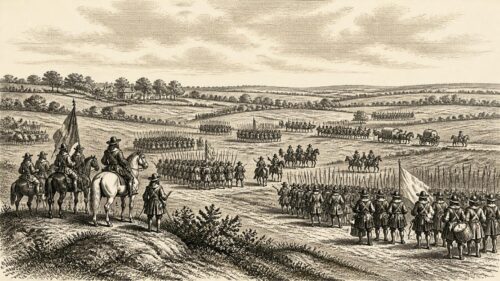
Welcome to the Emerald Archives Gazette. In today’s issue we look back at the latest additions to the archive. Carbury Captivity — In 1466, Ireland’s political geography was made visible in the movement of armies, captives, cattle and tribute. The year’s most dramatic episode came in Uí Fhailí, roughly modern County Offaly, where Conn Ó Conchobhair Fáilghe defeated an expedition drawn from the English lordship’s counties of Meath and Leinster. Thomas FitzGerald, earl of Desmond and deputy in Ireland, was captured and taken towards Carbury Castle. His humiliation was brief, but its consequences were not.
Dateline
The Day in Irish History
Welcome to the Emerald Archives Gazette. In today’s issue we look back at the latest additions to the archive.
Carbury Captivity — In 1466, Ireland’s political geography was made visible in the movement of armies, captives, cattle and tribute. The year’s most dramatic episode came in Uí Fhailí, roughly modern County Offaly, where Conn Ó Conchobhair Fáilghe defeated an expedition drawn from the English lordship’s counties of Meath and Leinster. Thomas FitzGerald, earl of Desmond and deputy in Ireland, was captured and taken towards Carbury Castle. His humiliation was brief, but its consequences were not. It opened space for Tadhg an Chomhaid Ó Briain of Thomond to press demands deep into territories associated with Desmond and Limerick.The annals also record warfare in…
Kilcrea Friary — For Ireland, 1465 was remembered not for one kingdom-wide battle or royal proclamation, but for the collision of weather, hunger and intensely local politics. The surviving records are uneven: the Dublin administration left statutes and appointments, while Irish annals preserve sharp reports from Connacht, Ulster, Breifne and Munster. Together they show a country of many lordships and jurisdictions, linked by churchmen, kinship, trade and warfare, but exposed to sudden failures of food and authority. A Winter That Would Not End The most striking contemporary notice comes from the Annals of Connacht. They record “exceeding great frost and snow and stormy…
Youghal College — In 1464, Ireland’s political map was anything but settled. Authority was divided among Gaelic lordships, Hiberno-English magnates, church jurisdictions and the limited institutions of the English lordship centred on Dublin. Yet the year was not simply a catalogue of disorder. Its records show negotiation as well as raiding, religious investment alongside violence, and communities responding to sickness, bereavement and disputed succession. Two developments give the year particular definition: Thomas FitzGerald, earl of Desmond and the king’s lieutenant, sought agreement with powerful Irish leaders; and, on 27 December, he founded Our Lady’s College at Youghal. A Year Preserved Unevenly The evidence…
Lordship Networks — In 1463, Ireland’s political geography was not governed from a single centre. The lordship claimed by Edward IV had institutions, courts, ports and mints, but its effective reach was uneven. Beyond and across the English-controlled districts, Gaelic and Gaelicised dynasties exercised authority through kinship, clientship, tribute, military followings and negotiated alliances. The year’s surviving records are especially rich in such local dealings. They do not describe one national crisis; rather, they reveal an island linked by gifts, cattle-raids, ransoms, church offices, coinage and the movement of armed men.Most events below come from annals compiled within learned Irish traditions. Annalists normally…
Piltown Battle — In 1462, the best-documented Irish developments were not the acts of a single government but a series of wars, settlements, raids and religious foundations across several political worlds. In the south-east, the Butler–FitzGerald contest became the Irish episode most clearly connected with the Wars of the Roses. In Ulster, Henry Ó Néill carried a destructive hosting into Tír Chonaill against Aodh Ruadh Ó Domhnaill. In Monaghan, meanwhile, a new Franciscan house was begun, and Armagh hosted a celebrated teacher of law. The contrast is instructive: force, lordship, learning and religious patronage all mattered in the Ireland of this year. Piltown…
Ceann Maghair — In 1461 Ireland’s annalists recorded no single national event, because there was no single Irish state to experience one. Instead, their entries trace a country of competing lordships, disputed successions, raiding armies and learned households, all overshadowed by a terse but grave notice: there was “great dearth throughout Ireland”. The year is best understood through the sharp local crises that the surviving annals place within it, above all the decisive overthrow of Toirdhealbhach Cairbreach Ó Domhnaill in Tír Chonaill. Ceann Maghair and Tír Chonaill The most consequential conflict of the year occurred at Ceann Maghair, during the long civil struggle…
York’s Parliament — In 1460 Ireland was not governed by one rhythm or one political community. The king of England, Henry VI, remained lord of Ireland; Richard, duke of York, was the king’s lieutenant and an exceptionally powerful landholder; the towns and shires of the English lordship maintained their own institutions; and Gaelic and Gaelicised lordships exercised authority across most of the island. This was also a year in which the formal politics of the lordship produced an unusually emphatic constitutional statement, while warfare and succession altered power on several frontiers. The surviving record is uneven. Parliament supplies unusually precise dates for its…
Cloyne Translation — The surviving record for 1459 does not yield a single, island-wide turning point. It instead shows Ireland as a patchwork of lordships, churches, towns and learned households, linked by travel and patronage but governed through many competing centres of power. The year brought a major defeat in Offaly, raids and burnings in the north-west and north-east, changes among regional rulers, and a notable act of medical translation at Cloyne. It also ended with the arrival in Ireland of Richard, duke of York, whose flight from English politics would give the lordship a new importance in the Wars of the Roses.…
Aghavea Manuscripts — In 1458, Ireland’s political map was made not by one central government but by the movements, bargains and bereavements of many lordships. The year is unusually revealing because the surviving annals preserve both large-scale coercion and intimate losses: an expedition into Connacht that took hostages and burned a settlement; the deaths of rulers whose authority rested on hospitality as well as force; a disputed episcopal appointment; and, in Fermanagh, the burning of a church with its books. These are not fragments of a single national story. They are records from a country of overlapping Gaelic, Anglo-Irish and ecclesiastical jurisdictions, where…
Gráinne Battle — The most fully recorded Irish events of 1457 unfolded not in Dublin or the English lordship but along the unstable borderlands of Fermanagh, Oriel and Breifne. The year’s annals describe a sequence of raids, counter-raids and a broken meeting between neighbouring lordships. Cattle were hidden in defensive places; settlements and a lord’s town were burned; armed followers fought beside a river between Fermanagh and Breifne; and the victors displayed the heads of enemy nobles at their residence. This was harsh local politics, but it was not minor in its consequences. Control of livestock, territory, clients and reputation was the practical…
O’Neill’s Supremacy — The surviving Irish record for 1456 is brief, but it preserves a year of exceptional consequence in the north. At its centre stood Enrí Ó Néill, recently installed as head of the Uí Néill of Tír Eóghain, and his campaign into Inis Eógain against Domhnall Ó Domhnaill, king of Tír Conaill. The campaign ended with the killing of Domhnall, the capture of leading opponents, and the imposition of an Ó Néill-approved ruler in Tír Conaill. The Annals of Ulster, unusually precise on this point, place the decisive encounter on 28 May.Elsewhere the annals chiefly record deaths: an aged former ruler…
O’Neill’s Inauguration — In 1455, the most conspicuous political act recorded in Ireland was not a royal decree from Dublin, but an inauguration at Tulach Óg, or Tullyhogue, in what is now County Tyrone. About a month before Lammas—1 August—the Irish annalist of Ulster recorded that Henry O’Neill, son of Eoghan O’Neill, was “made king over Ulster”. The wording matters. This was not a modern-style succession to a fixed crown, nor an uncontested transfer of a hereditary office. It was a public assertion of lordship, achieved through consent, ceremony, alliances and the visible support of powerful neighbours.The surviving record for the year is…
Inis Castle — For Ireland, 1454 is unusually vivid in one place and unusually thin almost everywhere else. Its clearest episode occurred in the north-west, where a disputed lordship in Tír Chonaill turned on a siege, a burning gate and a stone thrown from a castle wall. Elsewhere, terse annalistic notices record deaths, killings, a sermon and a change in the Dublin administration. A manuscript copied for an Anglo-Irish lord, meanwhile, preserves an exceptionally human glimpse of campaigning and book-making at the year’s end. Together these records show a country of overlapping political worlds: Gaelic lordships, Anglo-Irish estates and towns, church communities, and…
Ardglass Fleet — The clearest Irish story of 1453 unfolded where sea power, local lordship and the fragile authority of Dublin met: at Ardglass on the County Down coast. Yet the year’s surviving notices range much more widely, from Carbery in the south-west to Connacht, Bréifne and Oriel. They show no single national crisis and no central Irish government directing events. Instead, power was exercised through lordships, kin-groups, church connections, ports and armed followings. A raid at sea could quickly become a contest on land; the death of a lord could prompt an orderly succession, or expose a rivalry that neighbours might exploit.…
Ormond Circuit — In 1452, Ireland’s political map was shaped less by a single government than by overlapping lordships, kin-groups, clientships and negotiated obligations. The English crown’s authority was strongest in and around the towns and lordships of the east and south-east, but its leading Irish magnates depended upon bargains with Gaelic rulers. Beyond those areas, regional dynasties exercised power through armed followings, tribute, marriage alliances, hostages and the capacity to protect dependants. This was the setting for a year marked by a spectacular killing in Tír Chonaill, a costly clash in the Fews, the final campaigning circuit of James Butler, fourth earl…
Killeigh Patronage — For Ireland, 1451 is not a year dominated by one island-wide campaign or governmental act. Its surviving record is instead a set of sharply local episodes: the death of a renowned midland patron, a fire in a Franciscan friary at Cavan, a return from Rome, murders and hostage agreements, and the building of a castle in Connacht. Read together, they show an Ireland of overlapping lordships rather than a single political community: Gaelic rulers, Anglo-Irish families, religious houses and learned networks all exercised authority in particular places.The evidence has limits. The principal narratives were written or compiled in monastic and…
Maguire Pilgrimage — The clearest Irish story of 1450 begins not in Dublin but on the waterways and lordships of Fermanagh. Thomas Óg Mág Uidhir, lord of Fir Manach and grandson of Philip na Tuaighe, left Ireland for Rome during a jubilee year. His journey expressed the outward reach of a Gaelic lordship whose political world was intensely local but whose religious horizons extended to the centre of western Christendom. Yet the departure also exposed the danger of leaving a contested inheritance behind. Within a week, violence broke out among the Maguires; before the year was out, murder, negotiation and punitive mutilation had…
York’s Arrival — In 1449, Ireland became the scene of an unusually important encounter between a great English prince and the island’s many local powers. Richard, duke of York—also earl of Ulster and heir to vast Mortimer interests in Ireland—arrived as King Henry VI’s lieutenant. The Annals of the Four Masters record his coming with “great honour”, adding that the earls of Ireland came to his house and that Gaelic people of half Meath gave hostages into his keeping. Other evidence securely dates an agreement at Drogheda on 27 August between York and Énrí Ó Néill, acting with the consent of his father…
Muckross Foundation — In 1448, Ireland’s written record does not offer one commanding national event. Instead, the surviving notices bring several worlds into view at once: disease in Meath, violent local rivalries in Leinster and Connacht, deaths among bishops and abbots, a fatal accident on an Ulster waterway, the passing of two distinguished poets, and the foundation of a Franciscan house at Muckross in Kerry. Taken together, they show a country of many political jurisdictions and overlapping communities, bound together by travel, religion, learning and patronage as much as divided by lordship and war.The year must be handled carefully. Much of what is…
Talbot’s Parliament — In 1447, Ireland’s most revealing events joined together places that were politically and culturally very different: Trim, where the English administration attempted to legislate for its shrinking lordship; Breifne and Fermanagh, where Gaelic dynasties defended contested successions; and churches and religious houses where patrons invested in stone, burial and learning. The year was also marked by a severe epidemic. The surviving annals provide unusually sharp glimpses of individual loss, but they do not permit a complete national narrative. What they do show is a country of several political worlds, connected by travel, diplomacy, religious institutions and danger.A Killing Beyond Lough…
Dunamon Alliance — The most revealing Irish event recorded for 1446 was not a pitched battle but a long armed journey. Neachtan Ó Domhnaill, lord of Tír Chonaill, led what the Annals of the Four Masters calls a “great army” south into Connacht to aid allies. The route is unusually carefully set down: through Ó Ruairc country, across Magh Nisse and the Shannon, into Moylurg, through Machaire Chonnacht and Clann Conway. At Dunamon, a strategically placed site beside the Suck in modern County Roscommon, Mac William met him and escorted him onwards to Conmaicne Cúile Toladh. This was an expedition across a succession…
Sligo Burning — The surviving record for 1445 is uneven, but it is unusually revealing about how power worked in later medieval Ireland. No single government directed the island. Rather, lordships, kindreds, church houses, towns and the English administration around Dublin made and unmade local arrangements. The most dramatic event placed in this calendar year was the burning of Sligo by a coalition of northern and Connacht forces. Yet the same annals also record disputed successions in Annaly and West Breifne, a Leinster killing during a cattle raid, a diplomatic agreement in the English lordship, and Irish pilgrims travelling to the shrine of…
Clandeboye Succession — In 1444, Ireland’s politics were made in raids, assemblies, church appointments and family coups. The most consequential upheaval came in east Ulster, where the death of Aodh Buidhe O’Neill of Clandeboye opened a sudden contest between related branches of the wider O’Neill kindred. Yet the year was not reducible to one conflict. Eóghan O’Neill of Tír Eógain pressed the English settlements around Dundalk for payment; Thomond saw an exceptionally brutal overthrow; a new bishop of Ardagh was provided from Rome; and reports from Trim show how pilgrimage and miracle could shape popular religious life. The surviving record is uneven, but…
Athlone Capture — In 1443, a short and violent episode at Athlone revealed both the strategic value of the Shannon crossing and the fragmented character of political authority in fifteenth-century Ireland. The Annals of Connacht record that Muirchertach, a member of the Ó Cellaigh kindred of Uí Maine, captured Athlone Castle. James Dillon and William Boy Dillon then recovered it. Before surrendering, Muirchertach killed William Boy; nevertheless, he was allowed to leave under safe escort. No day or month is supplied, and the episode should not be dressed up as a prolonged siege. Yet its compact narrative is unusually revealing: a royal castle…
Castlefin Cession — The Irish annals open 1442 with the usual machinery of time: the Kalends of January, the day of the week and the age of Christ. Yet the year that follows was anything but routine. Across Ireland, lordship was exercised through castles, hostages, marriage alliances, military service, tribute and negotiated compensation. The most consequential recorded development was in the north-west, where an O’Neill prince sought aid from the English settlement and helped force a settlement at Castlefin. It was a sharp illustration of how little the island’s politics can be reduced to a simple opposition between “Irish” and “English”.Ormond Returns to…
Mailin’s Burial — A Year Recorded Through LossThe evidence for Ireland in 1441 is unusually concentrated in obituaries. Rather than a single national turning point, the surviving annals preserve a succession of deaths: churchmen, regional lords, poets, historians and hereditary scholars. This is not merely a thin record of an uneventful year. In fifteenth-century Ireland, learned families and ecclesiastical officeholders carried practical political weight. They preserved pedigrees, legal memory, chronicles, religious teaching and the formal poetry through which rulers advertised authority and generosity. Their passing could therefore matter far beyond a household or monastery.The fullest notice concerns Mailin mac Tanaide Ó Maolconaire, ollamh…
Burke Succession — Ireland in 1440 is visible less through a single island-wide turning point than through a concentrated set of annalistic notices: a lord died of plague in Connacht, rival northern rulers made peace, and Fermanagh lost men and women whose positions linked lordship, law, learning and the church. The year’s surviving record is therefore unusually revealing. It shows political authority resting not simply on a ruler’s military following, but on hereditary offices, learned expertise, ecclesiastical foundations and the capacity to manage succession without immediate collapse.The evidence must be read with care. The Irish annals assign these occurrences to 1440, but were…
Enniskillen Hostages — In 1439, Ireland’s political map was not altered by a single national campaign or royal settlement. Instead, the year is revealed through a cluster of crises in which control of people, strongholds and titles was fiercely contested. The most vivid episode occurred in Fir Manach (Fermanagh), where Tomás Óg Maguire, lord of the territory, was seized inside his own castle. Yet the annals also record a change of lordship in Tír Chonaill, a disputed succession in Connacht, severe sickness in Dublin, and a lord’s decision to abandon secular power for religious life. Taken together, these events show how authority worked…
Crawley’s Return — In 1438 Ireland’s political map remained a patchwork of lordships, lordly towns, ecclesiastical jurisdictions and kin-based territories. The year does not offer one island-wide turning point. Instead, its contemporary records reveal how authority was made and unmade at several levels: through appointments made by the English crown, disputes among Gaelic ruling families, custody in castles, alliances between kinsmen, and the work of bishops, religious houses and learned professionals. The annals are especially valuable here because their apparently disconnected notices expose the links between public power, family succession and cultural life. A Year Recorded Unevenly The surviving evidence must be handled…
Tuam Vacancy — The surviving notices for 1437 are brief, but they are revealing. This was not a year marked in Irish records by a single island-wide battle, parliament or royal progress. Instead, the annals preserve a cluster of deaths, a church vacancy, a woman’s religious retirement and a contested peace in the north. Read carefully, these small entries show how political power, ecclesiastical office, kinship and learning were distributed across late medieval Ireland: among regional lordships, monastic communities, cathedral sees and urban jurisdictions rather than through any central Irish state. A Death at Tuam The most consequential firmly dated Irish development was…
Offaly Defeat — The record for 1436 is unusually revealing because it preserves two sides of a struggle in the Irish midlands. One annal says that Ó Conchobhair Fáilghe waged a great war against the English, burning, plundering and killing in revenge for the imprisonment of an O’Donnell relative by marriage. Another, the Annals of Connacht, reports a decisive counterstroke: the English of Meath, the sons of Ó Fearghail and the Prior of Kilmainham defeated Ó Conchobhair Fáilghe, killing Murchadh Óg Ó Lochlainn and mercenaries from Munster. Neither account supplies a day, battlefield or full sequence of operations. Together, however, they make 1436…
Lough Erne — A Winter Made PassableFor Ireland, 1435 opened in a landscape temporarily remade by cold. The annals call it an exceptional frost: lakes and rivers were hard enough to be crossed on solid ice. The Annals of Ulster add an unusually vivid detail from Fermanagh. When Eóghan Ó Néill entered the region with an army, the people of Fir Manach moved cattle, horses carrying loads and other portable goods westward across Lough Erne—not in boats, but over the frozen lake. This was not merely a picturesque curiosity. It changed the practical geography of a frontier lordship. Water that normally protected communities,…
Nobber Disaster — In 1434, the most consequential events in Ireland unfolded along the uneasy frontier between the English lordship and the powerful Gaelic lordships of Ulster. The year brought a remarkable joint expedition by Eóghan Ó Néill of Tír Eóghain and Niall Garbh Ó Domhnaill of Tír Chonaill into Louth, Oriel and Meath. It also brought an abrupt reversal: Niall Garbh’s heir was killed and the king of Tír Chonaill himself taken prisoner. Before the year closed, an exceptional frost began, freezing lakes sufficiently hard for people, laden horses and herds to cross them. These events reveal a country in which lordship…
Quin Observance — In 1433 Ireland’s political map was made and remade not by a single national government but through the movements of regional lords, armed followings, churchmen, professional families and seaborne allies. The year is unusually well illuminated by the Annals of Ulster, whose account is substantially echoed by the later Annals of the Four Masters. Their entries preserve a northern campaign extending from Dufferin and Ardglass to Inishowen, a destructive local war in Breifne, a grave summer famine, prominent acts of hospitality and a significant papal licence connected with Quin in Thomond. These were not separate worlds. Warfare disrupted crops and…
Tullaghoge Inauguration — In 1432, the most consequential change in Ireland occurred not in Dublin but at Tullaghoge, the ceremonial centre of Tír Eóghain in modern County Tyrone. Domhnall Bog Ó Néill, a long-contested ruler of Tír Eóghain, was killed in the country of the Ó Catháin. His rival and kinsman Eóghan, son of Niall Óg, was then inaugurated on the Leac na Ríogh, the kings’ stone at Tullaghoge. The annals present this as a unanimous act, carried out with the assent of bishops and learned men. It was both a dynastic succession and a carefully staged public declaration that Eóghan’s branch now…
Ballymagauran Reprisal — The annalists’ heading for 1431 gathers a year of raids, reprisals, political reversals and deaths from every side of Ireland. Its notices are not a diary: few can be assigned to a month or day, and their order does not necessarily show the order in which events happened. Yet they securely place a series of developments within this calendar year. Taken together, they show an island in which authority was intensely local, but never merely local. A killing in Tullyhaw could bring the king of Fermanagh into Cavan; a dispute between Ulster dynasties could imperil crops and homes far from…
Thomas Maguire — The records for 1430 reveal no single island-wide turning point, but they do show several local powers testing their reach, defending their authority and arranging succession. The clearest dated event came in Fermanagh, where Tomás Mág Uidhir, known in the annals as An Giolla Dubh or ‘the Black Gillie’, died on 13 November after thirty-six years as king. His son, Tomás Óg, was accepted as his successor. Elsewhere, Eóghan O’Neill led forceful expeditions across Oriel and into Meath; conflict reshaped ownership of Kilbrittain castle in south-west Cork; and rival lineages in Breifne, Connacht and beyond pursued their claims through raids,…
Aghakilmore Defeat — The best-documented Irish event of 1429 was a major defeat at Achadh Cille Móire, now generally identified with Aghakilmore in County Cavan. It was not a battle between two neatly bounded nations. Rather, it grew from the shifting alliances, rival branches and armed followings that shaped lordship in the Breifne borderlands. The annals place it firmly in this year, while their differing emphases also reveal why a single encounter could matter far beyond the field on which it was fought. War in Breifne The Annals of Ulster report a “great war” between Tadhg Ua Ruairc (O’Rourke) and Eóghan Ua Raighillaigh…
Compostela Death — The Irish record for 1428 is unusually revealing because its notices range from a death in a Munster harbour to upheaval within a Fermanagh lordship, the release of a Leinster ruler, and the passing of local chiefs and church office-holders. They do not describe a single island-wide crisis. Instead, they show an Ireland governed through many overlapping jurisdictions: Gaelic lordships, Anglo-Irish towns and liberties, hereditary ecclesiastical communities, and powerful kin-groups whose internal disputes could alter the balance of an entire region. Some cautions are essential. The fullest surviving accounts are annalistic compilations, and their year headings do not always correspond…
Leinster Return — The surviving record for 1427 presents Ireland not as a country moving to one political rhythm, but as a mosaic of lordships, dynasties, ecclesiastical territories and a much-reduced English royal administration. This was a year in which a king of Leinster returned from long imprisonment in England, an English lord lieutenant arrived to take charge of government, a castle in Offaly was dismantled, and a northern alliance used force to alter the balance of power. Yet the annals also preserve quieter measures of status and social obligation: penitential deaths, long-lived hospitality, and the work of a woman who had maintained…
O’Donnell Hostages — In 1426, Ireland’s political map was not governed from one centre. The young Henry VI was lord of Ireland, and the king’s Dublin administration retained courts, officials, boroughs and a shrinking but important zone of effective influence in the east. Beyond it, and often across its frontiers, Gaelic and Gaelicised lordships exercised power through kinship, clientage, tribute, military followings and control of land. The events entered under this year in the Irish annals are therefore not fragments of a single national narrative. They are local and regional acts of ransom, succession, reconciliation, killing, learning and religious death. Taken together, they…
Mortimer Death — In 1425, Ireland’s political map was not altered by a single conquest or parliament, but by sudden deaths, fragile agreements and a punishing season. Edmund Mortimer, earl of March and Ulster and the English king’s lieutenant in Ireland, died at Trim early in the year just as he was attempting to turn meetings with northern Gaelic lords into a workable political settlement. In Connacht, the death of Toirrdelbach Ruad Ó Conchobair ended one kingship and brought Cathal, son of Ruaidrí, to power. In Ulster, an alliance-building effort was damaged by arrests and then by the killing of Brian Ballach Ó…
Mortimer Arrival — In 1424, Ireland’s political map was defined less by a single national struggle than by a series of overlapping lordships, rival dynasties and negotiated allegiances. The English crown governed most directly from Dublin and its surrounding lordship, but royal office depended upon the cooperation of magnates whose power reached well beyond the formal limits of crown administration. Gaelic rulers, Hiberno-Irish dynasties and English settlers all made and remade local political worlds through warfare, tribute, marriage, submission and the possession of castles. The year is especially notable for the arrival in Ireland of Edmund Mortimer, earl of March and Ulster, as…
Ath Seanaigh — In 1423, Ireland’s political map was defined less by a single government than by competing lordships, shifting alliances and the practical reach of armed power. The year’s clearest events are concentrated in Ulster and Connacht, while changes in the administration based at Dublin reveal how uncertain royal authority could be even within the English lordship. The most vivid record is a major Ulster expedition against the English of the north-east and Meath, followed by a settlement that the annals present as highly favourable to the Gaelic coalition. At the opposite end of the island, successions, deaths and a killing within…
Youghal Indenture — In 1422 Ireland’s political map was neither neatly divided between an English colony and a Gaelic exterior nor governed from a single centre. Authority was assembled locally: through lordship, clientage, hostage-taking, marriage, castles, church connections and the ability to gather armed followers. The year’s surviving records show this with unusual clarity. A land agreement at Youghal linked two great Anglo-Irish earls; in Ulster, a new ruler of Tír Conaill demonstrated his reach through alliance and campaigning; and in the midlands, Offaly forces struck directly towards Trim. At village level, the same politics brought burned crops, taken cattle, destroyed homes and…
Melvin Coup — The record for 1421 is unusually rich in connected local events, though it offers no single island-wide turning point. Ireland appears instead as a mosaic of lordships, church territories, castles, lakeside strongholds and monastic centres. In Connacht, Breifne, Fermanagh, Offaly and the north-west, deaths altered successions; alliances brought large forces across regional boundaries; and one night attack on an island in Lough Melvin changed possession of a strategically valuable lake. The surviving annals give the year a strongly western and northern emphasis. They also preserve the values by which leading people wished to be remembered: generosity, hospitality, religious penitence, courage,…
Bundrowes Castle — In 1420, the most sharply recorded Irish events clustered around contested strongholds, river crossings and the movement of mounted warbands. The year’s evidence is uneven: the Irish annals preserve dramatic notices from Connacht, Ulster and the midlands, while Irish chancery records illuminate the smaller but durable machinery of royal government in Dublin. Some occurrences can be dated precisely; many others are assigned only to the year, or to a season. Taken together, they show an island of several political worlds, linked by trade, kinship, hostage-taking and ecclesiastical institutions, yet divided by local rivalries and shifting military power. A Castle at…
Thank you for reading today’s Gazette. Follow any of the links above to read the full article and explore its sources.