


30200–30101 BCE

Cork Bones, Fermanagh Silts
Around 30,200 BCE, Ireland lay within the unstable MIS 3 phase of the last Ice Age, and no precise event or island-wide conditions can be identified. Derryvree, County Fermanagh, preserves freshwater silts between glacial tills, indicating a locally ice-free, treeless periglacial wetland during a broad Late Pleistocene interval. Castlepook Cave, County Cork, yielded mixed deposits containing mammoth, reindeer, giant deer, hyaena, wolf and other cold-adapted fauna, demonstrating intermittent ecological connections with Britain and Europe. A possibly cut-marked reindeer bone may indicate early human butchery, but lacks secure context. Evidence depicts shifting ice, wetlands, open ground and uncertain human presence overall.

Doneraile’s Advancing Ice
Around 32,000 calibrated years before present, Ireland was entering a severe glacial phase during unstable North Atlantic climatic conditions. Expanding sectors of the British–Irish Ice Sheet increasingly reshaped habitats, coastlines and landscapes, although ice advance varied regionally. Cave remains at Castlepook, County Cork, demonstrate an Ice Age fauna including reindeer, mammoth, hyaena and lemmings, indicating cold, open environments. A possibly cut-marked reindeer bone offers tentative evidence of human activity around 33,000 years ago, but cannot prove settlement, culture or continuity. Glacial erosion and later sea-level rise destroyed much evidence. Ireland’s history at this date remains indirect, fragmentary and necessarily uncertain.

BIRM-166’s Tundra Biota
Around 30,198 BCE, Ireland formed part of a Late Pleistocene cold landscape linked with the Midlandian and Marine Isotope Stage 3. Derryvree, County Fermanagh, preserves freshwater sediments between glacial tills dated broadly to this period, indicating tundra wetland with sedges, mosses, aquatic plants and cold-adapted herbs. Ice cover was regionally uneven and advancing, while glaciation obscured earlier evidence. Cave remains reveal mammals including mammoth, reindeer, giant deer, predators and Arctic species, reflecting connections with Britain and Europe. No secure human occupation is known, although a possibly butchered reindeer bone suggests a tentative human encounter. Derryvree demonstrates refuges amid glacial change.

Derryvree’s Salix Herbacea
About 30,197 BCE, Ireland lay within the cold, unstable Late Pleistocene, although no events can be dated to that exact year. At Derryvree, County Fermanagh, freshwater organic deposits between two tills record an ice-free interval before renewed glaciation. Radiocarbon dating broadly encompasses the date, while plant remains, including bogbean, water-milfoil, dwarf willow and lesser clubmoss, indicate open, waterlogged tundra-like conditions. Castlepook Cave, County Cork, yielded reindeer, giant deer, bear and mammoth remains, demonstrating intermittent faunal presence. A possibly tool-marked reindeer bone raises, but does not prove, human visitation. Evidence supports dynamic environments, not permanent settlement, across glacial Ireland at all.

British Irish Ice Sheet
Around 30,196 BCE, Ireland lay in the later Late Pleistocene, during Marine Isotope Stage 3, as the British–Irish Ice Sheet expanded but before its maximum. Conditions varied regionally: low sea levels altered coasts, while ice, meltwater and frost reshaped terrain. Derryvree, County Fermanagh, preserves evidence of treeless tundra-steppe wetland with cold-tolerant plants and freshwater pools between glacial phases. Castlepook Cave, County Cork, yielded remains of reindeer, mammoth, giant deer and predators, indicating open cold-country habitats. A cut-marked reindeer bone may indicate human butchery, but no secure settlement evidence exists. Ireland's record reveals changing environments, fauna, uncertain access routes, and ice.

Derryvree’s Fossil Milfoil
30,195 BCE is not a recoverable Irish historical year, but falls within MIS 3, a climatically unstable Late Pleistocene period. Derryvree, County Fermanagh, preserves freshwater organic sediments between glacial tills, indicating a local ice-free wetland with cold, treeless tundra vegetation, rather than island-wide conditions. Castlepook Cave's mixed fauna records reindeer, mammoth, giant deer and predators across extended periods, not one contemporaneous community. A cut-marked reindeer femur may indicate Upper Palaeolithic human carcass processing, but cannot demonstrate settlement. Ireland was undergoing changing pre-maximum glacial conditions; evidence supports ecological reconstruction, while political, cultural and precise chronological narratives remain unknowable in historical detail.

Bogbean Beneath Derryvree
Although 30,194 BCE is a modern label rather than a date experienced in Ireland, evidence from Derryvree and Castlepook illuminates the period. Organic sediments at Derryvree, between glacial tills, record an ice-free interval with cold, sparse freshwater wetland vegetation, including bogbean, later overridden by ice. Castlepook Cave preserves remains of mammoth, reindeer, giant deer, hyaena and other fauna, indicating varied open habitats, though its chronology is broad. A possibly cut-marked reindeer bone may signal early human activity, but no settlement is confirmed. Ireland’s ice, coastlines and access routes were unstable; political, cultural and linguistic histories remain unknowable in this era.

Derryvree’s Aquatic Plant Remains
At roughly 30,193 BCE, Ireland lay within a climatically unstable Late Pleistocene interval, not a precisely datable historical moment. Derryvree, County Fermanagh, preserves freshwater sediments between glacial tills, indicating a temporary wetland landscape of cold-adapted, largely treeless vegetation, including aquatic plants, mosses, sedges and dwarf shrubs. Radiocarbon evidence places the deposit within a broad range, while later ice sealed it. Ireland experienced changing ice margins, periglacial conditions and shrinking habitats rather than uniform glaciation. Castlepook Cave fauna demonstrate wider cold-stage animal presence, but not coexistence at this date. A modified reindeer bone suggests unconfirmed human activity; no settlement evidence survives.

Castlepook’s Pre-Ice Passage
Around 30,192 BCE, Ireland was a cold, variable Late Pleistocene frontier, not a documented human society. Derryvree sediments in Fermanagh record ice-free freshwater wetlands with sedges, mosses, aquatic plants and dwarf willow before later glaciation. Castlepook Cave in Cork preserved remains of reindeer, giant deer, bear, Arctic fox, lemming and other animals, demonstrating intermittent access from north-west Europe. A possibly cut-marked reindeer bone may indicate brief human activity, but cannot prove settlement or sustained occupation. Lower sea levels may have created movement opportunities, although routes remained uncertain. Later ice buried much evidence, leaving an incomplete environmental archive open to reassessment.

Alternate Milfoil Silts
Around 30,191 BCE, Ireland was a fluctuating later-Pleistocene landscape, not a historically recoverable year. Organic silts at Derryvree, Fermanagh, dated broadly rather than precisely, indicate an interval of ice-free tundra wetland between glacial advances, supporting sedges, mosses, dwarf shrubs and aquatic plants. Ice margins, sea levels and connections with Britain varied regionally. Castlepook Cave in Cork preserves evidence of diverse cold-adapted fauna, including mammoth, reindeer, giant deer, predators and smaller mammals, though its mixed bones are not contemporaneous. A possibly cut-marked reindeer bone suggests unresolved early human activity, but no secure settlement evidence exists. Subsequent glaciation destroyed or buried evidence.

Cork’s Hyena-Den Landscape
Around 30,190 BCE, Ireland lay in the later Marine Isotope Stage 3, approaching major glaciation but not necessarily uniformly ice-covered. Dating and ice margins remain uncertain. Glacial processes were shaping landforms later visible across Ireland. Castlepook Cave, County Cork, preserves a time-averaged MIS 3 fauna including reindeer, mammoth, giant deer, bears, wolves and spotted hyenas. Revised dates mean these animals cannot securely be placed in this year. Treeless or sparse cold-steppe and tundra supported shifting ecological communities, while changing sea levels and ice affected dispersal. No accepted evidence demonstrates human settlement or activity; Ireland’s earliest confirmed human evidence is later.

Derryvree Between Glaciations
At the notional date of 30,189 BCE, Ireland’s history can only be reconstructed from uncertain environmental evidence. Derryvree, County Fermanagh, preserves organic freshwater sediments between glacial tills, dated broadly to later Marine Isotope Stage 3, showing a temporary ice-free, tundra-like landscape before renewed glaciation. Castlepook Cave in County Cork contains diverse Late Pleistocene fauna, including reindeer, mammoth and hyaena, although its mixed deposits cannot depict one moment. A possibly tool-marked reindeer bone suggests a brief human visit around 33,000 years ago, but secure evidence of occupation is absent. Ireland remained a harsh ecological frontier, repeatedly altered by ice and sea.
Derryvree’s Sealed Wetland
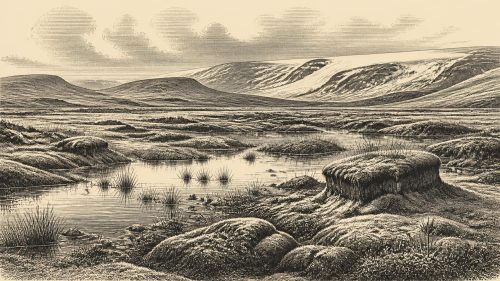
30,188 BCE is a label for a Late Pleistocene horizon, not a recoverable Irish year. Derryvree, County Fermanagh, preserves a sequence of glacial till, freshwater organic sediments and later till, demonstrating an ice-free interval between glacier advances. Radiocarbon dating places it broadly within MIS 3, although calibration prevents annual precision. Mosses, sedges and insects indicate cold, treeless wet tundra. Castlepook Cave records cold-stage fauna, but not a single contemporaneous community. Ireland’s ice sheet was expanding unevenly, while sea crossings remained uncertain. No evidence identifies human occupation, social institutions, farming or technology at date. Derryvree documents environmental change before renewed glaciation.

Derryvree’s Treeless Shore
30,187 BCE is a modern label within climatically unstable Marine Isotope Stage 3, not a recoverable Irish year. Derryvree, County Fermanagh, preserves freshwater silts beneath later glacial till, indicating treeless, cold wetland habitats with hardy plants and local biological productivity between ice advances. Castlepook Cave, County Cork, contains diverse late-Pleistocene fauna, including mammoth, reindeer, giant deer, hyaena and horse, though remains need not be contemporaneous. Ice expansion later erased much evidence. A marked reindeer femur may indicate Upper Palaeolithic butchery, but cannot demonstrate settlement or permanent population. No named communities, political structures, culture, routes or beliefs can be securely reconstructed.

Doneraile’s Hyena Corridor
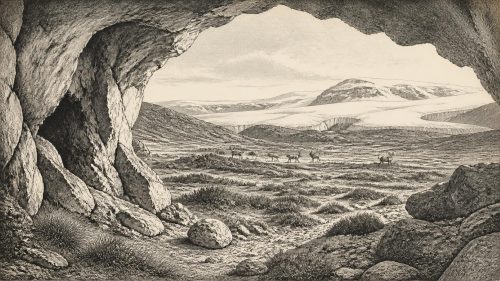
Around 30,186 BCE, Ireland experienced unstable Late Pleistocene conditions as ice expanded and sea levels fell. Castlepook Cave near Doneraile, County Cork, preserves major evidence: bones of mammoth, giant deer, reindeer, bear and spotted hyaena, accumulated across many millennia rather than one period. These animals indicate intermittent connections with north-west Europe and cold, open habitats, though not a single reconstructed ecosystem. Hyaena activity explains much bone damage and deposition. A marked reindeer femur may show human butchery, but remains unproven. No secure evidence exists for settlement, tools, houses, burials, farming, trade or political communities. Environmental change dominates this prehistoric horizon.
Castlepook’s Hyaena Bonebed
Thirty-thousand years BCE is a modern label, not a recoverable Irish historical year; evidence supports only broad Late Glacial reconstructions. Around 32,000 calibrated years BP, Ireland experienced unstable, severe cooling as the British–Irish Ice Sheet expanded, reshaping coasts, drainage and habitats. Ice-free areas, if present, held sparse tundra and steppe-tundra vegetation supporting varied fauna, documented in cave deposits including Castlepook, Cork. These assemblages include reindeer, hyaena and mammoth but may mix different periods. A possibly cut-marked Castlepook reindeer bone suggests unconfirmed early human visitation, not settlement. Secure Irish human evidence is far later. Caves and landforms preserve vital environmental evidence.
Derryvree Periglacial Microcosm
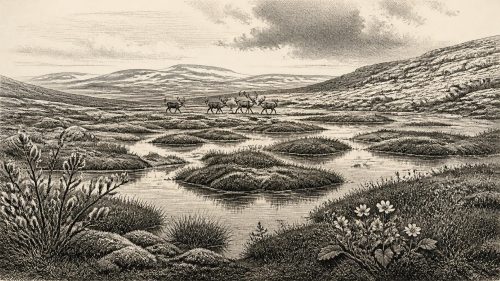
Thirty thousand one hundred and eighty-four BCE is a modern label, not a securely resolvable Irish date. Derryvree, County Fermanagh, preserves a wetland interval between glacial advances, broadly dated to 36,900–31,700 calibrated BP, with cold-water plants, mosses, insects and open tundra vegetation. Castlepook Cave, County Cork, records varied Ice Age fauna, although disturbed deposits prevent simple reconstructions. A possibly cut-marked reindeer bone may suggest an early human visit, but remains unconfirmed. No evidence establishes settlement, society or politics. Ireland formed a shifting periglacial landscape of ice, water, animals and possible transient people, documented only by fragmentary, local and revisable evidence.

Threeleaf Pools at Maguiresbridge
At 30,183 BCE, Ireland has no recoverable annual history or confirmed human settlement. Derryvree, near Maguiresbridge, provides evidence from freshwater sediments between glacial tills, dated broadly to 36,900–31,700 calibrated years BP. These reveal a locally ice-free, treeless wetland of pools, sedges, mosses, grasses and cold-adapted plants, subject to severe seasonal conditions before renewed glaciation. Ice extent elsewhere remained variable and uncertain. Castlepook Cave’s mixed fauna demonstrates intermittent availability to mammoth, reindeer and predators, while a possibly cut-marked reindeer bone suggests unproven brief human activity. No evidence supports resident communities, political life or reconstructed society; ecological remains form the principal archive.

Maguirebridge’s Muskeg Horizon
About 30,182 BCE, Ireland lay within the unstable, cold Late Pleistocene. At Derryvree near Maguiresbridge, County Fermanagh, freshwater sediments between till layers document an ice-free interval, broadly dated to 34,950–29,750 BCE. Fossils reveal treeless periglacial wetlands of grasses, sedges, dwarf willow, aquatic plants and insects. Conditions varied regionally as ice expanded, sea levels fell, and coastlines shifted. Castlepook Cave preserves cold-stage fauna, including mammoth, reindeer and hyaena. A possibly tool-marked reindeer bone may indicate brief human presence, but no secure settlement evidence exists. Glaciation destroyed much evidence, leaving a fragmented record of dynamic environments, mobile animals and uncertain human activity.
Derryvree’s Drumlin Interlude
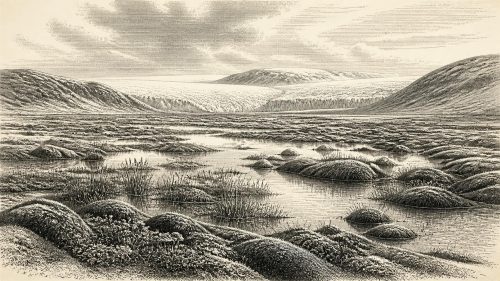
Thirty thousand years BCE is a modern approximation, not a date capable of identifying a specific Irish event. At Derryvree, County Fermanagh, sediments between two glacial tills record an ice-free interlude around 33,500 calibrated years BP, when shallow freshwater, tundra plants and periglacial conditions existed before renewed ice advance. Irish cave fauna, notably Castlepook’s, shows cold-adapted mammals, including reindeer, mammoth and giant deer, occupied landscapes during Marine Isotope Stage 3. A possibly tool-marked reindeer bone may indicate human activity, but proves neither settlement nor occupation. No evidence supports communities, farming or institutions; Ireland’s fragmentary deep past is geological and palaeoecological.

Waterford Red Deer
Around 30,180 BCE, Ireland was a changing Pleistocene margin rather than a definable historical society. Dynamic ice sheets, periglacial conditions, low sea levels and unstable routes shaped an exposed, seasonally harsh landscape. Derryvree, County Fermanagh, preserves a locally ice-free wetland episode, whose plants and insects indicate treeless tundra, shallow water and sparse vegetation. Cave finds show that reindeer, red deer, mammoth, bears, wolves, hyaenas and smaller cold-adapted animals reached Ireland during favourable intervals; a Waterford red-deer date overlaps this horizon. A possibly cut-marked Castlepook reindeer bone suggests, but cannot prove, human visits. No evidence supports settlements, farming, institutions or occupation.
BIRM-166’s Frozen Catchment
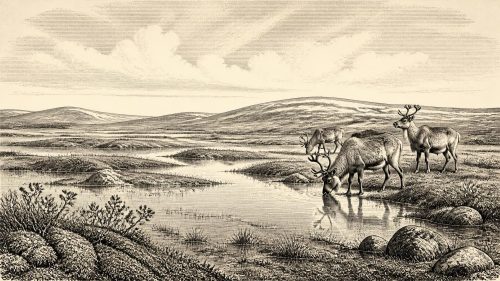
Around 30,179 BCE, Ireland was in the unstable cold climate of Marine Isotope Stage 3, not a datable historical year. Derryvree, County Fermanagh, preserves freshwater silts between glacial tills, indicating ice-free tundra wetland conditions before later ice advance. Castlepook Cave, County Cork, contains a long, mixed record of mammoths, giant deer, reindeer, carnivores and other Ice Age fauna. Its deposits demonstrate changing habitats, though not a single contemporary animal community. A possibly cut-marked reindeer bone may indicate human activity, but no settlement evidence exists. Ireland’s surviving record is environmental: dynamic landscapes repeatedly reshaped by ice, water, climate and animal migration.

Castlepook’s Cold-World Fauna
Labelled 30,178 BCE only approximately, this period belongs to later Marine Isotope Stage 3, before the Last Glacial Maximum, when Ireland experienced unstable cold climates and advancing ice. Castlepook Cave in County Cork preserves evidence of varied fauna, including reindeer, bears, deer, hyaenas, lemmings and mammoth, indicating open, changing habitats. Derryvree deposits suggest sedgy, tundra-like wetlands. Lower sea levels altered coastlines, but migration routes remain uncertain. A possibly cut-marked reindeer bone raises, without proving, early human visitation. No secure settlements or artefacts establish occupation. Subsequent ice expansion reshaped terrain and destroyed evidence, leaving fragmented records of a dynamic ecological frontier.

Castlepook’s Last Open Country
Around 30,177 BCE, Ireland lay in the later Marine Isotope Stage 3, a cold, largely treeless landscape approaching the Last Glacial Maximum. Cave deposits at Castlepook in north Cork preserve evidence of reindeer, mammoth, giant deer and predators, demonstrating habitable open country despite climatic instability. Scientific dates provide ranges, not exact calendar years, and disturbed deposits require caution. A marked reindeer femur may record stone-tool butchery about 33,000 years ago, suggesting possible human visits. No settlement, tools, hearths or society are securely known. Advancing ice later erased much evidence, making Castlepook a vital but incomplete archive of Ice Age Ireland.

Crag Cave’s Silent Dripstone
Around 32,125 cal BP, rather than a precisely knowable 30,176 BCE, Ireland experienced unstable late MIS 3 conditions. Crag Cave stalagmites ceased growing, indicating colder, drier or frozen local ground. As the British-Irish Ice Sheet expanded, Ireland remained regionally varied, with lower seas and shifting routes rather than uniform ice cover or a permanent land bridge. Open habitats supported reindeer, mammoth, giant deer, hare, lemmings, wolves and hyaenas, evidenced especially at Castlepook Cave. A possibly stone-cut reindeer bone may indicate brief Upper Palaeolithic carcass processing, but proves neither settlement nor continuous occupation. Environmental archives document climate, fauna, hydrology and ice.
Castlepook’s Uncertain Horizon
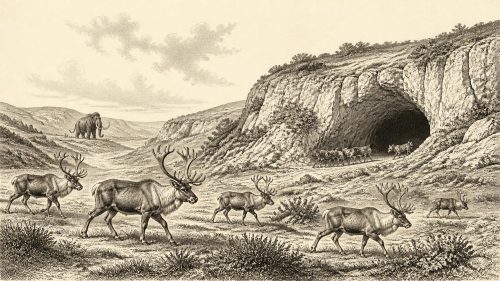
Around 30,175 BCE, Ireland lay within the unstable later Pleistocene, before maximum expansion of the last British–Irish Ice Sheet. Precise dating is impossible, and evidence survives chiefly in disturbed cave deposits. Castlepook Cave, County Cork, preserves remains of mammoth, reindeer, giant deer, hyaena, bear and other cold-adapted animals, accumulated across millennia rather than in one episode. Open tundra-like habitats and lower sea levels shaped a landscape. A marked reindeer femur may indicate Upper Palaeolithic butchery, but lacks secure context and cannot prove settlement. No wider reconstruction is justified. Castlepook instead records intermittent animal life and a possible fleeting human encounter.

Derryvree’s Intertill Macrofossils
Thirty thousand one hundred and seventy-four BCE is a calendar label within Marine Isotope Stage 3, not a datable event. Derryvree, County Fermanagh, preserves freshwater sediments between glacial tills, showing a locally ice-free, cold, treeless wetland during a broadly dated interval. Plant, insect and pollen remains indicate sedges, grasses, mosses, herbs and shallow pools, rather than forest or settlement. Castlepook Cave, County Cork, holds long-accumulated remains of mammoth, giant deer, reindeer, bears and hyaenas, demonstrating varied fauna but not a contemporary community. No secure evidence confirms human occupation. These fragmentary deposits document changing habitats before Last Glacial Maximum ice growth.

Derryvree’s Herbaceous Pollen
30,173 BCE cannot be identified as a recoverable Irish historical year; it falls within a broad calibrated radiocarbon range for the Late Pleistocene. At Derryvree, County Fermanagh, freshwater sediments sealed between glacial tills record a cold, treeless, periglacial wetland with herbaceous pollen, mosses, sedges, bogbean and other cold-adapted plants. The site demonstrates environmental intervals between ice advances, not island-wide conditions. Castlepook Cave preserves diverse cold-stage fauna and a possibly cut-marked reindeer bone, suggesting but not proving brief human visits. No evidence establishes settlement, politics or farming. Ireland instead experienced fluctuating water, open vegetation, animal life and increasingly influential glaciation change.

Crag Cave’s Thawwater Flowstone
Thirty-thousand years BCE is best understood as a broad Late Pleistocene horizon, not a date for a recorded Irish event. During Marine Isotope Stage 3, Ireland experienced unstable climates, fluctuating ice and altered coastlines. Derryvree, County Fermanagh, preserves treeless wetland sediments between glacial tills, indicating cold, open habitats during an ice-free interval. Crag Cave flowstones in Kerry show liquid-water infiltration around 32,100 years ago, suggesting locally above-freezing annual conditions. Southern caves contain cold-stage fauna, including mammoth and reindeer. A possibly butchered reindeer bone at Castlepook hints at human activity, but permanent settlement remains unproven before later extensive glaciation across Ireland.

Castlepook’s Spotted Hyaena
At 30,171 BCE, Ireland experienced unstable Marine Isotope Stage 3 conditions, a period unsuitable for conventional historical narrative. Growing ice, tundra wetlands and fragmented habitats characterised a varied landscape, later heavily altered by glaciation. Derryvree deposits in Fermanagh preserve sedges, mosses, dwarf willow and aquatic plants from periglacial freshwater environments. Castlepook Cave in County Cork records mammoth, reindeer, giant deer, predators and spotted hyaena, whose bones accumulated over long periods. A marked reindeer bone may indicate human carcass processing around 33,000 years ago, but cannot establish settlement, culture or a specific visit. Evidence reveals environmental change, animal movement and uncertainty.

Derryvree’s Coldwater Beetles
Around 30,170 BCE, Ireland lay in the Late Pleistocene, but no precise historical event can be reconstructed. Derryvree, County Fermanagh, preserves freshwater organic sediments between glacial tills, dated broadly to 34,950–29,750 BCE. Mosses, sedges, aquatic plants and cold-adapted insects indicate locally ice-free, treeless wetlands amid unstable periglacial conditions. Comparable Fermanagh deposits suggest intermittent open habitats, while advancing ice repeatedly transformed landscapes. Castlepook Cave's animal remains, including reindeer, mammoth, bear and hyaena, demonstrate varied Ice-Age fauna but cannot represent one moment. A possibly tool-marked reindeer bone hints at early human presence, yet proves neither settlement nor occupation. Environmental evidence is strongest.
Derryvree’s Juniper Macrofossils
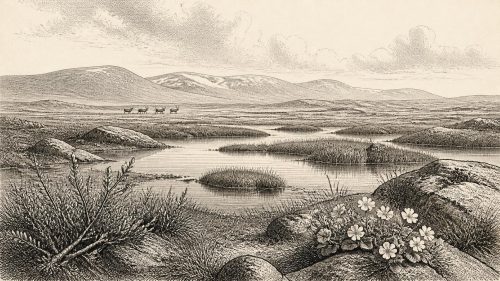
Around 30,169 BCE, Ireland’s history is reconstructed from environmental evidence rather than events. Derryvree, County Fermanagh, preserves organic sediments between glacial tills, dated approximately 30,500 radiocarbon years BP, indicating an ice-free freshwater tundra landscape with grasses, sedges, mosses, juniper and low shrubs. Climate and ice extent fluctuated during MIS 3, producing strong regional variation before the Last Glacial Maximum. Castlepook Cave, County Cork, yielded mammoth, reindeer, giant deer, hyaena and other fauna, demonstrating connections with north-west Europe. A possible tool mark suggests transient human activity, but sustained occupation remains unproven. These records reveal ecological richness, not a precise annual history.

Castlepook’s Fresh-Bone Reindeer
Around 30,168 BCE, Ireland lay in a climatically unstable Late Pleistocene world as the British–Irish Ice Sheet expanded. Conditions varied regionally; exposed ground supported patches of cold, open habitat and mobile fauna, including reindeer, horse, mammoth and predators. Castlepook Cave preserves animal remains and a reindeer femur bearing a possible stone-tool cut mark. This may indicate brief human carcass processing roughly 33,000 years ago, but does not prove settlement. No securely documented Palaeolithic habitation, polity, economy or culture is known. The period’s history is reconstructed from uncertain radiocarbon ranges, cave deposits, fauna and glacial evidence, leaving Castlepook an unresolved clue.

BIRM-166 Organic Interbed
Around 30,167 BCE, Ireland’s history is reconstructed from environmental evidence rather than recorded events. At Derryvree, County Fermanagh, organic freshwater deposits between glacial tills, dated broadly to this interval, reveal tundra vegetation, pools and severe periglacial conditions during an ice-free phase. Castlepook Cave, County Cork, preserves diverse cold-stage fauna, including mammoth, reindeer and giant deer, although its mixed deposits span a long period. A marked reindeer bone may indicate human carcass processing, but remains unconfirmed and does not demonstrate settlement. Changing ice margins, sea levels and regional conditions shaped a fragmented Late Pleistocene landscape across the island and through time.

BIRM-166 and Ireland’s Cold Stage
Thirty thousand years BCE is not a recorded Irish event but an approximate point within Marine Isotope Stage 3, reconstructed from limited environmental evidence. Derryvree, County Fermanagh, preserves wetland sediments between tills, dated by BIRM-166 within a calibrated range. They indicate an ice-free interval with cold, open tundra vegetation, freshwater and seasonal biological activity before later glaciation. Greenland records place the period near a cold stadial, although local conditions varied. Castlepook Cave documents diverse Ice Age fauna, not a simultaneous community. Possible early human activity remains unconfirmed; no secure settlement exists. These archives depict an ecologically inhabited, repeatedly glaciated Ireland.
BIRM-166’s Ice-Free Fermanagh
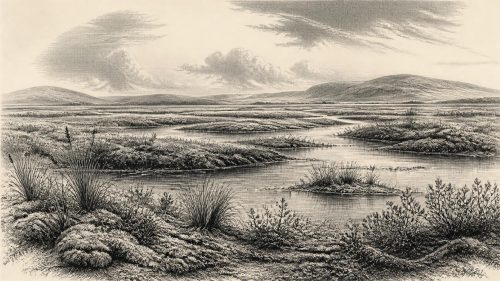
Around 30,165 BCE, Ireland’s history is reconstructed from deposits rather than annual records. At Derryvree, County Fermanagh, freshwater sediments between glacial tills show a locally ice-free, cold wetland interval during MIS 3, supporting tundra-like vegetation, insects and shallow-water habitats before renewed glaciation. This evidence does not establish island-wide conditions. Castlepook Cave, County Cork, preserves MIS 3 fauna including mammoth, reindeer, hyaena and giant deer, demonstrating changing animal communities. A possibly tool-marked reindeer bone may indicate human handling, but cannot prove settlement or continuous occupation. Ireland remained environmentally variable as the more extensive Last Glacial Maximum ice advanced over coming millennia.

Derryvree’s Threeleaf Waters
Around 30,164 BCE, Ireland lay within the unstable Late Pleistocene, not a historically datable year. Derryvree, County Fermanagh, preserves freshwater sediments between glacial tills, indicating an ice-free interval with cold, treeless wetland, pools, sedges, mosses and tundra plants. Its radiocarbon evidence spans a broad calibrated range, preventing precise national conclusions. Castlepook Cave, County Cork, contains a chronologically mixed Ice Age fauna, including mammoth, reindeer, giant deer, predators and lemmings, demonstrating changing open-country ecosystems. A cut-marked reindeer bone may indicate transient Upper Palaeolithic human activity, but not permanent settlement. Advancing ice later reshaped landscapes and obscured substantial evidence from earlier deposits.

BIRM-166’s Radiocarbon Bracket
30,163 BCE is a nominal label rather than a recordable Irish year. Evidence from Derryvree, County Fermanagh, places freshwater sediments and remains between glacial tills during MIS 3, showing cold, treeless, waterlogged ground with hardy plants, insects and shallow water. Radiocarbon BIRM-166 provides a broad calibrated bracket, not a precise date. Castlepook Cave, County Cork, preserves Ice Age fauna, including mammoth, reindeer and predators, accumulated over time. A possibly tool-marked reindeer bone may indicate human activity, but no secure settlement exists. Ireland was environmentally variable, affected by shifting ice, low seas and climatic instability; its history remains landscape-based and uncertain.

Derryvree’s 1969 Exposure
At approximately 30,162 BCE, Ireland lay within the cold conditions of Marine Isotope Stage 3, although no precise calendar dating is possible. Roadworks at Derryvree, County Fermanagh, exposed a freshwater organic layer between glacial tills, showing a tundra wetland persisted between ice advances. Its flora indicates treeless, waterlogged, periglacial terrain. Castlepook Cave, County Cork, preserves a mixed, poorly dated assemblage including mammoth, reindeer and carnivores, demonstrating intermittent cold-stage animal habitats. A possibly cut-marked reindeer bone suggests, but cannot confirm, early human visitation. Evidence reveals dynamic regional environments, changed coastlines and uncertain ice extent, rather than settlement, society or continuous glaciation.
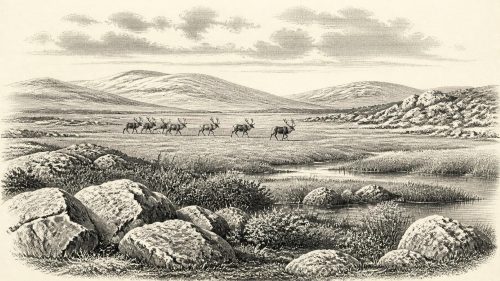
Carden’s Fresh-Bone Incision
Around 30,161 BCE, Ireland cannot be assigned a recoverable event, but evidence indicates a climatically unstable, intermittently habitable Pleistocene landscape. At Derryvree, County Fermanagh, organic sediments beneath later glacial deposits reveal a cold freshwater basin supporting open-ground plants between ice advances. Castlepook Cave, County Cork, preserves pre-Last Glacial Maximum fauna, including reindeer, mammoth, deer, predators and mammals, though deposits are mixed and span millennia. A reindeer femur bearing a possible fresh-bone stone-tool cut may indicate fleeting Upper Palaeolithic human activity. It does not demonstrate settlement, culture or continuous occupation. Changing ice, coasts and routes governed movement across this ecological region.

Mammoth Cave’s Narrow Window
Around 30,160 BCE, Ireland experienced unstable Late Pleistocene conditions during Marine Isotope Stage 3, rather than a datable historical year. Derryvree, County Fermanagh, records a cold freshwater interval between glacial advances, with tundra vegetation, wetlands and sparse treeless terrain. Crag Cave speleothems indicate intermittent milder phases. Castlepook Cave, County Cork, preserves fauna including mammoth, reindeer, giant deer and carnivores, though its disturbed deposits limit precision. A cut-marked reindeer femur may suggest an early human visit, but cannot prove permanent settlement. Changing ice, sea levels and landscapes allowed occasional animal movement, while evidence remains fragmentary and regionally specific in character overall.

Ussher’s Castlepook Collection
Thirty thousand years ago, Ireland lay within the climatically unstable later Marine Isotope Stage 3, not a precisely datable calendar year. Derryvree sediments in County Fermanagh indicate locally ice-free, periglacial wetlands supporting tundra vegetation between glacial advances. Castlepook Cave, County Cork, yielded a complex fauna including reindeer, mammoth, giant deer, predators and small cold-adapted mammals, accumulated over different times and processes. A cut-marked reindeer femur may record human carcass processing, but its old excavation context prevents firm conclusions about occupation. No evidence establishes settlements, politics, religion or culture. Dating, palaeoecology and zooarchaeology instead reveal environments, animal movements and human presence.

Castlepook’s Stone-Mark Debate
30,158 BCE is a modern label rather than a recoverable Irish year. Ireland lay within the volatile Late Pleistocene, before the greatest British–Irish Ice Sheet advance, with ice-free areas appearing between glaciations. Derryvree’s sediments record a cold, treeless freshwater wetland, later sealed by renewed ice. Castlepook Cave preserves bones from animal communities arriving at different times, including reindeer, mammoth and predators, but not a single contemporaneous fauna. A marked reindeer femur may show stone-tool butchery about 33,000 years ago, yet remains contested and proves neither settlement nor occupation. Evidence depicts changing landscapes, mobile fauna and uncertain human access, not history.

Derryvree’s Paired Glacial Tills
Although 30,157 BCE is not a precise Irish historical date, evidence from Derryvree, County Fermanagh, illuminates a broad Late Pleistocene interval. Beneath a drumlin, an earlier till, freshwater sediments and later till record ice retreat, a cold treeless wetland, and renewed glaciation. Radiocarbon dating places the organic deposits within a wide calibrated range encompassing the nominal year. As the British–Irish Ice Sheet expanded unevenly, Ireland contained varied habitats rather than uniform ice. Castlepook Cave’s fauna confirms cold-adapted mammals; a possibly cut-marked reindeer bone suggests, but does not directly prove, human presence. No evidence establishes permanent settlement, society or year-specific events.
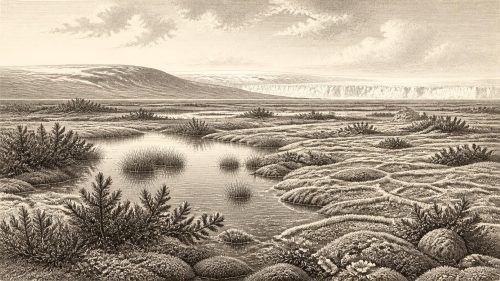
The Derryvree Muskeg
Thirty thousand years BCE is an imprecise modern label for a later Pleistocene interval. At Derryvree, County Fermanagh, freshwater silts between two glacial tills record a temporary ice-free basin, dated broadly to 34,950–29,750 BCE. Fossils indicate treeless, periglacial tundra with grasses, sedges, juniper, mosses, wetland plants and shallow water, before renewed ice advance. The site demonstrates local rather than island-wide conditions amid a dynamic British–Irish Ice Sheet. Castlepook Cave, County Cork, preserves diverse Ice Age animal remains, but not a single contemporary fauna. No secure human settlement is known; a possibly cut-marked reindeer bone may indicate brief human presence there.
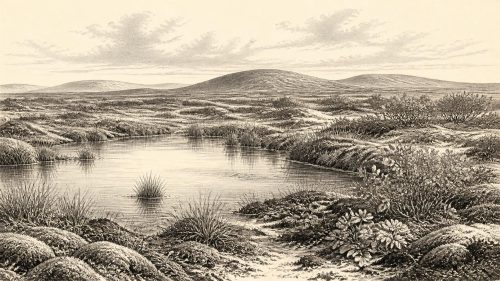
Maguirebridge’s Mossland Basin
30,155 BCE cannot be identified as a specific Irish historical year; it falls within a broad Late Pleistocene radiocarbon range. Derryvree, near Maguiresbridge, preserves freshwater sediments between glacial tills, indicating treeless tundra-like wetlands with mosses, sedges, dwarf willow and aquatic plants. Insects and wider cave faunas suggest cold, open habitats supporting mammals including reindeer, deer and predators, although assemblages span long periods. Growing ice preceded the Last Glacial Maximum, altering routes and habitats. A marked Castlepook reindeer bone may indicate human butchery, but proves neither settlement nor continuity. Later glaciation destroyed evidence, leaving fragmentary record of ecological connections with Europe.
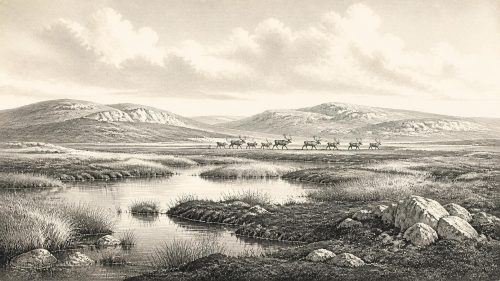
Derryvree Freshwater Silts
Around 30,154 BCE, Ireland was a climatically unstable Late Pleistocene landscape rather than a documented human society. Derryvree, County Fermanagh, preserves freshwater silts between glacial tills, demonstrating a locally ice-free, treeless periglacial wetland interval before renewed glaciation, though its radiocarbon date cannot identify a precise calendar year. Plants indicate open, cold, wet habitats. Castlepook Cave, County Cork, contains MIS 3 fauna including mammoth, reindeer and hyaena, but deposits are chronologically complex. A possibly cut-marked reindeer femur may indicate brief human activity, not settlement. Together, these records reveal shifting Irish habitats, animal movement and later ice-driven destruction or burial of evidence.
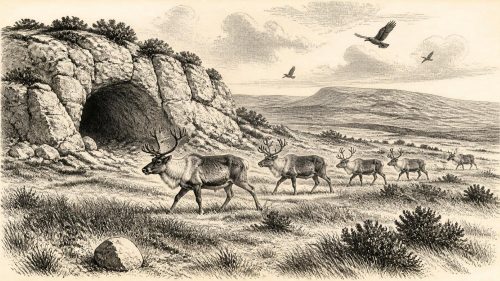
Hyenahall’s Reindeer Bone
30,153 BCE is an approximate modern waypoint within Ireland’s climatically unstable Late Pleistocene, not a recordable historical year. Castlepook Cave, County Cork, preserves the island’s richest vertebrate assemblage from the period, though disturbed deposits and revised radiocarbon dates require caution. Reindeer, mammoth, giant deer, hyaena and lemmings indicate predominantly open, cold, variable landscapes. A reindeer femur from Hyenahall bears a possible stone-tool butchery cut, suggesting limited Upper Palaeolithic human activity, but not settlement, hunting, or continuous occupation. Later glaciation reshaped landscapes and destroyed evidence. Ireland’s deep prehistory is therefore understood through fragmentary surviving remains, calibrated dating ranges, and cautious interpretation.

Carden Reindeer Femur
Around 30,152 BCE, Ireland lay within the climatically unstable Late Pleistocene, before the Last Glacial Maximum. Evidence cannot identify events in a single year, but Derryvree sediments in Fermanagh reveal locally exposed, treeless periglacial habitats with freshwater and tundra vegetation. Castlepook Cave, County Cork, preserves a mixed, long-lived faunal record including mammoth, giant deer, reindeer, bears and hyenas, demonstrating intermittent access for animals. A reindeer femur bearing a possible stone-tool cut may indicate brief human carcass processing about 31,000 BC. However, no associated settlement, tools, hearths or human remains prove occupation. Ireland’s history is environmental: shifting habitats, coasts and routes.

Castlepook’s Open-Range Fauna
Around 30,151 BCE, Ireland lay within the unstable, cold Marine Isotope Stage 3, before maximum glaciation. Evidence is sparse because later ice reshaped landscapes. Derryvree, County Fermanagh, preserves freshwater silts indicating treeless tundra wetland, with sedges, mosses, herbs and Arctic-alpine plants. Castlepook Cave, County Cork, contains a diverse Late Pleistocene fauna, including reindeer, mammoth, giant deer, predators and cold-adapted small mammals. A reindeer femur may bear a stone-tool cut mark, suggesting possible Upper Palaeolithic visitation, but not permanent settlement. Lower sea levels altered routes, though connections remain uncertain. The period reveals a varied Ice Age Ireland; human evidence remains contested.

National Museum Reindeer Femur
30,150 BCE denotes an approximate late-Marine Isotope Stage 3 horizon, rather than a recoverable Irish year. Ireland experienced unstable cold conditions before maximum British-Irish ice expansion, with local ice-free intervals indicated by Crag Cave speleothems. Castlepook Cave, County Cork, preserves a fauna including reindeer, mammoth, giant deer, predators and tundra species, demonstrating open habitats. A National Museum reindeer femur, possibly cut by a stone tool and dated around 31,000–33,000 BCE, may indicate Ireland's human activity. However, disturbed context and explanations preclude proof of settlement. Glaciation and later landscape change destroyed evidence, leaving caves as archives of change and hunter presence.

Giant Deer on Blackwater
Although labelled 30,149 BCE, this period cannot be dated precisely and is understood through broad environmental evidence from Marine Isotope Stage 3. Ireland experienced fluctuating cold conditions before the Last Glacial Maximum, with changing ice, sea levels and land connections. Derryvree, County Fermanagh, preserves a local ice-free freshwater wetland, supporting treeless vegetation, insects and marsh habitats. Southern caves reveal a diverse earlier fauna, including mammoth, reindeer and giant deer, though deposits are time-averaged and giant deer cannot be securely assigned to this date. Human presence remains unproven. The surviving record documents climatic instability, ecological change and glacial erosion across Ireland.

Derryvree’s Arctic Marsh
Labelled 30,148 BCE, this period in Ireland belongs broadly to unstable Late Pleistocene MIS 3, not a dated historical year. At Derryvree, County Fermanagh, freshwater silts sealed between glacial tills, radiocarbon dated within a wide range encompassing the nominal date, reveal a temporary cold, periglacial wetland. Mosses, sedges, bogbean, dwarf willow and other Arctic-alpine plants indicate open, largely treeless tundra. Castlepook Cave fauna demonstrates varied Ice-Age animals, though not necessarily contemporaneous communities. Human occupation remains unproven: a possibly cut-marked reindeer bone suggests only a tentative visit. Changing ice, sea levels and connectivity created a dynamic, regionally varied landscape over millennia.

North Channel Ice Advance
Around 30,147 BCE, Ireland was entering major glacial expansion during Marine Isotope Stage 3, although dating and ice limits remain uncertain. Growing upland glaciers merged towards the British–Irish Ice Sheet, particularly around the North Channel and northern Ireland, while southern ice remained more localised. Ice and meltwater reshaped bedrock and sediments, contributing to landscapes formed through repeated glaciations. Ice-free areas supported cold, open, variable vegetation and, at different times, fauna including reindeer, mammoth and giant deer. Cave evidence requires reassessment through improved dating. No secure human occupation exists; a modified reindeer bone suggests only an unproven, transient Upper Palaeolithic visit.
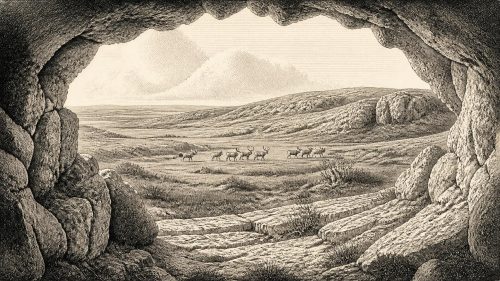
Carden’s Lithic Femur Incision
Thirty thousand years BCE is a notional marker within Ireland’s Late Pleistocene, not a securely datable historical event. Amid unstable pre-Last Glacial Maximum conditions, ice, periglacial processes, altered sea levels and open habitats shaped a landscape. Castlepook Cave, County Cork, preserves Ireland’s vertebrate record, including mammoth, giant deer, reindeer, bears, hyenas and later cold-adapted fauna, although its deposits span millennia and are disturbed. A cut-marked reindeer femur, perhaps 33,000 radiocarbon years old, may indicate human carcass processing with a stone tool. It cannot prove settlement, continuity or society. Later glaciation likely destroyed evidence; research may clarify tentative early human presence.

Castlepook’s Lemming Bones
Around 30,145 BCE, Ireland was a cold, unstable Late Pleistocene landscape approaching maximum glaciation, not a dated historical moment. Marine Isotope Stage 3 evidence, especially from Castlepook Cave, records reindeer, giant deer, mammoth, predators, lemmings and fauna, although bones accumulated across millennia and cannot represent one community. Revised radiocarbon dating confirms southern Irish animals before the Last Glacial Maximum. A marked reindeer femur may show Upper Palaeolithic butchery, suggesting brief human visits. It does not prove settlement, society or continuity of occupation. Changing coasts, ice and erosion obscure access routes and camps. Evidence supports uncertainty rather than a prehistoric chronicle.

Maguiresbridge Silt Window
At the notional date of 30,144 BCE, Ireland’s past is reconstructed from fragmentary environmental evidence rather than historical events. Derryvree, County Fermanagh, preserves freshwater silts formed during an ice-free interval, indicating treeless tundra, wetlands and severe periglacial conditions before renewed glaciation. Castlepook Cave, County Cork, contains remains of reindeer, mammoth, giant deer, hyaena and other cold-climate fauna, demonstrating varied open-country ecosystems and continental connections. A marked reindeer bone may indicate early human carcass processing, but no secure settlement or population is known. Ice extent, coastlines and chronology remain uncertain; later ice advances destroyed much evidence across Ireland over subsequent millennia.
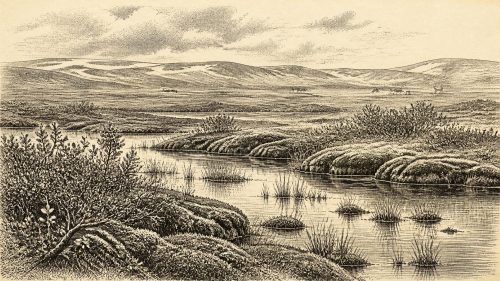
Derryvree’s Periglacial Fen
Although 30,143 BCE is a modern, imprecise conversion, Derryvree, County Fermanagh, provides Ireland’s strongest evidence for conditions within this later Pleistocene interval. Freshwater sediments, dated broadly to 36,900–31,700 calibrated BP, lay between glacial tills, recording open water, marsh, tundra vegetation and severe periglacial climate before renewed ice advance. Castlepook Cave, County Cork, preserves a mixed fauna including mammoth, reindeer, giant deer, predators and smaller cold-adapted animals, demonstrating ecological links beyond Ireland. No secure human settlement is known. A possibly cut-marked reindeer bone suggests brief human presence, but remains uncertain. Together, sites reveal regionally varied, unstable environments, not fixed political history.

Derryvree Tundra Mosses
30,142 BCE is a modern chronological label, not a recoverable Irish historical year. During Marine Isotope Stage 3, Ireland experienced uneven climatic change, with expanding ice, exposed land, wetlands and animal routes preceding the Last Glacial Maximum. Derryvree, County Fermanagh, preserves a radiocarbon-dated tundra-like wetland between till layers, demonstrating cold but temporarily ice-free conditions. Castlepook Cave, County Cork, contains MIS 3 fauna including mammoth, reindeer, giant deer and hyaena, although deposits span different periods. A cut-marked reindeer bone suggests possible Upper Palaeolithic visitors, but no secure settlement evidence exists. Environmental uncertainty and fragmentary preservation define this deep past in Ireland.

Bogbean Pools Beneath Fermanagh
About 30,141 BCE, Ireland’s record permits environmental reconstruction rather than annual history. At Derryvree, County Fermanagh, freshwater organic sediments between glacial tills, broadly dated to 36,900–31,700 calibrated years BP, show an ice-free interval before later ice returned. Plant, insect and aquatic remains reveal treeless tundra-like wetlands, with sedges, mosses, bogbean and shallow pools. Ireland’s ice cover and coastal geography varied greatly during this unstable period. Castlepook Cave preserves wider Pleistocene fauna, including mammoth, reindeer, giant deer and predators, but not a single contemporary community. A cut-marked reindeer bone suggests an early human visit, although permanent settlement there remains unproven archaeologically.
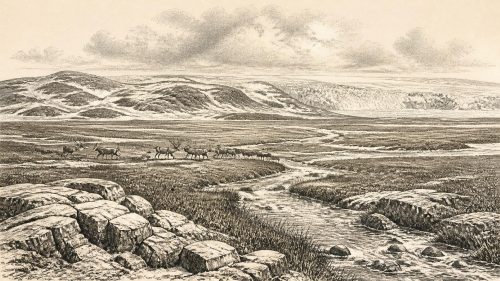
Castlepook Reindeer Threshold
Around 30,140 BCE, Ireland faced severe climatic deterioration as the British–Irish Ice Sheet expanded, although local conditions varied. Later glaciation and changing seas destroyed or obscured much evidence, preventing precise reconstruction. Exposed areas supported treeless tundra, grassland and sparse scrub inhabited by mammoth, reindeer, giant deer, predators and smaller cold-adapted animals. Castlepook Cave in County Cork preserves important faunal remains and a debated cut-marked reindeer bone, possibly indicating brief Upper Palaeolithic human activity. However, no settlement, tools, human remains or cultural assemblage confirms permanent occupation. Travel routes remained uncertain and hazardous. Ireland’s environment is better documented than its possible visitors.

Doneraile Reindeer Country
Around 30,139 BCE, Ireland was a climatically unstable Late Pleistocene landscape approaching extensive glaciation. Ice was advancing unevenly, while lower sea levels connected the island ecologically to wider north-west Europe. Castlepook Cave near Doneraile yielded reindeer, mammoth, giant deer, predators and cold-adapted smaller mammals, indicating open steppe-tundra habitats and complex food webs. A marked reindeer bone may indicate human butchery about 33,000 years ago, but poor excavation records and absent associated artefacts preclude claims of settlement. Any visitors were likely mobile foragers. Glaciation reshaped terrain and obscured earlier evidence, leaving uncertainty central to this period’s history and its interpretation today.

Mammoth Cave at Doneraile
About 30,138 BCE, Ireland experienced fluctuating Late Pleistocene conditions during Marine Isotope Stage 3, before the Last Glacial Maximum. Ice, tundra, wetlands and meltwater varied regionally; lower sea levels did not guarantee a permanent land bridge to Britain. Derryvree, County Fermanagh, preserves a radiocarbon-dated freshwater deposit indicating ice-free, treeless tundra and diverse wetland plants. Castlepook, or Mammoth Cave, near Doneraile, yielded reindeer, mammoth, giant deer and other cold-adapted fauna. A marked reindeer femur may record Ireland’s earliest human butchery, but proves neither settlement nor continuous occupation. These sites offer a tentative environmental and archaeological horizon, not a conventional historical event.

Threeleaf Under Drumlin Clay
Around 30,137 BCE, Ireland lay within the climatically unstable Marine Isotope Stage 3, and evidence permits no precise annual reconstruction. At Derryvree, County Fermanagh, organic sediments between glacial tills record a temporary, cold ice-free wetland, with grasses, sedges, bogbean and water-milfoil, later buried by advancing ice. Castlepook Cave, County Cork, preserves fauna including reindeer, mammoth, giant deer, bear, hyaena and Arctic lemming, indicating links with wider Europe. A possibly cut reindeer bone suggests, but cannot confirm, human visits. No settlement, tools, institutions or culture are securely attested. Ireland was a dynamic, intermittently habitable landscape approaching more extensive regional glaciation soon.

Awbeg Reindeer Range
About 30,136 BCE, Ireland lay within the cold, changing environment of Marine Isotope Stage 3, as conditions developed towards later extensive glaciation. Open steppe-tundra, sparse vegetation and periglacial processes characterised landscapes, although ice extent, coastlines and access remained uncertain. Castlepook Cave in County Cork preserves time-averaged remains of mammoth, reindeer, deer, bears, wolves, foxes, hares, lemmings and hyaenas, indicating intermittent use by cold-adapted fauna. Revised dating and disturbed deposits prevent reconstruction of a single moment. A cut-marked reindeer bone may indicate an early human visit, but permanent settlement, social organisation and economy remain unproven; environmental change is the historical theme.

Derryvree’s Frost-Shattered Wetland
Thirty thousand years BCE is not a precise recoverable Irish date but falls within Marine Isotope Stage 3. At Derryvree, County Fermanagh, radiocarbon-dated freshwater deposits, sealed between tills, record an ice-free interval before later glaciation. Their plants, insects and sediments reveal cold, treeless tundra wetlands with pools, mosses, sedges and short seasonal productivity. Castlepook Cave, County Cork, yielded diverse remains of reindeer, mammoth, horse, predators and other open-country fauna, though accumulation spans time. A cut-marked reindeer femur may indicate human activity, but proves neither settlement nor society. Together, the sites document severe yet habitable, climatically unstable Late Pleistocene Irish landscapes.

Doneraile’s Ice-Age Bone Archive
Around 30,134 BCE, Ireland was approaching the Last Glacial Maximum, although ice expansion varied regionally and no precise annual reconstruction is possible. Cave deposits, notably Castlepook near Doneraile, preserve a disturbed, long accumulated record of MIS 3 fauna, including mammoth, giant deer, reindeer, bears, wolves, foxes, hyaenas and lemmings. These remains indicate intermittent open, treeless cold habitats and connections with north-west Europe, not a uniform national fauna. Human occupation remains unproven: a possibly butchered reindeer bone suggests brief presence but lacks secure context. Growing ice fragmented habitats and obscured evidence, leaving ecological change rather than social or political history here.

Norwegian Lemmings at Castlepook
About 30,133 BCE, Ireland cannot be described through annual history, but Late Pleistocene evidence indicates a cold, changing MIS 3 environment. Derryvree, County Fermanagh, preserves freshwater deposits dated broadly to this period, showing treeless tundra-like wetlands with sedges, mosses and cold-adapted plants between glacial episodes. Castlepook Cave, County Cork, contains a mixed, complex fauna including mammoth, reindeer, giant deer, lemmings, Arctic fox, wolf and hyaena, demonstrating open cold habitats but not contemporaneity. A possibly tool-marked reindeer bone suggests human activity around 33,000 years ago, although no settlement is proven. Later ice and sea-level change destroyed or obscured much surviving evidence.
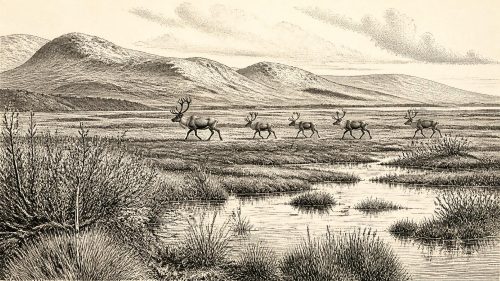
Derryvree’s Dryas Octopetala
At roughly 32,000 years before present, Ireland lay within the climatically unstable Marine Isotope Stage 3. Evidence from sediments, fossils, caves and glacial landforms permits environmental reconstruction but not precise history. At Derryvree, County Fermanagh, freshwater deposits between tills record tundra-like marsh vegetation, aquatic life and ice-free conditions during a broad calibrated interval encompassing 30,132 BCE. Castlepook Cave, County Cork, preserves remains of mammoth, reindeer, giant deer and predators, though its mixed deposits cannot establish contemporaneity. A cut-marked reindeer bone may indicate human activity, but no secure settlement evidence exists. Later glaciation erased much evidence, leaving a fragmentary environmental record.
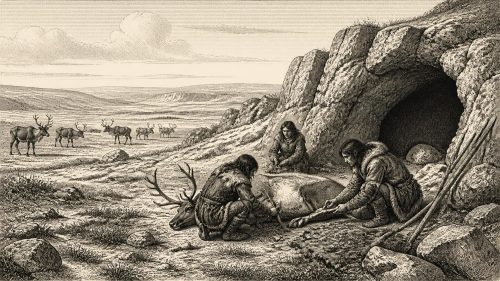
Castlepook’s Modified Femur
About 32,000 calibrated years BP, Ireland lay within an unstable Ice Age environment, as ice, sea levels and climates changed over periods. The British–Irish Ice Sheet's local extent remains uncertain, while open tundra-steppe supported reindeer, mammoth, horse and predators. Castlepook Cave, County Cork, produced a reindeer femur with a possible stone-tool cut or chop, tentatively indicating Palaeolithic human handling around 31,000 BC. However, disturbed deposits, antiquarian excavation and absence of associated tools or habitation evidence prevent claims of settlement or continuity. The record instead suggests possible brief hunter incursions amid ecological opportunity, reconstructed through fragmentary bones, sediments, landforms and dates.

Castlepook’s Late MIS 3 Fauna
Labelled 30,130 BCE, this period falls in late Marine Isotope Stage 3, as Ireland moved towards, but had not reached, maximum glaciation. Conditions were cold, open and changing, with lower seas and unstable ice margins linking Ireland ecologically to north-west Europe. Castlepook Cave, County Cork, preserves Ireland’s principal pre-maximum vertebrate archive, including mammoth, giant deer, reindeer, bear, hyena, lemmings, Arctic fox and wolf. Its mixed, disturbed deposits cannot date all species together, though modern redating has revised ages older. The evidence indicates mobile Ice Age fauna in patchy tundra-like habitats, not human settlement. Secure human activity appears 12,800 years ago.

Derryvree’s Periglacial Beetles
Thirty thousand years BCE is not a precise recoverable Irish date, but falls within unstable late Marine Isotope Stage 3. At Derryvree, County Fermanagh, organic sediments between glacial tills, dated broadly to 36,900–31,700 calibrated years BP, preserve a cold, treeless freshwater wetland of mosses, sedges, hardy plants and periglacial insects. Ireland experienced shifting ice margins before the later glacial maximum, with fragmented evidence of changing environments. Castlepook Cave, County Cork, records cold-adapted mammals, including mammoth, reindeer and giant deer, across long periods. A possibly tool-marked reindeer bone may indicate a human visit, but no evidence demonstrates settlement, culture or institutions.
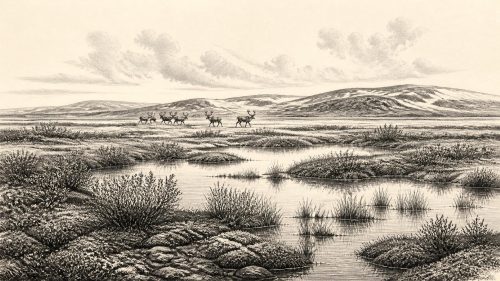
Maguirebridge’s Arctic Waterline
30,128 BCE is a modern label for a Late Pleistocene interval, not a recoverable Irish historical date. Environmental evidence from Derryvree, County Fermanagh, records a cold, treeless wetland between glacial advances, with sedges, grasses, mosses, aquatic plants and hardy shrubs. Castlepook Cave, County Cork, preserves MIS 3 fauna including mammoth, reindeer, giant deer, predators and scavengers, indicating productive open habitats. A possibly tool-marked reindeer bone suggests, but does not establish, early human presence. Lower sea levels altered routes, while later ice destroyed evidence. These fragile archives reveal changing ecosystems before extensive glaciation, not named communities, events or institutions in Ireland.
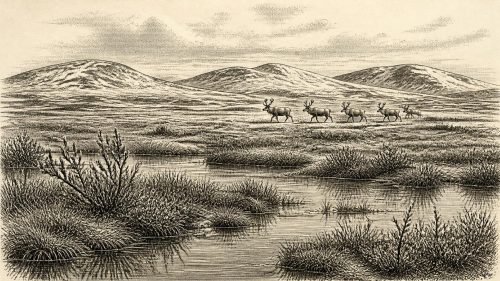
Cork’s Vanishing Cave Fauna
Rather than a precise historical year, 30,127 BCE denotes a Late Pleistocene, Marine Isotope Stage 3 interval of climatic instability before the Last Glacial Maximum. Ireland comprised shifting cold environments, with uncertain ice extent. Derryvree, County Fermanagh, preserves a buried freshwater wetland, dated broadly to this period, whose plants indicate treeless periglacial conditions and shallow water. Castlepook Cave, County Cork, contains a long, disturbed accumulation of mammal bones, including mammoth, reindeer and hyaena, demonstrating diverse Ice-Age fauna. A cut-marked reindeer femur may indicate human butchery, but cannot prove settlement. Evidence reveals ecological richness, not a historical chronicle for this island.

Maguirebridge’s Double-Till Record
Thirty-thousand years BCE is a modern chronological label, not a recoverable Irish year. Around this period, during MIS 3, Ireland experienced fluctuating climates and advancing, retreating ice. At Derryvree near Maguiresbridge, freshwater silts between two tills, broadly dated to 34,950–29,750 BCE, preserve cold treeless wetland plants and insects, demonstrating locally habitable refuges between glacial episodes. Castlepook Cave’s imperfectly recorded fauna, including mammoth, reindeer, giant deer and predators, indicates connections with wider mammoth-steppe ecosystems. A possible cut-marked reindeer bone may suggest human presence, but no secure evidence establishes settlement. Environmental instability, later glaciation and fragmented survival of evidence prevent conventional history.

Doneraile’s Mammoth-Steppe Borderland
About 32,000 years before present, Ireland was a cold, unstable Marine Isotope Stage 3 landscape, increasingly affected by the expanding British–Irish Ice Sheet. Open grassland, steppe and tundra-like habitats supported mobile large mammals, although coasts, ice margins and sea routes remained variable. Castlepook Cave in County Cork, Ireland’s richest pre-Last Glacial Maximum vertebrate archive, preserves time-mixed remains including mammoth, reindeer, giant deer, bear and hyena. Its disturbed deposits cannot prove simultaneous species or human hunting. A possibly cut-marked reindeer bone may indicate a brief human visit, but no secure settlement exists. Growing ice later reshaped terrain and obscured earlier evidence.

Derryvree’s Threeleaf Basin
About 32,000 calibrated years before AD 1950, Ireland lay within the climatically unstable Late Pleistocene. Derryvree, County Fermanagh, preserves freshwater organic sediments between glacial tills, demonstrating an interval of ice-free, treeless wetland amid advancing ice. Its plants indicate sedges, mosses and hardy herbs in tundra-like, periglacial conditions. Cave remains show that cold-adapted fauna, including reindeer, giant deer, mammoth and hyaena, reached Ireland during wider MIS 3, though not necessarily together. A potentially cut-marked Castlepook reindeer bone suggests, but does not establish, Upper Palaeolithic human presence. Evidence supports environmental change and episodic animal movement, not settlement, society, trade or recorded events.

Derryvree Bogbean Macrofossil
30,123 BCE is a modern label for an uncertain Late Pleistocene horizon, not a recorded Irish year. At Derryvree, County Fermanagh, organic freshwater sediments between glacial tills, radiocarbon-dated broadly to this period, preserve bogbean, pollen, mosses and insects. They indicate locally ice-free, treeless tundra wetland with pools, sedges, grasses, herbs and juniper. Ireland experienced changing ice margins before the later Last Glacial Maximum, while lower sea levels did not guarantee access routes. Castlepook Cave, County Cork, contains cold-climate fauna. A possibly tool-marked reindeer bone may indicate human carcass processing, but cannot demonstrate settlement. No evidence supports society, agriculture or institutions.

BIRM-166’s Periglacial Witness
30,122 BCE cannot be reconstructed as a precise year, but falls within a late-MIS-3 interval represented by the Derryvree BIRM-166 organic silt. Deposited between glacial tills in County Fermanagh, it records a locally ice-free freshwater tundra wetland with grasses, sedges, dwarf shrubs, mosses, insects and water plants. Ireland formed an unstable mosaic of ice, periglacial terrain and open habitats before later ice-sheet expansion. Castlepook Cave, County Cork, preserves diverse cold-stage fauna, including mammoth, reindeer and predators, though remains accumulated over time. A marked reindeer bone may indicate human butchery, but sustained occupation remains unproven. Evidence illuminates environmental change, not society.

Hyaenahall’s Mammoth Horizon
About 30,121 BCE, Ireland lay in a cold, unstable Late Ice Age landscape as the British–Irish Ice Sheet expanded. Open tundra-like habitats, altered coastlines and routes supported cold-adapted fauna, while glaciation later destroyed or buried much evidence. Castlepook Cave in County Cork preserves Ireland’s vertebrate archive for this period, though its mixed deposits span many millennia and were excavated. Bones of mammoth, reindeer, giant deer, hyaena, wolves and Arctic mammals demonstrate animal access. A possibly tool-marked reindeer bone may indicate human activity around 33,000 years ago, but cannot establish settlement, society or sustained occupation. The period remains an environmental history.

Derryvree’s Vanishing Tundra
Although 30,120 BCE lies within Derryvree’s calibrated radiocarbon range, no year-specific Irish history can be recovered. During unstable Marine Isotope Stage 3, Fermanagh’s Derryvree deposits record an ice-free interval between glacial advances: cold, treeless wetlands of pools, sedges, grasses, mosses, juniper and herbs. Later ice buried and preserved this evidence. Castlepook Cave in Cork contains remains of diverse Ice Age animals, but mixed deposits prevent a single contemporary reconstruction. A modified reindeer bone may indicate brief human butchery, not settlement. Ireland was periodically habitable amid shifting ice and sea conditions, yet lacks evidence for societies, economies, culture or enduring occupation.
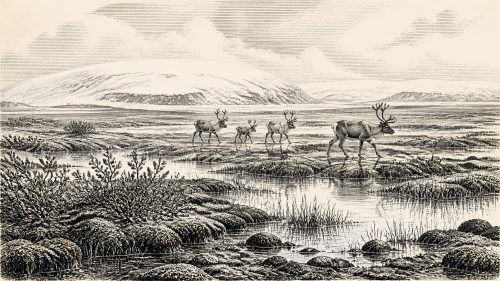
BIRM-166 Wetland Sample
At approximately 30,119 BCE, Ireland lay within the climatically unstable later Marine Isotope Stage 3, beyond precise calendar dating or historical record. At Derryvree, County Fermanagh, organic sediments between two glacial tills document an ice-free local landscape of shallow pools, mosses, sedges, herbs and tundra-like vegetation. They demonstrate regional climatic fluctuation, not an ice-free island. Lower seas and shifting ice altered coasts, while Crag Cave records intermittent conditions. Faunal remains at Castlepook Cave indicate open-country mammals. A marked reindeer bone suggests tentative Upper Palaeolithic human activity, but no secure settlement evidence exists. Environmental change and renewed glaciation define this period.

Elephant Hall’s Incised Femur
Labelled 30,118 BCE, this horizon represents an uncertain Late Pleistocene interval, not a precise Irish date. During Marine Isotope Stage 3, Ireland contained shifting ice, periglacial terrain, wetlands and open grazing country as the British–Irish Ice Sheet expanded towards its later maximum. Derryvree sediments indicate local ice-free freshwater environments, while Castlepook Cave preserves cold-adapted fauna including mammoth, reindeer, giant deer, hyaena and wolf. An incised reindeer femur may indicate early human butchery, but its insecure context and lack of associated tools prevent firm conclusions. Later glaciation destroyed much evidence, requiring cautious interpretations based on dated deposits, animal remains and landforms.

Castlepook’s Mammal Passage
Ireland around 30,117 BCE lay within the climatically unstable Late Pleistocene, as the British–Irish Ice Sheet expanded unevenly and low sea levels reshaped coasts and possible dispersal routes. Derryvree, County Fermanagh, preserves freshwater organic deposits between glacial tills, indicating a treeless, wet tundra-like mosaic during a local ice-free interval. Castlepook Cave, County Cork, contains a time-spanning fauna including reindeer, mammoth, giant deer, predators and cold-adapted small mammals, demonstrating ecological richness but not a single contemporary assemblage. A cut-marked reindeer bone may suggest human carcass processing, yet no secure evidence proves settlement. Regional records reveal ice, water, vegetation and animal movements.