

1800–1899 CE
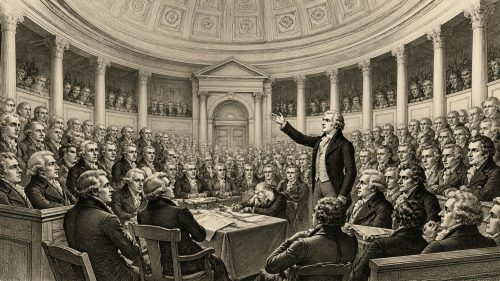
College Green’s Last Session
In 1800, Ireland remained a separate kingdom with its own parliament, courts and administration, but the Acts of Union passed in Dublin and London, ending its legislature from 1 January 1801. Cornwallis and Castlereagh secured support amid patronage, compensation and opposition led by Henry Grattan. The Union transferred limited Irish representation to Westminster, preserved the established Protestant church, and left Catholic emancipation unresolved. Post-rebellion repression continued, including Roddy McCorley’s execution, while food scarcity prompted controls on distilling and exports. Parliament also regulated trade, institutions and local improvements. Dublin retained political activity yet faced loss of its resident legislature and disruption.

Napper Tandy’s Reprieve
In 1801 the Act of Union abolished Ireland’s parliament and incorporated the kingdom into the United Kingdom, while Dublin Castle and local administration remained. Ireland received limited Westminster representation, dominated by property and borough influence. Catholic hopes of emancipation collapsed after George III’s opposition, strengthening the established Protestant church and prompting ministerial resignations. Lord Hardwicke became lord lieutenant amid fears after the 1798 rebellion. United Irishman James Napper Tandy, condemned for treason, was pardoned and spared execution. Food scarcity, high prices and uneven relief burdened households. Fiscal and trade integration proceeded gradually, while officials envisaged Ireland within an imperial framework.
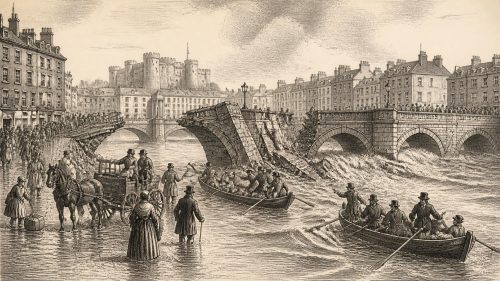
Ormond Bridge’s Winter Torrent
In 1802, Ireland adjusted to Union government as its first Westminster election exposed restricted representation and Catholic exclusion. The Treaty of Amiens briefly eased fears of French intervention, yet official vigilance persisted and Robert Emmet’s return signalled surviving revolutionary ambition. Social initiatives addressed poverty and disease: Edmund Rice began educating poor Catholic boys in Waterford, Cork opened a fever hospital, Dublin’s dispensary aided the poor, and Belfast’s library gained Linen Hall premises. In December, torrential rain flooded Dublin, bursting rivers and destroying Ormond Bridge. These events revealed a society experiencing constitutional change, unresolved grievances, voluntary reform, urban hardship and vulnerability.

Thomas Street’s Broken Rising
In 1803, amid post-Union discontent and renewed war with France, Robert Emmet organised a United Irish-inspired attempt to seize Dublin Castle and establish a provisional government. Conspirators produced pikes and explosives, while Anne Devlin carried messages, but weak coordination, limited firearms and absent regional support undermined the plan. On 23 July, the Thomas Street rising collapsed into confused violence; Lord Chief Justice Kilwarden and his nephew were murdered. Emmet was arrested, tried and executed, while Devlin and other suspects faced repression. Though militarily insignificant, the failure strengthened coercive government and preserved republican ideals of independence, popular sovereignty and inclusive citizenship.
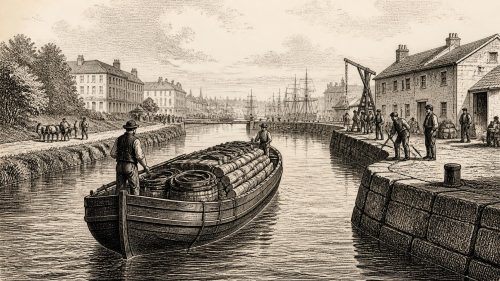
The Ranger’s Inland Passage
In 1804, Ireland remained shaped by the legacy of 1798, the Union and war with France. James Corcoran’s guerrilla band was destroyed near Enniscorthy, while transported Irish prisoners invoked Vinegar Hill during the failed Castle Hill rebellion in New South Wales. Invasion fears prompted a gun tower at Sutton and Edgeworth’s short-lived Dublin–Galway semaphore. Economic integration advanced when The Ranger completed the commercial Grand Canal passage from the Shannon to Dublin. Cork Street Fever Hospital admitted its first patients, providing isolation and care in the Liberties. These developments reveal governance, defence, infrastructure and philanthropy amid unresolved political and social grievances.

Fox’s Irish Petition
In 1805, Irish Catholics petitioned Westminster for equal political rights after the Union abolished Dublin’s parliament. Introduced by Charles James Fox and Lord Grenville, the loyal, constitutional appeal sought admission to Parliament and major offices, while rejecting papal temporal authority and threats to the Protestant establishment. Parliament decisively rejected it, exposing Catholic exclusion and establishing a pattern of failed emancipation campaigns until 1829. The state simultaneously transported Wicklow insurgent Michael Dwyer and companions to New South Wales. Ireland shared in Napoleonic war’s consequences after Trafalgar, while cultural life included Mary Tighe’s Psyche, William Rowan Hamilton’s birth, and Brian Merriman’s death.
Glorvina Enters Print
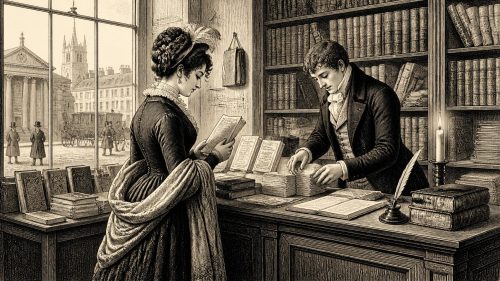
In 1806, five years after the Union, Ireland was governed increasingly through Westminster, while Catholic emancipation remained unrealised despite Lord Grenville’s sympathetic ministry. The United Kingdom election returned Irish MPs through restricted, patronage-driven constituencies, and wartime administration integrated Irish finance, trade and defence into imperial structures. Legislation regulated butter exports, excise, and charitable hospitals, illustrating expanding state oversight without comprehensive poor relief. Coastal defences reflected continuing fear of French invasion. Dublin retained elite social importance, marked by Arthur Wellesley’s marriage. Literary publishing proved significant: Sydney Owenson’s The Wild Irish Girl articulated Gaelic cultural survival, alongside satire and Ulster vernacular verse.

The Rochdale Storm
In 1807, six years after Union, Ireland remained governed from Dublin Castle and Westminster amid war, restricted representation and unresolved Catholic claims. George III's opposition defeated a limited Catholic military service measure, toppling Grenville ministry. The new lord lieutenant, Duke of Richmond, and chief secretary Arthur Wellesley pursued security, elections and renewed coercive powers, including insurrection and arms legislation. Michael Dwyer’s colonial trial illustrated repression’s imperial reach. Dublin gained a paving board amid wartime commercial pressures. In November, Rochdale and Prince of Wales were wrecked in Dublin Bay, killing about 400 and prompting later plans for a harbour at Dunleary.
Parliament House Becomes a Bank
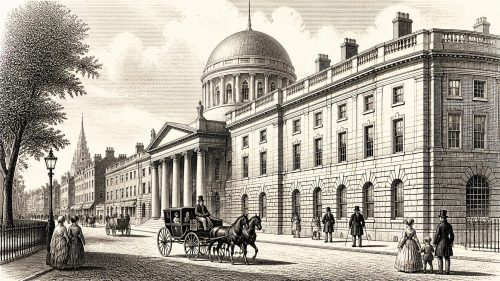
In 1808, seven years after the Union, Ireland experienced political subordination, wartime economic activity and Catholic institution-building. The Bank of Ireland opened in Dublin's former Parliament House, symbolising the loss of domestic legislature and the growing importance of finance and commerce. Catholic petitions, presented by Henry Grattan, sought equality but were overwhelmingly rejected at Westminster; controversy over a proposed royal veto on bishops deepened divisions. Meanwhile, the Patrician and Presentation Brothers were founded, and Cork's North Cathedral was dedicated. Cork Harbour dispatched Wellesley's expedition to Iberia, while Nelson's Pillar foundation and Mary Leadbeater's poetry reflected imperial commemoration and cultural life.
Taylor’s Mountain Road
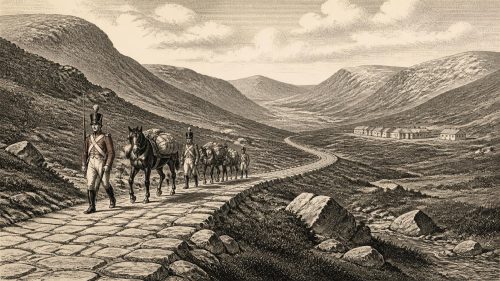
In 1809, post-Union Ireland remained governed through Dublin Castle, Westminster and local institutions amid war and unresolved Catholic disabilities. Administrative changes followed Arthur Wellesley’s departure for Portugal. Captain Alexander Taylor’s Military Road across Wicklow, completed in October, extended state access to former insurgent terrain. Legislation supported road improvements, Dublin waterworks, Church of Ireland buildings and investigation of bog reclamation. Nelson’s Pillar opened in Dublin, celebrating imperial naval power. Belfast manufacturing collapse prompted charitable relief, while Cork’s Magdalene asylum reflected religious social discipline. Edward Bunting’s music collection preserved and reshaped Irish harp traditions through print, illustrating infrastructure, commemoration and cultural interpretation.
O’Connell’s County Circular
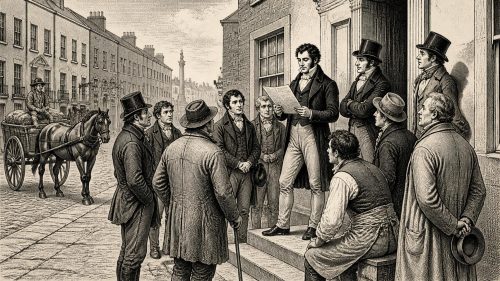
In 1810, nine years after Union, Ireland’s Catholics remained excluded from Parliament and offices despite earlier relief. Henry Grattan’s unsuccessful Westminster initiative exposed disputes over a proposed veto on episcopal appointments. Daniel O’Connell, opposing such control, issued a Dublin circular encouraging county committees to correspond with the Catholic Committee, strengthening constitutional, national organisation. Authorities nevertheless feared representative associations under the Convention Act. Parliament’s Unlawful Oaths (Ireland) Act punished coercive combinations amid rural insecurity. Meanwhile, agriculture dominated livelihoods, while Ulster linen connected production and Belfast commerce to wartime markets. Print, learned culture and Irish historical interests accompanied a contested public life.
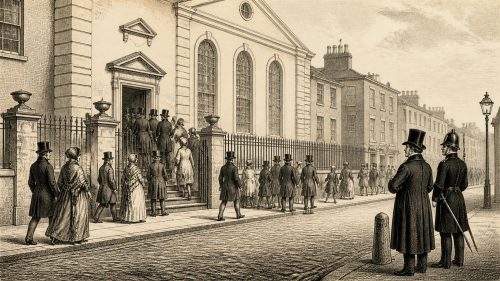
Capel Street’s Circular
In 1811, Irish politics centred on Catholic emancipation and the legality of organised petitioning. Edward Hay’s plan for county-appointed petition managers prompted Chief Secretary Wellesley-Pole’s circular, invoking the Convention Act to restrain the Dublin Catholic Committee. The ensuing controversy exposed tensions between constitutional petitioning, representative organisation and Dublin Castle’s authority after the Union. Henry Grattan presented a Catholic petition at Westminster, but emancipation failed; nevertheless, Catholic activists developed safer organisational methods, influencing Daniel O’Connell’s later strategy. The year also saw the foundation of the Kildare Place Society, cultural works by Owenson and Knowles, and HMS Saldanha’s wreck at Lough Swilly.

The Catholic Board Reassembles
In 1812, Catholic politics revived through the Catholic Board, which defended constitutional petitioning against Convention Act restrictions. Daniel O’Connell emerged as a forceful opponent of the proposed Crown veto over bishops’ appointments. At Westminster, Henry Grattan secured a Commons vote favouring consideration of Catholic claims, but no emancipation legislation followed. Robert Peel’s appointment as chief secretary strengthened Dublin Castle’s resistance. Wartime markets supported agricultural output and trade, yet rural households faced insecure holdings, rents and poverty. Wakefield surveyed these inequalities; Edgeworth’s The Absentee criticised distant landlordism. Sadler’s balloon attempt provided a fleeting spectacle amid unresolved political, social and economic tensions.
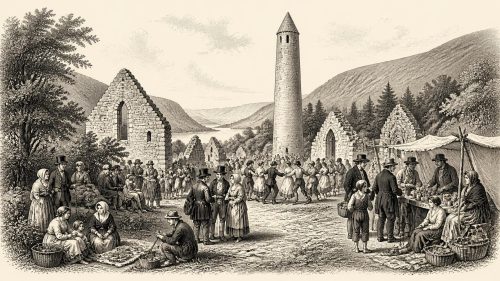
Garvagh and the Adare Fireball
In 1813, Catholic emancipation dominated Irish politics as Henry Grattan’s relief bill advanced at Westminster before collapsing over parliamentary admission and proposed state influence on episcopal appointments, opposed by bishops and Daniel O’Connell. Sectarian tension erupted at Garvagh, County Londonderry, where armed Protestants and Orangemen repelled Ribbonmen during a fair. An unsuccessful census initiative reflected administrative uncertainty, while observations of poverty, fever and education highlighted social pressures. Cultural life included Hugh Porter’s poetry and Glendalough’s patron festival. In September, the Limerick meteorite fell near Adare, becoming Ireland’s largest recorded meteorite fall and was preserved for scientific study as material evidence.
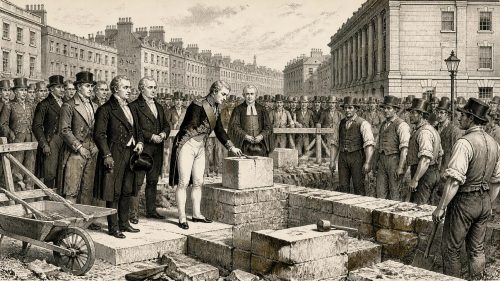
Middlethird and the New Post Office
In 1814, post-Union Ireland faced peace as Napoleon’s abdication altered wartime trade while rural poverty and land tensions persisted. Robert Peel’s government answered disturbances, notably in Tipperary’s Middlethird, with the Peace Preservation Act, creating salaried magistrates and constables and strengthened coercive powers against unlawful combinations. Catholic politics were divided over a proposed Crown veto on bishops, with Daniel O’Connell opposing state control; emancipation remained unresolved. Dublin saw Whitworth lay the General Post Office foundation stone and Chapel Royal inaugurated, while Belfast’s Academical Institution opened. Shaw Mason began his parochial survey, and the Apprentice Boys Club formed in Derry, reflecting division.
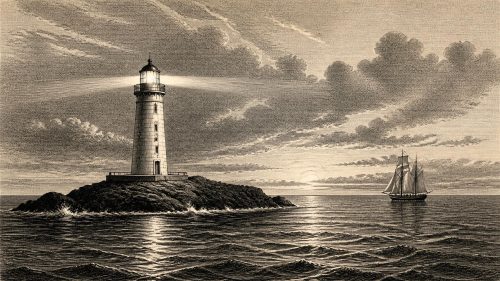
Tuskar Light, Bianconi Car
In 1815, Ireland, within the United Kingdom, faced transition from Napoleonic war to peace. Daniel O’Connell’s fatal duel with John D’Esterre heightened his prominence amid Catholic exclusion and Protestant civic power. Waterloo ended wartime demand, exposing agriculture’s dependence on British markets and foreshadowing hardship. New infrastructure included Tuskar Rock lighthouse, Charles Bianconi’s Clonmel–Cahir passenger service, and Cork’s first Irish-built steamship. Catholic public confidence appeared in St Mary’s Pro-Cathedral’s foundation and the Religious Sisters of Charity. The Dublin Society acquired Leinster House, William Drennan published reformist writing, and asylum governance was formalised, revealing Ireland’s changing political, religious, commercial and institutional systems.
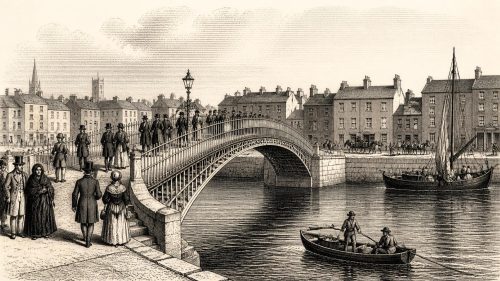
Wellington Bridge and Wildgoose Fire
In 1816, postwar recession and exceptionally cold, wet weather brought Ireland a serious subsistence crisis, with deficient potatoes and grain, costly food, wet fuel and conditions favouring fever. Westminster acknowledged distress and disorder but rejected major inquiry or reform. Maritime wrecks killed hundreds near Waterford and Kinsale. Dublin opened Richmond and Wellington, later Ha'penny, bridges, began Dunleary harbour, and founded an institution for deaf children. Belfast gained Ireland's first successful savings bank and St George's Church. Yet progress coexisted with exclusion, poverty and violence: Catholic disabilities persisted, while the burning of Wildgoose Lodge killed eight, exposing agrarian conflict and insecurity.
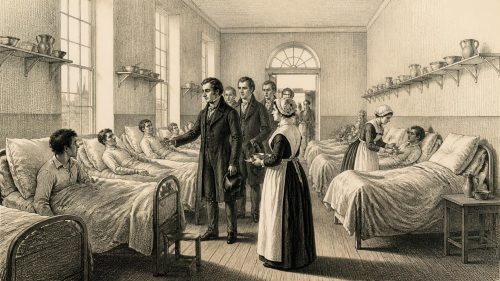
Steevens’ Fever Wards
In 1817, Ireland faced severe scarcity, unemployment and typhus amid poor harvests and post-Napoleonic depression, though not an island-wide famine comparable to the Great Famine. Dublin fever surged in September, prompting Dr Steevens’ Hospital to open emergency wards for labourers, artisans and servants. Relief depended on fragmented charities, local bodies and government employment schemes, while new legislation addressed public works, grand-jury finance and institutional care. Fiscal integration with Britain advanced, and Catholic emancipation remained unresolved. Despite crisis, the Royal Canal reached Cloondara, Dunleary harbour construction began, temperance emerged in Skibbereen, and O’Reilly published an Irish-English dictionary, carefully preserving linguistic knowledge.

Fever Wards and Steam Packets
Ireland in 1818 faced a contagious-fever epidemic, associated chiefly with typhus, intensified by poverty, overcrowding and post-war dislocation. Parliamentary inquiry and the Fever Hospitals Act established local bodies to provide hospitals, though funding, coverage and care remained uneven, and compulsory removal reflected social control. Dublin opened Francis Johnston’s General Post Office, symbolising communications, while pioneering steamships connected Dublin and Belfast with Scotland. Religious developments included the death of Archbishop Richard O’Reilly, an Irish-language Protestant educational society, and the Secession Synod. Official records revealed crime and distress; Anthony Gallagher was executed. Literary works by Lady Morgan and Patrick Brontë portrayed Ireland.

Newport’s Fever Inquiry
In 1819, Ireland faced continuing fever, hunger and unemployment after the post-war downturn and bad seasons. Sir John Newport’s Commons committee investigated contagious disease and labouring poverty, linking epidemic conditions to destitution while favouring regulated charity, fever hospitals and work over an Irish poor law. The Fisheries Act sought employment and food through managed fisheries, but offered limited immediate relief. Henry Grattan’s Catholic emancipation motion narrowly failed, confirming enduring political exclusion. John Devereux recruited an Irish Legion for Bolívar’s cause, though recruits suffered overseas. Belfast founded the Irish Harp Society, while Ribbonism reflected rural tension. The year exposed persistent insecurity.

Kilmainham’s Queen Caroline Revolt
George IV’s accession in 1820 left Ireland under the Union, with limited property-based representation and Catholic exclusion from Parliament. Henry Grattan’s death removed a leading advocate of Catholic relief. Post-war depression and private-bank failures disrupted credit, trade and livelihoods, while Cork’s North Cathedral burned. The Dublin Gas Act, completion of the Lough Allen Canal, local schooling and the Royal Dublin Society reflected gradual improvement. Irish people also participated in Antarctic exploration and Cape Colony migration. In December, County Dublin freeholders at Kilmainham challenged an official loyal address, condemning the king’s treatment of Queen Caroline and Ireland’s distress, foreshadowing O’Connell’s mobilisation.
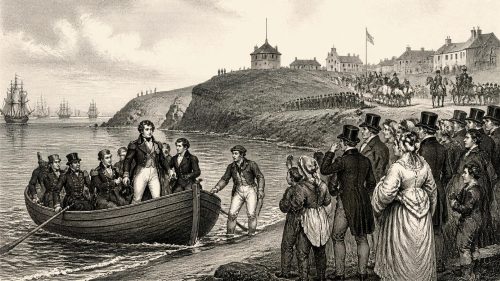
Howth’s Royal Landing
In 1821, Ireland experienced population growth, economic hardship, political exclusion and royal pageantry. The first comprehensive census recorded about 6.8 million people, exposing dependence on insecure rural livelihoods; most detailed returns were later destroyed in 1922. Post-war depression, rents, tithes and scarce employment contributed to Munster’s emerging Rockite disturbances. Westminster’s Catholic Disability Removal Bill passed the Commons but failed in the Lords, preserving Catholic exclusion from Parliament. George IV’s August landing at Howth inspired displays of loyalty, including Daniel O’Connell’s conciliatory participation, but brought no reform. Administrative changes and cultural activity highlighted tensions between Union, equality, rural insecurity and identity.

Wellesley’s Bottle Riot
In 1822, Ireland endured agrarian unrest, food scarcity and emergency government. Lord Lieutenant Richard Wellesley inherited Rockite violence, chiefly in Munster, where the Insurrection Act, habeas corpus suspension, troops and special commissions produced prosecutions, transportation and executions. Poor harvests caused severe regional distress, especially in the west and south-west. Government coordinated charity and funded public works, employing labourers on roads, piers and harbours under engineers including Alexander Nimmo and Richard Griffith. Political divisions persisted over Catholic exclusion and the established Church. A new constabulary law encouraged organised policing. December's Bottle Riot, when a jar was thrown at Wellesley, symbolised conflict.
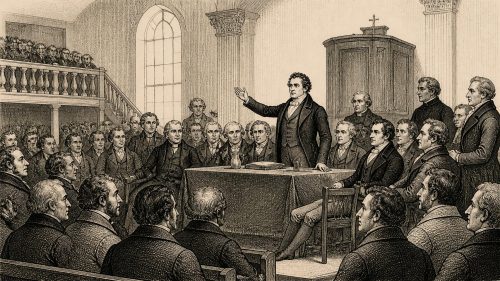
Townsend Street’s Constitutional Experiment
In 1823 Daniel O’Connell and fellow Catholic leaders founded the Catholic Association at Townsend Street Chapel, Dublin, creating a constitutional organisation to pursue emancipation through petitions, publicity and meetings. Initially limited to wealthier subscribers, it preceded the mass Catholic Rent of 1824. Its campaign developed amid exclusion of Catholics from Parliament and office, parliamentary debates on Irish justice, and renewed coercive legislation against rural disorder. The Composition for Tithes Act replaced payments in kind with monetary assessments but preserved an unpopular burden supporting the established church. Population pressure, poverty and potato-crop failure intensified grievances, making the Association’s political framework significant.
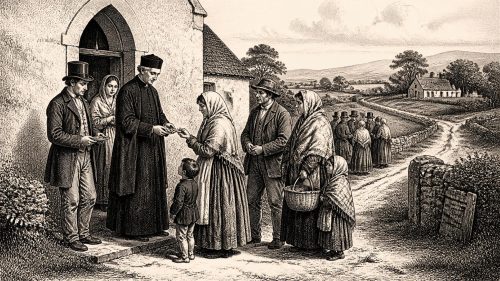
The Penny Rent
In 1824, Ireland saw organisational developments rather than decisive settlement or revolt. Daniel O’Connell’s Catholic Association introduced the penny Catholic Rent, linking parish subscriptions, clerical networks and constitutional agitation for emancipation. Tithe commutation and applotment sharpened rural grievances, amid official concern about agrarian secret societies. Parliament authorised a uniform survey and valuation, initiating the Ordnance Survey’s mapping. Economic and administrative modernisation included Belfast’s joint-stock Northern Banking Company, Donaghadee harbour planning, and standardised weights and measures. Belfast’s Academical Institution, Croker’s Irish travel and folklore publication, and Bishop Kernan’s succession illustrated expanding educational, cultural and Catholic institutional life, despite inequality and exclusion.
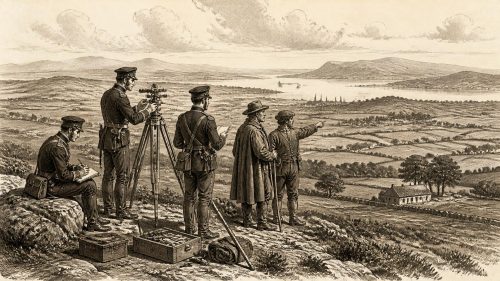
Colby’s Measuring Ireland
In 1825, government suppressed the Catholic Association through the Unlawful Societies Act, but Daniel O’Connell quickly reorganised constitutional agitation for emancipation, while a relief bill failed in the Lords. Thomas Colby’s Ordnance Survey began mapping Ireland for taxation and administration, incorporating local knowledge into state records. Government-assisted migration sent 2,024 people from Cork to Upper Canada. The Provincial Bank, Portlaw’s cotton venture, revised excise licences and packet steamers reflected economic change. Educational inquiry documented extensive yet fragmented schooling, while Croker’s Fairy Legends promoted Irish oral traditions. These developments linked politics, administration, migration, commerce and culture in an unequal, changing Ireland.
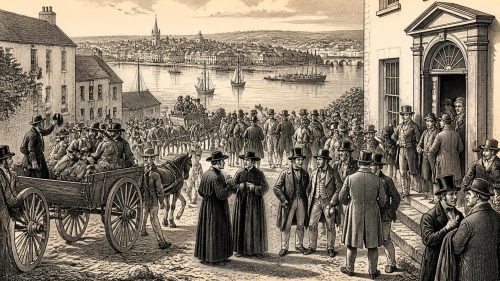
Waterford’s Freeholder Summer
In 1826, Ireland saw organised Catholic politics challenge landlord authority without achieving emancipation. Daniel O’Connell’s reconstituted Catholic Association mobilised parish networks, subscriptions and forty-shilling freeholders around religious rights, education and electoral action. County Waterford’s election symbolised this change: Henry Villiers Stuart, a Protestant emancipation supporter, defeated Lord George Beresford, demonstrating tenants’ capacity to resist estate influence. Pro-emancipation gains elsewhere reinforced warning to government. Sterling replaced Irish currency, integrating financial administration with Britain. An education inquiry exposed fragmented, denominational schooling, while land legislation addressed complex tenancies amid rural hardship. Arklow received Ireland’s lifeboat station, and Tyrone Power advanced his London career.
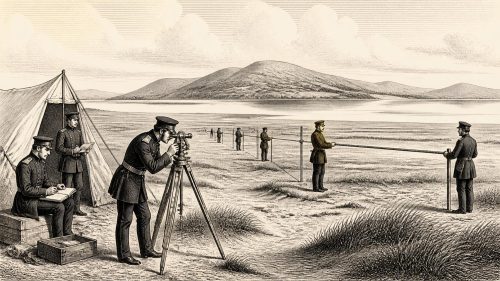
Mercy House and Foyle Baseline
In 1827, Ireland remained politically unsettled as Catholic emancipation was debated but denied, despite petitions, Daniel O’Connell’s New Catholic Association and concern for vulnerable forty-shilling freeholders. The Petty Sessions Act regularised magistrates’ courts, while Beggars Bush Barracks reflected the state’s military reach. Fever, drought and harvest uncertainty exposed rural precarity. Religious controversy appeared in Dublin’s Maguire–Pope debate, alongside Franciscan restorations and Catherine McAuley’s lay House of Mercy. Ordnance Surveyors began the Lough Foyle baseline, initiating systematic mapping. In Callan, Amhlaoibh Ó Súilleabháin commenced his Irish-language diary, recording everyday life and cultural continuity amid administrative, religious and social change during 1827.

O’Connell at Ennis
Daniel O’Connell’s decisive County Clare by-election victory at Ennis in 1828 exposed the contradiction of allowing Catholic freeholders to vote while barring Catholic MPs from taking Westminster oaths. Challenging ministerial supporter William Vesey Fitzgerald, O’Connell secured 2,057 votes to 982, aided by priests, organisers and disciplined popular mobilisation. Though unable to take his seat, he forced government and parliament to confront Catholic exclusion. The campaign demonstrated constitutional agitation’s power amid rural poverty, contested education, coercive criminal law, and uneven economic development. Belfast’s new Botanic Garden and expanding trade statistics reflected urban and administrative ambitions, while Clare transformed local politics nationally.

Clare’s Second Verdict
In 1829, Catholic Emancipation transformed Irish constitutional politics after Daniel O’Connell’s 1828 Clare election and the Catholic Association’s mass mobilisation forced Wellington’s government to act. The Roman Catholic Relief Act, assented to on 13 April, enabled Catholics taking a new oath to enter Parliament and many public offices, though it preserved the Protestant state settlement and excluded them from certain positions. Simultaneously, the Irish election law raised the county freehold qualification from forty shillings to £10, disfranchising many poor Catholic voters. O’Connell’s pre-Act election required a Clare by-election, which he won unopposed. Protestant opposition persisted; Gerald Griffin’s novel reflected society.
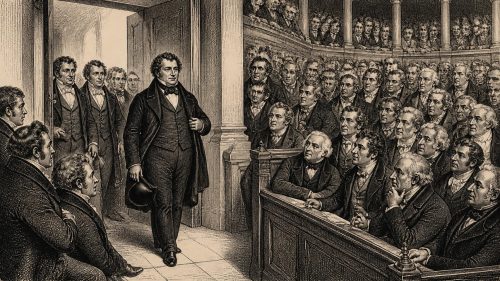
O’Connell Takes His Seat
In 1830 Daniel O’Connell took his Westminster seat, embodying Catholic Emancipation after the 1829 Relief Act, while its limitations remained stark. The raised £10 franchise disfranchised many former forty-shilling freeholders, and Ireland remained governed under the Union. O’Connell’s Waterford election followed William IV’s accession and a general election, amid emerging British reform debates. Resistance to tithes supporting the Church of Ireland intensified, particularly late in the year, reflecting religious inequality and rural hardship. Distress, insecure agricultural work and market grievances sharpened tensions. Belfast’s July Orange riots exposed northern sectarian divisions. Contemporary diaries and records reveal political life extending beyond Parliament.

Ralahine and Carrickshock
In 1831, Ireland experienced escalating conflict over tithes, compulsory payments supporting the established Church, despite most occupiers being Catholic. Organised resistance, including Patt Lalor’s boycott strategy, culminated at Carrickshock, County Kilkenny, where twelve constables and a process-server were killed. The census recorded approximately 7.8 million people amid poverty and land pressure. Edward Stanley established the basis for non-denominational national education. At Ralahine, County Clare, an Owenite co-operative sought security through shared labour and profits. Catholic and evangelical institutions developed, while James Hardiman’s Irish Minstrelsy promoted Irish-language poetry. The year combined coercion with reform, social experimentation, demographic observation and cultural assertion.

Glasnevin’s First Graves
In 1832, Ireland experienced reform, conflict and epidemic crisis. Glasnevin Cemetery opened in February as Daniel O’Connell’s inclusive burial project, its first interment an eleven-year-old Dublin boy. Cholera soon spread from Belfast to Dublin and other towns, killing perhaps 25,000 people and exposing poor sanitation, inadequate institutions and improvised medical and burial provision. Local boards of health organised contested responses. Meanwhile, resistance to Church of Ireland tithes continued despite government relief and enforcement measures. Parliamentary reform revised constituencies and increased representation but retained a property-based franchise. Debates over national education and restrictions on partisan processions reflected religious and political tensions.
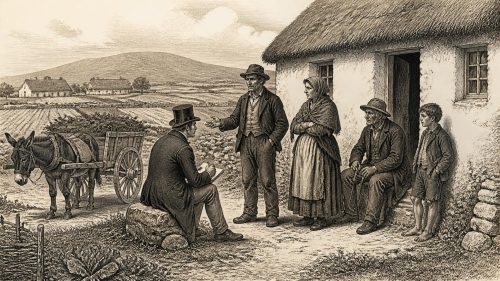
Whately’s Poor Inquiry
In 1833, Irish government combined coercion, church reform and social investigation amid unrest and poverty. The Suppression of Disturbances Act expanded powers over meetings, movement and suspected rural disorder, constraining constitutional mobilisation associated with Daniel O’Connell. Tithe resistance persisted despite legislation adjusting arrangements, while the Church Temporalities Act abolished levies, reorganised bishoprics and revenues, but preserved Protestant establishment and endowments. O’Connell continued to advocate repeal, tithe reform and redress. In September, Archbishop Richard Whately began a Royal Commission examining poorer classes, inaugurating systematic inquiry into labour, land, charity and deprivation. The year left Ireland’s religious, political and economic crises unresolved.
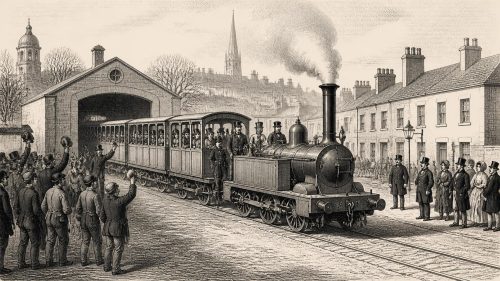
Westland Row, Gortroe
In 1834, Ireland’s contrasts were embodied by the opening of the Dublin and Kingstown Railway and the Rathcormac massacre at Gortroe, County Cork. The railway, Ireland’s first, linked Dublin’s commercial centre with its packet harbour, demonstrating private investment, engineering and growing passenger mobility. Next day, troops protecting tithe collection killed at least nine people resisting payments to the established Church of Ireland. The Tithe War exposed rural poverty, Catholic resentment and dependence on coercion. Westminster debated repeal, tithes and church reform amid ministerial instability. Population pressure, insecure labour, poor housing, disease and limited educational and health measures underscored persistent inequality.

Lichfield House Alliance
In 1835, Daniel O’Connell’s Repealers allied with Whigs and Radicals in the Lichfield House Compact, helping Lord Melbourne defeat Peel and return to office. The alliance increased Irish influence at Westminster but delivered neither repeal nor a tithe settlement; Lords blocked church reforms, although collection relief was granted. Mulgrave, Morpeth and under-secretary Thomas Drummond brought a more conciliatory Dublin Castle administration, while Michael O’Loghlen became attorney general, the first Catholic since James II. The Poor Inquiry exposed widespread rural insecurity. Public works included Limerick’s Wellesley Bridge and Eagle Island lights; Castleknock seminary opened, and Irish-language poet Antaine Ó Raiftearaí died.
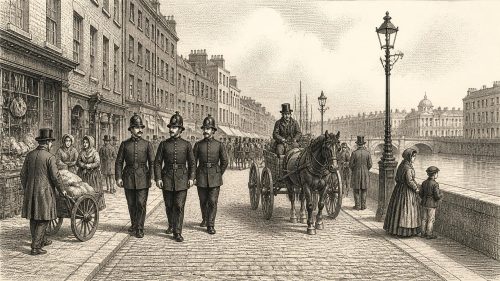
Constables and Tithe Arrears
In 1836, Ireland experienced contested administrative reform rather than a decisive settlement. Westminster strengthened policing through the Constabulary and Dublin Police Acts, while licensing rules extended supervision of public houses. Tithe arrears remained unresolved: the Tithe Compositions Act merely suspended recovery proceedings, and church reforms scrutinised ecclesiastical revenues. O’Connell’s Catholic organisation demonstrated popular political strength despite a narrow franchise, notably in Longford. Municipal reform largely stalled. The Poor Inquiry documented severe, varied poverty but produced no agreed remedy; poor law followed in 1838. Crop failures heightened anxiety, while banks, newspapers and Mount Jerome cemetery reflected emerging institutional and urban change.
Tuam’s New Cathedral
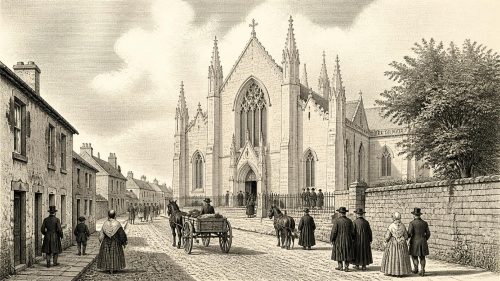
In 1837, Victoria’s accession prompted an Irish general election in which Daniel O’Connell and his allies demonstrated Catholic political organisation despite a restricted, public franchise. Parliament debated Irish poor relief amid widespread insecurity, but legislation followed only in 1838. Tithe grievances, local crop failures, potato dependence and uneven employment exposed rural vulnerability. Tuam’s completed Catholic cathedral symbolised post-emancipation confidence, although religious divisions endured. Samuel Lewis’s dictionary, Ordnance Survey work and Dublin policing measures reflected administrative control. Ireland remained commercially and imperially connected, illustrated by HMS Terror’s repair at Lough Swilly, yet the Union, unequal landholding, poverty and representation remained unresolved.
Drummond’s Lumper Warning
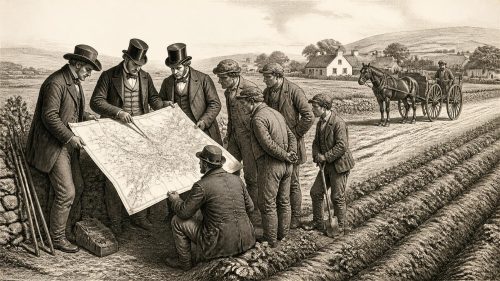
In 1838, Ireland was surveyed, classified and governed amid widespread rural insecurity. The Irish Railway Commissioners’ final report mapped population, trade and transport, advocated publicly directed railways, and warned of labourers’ heavy reliance on the nutritionally poor lumper potato, without predicting famine. The Poor Relief (Ireland) Act created poor-law unions, rates, guardians and a workhouse-centred system, reshaping local administration despite opposition. The Tithe Rentcharge Act replaced direct occupiers’ payments with a reduced landowners’ charge, easing but not ending religious grievance. Father Theobald Mathew’s Cork temperance campaign mobilised mass voluntary action. The Sirius voyage and surveys highlighted Atlantic and administrative links.
Big Wind, Lisburn Line
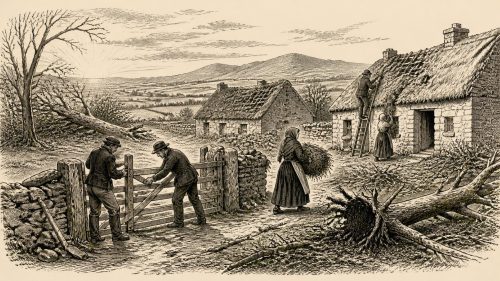
In 1839 Ireland experienced the Night of the Big Wind, a devastating storm of 6–7 January that damaged homes, farms, shipping and infrastructure, caused numerous deaths, and became a lasting marker in popular memory. Its effects intensified existing rural poverty and seasonal insecurity. Meanwhile, implementation of the 1838 Poor Law advanced through unions, guardians, rates and workhouse planning, while amendments refined administrative boundaries. Policing legislation strengthened state capacity in Dublin and nationally, amid O’Connell’s reform politics and continuing tithe disputes. National education and Griffith’s valuation expanded official knowledge. In August, the Belfast–Lisburn railway opened, signalling transport, commerce and institutional modernisation.
Corn Exchange Repeal Launch
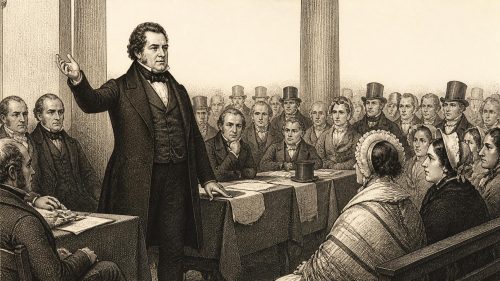
In 1840 Daniel O’Connell relaunched the constitutional campaign to repeal the Act of Union through the National, later Loyal National, Repeal Association, seeking an Irish legislature within the Crown rather than separation. Though initially modest, it established subscriptions, committees and local mobilisation. Parliament’s Municipal Corporations (Ireland) Act replaced most old corporations and reformed ten boroughs, but retained restricted franchises and limited powers. The Poor Law entered operation, with Cork’s temporary workhouse admitting inmates, signalling a restrictive institutional response to poverty. Rural inequality, population pressure and regional contrasts persisted, alongside railway plans, church reforms and Father Mathew’s temperance movement across Ireland.
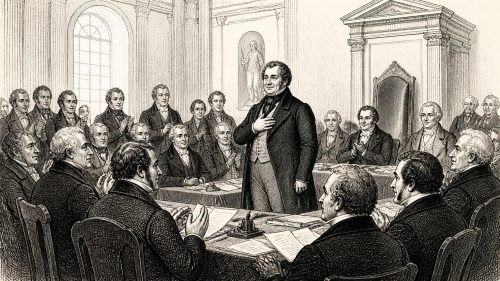
O’Connell’s Civic Breakthrough
In 1841, Ireland’s census recorded 8,175,124 people, revealing a populous, unequal society where most families occupied modest cottages or single-room cabins and depended heavily on agriculture and potatoes. The general election returned Peel’s Conservatives, while Daniel O’Connell maintained repeal agitation despite restricted franchises and sectarian political division. Dublin’s reformed council elected O’Connell Lord Mayor on 1 November, the first Catholic to hold the office for over 150 years, marking expanded but limited civic participation. Poor Law workhouses embedded institutional relief, inadequately serving widespread vulnerability. Belfast combined industrial growth with confessional cooperation, while the Irish Archaeological Society published texts, reflecting recovery.
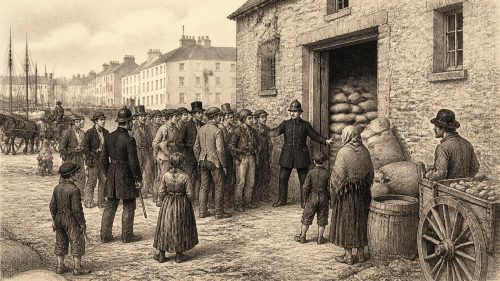
Galway’s Hungry June
In 1842, before potato blight, Ireland experienced acute distress from scarcity, high prices, seasonal unemployment and entrenched poverty. Galway symbolised the crisis when hungry people attacked a potato store in June, reflecting fears of hoarding and food beyond local reach. The expanding Poor Law rapidly opened workhouses, offering deterrent, stigmatising relief while leaving many needy people outside. Temporary government aid acknowledged emergency conditions. Daniel O’Connell’s Repeal Association strengthened its organisation, linking constitutional demands with economic grievances and opposing slavery. Peel’s tariff reforms fuelled criticism of Westminster. In October, The Nation began promoting nationalism, connecting material hardship, identity and political self-government.
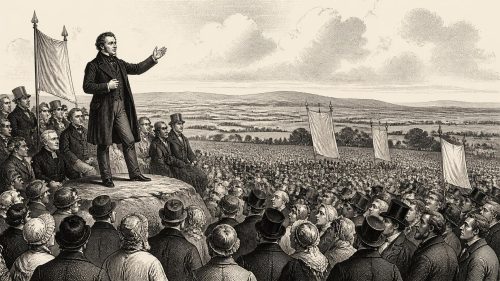
Tara and Clontarf
In 1843 Daniel O’Connell’s Repeal campaign sought restoration of an Irish parliament while retaining the Crown. Organised by the Repeal Association, enormous peaceful monster meetings at Trim, Tara and Mullaghmast mobilised supporters and linked self-government to Ireland’s nationhood, poverty, land insecurity and development. Thomas Davis and The Nation broadened its cultural nationalism, while clergy played organisational roles. Beneath pageantry, agricultural dependence, insecure tenancies and harsh Poor Law relief revealed social vulnerability. The prohibited Clontarf meeting marked the campaign’s defeat: O’Connell cancelled it to avert violence, after which government prosecutions began. Repeal failed, but 1843 shaped nationalism and highlighted Ireland’s crisis.
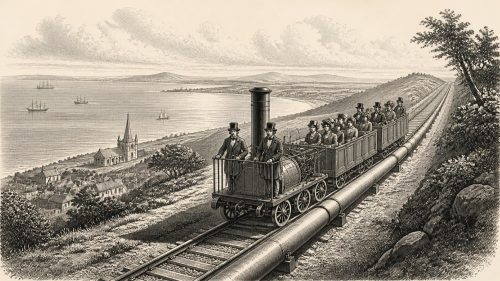
Dalkey, Bridewell and St Michan’s
In 1844, Ireland combined political mobilisation, entrenched poverty and uneven modernisation. Daniel O’Connell’s conviction was overturned by the House of Lords, restoring him to public life but revealing limits on Repeal. Thomas Davis’s A Nation Once Again strengthened cultural nationalism within Young Ireland. Workhouses, already housing and relieving many people, exposed chronic vulnerability before the famine. The Dalkey Atmospheric Railway and Richard Turner’s engineering demonstrated technological ambition, while Belfast’s linen trade reflected industrial growth alongside insecurity. Catholic institution-building included St Malachy’s Church and Dublin’s first St Vincent de Paul conference. Francis Rynd’s hypodermic treatment illustrated Irish medical innovation amid precarity.

Davis and the Potato Rot
In 1845, potato blight initiated Ireland’s Great Famine, although mortality remained limited compared with later years. Dependence on potatoes left labourers, cottiers and smallholders especially vulnerable, while food production continued beyond their purchasing power. Peel’s government commissioned scientific inquiries, secretly bought American maize, and linked the crisis to Corn Law repeal, but relief remained cautious. The Devon Commission documented insecure tenure and rural inequality. Educational reforms funding Maynooth and Queen’s Colleges provoked religious and nationalist disputes. Thomas Davis, Young Ireland’s inclusive cultural nationalist, died in September. By year’s end, blight, poverty, weak tenure and political division foreshadowed catastrophe to come.
The Labour Rate Winter
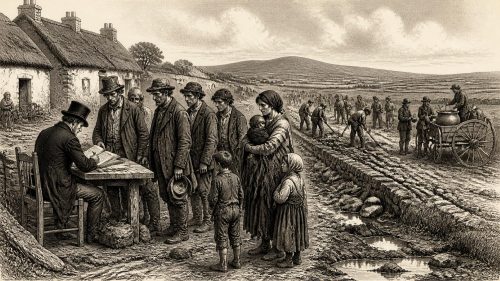
In 1846, a second, devastating potato blight transformed Ireland’s food crisis into catastrophe, destroying the staple relied upon by labourers, cottiers and smallholders. Although food continued to be produced and imported, poverty and rising prices denied many access. After Peel resigned, Russell’s government prioritised market supply and paid public works over direct food provision. The Labour Rate Act rapidly expanded employment schemes, but delayed wages, harsh outdoor labour, local debt and administrative failures deepened suffering and disease. Political division split the Repeal movement, while local and Quaker relief networks emerged. By winter, conditions had laid the foundations for Black ’47.

Soyer’s Kitchen, Black ’47
Black ’47 marked the Great Famine’s worst turning point, after potato failure had exhausted household resources and public works proved inadequate. The Temporary Relief Act replaced wages with cooked rations, feeding about three million people daily at its peak through local soup kitchens, aided by Quakers and publicised by Alexis Soyer. Hunger and overcrowding accelerated fever, while Poor Law reforms expanded outdoor relief but shifted costs to impoverished localities. The Gregory Clause pressured small occupiers to surrender land for aid. Political divisions persisted amid O’Connell’s death. Kitchens closed prematurely, workhouses overflowed, and mass emigration intensified, leaving Ireland’s countryside fundamentally altered.

The Irish Felon’s Last Issue
In 1848, renewed potato blight shattered hopes of Irish recovery after the catastrophic famine year of 1847, deepening hunger, disease and regional inequality. With soup kitchens closed, Poor Law unions, overcrowded workhouses and restricted outdoor relief became central, often forcing destitute tenants to surrender land. Cholera’s arrival foreshadowed mortality. Meanwhile, European revolutions inspired Young Ireland militants. John Mitchel’s United Irishman prompted the Treason Felony Act and his transportation; The Irish Felon briefly continued radical journalism. After habeas corpus was suspended, Smith O’Brien’s poorly supplied rising collapsed at Ballingarry. Subsequent trials created nationalist martyrs, while emigration, eviction and death devastated communities.

Ballinasloe’s Cholera Spring
In 1849, the Great Famine continued as blight, hunger, eviction, overcrowded workhouses and disease devastated Ireland. Cholera killed 772 of 1,077 recorded cases at Ballinasloe Union Workhouse, illustrating inmates’ vulnerability. Relief depended heavily on inadequate local rates; the May rate-in-aid redistributed Irish, rather than British, resources. The Incumbered Estates Act signalled restructuring of landownership, while emigration, consolidation and evictions altered rural life. Young Ireland leaders were transported, and unrest persisted; Dolly’s Brae exposed sectarian tensions. Victoria’s tour, new Queen’s Colleges and the Dublin–Cork railway projected progress, yet famine, political conflict and social upheaval still continued across the island’s fractured communities.

Thurles, Tenure and Survival
In 1850, Ireland remained scarred by famine despite a less destructive, uneven potato blight. Workhouses, poor-law debt, eviction, emigration and a shrinking rural labour market continued to shape survival. Land insecurity intensified as the Encumbered Estates Court facilitated sales of indebted properties. The Dublin Tenant-Right Conference formed the Irish Tenant League, uniting diverse reformers behind fair rents, secure tenure and free sale of tenants’ interests. The Synod of Thurles, led by Paul Cullen, strengthened Catholic discipline, episcopal authority and Roman alignment, while opposing the Queen’s Colleges. These initiatives made 1850 a hinge between catastrophe and political, social and religious change.

Newman, Donnelly and the Count
In 1851, Ireland’s census recorded 6,552,385 inhabitants, a decline of 1,659,330 since 1841, exposing famine mortality, disease, eviction and emigration while imperfectly distinguishing deaths from departures. Losses were greatest in western and southern potato-dependent districts, accelerating the disappearance of poor cabins and weakening Irish-speaking communities. Emigration remained immense, reshaping families and local economies. Estate sales under the Encumbered Estates Act, limited tenant-improvement legislation and Tenant Right agitation intensified land questions. The Medical Charities Act expanded dispensary provision. John Henry Newman’s appointment advanced plans for a Catholic university. Meanwhile, Ulster linen exhibitors at the Great Exhibition displayed industrial strength amid devastation.
Craigmore and the Tenant Pledge
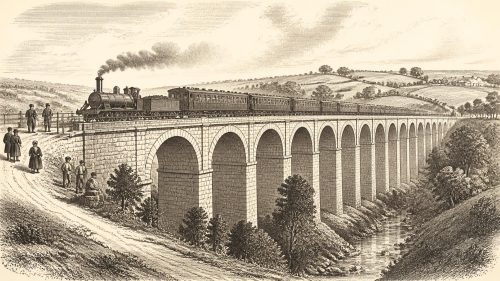
In 1852, post-Famine Ireland remained shaped by depopulation, emigration, poor-law hardship, estate sales and rural insecurity. William Sharman Crawford’s Tenant Right Bill sought recognition of Ulster custom, compensation for improvements and limits on eviction, but failed despite sustained Commons debate. The Tenant Right League united Catholic, Presbyterian and nationalist reformers, securing forty-eight pledged MPs in the July election, though its unity remained fragile. Derby’s government introduced further land bills in November, but fell before settlement. Meanwhile, Craigmore Viaduct opened the Belfast–Dublin route, symbolising industrial investment. Belfast’s British Association meeting also highlighted worsening urban sanitary conditions amid Ireland’s uneven post-Famine transformation.
Dargan’s Glass Palace
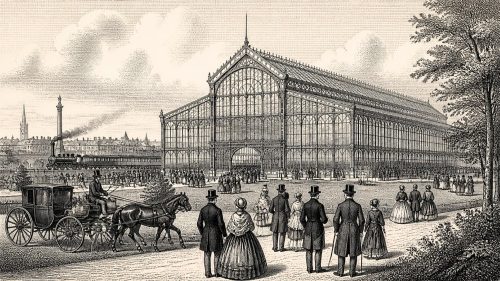
Dublin’s Great Industrial Exhibition opened on Leinster Lawn in May 1853, funded largely by railway contractor William Dargan and organised with the Royal Dublin Society. Its glass-and-iron halls displayed art, manufacture, machinery and Irish antiquities, projecting modernity after the Famine, though access remained socially limited. Queen Victoria’s August visit amplified its civic and imperial significance. Meanwhile, population decline, emigration, workhouses and estate sales showed continuing hardship. Tenant Right politics fractured as leading advocates accepted office. Gladstone extended income tax to Ireland despite objections. Plans for a gallery and Catholic university developed, while John Mitchel escaped transportation, symbolising enduring nationalist exile.
Fastnet, Lambay and Newman
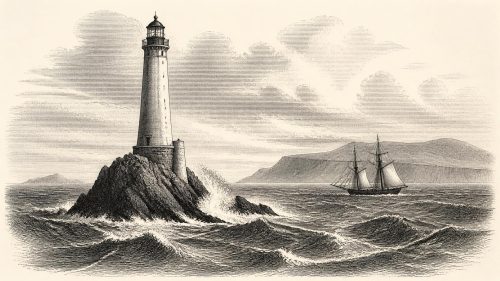
In 1854, Ireland remained deeply marked by famine, depopulation, poverty, emigration and changing landholding. Fastnet Lighthouse opened to improve Atlantic navigation, yet the emigrant ship Tayleur was wrecked off Lambay, killing hundreds and exposing migration’s dangers. Poor-law institutions managed continuing hardship while mass emigration connected Ireland with Britain, America and Australia. Tenant-right politics weakened amid conflict between Archbishop Paul Cullen and Frederick Lucas over clerical involvement. John Henry Newman opened the Catholic University of Ireland, despite limited resources and no degree-granting charter. The National Gallery Act and Charles Davis Lucas’s Baltic heroism also reflected Ireland’s developing cultural and imperial connections.
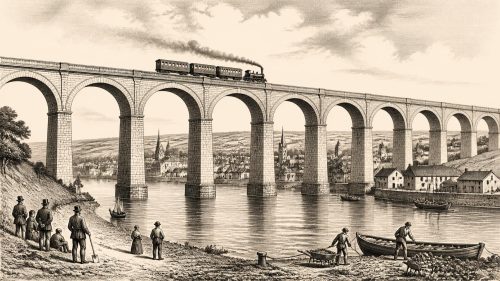
Boyne Viaduct, Duffy’s Farewell
In 1855, post-Famine Ireland combined reconstruction with enduring demographic loss, poverty and emigration. The Boyne Viaduct opened on 5 April, completing rail travel between Dublin and Belfast and strengthening commerce, while offering no cure for insecure livelihoods. Agriculture increasingly favoured livestock, larger holdings and grazing; Encumbered Estates Court sales, workhouses and migration continued to reshape communities. Charles Gavan Duffy’s August farewell and departure for Australia, followed by Frederick Lucas’s death, symbolised the Tenant League’s collapse. Irish people served in the Crimean War. St Mary’s Cathedral, Killarney, was consecrated; George Petrie published traditional melodies; library legislation and Dublin Zoo reflected institutions.
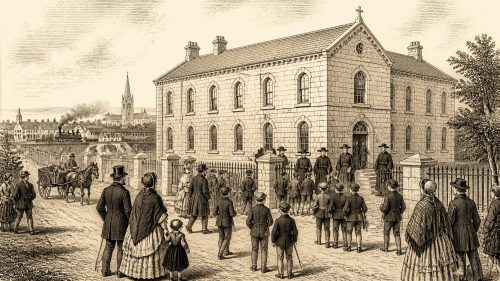
Hevey Institute and St Mel’s
In 1856, post-Famine Ireland remained marked by depopulation, emigration, poverty and institutional reform. Poor Law debates addressed electoral fraud and the removal of destitute migrants from Britain, while estate sales and legislation on public works, drainage and valuation reshaped land, waterways and local taxation. St Mel’s Cathedral opened for worship in Longford, symbolising renewed Catholic confidence after construction halted during the Famine. Mullingar’s Hevey Institute combined charitable elementary schooling with classical education. In Dublin, Michael Henry Gill acquired McGlashan’s publishing business, while the murder of a railway cashier at Broadstone highlighted railway commerce. Reconstruction proceeded alongside continuing displacement and insecurity.

Hanna’s Belfast Summer
In 1857, post-Famine Ireland remained marked by emigration, altered landholding and poverty, while political representation was limited by property-based voting. The general election strengthened Liberals but also revealed the weakness of the tenant-right Independent Irish Party. Belfast's Orange Day riots, prolonged through summer, exposed sectarian tensions and discredited a predominantly Protestant police force, prompting a later inquiry. Administrative reforms, including the Boundary Survey Act and Griffith's Valuation, expanded state oversight of land and taxation. Institutions and enterprises included Kilkenny's St Mary's Cathedral, Dublin's Natural History Museum, zoo breeding, Gallaher's tobacco venture and Scrabo Tower, illustrating reconstruction, commerce and contested authority.
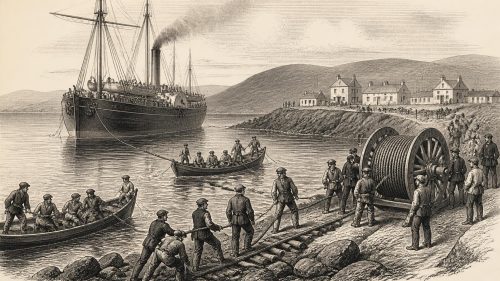
Valentia Signals, Lombard Oaths
In 1858, Ireland experienced political, technological and social change. James Stephens founded the secret Irish Republican Brotherhood in Dublin, supported by Irish-American networks and committed to republican revolution. Valentia Island became the Irish terminus of the first transatlantic telegraph cable, briefly linking Britain and North America before failure. Post-Famine society continued to be reshaped by emigration, altered farming, poverty administration and Griffith’s Valuation. Infrastructure included Ballinacourty lighthouse, while Edward James Harland acquired Belfast’s Queen’s Island shipyard. Dundalk opened a free public library. These developments revealed uneven modernisation, connecting Ireland more closely with Atlantic migration, imperial commerce, industry and revolutionary politics.
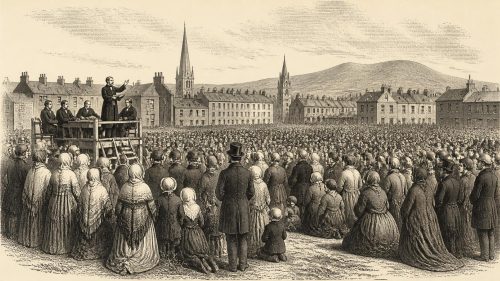
Blackwater Bank and Belfast Revival
In 1859, post-Famine Ireland displayed religious revival, political restriction, migration and uneven modernisation. The Ulster Evangelical revival, rooted in earlier prayer meetings, reached peak visibility through mass gatherings, conversions and controversy, strengthening Protestant culture while provoking clerical criticism. Westminster elections operated under a narrow property franchise, leaving most people excluded. Dublin saw the launch of The Irish Times and the National Gallery’s foundation stone. The Pomona’s wreck off Wexford killed 424, highlighting emigrants’ perils. Railways reached Enniskillen and linked Tralee with Killarney, yet rural hardship deepened. Meanwhile, Fenian reorganisation abroad connected secret republicanism with Ireland’s diaspora and future political conflict.

Deasy’s Contract Law
In 1860, Ireland remained shaped by post-Famine population loss, insecure rural tenancies and religious division. Deasy’s Act recast landlord–tenant relations as contractual, consolidating rules while failing to secure customary tenant-right or resolve ownership of improvements. Census legislation prepared a detailed 1861 enumeration, though household returns were later destroyed. Education expanded but attendance and progression remained limited, amid denominational conflict. Sectarian disturbances in Ulster prompted restrictions on party emblems and renewal of coercive policing. Railways, coaches, ports and emigration strengthened internal and Atlantic links, while the Irish Republican Brotherhood stayed clandestine. Boucicault’s The Colleen Bawn popularised a commercial theatrical Ireland abroad.
Derryveagh and the Enumerators
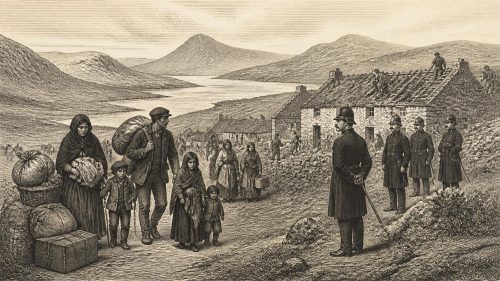
In 1861, Ireland faced continuing post-Famine decline, emigration and unequal development. The Derryveagh evictions in Donegal saw John George Adair remove 244 people from forty-seven families, with police enforcing lawful writs and homes destroyed. Parliamentary debate exposed tenants’ lack of security, while poor-law authorities assisted displaced families. Census enumeration recorded 5,798,967 inhabitants, reflecting sustained demographic loss, although household returns were later destroyed. Land-improvement legislation promised rural progress amid continuing insecurity. Queen Victoria reviewed troops at the Curragh, while Dublin’s Mater Misericordiae Hospital opened. Belfast’s linen industry expanded, Sheridan Le Fanu began a novel serial, and Irish scholar John O’Donovan died.

Bedford Street, Belfast Lough
In 1862, Ireland saw significant infrastructural, civic and institutional development alongside enduring poverty and political frustration. Edward Harland and Gustav Wolff formed their Belfast shipbuilding partnership, while Ulster Hall opened, symbolising the city’s industrial and cultural confidence. The railway reached Sligo, and a Stranraer–Larne steam service improved connections with Scotland. Dublin gained statutory authority for a municipal fire brigade. Meanwhile, parliamentary debates highlighted severe rural distress and workhouse dependence; Poor Law changes expanded infirmary care and child boarding-out. Churches marked Archbishop Beresford’s death, republican organisation persisted covertly, and Irish communities remained connected to America, literature, and expanding national education systems.

Parliament Street’s Fenian Press
In 1863, post-Famine Ireland remained marked by poverty, precarious employment, local distress and continued emigration, linking communities with Britain and North America. Parliamentary debates addressed relief, destitution and insecure tenant tenure, while drainage legislation promoted estate improvement without resolving tenant rights. The Poor Removal Act addressed welfare disputes arising from migration. Against this background, James Stephens and Irish Republican Brotherhood associates established The Irish People in Dublin on 28 November, funded partly by American Fenians. Edited and managed by organisers, the newspaper provided public republican platform, encouraging recruitment and fundraising. Belleek Pottery’s Parian production also indicated uneven national industrial development.
Merrion, Glasnevin, Belfast
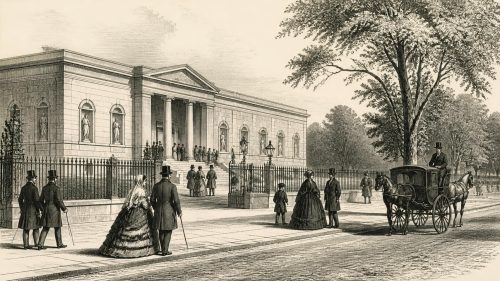
In 1864, Ireland saw expanding state and cultural institutions alongside social and political division. Civil registration of births, deaths and marriages began, while Dublin’s National Gallery opened and scientific collecting continued. A memorial tower to Daniel O’Connell was begun at Glasnevin, affirming Catholic nationalist memory. Post-famine agricultural consolidation, livestock growth, emigration and the foundation of Cork’s Munster Bank indicated uneven economic change. Belfast’s August sectarian riots caused deaths, injuries and controversy over policing, prompting a royal commission. Meanwhile, the Irish Republican Brotherhood organised clandestinely through The Irish People, and Archbishop Cullen founded the Irish Ecclesiastical Record, strengthening Catholic institutional authority.

Earlsfort Glass, Fenian Ink
In 1865, Dublin’s International Exhibition at Earlsfort Terrace showcased Irish art, industry and agriculture, affirming civic ambition, imperial connections and establishment loyalty, while masking persistent rural poverty and inequality. July’s restricted-franchise general election returned Palmerston’s Liberals, but offered no agreed Irish political programme. More consequentially, police suppressed the Fenian Irish People in September, arresting leading Irish Republican Brotherhood activists. James Stephens was captured in November but escaped Richmond Bridewell. Green Street trials sentenced O’Leary, Luby and O’Donovan Rossa to penal servitude, creating nationalist symbols. Catholic Archbishop Paul Cullen opposed revolutionary secrecy. Livestock remained vital, and W. B. Yeats was born.

Cullen’s Red Hat, Valentia Wire
In 1866, Ireland experienced political repression alongside religious, educational and technological change. Parliament suspended habeas corpus amid fears of Fenian conspiracy, enabling 752 arrests and weakening republican organisation before the failed 1867 rising. Fenian raids into Canada highlighted nationalism’s Atlantic dimension, while Paul Cullen’s elevation as Ireland’s first cardinal symbolised Catholic institutional confidence, also visible in Belfast’s St Peter’s Church. Anne Jellicoe founded Alexandra College, extending advanced educational opportunities for women. Railway expansion to Westport and changing livestock agriculture altered rural life. Most dramatically, the successful Valentia–Newfoundland telegraph cable connected Ireland to North America, making Kerry a global communications hub.
Bottle Hill Rising
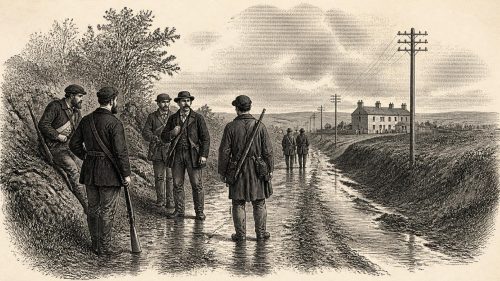
In 1867 the Irish Republican Brotherhood launched a poorly coordinated Fenian rising seeking an independent republic and social reform. After alarms including the failed Chester Castle raid, authorities extended habeas corpus suspension, arrested suspects, and strengthened policing. On 5 March, insurgents attacked police and coastguard stations, disrupted telegraphs and railways, and assembled near Dublin and in Munster. Better-armed government forces, intelligence, poor communications, inadequate weapons, and absent mass support quickly defeated them. Peter O'Neill Crowley's later death fostered martyrdom. The year brought Fenian rescues and executions in Manchester, transportation to Western Australia, the Clerkenwell bombing, hardship, reform, and Orange mobilisation.
Ardagh and Disestablishment
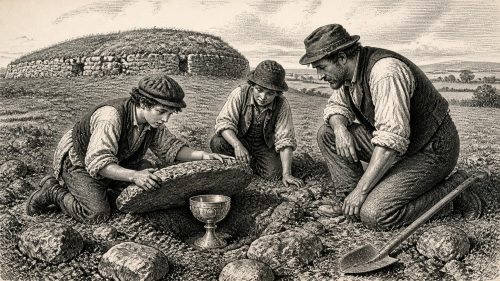
In 1868, Ireland faced a constitutional crisis over the Anglican Church of Ireland, whose privileged status conflicted with the Catholic majority and Presbyterian presence. Gladstone’s resolutions, Commons victories and Liberal election gains made disestablishment unavoidable, although legislation followed in 1869. Franchise reform enlarged, but did not democratise, the male electorate, while Gladstone’s ministry symbolised reform through Catholic lord chancellor Thomas O’Hagan. Fenian prosecutions sustained security fears. National schools expanded amid attendance, and industrial schools extended state control. Emigration, pastoral change and poverty persisted. St Colman’s Cathedral began at Queenstown, Valentia Observatory opened, and the Ardagh Chalice discovered during potato digging.
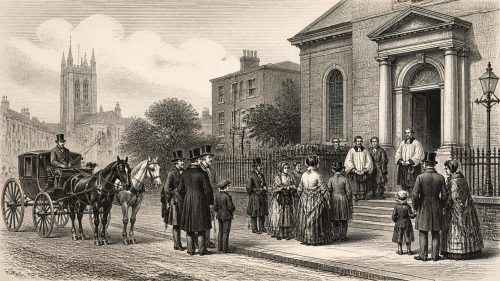
Maynooth, Tithes and Parsonstown
In 1869, Gladstone’s Irish Church Act reshaped Ireland’s settlement by legislating disestablishment of the Church of Ireland, effective in 1871, while protecting clergy and reorganising property. It ended grants to Maynooth and Presbyterian ministers through compensation arrangements, prompting new church financing and governance. Selective release of Fenian prisoners sustained amnesty agitation, with Isaac Butt emerging as a constitutional nationalist figure. Inquiries into tenant rights and agricultural improvements prepared the ground for land reform in 1870. Mary Ward’s death near Parsonstown in an experimental steam carriage marked Ireland’s first recorded mechanised road fatality. Master McGrath’s Waterloo Cup victory generated sporting pride.

Bilton’s Constitutional Gamble
In 1870, Irish politics increasingly moved from Fenian insurrection towards constitutional campaigning, though prisoner amnesty remained contentious. Isaac Butt founded the Home Government Association at Bilton’s Hotel, uniting disparate interests behind a federal-style Irish legislature within the Crown and empire. Gladstone’s Landlord and Tenant (Ireland) Act recognised Ulster custom, improvements and eviction compensation, but neither secured fair rents nor ownership. Church of Ireland disestablishment, legislated in 1869, awaited implementation in 1871, while its Representative Church Body was established. Emigration, infant mortality, literacy and livestock farming highlighted pressures. The year transformed methods and principles without settling Ireland’s land or religious questions.

Disestablishment, Westmeath, Ormeau
In 1871, Ireland experienced constitutional, demographic, agrarian and civic change. The Church of Ireland was disestablished, ending its privileged state position while preserving it as a self-governing voluntary body. The census recorded 5,412,377 people, confirming continuing post-Famine decline and emigration, alongside Belfast’s industrial growth. Land reform under the 1870 Act offered limited tenant protections, but agrarian violence prompted the coercive Westmeath Act, permitting detention without trial in proclaimed districts. Isaac Butt’s election for Limerick advanced constitutional home government. Belfast opened Ormeau Park, while expanding national education and Trinity’s academic life highlighted uneven access, religious tensions and unresolved inequalities across Ireland.
Londonderry’s Secret Ballot
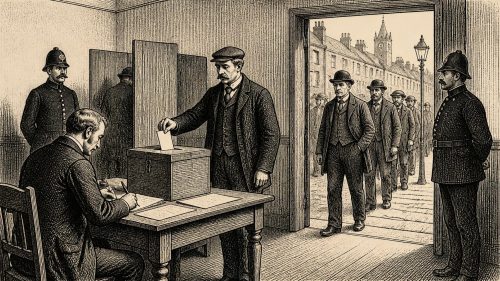
In 1872, the Ballot Act introduced secret voting for Irish parliamentary and municipal elections, first tested at Londonderry City, where Conservative Charles Lewis won a four-cornered by-election. Franchise restrictions and local religious, social and political influence nevertheless persisted. Isaac Butt’s Home Rule movement expanded through contested elections, linking constitutional reform with tenant grievances. Repeal of the Party Processions Act enabled nationalist demonstrations: Derry’s passed peacefully, but Belfast’s Hannahstown procession preceded severe sectarian rioting, deaths and displacement. Religious education, Church affairs, agricultural change, urban institutions and literary publication reflected pressures. Lord Mayo’s assassination in India highlighted Ireland’s connections to imperial government.
Butt’s Rotunda League
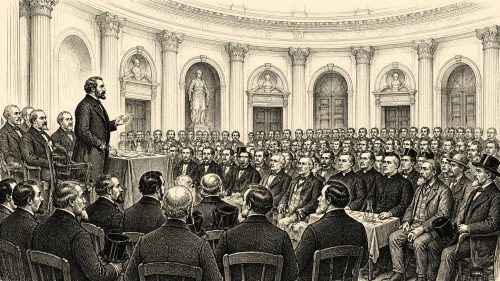
In 1873, Gladstone’s failed University Education (Ireland) Bill exposed divisions over denominational higher education, destabilised his ministry, and left Catholic demands unmet despite liberalising Trinity restrictions. The controversy strengthened Isaac Butt’s case for domestic self-government. At Dublin’s Rotunda, delegates transformed the Home Government Association into the Irish Home Rule League, seeking an Irish legislature within the United Kingdom and Empire. Land insecurity, emigration and unequal rural wealth persisted despite livestock-based agriculture and limited tenant protections. Railway, drainage, poor-law and sanitary reforms signalled uneven modernisation. The opening of St Eugene’s Cathedral in Derry reflected Catholic institutional confidence amid continuing sectarian tensions.
Butt’s Ballot Breakthrough
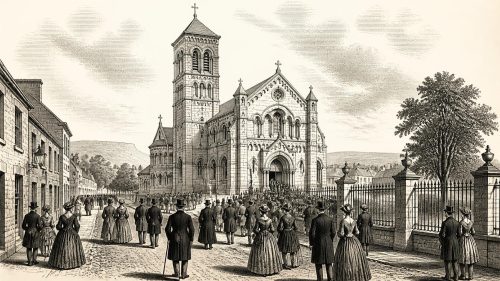
In 1874, Isaac Butt’s Home Rule League won about sixty of Ireland’s 103 Westminster seats, displacing Liberals and establishing a broad but undisciplined constitutional movement. Butt’s proposed Irish legislature, retaining imperial responsibilities at Westminster, received little British support, exposing the gap between electoral representation and influence. Parliament nevertheless handled Irish courts, loans, licensing and navigation. Cardinal Cullen opened Sligo’s Catholic cathedral, symbolising institutional confidence. Registration recorded 141,288 births and 91,961 deaths, while 73,184 people emigrated, chiefly young adults. Agriculture, weather and rural administration remained central to life. Births included Kathleen Lynn, Ernest Shackleton, Annie Moore and Cathal Brugha, among others.

Parnell’s First Westminster Spring
In 1875, Irish politics exposed emerging strains within constitutional nationalism. John Mitchel’s two Tipperary victories, followed by parliamentary disqualification and his death, made elections vehicles for protest. Charles Stewart Parnell entered Parliament for Meath, while Joseph Biggar’s resistance to coercion foreshadowed new Westminster tactics. Thomas Croke became archbishop of Cashel, initially concentrating on diocesan affairs. Population decline, emigration and livestock dependence reflected post-Famine economic change, while Dublin’s whiskey fire revealed urban industrial danger. Railway expansion, Ireland’s first rugby international, and Hibernian Football Club’s foundation demonstrated widening commercial, sporting and migrant connections, anticipating later political and agrarian conflicts across Irish society.
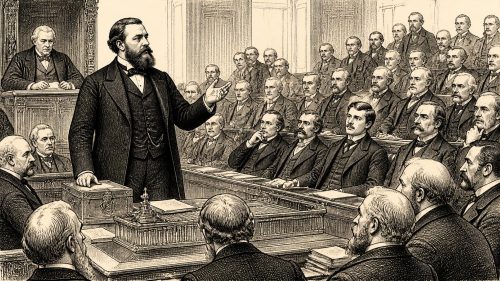
Butt’s Unanswered Committee
In 1876, Isaac Butt’s request for a Commons committee on Irish self-government was defeated overwhelmingly, exposing Westminster’s resistance and divisions within Home Rule, where Parnell advocated repeal of the Union. Land tenure remained contested despite the 1870 Act; parliamentary initiatives and Return of Owners of Land highlighted insecurity and concentrated property, although harvests were good. Railway consolidation created Great Northern Railway, while Dublin established an artisans’ dwellings company. The Dublin Women’s Suffrage Association, led by Anna Haslam, organised campaigning. The Society for the Preservation of the Irish Language formed, signalling cultural activism amid continuing emigration, rural dependence and British rule.
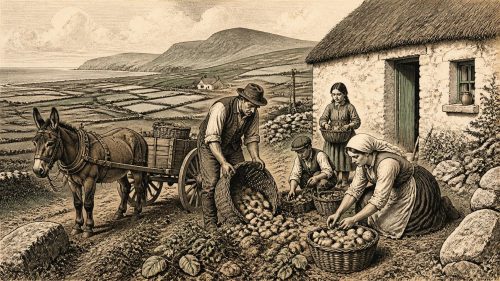
Parnell, Pedro and the Science Museum
In 1877, Charles Stewart Parnell and Joseph Gillis Biggar used prolonged Commons obstruction to challenge Westminster’s neglect of Irish concerns, weakening Isaac Butt’s constitutional leadership. A poor potato harvest and falling agricultural prices increased hardship among tenants, especially in western districts, foreshadowing but not yet constituting the Land War. Dublin saw centralising prison reform, creation of the Science and Art Museum, and medical licences for Sophia Jex-Blake, Mary Edith Pechey and Louisa Atkins. Dom Pedro II of Brazil toured Ireland, highlighting international connections. Meanwhile, the Ballymena and Larne Railway opened goods traffic, illustrating uneven regional economic development within Ireland clearly.
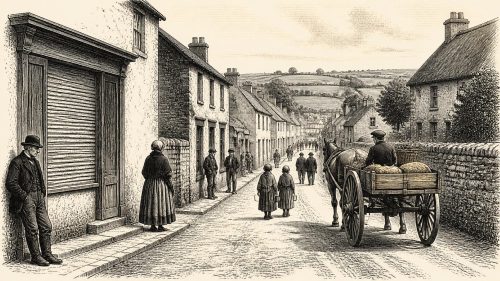
Cratlagh, Exams and Sunday Doors
In 1878, Ireland faced mounting tensions before the Land War. Lord Leitrim, notorious among tenants, was killed with two companions in Donegal, highlighting grievances over eviction and insecure tenure. Agricultural depression, poor harvests, emigration and severe disease increased hardship, though conditions varied regionally. The Public Health (Ireland) Act strengthened sanitary administration amid high mortality. The Intermediate Education Act created examination-based support for secondary schooling, including potential provision for girls. Sunday licensing restrictions reshaped social life, with urban exemptions. Politically, Isaac Butt weakened as Charles Stewart Parnell advanced tenant-rights agitation and contacts associated with the emerging New Departure in Irish politics.
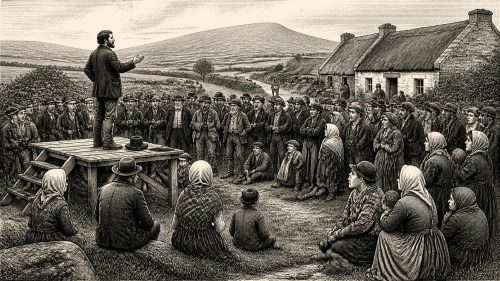
Irishtown, Knock and Castlebar
In 1879, poor harvests, falling agricultural prices and insecure small tenancies caused distress in Connacht, reviving fears of hunger, debt and eviction. On 20 April, tenants meeting at Irishtown, County Mayo, transformed a local rent dispute into agitation. Further meetings led to the Mayo Land League at Castlebar in August and the Irish National Land League in Dublin in October, connecting rural protest with Parnell’s parliamentary nationalism. Isaac Butt died, while Home Rule leadership was contested. In August, Knock villagers reported a Marian apparition, investigated by church authorities. Relief efforts began, and university reform created the Royal University of Ireland.

Lough Mask’s New Word
In 1880, agricultural failure, falling prices and rent arrears intensified Irish rural distress, prompting relief measures, emigration and debate over tenants’ responsibilities. The general election and Charles Stewart Parnell’s American fundraising strengthened nationalist organisation; his victory over William Shaw established parliamentary leadership. The Lords’ rejection of the limited Compensation for Disturbance Bill deepened distrust of Westminster. Parnell promoted ostracism of those taking evicted farms, exemplified by Captain Boycott’s isolation at Lough Mask, which created the word boycott. Agrarian violence and prosecutions revealed mounting conflict. Meanwhile, the Royal University of Ireland expanded degree access, including for women, linking crisis with change.
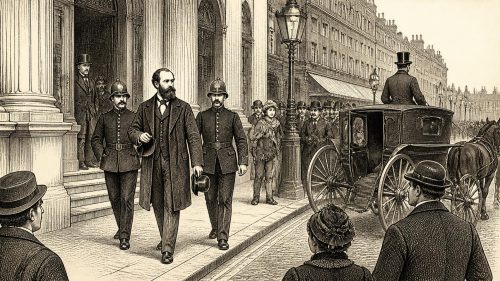
Kilmainham and the Three Fs
In 1881, Ireland’s Land War intensified as Gladstone’s government combined coercive detention powers with the Land Law (Ireland) Act. The Act advanced the Land League’s three Fs—fair rent, fixity of tenure and free sale—through judicial rents, security and protected tenant interests, but left arrears and ownership unresolved. Michael Davitt and Charles Stewart Parnell were imprisoned, while the Irish National Land League was suppressed after its No Rent Manifesto. Anna Parnell’s Ladies’ Land League organised relief and resistance. Census returns recorded continuing population decline and rural predominance. The year permanently weakened landlord authority while linking land reform, political protest and self-government.
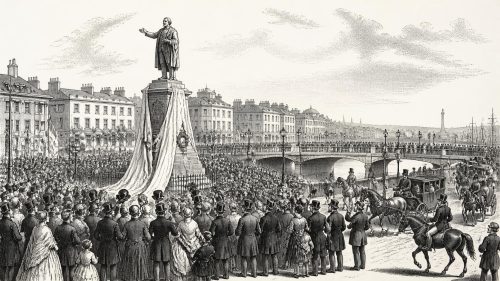
Phoenix Park, O’Connell’s Bronze
1882 in Ireland combined attempted settlement, assassination, land relief, coercion, injustice, and nationalist reorganisation. Informal negotiations between Parnell and Gladstone’s government secured nationalist releases and promised arrears relief, prompting Forster’s resignation. Days later, Irish National Invincibles murdered Chief Secretary Lord Frederick Cavendish and under-secretary Thomas Henry Burke in Phoenix Park, damaging constitutional nationalism. The government responded with the Prevention of Crime Act and the limited Arrears of Rent Act. At Maamtrasna, inadequate interpretation imperilled Irish-speaking defendants; Myles Joyce was executed and posthumously pardoned. Parnell’s supporters founded the Irish National League, while Dublin unveiled O’Connell’s monument, affirming constitutional public national aspirations.
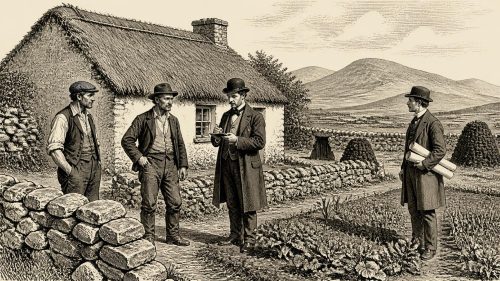
Crumlin Road and Newgate
In 1883, Ireland remained divided by unresolved land ownership, coercive government and demands for Home Rule, while the aftermath of the Phoenix Park murders shaped prosecutions and political debate. The Labourers (Ireland) Act established a cautious framework for sanitary authorities to build rural cottages, foreshadowing later reforms. Nationalist organisation persisted through Parnell, the National League and transatlantic support. Catholic institutions expanded with Belfast’s Mater Hospital and a Jesuit University College in Dublin. Completed O’Connell monument figures, international rugby, emigration, a Tyrone tramway proposal and George Moore’s first novel reflected wider civic, economic and cultural change amid continuing uncertainty, national tensions.
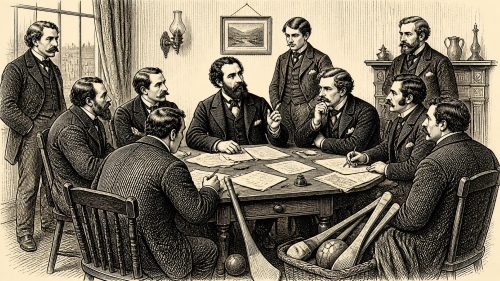
Hayes Hotel’s New Association
In 1884, Michael Cusack, Maurice Davin and others founded the Gaelic Athletic Association at Hayes’s Commercial Hotel, Thurles, to organise and promote Irish games and athletics. Supported by patrons including Charles Stewart Parnell, Michael Davitt and Archbishop Croke, it linked recreation with nationalist cultural confidence, though formal rules followed in 1885. Meanwhile, franchise reform widened male voting rights without enfranchising women or all men, intensifying Home Rule politics and land concerns. Emigration exceeded natural population growth, while disease and infant mortality remained high. Nine women received Royal University degrees, signalling limited educational progress amid persistent social, economic and religious inequalities.
Ashbourne, Carnarvon and the Poll
In 1885, Ireland’s land and constitutional politics were reshaped. The first Ashbourne Act authorised £5 million for state-backed tenant purchases, advancing the shift from landlordism, while educational endowments legislation addressed school resources. Lord Salisbury’s minority Conservative government appointed Lord Carnarvon, whose private discussion with Charles Stewart Parnell indicated tentative interest, not commitment, in Irish legislative autonomy. Franchise extension and redistribution enlarged and reorganised constituencies. The Irish National League’s organisation helped Parnellites win 85 of Ireland’s 103 seats, giving their Westminster bloc decisive leverage. Unionist strength persisted in Ulster. Economic contrasts, emigration, and Gaelic Athletic Association rule-making also marked the year.

Woodford’s Campaign Plan
In 1886, Gladstone’s First Home Rule Bill offered Ireland limited self-government under the Crown, but Liberal divisions defeated it and strengthened Conservative and Unionist politics. Elections sharpened nationalist and unionist electoral blocs, particularly in Ulster. Belfast suffered prolonged sectarian riots, causing 31 deaths and exposing communal insecurity. Rural hardship persisted amid falling agricultural prices, emigration and increased poor relief. In October, John Dillon and William O’Brien launched the Plan of Campaign, organising tenants to seek collective rent reductions and support evicted families, despite Parnell’s reservations. Labourers’ and tramway legislation continued modest reform, while Yeats’s early publication indicated enduring cultural activity.

Mitchelstown’s September Dead
In 1887 Arthur Balfour’s Unionist administration combined coercion with limited land reform amid depressed farm incomes and organised tenant resistance. The Criminal Law and Procedure Act proclaimed districts and outlawed the Irish National League, while the Land Law Act revised protections, rents and purchase provisions. The Plan of Campaign mobilised tenants, notably on the Kingston estate near Mitchelstown. On 9 September, RIC police fired on a crowd, killing Michael Lonergan and mortally wounding John Shinnick and John Casey. The shootings intensified controversy over public meetings and policing. Meanwhile, The Times attacked Parnell, while antiquarian scholarship asserted Ireland’s distinct cultural heritage.
Davin’s American Invasion
In 1888 Ireland faced coercion, agrarian conflict and scrutiny of constitutional nationalism. The Special Commission investigated allegations against Charles Stewart Parnell and Irish MPs, while the Plan of Campaign provoked prosecutions, evictions and papal condemnation. Local government reform failed, leaving Ireland without elected county councils. Meanwhile, Horace Plunkett promoted co-operation, Christian Brothers College opened in Cork, and W. B. Yeats published Fairy and Folk Tales of the Irish Peasantry. Maurice Davin led Gaelic Athletic Association athletes to America, promoting hurling among emigrants despite financial difficulties. These developments demonstrated continuing struggles over political representation, land, religion, culture and Irish institutional independence.
Pigott, Armagh and Oisín
In 1889, Richard Pigott’s forged letters linking Charles Stewart Parnell to the Phoenix Park murders collapsed under cross-examination, vindicating Parnell though the Special Commission continued. Rural conflict persisted around the Plan of Campaign and coercive enforcement, despite reduced official proclamations. The Armagh railway disaster killed 80 people and injured 260, prompting railway safety legislation. Horace Plunkett began co-operative experiments at Doneraile. Cultural developments included Yeats’s The Wanderings of Oisin and Other Poems and Douglas Hyde’s Irish-language folktale collection. Parnell’s year ended ominously when Captain William O’Shea filed a divorce petition, foreshadowing the crisis of 1890 and the ensuing party split.
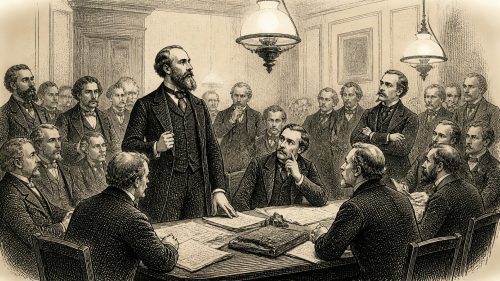
Committee Room Fifteen
In 1890, Charles Stewart Parnell emerged largely vindicated from the Special Commission, but his leadership of the Irish Parliamentary Party collapsed after Captain O'Shea's divorce case exposed his relationship with Katharine O'Shea. Gladstone warned that retaining Parnell endangered Liberal support for Home Rule, while Catholic bishops opposed him. In Committee Room 15, forty-five MPs abandoned Parnell, leaving twenty-eight supporters and dividing nationalism for the decade. Meanwhile, land, labour and food insecurity persisted, despite Davitt's activism. Belfast's market, Derry's Guildhall and Dublin's museum signalled civic development, whereas removal of Inishbofin remains exposed exploitative Victorian anthropology and unequal institutional power over bodies.
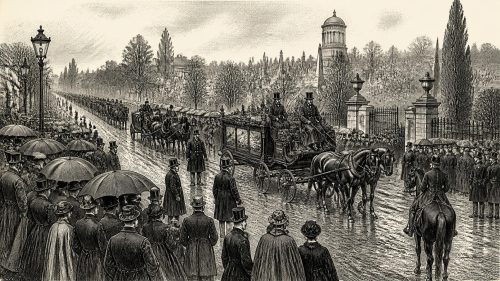
Carlow, Creggs and Glasnevin
In 1891, the Parnell split dominated Irish politics as anti-Parnellites organised in the Irish National Federation, won North Sligo and Carlow, and gained episcopal support. Parnell defended Irish independence, married Katharine O’Shea, addressed his last major meeting at Creggs, and died in Brighton; his Glasnevin funeral drew vast crowds. The Purchase of Land Act strengthened tenant purchase and created the Congested Districts Board to address western poverty. The census recorded continuing population decline, driven by emigration and limited rural opportunity. Meanwhile, the Irish Daily Independent began publication, Wilde published Dorian Gray, Stephens returned, and Redmond’s Waterford victory preserved minority Parnellism.
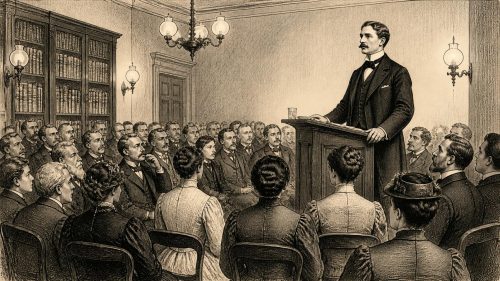
Hyde’s De-Anglicising Address
In 1892, Ireland’s general election confirmed anti-Parnellite dominance, with Justin McCarthy’s federation winning seventy-two seats against nine for John Redmond’s faction, while nationalist division persisted. Liberal victory returned Gladstone to office, making Home Rule possible but not yet enacted. Belfast’s Ulster Unionist Convention demonstrated organised resistance, and Edward Carson entered Parliament. Rural labourers founded Knights of the Plough, demanding land, wages and housing. St Macartan’s Cathedral was dedicated in Monaghan. Douglas Hyde’s Dublin address, The Necessity for De-Anglicising Ireland, urged cultural renewal through language and tradition. Census reports documented social change; Belfast also hosted Ireland’s international football match against England.

Sackville Street’s Gaelic League
In 1893, Gladstone’s second Home Rule Bill proposed an Irish legislature within the Union, retaining Westminster supremacy, imperial responsibilities and Irish representation. Despite Commons approval, it was overwhelmingly rejected by the Lords, exposing constitutional limits and intensifying unionist fears. On 31 July, Douglas Hyde, Eoin MacNeill and others founded the non-sectarian Gaelic League in Dublin to revive spoken Irish through classes, publications and branches, amid language decline. The year also reflected religious and social organisation: Archbishop Michael Logue became cardinal, St Mel’s Cathedral was consecrated, Margaret Lyttle began a girls’ club, and the National Labour League highlighted rural workers’ grievances.
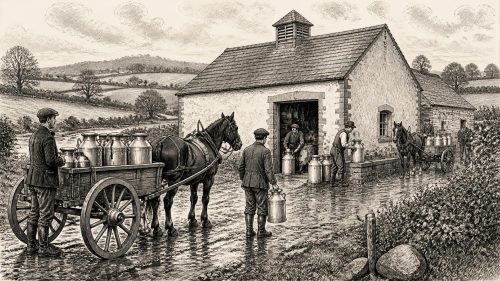
Plunkett’s Creameries, Labour’s Congress
Amid stalled Home Rule and unresolved land grievances, 1894 saw Ireland develop new forms of collective organisation. Gladstone’s resignation, the Lords’ rejection of Home Rule and the Evicted Tenants Bill, and the Irish Parliamentary Party split exposed constitutional nationalism’s weakness, while a financial-relations commission acknowledged fiscal concerns. Administrative shortcomings persisted, including local democracy and poor-rate oversight. In April Horace Plunkett’s Irish Agricultural Organisation Society began coordinating rural co-operation, promoting creameries, collective marketing and expertise. Dublin’s Irish Trades Union Congress and May Labour Day demonstration gave organised workers a forum. Compulsory school attendance expanded unevenly, while Æ’s poetry reflected cultural revival.
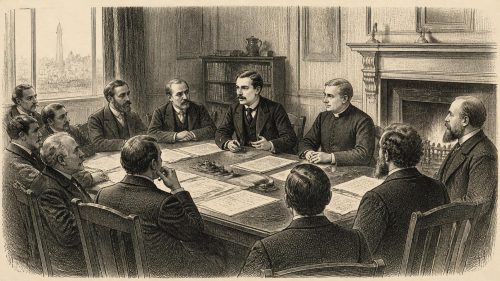
Plunkett’s Recess Committee
In 1895, the fall of Lord Rosebery’s Liberal government ended immediate hopes of Home Rule, while the general election confirmed nationalist strength but exposed continuing division after the Parnell split. Gerald Balfour became chief secretary amid unresolved land grievances, limited purchase reform and persistent rural inequality. Horace Plunkett launched negotiations for the cross-party Recess Committee, promoting agricultural cooperation, technical education, credit and industry; its later achievements were not yet assured. The Irish Homestead and early Gaelic League records reflected growing economic and cultural organisation. John Daly’s election highlighted political imprisonment, while Oscar Wilde’s conviction and imprisonment marked devastating cultural loss.
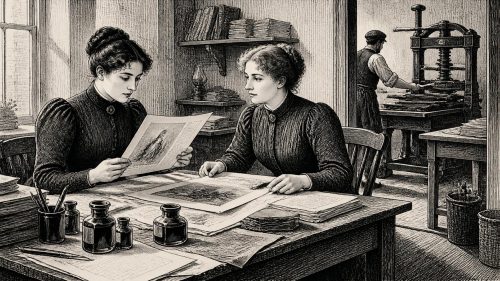
Shan Van Vocht Launches
In 1896, Ireland saw no single decisive crisis, but several developments foreshadowed later change. Alice Milligan and Anna Johnston launched Belfast’s Shan Van Vocht, promoting cultural nationalism, women’s participation and 1798 commemoration. Home Rule remained divided and politically stalled under John Dillon and John Redmond. The Land Law Act advanced tenant purchase without ending rural inequality. James Connolly helped found the Irish Socialist Republican Party, linking independence with workers’ interests. Maynooth gained pontifical university status. Dublin opened its first electric tram service, while Belfast’s industry prospered unevenly. Discovery of the Broighter Hoard connected contemporary cultural revival with Ireland’s ancient past.
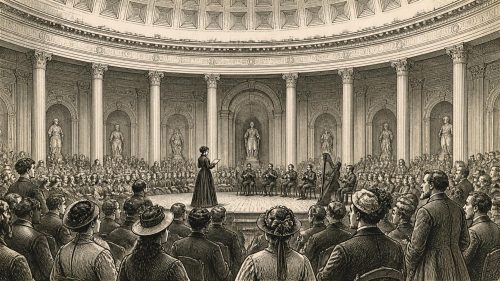
Rotunda’s First Oireachtas
In 1897, Ireland remained under the Union, with Home Rule stalled and nationalist parliamentary strength weakened after Parnell. Debate increasingly focused on prospective local-government reform, while Victoria’s Diamond Jubilee exposed competing loyalist, nationalist, republican and socialist allegiances. Cultural nationalism gained durable institutions: Gaelic League held first Oireachtas at Dublin’s Rotunda, and first Feis Ceoil promoted musical cultivation. Yeats, Lady Gregory and Edward Martyn planned an Irish Literary Theatre, while Bram Stoker published Dracula. Rural life depended on land and British markets; Horace Plunkett advanced agricultural co-operation. Anti-jubilee protests, cultural initiatives and practical reform reflected an increasingly organised, diverse national life.
Westport’s United Irish League
In 1898, Ireland saw agrarian, political and cultural change. William O’Brien founded the United Irish League at Westport, seeking land redistribution and linking western congestion to self-government. The Local Government (Ireland) Act replaced landlord-dominated grand juries with elected councils, although implementation followed in 1899 and franchise limits remained. Centenary commemorations of 1798 elevated Wolfe Tone while exposing competing nationalist, unionist and regional interpretations. Cultural revival advanced through Fáinne an Lae, the Gaelic League’s Oireachtas, Pearse’s Aran visit and Irish literature. Mary Immaculate College, Belfast City Hall and Killybegs carpet manufacture reflected educational, municipal and industrial development. They reshaped public life.
Rotunda, Ratebooks and Veld
In 1899, Ireland saw institutional, cultural and political developments without resolving its constitutional future. Elections under the Local Government Act replaced grand-jury administration with elected county, rural and urban councils, widening participation though property restrictions remained. The Agriculture and Technical Instruction Act created a department to promote farming, fisheries, industry and education, associated with Horace Plunkett’s cooperative ideas. Dublin’s Irish Literary Theatre inaugurated productions amid controversy, while the Gaelic League’s Oireachtas demonstrated language-revival organisation. The Second Boer War exposed divided loyalties: Irish people served Britain, whereas nationalists supported the Boers. Together, these changes expanded Irish public life, debate and organisation.