1900–1999 CE
MacArthur, Gregory and Stormont
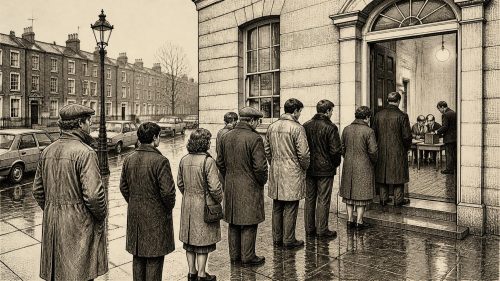
In 1982, Ireland endured two general elections, the collapse of governments and changes between Charles Haughey and Garret FitzGerald amid recession, unemployment, borrowing and tax protests. Haughey’s precarious minority relied on Tony Gregory’s inner-city development agreement before losing confidence; the MacArthur affair and telephone-tapping allegations further damaged public trust. Northern Ireland elected a Stormont Assembly, but nationalist boycotts limited its legitimacy as violence continued, including fatal bombings in London and Ballykelly. Social change included abolition of school corporal punishment and Dublin’s first crematorium. Constitutional debate on abortion intensified, while cultural, neutrality and Falklands issues underscored unresolved political divisions across Ireland.
Referendum, Forum and Maze
In 1983, Ireland confronted constitutional, political and security questions that would echo for decades. Voters approved the Eighth Amendment, inserting constitutional protection for the unborn. Garret FitzGerald’s coalition launched the New Ireland Forum, while Gerry Adams won West Belfast at Westminster. In Northern Ireland, thirty-eight IRA prisoners escaped from the Maze Prison, intensifying debate over security. The kidnapping of supermarket executive Don Tidey ended with two members of the security forces killed during his rescue. Economic recession, unemployment and emigration remained severe. Together, these events made 1983 a year of constitutional change, political realignment, conflict and social strain across Ireland.
Granard, Henry Street and Howth
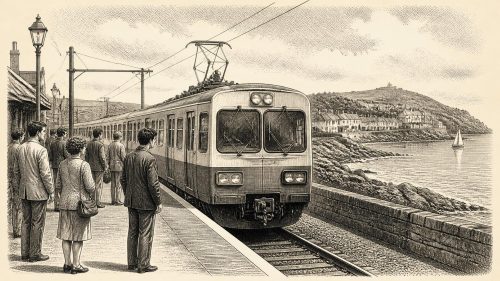
In 1984, recession, unemployment and industrial closures, including Ford Cork and Irish Shipping, shaped Irish life, while DART and the East-Link bridge improved Dublin transport. The New Ireland Forum developed a shared nationalist approach to Northern Ireland, although Thatcher rejected its options and violence continued, notably the Brighton bombing and supergrass case collapses. Reagan’s visit prompted both celebration and protest. Ann Lovett’s death in Granard and the Kerry babies investigation exposed harsh attitudes and institutional failings affecting unmarried pregnant women. Dunnes Stores workers began an anti-apartheid strike, while the GAA centenary provided a significant cultural celebration in Thurles that year.
Hillsborough’s Uneasy Promise
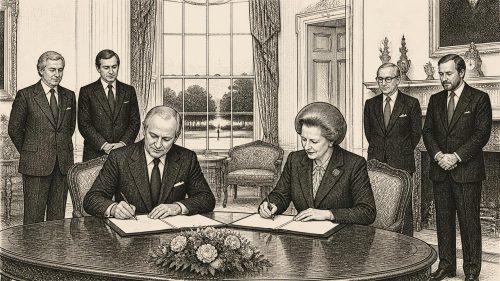
In 1985, the Anglo-Irish Agreement, signed by Garret FitzGerald and Margaret Thatcher at Hillsborough, created a permanent consultative role for Dublin in Northern Ireland affairs while confirming majority consent for constitutional change. It offered constitutional nationalists progress but provoked unionist protest and Fianna Fáil opposition. Violence continued, including major IRA attacks and the killing of a Garda officer. Sinn Féin advanced electorally and revised its Dáil abstention policy. The Republic faced severe unemployment and emigration, alongside the Progressive Democrats’ foundation and liberalised contraception law. Religious controversy, theatre, U2’s Croke Park concert and Cork 800 reflected changing national identities amid hardship.
The Divorce Vote and Clontibret
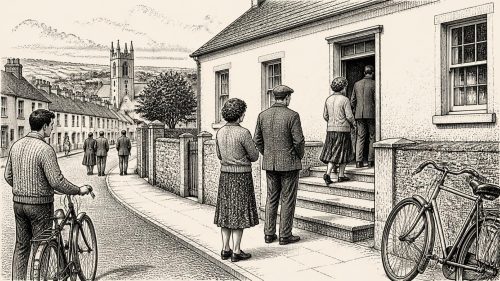
In 1986, Ireland faced economic hardship, social change and intensified Northern conflict. Garret FitzGerald’s coalition confronted debt, unemployment and emigration, while legislation addressed poverty, welfare and public archives. Voters decisively rejected a constitutional amendment permitting limited divorce, though separation and marital breakdown remained prominent realities. The census recorded 3,540,643 people; Self-Aid highlighted mass unemployment, and Knock airport symbolised regional aspiration. Chernobyl contamination fears and the Russborough art theft caused concern. The Anglo-Irish Agreement provoked unionist resistance, culminating in Peter Robinson’s loyalist incursion into Clontibret. Sinn Féin ended Dáil abstention, prompting a republican split, revealing deep enduring strains across Irish society.

Crotty and Enniskillen
In 1987, Fianna Fáil returned under Charles Haughey as a minority government after the collapse of the Fine Gael–Labour coalition, amid severe unemployment, debt and emigration. Ray MacSharry’s budget imposed spending restraint, while the Programme for National Recovery inaugurated social partnership. In Crotty v An Taoiseach, the Supreme Court required popular approval for elements of the Single European Act; voters subsequently passed the Tenth Amendment. Northern Ireland remained scarred by conflict, including the Loughgall ambush and the IRA’s Enniskillen bombing, which killed eleven civilians. Johnny Logan’s Eurovision victory and Seamus Heaney’s The Haw Lantern provided notable cultural moments that year.

Gibraltar, Milltown and Stuttgart
In 1988, Ireland combined economic hardship, political change, cultural celebration and continuing conflict. Charles Haughey’s government implemented the first full year of the Programme for National Recovery, using fiscal restraint and social partnership, alongside tax and urban-renewal measures. Northern Ireland endured killings at Gibraltar, Milltown, Andersonstown, Ballygawley and Drumnakilly, while emergency powers persisted and Anglo-Irish relations remained strained. John Hume’s private talks with Gerry Adams opened a tentative nationalist channel. The European Court’s Norris judgment challenged criminalisation of homosexual acts; broadcasting laws reshaped media. Dublin’s millennium, Eurovision and Ireland’s Stuttgart victory provided civic and international optimism amid unresolved constitutional violence.

Malta, Leixlip and Leinster House
In 1989, Ireland combined tentative recovery with enduring social and political strain. Fianna Fáil, short of a majority after June’s election, formed its first coalition, with the Progressive Democrats. Judicial separation legislation modernised family law without legalising divorce. Social partnership, European structural funding and Intel’s Leixlip investment signalled economic change, although unemployment and emigration remained severe. Northern Ireland endured killings, including Patrick Finucane’s murder and the IRA attack on two RUC officers, while Peter Brooke acknowledged military means alone could not end conflict. Three Irish UN soldiers died in Lebanon. Ireland’s football team qualified for its first World Cup finals.

Saint Jack and the Áras
In 1990, Ireland combined growing international confidence with economic insecurity and continuing Northern conflict. Dublin’s European Community presidency hosted discussions on German reunification and future union, while Italia ’90 inspired nationwide celebration after Ireland reached the World Cup quarter-finals. Nelson Mandela’s visit highlighted Irish anti-apartheid solidarity, and abolition of the death penalty marked legal reform. Economic recovery remained uneven, with unemployment at 12.9 per cent. Northern Ireland saw violence alongside tentative political developments. Mary Robinson’s presidential victory over Brian Lenihan, following damaging controversy, made her Ireland’s first woman president and challenged established assumptions about political authority, gender and public life.
Dublin, Downing Street and Haughey
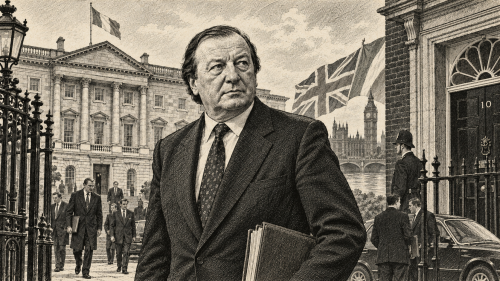
In 1991, Ireland combined tentative recovery with political instability and continuing conflict. Dublin’s European City of Culture programme promoted the capital’s contemporary artistic identity, despite criticism of its visibility and reach, and supported Temple Bar’s emergence as a cultural quarter. The Fianna Fáil–Progressive Democrats coalition was strained as Taoiseach Charles Haughey dismissed finance minister Albert Reynolds, replacing him with Bertie Ahern. Fiscal restraint and social partnership reduced borrowing and inflation, but unemployment reached about 14.7 per cent and insecurity persisted, although emigration eased. The IRA’s Downing Street mortar attack underscored the Troubles’ reach, while negotiations continued without a peace breakthrough.
Reynolds, X Case and Maastricht
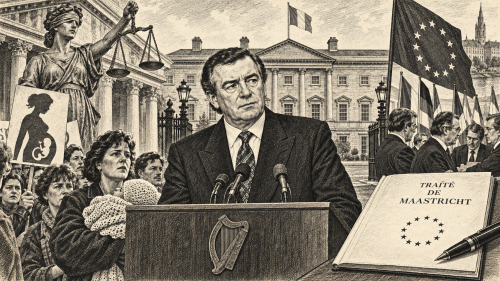
In 1992, Charles Haughey resigned and Albert Reynolds became Taoiseach amid economic hardship and coalition tensions. The X Case, involving a raped fourteen-year-old prevented from travelling for an abortion, led the Supreme Court to permit abortion where a woman’s life faced a real and substantial risk, including suicide. Referendums rejected limiting this ruling but protected travel and information rights. Ireland overwhelmingly approved Maastricht, endorsing European Union membership and deeper integration. November’s election weakened Fianna Fáil, boosted Labour and led to a Fianna Fáil-Labour coalition in 1993. Northern peace talks continued despite violence, laying foundations for later progress in later years.
Decriminalisation and Downing Street
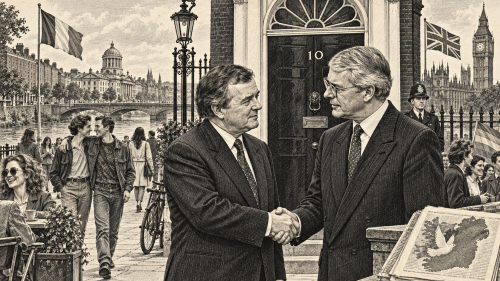
In 1993, Albert Reynolds led Ireland's first Fianna Fáil–Labour coalition, with Dick Spring as Tánaiste and Foreign Affairs Minister, reflecting changing electoral politics. The Criminal Law (Sexual Offences) Act decriminalised consensual sex between adult men, ending Victorian-era provisions after David Norris's campaign and European court ruling. European integration advanced through the single market and Maastricht Treaty's creation of the European Union. Reynolds and John Major's Downing Street Declaration provided a constitutional, peaceful framework for Northern Ireland, despite continuing violence. Unemployment remained 15.7 per cent, but investment, European funding and policy reforms foreshadowed growth, while social divisions and emigration persisted nationally.
Ceasefires, Riverdance and Coalition
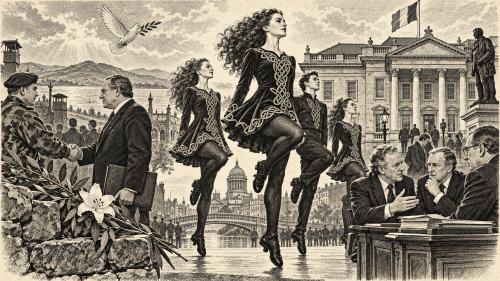
In 1994 Ireland underwent major political, cultural and economic change. Riverdance, premiered during Dublin’s Eurovision interval, transformed Irish dance into a globally successful expression of modern cultural confidence. The IRA’s August cessation of military operations, followed by an October loyalist ceasefire, reduced organised violence and created opportunities for negotiations, though disarmament, constitutional issues and political participation remained unresolved. Taoiseach Albert Reynolds, influential in advancing the peace process, resigned after the Fianna Fáil–Labour coalition collapsed amid controversy over Brendan Smyth and Harry Whelehan. John Bruton then led a Fine Gael–Labour–Democratic Left coalition. Meanwhile, falling unemployment, investment and exports signalled national recovery.
The Remarriage Majority
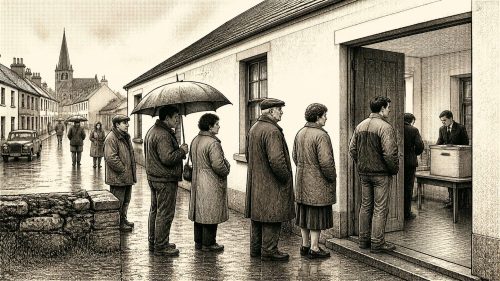
In 1995, Ireland confronted constitutional, social and political change amid economic growth and cultural confidence. The Government and Britain issued Framework Documents for Northern Ireland, while disputes over paramilitary decommissioning delayed talks; the twin-track initiative and President Clinton’s visit sustained peace-process momentum. In November, voters narrowly approved the Fifteenth Amendment, ending the constitutional ban on divorce subject to conditions. The Supreme Court’s McKenna ruling required state neutrality in referendum campaigns. Legislation permitted regulated information on abortion services abroad and established civil legal aid. Rising employment foreshadowed the Celtic Tiger, while Riverdance and plans for Irish-language television symbolised modernising cultural ambition.
Guerin, Divorce and TnaG
In 1996, Ireland combined economic optimism and demographic recovery with political violence, reform and institutional change. The IRA’s Canary Wharf bombing ended its ceasefire, while the killing of Detective Garda Jerry McCabe, the Manchester bomb and Drumcree tensions strained Northern Ireland peace negotiations. Investigative journalist Veronica Guerin’s murder highlighted organised crime, prompting stronger anti-crime measures. Divorce became legally available under the Family Law (Divorce) Act. Growth, employment and EU presidency indicated growing confidence, though unemployment and inequality persisted. Teilifís na Gaeilge launched, strengthening Irish-language broadcasting. The year thus revealed a modernising State still vulnerable to conflict, crime and uneven prosperity.
Ahern, McAleese and Ceasefire
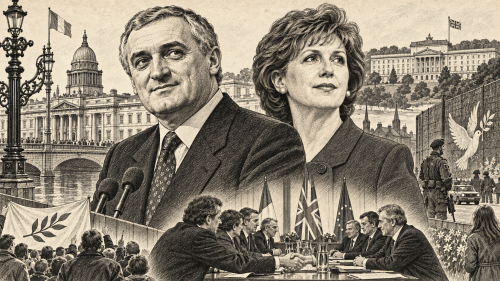
In 1997, Ireland underwent major political, social and economic change. Bertie Ahern became Taoiseach after Fianna Fáil formed a coalition with the Progressive Democrats, as rapid growth and falling unemployment strengthened the emerging Celtic Tiger. Divorce became legally available under the 1996 Act, reflecting changing social attitudes. The IRA restored its ceasefire, enabling Sinn Féin to join Stormont talks chaired by George Mitchell, despite unionist opposition. Mary McAleese, Belfast-born, was elected President and promoted reconciliation through “Building Bridges”. European integration, investment and social partnership supported expansion, though benefits were uneven. These developments established conditions for following year’s Good Friday Agreement.

The Consent Vote and Omagh
In 1998, the Good Friday Agreement created a consent-based framework for Northern Ireland, recognising British and Irish identities, establishing proposed devolved and cross-border institutions, and requiring constitutional change. Referendums on 22 May endorsed it strongly in Northern Ireland and overwhelmingly in the Republic, where the Nineteenth Amendment enabled revised Articles 2 and 3. Assembly elections followed, but disputes over decommissioning delayed an Executive. The Real IRA's Omagh bombing killed twenty-nine people, exposing continuing violence and prompting security measures. John Hume and David Trimble received the Nobel Peace Prize, while economic growth and equality, enterprise and food-safety reforms reflected wider change.

Stormont’s First Cabinet
In 1999, Northern Ireland’s devolved Executive began work at Stormont, led by David Trimble and Seamus Mallon, while new North/South and British-Irish bodies implemented the Good Friday Agreement. The Republic amended its Constitution, replacing territorial claims with consent-based unity, though decommissioning and policing reform remained disputed. Ireland joined the euro’s non-cash phase amid rapid economic growth, but nurses’ industrial action revealed pressure on public services. Kosovar refugees arrived and immigration law changed. States of Fear prompted official acknowledgement of institutional abuse. Gay Byrne left The Late Late Show, Heaney published Beowulf, and Cork won the All-Ireland hurling final in September.