
600–699 CE
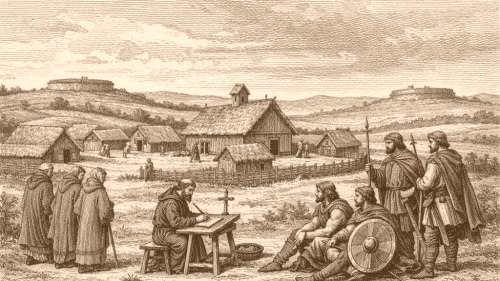
Comgall’s Passing
The extant annalistic notices around 600 CE record several deaths, battles, and political killings, but they do not provide a continuous narrative for the year. The entry marked 600 names the deaths of Comgall of Bangor and Uata son of Aed, king of Connacht, and it reports two battles, at Cúil Slemna and Cúil Cóel. The surrounding notices for 599, 601, and 602 show nearby years with similar terse entries. This account separates the securely dated 600 notice from adjacent material and avoids turning silence into conjecture about wider events in Ireland.
Slemain Battles
The surviving notices for 601 CE are brief and uneven. In the Annals of Ulster, the year labelled AD 601 contains an earthquake in Bairche, the death of Brénainn son of Cairpre son of Feichíne, and a cluster of entries attributed to the book of Cuanu, including battles and deaths said to belong to that year. The same year in the Annals of the Four Masters names Aedh Uairidhnach as king of Ireland, records the death of Laisren of Iona, and notes the battle of Slaibhre. Read together, the witnesses preserve events and chronology, but they do not always agree on dating.
Colmán Rímid
Entries clustered around AD 602 in the Annals of Ulster, Annals of Tigernach, and Annals of Inisfallen record several battles, killings, and deaths, but they do so with different wording, ordering, and cross-references. The Ulster text places the battle of Echros and the battle of Sliab Cua under AD 602, while Tigernach and Inisfallen distribute related notices across different annal years. Tigernach also preserves a sequence of killings involving Colmán Rímid, Aed Sláine, and Aed Rón. Inisfallen compresses these events into later annal entries and adds explicit cross-references to earlier notices.
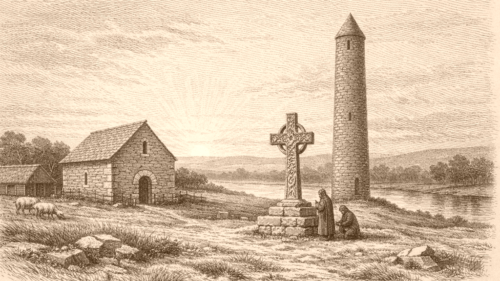
Sillán’s Repose
The surviving excerpts for 603 CE are sparse. In the Annals of Inisfallen, the year 603 records the repose of bishop Sillán and the repose of Cainnech moccu Dálann. No battle, kingship change, or regional disruption is stated in that entry. The other retrieved excerpts belong to different years or to other annal passages, so they cannot be used to supply a missing 603 event. This year can therefore be described narrowly, from the explicit 603 notice alone, while broader context must remain separate from the dated evidence.
Royal Slayings
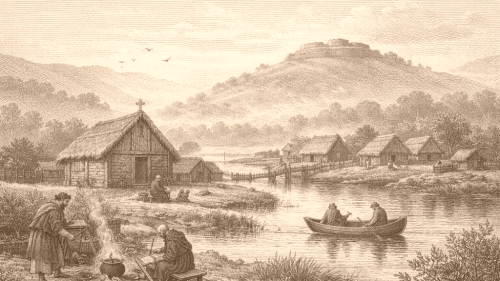
The surviving annals do not provide a single, uncontested narrative for 604 CE. Instead, they preserve short notices under year headings, with some entries explicitly cross-dated to nearby years in other annalistic systems. In this record, the securely placed material for 604 includes deaths, slayings, and a contested sequence of battle notices, especially those attached to Colmán Rímid, Áed Sláine, and Áed Rón. The same manuscripts also place related events in adjacent years, so the year must be treated carefully. This summary distinguishes the notices firmly assigned to 604 from broader context and from entries that appear elsewhere under different years.
Cúil Battles
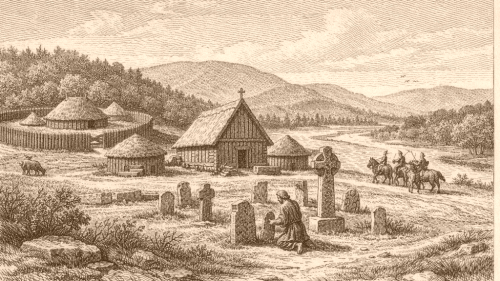
The annals preserve a small cluster of notices around 605 CE, but they do not present a full narrative for the year. In the Irish annals, the clearest 605 entries concern the death of Brandub son of Eochu, king of Laigin, and the repose or death of several ecclesiastics. Different compilations place some of these notices in 605, while others shift nearby events into adjacent years. This makes 605 best read as a year of scattered record rather than a complete sequence. The evidence allows careful comparison of dating and wording, but not reconstruction beyond what the texts explicitly state.
Aedán’s Death
The surviving annalistic excerpts do not give a single, uniform picture of Ireland in 606 CE. In the passages labeled for that year, one set records the deaths of named figures and another set assigns the same chronological framework to related deaths, abbots, kings, and churchmen. Some excerpts explicitly place comparable events under neighboring years, showing that the year labels vary between compilations. The safest account of 606 CE is therefore limited to what each excerpt actually dates to that year, while noting where the same material is distributed differently across annals.
Dynastic Killings
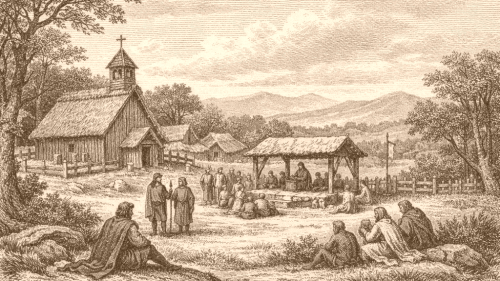
The surviving annal entries that touch 607 CE are sparse but specific. In the Irish annals, one set of entries records the killing of Sechnusach son of Garbán and the death of Conall Redspear son of Daimine; another records the death of Fiachna Crach son of Baetán and the repose of Aed son of Dall. The Annals of Ulster places the first cluster under an entry labeled AD 606 and the second under AD 607, while Tigernach and Inisfallen present the same kinds of notices in their 607 entries. No securely dated Irish entry for this year supplies a fuller narrative than these deaths and burials.
Clonmacnois Pilgrimage
The annalistic record for 608 CE is brief and uneven. In the Annals of Tigernach, the year includes the death of Aodh son of Colgu, king of Airgiall, at Clonmacnois, the death of Sillán son of Cumaine, abbot of Bennchor, and the death of Aedán the anchorite. The Annals of the Four Masters treat 608 more sparsely, noting only the first year of Maelcobha in the kingship. This comparison shows what is dated, what is omitted, and what cannot be supplied from silence.
Bairche Thunder
The notices attached to 609 CE are sparse and uneven. The Annals of Tigernach preserve a cluster of deaths and a military setback, while the Annals of Ulster record several deaths, the end of Eusebius’s chronicle, and an entry for the army of the Ulaid in Bairche under the following year’s heading in that text. The Annals of Inisfallen preserve only a brief cross-referenced note for this period, showing that the same year was not treated uniformly in every surviving annalistic tradition.
Bairche Storm
The surviving annalistic notices nearest to 610 CE are brief and uneven. In Annals of Ulster, the year headed AD 610 records deaths of Aed son of Colgu, Sillán of Bennchor, Aedán the anchorite, and Mael Umai son of Baetán, together with the statement that the army of the Ulaid was struck by terrible thunder in Bairche. Annals of Tigernach and Chronicon Scotorum preserve a similar cluster of deaths and the battle of Odba. This account separates securely dated notices from broader year-block context and avoids adding events not stated in the excerpts.
Beannchair Fire
The annalistic record for 611 CE is brief but not empty. One Irish chronicle places the year as the first year of Suibhne Meann and records the burning of the church of Beannchair Uladh. The Annals of Inisfallen also preserve a 611-dated notice, including the deaths of Colmán Daimíne and Aengus, son of Aed Sláine. A nearby Inisfallen entry assigns lightning destruction of the army of Ulaid to AU 611. These notices allow a cautious year-specific account, but not a fuller narrative.
Lightning Devastation
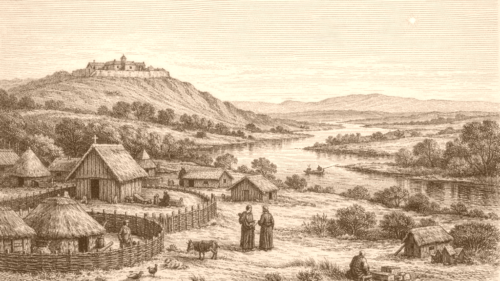
The annalistic record for 612 CE is brief and uneven, but it still allows a cautious reconstruction of what each text preserves. In the Fragmentary Annals, the year opens with the beginning of Mael Coba’s reign and a statement about its length. In Tigernach, the year contains the repose of To-Lua and a star seen in daylight. In Inisfallen, the 612 sequence records deaths, burials, and a lightning strike on the Ulaid. Ulster places similar royal material in a neighboring year label, which makes chronology a central issue. The surviving notices support comparison, not harmonisation.
Mael Coba’s Defeat
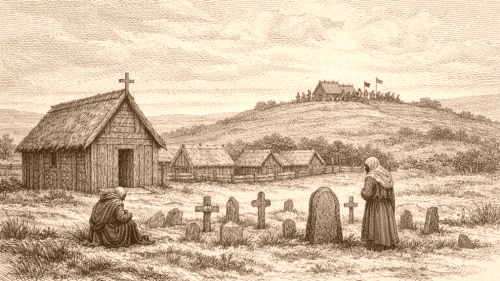
The annals preserve only a narrow and uneven picture of Ireland in 613 CE. For that year, one tradition records the death of Mael Coba son of Aed in battle and the succession of Suibne Menn, while another tradition records the death of Aed Allain, the accession of Mael Coba, and the repose of Colman abbot of Cluain. Nearby notices are explicitly dated to adjacent years, and several later compilations attach 613-year headings to material that appears elsewhere under different regnal schemes. This account distinguishes securely dated notices from broader contextual entries and refrains from filling annal gaps with conjecture.
Bennchor Ablaze
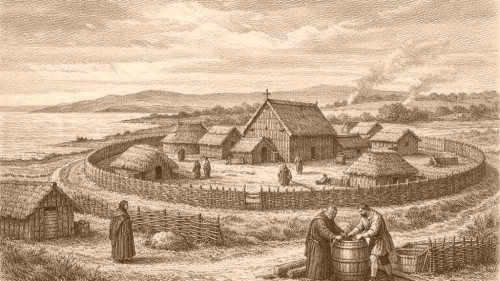
The surviving annalistic evidence for 614 CE is extremely sparse. One Irish sequence records only the burning of Bennchor under that year, while another tradition places a battle in Britain under 614 and notes that other annals assign it to 613. A fragmentary annal sequence also records a star seen in the third hour of the day for 614. These notices are brief, separate, and not linked by the texts themselves. This account distinguishes those securely dated entries from nearby or cross-referenced material, and it avoids filling gaps with conjecture about causes, participants, or wider consequences.
Donnán’s Martyrdom
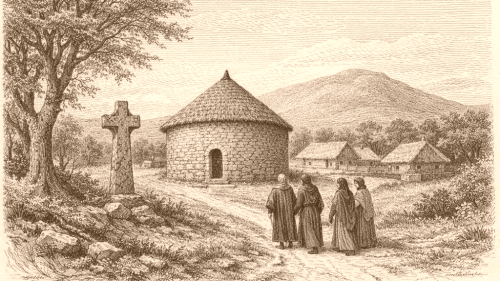
The surviving annals preserve only brief notices for the year commonly discussed as 615 CE, and they do so in different chronological frames. The Annals of Ulster places its relevant material under a heading marked AD 614, while the Annals of Tigernach uses T615, and Inisfallen later cross-references one battle notice to AU 615. This essay keeps those systems separate and identifies only the items explicitly placed in or linked to the year. It distinguishes securely dated notices from adjacent-year material and avoids filling the annal gap with conjecture.
Armagh Ravaging
This study examines the evidence for Ireland in 616 CE as preserved in a small group of annalistic entries. It separates notices securely placed in that year from nearby material assigned differently in other annals. The year is marked by clerical deaths, a murder, the death of Fergus son of Colmán Mór, a ravaging of Armagh, and an earthquake in Gaul in Tigernach, while Inisfallen and Chronicon Scotorum provide partially overlapping but not identical chronologies. The result is a careful year-by-year account that preserves what is directly stated and leaves gaps unfilled within the limits of the surviving annal entries.
Bangor Burning
The surviving annalistic notices for 617 CE in these excerpts are sparse but specific. The clearest securely dated item is the burning of Donnán of Eg on 17 April, cross-referenced to AU 617 in the Annals of Inisfallen. The same year also contains notices for the burning of Bennchor of Ulaid, the laying waste of Torach, and several death or repose entries. The evidence does not support a broader narrative. It only permits a cautious comparison of how different annals record the same year. Other details remain unprovided here and therefore uncertain.
Eilenn Conflict
The annals preserve 618 CE as a year of terse notices rather than continuous narrative. In the Annals of Ulster, Tigernach, the Four Masters, and Chronicon Scotorum, the year is marked by deaths of churchmen, a conflict, a kingship notice, and, in one compilation, an earthquake and a burning. The record is uneven: some names recur across compilations, some do not, and several passages add only brief detail. The safest account keeps each notice within its own annal year and avoids inventing events for gaps.
Earthquake Notices
The annalistic witnesses for 619 CE preserve a compact and uneven record: deaths of abbots, bishops, and rulers, one destruction notice, and an earthquake in Gaul. The evidence is strongest when each annal is read on its own terms, because the year labels do not align perfectly across the surviving excerpts. This account distinguishes the notices securely attached to 619 from nearby entries in adjacent years, and it avoids extending the record beyond what the passages actually state.
Mongan’s Killing
The surviving notices for 620 CE are brief and mostly funerary. In the Annals of the Four Masters, the year is marked by a cluster of deaths, including an abbot of Clonfert, several other named men, Mongan son of Fiachra Lurgan, and Cathal son of Aedh, king of Munster. The Tigernach material available here does not preserve a 620 notice, but it provides nearby years for comparison. Read narrowly, the evidence supports a careful record of named deaths and one killing, not a full narrative of events.
Ulster Obituaries
The surviving evidence for AD 621 is sharply limited but still identifiable. The Annals of Ulster preserve a year heading equated with AD 621 and a compact sequence of notices about battles, deaths, one drowning, and one qualified statement of uncertainty. Other annal material in the retrieved evidence helps compare chronology and manuscript description, but it does not add a securely dated 621 event. The result is a narrow historical profile: a dated annal block, not a reconstructed narrative. This article distinguishes the year’s directly attested notices from broader contextual material and from what the record leaves unstated.
Conall’s Victory
The annals for 622 present a compact but uneven record of Ireland in that year. Ulster gives the year heading and records battles, a drowning, and several deaths, while the Four Masters and Inisfallen preserve partly overlapping notices. This narrative distinguishes securely dated entries from broader contextual material and avoids supplying missing detail. It compares the wording, order, and scope of the notices as they stand, and it treats omissions as part of the evidence rather than as gaps to be filled by speculation.
Ráth Guala
The surviving annal entries associated with 623 CE are brief and uneven, but they still allow a careful account of what is securely attested. This narrative compares the placement of named deaths, reposes, a monastery notice, and one armed action across the Annals of Ulster, the Annals of Inisfallen, and the Annals of the Four Masters. It distinguishes events securely dated in each text from broader nearby context, and it avoids harmonizing entries beyond what the passages themselves support. Where the annals differ in year headings, that difference is noted as an observable feature of the record only.
Domhnall’s Accession
The annalistic record for 624 CE is brief but not empty. In the Annals of Ulster, the year is marked as AD 624 and described as a dark year, with several deaths recorded under that heading. The Annals of the Four Masters give the Age of Christ, 624 and the first year of Domhnall son of Aedh son of Ainmire in the sovereignty of Ireland. They also place clerical deaths and two battle notices in the year. Comparison with Inisfallen shows that some close material appears under adjacent years there, so the year must be read text by text. No broader narrative is added beyond what the notices directly state.
Dark Ireland
The surviving annalistic record for 625 CE is brief and uneven. One annal explicitly labels the year dark and records several deaths and a church repose, while another preserves a similar cluster of notices whose marginal year assignments sometimes diverge. The evidence also includes an eclipse entry attached to 625 and names several figures whose deaths are placed there by one compilation but shifted elsewhere in another. This narrative restricts itself to what the extant entries directly state, and separates year-specific notices from broader chronological context and later editorial alignment.
Fursa’s Vision
The surviving annals preserve a small but usable dossier for Ireland in 626 CE. Their securely dated notices record battles, deaths, and a religious vision, while related entries in other annal traditions help confirm the placement of several items. The evidence is uneven: some notices are explicitly tied to AD 626, others are cross-referenced from neighboring years or later compilations. This account keeps the year distinct from wider context, avoids filling gaps with conjecture, and compares only what the texts themselves state about that year.
Inis Medcoit
The annalistic evidence for 627 CE in Ireland is sparse and uneven. In the Four Masters, the year is marked as the Age of Christ 627 and the fourth year of Domhnall, with notices for the battle of Ath Abla and the foundation of Inis Medcoit by Bishop Aedhan. Chronicon Scotorum presents a different 627 entry, with battles at Ard Corann and Carn Feradaig. This account separates securely dated notices from surrounding context, notes where the witnesses diverge, and avoids filling any annal gap with conjecture. Editorial framing is also kept distinct from the year entries themselves.
Suibne’s Slaying
The annalistic record for 628 CE is unusually compressed and must be read with care. One set of excerpts fixes the year as AD 627, alias 628, while others place the same cluster of notices under different regnal or calendar headings. Securely dated material includes the death of Cathal son of Aed, king of Mumu, and several battle notices associated with Laigin, Dál Riata, and the kingship of Ireland. The surviving passages also preserve strong evidence of chronological overlap, duplication, and retrospective alignment. This narrative separates what the excerpts place in 628 from what they only imply by comparison.
Ard Corann
The surviving notices for 629 CE in Irish annalistic material are sparse and uneven. One entry in the Annals of Tigernach places the battle of Ard Corann in that year and records a Dál Riata victory with the death of Fiachna son of Deman. A comparative note, however, says the same battle is dated to 629 in one tradition and 630 in another. This narrative therefore separates the securely attested battle notice from broader context, and avoids turning an annal gap into invented sequence or consequence. The year is visible, but only through a very short and disputed record.
Duma Aichir
The annals do not preserve a single, uniform picture of Ireland in 630 CE. One witness, the Annals of Ulster, assigns the year to a brief notice about a battle of Aille’s son and the death of Cinaed son of Lugthriene. The Annals of Tigernach, under 630, preserve several notices for battles, deaths, a church foundation, and the devastation of Leinster. The Annals of the Four Masters also give 630 entries, but with different wording and a different selection of events. Comparison of these witnesses shows both overlap and divergence in dated notice, while the year remains sparse and carefully delimited.
Royal Expulsion
The surviving annalistic notices for 631 CE are brief and uneven. One annal gives only the year heading, while another records the death of Ernaine son of Fiachna and the banishment of Carthach, identified as Mochuda, from Rathain. The Annals of Inisfallen, in its own year entry, names the death of Echaid Buide, the battle of Dún Cethrair, and the slaying of Cáilchíne from Liathmuine. Its bracketed references link the notices to earlier annalistic numbering. No extra event should be added to fill the gap.
Fid Eoin
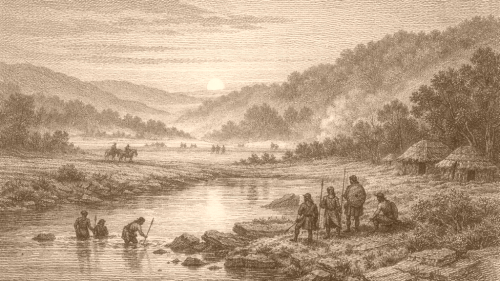
The surviving annalistic evidence for 632 CE in Ireland is narrow but clear. Two battles, Fid Eoin and Dún Cethirn, anchor the year in the Annals of Tigernach, together with named deaths associated with those conflicts. Comparative notices in the Four Masters and Inisfallen help confirm the historical memory of the events, while also showing that medieval chronicle dating could vary. The year therefore offers a disciplined case study in how to separate secure dating from broader context, and how to resist filling annalistic silence with conjecture.
Silent Munster
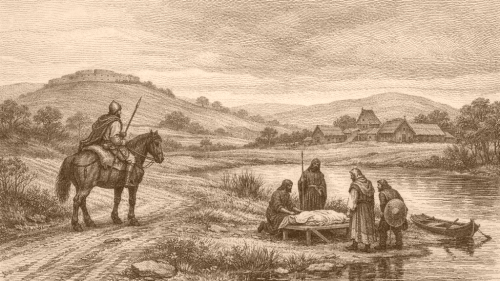
Ireland in 633 CE is visible in the annals chiefly through one securely dated notice: the death of Failbhe Flann, king of Munster. This brief entry does not supply a cause, place, or political aftermath, so any fuller narrative must remain cautious. The surviving evidence also invites attention to method, because Irish annals are later textual constructions shaped by chronology and transmission. By separating the attested year from surrounding seventh-century context, this account shows how much can be said, and how much cannot, about a single annalistic year.
Magh Rath
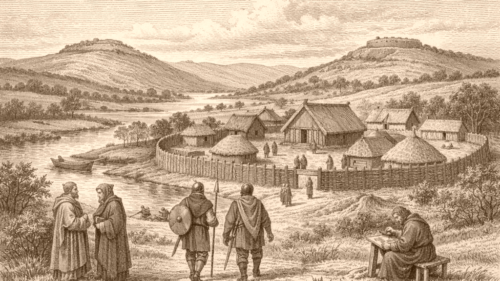
The surviving Irish annals for 634 CE are uneven and must be read with caution. The Annals of Inisfallen preserve a short cluster of notices for that year, including deaths and a slaying, while the Annals of the Four Masters attach a fuller set of notices to 634, notably the battle of Magh Rath and related deaths. The Annals of Tigernach survive for this period but show a different chronological alignment and, for 634, no substantive entry in the preserved fragment. The result is not a single coherent narrative, but a layered annalistic record that mixes secure year notices with chronology that shifts between texts.
Irish Mission
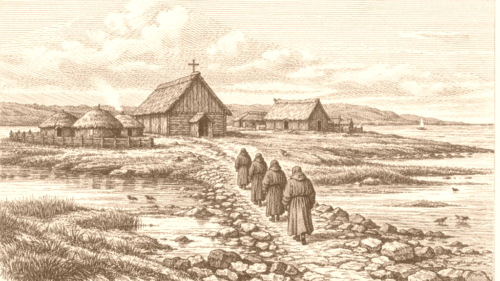
This article examines the documented 635 mission associated with Aidan, an Irish monk sent from Iona to Lindisfarne at the request of the Northumbrian king Oswald. It separates the Irish monastic background of Aidan and Iona from Ireland itself, and it avoids extending the evidence beyond what is directly attested. The discussion also places Lindisfarne within Northumbria, not Ireland, while noting the later prestige of the site. Because the supplied evidence is uneven, the argument emphasizes what can be proved, where sources overlap, and where later interpretation must remain cautious. The result is a strictly sourced account of early seventh-century connections.
Mochuda’s Expulsion
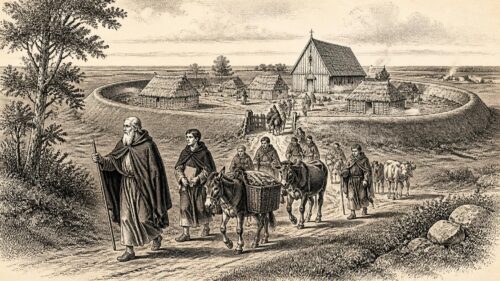
In 636, Carthach (Mochuda), abbot of Rahan in County Offaly, was expelled from his monastery at Eastertide. The annals record the event but give no motive or account of its procedure. Tradition associates the removal with Blathmac of the Uí Néill, though his precise role is uncertain. The expulsion may have involved ecclesiastical and political rivalries, rather than solely disagreement over Easter calculation. Mochuda subsequently moved to Déisi Muman, beginning his association with Lismore in County Waterford. The episode shows how monasteries were embedded in early Irish power, landholding, economy and kinship.
Sailtír Battles
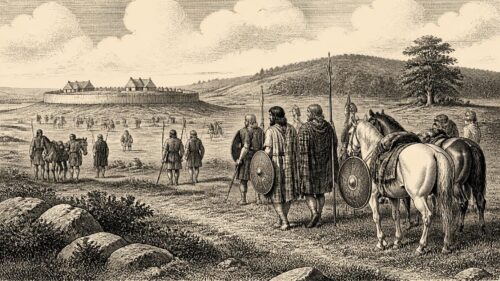
In 637, despite uncertainties in annalistic dating, Domnall mac Áedo’s victories at Mag Rath and Sailtír strengthened his position as ruler of Tara. At Mag Rath, Congal Cáech of Ulaid was killed, ending a major challenge to Domnall and weakening Dál nAraide; Sailtír defeated opposing elements within Cenél nEógain. The conflicts may have involved links with Dál Riata across the Irish Sea, though later military details are unreliable. The year also saw the death of Failbe Flann, king of Mumu, and the recorded death of Mo-Chutu of Raithen. Together, these notices show Ireland as a network of competing dynasties and politically influential churches.
Eten Besieged
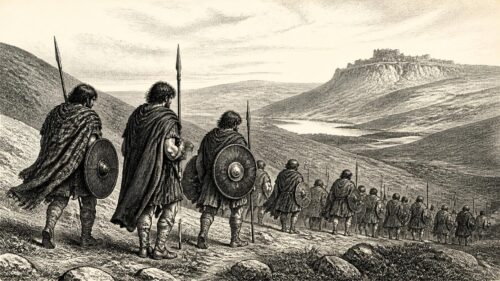
In 638, followers of Domnall Brec of Dál Riata were defeated at the uncertain site of Glenn Muiresan, followed by a siege of Eten, probably Edinburgh. The episode reflected political instability after the 637 battle of Mag Roth and Ireland’s connections with western Scotland. Domnall mac Áedo remained a powerful but not undisputed king of Tara. Annals also record deaths of abbots including Crónán of Clonmacnoise and Mochua of Balla, highlighting churches’ growing economic and political importance. Ireland remained a rural, cattle-centred society sustained by farming, labour, waterways and ecclesiastical networks.
Áed’s Obituary
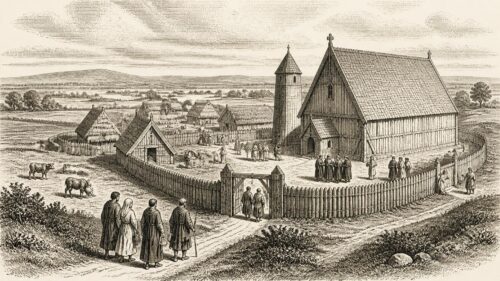
In 639, conventionally dated despite conflicting annalistic chronology, Áed Dub, bishop and abbot of Kildare, died. A member of the Uí Dúnlainge dynasty, he embodied the close connection between ecclesiastical office and political authority in Leinster. His death left a vacancy at a wealthy church whose resources, cult of Brigit and regional connections gave it major influence. Annals also record the deaths of church leaders at Nendrum and Leighlin, Ailill son of Áed Rón, and Dúinsech, wife of King Domnall of Tara, as well as Congal son of Dúnchad’s killing. These terse notices reveal an Ireland linked by kinship, churches and patronage rather than central rule.
Clonmacnoise Obituary
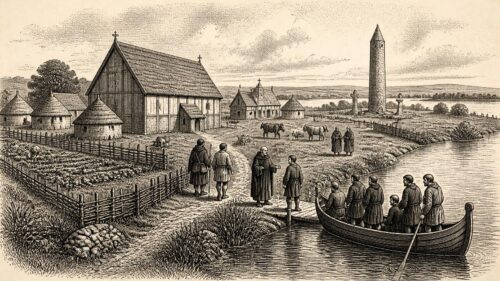
In 640, Irish annals chiefly recorded the deaths of Crónán, abbot of Clonmacnoise, and Mochua of Balla in Connacht. Differences between annalistic dates show the difficulty of reconstructing seventh-century chronology, but modern synchronisation places these obituaries in this year. Crónán’s office reflects Clonmacnoise’s importance as a religious and economic centre on major travel routes. Politically, Ireland remained divided despite Domnall mac Áedo’s victory at Mag Rath in 639. Annals also noted a battle and siege involving Domnall Brecc’s followers in the wider Gaelic world. Most rural life, farming and local hardship remained unrecorded.
Cúán’s Death
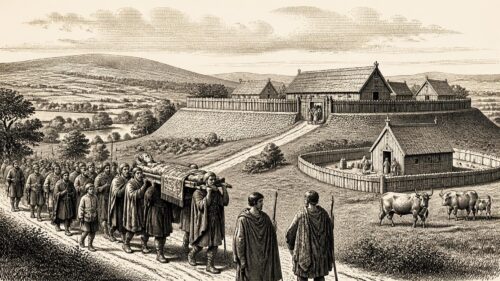
In 641, Cúán mac Amalgado of the Eóganacht Áine died as king of Munster. The annals record only his death, leaving its cause, location and circumstances unknown. His passing marked a dynastic transition within Munster’s fragmented system of kingships, alliances and tributary relationships. He was succeeded, according to later reconstructions, by Máenach mac Fíngin of another Eóganacht branch. Munster was not governed from a fixed capital, but through personal authority, kinship and regional negotiation. Churches and learned communities supported royal memory and legitimacy, while most people depended on mixed farming, livestock and local exchange.
Domnall’s Passing
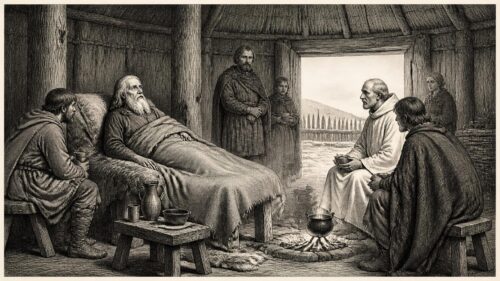
In 642, Domnall mac Áedo of Cenél Conaill died at the end of January, described by the Annals of Ulster as ‘king of Ireland’. His authority, strengthened by victory over Congal Cáech at Mag Roth in 637, rested on personal alliances rather than a unified state and became uncertain after his death. His nephews Conall Cóel and Cellach later emerged as successors. The same annal records the killing of Ailill of Cenél Loegaire, illustrating persistent dynastic violence. It also notes the death in Britain of Domnall Brecc of Dál Riata, reflecting Irish Sea connections. Later Christian tradition portrayed Domnall’s peaceful death as evidence of saintly favour.
Disputed Succession
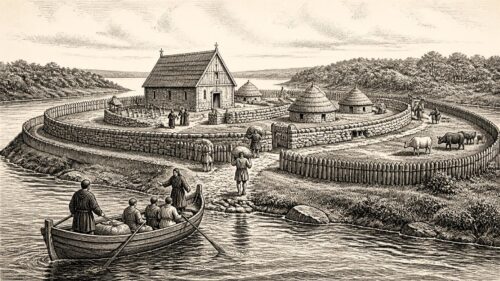
In 643, Irish annals recorded disputed succession after the death of Domnall mac Áedo, a prominent northern Uí Néill ruler. Sources variously named his nephews Cellach and Conall Cáel as successors or described shared authority with Diarmait and Blathmac of the southern Uí Néill. Chronological differences place these events around 642–643, but all reflect uncertainty over wider kingship. Regional conflict, including the battle of Cenn Con, demonstrated the independence of Munster dynasties. The death of Bishop Crónán of Naendruim also illustrates the political and economic importance of churches. Ireland remained a network of competing kingdoms, kin groups and ecclesiastical communities.
Leinster Turmoil
Around 644, Irish annals record contested authority after the death of Domnall mac Áedo, with several Uí Néill rulers claiming or sharing the overkingship. In Leinster, Uaisle, wife of King Fáelán, died, highlighting dynastic links with the midlands. A battle at Cenn Con, probably involving Munster rivals, caused heavy losses, while kings of Osraige and Farney also died. Crónán, bishop of Nendrum, was commemorated, reflecting the importance of churches in literate and political life. The notices reveal a fragmented Ireland of regional kingdoms, alliances and recurring violence, rather than a unified state.
Cenn Con
The Annals of Inisfallen associate 645 with a battle at Cenn Con between Mael Dúin of Éoganacht Locha Léin and Áengus Liath of Áine, the death of Máel Ochtraig, king of the Déisi, and the repose of the churchman Mac na Cerda. However, comparison with other annals suggests that some entries belong earlier in the 640s. The notices nonetheless illuminate a rural society shaped by competing regional kingships, armed retinues, cattle-based wealth and uncertain successions. Churches held land and political influence while sustaining learned links with Britain and the Continent. The year demonstrates both the value and chronological limitations of early Irish annalistic evidence.
Scannal MacLaisre
In 646, the Annals of Ulster record the killing of Scannal son of Béc, styled king of the Cruithin, and the death of Mac Laisre, abbot of Bangor. Scannal’s violent death reflects continuing political competition in north-east Ulaid after the battle of Mag Roth, though the annals name neither his killer nor location. Mac Laisre’s obituary marks a leadership change at Bangor, an important monastery beside Belfast Lough with wider Irish Sea connections. Sparse sources reveal little else about the year, but these notices illuminate the coexistence of vulnerable secular rulership and enduring ecclesiastical institutions within a predominantly rural society.
Ulaid Kinslaying
In 647, Máel Cobo son of Fiachnae, overking of Ulaid and a member of Dál Fiatach, was killed by his nephew Congal Cennfhota. Annalistic sources support this date despite differing manuscript chronologies. The killing exposed tensions within a dynasty recently strengthened after Dál nAraide’s defeat at Mag Roth. Congal did not immediately gain the kingship; Máel Cobo’s son Blathmac succeeded and ruled until 670. The event illustrates the vulnerable, kin-based nature of early Irish kingship. Bangor was an important regional religious centre, while most people lived in rural farmsteads dependent on livestock, crops and local craft production.
Cúil Corra
Notices assigned to 648 by the Annals of the Four Masters, including the death of Abbot Mainchéne and the killing of Cillíne of Uí Failge at Cúil Corra, appear under 652 in older annalistic traditions. They therefore illuminate the mid-seventh century rather than securely dating events to 648. The period saw contested Uí Néill overlordship, with Conall Cóel and Cellach’s authority uncertain, alongside politically significant regional rulers. Monasteries were major religious, economic and learned institutions, while most people lived through farming and cattle husbandry. Ireland remained a network of competing local kingdoms, kin-groups and churches, not a unified state.
Carn Conaill
In 649, Irish annals record the killing of Raghallach mac Uatach, king of Connacht, and Diarmait mac Áedo Sláine’s defeat of Guaire of Aidne at Carn Conaill on Whit Sunday. Guaire fled, while allied rulers from Munster and neighbouring kingdoms were killed, showing the wide political connections involved. The events reflected rival dynasties, resource-based lordship and obligations of vengeance rather than a unified Irish state. Later tradition associated Diarmait’s victory with Clonmacnoise, royal patronage and St Ciarán’s protection. Although literary accounts added miracles and reconciliation, the reliable evidence confirms a significant battle, political disruption and enduring monastic influence.
Dún Cremthainn
In 650, the battle of Dún Cremthainn reflected continuing rivalry within the northern Uí Néill. Óengus, son of the former Cenél Conaill ruler Domnall mac Áedo, was killed by his cousins Cellach and Conall Cóel, sons of Máel Coba. The victory did not secure lasting supremacy, as later conflicts displaced both victors. Annalistic dating is uncertain, and other notices assigned to the year include local warfare, deaths of rulers and abbots, and church activity. Ireland remained a patchwork of small kingdoms, lordships and ecclesiastical centres. Rural life depended on farming, cattle wealth and labour, while churches preserved learning and maintained wider connections.
Blathmac’s Sons
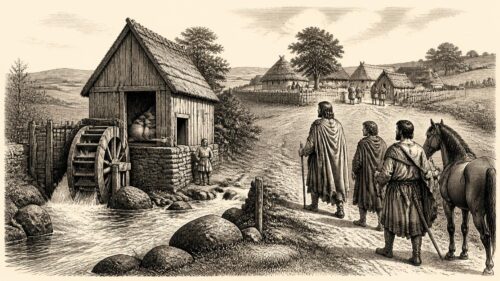
In 651, Irish annals record the killing of Dúnchad and Conall, sons of Blathmac of the powerful Síl nÁedo Sláine dynasty, at Máel Odhrán’s mill. Máel Odhrán, identified as a man of Leinster, was named as their killer, though the location and circumstances remain uncertain. Later sources add unconfirmed details, while annalistic verse portrays the deaths as the loss of an eminent lineage. A separate Christian moral judgement interpreted them as punishment for Blathmac’s alleged sexual transgression. The episode illustrates the links between regional dynastic conflict, rural productive sites, vernacular poetry and monastic historical memory in early medieval Ireland.
Ségéne’s Death
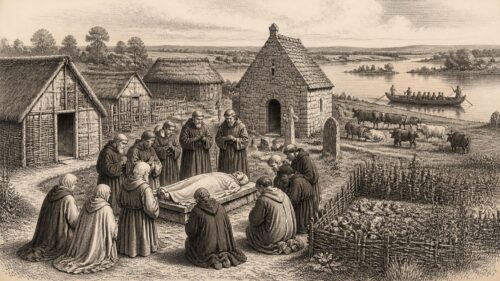
Around 652, despite conflicting annalistic dates, Irish records note the deaths of prominent churchmen and a dynastic battle. Ségéne, abbot of Iona since 623, led an influential Columban network linking Ireland, Pictland and Northumbria. Aedlug of Clonmacnoise and Mainchéne of Min Droichit also died, illustrating the importance of both major monasteries and local religious communities. At Cúil Corra, Cuiléne, king of Uí Fhailge, was killed by rival forces, reflecting unstable regional kingship. These notices depict a rural, politically fragmented Ireland connected through kinship, river routes and ecclesiastical networks.
Airther Seóla
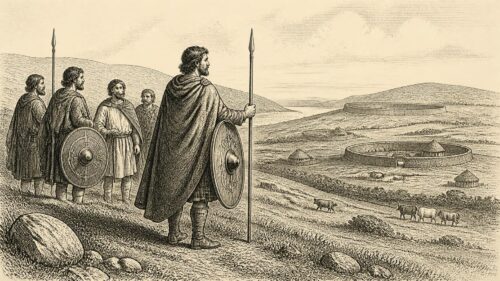
In 653, the battle of Airther Seóla in Connacht saw Marcán, king of the Uí Maine, killed by forces led by Cenn Fáelad and Máenach, king of the Uí Briúin. The conflict illustrates rivalry among regional dynasties rather than a unified Connacht. The death of Máel Dóid, king of Mide, marked another potential shift in Irish politics. Irish annals also noted Pictish deaths and ecclesiastical figures, reflecting networks linking kings, churches and neighbouring regions. Dating remains uncertain: some annals place the Connacht battle in 652. Most people lived in dispersed agricultural communities supporting these competing centres of authority.
Conall Cóel
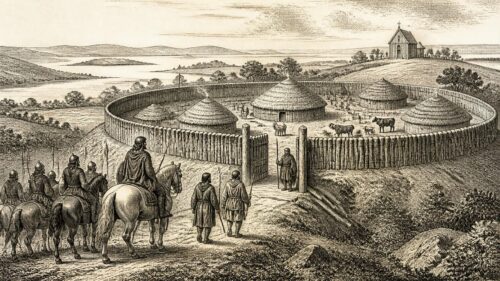
In 654, Diarmait mac Áedo Sláine killed Conall Cóel of Cenél Conaill, strengthening the southern Uí Néill dynasty of Brega in its rivalry for pre-eminence. The annals, though brief and chronologically uncertain, also record dynastic killings in Connacht, where Uí Fiachrach Aidhne attacked rivals, and a Pictish victory over Dál Riata in Scotland. The deaths of two abbots at Clonard demonstrate the political and economic importance of major churches. These events reveal a fragmented Ireland shaped by competing kindreds, ecclesiastical institutions and Irish Sea connections, while farming communities supported the power of kings and churches.
Battle in the North
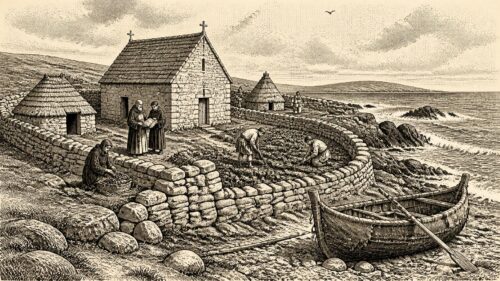
Ireland’s record for 655 is sparse and chronologically uncertain, but annalistic notices illuminate regional politics and church life. The battle of Flescach, dated variously to 655 or 656, saw Crunnmáel of Cenél nEógain defeat and kill Cumascach of Uí Cremthainn, reflecting rivalry among northern kingdoms. Notices also record the deaths of rulers in Leinster and Connacht and churchmen at Terryglass and Lorrha. The contested date of Nem of Aran’s death highlights Aran’s monastic links with wider Irish society. Irish annals also noted British events, demonstrating learned ecclesiastical networks, Latin literacy and connections across the Irish Sea.
Suibne’s Passing
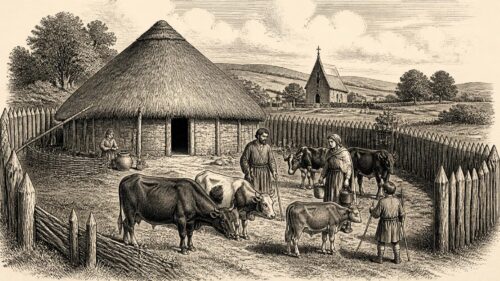
In 656, Irish annals recorded deaths, conflict and an unusual rural event, revealing Ireland’s interconnected early medieval world. Suibne moccu Urthrí, abbot of Iona, died, marking a change in Columban leadership, while Ultán of Ardbraccan and Cellcéne of Lothra were also commemorated. The battle of Deliu killed Máel Deith, son of Conall, though its circumstances remain unknown. The annals noted the death of Tolorgan, king of the Picts, reflecting links between Ireland and northern Britain. A cow at Láthair Briúin reportedly bore four calves, highlighting cattle’s importance in rural society.
Four Calves
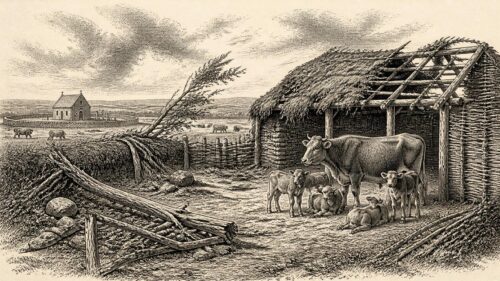
In 657, later tradition dated the joint rule of Diarmait and Blathmac of Síl nÁedo Sláine, kings of Tara, though their claimed sovereignty represented precedence among competing regional rulers rather than unified government. The Annals of Ulster records several deaths, including that of Guret, king of Alt Clut, reflecting Ireland’s links across the Irish Sea. Obituaries also indicate the importance of ecclesiastical communities within secular society. A violent windstorm and the reported birth of four calves to a cow at Láthair Briúin show how weather and livestock mattered in rural life.
Episcopal Deaths
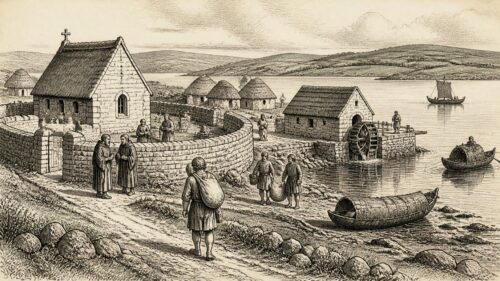
In 658, Irish annals chiefly record the deaths of bishops Díma Dub of Connor and Cuiméne of Nendrum, with the later Four Masters also naming Sillán of Daiminis. These notices show the importance of church settlements as religious, economic and political centres linked to regional patrons. The Four Masters places the year during the prominence of Diarmait and Blathmac of Síl nÁedo Sláine, while also recording dynastic deaths and the reported killing of Faelán of Osraige by Leinstermen. Despite uncertain dating in some sources, the evidence depicts rural communities sustained by farming, cattle, waterways, churches and local lordship.
Colmán at Glendalough
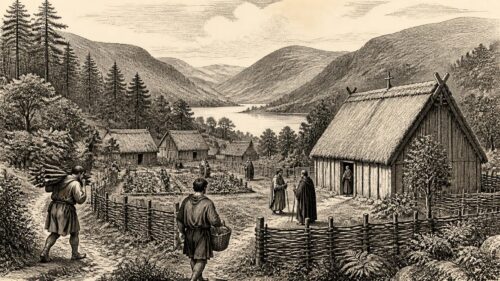
The annals for 659 chiefly record deaths rather than major events, including Colmán of Glendalough, Fínán of Lindisfarne, Daniél of Kingarth, Echaid son of Blathmac, Conall Crandomna of Dál Riata and Eóganán son of Tóthalán. Differing annalistic chronologies make exact dates uncertain, particularly for Fínán. The notices reveal links between Irish churches, Iona, Northumbria and western Scotland, alongside dynastic losses in Brega and Dál Riata. They do not establish causes of death or political consequences. Although ordinary life centred on farming settlements and local labour, the surviving record offers no evidence of famine, epidemic or island-wide warfare.
Ogaman Battle
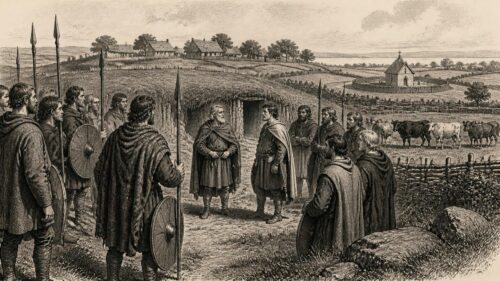
Around 660, the battle of Ogaman at Cenn Corbadáin exposed conflict within the southern Uí Néill. Although annals date it variously to 660–662, they agree that Diarmait’s followers defeated those of his co-ruler and brother Blathmac, killing leaders linked to the Ciannachta and Ard Ciannachta of Brega. Blathmac survived, suggesting a shift in power rather than deposition. The same chronological horizon includes deaths among Munster’s elite and leading churchmen, notably Tóiméne, bishop of Armagh. These events reflected Ireland’s fragmented political order, where dynastic alliances, local rulers and ecclesiastical centres shaped authority amid a predominantly rural society.
Cummian Fota
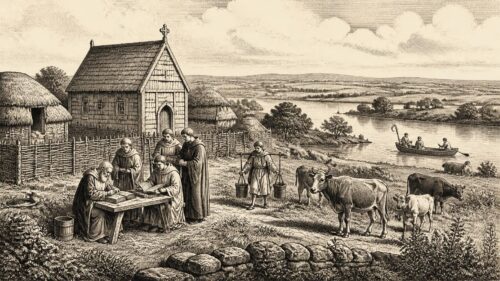
In 661, Irish annals record ecclesiastical, dynastic and royal change across a politically fragmented but connected island. Cummian Fota of Clonfert, a learned churchman of aristocratic Munster ancestry and probable author of a major Easter treatise, died aged seventy-one or seventy-two. Abbot Cumméne Find of Iona visited Ireland, illustrating active Irish Sea monastic networks. At Ogaman, conflict within the Brega-based Síl nÁedo Sláine dynasty saw Blathmac defeated by followers of his brother Diarmait. Máenach son of Fíngen, king of Munster, also died. Together, these events reveal the importance of contested kingship, ecclesiastical authority and scholarship.
Ogoman Clonfert
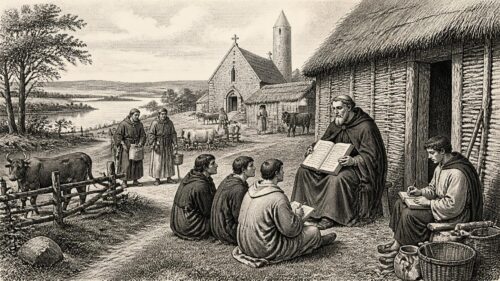
In 662, the battle of Ogoman exposed rivalry within the southern Uí Néill of Brega, killing Conaing, Ultán of the Ciannachta and Cenn Fáelad. Accounts suggest Blathmac was defeated by followers of his brother Diarmait, though the political outcome remains uncertain. The annals also record the death of Máenach, king of Munster, emphasising the importance of Eóganachta descent. Cummíne Fota of Clonfert died around 661–62 and was remembered as a distinguished scholar of the Easter controversy. These events reflect an Ireland of competing kin-groups, rural lordships and influential ecclesiastical networks.
Guaire Aidne
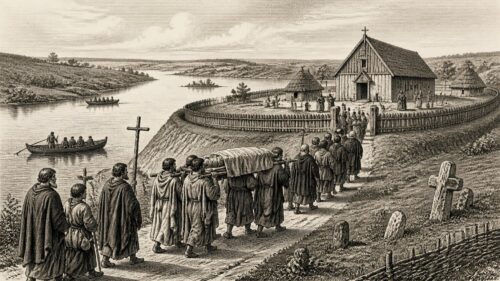
In 663, Irish annals chiefly record deaths and killings rather than major campaigns. Guaire Aidne, king of Connacht, died and was buried at Clonmacnoise, linking his dynasty with an influential monastery. The killing of Conall and Colcu, sons of the former northern Uí Néill king Domnall mac Áedo, reflected continuing dynastic danger. Ecclesiastical losses included Ségíne, abbot of Bangor, and Tu-Enóc, abbot of Ferns, alongside several bishops. Annalistic dating varies slightly between sources, but 663 is generally accepted. These sparse notices reveal a politically fragmented Ireland in which kingship, kinship and churches shaped authority and remembrance, shortly before the mortality recorded for 664.
Uncertain Mortality
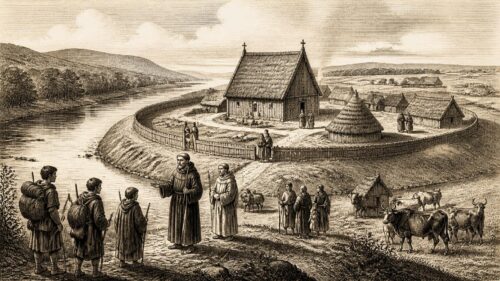
In 664, Irish annals recorded a devastating mortality arriving on 1 August at Mag Itha of Fotharta, though the disease and location cannot be identified with certainty. Later called the Yellow Plague, the epidemic formed part of a wider Irish Sea crisis also reported by Bede. Annalists linked it with an eclipse, fiery skies and uncertain earthquake reports, while recording deaths among dynasts and abbots without always attributing them to disease. The outbreak threatened interconnected monasteries and rural communities, amid active travel and religious exchange. The year also saw the Synod of Whitby and reports of conflict in Scotland, illustrating Ireland’s wider regional connections.
Loch Fén
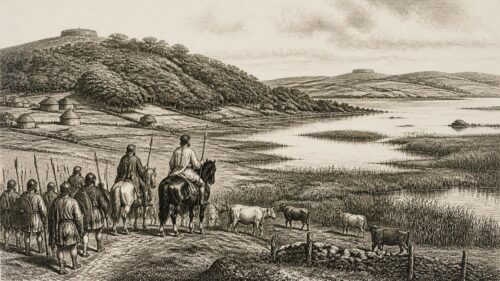
In 665, Ireland faced the devastating buide Chonaill, or yellow mortality, while conflict continued between regional powers. The Annals of Inisfallen record a battle at Loch Fén between Munster and Connacht, in which Talamnach son of Laidcenn was killed, but give no cause or victor. The epidemic caused the deaths of major rulers, including Diarmait Ruanaid, Blathmac and probably Cathal Cú cen Máthair of Munster, altering dynastic politics without ending established kingdoms. It also struck leading churchmen and monasteries. Differing annal dates limit certainty, but the evidence shows epidemic, succession and warfare reshaping Ireland simultaneously.
Buide Chonaill
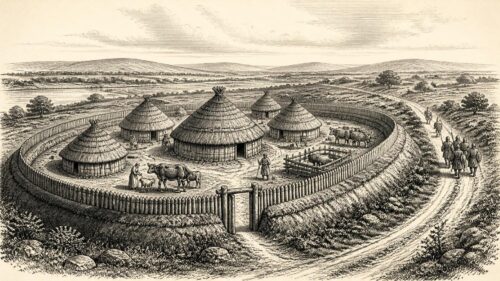
In 666, the buide Chonaill epidemic continued in Ireland, prolonging a mortality crisis that had begun in 663 and affected both elites and wider rural society. Despite disease, regional conflict persisted: the Arada and Uí Fhidgeinti fought at Áine, where Eógan son of Crunnmáel was killed. The death of Cernach Sotal, son of the Uí Néill ruler Diarmait mac Áedo Sláine, reflected dynastic vulnerability after earlier plague deaths. Annalistic chronology varies between sources, limiting certainty about dates and related events. The surviving records show communities, churches and political rivalries enduring under the shadow of prolonged illness.
Bangor Abbots
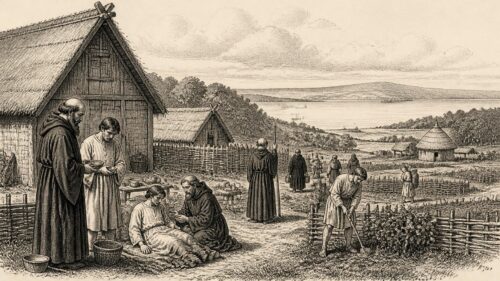
In 667, Ireland remained affected by the great mortality first recorded in 664. Annals associate the year with the deaths of four Bangor abbots, showing the epidemic’s impact on major religious institutions, though its nature and scale remain uncertain. Regional conflict continued: Eógan son of Crunnmael died at Áine, Bran Finn of the Déisi was slain, and the contested battle of Fertas belonged to the same period. Bishop Colmán, leaving Northumbria after Whitby, founded a church on Inishbofin with relics and monks. These events reflect a politically fragmented Ireland linked by active ecclesiastical and maritime networks.
Fertas Battle
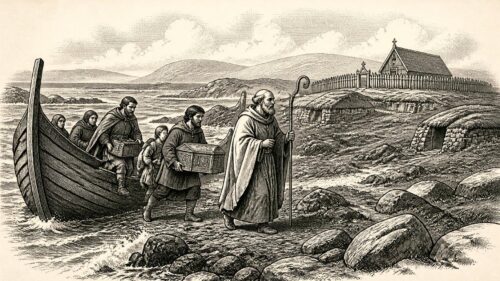
In 668, annalistic sources record the battle of Fertas, where the Dál Fiatach Ulaid defeated their Dál nAraide rivals and Cathassach son of Luirgéne was killed, probably near the lower River Lagan. Bishop Colmán, commonly identified with the former bishop of Lindisfarne, founded a church on Inishbofin after travelling from the Irish Sea world of Iona and Northumbria. The arrival of Gartnaid’s sons from Skye further indicates maritime connections. Notices of plague and elite deaths reflect continuing epidemic uncertainty. Though chronologically imperfect, the sources portray a politically divided, rural Ireland linked by warfare, monastic networks and sea travel.
Rural Hardship
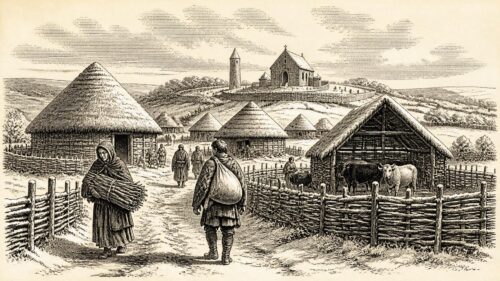
In 669, Irish annals record a great snowfall and famine, indicating severe pressure on rural food supplies. The year also saw the deaths of Cumméne Find, abbot of Iona, and Crítán, abbot of Bangor, marking changes at influential monastic centres linked across Ireland and northern Britain. Máel Fothartaig, king of Uí Thuirtri, died and was commemorated in verse, reflecting the importance of regional kingship and praise poetry. Máel Dúin son of Máenach was killed, while deaths in Pictland underline Ireland’s wider connections. These fragmentary notices reveal hardship, institutional continuity, local political loss and an interconnected Irish Sea world.
Snowfall Famine
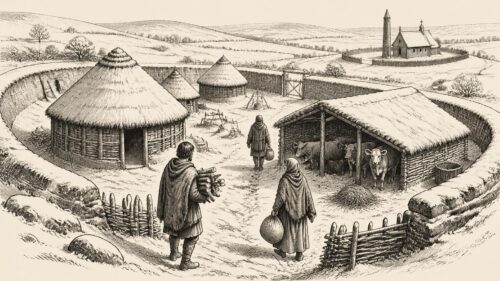
In 670, the Annals of Tigernach recorded great snowfall and famine in Ireland, indicating severe environmental and subsistence pressure without revealing its precise extent or causes. In a rural economy dependent on crops, cattle and stored food, scarcity tested households, rulers, kin networks and churches. The year also saw several killings and deaths, reflecting persistent local political conflict. The assassination of Sechnassach, king of Tara, is dated to 670 by the Annals of Ulster but to 671 by Tigernach, illustrating chronological uncertainty. Ireland remained connected to Britain through ecclesiastical and maritime networks, despite hardship and political instability.
Sechnassach’s Killing
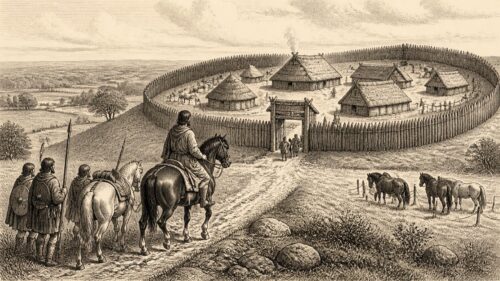
In 671, Sechnassach mac Blathmaic, king of Tara and member of Brega’s Síl nÁedo Sláine, was killed by Dub Dúin of Cenél Cairpri. An elegiac verse recalls his household’s horses, equipment and abundance, reflecting aristocratic status. His brother Cenn Fáelad succeeded later. Annals also note the uncertain death of Déisi ruler Bran Finn, Fergus son of Crunnmael, and the unexplained Battle of Druim Cepais. Máel Ruba voyaged to Britain, preceding his foundation at Applecross in 673. These fragmentary records reveal competitive kingdoms, maritime church links and a rural economy underpinning political power.
Tulach Árd
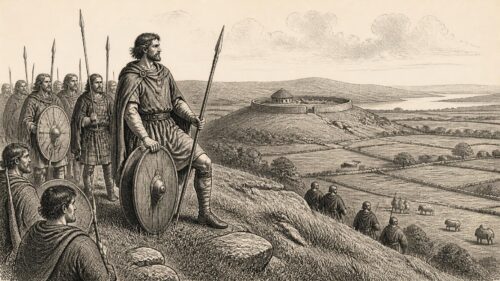
In annalistic year 672, Dúngal of Cenél Bógaine was defeated and killed by Loingsech at Tulach Árd, while Cenn Fáelad of Síl nÁedo Sláine succeeded his murdered brother as king of Tara. Armagh suffered a poorly explained fire, illustrating the vulnerability of an important ecclesiastical and political centre. An abundant mast crop suggested productive woodland resources, particularly for pig feeding, although it cannot indicate general prosperity. The annals also recorded upheaval in the Hebrides, the expulsion of Drost and the burning of Bangor of the Britons, reflecting Ireland’s connections across the Irish Sea.
Mag Luinge
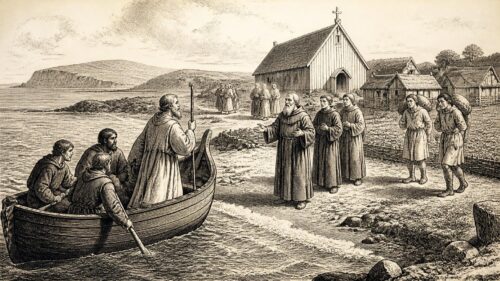
In 673, sparse Irish annals record the killing of Domangart, king of Dál Riata, the burning of Mag Luinge, the capture of named men, Cormac son of Máel Fothartaig’s death, and Abbot Fáilbe’s journey from Iona to Ireland. The evidence does not explain motives, locations or consequences in detail. Mag Luinge was probably a Columban monastery on Tiree, though this remains uncertain. Fáilbe’s visit demonstrates Iona’s active connections with Irish churches. Together, the notices reveal contested authority, vulnerable ecclesiastical communities and the importance of sea routes linking Ireland, Dál Riata and the Hebrides.
Brega Succession
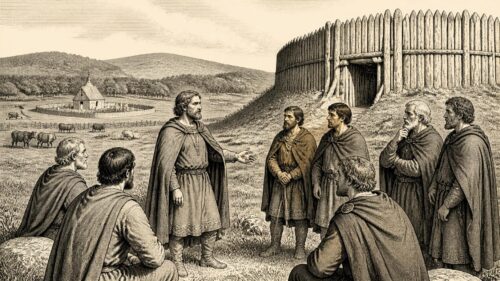
In 674, Cenn Fáelad of Síl nÁedo Sláine was killed in battle by his kinsman Fínnechta Fledach, who succeeded to the contested kingship of Tara. Annalistic dates vary slightly, but the succession crisis belongs closely to this year. The conflict reflected rival dynastic claims within Brega rather than a unified national war. The killing of Congal Cennfhota in Ulaid also affected political and marriage alliances linking north-east Ireland and the midlands. Beneath elite struggles lay an agrarian society sustained by cattle, grain and rural settlements, while churches preserved the brief records on which this history depends.
Fínnechta’s Accession
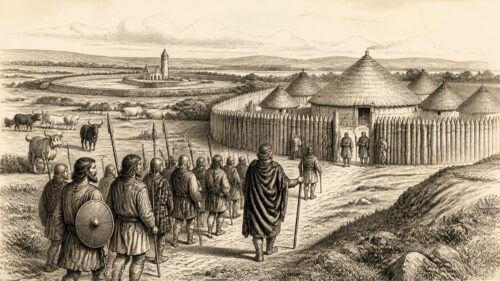
In 675, Fínnechta Fledach mac Dúnchada defeated and killed his cousin Cenn Fáelad mac Blathmaic, succeeding to the kingship of Tara. The battle, later called Aircheltair and possibly fought at Tech Uí Máine in Dál Céltra, cannot be securely located. It marked a dynastic change within Síl nÁedo Sláine, the southern Uí Néill kindred based in Brega, rather than national unification. Control of Tara depended on descent, military strength, alliances and recognition. The conflict affected communities supplying royal retinues, although the annals record few details. Fínnechta’s reign lasted until 695, while later traditions and events should not be assigned to his accession year.
Ailech Frigrenn
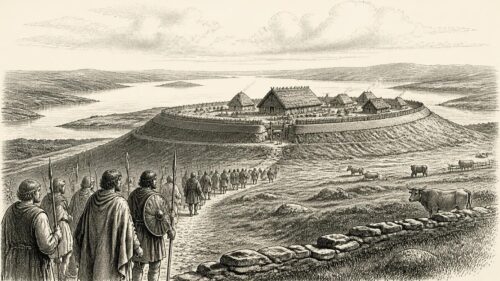
In 676, Fínsnechtae Fledach, southern Uí Néill king of Tara, destroyed Ailech Frigrenn, a royal centre of the northern Cenél nÉogain. The attack demonstrated his recently secured authority but did not end northern autonomy. Annalistic dating is imperfect, though several sources associate the event with this year. The records also note killings among elite kindreds, whose circumstances remain unknown. Deaths of Colmán, bishop of Inis Bó Finne, and Fínán son of Airennán, together with Failbe’s return from Ireland, reveal active ecclesiastical and Irish Sea connections. The year illustrates the links between dynastic warfare, rural resources and religious institutions.
Loch Gabair
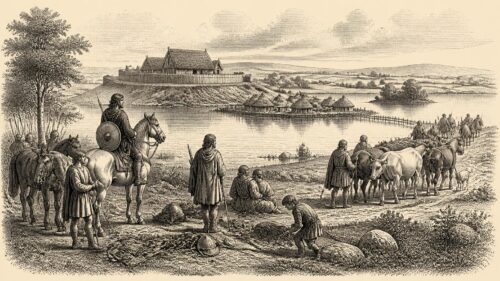
In 677, Fínshnechtae Fledach, king of Tara, defeated the Laigin near Loch Gabair in southern Brega, close to the royal landscape of Tara. The battle, apparently costly to both sides, defended his heartland but did not lead to the conquest of Leinster. The Leinster force was probably led by Fiannamail mac Máele Tuile, whose position survived the defeat. Other annalistic notices record the killing of Dúnchad of Airgíalla and an obscure violent encounter at Cúil Maine, reflecting widespread political instability. The death of Becán of Rùm also points to Ireland’s ecclesiastical links across the Irish Sea. Chronological uncertainty affects several notices.
Osraige Defeat
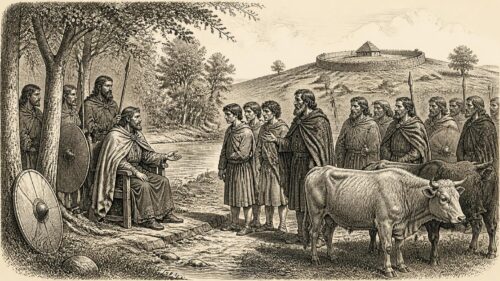
In 678, Fáelán Senchustul of Uí Cheinnselaig defeated Osraige, killing its king, Tuaim Snáma, and reportedly securing hostages that affirmed Osraige’s submission. The victory formed part of continuing pressure by Leinster’s southern dynasty on its neighbour. Colgú, king of Munster, also died, prompting a poorly documented royal transition. Annals record the deaths of bishops at Glendalough and Ferns, underlining the political and economic importance of church centres. Notices from western Scotland reflect continuing Irish Sea connections, though some are chronologically uncertain. No evidence records famine, plague or a nationwide crisis in Ireland that year.
Adomnán’s Succession
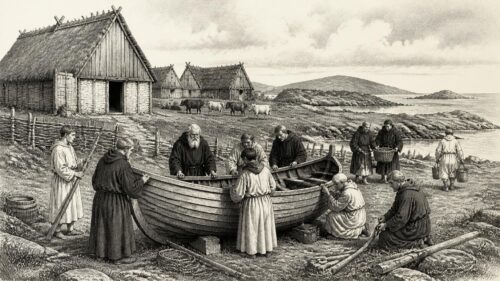
In 679, the death of Fáilbe, abbot of Iona, brought Adomnán to leadership of the Columban network linking Ireland and western Britain. The annals also note the death of Cenn Fáelad, remembered as a learned man, though later stories of his scholarship cannot be accepted uncritically. Fínnechta Fledach, king of Tara, defeated Bécc Bairrche of Dál Fiatach at Tailtiu, demonstrating the reach but not the supremacy of Uí Néill power. Leinster’s kingship remained contested. These notices reveal a rural, cattle-centred society shaped by rival dynasties, churches and learned culture.
Bolgach Epidemic
In 680, Irish annals record dynastic violence, ecclesiastical deaths, local conflict and a severe epidemic called bolgach. Fíanamail mac Máel Tuile, king of Leinster, was killed by Foidsechán of his household, apparently in connection with Fínnechta Fledach of Brega. Colmán, abbot of Bennchor (Bangor), and Máel Fothartaig, bishop of Ard Sratha, also died. Notices mention the siege of Dún Baite, a battle at Bodbgna and other killings. Bolgach may have been a blistering or smallpox-like disease, though its precise nature is uncertain. Irish annalists also noted Ælfwine’s death in northern Britain, reflecting cross-channel connections.
Ráith Mór
In 681, Irish annals record the killing of Cenn Fáelad, king of Connacht; a battle at Ráith Mór in Mag Line against Britons, where Cathasach, king of the Cruithin, died; and the death of Suibne, superior of Corcach. These brief, variant records demonstrate fragile regional kingship, conflict involving cross-channel contacts, and the public importance of ecclesiastical leaders. They do not establish a single coordinated campaign or detailed causes. Ireland remained divided among interconnected rural kingdoms and church communities, sustained by farming, livestock, patronage and kinship amid recurring local insecurity.
Royal Killing
In 682, Cenn Fáelad son of Colgú, king of Connacht, was killed when Ulcha Derg of the Conmaicne Cúile and his followers stormed his residence. The annals confirm the death but give no motive, location or account of its consequences. It illustrates the fragile, negotiated character of provincial kingship among competing kindreds. Another Connacht king was slain the following year, though no direct connection is recorded. Elsewhere, a battle at Ráith Mór in Mag Line involved Britons and northern Irish rulers, while Pictish forces devastated Orkney. Rural communities, dependent on farming, livestock and churches, sustained the political and literate world that preserved these events.
Child Mortality
In 683, Irish annals record the killing of Dúnchad Muirisce, king of Connacht, and the deaths of Colgu son of Blathmac and Fergus of Cenél Cairpri at Corann. Two unnamed strongholds were also besieged, though the sources give no participants or outcomes. In October, a ‘mortality of children’ began, reportedly lasting three years, but cannot be identified with a specific disease. The year also saw the deaths of ecclesiastical figures including abbots linked to Cráeb Laisre and Clonmacnoise. Despite chronological variations between annals, the evidence presents 683 as a troubled year of contested kingship, warfare and widespread disease.
Brega Raid
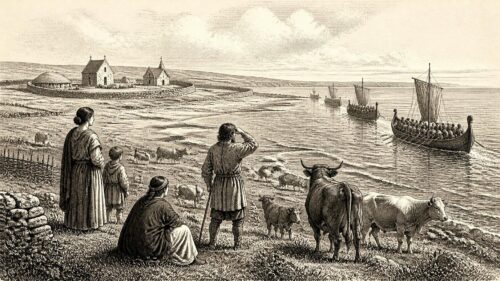
In June 684, King Ecgfrith of Northumbria sent an army under Berht to devastate Mag Breg, or Brega, a wealthy and politically important Irish kingdom. Irish annals and Bede record the destruction of churches; later tradition also reports plunder and captives. The raid struck settlements, ecclesiastical communities and agricultural resources, exposing the Irish Sea as a route for coercion as well as travel and exchange. Its precise motives, landing place, scale and course remain unknown. Contemporary records also note a mortality among children, while later accounts of famine, frost and captive returns cannot securely be assigned to 684.
Banbán’s Obituary
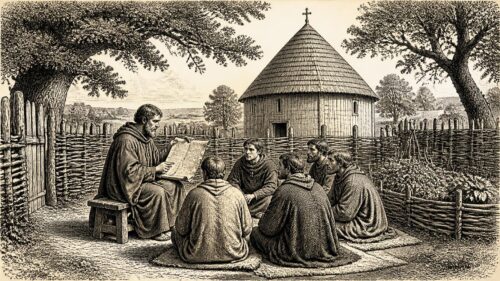
In 685, Irish annals record the deaths of Banbán, learned lector of Kildare, and Forcrann, abbot of Clonmacnoise, though differing chronologies prevent precise dating. Their notices demonstrate the importance of major churches as centres of learning, landholding, authority and record-keeping. Ireland remained politically fragmented under competing dynasties, with Fínnechta Fledach holding the overkingship of Tara rather than ruling a unified state. Irish writers also carefully recorded Ecgfrith of Northumbria’s defeat and death at Dún Nechtain on 20 May, reflecting ecclesiastical and political links across the Irish Sea.
Sixty Captives
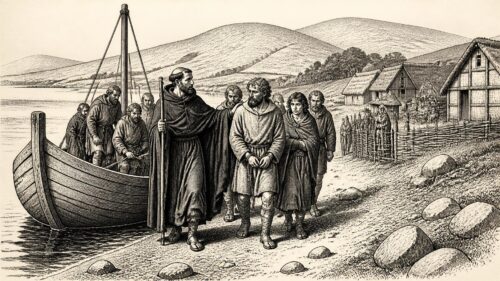
In 686, Adomnán, abbot of Iona, brought sixty former captives back to Ireland, probably following the Northumbrian raid on Brega in 684. Although the annals do not identify the captives or explain their release, the episode demonstrates links between Ireland, Iona and Northumbria, and the role of clerical diplomacy across the Irish Sea. The deaths of abbots at Glendalough and Corcach Mór, and of Bishop Oiséne, also reflect established religious communities. Ireland remained politically fragmented under regional rulers, including Fínshnechtae Fledach of Tara. Later-dated battles should not be assigned to 686.
Captive Returns
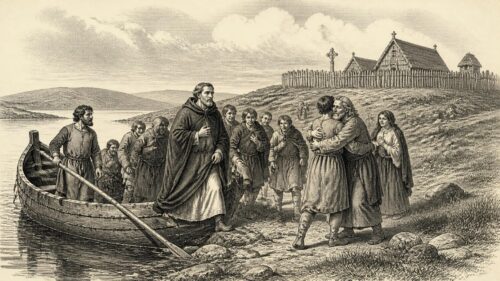
In the annalistic sequence for 687, Adomnán, abbot of Iona, returned sixty former captives to Ireland, probably people seized during King Ecgfrith of Northumbria’s raid of 684. Although the precise date and negotiations remain uncertain, Adomnán’s links with King Aldfrith and Northumbrian ecclesiastical networks likely enabled their release. The episode illustrates Irish Sea connections linking warfare, diplomacy and learning; Adomnán’s scholarly exchanges with Aldfrith may have occurred during related visits. The annals also record the deaths of abbots at Glendalough and Cork, and of a bishop attached to an uncertain monastery, alongside the unexplained killing of Feradach son of Congal.
Imlech Pich
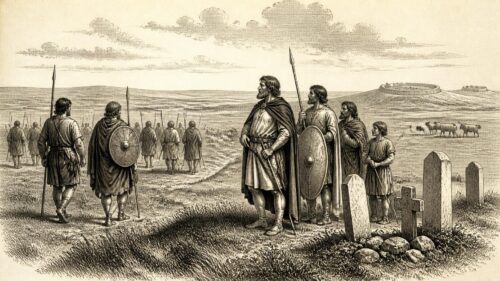
In 688, the battle of Imlech Pich reshaped power in Brega when Niall son of Cernach Sotal defeated Congalach son of Conaing. Two of Congalach’s allies, the kings of Ard Cianachta and Conaille Muirthemne, were killed, while Congalach escaped, leaving rival claims unresolved. The defeat probably reduced Ard Cianachta’s independence and strengthened southern Brega. Elegiac verse recalls the wider human and material losses of warfare. The annals also record high-king Fínnechta Fledach’s temporary entry into clerical life and the death of Ségéne of Armagh, illustrating the close interconnection of royal, ecclesiastical and regional authority.
Diarmait’s Killing
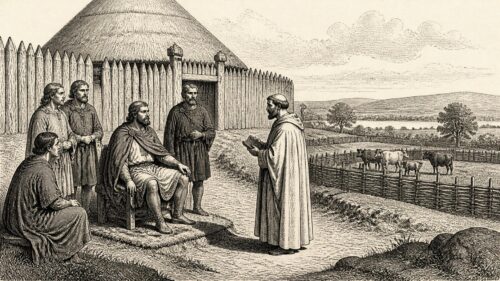
The annals traditionally associated with 689 record the killing of Diarmait son of Airmedach Cáech, king of Mide, by Áed son of Dlúthach of Fir Chúl, illustrating rivalry among regional rulers. They also note Fínnechta Fledach’s return to kingship, without establishing a link between the events. Deaths of Bishop Iolán of Cenn Garad and other figures reflect the importance of ecclesiastical and kin networks. A notice of Adomnán recovering captives may duplicate an earlier record of his diplomacy with Northumbria. A solar eclipse, probably seen on 3 July 688, reveals chronological displacement in the annals.
Iarmumu Succession
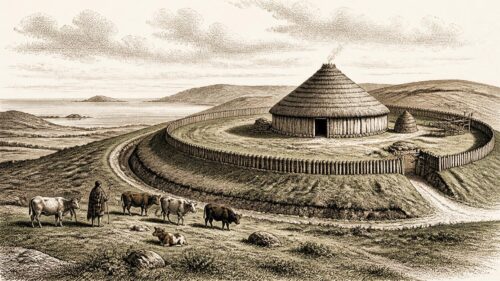
In 690, Congal son of Máel Dúin, king of Iarmumu in western Munster, was killed, creating uncertainty over regional succession. Ailill son of Dúngal, associated with the Cruthin of Éilne, and Dúnchad son of Orc Doith were also recorded as killed. The annals note a fire at Armagh and the death of Do-Bécóc of Clonard. Dating differs among surviving chronicles, and motives, locations and perpetrators remain unknown. These notices reveal an Ireland divided among regional dynasties, churches and kin-groups, where authority depended on lineage, alliances and control of resources.
September Gale
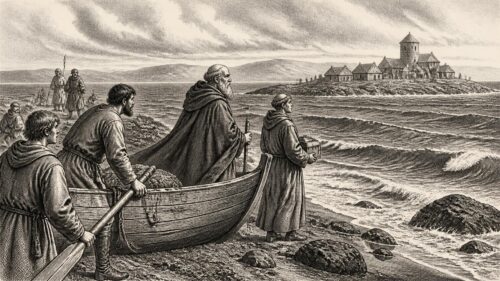
The annals conventionally associate 691 with the death of Crónán, abbot of Bangor, and Fidchellach son of Flann, king of Uí Maine. They also record a raid by Dál Riata on the Cruithin and Ulaid, illustrating the military importance of Irish Sea routes. On 16 September, a severe windstorm drowned about six members of Iona’s community, highlighting the dangers faced by coastal religious settlements. Together these sparse notices reveal interconnected yet fragmented political and ecclesiastical worlds, shaped by local kingship, influential monasteries, maritime travel and environmental hazards. The dating of some entries remains uncertain.
Leinster Conflict
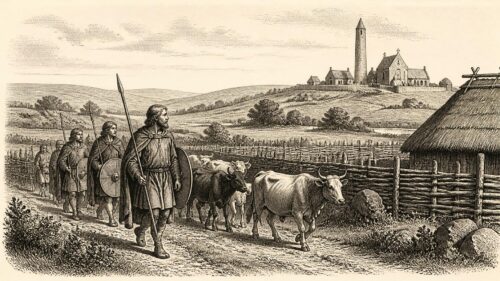
In 692, annals record the deaths of Dirath, bishop of Ferns, and Bran, grandson of Faelán and king of Leinster. A battle between the Osraige and Laigin killed Faelchar, grandson of Máel Odor, though its cause, location and outcome are unknown. Other fragmentary notices cannot be securely interpreted. Parallel annals also associate Leinster with blood-coloured rain, perhaps an observation, portent or later elaboration. These events occurred in a rural society sustained by farming, cattle and ecclesiastical communities. The sparse records reveal political and religious change, but leave many details unrecoverable.
Crón Bec
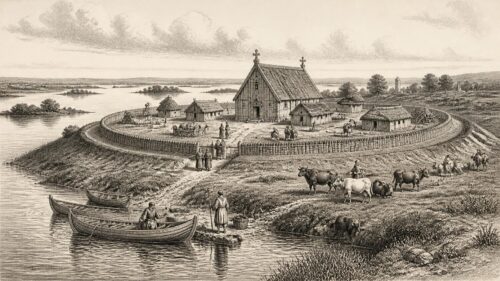
In 693, Irish annals recorded the death of Crón Bec, abbot of Clonmacnoise, alongside ecclesiastical deaths at Movilla and Balla, the killing of Cerball son of Máel Odar, and the siege of Dún Foither. These brief notices reveal the importance of monasteries as religious, economic and political centres within a fragmented society. Clonmacnoise, strategically located on the Shannon, depended on rural resources and river communications. The siege may have occurred in northern Britain, reflecting Irish Sea connections. Disputed annalistic dates prevent certainty over wider struggles for Tara, but the year shows institutional succession, local violence and interconnected ecclesiastical networks.
Crónán Becc
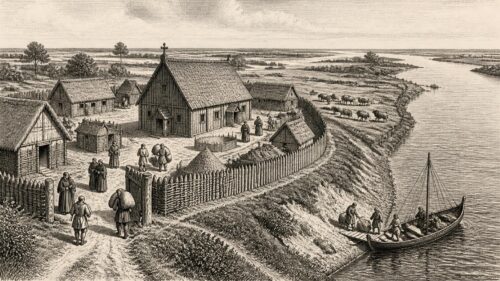
In 694, Crónán Becc, abbot of Clonmacnoise, died, an event securely associated with the year in several Irish annalistic traditions. His obituary reflects the importance of Clonmacnoise as a religious, economic and strategic centre on the Shannon, then largely built of timber. Other notices record the deaths of churchmen including Crónán of Balla, Bishop Bec Fhola and Uidréne of Mag Bili, alongside the killing of the Uí Néill king Cerball and a siege at Dún Foither. Domnall of Alt Clut also died. These sparse, chronologically uncertain records portray a politically fragmented but interconnected Ireland, linked by churches, kinship, waterways and Irish Sea contacts.
Grellach Dollaig
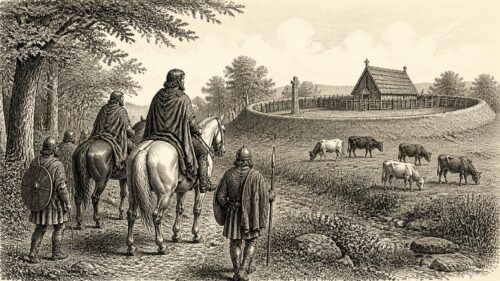
In 695, Fínsnechtae Fledach, king of Tara, and his son Bresal were killed at Grellach Dollaig by rivals from related Síl nÁedo Sláine branches in Brega. The annals provide few details, but the deaths disrupted Brega’s leadership and opened the way for Loingsech of the northern Cenél Conaill to claim kingship. Later tradition praised Fínsnechtae for remitting cattle tribute, reflecting the economic and political importance of livestock. The annals also record the death of Menn Bairenn, abbot of Aghaboe, illustrating the close connection between royal power, kinship, rural economy and ecclesiastical institutions.
Lóchéne Menn
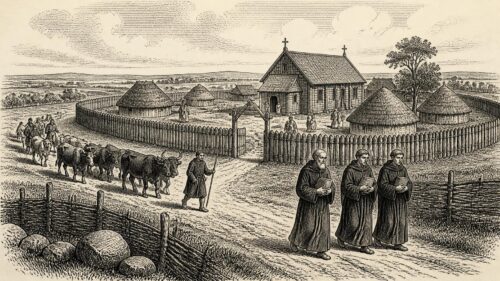
In 696, Irish annals recorded the deaths of several prominent rulers and the killings of Lóchéne Menn, learned abbot of Kildare, and Domnall son of Conall Crandomna. Finguine, king of Munster, died, while Fergal of Aidhne’s death coincided with a shift in Connacht kingship towards Muiredach Muillethan. Congalach of Brega, involved in the previous year’s overthrow of Fínnechta of Tara, also died. The sources provide few circumstances or connections between these events. They nevertheless reveal unstable authority among competing dynasties and ecclesiastical communities, while the wider lives of farming populations remain largely unrecorded.
Cáin Adomnáin
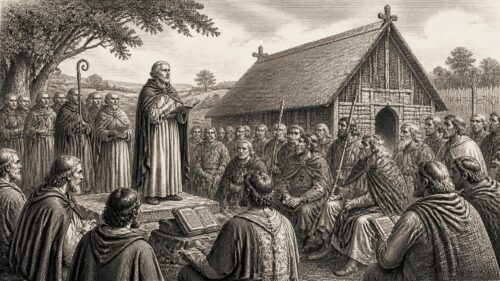
In 697, Adomnán of Iona promulgated the Cáin Adomnáin, or Law of Innocents, at the Synod of Birr. The law sought to restrain warfare by protecting women, children, clerics, churches and other non-combatants from killing, injury, sexual violence and seizure. It relied on compensation, religious penalties and the guarantees of rulers and churchmen, including figures from Ireland, Dál Riata, Pictland and Northumbria. Although Ireland remained politically divided and conflict continued, the law represented a major effort to impose moral and legal limits on violence. Its later renewal suggests that enforcement required continuing support.
Tarachin’s Journey
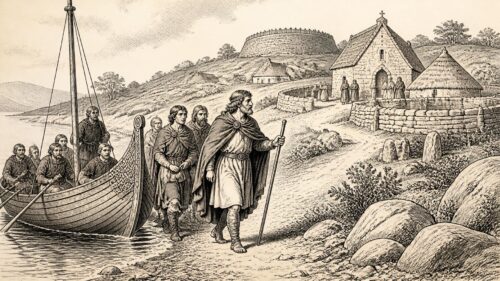
In 698, Irish annals record Tarachin’s journey to Ireland and an unexplained battle associated with Fiannamail son of Oiséne. Chronological variation requires caution: Tarachin may have been connected with the deposed Pictish ruler Taran, but neither identity nor motives are certain. His crossing nevertheless illustrates Ireland’s maritime links with Dál Riata, Pictland and western Britain, and its potential role as refuge for displaced elites. Fiannamail’s battle reflects localised violence within a fragmented political landscape under Loingsech’s influence. Churches, rural production and literate communities supported authority and preserved selective memories. Ireland was connected, decentralised, and politically active, not unified or isolated.
Colmán’s Obituary
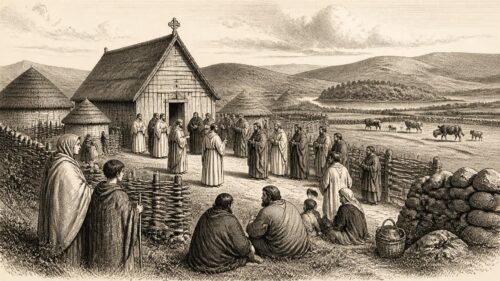
In 699, the Annals of the Four Masters record the death on 30 March of Colmán of Linn Ua Chaille, though his office remains unknown. They also assign deaths of Ailill, king of Munster, and Conall of Uí Fhidgeinte, and Írgalach’s killing of Niall Ua Cernach in Brega. Parallel annals date these political events shortly later, demonstrating chronological divergence in transmitted records. The notices illuminate ecclesiastical commemoration, unstable dynastic authority and aristocratic violence. Set after the synod of Birr, they also evoke a rural society where churches, kinship, cattle, agricultural production and local kingship shaped everyday life and political power.