

31500–31401 BCE

Derryvree’s Drumlin Pool
Around 31,500 BCE, Ireland lay within the fluctuating cold conditions of Marine Isotope Stage 3, not a historically identifiable year. At Derryvree, County Fermanagh, freshwater sediments dated broadly to this period preserve tundra-like plants and wetland evidence between glacial deposits, demonstrating a local ice-free or ice-marginal interval. Castlepook Cave, County Cork, contains MIS 3 fauna, including a reindeer femur dated about 31,000 BCE with a possible stone-tool butchery mark. This may indicate a brief human visit, but cannot prove settlement. Ireland’s ice, water, fauna and climate changed regionally; no secure evidence exists for communities, ritual, trade, dwellings or sustained population.
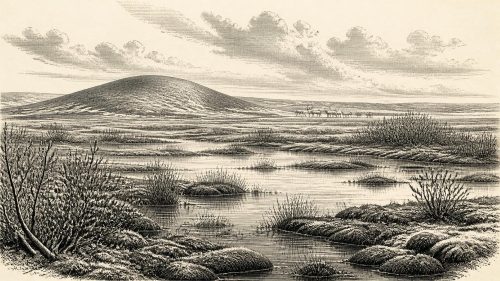
Fermanagh’s Intertill Mosses
31,499 BCE is best understood as a broad later Marine Isotope Stage 3 interval, not a datable Irish year. Ireland experienced unstable Ice Age conditions, with shifting ice margins, lowered seas and locally varied open, tundra-like habitats. At Derryvree, Fermanagh, freshwater organic sediments between tills preserve evidence of sedges, mosses, herbs, shrubs and pools during an ice-free episode. Crag Cave calcite indicates intermittent milder conditions. Castlepook Cave documents reindeer, mammoth, giant deer and predators. A cut-marked reindeer bone may suggest human activity, but lacks secure context. Evidence supports dynamic environments and mobile fauna, not settlement, society or certain historical events.

Derryvree’s Insect Ledger
Around 31,498 BCE, Ireland cannot be described through precise dates or written history, but environmental evidence reveals a variable late-Pleistocene landscape. Organic silts at Derryvree, County Fermanagh, indicate an ice-free freshwater wetland with treeless tundra vegetation, mosses, sedges and northern insects during part of MIS 3. Other deposits suggest regional, rather than continuous, ice cover. Castlepook Cave, County Cork, preserves fauna including mammoth, reindeer, giant deer, hyaena, Arctic fox and lemmings, demonstrating open, cold habitats. A possibly cut-marked reindeer bone may indicate Upper Palaeolithic human activity, but cannot prove settlement. Later ice expansion destroyed or buried much evidence from landscapes.
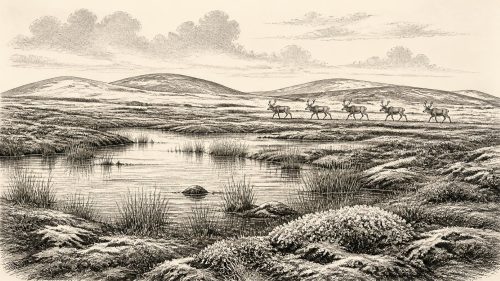
The BIRM-166 Landscape
Around 31,497 BCE, Ireland was a climatically unstable Late Pleistocene landscape rather than a datable year. Derryvree, County Fermanagh, preserves freshwater sediments between successive glacial tills, indicating cold, open periglacial wetlands during part of MIS 3. Castlepook Cave, County Cork, produced remains of reindeer, giant deer, bears, wolves, Arctic foxes, hyaenas and possibly mammoths, though cave contexts are disturbed and revised dating is essential. An incised reindeer bone may indicate butchery but cannot prove settlement. No evidence supports resident communities, agriculture, trade, polities or culture. Later glaciation erased much evidence, leaving a treeless, intermittently accessible Ice Age frontier for fauna.
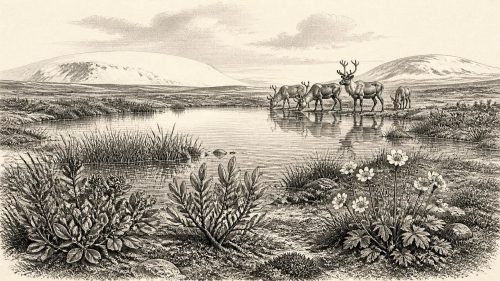
Maguirebridge’s Trifoliate Seed
Around 31,496 BCE, Ireland’s history is reconstructed from environmental evidence rather than recorded events. At Derryvree, County Fermanagh, freshwater silts between glacial tills preserve bogbean, dwarf willow and other cold-adapted plants, indicating temporary wetlands within open tundra-steppe conditions. Castlepook Cave, County Cork, yielded remains of reindeer, mammoth, giant deer and predators, though accumulated deposits cannot prove contemporaneous fauna. A cut-marked reindeer bone may indicate an exceptionally early human visit, but cannot establish settlement or population continuity. Ireland’s climate, ice cover, coastlines and possible access routes were changing. The evidence depicts a productive yet precarious landscape before more extensive later glaciation.

Doneraile’s Open Margin
31,495 BCE is a modern label for roughly 33,500 years ago, during late Marine Isotope Stage 3, rather than a datable Irish event. Ireland was approaching, but had not reached, maximum glaciation; parts remained ice-free, supporting open tundra-grassland environments and large mammals. Castlepook Cave near Doneraile preserves mixed Pleistocene remains including mammoth, reindeer, giant deer, bear, wolf and Ireland’s sole spotted hyaena. A marked reindeer femur may record stone-tool butchery and Upper Palaeolithic visitors, but cannot prove settlement or occupation. Cave deposits and dates are uncertain. Secure human evidence is later, from a butchered bear bone around 12,800 years ago.

Castlepook Before the Ice Sheet
At 31,494 BCE, Ireland lay within the climatically unstable Late Pleistocene MIS 3. Derryvree’s dated freshwater sediments show that parts of north-central Ireland remained ice-free, supporting treeless tundra wetlands, before later glaciation. Castlepook Cave in Cork preserved bones of reindeer, mammoth, giant deer, hyaena and other Ice Age fauna, although its deposits span long periods and are partly disturbed. A marked reindeer femur may indicate human butchery about 33,000 years ago, but requires confirmation and cannot establish settlement. No evidence supports contemporaneous polities, agriculture, villages or culture. Changing sea levels and uncertain routes connected an ecologically diverse, archaeologically elusive island.
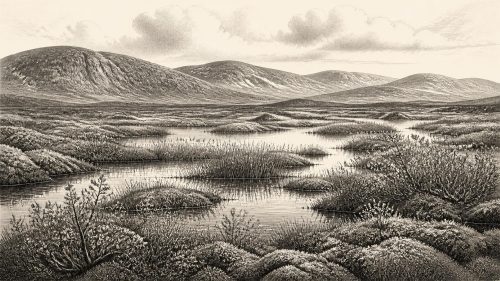
Derryvree’s Frosted Fen
31,493 BCE is a notional chronological marker within the climatically unstable Late Pleistocene, not a precisely recoverable Irish year. Ireland experienced alternating glacial and milder phases, while later ice largely erased early evidence. At Derryvree, County Fermanagh, organic sediments between tills record an ice-free freshwater tundra landscape, with wetlands, sedges, mosses and cold-adapted plants. Crag Cave indicates intermittent warmer conditions during MIS 3. Castlepook Cave's cold-stage fauna includes a reindeer bone possibly cut by humans, suggesting, but not proving, early visitation. No secure settlements, tools, burials or evidence of permanent population exist. Ireland's past remains environmental, fragmentary and cautiously interpreted.
Derryvree’s Juniper Wetland
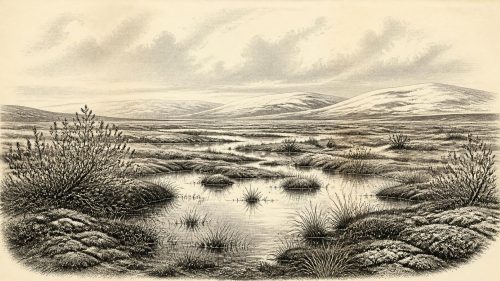
The modern label 31,492 BCE denotes no recoverable Irish event but falls near the younger end of Derryvree’s calibrated freshwater sequence in County Fermanagh. Organic silts between glacial tills, dated broadly to 36,900–31,700 calibrated years BP, record an ice-free interval of cold, open wetland containing grasses, sedges, herbs, juniper, dwarf willow, mosses, aquatic plants and insects. They demonstrate local environmental change, not uniform island conditions. Lower sea levels and fluctuating ice shaped a varied Irish Sea landscape. Cave fauna indicates wider mammoth-steppe connections. A possibly cutmarked Castlepook reindeer bone suggests, but cannot prove, early human activity; no settlement is attested.

BIRM-166’s Tundra Fauna
31,491 BCE is a modern filing label within a broad, uncertain MIS 3 chronology, rather than a recoverable Irish calendar date. Derryvree, County Fermanagh, preserves freshwater sediments between tills, indicating an ice-free, treeless periglacial tundra with mossy wetlands during part of the Middle Midlandian. Castlepook Cave, County Cork, documents a wider, time-mixed fauna including mammoth, reindeer, giant deer, hyena and wolf, evidencing intermittent ecological connections with neighbouring lands. Climate fluctuated, with milder episodes and habitable niches before renewed glaciation. No securely dated human occupation exists; possible cut marks warrant investigation only. These archives illuminate environments, not events or prehistoric society.

Derryvree’s Permafrost Fen
Approximately 31,490 BCE, Ireland lay within the climatically unstable Late Pleistocene, not a knowable single year. At Derryvree, County Fermanagh, organic silts between glacial tills preserve a cold, periglacial freshwater fen, with open tundra-like vegetation, shallow water and seasonal freezing. Castlepook Cave, County Cork, yielded remains of reindeer, mammoth, giant deer and predators, demonstrating wider Late Pleistocene animal dispersal, though not one simultaneous community. A cut-marked reindeer femur may indicate Upper Palaeolithic human processing, but remains contested and proves neither settlement nor continuous occupation. Later ice expansion reshaped Ireland and destroyed much earlier evidence, leaving a fragmentary environmental archive today.

Derryvree’s Eight-Petalled Dryas
Around 31,489 BCE, Ireland’s history is recoverable only through broad environmental evidence, not annual events or human communities. Derryvree, County Fermanagh, preserves freshwater silts between glacial tills, dated broadly to MIS 3. Its Dryas, mosses, bogbean, herb pollen and insects indicate cold, wet, treeless tundra-like terrain. Ireland experienced unstable climates, changing coasts and growing ice sheets, though not universal glaciation. Castlepook Cave fauna demonstrates mammals including mammoth, reindeer, giant deer, bear and hyaena, but accumulated remains cannot date coexistence precisely. A marked reindeer bone may indicate human processing, yet sustained occupation remains unproven. These archives document transformation before extensive glaciation.

Castlepook’s Distant Reindeer
The label 31,488 BCE denotes a broad late-MIS-3 interval rather than a recoverable Irish event, as deep radiocarbon dates carry substantial uncertainty. Ireland’s political and human history is unknown; surviving evidence is environmental. Patchy deposits indicate cold conditions, open tundra wetlands and varied ice cover before maximum glaciation. Cave remains, especially from Castlepook, show mammoth, reindeer and cold-adapted fauna, although old excavations and dating methods require reassessment. A possibly cut-marked reindeer bone raises the prospect of brief Upper Palaeolithic human activity, but proves neither its date nor permanent occupation. These fragments reveal ecological opportunity in landscapes later erased by ice.
Fermanagh’s Sealed Freshwater
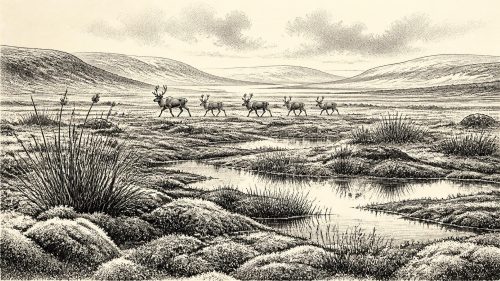
31,487 BCE is a modern label within unstable MIS 3, not a datable Irish event. At Derryvree, County Fermanagh, freshwater silts sealed between tills record a non-glacial interval of cold, treeless tundra wetland, dated broadly to 36,900–31,700 calibrated years before present. Castlepook Cave, County Cork, preserves a time-depth assemblage of Ice Age fauna, including reindeer, mammoth, hyaena and predators, demonstrating favourable open habitats during parts of MIS 3. A marked reindeer femur may indicate human butchery about 33,000 years ago, but insecure contexts prevent firm conclusions. Later glaciation erased evidence; no settlements, tools, burials, trade or political life are established.

BIRM-166’s Trifoliate Basin
Around 31,486 BCE, Ireland cannot be described through conventional history, as no calendar, writing, polity or dated events existed. Derryvree, County Fermanagh, preserves freshwater sediments between glacial tills, broadly dated to the later 30,000s–early 30,000s calibrated BP. Fossil plants and insects reveal open, wet tundra with mosses, sedges, dwarf willow, mountain avens and bogbean during an ice-free interval. Climatic instability and growing glaciers preceded the Last Glacial Maximum. Cave remains indicate diverse cold-adapted fauna, but accumulated over long periods. A cut-marked Castlepook reindeer bone may suggest transient human presence, yet cannot establish settlement. Evidence supports cautious environmental reconstruction, not history.

Castlepook’s Palaeolithic Claim
Around 31,485 BCE, Ireland lay within the climatically unstable Middle Midlandian/MIS 3, not a historically datable year. Evidence from Derryvree indicates wet, open tundra environments before later ice advances, while Crag Cave speleothems show intermittent milder, above-freezing conditions. Castlepook Cave preserves a long, mixed faunal record, including mammoth, reindeer, giant deer, bear and hyena, demonstrating periodically accessible, productive open landscapes before the Last Glacial Maximum. A reindeer femur, about 33,000 years old, bears a possible stone-tool cut mark and may signal brief Upper Palaeolithic human presence. However, disturbed deposits and absent associated artefacts preclude claims for permanent settlement or society.

Derryvree’s Radiocarbon Silt
31,484 BCE is not a date at which Irish history can be recovered year by year. No written records, named people, settlements, political communities or securely dated events survive from this remote part of the Late Pleistocene. Indeed, modern calendar-year precision is unavailable: radiocarbon results measure probability ranges, must be calibrated against changing atmospheric carbon levels, and commonly carry wide uncertainties at this depth of time. The best approach is therefore to place the notional year within a broader interval, roughly 33,400 calendar years before present, and to ask what deposits, bones and landforms can responsibly reveal about Ireland at or near that time.

Derryvree’s Interstadial Waters
Around 31,483 BCE, Ireland lay within the climatically unstable Late Pleistocene, but evidence cannot define a single year or permanent human population. At Derryvree, County Fermanagh, freshwater sediments between glacial tills record an ice-free interval, broadly dated to 34,950–29,750 BCE, with cold, treeless wetlands, mosses, sedges and diverse local habitats. Cave formations and faunas indicate fluctuating conditions and episodic animal movements, including reindeer, mammoth, giant deer, bears and hyaenas. A marked reindeer bone from Castlepook Cave may indicate Upper Palaeolithic human processing, but remains unconfirmed. Ireland’s record documents shifting ice, environments and ecological opportunities, not settlements, politics or sustained occupation.
Derryvree’s Fringed Sandwort
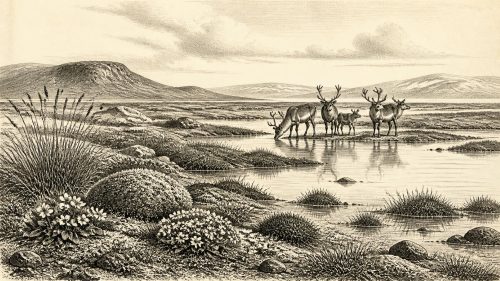
Around 31,482 BCE, Ireland has no recoverable written or event history, but environmental evidence indicates varied Late Pleistocene conditions. At Derryvree, County Fermanagh, freshwater sediments between tills, dated broadly to 36,900–31,700 cal BP, preserve tundra plants, mosses, insects and wetland habitats during an ice-free interval. Climate fluctuated sharply as the Irish Ice Sheet expanded towards its later maximum. Castlepook Cave, County Cork, contains time-averaged remains of mammoth, reindeer, giant deer, predators and fauna. A cut-marked reindeer bone may indicate human butchery, but disturbed deposits and absent artefacts leave this unconfirmed. The evidence depicts dynamic, biologically active landscapes, not settled society.
Castlepook’s Reindeer Debate
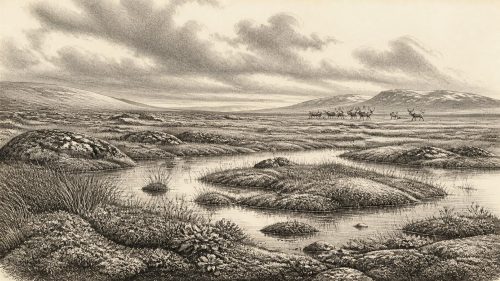
Around 31,481 BCE, Ireland experienced a variable MIS 3 glacial climate rather than uniform ice cover. Derryvree sediments in Fermanagh record cold, treeless wetlands during an ice-free interval, while Crag Cave calcite indicates episodic milder conditions in Kerry. Expanding ice sheets created a regional mosaic of glaciers, open ground and freshwater habitats. Castlepook Cave’s fauna, including reindeer, mammoth, hyena and arctic fox, demonstrates cold-stage animal presence, though deposits span time and were disturbed. A marked reindeer femur may indicate butchery by Upper Palaeolithic people, but cannot prove settlement. Evidence supports temporary environmental and human access, while social history remains unknown.

Maguirebridge’s Buried Bogbean
Around 31,480 BCE, Ireland’s history is reconstructed from environmental evidence rather than records. At Derryvree near Maguiresbridge, Fermanagh, freshwater sediments trapped between glacial tills preserve pollen, mosses, insects and bogbean seeds, indicating treeless, tundra-like wetland during part of MIS 3. Radiocarbon dating places this landscape broadly between 36,900 and 31,700 calibrated years BP, not at a precise year. Southern caves reveal a varied cold-climate fauna, including mammoths, reindeer, lemmings, predators and giant deer. A cut-marked reindeer bone from Castlepook may indicate human butchery, but no securely dated settlement exists. Later ice advances destroyed evidence, leaving a regionally varied, uncertain picture.

A Femur Beneath Castlepook
Around 31,479 BCE, Ireland lay in the unstable, cold Late Pleistocene, before maximum glaciation. Much terrain was probably ice-free, supporting tundra, steppe-tundra, wetlands and sparse shrubs, while later ice destroyed much evidence. Deposits at Derryvree and Maguiresbridge show wetland habitats with cold-adapted plants. Castlepook Cave in County Cork yielded fauna including reindeer, mammoth, giant deer, hyaena and Arctic fox. An incised reindeer femur, dated broadly to about 31,000 BC, may indicate human butchery, but lacks a secure archaeological context. It cannot prove settlement. Ireland’s evidence instead suggests a changeable landscape, rich Ice Age fauna, and only possible brief human visits.
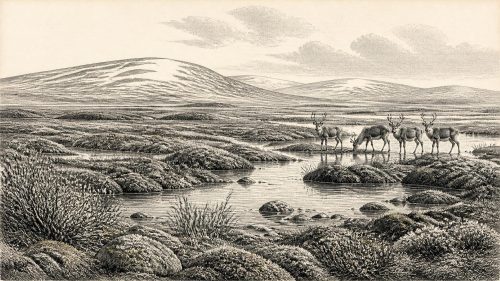
Maguirebridge’s Ice-Age Wetland
At roughly 33,400 years before present, Ireland lay within the climatically unstable later Last Glacial Period. Evidence is fragmentary, but Derryvree, County Fermanagh, preserves freshwater wetland sediments, indicating open tundra-like ground, mosses, sedges, shrubs, pools and insects between glacial advances. Southern caves document presence of reindeer, mammoth, horse, giant deer, carnivores and other cold-adapted fauna. Ice cover and access varied before the Last Glacial Maximum. A marked reindeer femur from Castlepook Cave may indicate Upper Palaeolithic butchery, although human settlement remains unproven. Lower seas altered routes, without demonstrating a land bridge. Climate, ice, fauna and visits shaped Ireland’s Ice-Age environment.
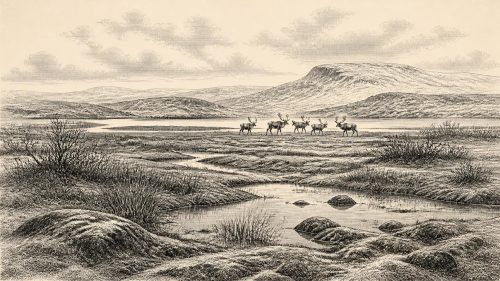
Maguiresbridge’s Mid-Glacial Marsh
31,477 BCE is a modern approximation within a broad Late Pleistocene radiocarbon horizon, not a recoverable historical year. At Derryvree near Maguiresbridge, deposits between glacial tills record an ice-free interval, dated broadly to 36,900–31,700 cal BP, with freshwater wetlands, tundra-like vegetation and insect life. Ireland’s conditions varied regionally amid volatile Marine Isotope Stage 3 climates and advancing glaciers. Castlepook Cave preserves remains of mammoth, reindeer, giant deer, predators and other cold-stage fauna, although its early excavations complicate interpretation. A marked reindeer bone may indicate human butchery, but cannot prove settlement or continuity. Evidence reveals changing Ice Age landscape, not society.
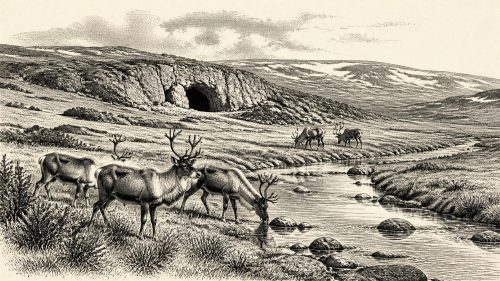
The Awbeg Femur Question
31,476 BCE is an imprecise modern label for a fluctuating Late Pleistocene interval in Ireland, within Marine Isotope Stage 3. Environmental evidence, including Derryvree freshwater deposits, cave calcite and glacial landforms, indicates alternating cold and milder conditions, varied habitats, advancing ice and uncertain routes from Britain. Castlepook Cave in County Cork produced cold-stage fauna and a reindeer femur bearing a possible stone-tool cut mark, dated around 31,000 BC. If anthropogenic, it suggests brief Upper Palaeolithic human activity. However, disturbed cave contexts, absent tools, hearths and human remains preclude claims for settlement or population. The femur remains important but contested evidence.
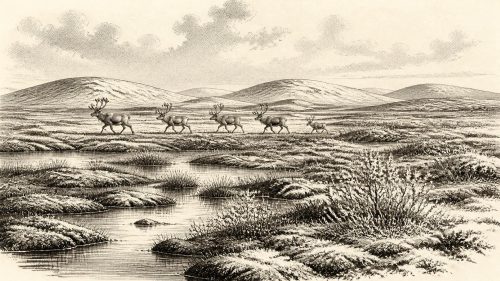
Derryvree’s Intertill Reedland
31,475 BCE is a modern label for an unrecorded MIS 3 interval, when Ireland experienced fluctuating cold conditions before the Last Glacial Maximum. Derryvree, County Fermanagh, preserves freshwater sediments between tills, indicating treeless, waterlogged tundra supporting mosses, sedges, aquatic plants and insects. Castlepook Cave, County Cork, contains MIS 3 fauna including reindeer, mammoth, giant deer and predators, demonstrating connections with north-west Europe despite uncertain routes. A marked reindeer bone may indicate human butchery, but its context is disputed and proves neither settlement nor society. Later glaciation transformed landscapes and destroyed evidence, leaving a fragmentary record of wetlands, animals and visitors.

Derryvree’s Tundra Clock
31,474 BCE is a modern label rather than a recoverable Irish year, corresponding roughly to 33,400 calibrated years before present in climatically unstable MIS 3. Derryvree, County Fermanagh, preserves sediments between glacial tills, dated broadly 36,900–31,700 cal BP, revealing treeless tundra wetlands with grasses, sedges, juniper, insects and seasonal freshwater. Castlepook Cave, County Cork, yielded bones of mammoth, giant deer, reindeer, bear and hyaena, though its mixed deposits cannot establish contemporaneity. No secure evidence proves human settlement, culture or economy. A possibly tool-marked reindeer bone may indicate brief human presence. Later glaciation obscured much evidence from this shifting ice-age frontier.

BIRM-166 and Mammoth Cave
About 31,473 BCE, Ireland lay within the climatically unstable later Marine Isotope Stage 3, not a precisely datable historical year. Derryvree, County Fermanagh, preserves freshwater silts between glacial tills, dated broadly to 31,700–36,900 calibrated years BP, demonstrating ice-free, treeless wetland conditions. Castlepook Cave, County Cork, produced pre-Last Glacial Maximum bones of mammoth, reindeer, giant deer, predators and cold-adapted mammals, although its mixed deposits require caution. A possibly cut-marked reindeer femur suggests human activity, not settlement. Later ice advances destroyed earlier evidence. No political, cultural or economic history can be reconstructed; the surviving record chiefly documents changing environments, fauna and uncertainty.

Sedges Between the Tills
31,472 BCE is a modern label within a broad Late Pleistocene dating range, not a recoverable Irish historical year. Derryvree, County Fermanagh, preserves freshwater sediments between glacial tills, indicating locally ice-free, treeless tundra with sedges, mosses and wet hollows during MIS 3. Castlepook Cave, County Cork, contains diverse cold-stage fauna, including reindeer, mammoth, giant deer, predators and lemmings, though its bones accumulated over long periods. A marked reindeer femur may indicate human butchery around 31,000 BC, but cannot prove settlement. Ireland was climatically unstable, intermittently accessible and increasingly affected by advancing ice, known only through fragmentary environmental and archaeological evidence.
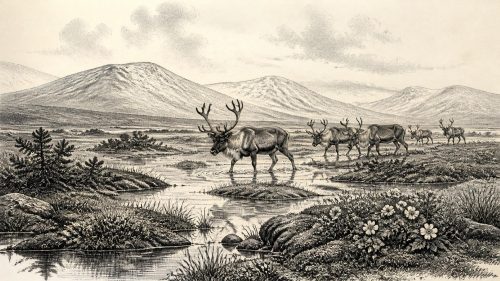
Derryvree’s Trifoliate Waterline
31,471 BCE is a modern retrospective date, not an identifiable Irish event. Derryvree, County Fermanagh, preserves freshwater sediments between glacial tills, dated broadly to 36,900–31,700 years before present. Its plants, insects and sediments indicate an ice-free but cold periglacial wetland of pools, sedges, mosses, herbs and open ground during an unstable Ice Age. Lower sea levels reshaped Ireland and surrounding routes, while later ice expansion transformed the landscape. Castlepook Cave, County Cork, records diverse cold-adapted fauna, including mammoth and reindeer. A possibly stone-cut reindeer bone suggests brief Upper Palaeolithic human visitation, but neither settlement nor social organisation is securely evidenced.

Mammoths Beneath Castlepook
31,470 BCE is a modern label for an uncertain MIS 3 interval, rather than a recoverable Irish calendar year. Before the Last Glacial Maximum, climatically variable Ireland included open, cold landscapes that intermittently supported mammoth, reindeer, giant deer, bears, hyaenas, wolves, foxes and lemmings. Castlepook Cave, County Cork, preserves these remains, although early excavation, disturbed deposits and revised radiocarbon dates require caution: its fauna accumulated across multiple phases, not one scene. A cut-marked reindeer femur may indicate Upper Palaeolithic butchery about 33,000 years ago, but cannot prove settlement or permanent population. Castlepook instead documents ecological change and possible human presence.

Derryvree’s Mossland Window
31,469 BCE is a modern label within an uncertain MIS 3 interval, not a recoverable Irish date. At Derryvree, Fermanagh, freshwater sediments between glacial tills, broadly dated to 34,950–29,750 BCE, preserve evidence of locally ice-free, periglacial wetlands. Mosses, sedges, dwarf willow, aquatic plants and cold-adapted insects indicate open tundra-like terrain with pools, frost and seasonal thaw. Crag Cave records milder phases in south-west Ireland, while Castlepook Cave fauna confirms cold-stage mammals, including mammoth and reindeer. A marked reindeer bone may indicate human butchery, but cannot prove occupation. Ireland’s environment remained dynamic, regionally varied and increasingly affected by expanding ice sheets.

Castlepook’s Faunal Clock
Around 31,468 BCE, Ireland lay within the climatically unstable later Marine Isotope Stage 3, not a historically identifiable year. Castlepook Cave in County Cork preserves faunal evidence for cold, open habitats, including mammoth, reindeer, giant deer, bear, wolf, Arctic fox and spotted hyaena. These remains show episodic links with wider Pleistocene Europe, though cave deposits accumulated through varied processes. A marked reindeer femur may record human butchery, potentially indicating a brief visit by mobile foragers, but lacks secure archaeological context. Derryvree wetland sediments in Fermanagh document treeless periglacial vegetation between glacial phases. Evidence supports neither permanent ice cover nor settlement.

Derryvree’s Sedge Hollow
Around 31,467 BCE, Ireland lacked written records, so evidence offers only calibrated reconstructions. During Marine Isotope Stage 3, before the Last Glacial Maximum, conditions were cold, open and harsh, though not uniformly ice-covered. Organic sediments at Derryvree, County Fermanagh, between glacial tills, preserve sedges, aquatic plants and treeless wetlands, demonstrating an ice-free interval later sealed by glaciation. Cave remains at Castlepook, County Cork, show Late Pleistocene fauna including reindeer, mammoth and hyaena. A cut-marked reindeer femur may indicate human activity, but proves neither settlement nor continuous occupation. These records reveal changing landscapes capable of sustaining wildlife and perhaps mobile hunter-gatherers.

Derryvree’s Two Tills
Around 31,466 BCE, Ireland was in the later Marine Isotope Stage 3, increasingly cold but not yet wholly covered by the British–Irish Ice Sheet. At Derryvree, County Fermanagh, freshwater sediments between tills, dated broadly to 33,500 calendar years BP, preserve treeless wetland plants and invertebrates, demonstrating local vegetated, unfrozen habitats. Castlepook Cave, County Cork, contains varied cold-stage fauna, including mammoth, reindeer, giant deer and hyena, though deposits span different periods. A marked reindeer femur may indicate brief Upper Palaeolithic butchery, but secure settlement evidence is absent. Glacial erosion explains much archaeological loss; Ireland remained an unstable Ice Age landscape overall.

BIRM-166’s Ice-Free Interval
31,465 BCE is an imprecise label for a broad late Marine Isotope Stage 3 interval. At Derryvree, County Fermanagh, freshwater sediments and organic remains between glacial tills demonstrate a local ice-free episode, with treeless, wet tundra conditions, sometime roughly 34,950–29,750 BCE. Castlepook Cave, County Cork, preserves diverse cold-climate fauna, including mammoth, reindeer and hyaena, although deposits span separate episodes. A cut-marked reindeer femur may indicate a brief human visit around 33,000 years ago, but proves neither settlement nor occupation. Dynamic ice, shifting coasts and uncertain routes shaped connectivity. Ireland intermittently supported north-west European Ice Age ecosystems, while evidence remains fragmentary.
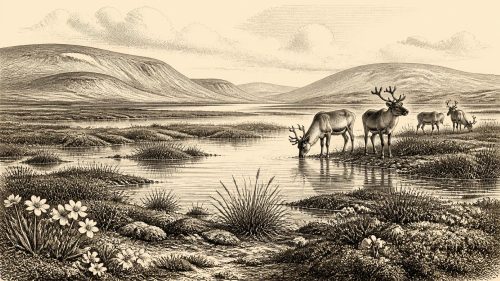
Derryvree’s Buried Summer
Although 31,464 BCE is a modern notional date, evidence places Ireland within the climatically unstable Marine Isotope Stage 3. At Derryvree, County Fermanagh, freshwater organic sediments between glacial tills record a temporary ice-free, cold, treeless wetland, demonstrating local environmental change rather than island-wide conditions. Castlepook Cave, County Cork, preserves pre-Last Glacial Maximum remains of mammoth, giant deer, reindeer, bear and hyaena, indicating intermittent animal dispersal across changing landscapes. A marked reindeer bone may suggest brief human activity, but no settlement or occupation is proven. Ireland had no polities, farming or trade, and remained environmentally dynamic, intermittently habitable and archaeologically uncertain.
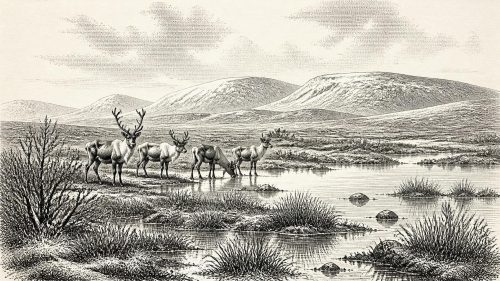
Ballyhoura’s Scored Reindeer
The label 31,463 BCE gives a useful point of entry, but it cannot identify an Irish event in the way that a historic year can. It corresponds conventionally to about 33,412 years before AD 1950, the reference point used for “BP” dating. No written calendar, ruler-list, settlement sequence or archaeological layer can distinguish this particular year from those immediately around it. The responsible scale is therefore a broad one: Ireland in the later Middle Midlandian, part of Marine Isotope Stage 3, during an unstable cold phase before the Last Glacial Maximum.
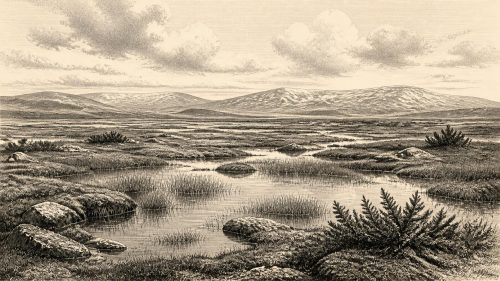
Derryvree’s Long Thaw
31,462 BCE is a notional date within the later Middle Midlandian, not a precisely datable Irish event. Derryvree, County Fermanagh, preserves freshwater sediments between glacial tills, indicating a cold, treeless, sedge-rich wetland with liquid water and seasonal tundra conditions during an ice-free or ice-distal interval. Ireland’s ice margins varied regionally before the later Last Glacial Maximum. Cave fauna, especially at Castlepook, records mammoth, reindeer, giant deer, predators and Arctic species, showing ecological links with north-western Europe. A possibly tool-marked reindeer bone suggests, but does not confirm, early human visits. No evidence supports settlement, polities, farming or culture; evidence is fragmentary.

The Reindeer’s Deep Groove
Around 31,461 BCE, Ireland lay within the climatically unstable Middle Midlandian of Marine Isotope Stage 3, not a uniformly frozen landscape. Derryvree, County Fermanagh, preserves evidence of ice-free, treeless wetland, while Crag Cave indicates episodic milder conditions. Castlepook Cave, County Cork, contains MIS 3 remains of reindeer, mammoth and other cold-adapted fauna, although accumulated over long periods. A grooved reindeer femur may bear a stone-tool butchery mark, potentially indicating fleeting Upper Palaeolithic human activity. However, no associated settlement, tools or social evidence survives. Subsequent ice-sheet growth transformed Ireland, destroying or burying much early evidence from this exceptionally ancient Irish period.
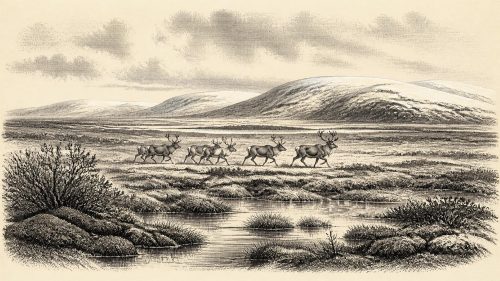
Maguirebridge’s Sealed Silts
“31,460 BCE” is a modern calendar label, not a year that can be identified in Ireland’s surviving prehistoric record. No written chronology, settlement sequence or archaeological layer can be assigned to that single year. In radiocarbon terms, it falls roughly 33,409 years before the conventional reference point of AD 1950, placing it in the later part of the Late Pleistocene, or Marine Isotope Stage 3 (MIS 3). The most responsible approach is therefore to use dated ranges and to ask what deposits, animals and landscapes can illuminate Ireland broadly around this time.
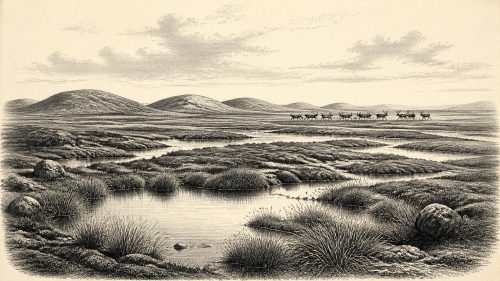
Awbeg Reindeer and Fermanagh Silt
Around 31,459 BCE, Ireland was in the climatically unstable Late Pleistocene, not uniformly ice-covered. At Derryvree, County Fermanagh, a freshwater organic layer later buried by glacial till records mossy, sedgy tundra-steppe wetlands during a broad interval spanning the notional date. Castlepook Cave, County Cork, yielded reindeer, mammoth, giant deer, horse, carnivores and lemmings, demonstrating cold open habitats and intermittent animal access before major ice expansion. Cave deposits accumulated over time, however, so they cannot define a single community. A cut-marked reindeer femur may indicate human carcass processing, but lacks contextual evidence. No settlement, culture or political history can be inferred.

Doneraile’s Mammoth-Steppe
31,458 BCE is a chronological label, not evidence for a dateable Irish event. During MIS 3, Ireland experienced unstable cold conditions, fluctuating ice margins, sea levels and habitats. Deposits at Fermanagh preserve non-glacial wetlands, while Castlepook Cave near Doneraile yielded mammoth, reindeer, horse, giant deer, carnivores and fauna, indicating steppe-tundra and wetlands during favourable intervals. Changing geography permitted animal dispersal from north-west Europe, though no permanent land bridge can be assumed. No secure human settlement exists. A possibly modified reindeer bone may indicate brief Upper Palaeolithic activity, but disturbed deposits and uncertain dating prevent conclusions. Predating Irish politics and writing.
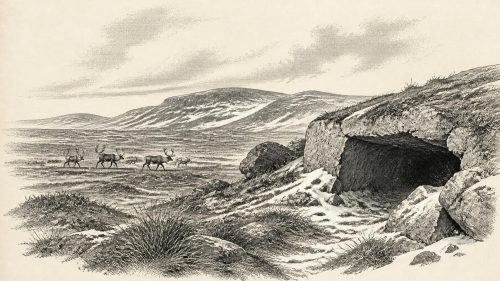
Castlepook’s Iceward Threshold
About 31,457 BCE, Ireland lay within the unstable later Last Glacial Period, before the British–Irish Ice Sheet reached its fullest extent. Cold conditions, changing ice margins, lowered seas and altered coastlines shaped a variable landscape rather than a uniformly frozen island. Cave faunas, notably at Castlepook, include reindeer, mammoth, giant deer and predators, indicating intermittent tundra-steppe ecosystems. Wetland deposits show local environmental diversity between ice advances. A marked Castlepook reindeer bone may record stone-tool butchery and exceptionally early human visitation, but lacks secure archaeological context. No settlement, society or continuous occupation can be inferred. Ireland’s history remains geological and ecological.

The Drumlin’s Freshwater Core
31,456 BCE is not a precise Irish historical date but falls within a broad MIS 3 interval. At Derryvree, County Fermanagh, organic sediments between glacial tills record an ice-free phase, dated roughly 36,900–31,700 calibrated years BP, with cold, treeless freshwater wetlands. Castlepook Cave, County Cork, preserves diverse open-country fauna, including mammoth, reindeer, giant deer, hyaena and Arctic fox, accumulated across multiple periods. A marked reindeer femur may indicate human butchery around 31,000 BC, but cannot prove settlement or continuity. No evidence supports prehistoric polities or culture. Later ice expansion destroyed much evidence, leaving ecological archive and possibilities of human presence.

The Mammoth and the Cutmark
31,455 BCE is a modern label rather than a recoverable Irish date. Environmental evidence from Derryvree in Fermanagh indicates cold, treeless tundra wetlands during Marine Isotope Stage 3, when parts of Ireland remained ice-free before major later glaciation. Castlepook Cave, County Cork, preserves a disturbed but important pre-Last Glacial Maximum fauna, including mammoth, reindeer, lemmings, hyaena and Arctic fox. Ancient DNA suggests links with Eurasian populations, though routes remain uncertain. A cut-marked reindeer femur may indicate brief human carcass processing, but cannot prove settlement. No securely associated tools, hearths, dwellings or human remains establish sustained occupation, political life, or culture.

Crag Cave’s Interstadial Dripstone
31,454 BCE is a modern label for later Marine Isotope Stage 3, not a dateable Irish event. Buried sediments at Derryvree, Fermanagh, indicate an ice-free interval between glacial advances, with treeless tundra, wetlands and cold-adapted life. Crag Cave, Kerry, preserves dripstone formed during episodic milder conditions, confirming climatic instability. Castlepook Cave, Cork, contains reindeer, mammoth, hyaena and other fauna accumulated over long periods, demonstrating links with north-west European ecosystems. A cut-marked reindeer bone may indicate Upper Palaeolithic human activity, but cannot prove settlement. Evidence reveals a changing Ice-Age landscape, not societies, monuments or historical communities across a fluctuating glacial margin.
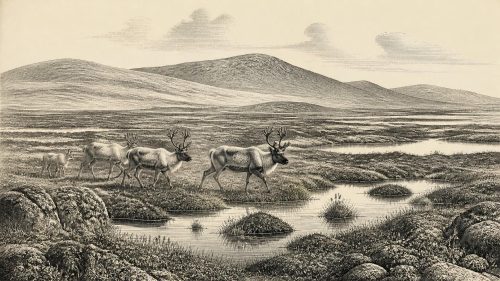
Greenagho’s Mossy Interstadial
31,453 BCE is a modern reference rather than a recorded Irish year. During unstable Marine Isotope Stage 3, Ireland experienced variable, local conditions rather than uniform ice cover. Freshwater deposits at Derryvree and Greenagho indicate ice-free, treeless tundra wetlands during intervals, while Crag Cave confirms episodic milder conditions supporting flowing water. Castlepook Cave preserves remains of mammoth, giant deer, reindeer, bears and hyenas, though mixed deposits limit precise reconstruction. A cut-marked reindeer bone may indicate brief Upper Palaeolithic human activity, not settlement. No contemporary houses, tools, burials, communities, politics or culture are securely known. Ireland was a frontier for fauna.

Awbeg’s Limestone Winter
31,452 BCE is a modern label for a fluctuating Late Pleistocene environment, not a documented Irish year. Lower sea levels altered connections, but shifting ice, waterways and terrain restricted movement. Sediments at Fermanagh and marine evidence in the west show that some regions were ice-free or open before the Last Glacial Maximum. Treeless tundra-steppe, wetlands and severe seasonal cold supported cold-adapted fauna. Castlepook Cave in Cork preserves mammal remains, including reindeer. A possibly cut-marked reindeer femur suggests brief Upper Palaeolithic human contact, but cannot establish settlement. Ireland was a changing northern landscape, later glaciation having erased or buried much evidence.

Maguirebridge’s Brief Thaw
31,451 BCE is a modern label for a broad Late Pleistocene interval, not a recoverable Irish historical year. Derryvree, County Fermanagh, preserves freshwater sediments between glacial tills, indicating a temporary ice-free, periglacial landscape of tundra wetlands, sparse vegetation and invertebrates before renewed glaciation. Castlepook Cave fauna demonstrate that reindeer, giant deer, mammoth, predators and other open-country animals occurred in MIS 3, though deposits span time. A cut-marked reindeer femur may indicate brief Upper Palaeolithic human activity, but cannot prove settlement. Shifting ice, low sea levels and uncertain routes linked Ireland variably to north-west Europe, while later ice destroyed much evidence.

Hyenahall’s Cold Fauna
Around 31,450 BCE, Ireland lay within a fluctuating Late Pleistocene environment rather than a datable historical moment. Derryvree sediments in Fermanagh record an ice-free, treeless periglacial wetland between glacial advances, demonstrating locally habitable conditions before later extensive ice cover. Castlepook Cave in Cork preserves a time-mixed assemblage of mammoth, reindeer, giant deer, bears, hyaenas and other cold-adapted animals, reflecting links with north-west European fauna. A possibly cut-marked reindeer femur may indicate Upper Palaeolithic human activity, but remains inconclusive without associated tools or habitation evidence. Environmental change, animal movement and advancing ice chiefly shaped Ireland; routes and human presence remain uncertain.

BIRM-166’s Bogbean Horizon
31,449 BCE is a modern label within volatile Late Pleistocene MIS 3, not a datable Irish year. Derryvree, County Fermanagh, preserves freshwater silts between glacial tills, radiocarbon-calibrated broadly to 34,950–29,750 BCE. Its bogbean, dwarf willow, clubmoss, pollen and insects demonstrate locally ice-free, treeless tundra-like wetlands before later ice advance. Castlepook Cave’s fauna, including mammoth, reindeer, giant deer, predators and small mammals, confirms links with wider Pleistocene Europe. A possibly cut-marked reindeer bone may indicate early human butchery, but remains disputed and cannot prove settlement. No Irish evidence establishes society, institutions or regular exchange. They reveal a living Ice Age landscape.

Mosses Under Maguiresbridge
31,448 BCE is a modern label for a broad Late Pleistocene interval, rather than a recordable Irish year. Sediments beneath Derryvree, County Fermanagh, document an ice-free freshwater wetland during MIS 3, later sealed by advancing ice. Mosses, pollen and insects indicate cold, open, wet, periglacial terrain with local ecological variety. Southern caves, especially Castlepook in County Cork, preserve diverse fauna including reindeer, mammoth, giant deer and predators. A cut-marked reindeer bone may indicate brief human carcass processing, but cannot prove settlement. Before the Last Glacial Maximum, Ireland's evidence chiefly reveals dynamic environments, scarce archaeological traces, and possible transient human presence.

Elephant Hall’s Cold Archive
31,447 BCE cannot be treated as a precise Irish historical year; evidence instead describes a broad late Pleistocene cold interval before the Last Glacial Maximum. Derryvree, County Fermanagh, preserves buried freshwater wetland deposits indicating treeless, tundra-like conditions with sedges, mosses, insects and limited forage. Castlepook Cave, north Cork, contains time-averaged remains of reindeer, mammoth, giant deer, hyaena and other animals, showing intermittent links with Britain and continental Europe. A possibly cut-marked reindeer bone suggests brief Upper Palaeolithic human activity, but lacks supporting artefacts or settlement evidence. Later ice expansion erased much evidence, leaving a cautious picture of habitable, fluctuating landscapes.
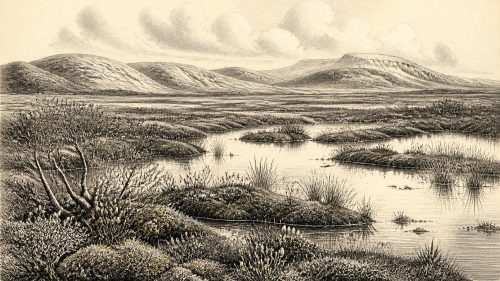
Derryvree’s Frozen Muskeg
31,446 BCE is a modern label, not a year that can be recovered from the Irish archaeological record. It corresponds approximately to 33,400 calibrated years before present (where “present” is conventionally AD 1950), in the later part of the Pleistocene and within Marine Isotope Stage 3. Neither a written calendar nor an event sequence permits historians to identify what happened during these particular twelve months. The responsible approach is therefore to place the date within wider, calibrated ranges and to ask what deposits, fossils and landforms can reveal about Ireland around it.

Hollymount’s Inter-Till Lake
31,445 BCE is a modern chronological label, not a year that can be recovered with calendar precision from the Irish archaeological record. Measured against the conventional radiocarbon baseline of AD 1950, it falls approximately 33,394 calendar years before present. At that depth of time, dates come as ranges, not anniversaries: radiocarbon ages require calibration because atmospheric carbon-14 has varied, and the resulting intervals may extend across centuries or millennia. The responsible subject is therefore Ireland during a broad part of the Late Pleistocene, rather than an invented event in one particular year.

Maguirebridge’s Three-Leaf Pool
31,444 BCE is not a recordable Irish year but falls within the climatically unstable Late Pleistocene. Deposits beneath a drumlin at Derryvree, County Fermanagh, reveal an ice-free interval containing freshwater sediments, mosses, sedges, aquatic plants, insects and pollen, indicating cold, largely treeless tundra wetland. Later ice buried and eroded much evidence. Castlepook Cave, County Cork, preserves cold-adapted fauna including mammoth, reindeer, giant deer, hyena and lemmings, though its deposits span episodes. A marked reindeer bone may indicate early human butchery, but remains unconfirmed. No secure contemporary settlement, tools, culture or institutions are known; the evidence instead documents a changing landscape.

BIRM-166’s Periglacial Pool
Around 31,443 BCE, Ireland lay within the unstable cold climate of Marine Isotope Stage 3, before the Last Glacial Maximum. Derryvree, County Fermanagh, preserves Birm-166, organic freshwater sediments between glacial tills, dated broadly to 36,900–31,700 cal BP. Its plants and insects indicate an ice-free local tundra wetland with mosses, sedges and cold-adapted flora, rather than continuous national ice cover. Greenagho supports episodic ice-free terrain. Lower sea levels altered coastlines, while cave remains indicate reindeer, mammoth and hyaena regionally. A marked Castlepook reindeer bone may suggest human activity, but lacks secure context. No evidence supports permanent settlement, polities, farming or trade.

Trifoliate Seeds Below Ice
31,442 BCE lies within Marine Isotope Stage 3, a climatically unstable Late Pleistocene interval for which precise annual dating is impossible. At Derryvree, County Fermanagh, organic freshwater sediments between glacial tills indicate locally ice-free tundra, with dwarf willow, mountain avens, sedges, mosses and bogbean. Southern Irish caves preserve remains of reindeer, mammoth, hyaena, bear, fox, hare and lemmings, although their chronology and associations require caution. A possibly tool-marked Castlepook reindeer bone suggests, but cannot confirm, human visitation. Later ice expansion destroyed much evidence, leaving sediment, seeds and bones as fragmentary records of cold ecosystems in Ireland and possible human contact.
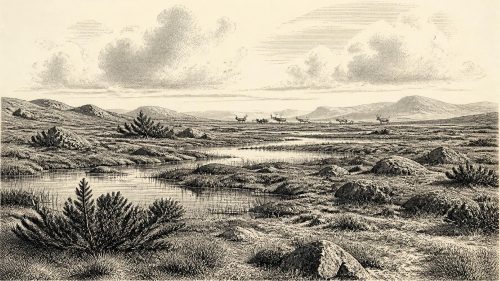
Castlepook’s Hyena Passage
Around 31,441 BCE, Ireland lay within Marine Isotope Stage 3, a fluctuating prelude to the Last Glacial Maximum rather than a uniformly ice-covered landscape. Derryvree sediments in Fermanagh indicate cold, treeless wetlands of sedges, grasses, juniper, mosses and arctic-alpine plants, alongside regional variation. Castlepook Cave in Cork preserves MIS 3 fauna including mammoth, reindeer, giant deer, bears, wolves, Arctic foxes, lemmings and spotted hyaenas, which used the cave as a den. A marked reindeer femur may indicate human butchery about 33,000 years ago, but cannot prove permanent settlement. Later glaciation erased much evidence, leaving deposits and bones as Ireland’s witnesses.

Fermanagh’s Intertill Reedbed
Around 31,440 BCE, Ireland lay within the climatically unstable later Marine Isotope Stage 3, although no evidence can identify events in that exact year. At Derryvree, County Fermanagh, freshwater silts sealed between glacial tills preserve a cold, treeless tundra wetland of sedges, mosses and shallow water. Castlepook Cave, County Cork, contains remains of mammoth, reindeer, giant deer, bear and hyena, indicating changing animal movements rather than a permanent fauna. A cut-marked reindeer bone may indicate human butchery about 33,000 years ago, but cannot prove settlement. Later glaciation obscured evidence; no politics, monuments, farming or permanent communities are firmly known anywhere.

Derryvree’s Entombed Herbarium
Around 31,439 BCE, a modern label within Marine Isotope Stage 3, Ireland was a changing cold-climate landscape rather than a historically documented society. Derryvree, County Fermanagh, preserves freshwater organic sediments beneath later glacial till, dated broadly to 36,900–31,700 calendar years BP. Pollen, plants and insects indicate open, wet tundra with sedges, mosses, herbs and pools. Cave faunas show reindeer, mammoth, hyaena and other cold-adapted animals reached Ireland, though deposits are mixed and imperfectly dated. A marked reindeer bone at Castlepook may suggest human butchery, but secure evidence of people is far later. Expanding ice eventually buried Derryvree’s wetland biological record.
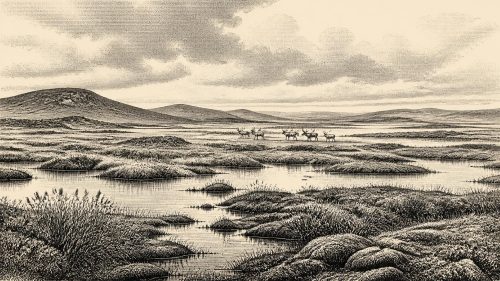
Derryvree’s Moss and Mammoths
Around 31,438 BCE, Ireland had no historical calendar, communities or written record; evidence instead describes a changing Late Pleistocene environment. At Derryvree, County Fermanagh, organic sediments between glacial tills indicate a locally ice-free, open tundra wetland during a broad, uncertain interval, later buried by ice. Plant and insect remains reveal cold, damp, sparsely vegetated ground. Castlepook Cave, County Cork, preserves mixed remains of mammoths, reindeer, giant deer, predators and other cold-adapted animals, demonstrating intermittent access to suitable habitats. A marked reindeer bone may indicate human butchery, but cannot establish settlement. Subsequent glaciation destroyed or obscured evidence of Ireland’s earliest visitors.

Derryvree’s Tundra Insects
“31,437 BCE” is a modern chronological label, not a year that anyone in Ireland could have named, recorded or commemorated. No writing, calendar, ruler-list or settlement sequence allows events to be fixed to a particular year so far back. Calendar arithmetic places the label roughly 33,386 years before AD 1950, but that must not be confused with a radiocarbon measurement. At this depth of time, archaeology works responsibly with broad phases, stratified deposits and calibrated probability ranges. The appropriate setting is the Late Pleistocene, within Marine Isotope Stage 3 (MIS 3), during the last glacial period but before the fullest expansion of the last Irish Ice Sheet.
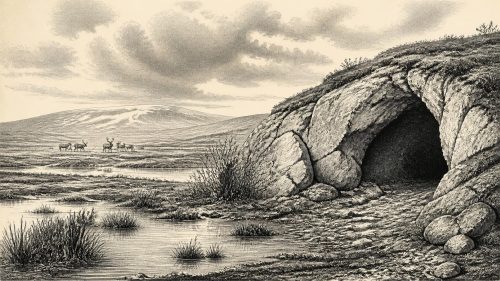
Doneraile’s Earliest Trace
At c. 31,436 BCE, Ireland cannot be described through annual events or human history, but through uncertain Late Pleistocene environmental evidence. Derryvree, County Fermanagh, preserves freshwater sediments between glacial tills, indicating episodically ice-free, cold, treeless wetlands with tundra plants during Marine Isotope Stage 3. Castlepook Cave near Doneraile contains remains of mammoth, reindeer, horse, bear, hyaena and other cold-stage fauna, although collections span long periods. A marked reindeer bone may indicate early human butchery, but sustained occupation is unproven. Dynamic ice, changing coasts and later erosion shaped intermittently habitable landscapes, while preventing reconstruction of societies, politics, settlement, or exact chronology.
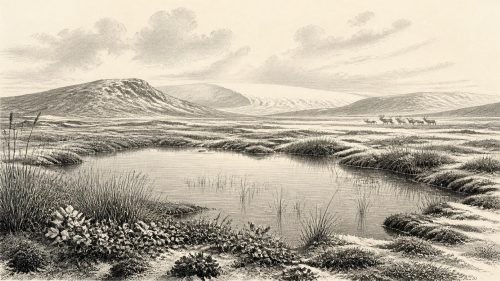
Derryvree’s Bogbean Season
Around 31,435 BCE, Ireland lay within the variable Midlandian cold stage, not a precisely reconstructable single year. Derryvree, County Fermanagh, preserves freshwater organic sediments between glacial tills, radiocarbon-dated broadly to 36,900–31,700 cal BP. Its bogbean, sedges, mosses and aquatic plants indicate treeless wet tundra with seasonal liquid water, rather than permanent ice or temperate woodland. Comparable deposits show changing local climates and ice limits. Cave fauna demonstrate that reindeer, mammoth, giant deer and predators occurred during overlapping Late Pleistocene phases, but not necessarily together. No securely dated human activity exists. Later ice expansion buried Derryvree and erased many older landscapes.

The Awbeg Tundra
Around 31,434 BCE, Ireland lay within a fluctuating Marine Isotope Stage 3 cold environment, although no event can be dated precisely to that year. Derryvree, County Fermanagh, preserves an inter-till wetland sequence showing locally ice-free, open tundra terrain with sedges, mosses, pools and cold-tolerant plants, rather than woodland. Castlepook Cave, County Cork, records a time-averaged fauna including reindeer, mammoth, giant deer and predators, indicating cold open country. A possibly stone-cut reindeer femur suggests brief human contact, but lacks secure archaeological context. No settled population, culture or institutions can be demonstrated from Ireland; later glaciation and inundation probably erased much evidence.

Derryvree’s BIRM-166 Waters
Labelled 31,433 BCE, this remote horizon cannot represent a recorded Irish year. During Marine Isotope Stage 3, Derryvree, County Fermanagh, contained freshwater sediments between glacial tills, indicating a locally ice-free, treeless tundra-wetland with cold-adapted plants and insects. Crag Cave records intermittent milder phases within an unstable glacial climate. Castlepook Cave’s MIS 3 fauna included mammoth, reindeer, giant deer, hyaena and wolf, although dates and associations remain uncertain. A marked reindeer femur may show Upper Palaeolithic butchery, but does not prove settlement. No evidence supports polities, permanent communities or cultural institutions. The evidence instead documents dynamic, locally habitable Ice Age environments.

Castlepook’s Reindeer Claim
31,432 BCE is a modern calendar label applied to a time far beyond written records, named places or annual chronologies. It cannot responsibly be treated as a year in which a dated Irish event occurred. In archaeological terms, it falls at roughly 33.4 thousand calibrated years before present, within Marine Isotope Stage 3, a long and unstable phase of the last Ice Age. The evidence for Ireland is exceptionally fragmentary: sediments sealed beneath later ice, cave bones with complicated histories, radiocarbon measurements with wide margins, and climate records that work on scales of centuries or millennia. They can illuminate a broad setting around this point, but not a day, season or individual year.

Awbeg’s Cave-Bone Archive
Around 33,000–34,000 calibrated years before present, Ireland lay in climatically unstable Marine Isotope Stage 3, with changing ice, coastlines and open habitats. Castlepook Cave, County Cork, preserves Ireland’s richest pre-Last Glacial Maximum vertebrate fauna, accumulated over millennia rather than representing one moment. Bones of mammoth, giant deer, reindeer, bear, wolf, hyaena, Arctic fox and lemmings demonstrate periodically viable cold-climate ecosystems. Radiocarbon dates require caution, especially for old collections. A modified reindeer bone may indicate human carcass processing about 33,000 years ago, but remains unconfirmed and cannot prove permanent settlement. No evidence establishes contemporary institutions, rituals, language, or sustained occupation there.

Maguirebridge’s Inter-Till Muskeg
Around 31,430 BCE, Ireland lay within the climatically unstable Late Pleistocene, not a historically recoverable single year. Derryvree, County Fermanagh, preserves freshwater organic sediments between glacial tills, demonstrating an intermittently ice-free, treeless tundra and waterlogged muskeg landscape before renewed glaciation. Castlepook Cave, County Cork, produced remains of mammoth, reindeer, giant deer, predators and other cold-adapted fauna, although these represent deposits accumulated over long periods. A possibly stone-tool-marked reindeer bone suggests a brief Upper Palaeolithic human encounter, but sustained occupation remains unproven. Ireland was an ecologically viable yet shifting Ice Age frontier, shaped by advancing ice, lower seas and uncertain connections.

Castlepook’s Stone-Scarred Femur
Around 31,429 BCE, a retrospective rather than precise date, Ireland lay within the unstable MIS 3 Ice Age environment. Castlepook Cave, County Cork, produced a reindeer femur bearing a deep stone-cut incision, possibly evidence that Upper Palaeolithic visitors processed a carcass. However, antiquarian recovery, carnivore activity and absence of associated tools or occupation deposits prevent claims of settlement. Cave faunas demonstrate reindeer, mammoths, giant deer, bears and hyaenas in productive open habitats. Derryvree sediments reveal treeless, wet tundra. Lower sea levels may have allowed crossings, but no migration evidence exists. Ireland was an ecologically variable frontier, later overwhelmed by glaciation.

Doneraile’s Single Reindeer
31,428 BCE is a notional date within Marine Isotope Stage 3, not a recoverable Irish year. Derryvree, County Fermanagh, preserves freshwater sediments between glacial tills, indicating a locally ice-free, periglacial wetland with tundra plants and animal life during a cold, unstable interval. Castlepook Cave, County Cork, contains remains of reindeer, mammoth, giant deer and predators, demonstrating a varied cold-stage fauna. A marked reindeer femur, dated broadly near this period, may record stone-tool carcass processing and Ireland’s earliest human trace. However, it proves neither settlement nor continuity. Later glaciation destroyed or buried evidence, leaving a fragmentary landscape archive for modern researchers.

BIRM-166’s Permafrost Flora
31,427 BCE is a modern label for a volatile Middle Midlandian phase of the last Ice Age, not a documented Irish year. Around this period, abrupt North Atlantic climatic shifts affected ice, drainage, vegetation and sea levels, while Ireland remained regionally varied rather than uniformly glaciated. Derryvree, County Fermanagh, preserves organic beds between tills, revealing cold, treeless freshwater wetlands with mosses, sedges and specialised plants. Castlepook Cave, County Cork, contains cold-adapted fauna, including mammoth and reindeer. A marked reindeer femur may indicate Palaeolithic butchery, but lacks corroborating archaeological context. Evidence supports intermittent habitats and possible human visits, not settled society.

Derryvree’s Arctic Willow
Around 31,426 BCE, Ireland’s history is environmental rather than political. Derryvree, County Fermanagh, preserves freshwater organic sediments between glacial tills, indicating a cold, treeless, periglacial wetland with dwarf willow, bogbean, sedges, mosses and shallow pools. Its broad radiocarbon range prevents precise annual reconstruction. Climatic conditions during Marine Isotope Stage 3 fluctuated sharply, while Crag Cave records intermittent milder phases. Castlepook Cave demonstrates that mammoth, reindeer, giant deer, bears and hyaenas occurred in Ireland during this wider period. A possibly butchered reindeer bone suggests fleeting human presence, but no settlement evidence exists. Growing ice sheets created changing, uncertain routes and refuges.
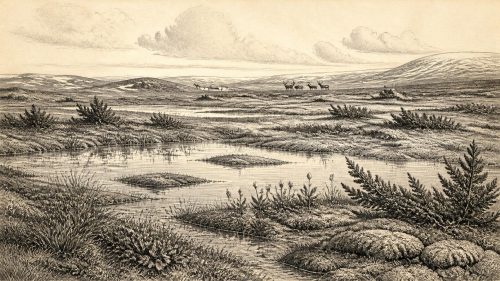
BIRM-166’s Tundra Witness
There was no calendar in Ireland in 31,425 BCE, and no evidence can identify an event in that single modern-style year. The label is nevertheless a useful point of orientation: it corresponds to roughly 33,374 years before AD 1950, the conventional reference point for “BP” dating. At this depth of time, archaeology and Quaternary science work with ranges, layers and probabilities rather than annual chronicles. The most relevant evidence places parts of Ireland within Marine Isotope Stage 3, a long, climatically unstable phase of the last Ice Age. It comes chiefly from fossil-bearing sediments in County Fermanagh and animal remains from a cave near Doneraile, County Cork.

Castlepook’s Re-Dated Menagerie
Around 31,424 BCE, Ireland lay within the unstable cold conditions of Marine Isotope Stage 3, before the Last Glacial Maximum. Lower sea levels and fluctuating ice created changing connections with Britain and continental Europe. Castlepook Cave, County Cork, preserves a complex, re-dated assemblage including mammoth, giant deer, reindeer, hyena, wolves and lemmings, demonstrating a rich, intermittent cold-stage fauna. Improved radiocarbon methods placed some remains far earlier than formerly believed, though dates remain ranges, not precise anniversaries. A cut-marked reindeer femur may indicate Upper Palaeolithic butchery, yet cannot prove settlement. Evidence depicts shifting Ice Age ecosystem; future research may clarify presence.
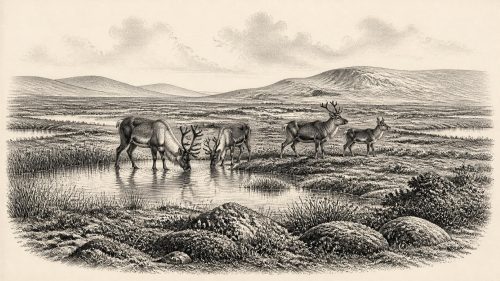
Derryvree’s Buried Pool
31,423 BCE is a modern chronological label within unstable MIS 3, not a recorded Irish year. At Derryvree, County Fermanagh, freshwater organic sediments between glacial tills indicate a temporary ice-free, treeless wetland landscape, dated broadly to 36,900–31,700 calibrated years BP. Plant and insect remains show pools, mosses and open periglacial ground. Comparable Ulster deposits demonstrate fluctuating ice cover. Castlepook Cave’s MIS 3 fauna, including reindeer, mammoth and hyaena, shows periodic ecological connections with Europe, while ancient-DNA findings remain provisional. Possible tool damage on a reindeer bone suggests, but does not establish, human visitation. Later glaciation buried or destroyed older evidence.

Maguirebridge’s Waterlogged Interval
31,422 BCE is a modern chronological label, not a date that can be recovered to the nearest year from Ireland’s Ice-Age record. No people then living in or visiting Ireland used a calendar of this kind, and neither radiocarbon dating nor glacial stratigraphy can identify an event in a single year so far back. The label corresponds broadly to 33,372 years before AD 1950, the conventional radiocarbon reference point. It belongs to the later part of the Late Pleistocene, within Marine Isotope Stage 3 (MIS 3): a long, climatically volatile portion of the last Ice Age, preceding the fullest expansion of the last British–Irish Ice Sheet.

BIRM-166’s Frozen Seedbank
Around 31,421 BCE, Ireland’s past is reconstructed from environmental rather than historical evidence. Derryvree, County Fermanagh, preserves a cold, ice-free tundra wetland between glacial advances, dated broadly to 36,900–31,700 years ago. Its plants, including bogbean, indicate pools and short productive seasons. Crag Cave records intermittent milder conditions. Castlepook Cave’s fauna, accumulated over long periods, includes mammoth, reindeer, giant deer and predators, demonstrating rich but fluctuating ecosystems. A possibly cut-marked reindeer femur may indicate Upper Palaeolithic human activity, although its context is insecure. No settlement or society is evidenced. Subsequent glaciation obscured remains, leaving a fragmentary record of landscapes and visitation.

Fermanagh’s Willow-and-Bogbean Bed
31,420 BCE is a modern label rather than a recoverable Irish year. Derryvree, County Fermanagh, preserves organic freshwater sediments, radiocarbon-dated broadly to this period, between glacial tills. Their pollen, plants and invertebrates reveal treeless tundra wetlands with bogbean, dwarf willow, mountain avens and shallow pools during a temporary non-glacial interval. Lower sea levels altered coasts, while advancing British-Irish ice later remodelled much of Ireland. Castlepook Cave, County Cork, contains mixed Pleistocene fauna, including mammoth, reindeer, giant deer, bear and hyena. A cut-marked reindeer bone may indicate transient Upper Palaeolithic human activity, but cannot demonstrate settlement, society or continuity with certainty.
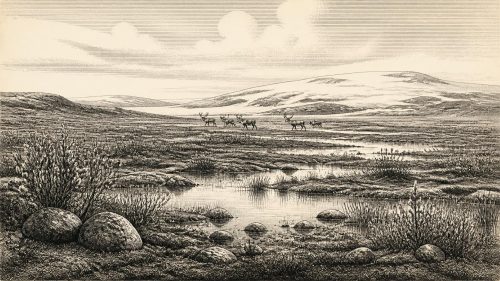
Birm-166’s Moss-Rich Mud
31,419 BCE is a label within a broad Pleistocene dating range, not a recoverable Irish year. At Derryvree, County Fermanagh, organic silts beneath later glacial till, including Birm-166, show a locally ice-free interval during Marine Isotope Stage 3. Mosses, sedges, grasses, plants and insects indicate cold, treeless, waterlogged tundra. Castlepook Cave, County Cork, preserves remains of mammoth, reindeer, giant deer and predators, although cave deposits are selective and mixed. A possibly cut-marked reindeer bone suggests brief human contact, not settlement. Later expansion of the British-Irish Ice Sheet buried deposits and reshaped landscapes, leaving sparse, local evidence of Ice Age habitats.

Derryvree’s Sedge-And-Beetle Archive
31,418 BCE denotes a broad MIS 3 interval, not a recoverable Irish year. At Derryvree, County Fermanagh, organic sediments between glacial tills record a locally ice-free, treeless wetland of sedges, mosses, bogbean and cold-adapted insects, dated broadly within the relevant period. Comparable northern deposits confirm changing conditions between ice advances. Castlepook Cave, County Cork, preserves fragmentary remains of mammoth, reindeer, giant deer, hyena and other fauna, demonstrating intermittent connections with continental Europe. A possibly cut-marked reindeer femur may indicate human activity, but lacks associated artefacts or occupation evidence. Later glaciation destroyed much evidence, leaving cautious environmental rather than historical reconstruction.

Maguirebridge’s Water-Milfoil
The label 31,417 BCE cannot identify a precise event, but falls within MIS 3, a climatically volatile Late Pleistocene interval. At Derryvree near Maguiresbridge, Fermanagh, organic freshwater sediments between tills, dated broadly to 33,500 calibrated years BP, preserve evidence of an ice-free, treeless periglacial wetland containing sedges, mosses, bogbean and alternate water-milfoil. Castlepook Cave, Cork, documents a cold-stage fauna, including mammoth, reindeer, giant deer, predators and lemmings. A marked reindeer bone may indicate human carcass processing, but remains uncertain. These fragments show a dynamic, biologically connected landscape, not uniformly ice-covered Ireland, while providing no evidence for settlement, society or polity.

Derryvree’s Hidden Wetland
At notional 31,416 BCE, Ireland cannot be described through calendar-year history but broad late MIS 3 environmental evidence. Derryvree, County Fermanagh, preserves freshwater organic sediments between glacial tills, indicating a cold, treeless, wet tundra or muskeg interval between ice advances. Plants, insects and pollen suggest sedges, mosses, herbs and shallow pools in a severe periglacial climate. Cave deposits at Castlepook record open-country fauna including reindeer, mammoth, giant deer, predators and lemmings, though not contemporaneous communities. A marked reindeer bone may indicate brief Upper Palaeolithic human activity, but no secure settlement evidence exists. Climatic instability and advancing ice defined this landscape.

The Reindeer Femur at Castlepook
Around 31,415 BCE, Ireland lay within the climatically unstable Marine Isotope Stage 3, approaching but preceding maximum last-glacial ice expansion. Evidence cannot date events to a single year. Derryvree sediments in Fermanagh indicate locally ice-free, treeless, cold wetlands with open vegetation. Castlepook Cave, Cork, yielded reindeer, mammoth, giant deer, predators and other cold-climate fauna; revised dating places key remains in this period. A reindeer femur bearing possible stone-tool cut marks suggests, but does not prove, human activity. Mixed cave deposits and absent associated artefacts preclude claims of settlement. Ireland’s record documents environments and animal movements; secure human evidence came later.
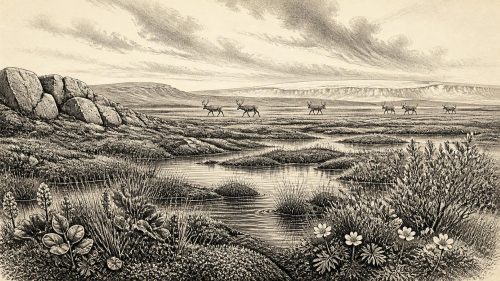
Hyenahall’s Reindeer Corridor
About 31,414 BCE, Ireland belonged to the unstable, cold later Pleistocene, not a historically datable nation. Calibrated evidence from Derryvree, County Fermanagh, indicates treeless tundra, wet hollows and shallow freshwater before renewed glaciation buried the deposits. Castlepook Cave, County Cork, preserves a time-mixed fauna including reindeer, mammoth, giant deer, hyena and Arctic fox, showing ecologically productive open country. A possibly cut-marked reindeer bone may indicate fleeting Upper Palaeolithic human activity in Ireland, but no settlement or associated tools are proven. Shifting ice, coasts and habitats governed survival, leaving evidence of landscapes and animals rather than societies, institutions or permanent communities.
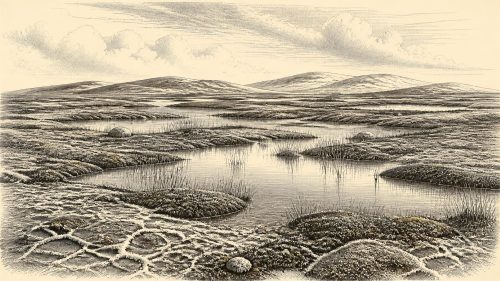
Derryvree’s Bogbean Wetland
At the notional date of 31,413 BCE, Ireland’s evidence records environmental change rather than history. Derryvree, County Fermanagh, preserves freshwater sediments between glacial tills, dated broadly to 36,900–31,700 calibrated BP. Pollen, plants, mosses and insects indicate exposed, treeless tundra-like wetland, with bogbean, sedges and standing water, during an ice-free interval later overwhelmed by glaciers. Castlepook Cave, County Cork, confirms Marine Isotope Stage 3 fauna including reindeer and mammoth. A marked reindeer femur may indicate human butchery, yet cannot prove occupation. Ireland was a climatically unstable, intermittently habitable landscape approaching extensive glaciation, with no securely evidenced society or settlement at all.

Derryvree’s Mossy Margin
At the notional date of 31,412 BCE, Ireland’s history is reconstructed from environmental evidence rather than annual records. Derryvree, County Fermanagh, preserves a freshwater wetland deposited between glaciations, indicating open, treeless tundra with mosses, pools, sedges and sparse vegetation. Crag Cave’s intermittent calcite growth demonstrates millennial climatic shifts and periods above freezing. Castlepook Cave in County Cork contains Ice Age fauna, including reindeer, mammoth and hyaena, and a possibly stone-tool-marked reindeer femur suggesting fleeting human activity. However, no securely dated occupation evidence exists. Ireland remained a climatically unstable, increasingly glaciated landscape, not a settled or politically identifiable society at all.
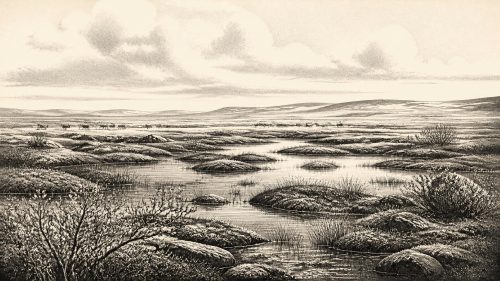
Derryvree’s Clubmoss Basin
31,411 BCE is a retrospective label, approximately 33,361 cal BP, not a date permitting year-specific Irish history. Derryvree, County Fermanagh, preserves freshwater organic sediments between tills, documenting an ice-free Middle Midlandian interval within fluctuating glacial conditions. Its sedges, mosses, clubmoss, dwarf willow and other remains indicate treeless periglacial wetlands rather than continuous ice or forest. Later ice buried this local archive as ice-sheet expansion developed. Castlepook Cave, County Cork, contains cold-adapted fauna and reindeer bone with a possible stone-tool cut mark, suggesting but not proving brief Upper Palaeolithic human visits. No settlement, tools, ritual, economy or political society is known.

Castlepook’s Uncertain Hunters
31,410 BCE is a modern label for a broad, uncertain interval in Ireland’s Late Glacial history, not a recoverable annual event. Derryvree, County Fermanagh, preserves freshwater sediments between tills, showing locally ice-free, treeless tundra wetlands with arctic-alpine flora during Marine Isotope Stage 3. Castlepook Cave, County Cork, contains a disturbed but significant fauna including reindeer, mammoth, giant deer, carnivores and lemmings, indicating cold open habitats. A marked reindeer femur may record butchery by people around 33,000 years ago, but cannot prove permanent occupation. As ice-sheet expansion approached, evidence portrays diversity, fragmentary records and possible transient hunters, not settlements or polities.

Maguiresbridge’s Coldwater Silts
Around 31,409 BCE, Ireland lay within Marine Isotope Stage 3 of the Last Glacial Period, though evidence cannot identify events in a single year. Freshwater silts at Derryvree, County Fermanagh, accumulated between glacial episodes and indicate cold, treeless, tundra-like wetlands with shallow water and sparse vegetation. Their calibrated age range plausibly includes this date, but does not establish island-wide conditions. Castlepook Cave, County Cork, preserves mixed remains of mammoth, reindeer, giant deer and other fauna, showing wider ecological connections. A possibly butchered reindeer bone may indicate a brief human visit, but no evidence demonstrates permanent Palaeolithic occupation, settlements or institutions.

Crag Cave’s Thaw Signals
31,408 BCE is a modern nominal date, not a recoverable Irish year. During climatically unstable Marine Isotope Stage 3, Ireland contained varying ice, tundra wetlands and occasional milder conditions. Derryvree, County Fermanagh, preserves freshwater sediments indicating treeless, seasonal, periglacial habitat with plants, insects and pools before later glaciation. Crag Cave calcite shows intermittent above-freezing water circulation in south-west Ireland. Castlepook Cave’s fauna includes reindeer, mammoth, giant deer, carnivores and hyena, although deposits span millennia. A possibly stone-cut reindeer bone may indicate human butchery, but cannot prove occupation. No securely dated settlements, tools, institutions or practices are known; evidence remains fragmentary.

BIRM-166 Below the Drumlin
31,407 BCE is a modern label within a broad MIS 3 dating range, not a recoverable annual event. Ireland experienced fluctuating cold conditions as ice expanded, producing a patchwork rather than uniform glaciation. At Derryvree, Fermanagh, freshwater sediments beneath a drumlin document locally ice-free, treeless, periglacial wetlands with plant and insect life. Castlepook Cave, Cork, preserves a disturbed MIS 3 fauna including mammoth, giant deer, reindeer, bear and hyaena, evidencing changing cold-stage ecosystems. A cut-marked reindeer bone may indicate transient Upper Palaeolithic visitors, but proves neither settlement nor continuity. Changing seas and erosion limited survival. Uncertainty fundamentally defines this period.

Hyaena Hall’s Reindeer World
31,406 BCE is a modern label within Marine Isotope Stage 3, not a precisely recoverable Irish year. Derryvree, County Fermanagh, preserves pre-glacial wetland sediments indicating open, treeless, tundra-like ground with grasses, sedges, mosses, herbs and freshwater habitats. Castlepook Cave, County Cork, contains mixed, long-accumulated faunal remains, including reindeer, mammoth, giant deer, hyaena, wolves, foxes and lemmings, evidencing cold open landscapes. A marked reindeer femur may indicate Upper Palaeolithic butchery, but cannot establish settlement or continuous occupation. No tools, hearths, burials or social institutions are securely known. Later glaciation and mixed deposits limit certainty, revealing active ecosystems rather than historical society.
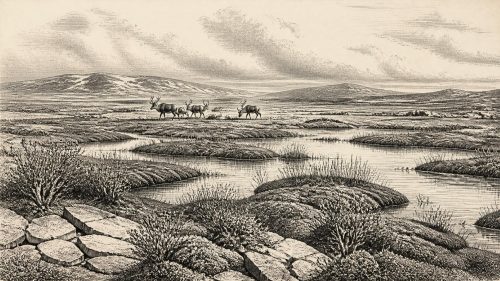
BIRM-166’s Pollen Census
31,405 BCE cannot denote a precisely dated Irish event, but falls within Marine Isotope Stage 3. At Derryvree, County Fermanagh, freshwater sediments between glacial tills, dated broadly to 34,950–29,750 BCE, preserve pollen, plants, mosses and beetles from an ice-free, treeless periglacial wetland. Comparable deposits confirm episodic cold open habitats, while Crag Cave records warmer interstadials. Castlepook Cave, County Cork, yielded cold-adapted fauna and a reindeer femur possibly bearing butchery marks, suggesting, but not proving, brief human presence. Later glaciation damaged evidence. No settlements, polities, trade or sustained occupation can be demonstrated; the period is reconstructed from environmental and faunal archives.
Awbeg’s Treeless Hinterland
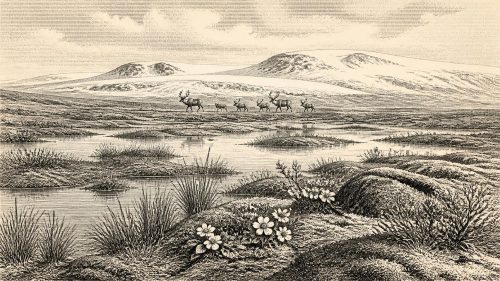
Around 31,404 BCE, Ireland was in Marine Isotope Stage 3, a cold, unstable phase before the Last Glacial Maximum, not a precisely datable historical year. Derryvree sediments in County Fermanagh record a freshwater, periglacial tundra mosaic between ice advances, with mosses, sedges, herbs and Arctic-alpine plants rather than woodland. Castlepook Cave, County Cork, preserves diverse fauna including reindeer, mammoth, giant deer, predators and smaller mammals, accumulated over long periods. A possibly cut-marked reindeer bone may indicate brief Upper Palaeolithic human activity, but proves neither settlement nor population. Lower sea levels facilitated regional movement, while advancing ice reshaped and destroyed landscapes.

Derryvree’s Winter Mosses
Around 31,403 BCE, Ireland’s past is reconstructed from environmental evidence rather than records. Derryvree, County Fermanagh, preserves freshwater sediments between glacial tills, dated broadly to 36,900–31,700 calendar years BP. Their mosses, plants, insects and pollen indicate an ice-free, treeless, tundra-like wetland during an unstable Late Pleistocene phase. Ice sheets were expanding but had not reached their later maximum. Castlepook Cave’s faunal remains, including reindeer and other cold-adapted animals, show ecological links with north-west Europe. A possibly cut-marked reindeer bone suggests human visitation, but no secure occupation evidence exists. Later glaciation erased much evidence, leaving a fragmentary yet intermittently habitable landscape.

Maguirebridge Drumlin Wetlands
The notional date 31,402 BCE denotes an uncertain interval in later Marine Isotope Stage 3, not a recorded event. At Derryvree near Maguiresbridge, freshwater silts between glacial deposits preserve evidence of a cold, largely treeless tundra-like wetland with mosses, sedges, grasses and pools. Radiocarbon calibration places it broadly between 36,900 and 31,700 years BP. Climatic fluctuations brought alternating milder and colder conditions before later ice-sheet expansion. Cave fossils document reindeer and other Ice-Age animals. A contested cut mark on a Castlepook reindeer bone may indicate brief human activity, but proves neither settlement nor social organisation. It records only environmental change.

Castlepook’s Unquiet Hinterland
Around 31,401 BCE, Ireland was in the climatically volatile later Pleistocene, before maximum expansion of the British–Irish Ice Sheet. Evidence from Crag Cave indicates intermittent thawing in south-west Ireland, while sub-till deposits at Derryvree and Greenagho record ice-free freshwater tundra, with sedges, mosses and arctic-alpine plants. Castlepook Cave preserves a diverse MIS 3 fauna, including mammoth, reindeer, giant deer, predators and spotted hyena, demonstrating productive open habitats. A cut-marked reindeer femur may indicate brief Upper Palaeolithic human activity, but cannot establish settlement. No polities, agriculture or recorded beliefs existed; surviving evidence instead reveals changing environments and severe archaeological uncertainty overall.