
31300–31201 BCE
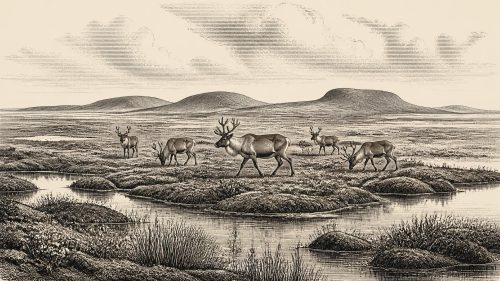
Fermanagh Grasses
Thirty-one thousand three hundred BCE has no identifiable Irish event, but falls within MIS 3’s unstable cold climate. At Derryvree, Fermanagh, freshwater silts between glacial tills, radiocarbon dated broadly to this period, preserve evidence of a treeless, periglacial wetland with grasses, sedges, herbs, juniper, mosses and aquatic plants. Castlepook Cave, Cork, records Late Pleistocene mammals including reindeer, mammoth, giant deer, wolves and hyaenas, demonstrating episodically viable open habitats. A cut-marked reindeer femur may indicate human butchery, but remains inconclusive. No settlements or cultural evidence survive. Growing ice sheets increasingly restricted life before the Last Glacial Maximum later in the period.
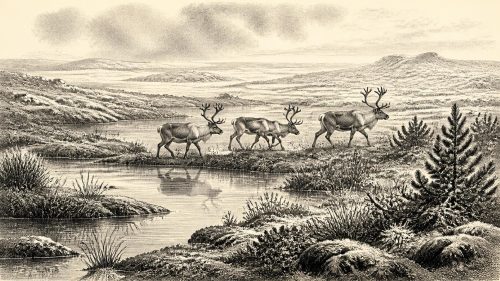
Buried Organics
Labelled 31,299 BCE, this period cannot be identified as a precise Irish historical year, but falls within a broad late Marine Isotope Stage 3 interval. Derryvree, County Fermanagh, preserves freshwater and organic sediments between glacial tills, showing locally ice-free, biologically productive tundra-like wetland conditions. Its radiocarbon date BIRM-166 calibrates broadly to 36,900–31,700 years before present. Castlepook Cave, County Cork, records reindeer, mammoth and hyaena from changing pre-maximum glacial faunas. A marked reindeer femur may indicate human butchery, but proves neither settlement nor population. Evidence instead reveals intermittent ecological opportunities before later glaciation, not continuous habitation, societies, or events with certainty.
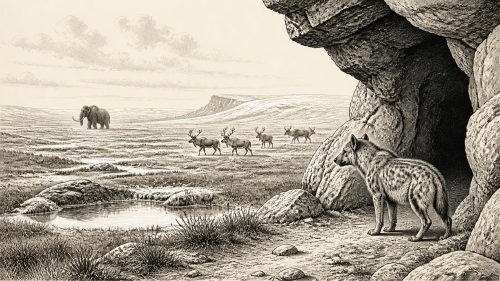
Cave Scavengers
Around 31,298 BCE, Ireland cannot be reconstructed as a dated historical event, but evidence places it within variable MIS 3 Ice-Age conditions. Castlepook Cave, County Cork, preserves fauna accumulated over millennia, including mammoth, reindeer, giant deer, bears, wolves and spotted hyenas, indicating cold open steppe habitats and continental connections before the Last Glacial Maximum. Derryvree, County Fermanagh, records tundra wetlands in a related period. Changing sea levels, ice margins and glaciation shaped access and preservation. A disputed modified reindeer bone suggests possible human activity, but no secure settlement exists. Ancient DNA may clarify faunal links; permanent occupation there remains unproven.
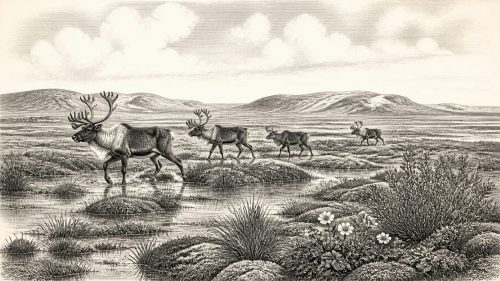
Treeless Pools
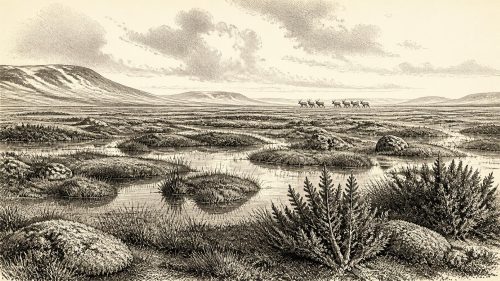
31,297 BCE denotes a broad Late Pleistocene horizon, not a recoverable Irish calendar year. At Derryvree, County Fermanagh, organic sediments between glacial tills indicate an ice-free interlude around 33,500 cal BP, with cold, wet, treeless tundra, pools and mountain avens. Crag Cave records intermittent liquid-water conditions, while Castlepook Cave preserves mammoth, reindeer, giant deer, predators and other open-country fauna. A marked reindeer femur may indicate human handling, but disturbed context prevents proof of settlement. Any visitors were probably mobile hunter-gatherers. Later ice-sheet expansion erased evidence, leaving fragmentary records of varied environments and only tentative evidence for early people in Ireland.
Tundra Organics
Rather than documenting a single year, evidence for Ireland around 31,296 BCE describes a variable later MIS 3 environment. At Derryvree, Fermanagh, organic freshwater sediments between tills indicate a locally ice-free tundra wetland with mosses, sedges, low shrubs and cold-adapted plants. Castlepook Cave, Cork, preserves a long-accumulated fauna of mammoth, giant deer, reindeer, predators and scavengers, demonstrating intermittent access for cold-stage mammals. Ice conditions, sea levels and routes changed repeatedly, preventing island-wide conclusions. A possibly stone-tool-marked reindeer bone may indicate brief Upper Palaeolithic human activity, but lacks contextual evidence of settlement. No states, agriculture or named peoples can be claimed.

Shifting Fauna
Around 31,295 BCE is a modern approximation within Ireland’s climatically unstable Middle Midlandian, not a precise historical date. Derryvree, County Fermanagh, preserves a wetland between glacial tills, demonstrating ice-free intervals with cold, open tundra vegetation and freshwater habitats. Castlepook Cave near Doneraile records diverse pre-Last Glacial Maximum fauna, including mammoth, giant deer, reindeer, hyena, wolves and Arctic species, though deposits are mixed. A cut-marked reindeer femur may indicate brief human butchery, but cannot prove settlement. No evidence exists for communities, politics, religion or farming. The period instead reveals a shifting, periglacial Atlantic landscape supporting cold-adapted animals and possibly transient foragers.
Toolmark Doubt
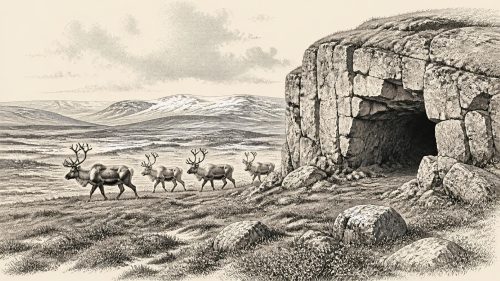
31,294 BCE is best treated as an approximate point within Ireland’s late Marine Isotope Stage 3, not a recoverable historical year. Cold, changing landscapes, lowered seas and expanding ice shaped an uncertain geography. Castlepook Cave, County Cork, preserves fauna including mammoth, giant deer, reindeer, bear and spotted hyena, demonstrating links with wider northern European ecosystems over millennia. A reindeer femur dated about 31,000 BC bears a possible stone-tool cut mark, suggesting brief Upper Palaeolithic human activity. However, no associated tools, hearths or settlements exist. Excavation disturbed evidence, but renewed dating, analyses and fieldwork may identify intact deposits, clarifying human presence.
Mossy Pools
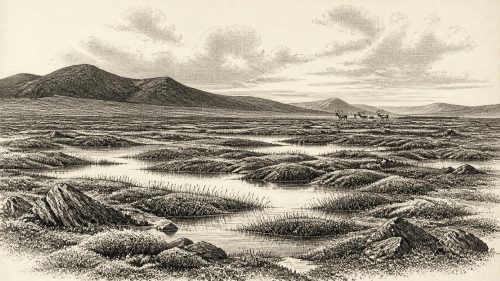
Around 33,000 years ago, later Marine Isotope Stage 3 Ireland experienced an unstable transition towards wider glaciation, not a precisely datable historical year. At Derryvree, County Fermanagh, freshwater deposits beneath glacial sediments show a locally ice-free periglacial landscape of tundra, wetlands, mosses, sedges and shallow pools. Ice expanded unevenly, with the British-Irish Ice Sheet reaching its maximum only later. Castlepook Cave, County Cork, preserves varied fauna, including mammoth, reindeer, giant deer, bears, wolves, foxes, lemmings and hyenas, demonstrating episodic ecological connectivity. A possibly tool-marked reindeer bone may indicate brief human presence, but no evidence establishes settlement, chronology, or resident communities.
Unproven Butchery
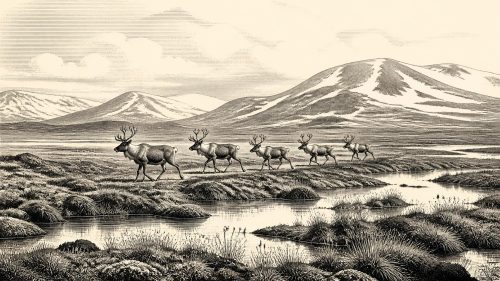
31,292 BCE cannot identify a discrete Irish event, but falls within climatically unstable Marine Isotope Stage 3. Before maximum glaciation, Ireland contained varied, partly ice-free landscapes, although routes from Britain or Europe remain unproven. Derryvree sediments in Fermanagh preserve evidence of treeless, periglacial wetland supporting cold-adapted plants, insects and herbivores between ice advances. Castlepook Cave in Cork contains diverse cold-stage fauna, including mammoth, reindeer and hyaena, accumulated over different periods. A cut-marked reindeer femur may indicate Upper Palaeolithic butchery, but cannot prove settlement. Subsequent glaciation probably destroyed evidence, leaving only a possibility of brief human visits during this remote period.
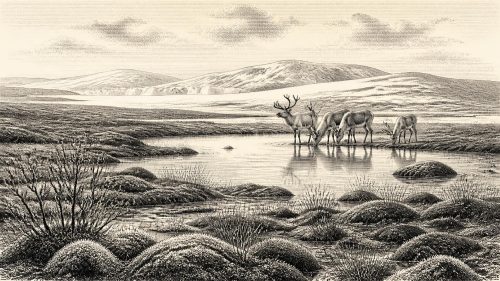
Sedge Marsh
At approximately 33,240 cal BP, corresponding broadly to 31,291 BCE, Ireland experienced the climatically unstable Marine Isotope Stage 3. Ice-free and glacial conditions alternated, while lower sea levels reshaped coasts without guaranteeing land bridges. At Derryvree, County Fermanagh, freshwater sediments dated 36,900–31,700 cal BP preserve evidence of sedges, grasses, mosses and cold-adapted wetland plants in a treeless landscape. Castlepook Cave, County Cork, records a time-averaged fauna including reindeer, mammoth, giant deer, predators and lemmings. Possible cut marks on reindeer bone suggest unconfirmed human visitation. Later glaciation destroyed much evidence, leaving environmental change, rather than recorded society, as this period’s history.
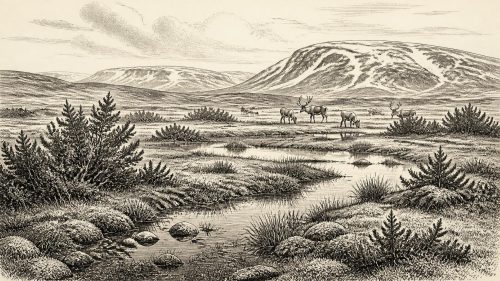
Sedge Mosaic
At 31,290 BCE, Ireland cannot be described through a precisely dated historical event, but through a Late Pleistocene environmental horizon. Derryvree, County Fermanagh, preserves freshwater sediments and organic remains between glacial tills, indicating an ice-free periglacial mosaic of tundra, wetlands, grasses, sedges and juniper during MIS 3. Its radiocarbon date spans a broad calibrated range, including this notional year. Crag Cave records milder episodic conditions, while Castlepook Cave documents cold-adapted fauna, including mammoth, reindeer, giant deer, hyaena and Arctic fox. Human presence remains possible, based on a potentially butchered reindeer bone, but settlement is unproven. Evidence reveals ice and water.
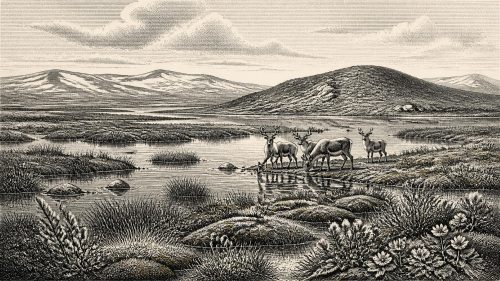
Seasonal Frost
Around 31,289 BCE, Ireland’s history is reconstructed from uncertain Pleistocene environmental evidence, not recorded events. Derryvree in Fermanagh preserves organic freshwater sediments between glacial tills, indicating a cold, treeless, periglacial wetland with sedges, mosses, aquatic plants and seasonal frost. Comparable northern deposits demonstrate repeated ice advances and ice-free intervals. Castlepook Cave in Cork yielded MIS 3 fauna, including reindeer, mammoth, giant deer and hyaena. A possibly cut-marked reindeer bone suggests human carcass processing, but does not prove settlement. No identifiable societies, institutions, beliefs or continuous human occupation can be established; the evidence securely depicts a changing, wildlife-rich Ice Age landscape.
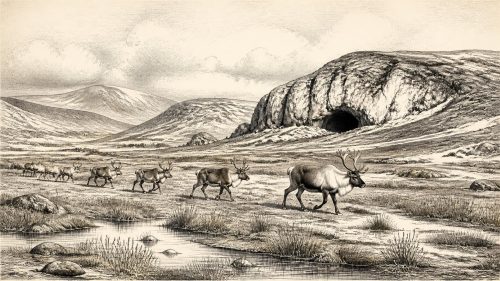
Tentative Trace
At roughly 33,200 years before present, Ireland lay within the climatically volatile later Marine Isotope Stage 3. Derryvree deposits indicate tundra wetlands and periglacial conditions, while Crag Cave stalagmites record recurrent milder intervals. Castlepook Cave near Doneraile preserves a mixed Ice Age fauna including reindeer, mammoth, giant deer, hyaena and bears. A reindeer femur reportedly dated to about 33,000 years ago bears a possible stone-tool butchery mark, perhaps Ireland’s earliest direct human trace. However, no associated tools, hearths or settlements confirm occupation. Changing ice, sea levels and habitats shaped animal and potential human movement. Later glaciation may have erased evidence.
Uncertain Deposits
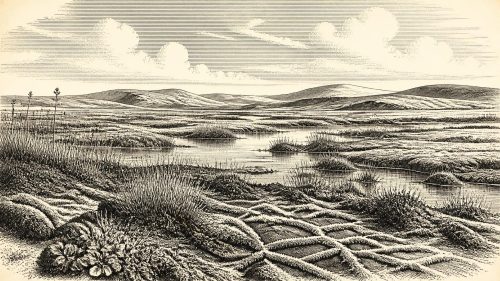
At the notional date of 31,287 BCE, Ireland lacked annual historical evidence; reconstruction relies on Late Pleistocene deposits. Derryvree, County Fermanagh, records a broadly dated, locally ice-free MIS 3 interval between glacial advances, with freshwater sediments, tundra vegetation, wetlands and periglacial conditions. Castlepook Cave, County Cork, preserves time-averaged remains of mammoth, reindeer, giant deer, bear and hyaena, demonstrating varied cold-stage fauna. A marked reindeer femur may indicate Upper Palaeolithic carcass processing, but remains contested and cannot prove settlement. Ireland faced climatic instability and impending wider glaciation, while evidence reveals neither polities nor established economy or human population at this time.
Castlepook Denning
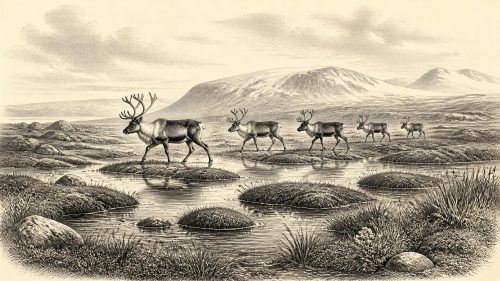
About 33,235 years ago, during Marine Isotope Stage 3, Ireland experienced fluctuating cold conditions rather than a single climate. At Derryvree, County Fermanagh, freshwater sediments between glacial tills preserve evidence of open tundra, wet muskeg, pools, mosses and cold-adapted life during an ice-free interval. Crag Cave records episodic milder phases. Castlepook Cave, County Cork, yielded abundant remains of mammoth, giant deer, reindeer, bears, hyaenas and other Ice Age animals; coprolites and crushed bones indicate hyaena denning. Faunal evidence shows intermittent European connectivity, though routes remain uncertain. No secure evidence demonstrates human settlement then; Ireland’s earliest accepted human activity dates later.
Reindeer Scarring
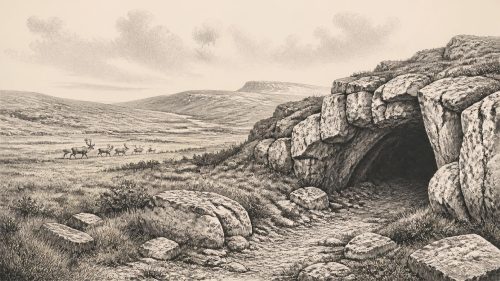
Around 31,285 BCE, Ireland lay within the fluctuating cold conditions of Marine Isotope Stage 3, before the Last Glacial Maximum. Southern landscapes probably comprised open tundra and steppe supporting reindeer, mammoth, giant deer, predators and smaller mammals. Castlepook Cave, County Cork, preserves a disturbed, repeatedly accumulated fauna rather than a single contemporary scene. A reindeer femur, dated approximately 31,000 BCE, bears a mark interpreted as possible stone-tool butchery, potentially Ireland’s earliest evidence of human activity. Yet no sealed occupation, tools, hearths or human remains confirm settlement. Later glaciation and sea-level change destroyed evidence; further dating and excavation remain especially essential.

Derryvree Bog
31,284 BCE is a modern label rather than a recorded Irish year. Derryvree, County Fermanagh, preserves freshwater sediments between glacial tills, dated broadly to a period encompassing this date, showing an ice-free tundra wetland with mosses, sedges and insects. Castlepook Cave, County Cork, contains MIS 3 fauna, including mammoth, reindeer, giant deer, predators and smaller cold-adapted animals, accumulated over millennia. A marked reindeer femur may indicate human butchery around 33,000 years ago, but remains disputed and cannot demonstrate settlement. Evidence supports intermittently habitable, climatically changing Pleistocene landscapes, not kingdoms, permanent communities or a specific event in the nominated year itself.
Treeless Freshwater
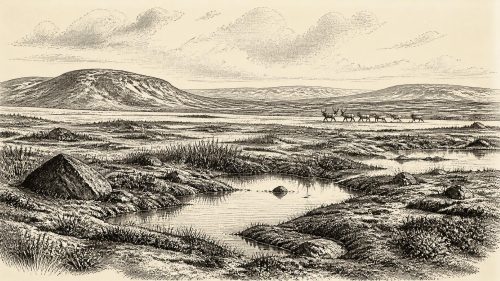
About 31,283 BCE, Ireland’s history is reconstructed from uncertain environmental and archaeological evidence, not annual events. During late Marine Isotope Stage 3, fluctuating Ice Age conditions produced shifting ice, exposed ground and wetlands. At Derryvree, Fermanagh, organic sediments sealed between glacial tills record an ice-free, treeless freshwater tundra with mosses, sedges and shallow water. Castlepook Cave, Cork, preserves pre-Last Glacial Maximum fauna, including reindeer, mammoth, giant deer, predators and cold-adapted small mammals. A marked reindeer femur may indicate human butchery, but cannot prove settlement or continuous occupation. No evidence supports communities, polities, farming or trade. Later glaciation erased much evidence.

Pleistocene Connectivity
Approximately 31,282 BCE represents a broad Late Pleistocene horizon, not a precise date, within unstable MIS 3 conditions preceding the Last Glacial Maximum. At Derryvree, County Fermanagh, organic freshwater deposits between glacial tills record cold, open tundra-steppe wetlands, although their dated range cannot define island-wide conditions. Lower sea levels connected Ireland ecologically with neighbouring regions, but routes varied. Castlepook Cave, County Cork, preserves diverse Ice Age fauna and a reindeer femur dated near this period, whose possible stone-tool cut mark may indicate human carcass processing. Disturbed contexts prevent certainty. Later ice erased evidence, leaving environmental change and possible human visitation.
Bogbean Avens
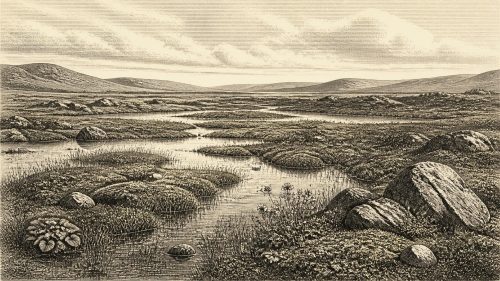
31,281 BCE is a modern label for a poorly resolved Late Pleistocene interval, rather than a recoverable Irish year. At Derryvree, County Fermanagh, freshwater sediments between glacial tills, dated broadly to 36,900–31,700 calibrated years BP, reveal treeless tundra wetland with bogbean, mountain avens and sedges. Castlepook Cave, County Cork, preserves evidence of diverse cold-climate fauna, including reindeer, mammoth, giant deer, predators and smaller mammals, demonstrating connectivity with north-west Europe. A marked, dated reindeer bone may indicate human butchery, but remains inconclusive. Ireland was an unstable frontier of ice-free habitats and advancing glaciers, without evidence for settled communities, polities or culture.
Castlepook Creatures
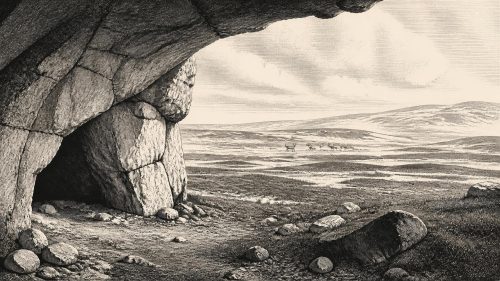
Around 33,200 calibrated years before present, Ireland lay within the climatically unstable Late Pleistocene, although no evidence can identify conditions in 31,280 BCE precisely. Ice sheets, sea levels and coastlines changed unevenly, while later glaciation destroyed much terrestrial evidence. Castlepook Cave in County Cork preserves Ireland’s richest relevant fauna, including mammoth, giant deer, reindeer, bear and hyena, accumulated across extended periods rather than a single moment. Redating places some remains in MIS 3, supporting intermittent animal occupation. A reportedly cut-marked reindeer bone may indicate human visitation, but remains contested and cannot demonstrate settlement. Evidence remains fragmentary, not an annual narrative.

Uncertain Visitation
31,279 BCE is a modern chronological label, not an identifiable Irish historical year. During Marine Isotope Stage 3, Ireland experienced severe, fluctuating glacial conditions, altered coastlines and open tundra-wetland habitats. Derryvree, County Fermanagh, preserves organic sediments indicating mosses, grasses, sedges, herbs, juniper, pools and cold-phase biodiversity between glacial advances. Castlepook Cave, County Cork, accumulated fauna over millennia, including mammoth, giant deer, reindeer and hyaena, shaped by carnivore activity and disturbance. A marked reindeer femur, tentatively interpreted as stone-tool butchery, may indicate human presence, but proves neither settlement nor society. The evidence reveals ecological opportunity, climatic instability and uncertain human visitation.

Mammoth Reindeer
31,278 BCE is a modern label, requiring interpretation through Late Pleistocene ranges rather than a dated Irish event. During climatically unstable Marine Isotope Stage 3, Ireland varied regionally between ice-affected and open environments. Derryvree sediments preserve a cold, treeless freshwater wetland supporting plants and insects between glacial episodes. Castlepook Cave in County Cork contains mixed, disturbed remains of reindeer, mammoth, giant deer and carnivores, demonstrating cold-stage fauna but not a single contemporaneous community. A cut-marked reindeer bone may indicate brief human butchery, although this remains debated. No evidence supports settlement, polity, ritual or trade; glaciation and sea-level change erased evidence.

Fermanagh Shallows
Around 31,277 BCE, Ireland lay in the unstable later Marine Isotope Stage 3, approaching the Last Glacial Maximum, rather than within recoverable written history. Ice expanded unevenly across the region, leaving temporary exposed, wetland or marine environments. At Derryvree, County Fermanagh, freshwater silts between tills preserve pollen, plants and beetles indicating shallow water, tundra-like ground and severe seasonal conditions before later ice advance. Cave remains from Castlepook suggest cold-open-country fauna, including reindeer, mammoth and predators, but accumulated across long periods. A possibly cut-marked reindeer bone offers uncertain evidence of early people; permanent settlement, politics, trade and social life remain unproven.
Willow Bogbean
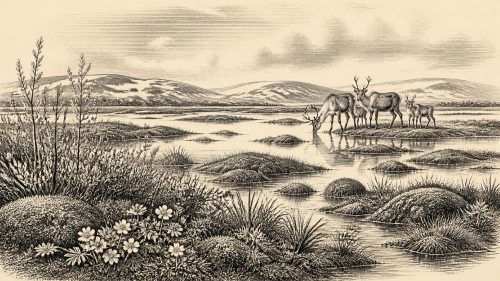
About 31,276 BCE, Ireland lay within the unstable later Marine Isotope Stage 3, not a datable historical year. Derryvree, County Fermanagh, preserves freshwater sediments between glacial tills, indicating an ice-free tundra wetland with sedges, grasses, dwarf willow, mountain avens, bogbean, water-milfoil and cold-adapted insects. Other northern deposits suggest recurrent open conditions. Castlepook Cave fauna indicates large mammals, including mammoth, reindeer and giant deer, but complex deposits limit precise dating. Ice was expanding before the Last Glacial Maximum. A possibly cut-marked reindeer bone suggests fleeting human presence, not settlement. Evidence supports a changing, resource-bearing landscape, while excluding claims of organised society.
Disturbed Stratigraphy
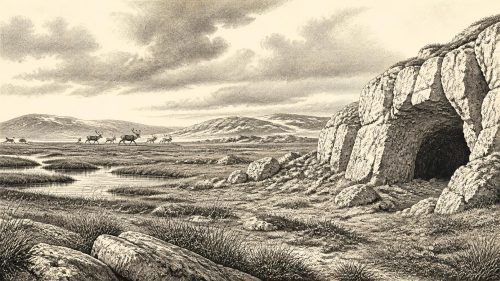
Around 33,224 calibrated years before present, Ireland occupied a volatile Late Pleistocene landscape of low seas, changing ice margins and largely treeless steppe-tundra. Its precise ice cover and connections to neighbouring lands remain uncertain. Castlepook Cave in north Cork preserves re-dated Marine Isotope Stage 3 remains of mammoth, reindeer, giant deer, carnivores and cold-adapted small mammals, though disturbed cave deposits cannot show they lived together. A marked reindeer femur may indicate human butchery around 33,000 years ago, but lacks secure archaeological context. No evidence supports settled population or social detail. Castlepook instead underscores cautious dating, taphonomic study and renewed excavation.
Animal Movement
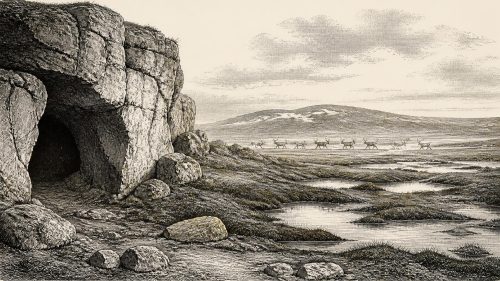
Around 31,274 BCE, Ireland experienced late Marine Isotope Stage 3 climatic deterioration before the Last Glacial Maximum. Open, treeless tundra, freshwater pools and periglacial conditions are evidenced at Derryvree, County Fermanagh. Castlepook Cave, County Cork, preserves remains of reindeer, mammoth, giant deer, brown bear, wolf and spotted hyaena, indicating intermittent animal movement through changing Ice Age landscapes. A marked reindeer bone may suggest early human butchery, but remains insufficient proof of occupation. Later ice advances destroyed or buried much evidence. This period therefore represents an uncertain environmental horizon, reconstructed through caves, sediments and re-dated animal remains rather than human history.
Organic Wetland
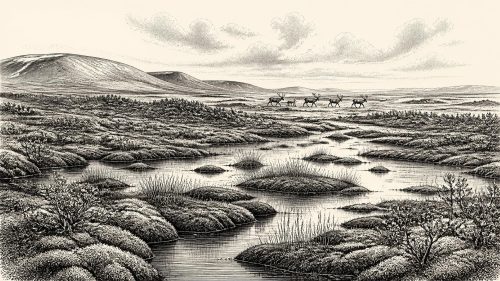
Although 31,273 BCE is a modern label rather than a precise lived date, Derryvree in County Fermanagh preserves evidence of an ice-free interval during late MIS 3. Its organic bed, deposited between glacial sediments, records open wetland with tundra plants, insects and freshwater pools. Ireland’s ice history was regionally uneven, with later maximum glaciation and climatic fluctuations indicated by Crag Cave. Castlepook Cave’s fauna demonstrates the presence of mammals and predators in southern Ireland; a cut-marked reindeer bone may indicate human butchery. These fragmentary archives suggest habitable landscapes and mobile people, but not settlement, polities, trade or annual historical events.
Sedge Mosses
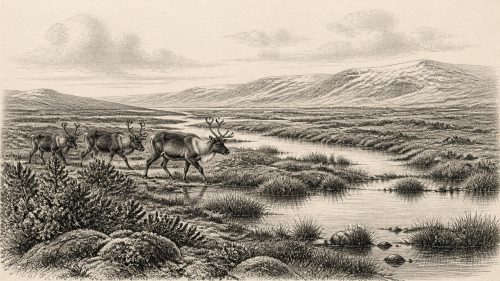
31,272 BCE is a notional date within uncertain Late Pleistocene chronologies, roughly 33,200 years before 1950. Derryvree, County Fermanagh, preserves freshwater organic deposits between glacial tills, indicating an open, treeless, sedge- and moss-rich wetland with pools, short growing seasons and periglacial cold during unstable MIS 3 conditions. Castlepook Cave, County Cork, contains remains of mammoth, reindeer, giant deer, hyaena and other fauna, showing intermittent habitats for cold-stage animals. A cut-marked reindeer bone may indicate early human butchery, but cannot prove settlement. No political, cultural or economic institutions are evidenced; Ireland’s recoverable history is environmental and fragmentary rather than event-based narrative.

Icefree Wetlands
31,271 BCE is not a recoverable Irish year but falls within Marine Isotope Stage 3, before the Last Glacial Maximum. At Derryvree, County Fermanagh, sediments between glacial tills record wetlands during an ice-free interval, dated broadly to 34,950–29,750 BCE. Plant and insect remains indicate cold, open tundra-like terrain with wet habitats. Ireland supported varied fauna, including reindeer, giant deer, mammoth and predators, though species were not necessarily contemporaneous. Castlepook Cave offers a stone-tool butchery mark on reindeer bone, suggesting fleeting human activity, not settlement. Ice margins, sea levels and access routes changed; no evidence supports societies, farming, trade or beliefs.
Possible Cutmark
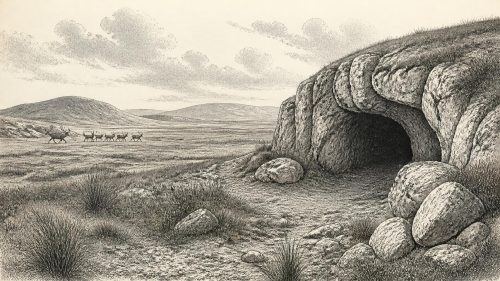
Around 31,270 BCE, Ireland had no recoverable historical record or securely dated human settlement. During Marine Isotope Stage 3, before the Last Glacial Maximum, its environments were severe, variable and increasingly affected by ice and periglacial processes. Castlepook Cave, County Cork, preserves mixed late Pleistocene fauna, including mammoth, reindeer, giant deer, predators and lemmings, but its deposits are disturbed and chronologically complex. A reindeer femur bears a possible stone-tool cutmark, suggesting human butchery, yet lacks associated artefacts or secure context. It may indicate a brief Upper Palaeolithic incursion, not permanent occupation. Environmental change, rather than social history, defines this period.

Silted Wetlands
At 31,269 BCE, Ireland lay within the unstable Late Pleistocene MIS 3, not a calendar year. Derryvree, County Fermanagh, preserves freshwater silts between tills, showing cold, treeless periglacial wetlands and open pools during an ice-free interval before later glaciation. Ireland’s ice cover was regionally variable; maximum expansion followed later. Cave deposits and landforms reveal climates, sea levels and possible animal routes. Castlepook Cave, County Cork, yielded reindeer, hyena, mammoth and cold-adapted fauna. A marked reindeer bone may record human butchery around 33,000 years ago, but no settlement evidence exists. The period represents a volatile, intermittently habitable landscape, not a society.

Castlepook Marking
Around 31,268 BCE, Ireland lay in the unstable Marine Isotope Stage 3, before the Last Glacial Maximum. Radiocarbon and sedimentary evidence provide broad ranges, not precise events. Freshwater deposits at Derryvree, County Fermanagh, demonstrate intervals of ice-free, cold wetlands supporting hardy plants, insects and animals between glacial advances. Castlepook Cave, County Cork, preserves a mixed fauna including mammoth, reindeer, giant deer, predators and Arctic species, indicating open, rigorous environments. A marked reindeer femur, dated roughly 33,000 years ago, may record stone-tool butchery and Ireland’s earliest human activity. However, without associated evidence, it cannot prove permanent settlement, society or sustained occupation.

Derryvree Mosslands
Around 31,267 BCE, Ireland was in the climatically variable later Last Glacial Period, not an era of recorded events. Freshwater deposits sealed between tills at Derryvree, County Fermanagh, preserve mosses, plants, insects and sediments indicating open, treeless tundra-like wetlands with cold-adapted vegetation. Castlepook Cave, County Cork, contains a long, mixed assemblage of Ice Age mammals, including mammoth, reindeer, giant deer, predators and lemmings, demonstrating intermittent animal movement. A possibly cut-marked reindeer bone suggests, but cannot confirm, early human contact. These fragmentary archives predate the later expansion of the British–Irish Ice Sheet and reveal changing cold-stage environments rather than settled society.

Derryvree Sedimentation
The label 31,266 BCE cannot identify a precise event, but falls within MIS 3, a climatically unstable phase of the Midlandian cold stage. At Derryvree near Maguiresbridge, freshwater silts between glacial tills record an ice-free interval dated broadly to 36,900–31,700 years BP. Wetlands, tundra-like vegetation, insects and aquatic plants indicate severe periglacial conditions. Castlepook Cave preserves a long-accumulated fauna including mammoth, giant deer, reindeer, bear and hyena, demonstrating intermittently productive habitats. A possibly cut-marked reindeer bone suggests early human activity, but without associated tools or settlements it cannot prove occupation. The evidence depicts shifting ice, water, vegetation and animal movement.

Derryvree Fenlands
31,265 BCE is a modern notional date within Ireland’s Late Pleistocene MIS 3, not a recordable year. At Derryvree, County Fermanagh, organic silts between tills document an ice-free interval, dated broadly to 36,900–31,700 calibrated BP, when tundra-like wetland supported grasses, sedges, mosses, juniper, insects and freshwater plants. Cave remains, especially at Castlepook, show mammoth, reindeer and hyaena reached Ireland. A marked reindeer femur may indicate Upper Palaeolithic butchery, but cannot prove permanent settlement. Evidence reveals no institutions or communities. Changing sea levels, ice and uncertain routes shaped access before the expanding British–Irish Ice Sheet transformed habitats and obscured earlier traces.
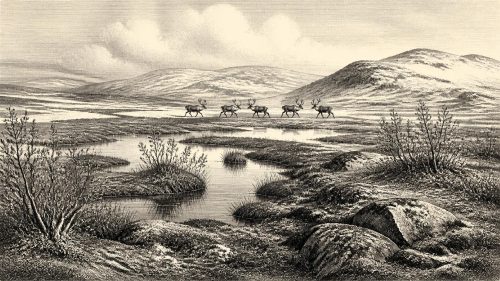
Suspected Butchery
About 31,264 BCE, Ireland lay within the unstable cold conditions of Marine Isotope Stage 3, before the Last Glacial Maximum. Evidence cannot reconstruct a single year or prove permanent human settlement. At Derryvree, County Fermanagh, sediments between glacial tills preserve a treeless tundra wetland of mosses, sedges, insects and freshwater pools. Castlepook Cave, County Cork, contains a long, mixed assemblage of cold-stage animals, including reindeer, mammoth, giant deer, bear and hyaena. A cut-marked reindeer femur may indicate carcass processing by people, but lacks associated occupation evidence. Ireland was thus an ecologically varied, intermittently habitable, poorly documented Ice Age frontier overall.
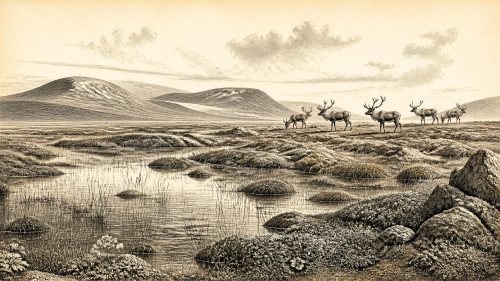
Contested Cutmark
Although 31,263 BCE cannot denote a precise Irish historical year, it falls broadly within MIS 3, before the Last Glacial Maximum. Ireland experienced fluctuating ice, low sea levels and patchy, cold open environments. Derryvree sediments in Fermanagh record an ice-free freshwater wetland between glacial advances, supporting tundra-like vegetation, insects and seasonal water. Castlepook Cave in Cork preserves re-dated MIS 3 fauna including mammoth, reindeer, giant deer, predators and lemmings, demonstrating rich cold-stage ecosystems. A purported stone-tool cutmark on a reindeer bone may indicate human butchery, but remains contested. No secure evidence establishes settlement, institutions; environmental change is the clearest history.
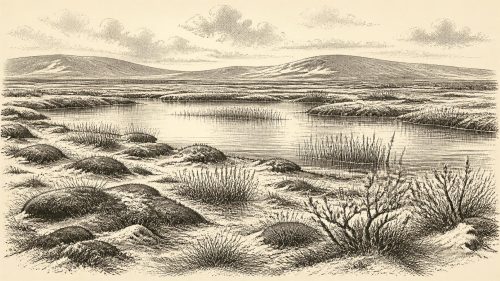
Derryvree Substrata
Around 31,262 BCE, a modern filing date within MIS 3 rather than a precise year, Ireland was a changing Ice Age landscape. Derryvree, County Fermanagh, preserves freshwater silts between glacial tills, indicating an ice-free cold wetland interval around 33,500 calendar years BP. Tundra vegetation and periglacial conditions prevailed, while lowered sea levels permitted animal movement across wider north-west Europe. Castlepook Cave, County Cork, yielded mammoth, reindeer, giant deer, carnivores and lemmings from differing episodes. A possibly butchered reindeer bone may indicate human activity, but no secure settlement exists. Later glaciation obscured earlier evidence, leaving human presence uncertain in the record.
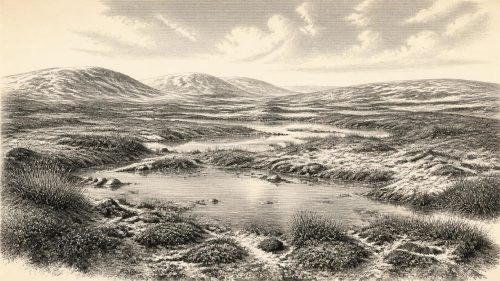
Derryvree Greenery
31,261 BCE is a modern label within unstable Marine Isotope Stage 3, not a precisely datable Irish event. At Derryvree, County Fermanagh, freshwater sediments between tills indicate a temporary ice-free interval, supporting tundra vegetation, pools, mosses and cold, frost-affected ground. Castlepook Cave, County Cork, preserves diverse Ice Age fauna, including reindeer, mammoth, predators and cold-adapted species, though dates and contexts require caution. A possibly cut-marked reindeer bone suggests, but cannot prove, early human visits. Ireland lacked evidenced settlements, polities or trade. Changing ice, sea levels and ecological routes shaped Ireland’s fragmentary landscape before later extensive glaciation and erased older evidence.
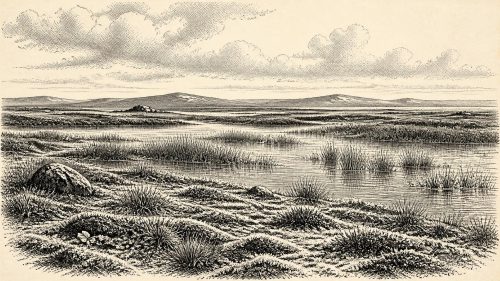
Moss Wetland
31,260 BCE is a chronological label, not a precise Irish date, within climatically unstable MIS 3. Derryvree, County Fermanagh, preserves freshwater sediments beneath later glacial till, radiocarbon dated broadly to 36,900–31,700 calibrated years BP. Mosses, herbs, sedges and bogbean indicate open tundra wetlands with severe seasonal conditions, not continuous woodland. Ireland's ice cover was variable, though major expansion approached. Castlepook Cave, County Cork, records diverse Ice Age fauna, but mixed deposits prevent reconstructing one contemporary community. A possibly tool-cut reindeer bone suggests human presence, yet lacks secure context. No settlement or history is established; sediments and ice define this past.
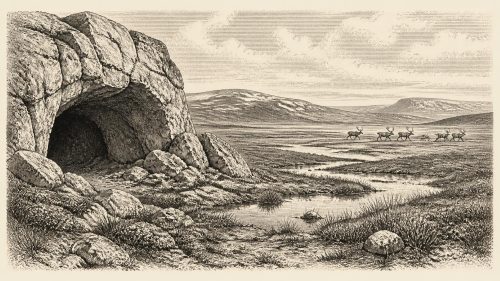
Cork Menagerie
31,259 BCE is a modern chronological reference within Marine Isotope Stage 3, not a recorded Irish year. Ireland then experienced fluctuating cold conditions as ice sheets expanded, while some lowland refuges supported open tundra and steppe. Castlepook Cave, County Cork, preserves a fauna including reindeer, mammoth, giant deer, wolves, Arctic foxes, lemmings and spotted hyaenas, demonstrating cold-stage ecosystems. Derryvree, County Fermanagh, records sedges, herbs, mosses, insects and wetland tundra beneath glacial deposits. A cut-marked reindeer femur may indicate brief human activity, but lacks secure context. No evidence establishes settlement, social organisation, routes, or population; the period remains an ecological frontier.
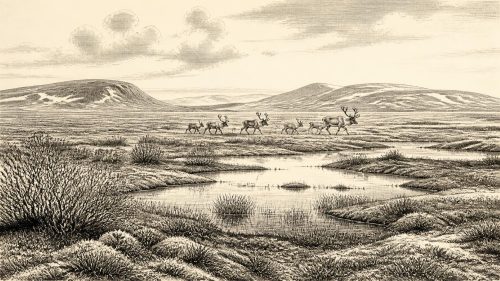
Southern Flowstones
Around 31,258 BCE, Ireland lay within the unstable MIS 3 phase of the Late Pleistocene. Derryvree, County Fermanagh, preserves freshwater sediments between glacial tills, dated broadly to 36,900–31,700 calibrated years ago, indicating an ice-free tundra wetland with sedges, mosses, insects and seasonal liquid water. Cave and speleothem evidence from Cork and Kerry confirms recurring animal activity and intermittent unfrozen conditions elsewhere. Castlepook Cave yielded mammoth, reindeer, giant deer, bear and hyena remains, though these represent accumulated deposits rather than one community. A possibly cut-marked reindeer bone suggests human visitation, but permanent settlement remains unproven. Later ice expansion destroyed much evidence.
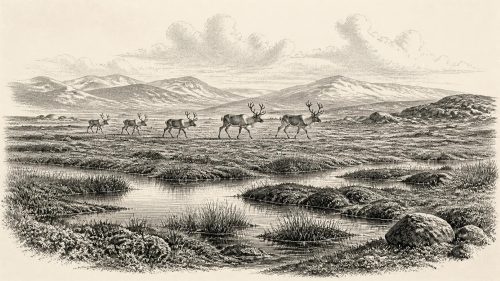
Glacial Overprint
At 31,257 BCE, Ireland was experiencing an unstable Late Pleistocene climate before the Last Glacial Maximum, rather than a recoverable historical year. Freshwater sediments at Derryvree, County Fermanagh, dated broadly to this period, show a locally ice-free, treeless tundra wetland later overridden by ice. Castlepook Cave, County Cork, preserves evidence of a diverse cold-adapted fauna, including mammoth, reindeer, giant deer, predators and small mammals, accumulated over time. A cut-marked reindeer bone may indicate brief human activity, but no settlement evidence exists. Growing ice sheets subsequently reshaped landscapes, obscuring earlier remains and leaving deep-time history necessarily uncertain in Ireland's geological record.
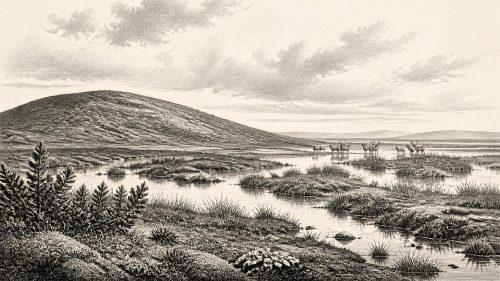
Derryvree Grasslands
31,256 BCE cannot be identified precisely in Ireland’s archaeological record, but falls within Middle Midlandian MIS 3. At Derryvree, County Fermanagh, organic sediments between till sheets document an ice-free interval before later glaciation, with cold, open wetlands supporting grasses, sedges, juniper, mosses, aquatic plants and beetles. Comparable northern deposits indicate episodic periglacial, rather than continuously ice-covered, conditions. Castlepook Cave, County Cork, preserves diverse cold-stage fauna, including mammoth, reindeer, giant deer, hyena and Arctic fox, although dates and depositional contexts are broad. A possibly butchered reindeer bone suggests transient human activity, not settlement. Subsequent ice expansion erased much evidence from Ireland.
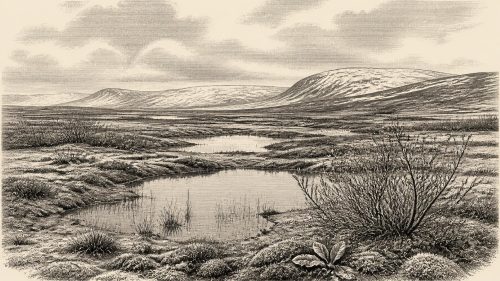
Fermanagh Stratigraphy
31,255 BCE is a chronological label, not a datable event. Derryvree, County Fermanagh, preserves freshwater sediments between two glacial tills, radiocarbon-dated broadly to a period encompassing this date. Its pollen, plants, mosses and insects indicate cold, treeless tundra wetlands with pools, seasonal productivity and severe periglacial conditions. Castlepook Cave in County Cork records MIS 3 fauna including mammoth, reindeer, giant deer, hyena and Arctic species, although its deposits are mixed. A marked reindeer bone may signal early human butchery, but cannot prove settlement. Ireland's history here is reconstructed from fragmentary environmental evidence amid changing ice, uncertain routes and no polities.
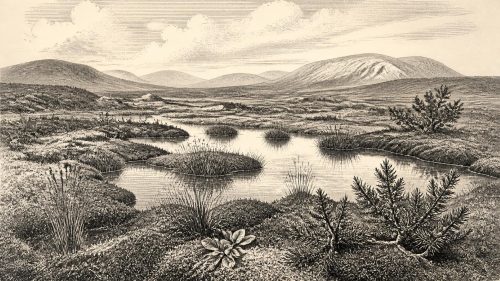
Derryvree Seed
31,254 BCE is a modern label within MIS 3, not a recorded Irish year. At Derryvree, County Fermanagh, organic freshwater silts between glacial tills, radiocarbon dated broadly to 36,900–31,700 calibrated years before present, show an ice-free local basin before later glaciation. Pollen, plants, insects and a bogbean seed indicate open, treeless tundra wetland with pools, sedges, herbs, juniper and mosses. Southern cave deposits at Castlepook document mammoths, deer, reindeer, predators and cold-adapted mammals, though not contemporaneous individuals. A possibly cut-marked reindeer bone suggests transient Upper Palaeolithic human presence, but lacks secure contextual evidence. Later ice destroyed and sealed this archive.

Aghnadarragh Insects
Around 33,200 cal BP, Ireland lay within the climatically unstable MIS 3 period, with changing ice margins, low sea levels and diverse open, wetland habitats. Intertill deposits at Derryvree, Greenagho and Aghnadarragh preserve evidence of freshwater environments, plants and insects. Southern caves, especially Castlepook, contain mammoth, reindeer, giant deer, carnivores and other Ice-Age fauna, demonstrating connections with north-west Europe. A possibly cut-marked reindeer femur from Castlepook may indicate brief Upper Palaeolithic human activity, but cannot prove settlement, hunting traditions or continuous occupation. No evidence supports reconstructed politics, society, ritual, agriculture or trade. Later ice expansion destroyed or concealed much evidence.
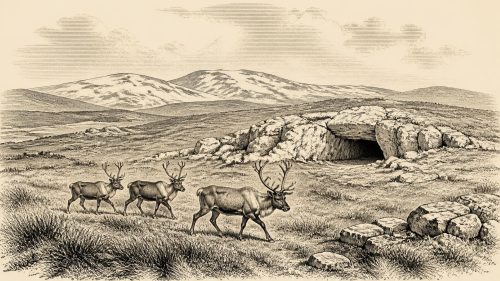
Palaeolithic Possibility
Around 31,252 BCE, Ireland lay within the variable cold conditions of Marine Isotope Stage 3, without recorded peoples, settlements or institutions. Cave fauna at Castlepook, County Cork, including reindeer, mammoth and hyaena, indicates diverse cold-stage habitats. A reindeer femur bears an incision interpreted as a possible stone-tool cut, suggesting a brief Upper Palaeolithic human visit, but not permanent occupation. Poor early excavation records and absent associated tools require caution. Fermanagh wetland sediments and Kerry speleothems show fluctuating climates before expanding ice sheets. Secure evidence of human presence comes far later, while sustained settlement began in the Mesolithic after 8000 BCE.
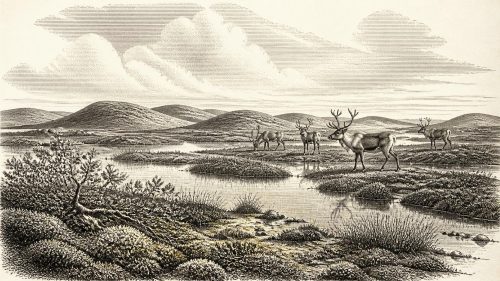
Uncertain Carving
Around 31,251 BCE, Ireland cannot be described through precise calendar dating or written history. Evidence from Derryvree, County Fermanagh, records an ice-free Middle Midlandian interval, with wet, treeless tundra vegetation between glacial advances. MIS 3 climates fluctuated, while the British–Irish Ice Sheet was expanding and changing coastlines and routes. Castlepook Cave, County Cork, preserves diverse Ice Age fauna, including a reindeer femur bearing a scar possibly made by a stone tool. This may indicate brief human carcass processing, but old excavation methods and disturbed cave deposits prevent proof of hunting, occupation or settlement. Ireland’s earliest human presence therefore remains unresolved.

Glacial Habitats
31,250 BCE is a modern label within variable Marine Isotope Stage 3, not a precisely dated Irish event. Ireland experienced fluctuating cold conditions, with ice, periglacial terrain and occasional ice-free habitats. At Derryvree, Fermanagh, an interglacial wetland deposit, dated broadly to 36,900–31,700 calibrated BP, preserves tundra-like plants and insects between glacial advances. Castlepook Cave, Cork, contains fauna accumulated over millennia, including reindeer, mammoth, predators and other cold-country species, indicating ecological connections with north-west Europe. A cut-marked reindeer femur may record Upper Palaeolithic butchery, but proves neither permanent settlement nor wider society. Together sites reveal changing environments and possible human visits.
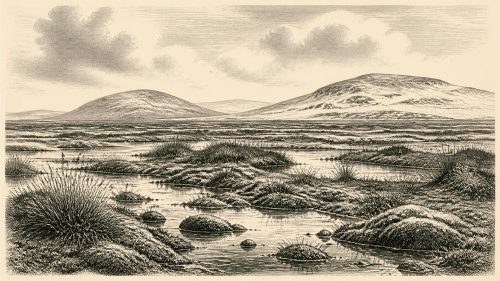
Episodic Infiltration
31,249 BCE is a modern label for a broad MIS 3 horizon, not a precise Irish event. Ireland experienced unstable cold-stage conditions, with shifting ice, permafrost, meltwater and sparse vegetation before the Last Glacial Maximum. Derryvree’s sediments preserve a treeless freshwater wetland between glacial advances, while Crag Cave calcite indicates episodic thaw and water infiltration in south-west Ireland. Castlepook Cave fauna show cold-adapted mammals, including reindeer, mammoth and hyena, reached the island. A marked reindeer femur may indicate early human butchery, but remains unconfirmed. Changing coastlines allowed ecological connections, though routes remain uncertain; political or cultural history is largely unrecoverable.
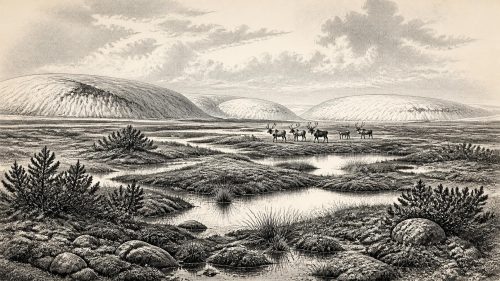
Bogbean Basin
At the notional date of 31,248 BCE, Ireland’s evidence cannot support an annual history, but illuminates a broad, variable Late Pleistocene interval. Derryvree, County Fermanagh, preserves freshwater sediments between glacial tills, dated broadly to 36,900–31,700 years BP, indicating locally ice-free, open wet tundra with sedges, mosses, juniper and bogbean. Ice-sheet extent and sea levels varied regionally before the later Last Glacial Maximum. Castlepook Cave, County Cork, contains cold-climate fauna, including reindeer and mammoth. A cut-marked reindeer femur may indicate human carcass processing, but cannot prove settlement. Glaciation and erosion have left Ireland’s ecological past clearer than its human history alone.
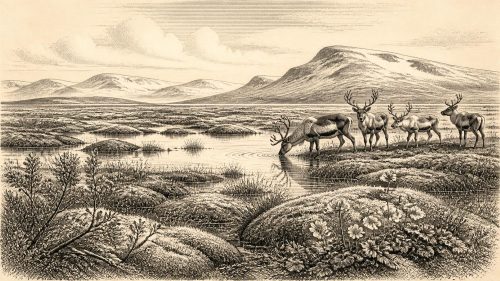
Calibrated Interval
Around 31,247 BCE, Ireland lay within the climatically unstable Late Pleistocene MIS 3, although this date represents a broad calibrated radiocarbon range rather than a precise year. Derryvree, County Fermanagh, preserves freshwater sediments beneath a drumlin, revealing ice-free periglacial tundra with pools, mosses, sedges, dwarf shrubs and cold-adapted insects. Castlepook Cave, County Cork, contains MIS 3 fauna including mammoth, reindeer, giant deer, predators and lemmings, indicating ecological connectivity. Ice-sheet growth was underway but maximum glaciation followed later. No secure settlement evidence exists. A possibly butchered reindeer bone suggests only tentative human presence. Evidence supports dynamic ecosystems, not societies or chronologies.

Treeless Interlude
31,246 BCE is not a recoverable Irish calendar year, but an approximate Late Pleistocene MIS 3 horizon. At Derryvree, County Fermanagh, freshwater organic sediments between glacial tills indicate an ice-free, treeless cold wetland before renewed ice advance. Castlepook Cave, County Cork, preserves reindeer, mammoth, hyaena and other fauna, demonstrating open habitats and broad north-west European ecological connectivity. A cut-marked reindeer femur may indicate human butchery, but its old, insecure context prevents claims for settlement or permanent occupation. Growing British-Irish ice sheets later transformed habitats. Evidence permits environmental reconstruction and cautious possibilities, not political, social or annual history at this depth.
Reindeer Fragment
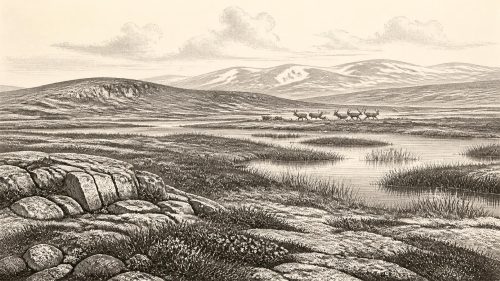
Around 31,245 BCE, Ireland was an unstable MIS 3 Ice Age landscape, not a datable historical year. Open tundra, wetlands and intermittent ice supported reindeer, mammoth, giant deer, predators and other fauna, while changing sea levels and ice margins affected access. Castlepook Cave in County Cork preserves varied Pleistocene remains, including a reindeer femur fragment dated to about 33,000 years ago with a possible stone-tool cut mark. If confirmed, it may indicate an early human visit, but not settlement or continuous population. Environmental deposits at Derryvree and Aghnadarragh show cold, treeless habitats. Evidence remains fragmentary, requiring cautious interpretation by researchers.
Intermittent Thaw
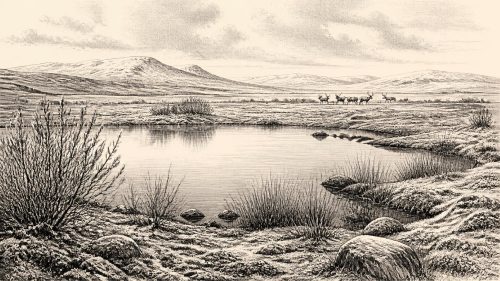
Around 31,244 BCE, Ireland was a climatically unstable glacial frontier, not a historically observable society. Organic sediments at Derryvree, County Fermanagh, dated broadly to later Marine Isotope Stage 3, preserve evidence of cold freshwater wetlands, open vegetation and arctic-alpine species between glacial advances. Kerry speleothems indicate intermittent above-freezing conditions, while cave finds demonstrate occasional presence of reindeer, mammoth, horse, giant deer, bear and hyena. A cut-marked reindeer bone from Castlepook Cave may indicate human butchery, but no secure settlement evidence exists. Falling sea levels altered access routes before expanding ice sheets reshaped landscapes and destroyed much earlier evidence across Ireland.

Cave Infiltration
31,243 BCE is not a recoverable Irish year but an interval within Marine Isotope Stage 3, when climate and ice limits changed. Later glaciation destroyed evidence, leaving environmental archives rather than social history. Derryvree sediments, sealed between tills, indicate cold, open tundra-like wetlands during an interstadial interval. Crag Cave speleothems show episodes of infiltration, implying local thaws and absence of continuous ice or permafrost. Southern cave fauna confirms Pleistocene mammals, though deposits are mixed across time. A cut-marked Castlepook reindeer bone may suggest human presence, but cannot establish settlement, culture or occupation. Evidence therefore depicts a fragmented, dynamic Ice-Age landscape.

Pleistocene Menagerie
Although 31,242 BCE is a modern filing date rather than a datable Irish event, evidence from surrounding millennia depicts a volatile Late Pleistocene environment. Derryvree, County Fermanagh, preserves tundra wetland deposits between tills, proving an ice-free interval with freshwater habitats, plants and insects before later glaciation. Castlepook Cave, County Cork, contains Ireland’s richest cold-stage vertebrate assemblage, including mammoth, giant deer, reindeer, hyaena and wolf, but accumulated over thousands of years. A marked reindeer femur may indicate brief human butchery around 33,000 years ago, though disturbed context prevents stronger claims. No evidence supports permanent settlement, institutions, agriculture or continuous population there.
Tundra Milfoil
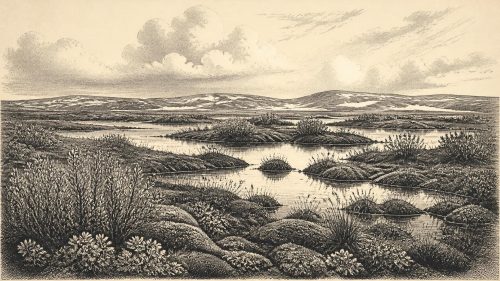
Around 31,241 BCE, Ireland was a cold, fluctuating Late Pleistocene landscape, not a historical society with known peoples or events. At Derryvree, County Fermanagh, freshwater silts between glacial tills preserve evidence of an interval between ice advances. Water-milfoil, bogbean, sedges, mosses, dwarf willow and insects indicate a wet, open tundra basin shaped by frost, pools and short summers. Elsewhere, cave remains show that cold-stage animals, including reindeer, mammoth and hyaena, reached Ireland at various times. Possible early human evidence remains disputed. Changing ice sheets, low sea levels and altered coastlines created varied conditions, while later glaciation sealed this ecological archive.
Maguiresbridge Vegetation
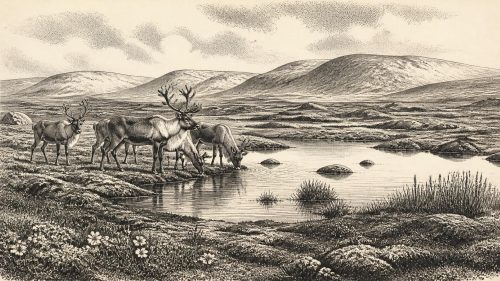
31,240 BCE denotes a broad Late Pleistocene dating window, not a recoverable Irish calendar year. Freshwater sediments buried between tills at Derryvree, near Maguiresbridge, indicate a locally ice-free, treeless tundra mosaic of pools, sedges, mosses and sparse plants during unstable cold conditions. The growing British–Irish Ice Sheet altered landscapes and coastlines, while connections beyond Ireland remain uncertain. Castlepook Cave's mixed, disturbed fauna, including mammoth, reindeer and predators, demonstrates varied cold-country habitats but not a single contemporaneous community. A possibly butchered reindeer bone may indicate brief human presence, yet lacks associated artefacts. Evidence securely supports ecological reconstruction, not conventional human history.
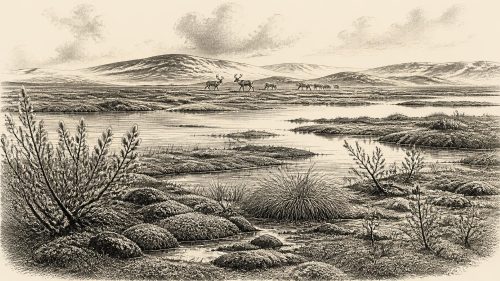
Wetland Vegetation
The modern date 31,239 BCE is an imprecise label for later Marine Isotope Stage 3, not a recorded Irish year. Derryvree, County Fermanagh, preserves organic silts between glacial tills, indicating an ice-free interval with treeless, tundra-like freshwater wetlands. Castlepook Cave, County Cork, contains reworked remains of reindeer, mammoth, giant deer and predators, demonstrating cold open habitats but not a single contemporary fauna. A modified reindeer bone may indicate brief human presence, although no settlement evidence exists. Later ice expansion extensively reshaped Ireland, explaining the scarcity of early traces. This period reveals changing environments more clearly than human history in Ireland.
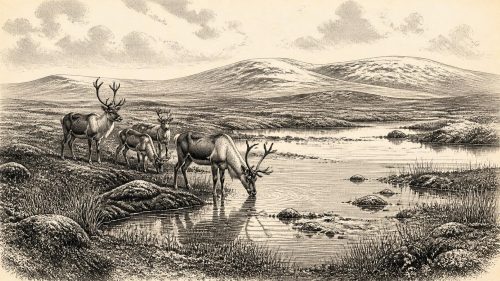
Intertill Interval
Labelled 31,238 BCE, this period cannot be reconstructed as a specific Irish year, but falls within a broad Late Pleistocene interval of climatic instability. At Derryvree, County Fermanagh, freshwater organic sediments between glacial tills indicate a locally ice-free, cold periglacial wetland, dated broadly to 36,900–31,700 calibrated years before present. Castlepook Cave, County Cork, preserves diverse cold-stage fauna, including mammoth, reindeer and hyaena, although its accumulated remains are chronologically complex. A cut-marked reindeer femur may indicate Upper Palaeolithic human activity, but remains contested. Later ice expansion reshaped Ireland and obscured evidence, leaving only limited environmental and possible human traces for researchers.
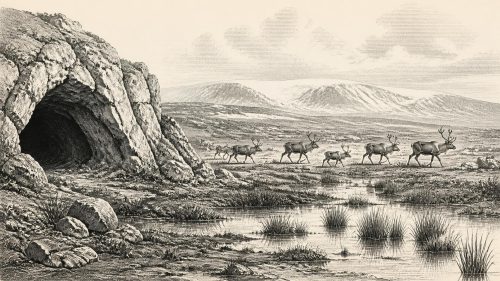
Faunal Reworking
Around 31,237 BCE, a modern label rather than a recoverable Irish date, Ireland lay within the unstable cold conditions of Marine Isotope Stage 3. Lower sea levels altered routes and coasts, while local environments ranged from wetlands and open tundra to ice margins. Derryvree, County Fermanagh, preserves sediments, plants and insects showing cold, treeless wetland conditions between glacial episodes. Castlepook Cave, County Cork, yielded mixed and reworked remains of mammoth, reindeer, giant deer and other cold-adapted fauna. A possibly stone-cut reindeer femur may indicate brief Upper Palaeolithic human activity, but lacks corroborating artefacts or deposits. Later glaciation erased earlier evidence.
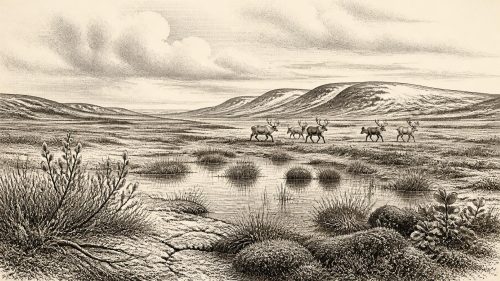
Cold Vegetation
31,236 BCE is a label for broad Late Pleistocene MIS 3 horizon, not a recorded Irish year. Derryvree, County Fermanagh, preserves freshwater sands, silts and organic beds between tills, proving a non-glacial interval before renewed ice-sheet growth. Its bogbean, dwarf willow, mountain-avens, pollen and insects indicate treeless, cold, wet, ecologically varied tundra. Southern caves, especially Castlepook, contain MIS 3 remains of reindeer, mammoth and other cold-adapted fauna, demonstrating intermittent connectivity with north-west Europe. A cut-marked reindeer femur may indicate brief human activity, but cannot prove settlement. No evidence supports polities, continuous population or cultural ancestry; environmental change defines this period.
Intertill Waters
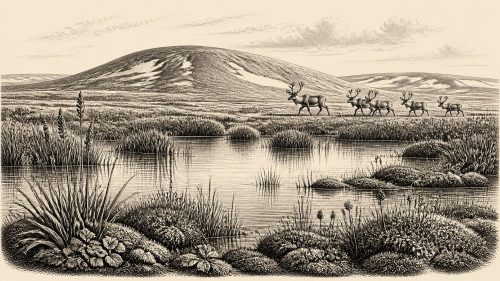
At approximately 31,235 BCE, Ireland lay within a variable Late Pleistocene glacial interval. At Derryvree, County Fermanagh, freshwater sediments and organic remains between two tills show that ice temporarily retreated or ceased occupying the locality. Fossils indicate cold, wetland tundra with low vegetation, aquatic plants and insects. Elsewhere, especially Castlepook Cave, animal remains demonstrate intermittent habitats for reindeer, giant deer, mammoths and predators. A possibly tool-marked reindeer bone suggests an early human visit, but securely dated settlement remains unproven. The date is a modern calibrated marker, not a year-specific event; evidence reveals shifting ice, water, ecosystems and uncertain human presence.

Freshwater Wetland
31,234 BCE is a modern chronological label rather than a recoverable Irish historical year. Evidence from Derryvree, County Fermanagh, records a cold, treeless, tundra-like freshwater wetland formed between glacial advances during Marine Isotope Stage 3. Plant and insect remains indicate severe, seasonal periglacial conditions, though local evidence cannot represent the entire island. Castlepook Cave, County Cork, preserves a diverse cold-stage fauna, including mammoth, reindeer and hyaena, demonstrating intermittent ecological connections but not a permanent land bridge. A possibly butchered reindeer bone may suggest human visitation, yet cannot prove settlement. No evidence supports contemporaneous politics, culture, trade or named human communities.

Tundra Muskeg
Although 31,233 BCE cannot identify a specific Irish event, it falls within a Late Pleistocene interval represented by Derryvree, County Fermanagh. Organic freshwater sediments between glacial tills show an ice-free, treeless tundra muskeg, supporting sedges, mosses, insects and shallow pools amid cold. Radiocarbon dating provides a broad period, not annual precision. Castlepook Cave, County Cork, preserves remains of reindeer, mammoth, giant deer, predators and fauna, though its chronology is complex. A possibly cut-marked reindeer bone may indicate early human carcass processing, but proves neither settlement nor population. Together, these records show a variable, biologically active Ireland affected by advancing ice.

Wetland Mosaic
31,232 BCE is a label within a broad Late Pleistocene range, not a datable Irish event. At Derryvree, County Fermanagh, freshwater silts between glacial tills record an ice-free interval, dated roughly 36,900–31,700 calibrated years before present. Plants, insects and sediments indicate cold, treeless tundra wetlands with pools, mosses and sedges, demonstrating ecosystems rather than uniform lifelessness. Castlepook Cave fauna shows that cold-stage mammals reached Ireland, although remains accumulated across periods. A cut-marked reindeer femur may indicate Upper Palaeolithic human activity, but proves neither settlement nor occupation. No evidence establishes polities, farming, monuments, trade or practices; climate shaped this Atlantic frontier.

Ambiguous Modification
Around 31,231 BCE, Ireland lay in a volatile Late Pleistocene environment, before the Last Glacial Maximum. Calibrated dates cannot identify conditions in a single calendar year, but Fermanagh sediments indicate periods of ice-free, treeless tundra wetlands with mosses, sedges and grasses, later buried by advancing ice. Cave and fossil assemblages show reindeer and other cold-stage animals reached the island. A marked reindeer femur from Castlepook Cave may record Upper Palaeolithic butchery, although its context and interpretation remain disputed. No settlement or political history is known. The evidence instead suggests active landscapes, changing access routes, climate, and possible visits by hunter-gatherers.
Ecological Patchwork
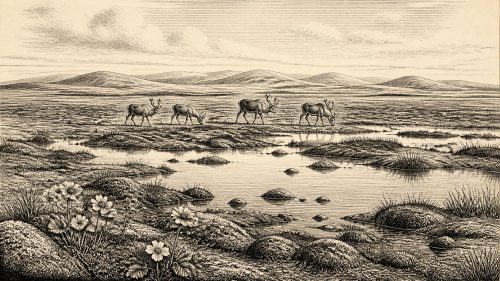
Circa 31,230 BCE, Ireland cannot be described through annual events or human history. At Derryvree near Maguiresbridge, Fermanagh, organic sediments between glacial tills, radiocarbon dated broadly to 36,900–31,700 calibrated BP, record an ice-free freshwater wetland during MIS 3. Plant and insect remains indicate cold, treeless, mossy tundra with pools, sedges, bogbean and mountain-avens. Elsewhere, deposits and cave calcite confirm varied conditions as ice advanced and retreated. Castlepook Cave fauna demonstrates Pleistocene mammals, although possible cut marks on reindeer provide only tentative evidence of people. The surviving record establishes ecological occupation, not human society, amid unstable ice, sea and land connections.

Faunal Assemblage
At the notional date 31,229 BCE, Ireland lay in the climatically unstable Late Pleistocene, approaching wider glaciation rather than wholly ice-covered. Derryvree in County Fermanagh preserves evidence of a cold, open, treeless wetland, later sealed beneath ice. Castlepook Cave, County Cork, contains Ireland’s richest Pleistocene fauna, including mammoth, reindeer, giant deer and spotted hyaena, though its deposits represent changing communities, not one moment. A possibly tool-marked reindeer bone suggests fleeting human presence, but remains unproven. No secure contemporary settlements, tools or social evidence exist. Environmental change, expanding ice and fragmented survival of evidence define this period in Ireland's prehistoric record.

Freshwater Organics
Modern dating labels 31,228 BCE only approximately describe later Marine Isotope Stage 3 Ireland, lacking written or securely dated human evidence. Derryvree, County Fermanagh, preserves freshwater organic sediments between glacial tills, radiocarbon dated broadly to the mid- to low-30,000s calibrated years BP. Pollen, seeds, mosses and insects show a cold, exposed, largely treeless wetland of sedges, grasses, aquatic plants and pools during an ice-free interval. Cave faunas demonstrate wider Pleistocene animal diversity, but cannot establish species present locally then. Later glaciation and rising seas destroyed evidence. Ireland's earliest secure human trace dates only to 12,800–12,600 calibrated years BP, far later.

Cave Lemmings
31,227 BCE represents an approximate point in Marine Isotope Stage 3, when Ireland was becoming colder as the British–Irish Ice Sheet grew, but before its maximum extent. Landscapes, coastlines and routes changed with climate, ice and lower sea levels. Castlepook Cave, County Cork, preserves a cold-stage fauna including reindeer, mammoth, giant deer, bear, Arctic fox, lemmings and hyaena, indicating open tundra-like habitats. A dated reindeer bone bearing a tool mark suggests a brief human visit, but requires confirmation and cannot prove settlement. No institutions are recoverable. It remains a threshold marked by environmental change, fragmentary fauna and uncertain human presence.
Linear Mark
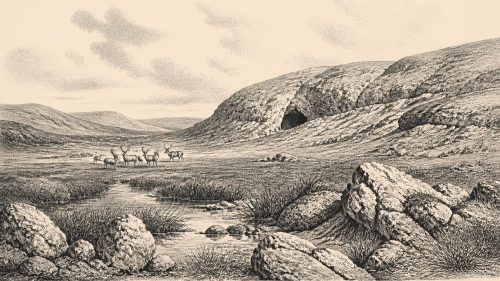
At around 31,226 BCE, Ireland lay within the fluctuating cold environments of Marine Isotope Stage 3. Castlepook Cave near Doneraile preserves a reindeer femur broadly dated to this period, bearing a linear mark interpreted as possible stone-tool butchery. If confirmed, it could be Ireland’s earliest evidence of human activity, but cannot prove permanent settlement. The cave’s mixed collection and later disturbance prevent secure conclusions about where or when processing occurred. Ireland then contained shifting combinations of ice, open steppe-tundra, wetlands and mobile mammals, during changing sea levels and climates. Later glaciation may have erased evidence, leaving only a tentative clue.

Tundra Conditions
At 31,225 BCE, Ireland cannot be described through annual events, but Derryvree’s freshwater sediments, preserved between glacial tills in County Fermanagh, document an ice-free Late Pleistocene interval. Calibrated dating places the deposit broadly around 34,950–29,750 BCE. Pollen, plants, mosses and insects indicate open tundra, freshwater and severe periglacial conditions, not local woodland. Cave remains at Castlepook show varied cold-adapted fauna, while a marked reindeer femur may suggest an early human visit, though this remains unconfirmed. No evidence supports settlement or social institutions. Later ice expansion destroyed or buried traces, leaving environmental change, rather than human history, as the clearest record.

Elusive Landscape
31,224 BCE cannot be reconstructed as a precise Irish year, because evidence is sparse and chronologies broad. Derryvree, County Fermanagh, preserves a freshwater deposit indicating locally ice-free, tundra-like wetland conditions before later glaciation. Castlepook Cave in County Cork contains varied cold-stage fauna, including reindeer, mammoth, giant deer, predators and smaller animals, accumulated over millennia rather than one event. A cut-marked reindeer femur may indicate very early human butchery, but does not prove settlement or a permanent population. Changing ice, sea levels and uncertain routes governed access. Ireland was an environmentally varied, highly archaeologically elusive Late Pleistocene landscape at this time.
Frosted Wetland
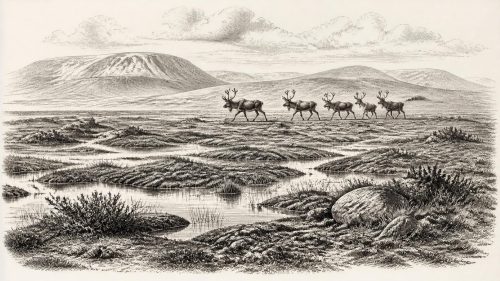
Although 31,223 BCE cannot identify an Irish event, it falls within unstable Marine Isotope Stage 3. Derryvree, County Fermanagh, preserves freshwater sediments dated broadly to 36,900–31,700 years before present, between glacial tills, demonstrating a local ice-free interval. Plant and insect remains reconstruct treeless, frost-affected tundra wetland with pools, sedges and mosses. Castlepook Cave fauna indicates periodic access for reindeer, mammoth, giant deer, predators and scavengers. No secure evidence proves human settlement; a possibly tool-marked reindeer bone suggests only tentative brief visitation. Later ice expansion destroyed or buried landscapes, leaving sparse evidence of ecological change rather than society, politics or culture.

Periglacial Recolonisation
About 31,222 BCE, Ireland lay in the unstable later stages of Marine Isotope Stage 3, approaching expansion of the British–Irish Ice Sheet. Derryvree, County Fermanagh, preserves a freshwater organic bed between tills, recording a brief ice-free periglacial wetland with tundra plants, mosses, insects and sparse vegetation. Southern caves, notably Castlepook in County Cork, yielded diverse cold-climate fauna, including mammoth, reindeer, giant deer and carnivores, though remains accumulated over long periods. A possibly cut-marked reindeer bone suggests fleeting human visitation around 33,000 years ago, not permanent settlement. Renewed glaciation eventually buried habitats, causing local ecological displacement or extinction before later recolonisation.

Vegetated Interlude
Around 31,221 BCE, Ireland was in the unstable MIS 3 phase of the Late Pleistocene, not a period permitting year-specific history. At Derryvree, County Fermanagh, the BIRM-166 deposit records a freshwater, vegetated interval between glacial advances, broadly dated to 36,900–31,700 cal BP. Its pollen, plants and insects indicate cold, open wetland habitats rather than continuous ice cover. Cave remains in County Cork show varied Ice Age fauna. A marked reindeer femur may indicate human butchery around 33,000 years ago, but cannot prove settlement or society. Expanding ice later destroyed or buried much evidence, leaving a fragmentary environmental record of change.
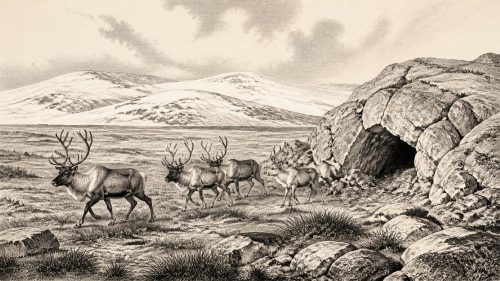
Tentative Scoring
Circa 31,220 BCE is a notional date within the volatile Late Pleistocene, not a precisely recorded Irish year. Before the Last Glacial Maximum, Ireland contained shifting cold, open habitats supporting reindeer, mammoth, giant deer and carnivores. Castlepook Cave in County Cork preserves remains from this fauna, though early excavation and disturbed deposits limit interpretation. A reindeer femur, dated roughly 33,000 years ago, bears a possible stone-tool cut mark. If confirmed, it may indicate brief Upper Palaeolithic human carcass processing, rather than settlement. Expanding ice later transformed landscapes and erased evidence, leaving a rare record of prehistoric ecology and human presence.

Mammoth Archive
Labelled 31,219 BCE, this period in Ireland belongs to unstable Marine Isotope Stage 3, not a precisely knowable historical year. Castlepook, or Mammoth Cave, County Cork, preserves Ireland’s richest pre-Last Glacial Maximum vertebrate archive, although disturbed deposits and revised dating demand caution. Its mammoths, reindeer, giant deer, hyaenas and fauna indicate intermittent cold, open habitats, without proving a single contemporary landscape or route of arrival. A reindeer femur bearing a possible stone-tool incision may record butchery and a human presence. However, no settlement exists. Subsequent ice-sheet growth reshaped landscapes and erased evidence, leaving qualified environmental evidence and possible human trace.
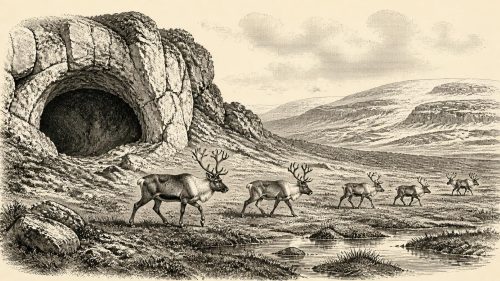
Pleistocene Frontier
Around 31,218 BCE, Ireland was a changing Late Pleistocene frontier rather than a stable, fully glaciated island. Ice margins, sea levels and open tundra-like habitats shifted repeatedly. Wetland deposits at Derryvree, County Fermanagh, preserve evidence of sedges, mosses, insects and cold-adapted plants between glacial episodes. Castlepook Cave, County Cork, yielded mixed remains of mammoth, reindeer, giant deer, hyaena, wolves and other fauna, though their dates and associations remain uncertain. A marked reindeer femur may indicate human butchery around 33,000 years ago, suggesting brief visits rather than proven settlement. The fragmentary record demands cautious interpretation of Ireland’s earliest possible human presence.

Treeless Landscape
31,217 BCE is a modern, imprecise label for a Late Pleistocene interval, not a documented Irish year. During unstable MIS 3, Ireland experienced increasingly extensive glaciation, though conditions varied locally. Derryvree, County Fermanagh, preserves freshwater organic deposits between tills, indicating an ice-free, cold, wet, treeless landscape sometime around 36,900–31,700 cal BP. Castlepook Cave, County Cork, contains a long, mixed assemblage of Ice Age fauna, including mammoth, reindeer and predators. A possibly stone-cut reindeer femur may indicate fleeting human activity, but remains unconfirmed. Available evidence securely establishes environmental change and animal presence, not settlement, society, religion, routes or specific annual events.
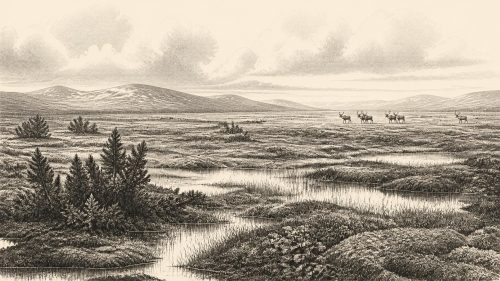
Waterlogged Sedges
About 31,216 BCE, Ireland lay within Marine Isotope Stage 3, a variable cold interval rather than a precisely dated historical moment. At Derryvree near Maguiresbridge, freshwater sediments preserved beneath later tills record treeless, waterlogged tundra of sedges, mosses, herbs and shallow pools. Castlepook Cave’s broad contemporary fauna included mammoth, reindeer, giant deer, hyaena, wolves and cold-adapted small mammals, though deposits accumulated over time. A marked reindeer femur may indicate human carcass processing around 33,000 years ago, but cannot prove settlement or sustained occupation. Dynamic glaciation, uncertain routes and regional environmental variation defined conditions there for much of this remote period.

Ambiguous Cutmark
31,215 BCE is a modern label for a point roughly 33,000 years ago, during the variable MIS 3 phase of the last Ice Age. Ireland contained shifting mosaics of ice, open tundra, wetlands and exposed ground, not a uniform ice cap. Derryvree deposits in Fermanagh preserve evidence of freshwater habitats, sedges, mosses and vegetation between glaciations. Castlepook Cave in Cork yielded Ice Age fauna, including mammoth, reindeer, giant deer, hyaena and bear. A possibly cut-marked reindeer bone may indicate Upper Palaeolithic human activity, but no tools, hearths or settlements confirm occupation. Evidence reveals ecological change, animal movement and archaeological uncertainty.
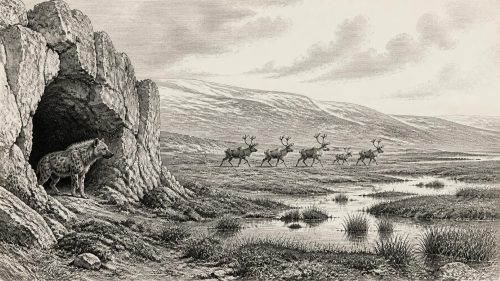
Castlepook Accumulation
Around 31,214 BCE, Ireland experienced variable Ice-Age conditions during Marine Isotope Stage 3, with open tundra, freshwater habitats and cold-adapted wildlife. Derryvree deposits in Fermanagh preserve evidence of sedges, mosses, insects and specialised plants between glacial advances. Castlepook Cave, County Cork, contains over 2,000 bones accumulated across millennia, including mammoth, reindeer, giant deer, hyaena and Arctic fox. A reindeer femur dated to about 31,000 BCE bears a possible stone-tool cut mark, suggesting brief human carcass processing. However, no securely associated artefacts, hearths or occupation layers confirm settlement. Castlepook remains an exceptional palaeoenvironmental archive and tentative evidence of early human visitation.

Revised Fauna
Castlepook Cave in County Cork preserves evidence for Ireland in Marine Isotope Stage 3, before the Last Glacial Maximum. Re-dated animal bones show that mammoth, reindeer, giant deer, brown bear, spotted hyaena and other cold-adapted mammals occupied parts of a variable, open landscape. Improved radiocarbon methods corrected overly recent dates, placing finds further back in time. A marked reindeer femur, about 33,000 years old, may indicate butchery by people, yet cannot prove settlement, identity or culture. Disturbed cave deposits, glacial erosion and missing habitation evidence require caution. Castlepook reveals animal dispersal and possible human visits, not a documented Palaeolithic community.
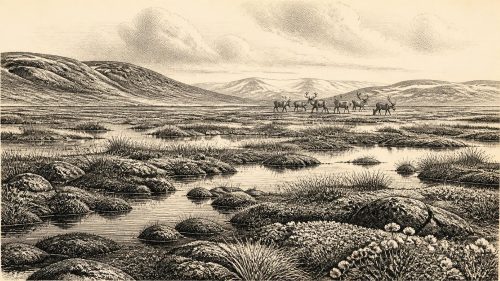
Freshwater Interbeds
Labelled 31,212 BCE, this Late Pleistocene interval cannot be dated precisely in Ireland. Derryvree, County Fermanagh, preserves freshwater silts between glacial tills, indicating an ice-free, treeless periglacial wetland sometime within a broad calibrated range encompassing the notional year. Ireland was environmentally varied, with shifting ice margins, wetlands and intermittent ecological links to north-west Europe. Castlepook Cave in County Cork yielded MIS 3 remains including mammoth, reindeer, giant deer, predators and lemmings, though they need not have been contemporaneous. A cut-marked reindeer bone may indicate an early human visit, but no secure occupation evidence exists. Later glaciation destroyed evidence, leaving uncertainty.
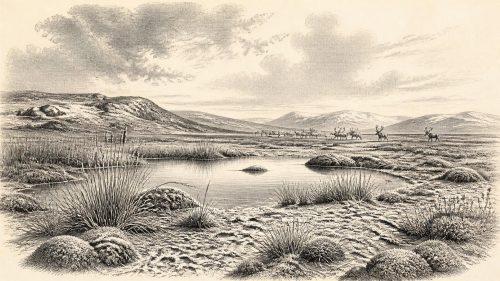
Aquatic Mosses
Labelled retrospectively as 31,211 BCE, this period belongs to Marine Isotope Stage 3, when Ireland’s ice-age environment changed repeatedly and cannot be reconstructed as a calendar moment. Derryvree, County Fermanagh, preserves silts between tills, revealing treeless tundra wetlands with mosses, sedges and freshwater plants before renewed glaciation. Castlepook Cave, County Cork, contains remains of reindeer, mammoth, giant deer and predators. A modified reindeer femur may indicate human carcass processing, but no settlement evidence confirms occupation. Ireland offered precarious habitats for mobile visitors, while shifting ice, sea levels and terrain restricted access. The evidence remains fragmentary, distinguishing demonstrated ecology from inference.
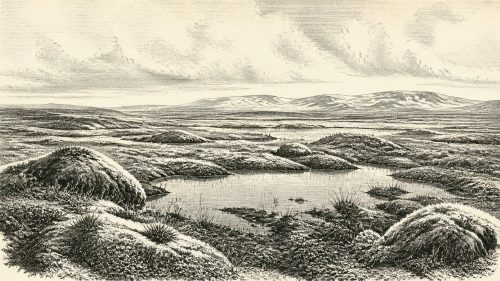
Tundra Mosaic
31,210 BCE is not a precisely recoverable Irish year, but falls near evidence from Derryvree, County Fermanagh, where freshwater organic sediments between glacial tills indicate a temporary tundra wetland during the later Pleistocene. Radiocarbon dates place this interval broadly in the mid-30,000s calibrated years BP, before the Last Glacial Maximum. Flora and invertebrates show cold, open, locally varied periglacial conditions. Castlepook Cave, County Cork, preserves time-averaged remains of mammoth, reindeer and other cold-adapted animals. A marked reindeer bone may indicate early human butchery, yet no secure settlement evidence exists. Ireland’s record is environmental, incomplete, and shaped by advancing later ice.
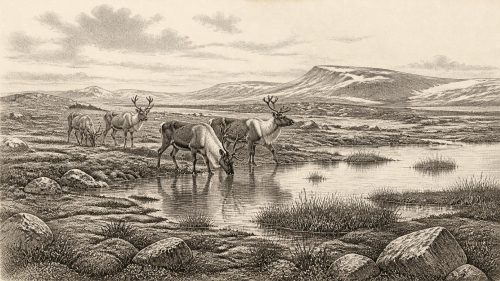
Bogbean Sedges
About 31,209 BCE, Ireland experienced a fluctuating Late Pleistocene climate rather than a precisely datable event. At Derryvree near Maguiresbridge, freshwater sediments between glacial tills, dated broadly to 36,900–31,700 years ago, show a local ice-free interval with pools, sedges, mosses, bogbean and open tundra vegetation. Castlepook Cave preserves remains of mammoth, reindeer, giant deer, predators and other cold-adapted animals, though not from one moment. A marked reindeer bone may indicate brief human butchery, but no secure settlement evidence exists. Ireland’s changing ice, lowered seas and later glaciation fragmented this record, preserving chiefly environmental history rather than political or social narratives.

Glacial Silts
31,208 BCE is a modern label rather than a recoverable Irish year; radiocarbon calibration permits only broad chronological ranges. At Derryvree, County Fermanagh, freshwater silts between tills, dated broadly to 36,900–31,700 calibrated years BP, record a local ice-free, treeless wetland of sedges, mosses and arctic-alpine plants during unstable MIS 3 conditions. Cave calcite confirms climatic fluctuation, while ice extent remains uncertain. Castlepook Cave, County Cork, preserves mixed remains of Pleistocene mammals, suggesting intermittent access for fauna. A marked reindeer bone may indicate early human butchery, but disturbed deposits preclude claims for settlement. No evidence supports polities, farming, occupation, or events.
Hyaena Occurrence
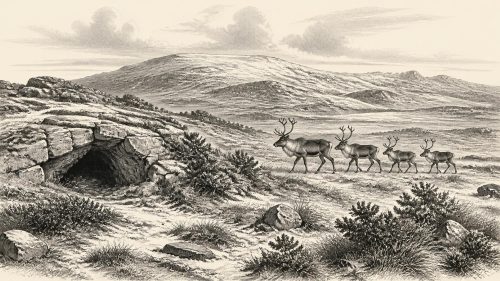
The modern label 31,207 BCE denotes a broad, uncertain MIS 3 horizon rather than a recoverable Irish year. Radiocarbon ranges and cave deposits show that southern Ireland supported, at different times, brown bears, mammoths, reindeer, giant deer, wolves, Arctic foxes, lemmings and spotted hyaenas. Castlepook Cave, County Cork, preserves notable hyaena remains, but mixed sediments cannot establish contemporaneous communities or behaviour. Ireland’s shifting ice, periglacial terrain, low sea levels and variable vegetation connected it intermittently with north-west Europe. Northern organic deposits indicate occasional milder habitats. No secure human occupation dates to this period; a possibly cut-marked reindeer bone remains inconclusive.
Ambiguous Butchery
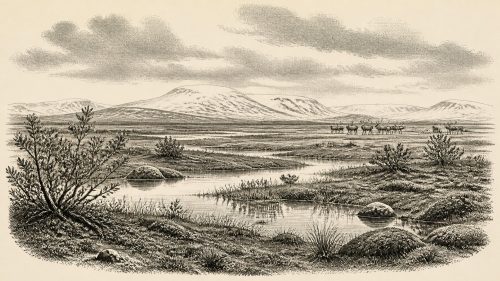
31,206 BCE is a modern label for a Late Pleistocene interval, not a recoverable Irish historical year. Derryvree, County Fermanagh, preserves organic sediments between glacial tills, indicating an ice-free, treeless wetland of sedges, mosses, pools and cold-adapted insects during Marine Isotope Stage 3. Castlepook Cave, County Cork, contains a mixed fauna including mammoth, reindeer, giant deer, carnivores and small cold-climate mammals, though its deposits lack precise stratigraphic control. A marked reindeer femur may indicate butchery by people, potentially Ireland’s earliest human trace, but proves neither settlement nor permanent population. Climatic deterioration expanded the British-Irish Ice Sheet, destroying or concealing evidence.
Disputed Toolmark
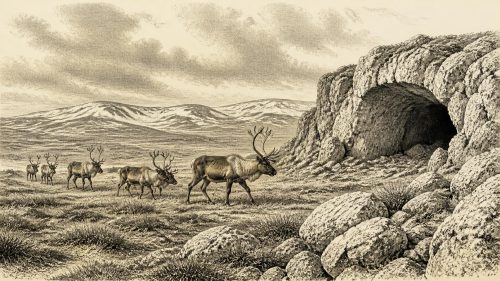
Around 31,205 BCE, an approximate modern label for a fluctuating MIS 3 interval, Ireland was a cold, changing landscape before the Last Glacial Maximum. Castlepook Cave, County Cork, preserves bones of mammoth, reindeer, giant deer, hyaena and animals, showing intermittent habitats for mammals but not a single contemporaneous community. A reindeer femur reportedly bears a possible stone-tool butchery mark and may represent Ireland’s earliest human activity, although dating, context and interpretation remain uncertain. No evidence establishes settlement or culture. Cave deposits, sediments and faunal remains instead reveal open tundra-like environments, mobile wildlife, shifting access, and records obscured by advancing ice.
Bogbean Presence
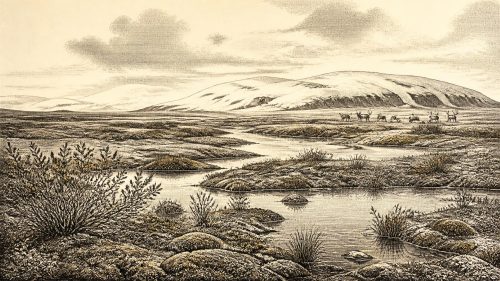
Around 31,204 BCE, Ireland's evidence is environmental rather than historical. Derryvree, County Fermanagh, preserves a wetland deposit between glacial tills, dating broadly to late Marine Isotope Stage 3. Its plants and invertebrates indicate treeless, periglacial tundra with freshwater pools, bogbean and seasonally thawed ground. Castlepook Cave, County Cork, contains time-averaged remains of reindeer, mammoth, giant deer, carnivores and other cold-adapted animals, demonstrating ecological links with north-west Europe. A marked reindeer bone may record Upper Palaeolithic butchery, but cannot prove settlement. Before the Last Glacial Maximum, Ireland experienced fluctuating ice extent; evidence remains fragmentary, uncertain and regionally variable throughout this period.
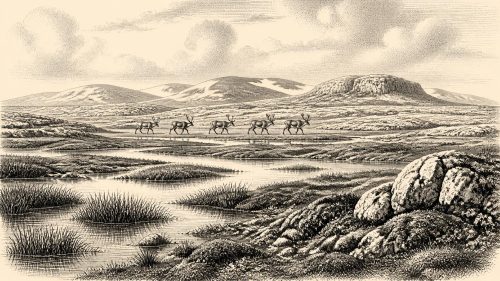
Butchery Question
31,203 BCE is a modern chronological marker rather than a recoverable Irish year. During this unstable Late Pleistocene period, Ireland experienced variable ice cover, lower sea levels and cold, open wetlands, evidenced by Derryvree sediments in Fermanagh. Castlepook Cave near Doneraile preserves a mixed late-Ice-Age fauna including mammoth, reindeer, giant deer, hyaena and wolf, though deposits were disturbed and span millennia. A dated reindeer femur bearing a possible stone-tool cut mark may indicate Upper Palaeolithic human processing around 33,000 years ago. It cannot prove settlement or continuity. It stresses uncertainty, distinguishing environmental evidence, animal remains, and an unresolved human trace.
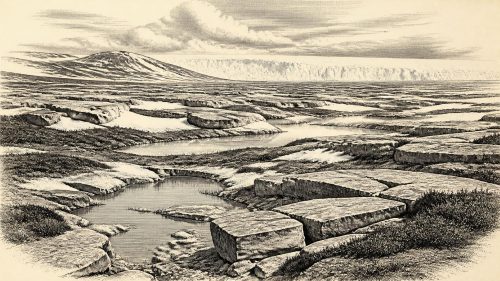
Advancing Ice
Around 31,202 BCE, Ireland lay within the climatically unstable Late Pleistocene, approaching major expansion of the British–Irish Ice Sheet. Evidence cannot reconstruct a single year: ice extent varied regionally, and later glaciers erased or disturbed earlier landscapes and deposits. Cold, seasonal open habitats probably persisted where ice did not cover land, while fossil caves attest to a wider earlier fauna including mammoth, reindeer and predators, though revised dates prohibit assigning species confidently to this moment. No secure evidence shows human residence, society, trade or conflict. Ireland’s first demonstrated human activity dates about 12,800 cal BP. Glaciation reshaped terrain, obscuring evidence.
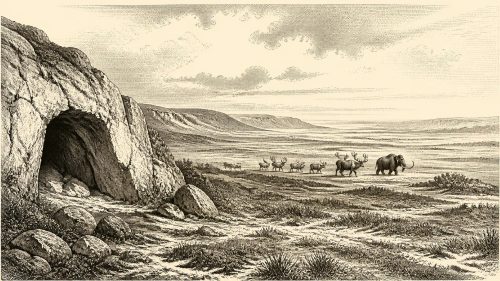
Castlepook Specimens
Castlepook Cave in County Cork preserves Ireland’s richest disturbed record of vertebrate fauna before the Last Glacial Maximum, during the climatically unstable later Marine Isotope Stage 3. Around 34,000–32,000 calibrated years ago, Ireland contained shifting cold, open habitats, developing ice and altered coastlines, rather than a uniformly frozen landscape. Mammoth, reindeer, giant deer, bear, wolf, hyena, lemmings and Arctic fox demonstrate connections with wider north-west European ecosystems. A tool-marked reindeer femur suggests fleeting Upper Palaeolithic activity, but cannot establish settlement or occupation. Dating, bone deposition and excavation methods require caution. Castlepook documents an ecological frontier increasingly transformed by advancing ice.