

31700–31601 BCE
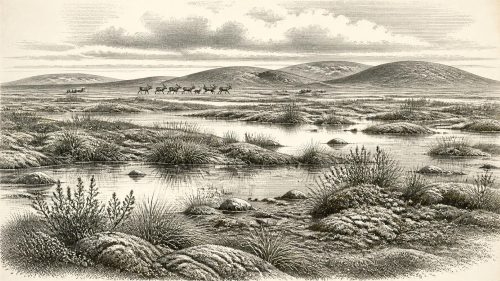
Derryvree’s Freshwater Beds
Derryvree’s freshwater sediments near Maguiresbridge provide a cautiously dated glimpse of Ireland during Marine Isotope Stage 3, within a calibrated range encompassing 31,700 BCE. Sandwiched between glacial tills, they indicate ice-free tundra wetland, with mossy vegetation, pools and animal life, rather than continuous ice cover. Greenagho offers comparable pre-maximum evidence. Castlepook Cave preserves mixed remains of mammoth, reindeer, giant deer, bears, hyaenas and other cold-climate fauna. A cut-marked reindeer bone may indicate Palaeolithic butchery, but cannot establish permanent settlement. Later ice destroyed much evidence. Ireland was environmentally variable, increasingly glacial, and possibly visited by mobile hunter-gatherers, though settlement remains unproven.
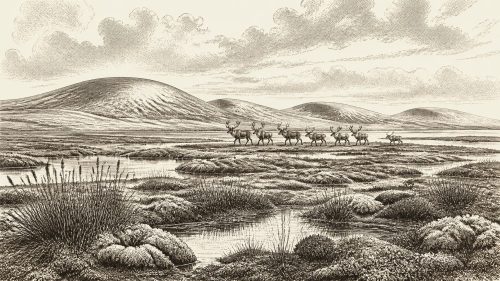
Derryvree’s Sedge Muskeg
Around 31,699 BCE, Ireland lay in the unstable cold of Marine Isotope Stage 3. Derryvree, County Fermanagh, preserves freshwater deposits beneath later glacial till, revealing treeless, sedge-rich, mossy wetlands and open tundra-like ground. Other northern sites indicate that some regions remained ice-free, though conditions varied and later ice advances reshaped the island. Castlepook Cave in County Cork contains remains of Ice Age mammals, including reindeer, mammoth and predators, but its mixed deposits cannot date species precisely. A marked reindeer bone may indicate brief human butchery, yet provides no proof of permanent settlement. Environmental evidence is stronger than evidence for people.

Birm-166’s Sedge Record
31,698 BCE is a retrospective label, not a recoverable Irish year. Derryvree, County Fermanagh, provides calibrated evidence for ice-free conditions between roughly 36,900 and 31,700 years before present, preserved as freshwater organic silts between tills. Mosses, sedges, bogbean and insects indicate a cold, open periglacial wetland, amid climatically unstable MIS 3 conditions. Cave calcite and deposits elsewhere confirm episodic milder intervals and fluctuating ice. Castlepook Cave's disturbed fauna documents diverse cold-stage mammals, while a possibly cut-marked reindeer bone suggests, but cannot prove, human activity. No settlements, polities or trade are attested. Sediments instead reveal changing wetlands, fauna and advancing ice.

Denekamp Over Doneraile
31,697 BCE cannot be reconstructed as a discrete Irish historical year, but belongs to unstable MIS 3 conditions near the Denekamp Interstadial. Ireland lacked known polities, settlements, farming or securely documented communities, while low sea levels and shifting ice and sea routes complicated access. Derryvree deposits in Fermanagh indicate cold, treeless freshwater and periglacial environments between glacial advances. Crag Cave speleothems record episodic thaw and climatic fluctuation. Castlepook Cave preserves diverse Ice-Age fauna, though its mixed assemblage spans long periods. A marked reindeer femur may suggest brief human butchery, but cannot establish permanent occupation. Ice erosion and excavation limit interpretation.

Derryvree’s Cold-Stage Wetland
Around 31,696 BCE, a nominal date within uncertain calibrated ranges, Ireland lay in the climatically unstable MIS 3 Ice Age. At Derryvree, County Fermanagh, organic sediments between glacial tills record an ice-free interval of cold, treeless wetland, with sedges, mosses, herbs, shallow water and frost-disturbed ground. Castlepook Cave, County Cork, preserves remains of cold-adapted mammals, demonstrating intermittent ecological connectivity with north-west Europe. A marked reindeer femur may indicate Upper Palaeolithic butchery, though no secure camp or continuous occupation is known. Later ice expansion erased much evidence. The period is directly understood through environmental archives, not dated events, societies or politics.

North Cork Reindeer Limb
Around 31,695 BCE, during later Marine Isotope Stage 3, Ireland was cold, open and partly affected by advancing glaciation. Buried freshwater deposits at Derryvree and Greenagho in Fermanagh demonstrate ice-free terrestrial environments before renewed ice advances. Castlepook Cave, County Cork, preserves remains of reindeer, mammoth, giant deer, bear, wolf and hyaena, indicating a Late Pleistocene grazing and predator landscape. A reindeer femur bearing a possible stone-tool cutmark may represent Ireland’s earliest human trace, but its uncertain cave context precludes proof of settlement. No tools, hearths, burials or social institutions are known. Environmental evidence, rather than human history, defines this period.

Castlepook’s Incised Femur
The nominal date 31,694 BCE cannot describe an event, but denotes a broadly dated MIS 3 interval of climatic instability. Ireland was a changing glacial frontier, with shifting ice, water and open terrain. Derryvree sediments record cold, treeless freshwater tundra between glacial advances; Crag Cave indicates episodic milder conditions. Castlepook Cave preserves diverse Ice Age fauna, though bones accumulated over time and are not contemporaneous. An incised reindeer femur may indicate stone-tool butchery and Ireland’s earliest human presence, but lacks secure contextual evidence. The article concludes that mobile hunter-gatherers may have visited, without proof of settlement, continuity or social details.

Derryvree’s Arctic Mosses
31,693 BCE denotes a broad Late Pleistocene interval, rather than a recoverable Irish year. At Derryvree, County Fermanagh, freshwater sediments between glacial tills reveal an ice-free episode with mosses, sedges, pools and sparse Arctic-alpine vegetation on treeless periglacial ground. Castlepook Cave, County Cork, preserves mixed MIS 3 animal remains, indicating connections with north-west European cold-stage ecosystems, though specimens cannot form a contemporary census. A possibly tool-marked reindeer bone raises, but does not prove, early human visitation. Expanding regional ice later overwhelmed habitats. Lower sea levels altered routes, while glaciation and coastal change destroyed evidence. Ireland was environmentally varied and uncertain.

Derryvree’s Trifoliate Seed
At roughly 31,692 BCE, Ireland lay within the fluctuating cold conditions of Marine Isotope Stage 3, although dating cannot identify a single-year event. Derryvree, County Fermanagh, preserves freshwater organic beds between glacial tills, indicating local ice-free or ice-marginal intervals amid changing ice-sheet conditions. Pollen, plants and insects reveal treeless wetlands of mosses, sedges, herbs and dwarf shrubs. Castlepook Cave fauna demonstrates cold-stage animal presence, including reindeer, mammoth and hyaena, but its deposits are chronologically complex. A modified reindeer femur may suggest brief Upper Palaeolithic human activity, yet no settlement evidence exists. Ireland’s record reveals dynamic environments, not recoverable political history.

The Castlepook Hindleg
31,691 BCE is a modern label for a broad Late Pleistocene interval, not a recoverable Irish date. Evidence from Derryvree indicates locally wet, treeless tundra with cold-adapted plants and insects, while Castlepook Cave preserves a mixed, poorly stratified fauna including reindeer, mammoth and hyaena. A reindeer femur, possibly cut by a stone tool, may indicate brief Upper Palaeolithic human activity, but cannot establish hunting, settlement or continuity. Lower seas altered access, as habitats and ice margins shifted. Subsequent ice expansion likely destroyed evidence. Ireland was an intermittently habitable frontier, understood through uncertain environmental fragments rather than political or social history.
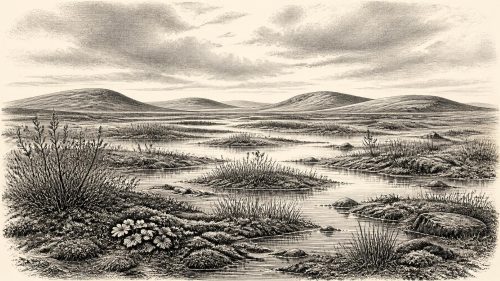
The Birm-166 Horizon
“31,690 BCE” is a modern chronological label, not a year that anyone in prehistoric Ireland could have counted, named or remembered. It corresponds arithmetically to about 33,640 calendar years before 1950, the conventional ‘present’ of radiocarbon dating, but the evidence cannot identify an event in that single year. The responsible subject is therefore Ireland during a broad late-Pleistocene interval: Marine Isotope Stage 3, within the last Ice Age and before the fuller expansion of the Last Glacial Maximum.

Castlepook’s Hyaena Accumulation
31,689 BCE is a modern label for a broad MIS 3 interval, not a datable Irish event. Castlepook Cave in north Cork preserves bones and sediments indicating a cold, open landscape inhabited intermittently by reindeer, mammoth, hyaenas, wolves and other fauna. Hyaenas probably accumulated much material, complicating interpretations of human activity. A marked reindeer femur, dated broadly to MIS 3, may bear a stone-tool incision and suggests a possible early human visit, but lacks secure excavation context or corroborating artefacts. Changing sea levels and approaching ice affected access and preservation. Castlepook therefore illuminates Ice Age ecology while leaving settlement unproven.

Hyaena Hall’s Bone Traffic
Around 31,688 BCE, a retrospective label rather than a recoverable Irish year, Ireland lay within the climatically unstable Marine Isotope Stage 3, before the Last Glacial Maximum. Castlepook Cave in County Cork preserves bones of mammoth, giant deer, reindeer, bears, wolves, Arctic foxes, lemmings and Ireland’s only known spotted hyaenas, indicating varied cold, open habitats. Disturbed excavations and revised radiocarbon dates prevent treating these remains as a single contemporaneous fauna. Hyaena evidence suggests den use. A marked reindeer femur may indicate Palaeolithic butchery, but no associated tools, settlement, or human remains exist. Environmental change, mobility and uncertainty define deep past.
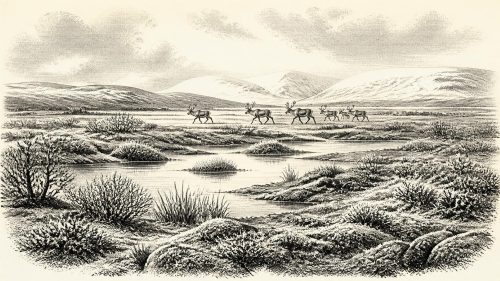
Fermanagh’s Frost Mosses
31,687 BCE is not a recoverable Irish year, but falls within later Marine Isotope Stage 3, before the Last Glacial Maximum. Derryvree, County Fermanagh, preserves freshwater sediments dated broadly to 36,900–31,700 cal BP, indicating an intermittently ice-free tundra wetland of mosses, sedges, grasses and shrubs. Castlepook Cave, County Cork, contains diverse Ice Age fauna, including mammoth, giant deer, reindeer, bear and hyaena, accumulated over millennia. A modified reindeer femur may record early human butchery, yet remains unconfirmed. No settlements or social institutions are evidenced. Ireland was a climatically unstable, variably habitable landscape of advancing ice, wildlife and possible human visits.

Derryvree’s Hidden Silt
About 31,686 BCE, Ireland lay in the fluctuating cold conditions of Marine Isotope Stage 3, though no evidence can date events to that single year. At Derryvree, County Fermanagh, freshwater sediments between glacial tills record a treeless, wet-tundra environment during an interval between ice advances. Castlepook Cave, County Cork, preserves MIS 3 remains of reindeer, bear, arctic fox, hare, hyaena, giant deer and mammoth, demonstrating episodic ecological links with north-west Europe. Possible human modification of a reindeer bone remains unconfirmed and cannot prove settlement. The evidence instead reveals shifting ice, wetlands, open vegetation and mobile fauna, while interpretations remain provisional.

Derryvree’s Greenland Six
Around 31,685 BCE, a notional date within Marine Isotope Stage 3, Ireland's evidence records changing Ice Age environments rather than a datable event. Organic silts at Derryvree, Fermanagh, preserved between glacial tills, indicate an ice-free, cold, treeless wetland of grasses, sedges, herbs, mosses and pools, later overridden by ice. Ireland was approaching, not experiencing, the Last Glacial Maximum. Castlepook Cave's mixed fauna demonstrates cold-stage animal diversity, but accumulated over separate periods. A possibly tool-marked reindeer femur may indicate an early human visit, yet lacks secure context. No settlement, culture or continuous population can be inferred; later glaciation further obscured evidence.
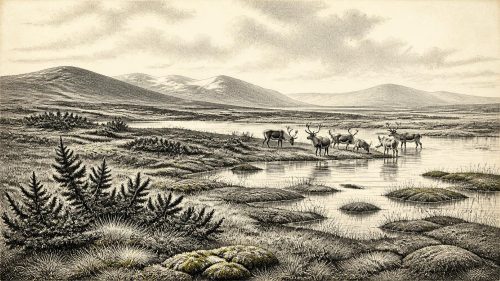
Derryvree’s Marsh Ledger
About 31,684 BCE, Ireland lay within the unstable Late Pleistocene, though no precise event can be dated to that year. Sediments at Derryvree, County Fermanagh, preserved between glacial tills, record an ice-free interval of freshwater marsh, open tundra-steppe vegetation and seasonal productivity. Comparable northern deposits reveal repeated climatic and ecological shifts. Castlepook Cave, County Cork, contains mammoth, reindeer, giant deer, predators and scavengers, indicating rich cold-country fauna. A cut-marked reindeer bone may provide Ireland’s earliest evidence of human butchery, but proves neither settlement nor continuous occupation. Later expansion of the British–Irish Ice Sheet erased or buried Ireland’s fragile archaeological evidence.

Derryvree’s Inter-Till Flora
Around 31,683 BCE, Ireland cannot be described through a precise calendar year, but through unstable MIS 3 conditions. Derryvree, County Fermanagh, preserves freshwater sediments between glacial tills, indicating open tundra, wet hollows, mosses, sedges and sparse vegetation during an ice-free interval. Castlepook Cave, County Cork, contains a long-accumulated fauna including reindeer, mammoth, giant deer, bear and hyaena, reflecting cold open landscapes. A marked reindeer femur may indicate brief human activity, though its interpretation remains contested and proves neither settlement nor occupation. Changing ice margins, lowered seas and uncertain routes shaped Ireland as it approached renewed extensive glaciation during this period.

Derryvree’s Frostwater Flora
Around 31,682 BCE, Ireland was an unstable later-MIS 3 Ice Age landscape, not a documented human society. Derryvree, County Fermanagh, preserves freshwater organic sediments between glacial tills, indicating an ice-free interval with tundra-like wetlands, mosses, sedges, aquatic plants and cold-adapted insects. Cave evidence and speleothems show environmental variation, while advancing ice sheets increasingly reshaped the island before the later Last Glacial Maximum. Castlepook Cave fauna, including reindeer, mammoth and hyena, reflects changing Pleistocene ecosystems rather than a single community. A possibly cut-marked reindeer bone suggests early human activity, but lacks corroborating archaeological context. Evidence remains fragmentary and interpretations necessarily cautious.
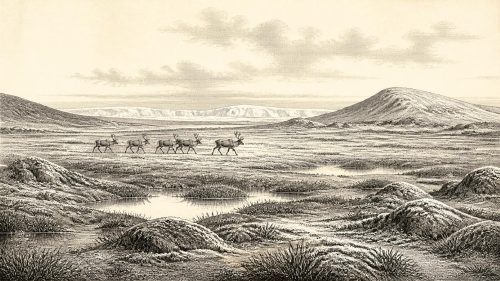
Derryvree’s Tundra Waterline
31,681 BCE is not a recoverable Irish historical date but falls within a broad Late Pleistocene, Marine Isotope Stage 3 timeframe. Derryvree, County Fermanagh, preserves freshwater sediments between tills, indicating severe periglacial yet tundra-like wetlands with sedges, dwarf shrubs and cold-adapted insects. Ireland was climatically and geographically variable before the Last Glacial Maximum, with changing ice, sea levels and access routes. Castlepook Cave, County Cork, contains fauna including mammoth, reindeer, giant deer and hyaena, accumulated over long periods. A marked reindeer bone tentatively suggests human processing, but confirms neither settlement nor continuous occupation. Evidence supports environmental history, not year-specific events.

Bogbean and Reindeer
Around 31,680 BCE, Ireland lay within the climatically unstable MIS 3 cold stage, where ice margins and habitats changed repeatedly. Derryvree in Fermanagh preserves freshwater deposits indicating open, waterlogged tundra, with sedges, mosses, dwarf willow and bogbean. Castlepook Cave in Cork contains MIS 3 remains of mammoth, reindeer, giant deer, predators and cold-adapted species, showing Ireland’s place in a wider Ice-Age ecosystem. A marked reindeer femur may indicate butchery by people, but lacks secure context. No evidence establishes permanent settlement, communities, political life or cultural practices; the period’s history is chiefly environmental, fragmentary and cautiously interpreted from sparse surviving evidence.

Fermanagh Between the Tills
Around 31,679 BCE, Ireland lay within a cold, unstable Late Pleistocene interval, rather than a precisely datable historical year. Evidence from Derryvree, County Fermanagh, shows freshwater sediments, tundra-like vegetation and insects preserved between glacial tills, demonstrating local ice-free conditions before later ice advance. Castlepook Cave, County Cork, contains remains of mammoth, reindeer, bears, wolves, foxes and hyenas, indicating changing open-country fauna. A cut-marked reindeer bone may suggest human activity around 33,000 years ago, but remains inconclusive. No secure evidence establishes permanent Palaeolithic settlement, political societies, farming, language or culture. Ireland’s record is geological, ecological and fragmentary in character and scope.

The Maguiresbridge Freshwater Series
31,678 BCE is a modern label for a broad Late Pleistocene interval, reconstructed from environmental evidence rather than recorded events. At Derryvree, County Fermanagh, freshwater deposits between glacial tills reveal an ice-free or largely ice-free, periglacial tundra landscape with pools, sedges, mosses and sparse vegetation before renewed glaciation. Castlepook Cave, County Cork, preserves MIS 3 remains of reindeer, giant deer, mammoth, hyaena and other fauna, though accumulated over time. A possibly cut-marked reindeer bone suggests brief human presence, but occupation remains unproven. These archives show dynamic, regionally varied Ice Age Ireland, later extensively reshaped by expanding ice sheets over millennia.

The Castlepook Carcass
“31,677 BCE” is a modern chronological label, not a year that can be recovered from the Irish archaeological record. No calendar, written testimony or event sequence allows historians to isolate a particular season, person or occurrence on the island at such depth of time. Expressed in the conventional archaeological scale of years before AD 1950, it falls roughly around 33.6 thousand calendar years ago. The responsible frame is therefore a broad one: later Marine Isotope Stage 3 (MIS 3), a volatile interval of the Last Glacial period conventionally spanning about 57,000 to 29,000 years ago. Ireland’s evidence is sparse, discontinuous and often derived from old cave excavations. Yet it is sufficient to illuminate an Ice Age world of changing ice margins, open habitats and large animals—and to raise a difficult, important question about very early human visits.

Mammoth Cave’s Cold Corridor
At the notional date of 31,676 BCE, Ireland lay within the climatically unstable later Marine Isotope Stage 3, before the last British–Irish Ice Sheet reached maximum extent. Derryvree sediments in County Fermanagh record a cold, open, waterlogged interval between glaciations, supporting sparse wetland vegetation. Castlepook Cave in County Cork preserves diverse cold-stage fauna, including mammoth, reindeer, giant deer, lemmings, predators and hyenas, though its bones accumulated across long periods. A cut-marked reindeer femur may indicate brief human presence, but remains contested and isolated. No evidence establishes settlement or society. Subsequent ice advance buried, disturbed and destroyed much of this record.
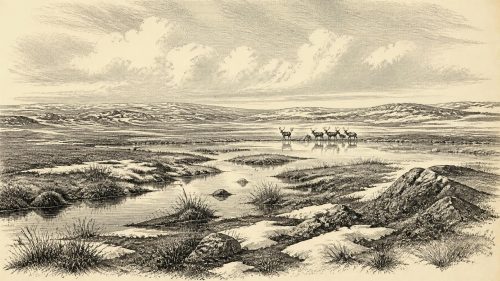
The Irish Sea Threshold
31,675 BCE is a modern label, not a datable Irish event, representing late Pleistocene Marine Isotope Stage 3 as the British–Irish Ice Sheet began sustained growth. Ireland contained ice-free tundra, wetlands and freshwater habitats, preserved beneath glacial deposits at Derryvree and Greenagho. Castlepook Cave's imperfect bone assemblage records reindeer, mammoth, giant deer and predators, indicating an ecologically active landscape. A cut-marked reindeer femur may signal Ireland's earliest human activity, but cannot prove settlement, culture or continuity. Glacial erosion, uncertain radiocarbon dates and changing sea geography limit conclusions. The period is an environmental threshold, illuminated by fragmentary evidence rather than events.
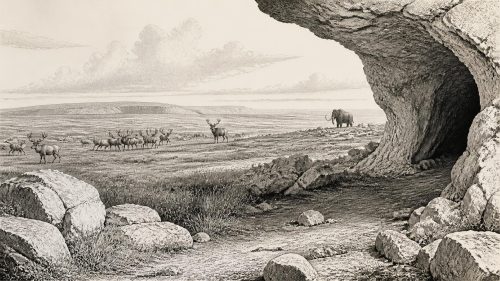
Cork’s Mammoth-Steppe Mosaic
Around 31,674 BCE, Ireland lay within the variable MIS 3 phase of the last glacial period, before the Last Glacial Maximum. Rather than a uniformly frozen landscape, it contained regionally diverse open habitats of grasses, sedges, shrubs and wet ground, shaped by changing ice and lower seas. Castlepook Cave in north Cork preserves bones of mammoth, reindeer, giant deer, hyaena and other cold-adapted animals, indicating a dynamic food web, though deposits span long periods. Sediments elsewhere provide botanical evidence. A marked reindeer femur may indicate human visitation, but remains contested. No evidence supports permanent settlement, polities, beliefs or continuous occupation.
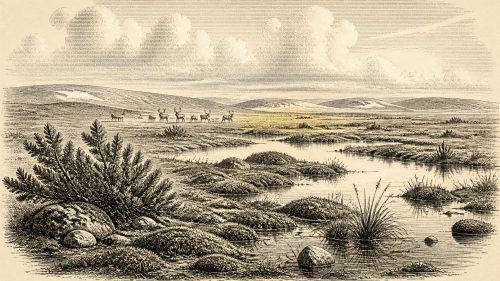
The Maguiresbridge Freshwater Lens
Circa 31,673 BCE, Ireland cannot be described through a dated event, but through a variable Marine Isotope Stage 3 environment. At Derryvree, near Maguiresbridge, freshwater silts between glacial tills preserve evidence of ice-free, treeless periglacial wetlands, with mosses, sedges, grasses, herbs and juniper. Castlepook Cave in Cork records mammals, including mammoth, reindeer, giant deer, bears, hyaenas, wolves and lemmings, across many millennia, demonstrating ecological links with north-west Europe. A marked reindeer bone may indicate human butchery, but remains contested. No settlements or social institutions are known. Together, these archives reveal dynamic, intermittently habitable landscapes, later overridden by advancing ice sheets.
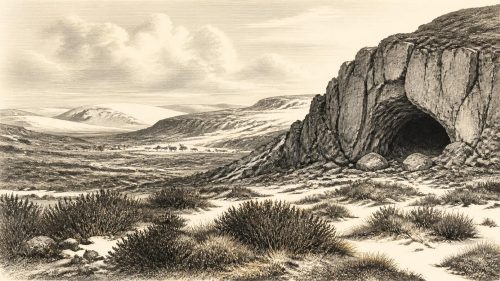
Castlepook’s Reindeer Incision
Circa 31,672 BCE, Ireland occupied a climatically unstable Late Pleistocene frontier, with open steppe-tundra, changing coastlines and uneven ice expansion. Castlepook Cave near Doneraile preserves a time-mixed fauna including mammoth, reindeer, giant deer, hyaena, Arctic fox and lemmings, showing intermittent cold-stage habitats. A reindeer femur, dated broadly to about 33,000 years ago, bears an incision interpreted as stone-tool butchery, suggesting an Upper Palaeolithic human visit. The evidence cannot establish a precise year, permanent settlement, identity, beliefs or social organisation. Any people were probably mobile foragers, while cave deposits require secure contexts, tools and sites to confirm Ireland’s earliest human presence.

Derryvree’s Denekamp Wetland
Although labelled 31,671 BCE, this is not a precisely datable Irish year. During the climatically unstable Late Pleistocene, Derryvree in County Fermanagh preserved freshwater organic silts between glacial tills, demonstrating an ice-free wetland interval within episodic glaciation. Pollen, plants and insects indicate open, treeless, waterlogged vegetation under severe seasonal conditions. Castlepook Cave in north Cork records mammoth, reindeer, giant deer, predators and other cold-adapted fauna, showing intermittent north-west European ecological connectivity. A cut-marked reindeer femur may indicate human butchery, but no associated settlement or tools establish sustained occupation. Changing ice, sea levels and later erosion shaped landscapes and limited evidence.
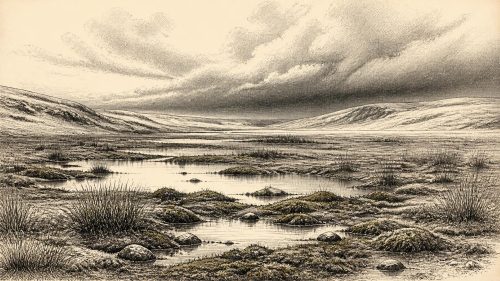
Derryvree’s Silted Pool
Although 31,670 BCE is a modern label rather than a precise Irish date, Derryvree, County Fermanagh, preserves organic freshwater sediments dated broadly to 36,900–31,700 cal BP. Trapped between glacial tills, they record a cold, treeless wetland landscape with pools, mosses, plants and insects during Marine Isotope Stage 3. Cave fossils elsewhere show that mammoth, reindeer and predators reached Ireland, but cannot be assigned to Derryvree or one moment. Ireland was increasingly affected by expanding ice, while lower sea levels did not guarantee easy migration routes. No secure human evidence exists until much later. Derryvree documents environmental change, not human history.

Sedges Beneath Fermanagh
Around 31,669 BCE, Ireland lay within the unstable later Marine Isotope Stage 3 of the Last Glacial Period, rather than a datable year. Freshwater sediments at Derryvree, County Fermanagh, indicate locally ice-free, treeless wetlands of sedges, mosses, herbs and shallow water, supporting cold-adapted life. Castlepook Cave, County Cork, records reindeer, mammoth, giant deer, predators and smaller mammals, though its deposits span multiple periods. Expanding ice increasingly reshaped and buried landscapes. Lower sea levels allowed animal access at times, but routes remain uncertain. No secure human settlement is known; a possibly cut reindeer bone offers only tentative evidence of Palaeolithic visitation.
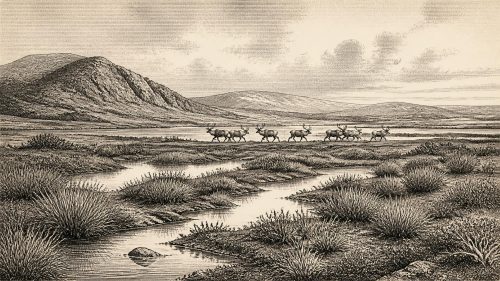
A Reindeer Femur at Castlepook
At the notional date of 31,668 BCE, Ireland experienced unstable cold conditions of Marine Isotope Stage 3, not a single recoverable historical year. Inter-till wetland deposits at Derryvree, County Fermanagh, show treeless, wet tundra habitats during an ice-free interval, though dating remains broad. Castlepook Cave, County Cork, preserves Late Pleistocene bones of mammoth, reindeer, giant deer, predators and other cold-adapted animals, accumulated over potentially separate episodes. A cut-marked reindeer femur may indicate human carcass processing around 33,000 years ago, but lacks associated tools or settlement evidence. Climate, ice advances and seas limited access, leaving no proof of occupation or continuity.

The Maguiresbridge Interstadial
At approximately 31,667 BCE, Ireland lay in the climatically unstable Late Pleistocene, not a historical year with identifiable communities. Freshwater deposits beneath later glacial till at Derryvree, County Fermanagh, and Greenagho indicate ice-free local basins supporting tundra-steppe vegetation, pools, sedges, mosses, dwarf willow and juniper. Cave remains at Castlepook, County Cork, demonstrate varied cold-climate fauna, including reindeer, mammoth, giant deer and predators, though not all were contemporary. A possibly stone-cut reindeer femur may indicate brief Upper Palaeolithic human activity, but remains disputed and proves neither settlement nor hunting. Expanding ice buried, disturbed and erased evidence before the Last Glacial Maximum.
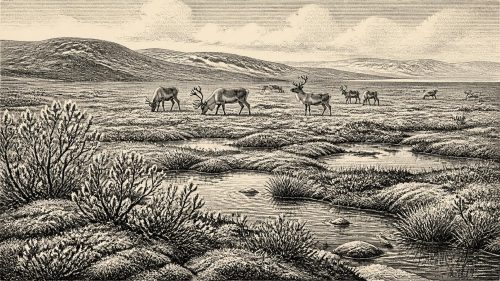
Greenagho’s Buried Lake
Labelled 31,666 BCE, this period belongs to the unstable later Marine Isotope Stage 3, not recorded history. Sediments beneath glacial till at Derryvree and Greenagho, County Fermanagh, preserve evidence of freshwater wetlands, cold-adapted vegetation and locally ice-free ground before expansion of the British–Irish Ice Sheet. Treeless landscapes contained sedges, mosses, dwarf willow and other plants suited to wet, open conditions. Castlepook Cave, County Cork, yields a complex pre-maximum fauna including mammoth, reindeer, giant deer, hyaena, bears and wolves. A possibly tool-marked reindeer bone suggests brief human activity, but cannot demonstrate settlement. Advancing ice later transformed habitats and destroyed earlier evidence.

Castlepook’s Reindeer Mark
31,665 BCE is a modern label for an uncertain MIS 3 Ice-Age period, not a recorded Irish year. Before the Last Glacial Maximum, Ireland contained open, periglacial habitats and altered coastlines, connected environmentally with wider north-west Europe. Castlepook Cave, County Cork, preserves fauna including reindeer, mammoth, giant deer, hyaena, bear, wolf, Arctic fox and lemmings, accumulated through complex processes. A reindeer femur, dated about 31,000 BCE, bears a possible stone-tool incision, suggesting Upper Palaeolithic carcass processing. However, its old, unstratified context and absence of associated artefacts, hearths or settlements mean human occupation remains unproven. The evidence indicates possibility, not population.

Hyaena Land’s Faunal Network
31,664 BCE is a modern label for a late Marine Isotope Stage 3 horizon, not a datable Irish event. Environmental evidence from Derryvree and Crag Cave indicates fluctuating cold conditions, open tundra wetlands and episodically milder intervals. Castlepook Cave preserves a diverse, time-mixed pre-Last Glacial Maximum fauna, including mammoth, reindeer, giant deer, hyaena, wolves and lemmings, demonstrating ecological links with north-west Europe. Ancient DNA may extend this picture, though remains provisional. A marked reindeer femur may indicate Upper Palaeolithic butchery, but cannot prove settlement. Ireland lacked communities or institutions; human visits remain uncertain amid changing ice, sea routes and landscapes.

Maguiresbridge Bogbean Pool
31,663 BCE is a modern label for a Middle Midlandian MIS 3 interval, not a recoverable historical year. At Derryvree, County Fermanagh, freshwater deposits between glacial tills record a cold, non-glacial wetland of sedges, mosses, bogbean, insects and open tundra vegetation, later sealed by ice. Related Fermanagh sites indicate complex regional climatic change. Castlepook Cave, County Cork, preserves bones of mammoth, giant deer, reindeer, predators and other cold-adapted fauna, though deposits span long periods. A marked reindeer bone may suggest human butchery, but cannot prove settlement. These archives reveal Ice Age environments, while political, cultural and economic history remains unknown.

The Derryvree Seedbed
Around 31,662 BCE, Ireland lay within the climatically unstable Late Pleistocene, not a precisely dateable historical moment. Derryvree, County Fermanagh, preserves freshwater silts between glacial tills, indicating an ice-free interval of cold, treeless wetland supporting mosses, sedges, herbs and aquatic plants. Castlepook Cave, County Cork, contains time-mixed remains of mammoth, reindeer, hyaena and other Ice-Age fauna. A cut-marked reindeer bone may indicate brief human handling, but lacks associated tools or settlement evidence. Lower sea levels and shifting ice margins shaped uncertain routes. Later glaciation obscured evidence, leaving Ireland biologically active yet only potentially, and not demonstrably, inhabited by people permanently.

Derryvree’s Arctic Sandwort
Around 31,661 BCE, Ireland lay within the climatically unstable Late Pleistocene, but the date is only a broad modern approximation. At Derryvree, County Fermanagh, freshwater sediments beneath glacial till preserve tundra-like wetlands with Arctic sandwort, mountain avens, mosses, sedges and shallow pools, formed before renewed ice advance. Cave deposits, especially Castlepook in Cork, record Ice Age fauna including mammoth, reindeer, giant deer, predators and lemmings, though not as one contemporaneous community. A marked reindeer bone may indicate human butchery, but cannot establish settlement or continuous occupation. Evidence reveals changing environments and animals, not identifiable societies, politics, routes or annual events.

Derryvree’s Permafrost Garden
Around 31,660 BCE, Ireland lay in the later Marine Isotope Stage 3, as conditions worsened before the Last Glacial Maximum. Derryvree, County Fermanagh, preserves silts recording an ice-free, periglacial wetland of tundra, sedges, mosses, insects and shallow pools. Castlepook Cave, County Cork, demonstrates the presence of cold-stage fauna, including mammoth, reindeer, giant deer, predators and smaller mammals, though not necessarily simultaneously. A marked reindeer femur may indicate brief human butchery, but cannot prove settlement. No polities or cultural communities are evidenced. Expanding ice, changing sea levels and uncertain routes made Ireland severe, intermittently accessible and ecologically still linked to Europe.

Birm-166’s Tundra Basin
Around 33,600 calibrated years before 1950, Ireland lay within the unstable MIS 3 cold phase, rather than a precisely datable historical year. Derryvree, County Fermanagh, preserves freshwater sediments between glacial tills, indicating locally ice-free, treeless tundra with wet hollows, hardy plants and insects. Cave finds at Castlepook, County Cork, show that reindeer, mammoth, giant deer, predators and other cold-adapted animals occurred in Ireland during MIS 3, though not necessarily simultaneously. A possibly cut-marked reindeer bone may indicate fleeting human activity, but cannot prove settlement. Expanding ice and changing seas shaped uncertain connections with Britain and Europe during this changing period.
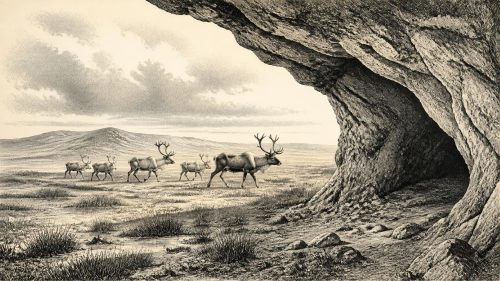
Castlepook’s Cut Reindeer
31,658 BCE is a modern chronological label, not a recorded Irish event. Castlepook Cave, County Cork, preserves Ireland’s principal pre-Last Glacial Maximum mammal archive, accumulated through carnivore activity, natural deaths, water movement and early excavation. Its bones, dated broadly from over 45,000 to about 20,000 BP, document intermittent cold-stage fauna including reindeer, mammoth, hyaena and wolves. A reindeer femur, assigned approximately 31,000 BC, bears a possible stone-tool butchery mark, potentially Ireland’s earliest evidence of human handling. It does not prove settlement or continuous occupation. Ireland then supported open, variable habitats before later ice-sheet expansion obscured much earlier evidence from view.
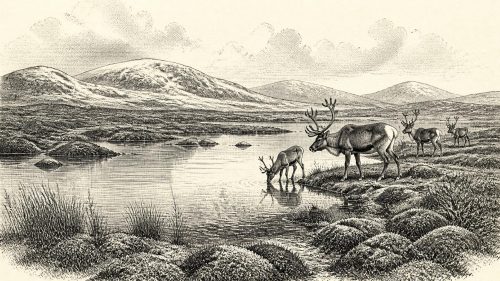
Maguirebridge’s Trifoliate Pools
About 31,657 BCE, Ireland lay within the climatically unstable later Marine Isotope Stage 3, not a recoverable historical year. Derryvree, County Fermanagh, preserves freshwater sediments between glacial tills, dated broadly to 34,950–29,750 BCE, indicating cold, open, wet tundra with pools, mosses, sedges and herbs. Castlepook Cave, County Cork, contains MIS 3 fauna including reindeer, mammoth, giant deer, hyaena and predators, though disturbed contexts limit interpretation. A possibly cut-marked reindeer bone may indicate an early human visit, but remains unconfirmed. No secure evidence supports permanent settlement, society or politics. These fragmentary archives document regional environmental change, animal use and advancing ice.

Castlepook’s Waning Fauna
31,656 BCE is a modern calendar projection, approximately 33,600 calibrated years before present, not a precisely datable Irish event. Ireland was entering colder Late Pleistocene conditions as the British–Irish Ice Sheet expanded unevenly. Derryvree deposits in Fermanagh preserve evidence of treeless, periglacial wetlands and open vegetation between glaciations. Castlepook caves in Cork contain mixed, imperfectly dated remains of mammoth, giant deer, reindeer, predators and other cold-adapted fauna, revealing changing connections with wider Europe rather than a single contemporaneous ecosystem. Routes of animal arrival remain uncertain. No archaeological evidence demonstrates human residence, society, rituals or institutions; environmental change defined this period.

Doneraile’s Reindeer Horizon
Around 31,655 BCE, Ireland was in Marine Isotope Stage 3, before the Last Glacial Maximum, with fluctuating ice, low sea levels and cold, varied habitats. Castlepook Cave near Doneraile preserves bones from repeated Late Pleistocene episodes, including mammoth, reindeer, hyaena, bear, wolf and Arctic fox, but mixed deposits prevent reconstruction of a single fauna or occupation. Derryvree wetlands indicate treeless tundra-like conditions. A dated Castlepook reindeer femur bearing a possible stone-tool mark may indicate brief human contact, yet cannot prove settlement. No securely associated camps, tools, hearths or cultural evidence exist. The record chiefly documents ecology, climate and uncertainty alone.
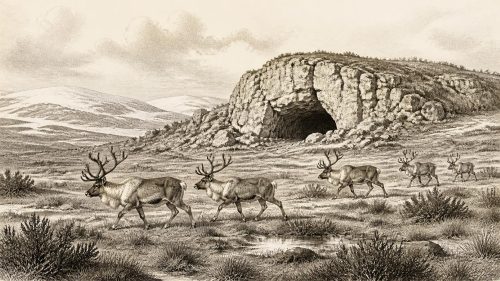
Mammoth Cave’s Cold Menagerie
Around 31,654 BCE, Ireland lay within the fluctuating cold conditions of Marine Isotope Stage 3, not a precisely datable year. Fermanagh sediments preserve evidence of open, wet habitats with cold-adapted plants and freshwater life, showing that some areas remained ice-free before later glaciation. Castlepook Cave in County Cork yielded Ireland’s richest cold-stage fauna, including mammoth, reindeer, giant deer, hyaena and Arctic fox. A cut-marked reindeer bone may indicate human carcass processing around 33,000 years ago, but requires confirmation. No permanent settlement is demonstrated. Subsequent ice-sheet growth reshaped landscapes and erased much earlier evidence, leaving an ecological, rather than societal, record.

Derryvree Before the Drumlin
Around 31,653 BCE, Ireland experienced unstable Late Pleistocene conditions during Marine Isotope Stage 3, before the Last Glacial Maximum. Derryvree, County Fermanagh, preserves freshwater sediments indicating locally ice-free tundra wetland, open pools and severe periglacial conditions between glacial advances. Cave records show intermittent milder phases and a varied fauna, including reindeer, mammoth, giant deer, bear, wolf and hyaena. Low sea levels may have enabled animal movement, though connections remained variable. No secure human settlement is known. A possibly butchered reindeer bone from Castlepook Cave may indicate brief Palaeolithic visitation, but remains inconclusive. Expanding ice later reshaped and obscured much evidence.

Crag Cave’s Thaw Windows
Around 31,652 BCE, Ireland lay within the climatically unstable Late Pleistocene, not a recorded historical world. Evidence is sparse and cannot demonstrate settlement, institutions or fixed events. Derryvree sediments indicate open tundra-like vegetation, wetlands and fluctuating conditions, while Crag Cave speleothems show intermittent liquid water in south-west Ireland during milder phases. Castlepook Cave fauna confirms repeated arrivals of mammals, including reindeer, mammoth, hyaena and bear, across changing routes. A marked reindeer bone may indicate human butchery about 33,000 years ago, but remains inconclusive. Ireland was a cold, shifting landscape, intermittently habitable for plants and animals, and possibly visited by people.
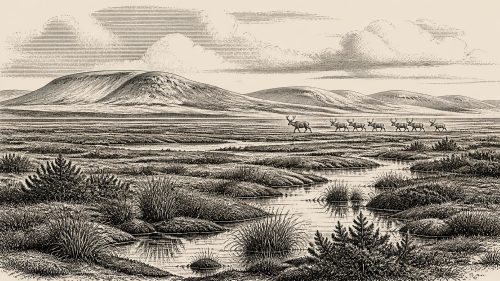
Mammoth Cave, Derryvree, and Ice
About 31,651 BCE, Ireland was not experiencing a datable historical year but a fluctuating Late Pleistocene interval within MIS 3. Organic deposits at Derryvree and Greenagho indicate local ice-free or withdrawn conditions before renewed glaciation, supporting cold open wetlands with grasses, sedges, juniper, mosses and insects. Castlepook Cave in Cork preserves remains of mammoth, reindeer, hyaena, bear and lemming, though accumulated deposits cannot define one ecosystem. A cut-marked reindeer femur may indicate Upper Palaeolithic carcass processing, but not settlement or permanent occupation. No evidence supports farming, monuments, political communities or regular trade. Expanding ice obscured this fragile, regionally varied landscape.

Castlepook’s Marked Femur
c. 31,650 BCE cannot be identified as a discrete Irish event, but falls within the climatically unstable MIS 3 interstadial landscape preceding the Last Glacial Maximum. Derryvree, County Fermanagh, preserves evidence of an ice-free, open tundra-like wetland interval, although its broad calibrated dates cannot pinpoint a year. Castlepook Cave, County Cork, contains MIS 3 fauna including reindeer, mammoth and predators, demonstrating cold-adapted animal movement. A marked reindeer femur may record stone-tool butchery and a brief human visit around 31,000 BCE. However, no associated tools, hearths, settlement, human remains or reliable route evidence exists; later glaciation severely damaged the archaeological record.

Fermanagh’s Birm-166 Deposit
Around 31,649 BCE, Ireland has no annual history, but Derryvree, County Fermanagh, preserves freshwater silts beneath later tills, broadly dated 36,900–31,700 cal BP. Mosses, sedges, grasses and insects indicate a cold, treeless, periglacial wetland during Marine Isotope Stage 3, before maximum ice-sheet expansion. The record demonstrates local ice-free conditions, not Ireland-wide climate or forest. Cave remains from southern Ireland show intermittent fauna including reindeer, mammoth, giant deer, predators and small cold-adapted mammals, though contexts are uncertain. Possible early human evidence remains unconfirmed; secure human activity is much later. No communities, institutions or cultural practices can be assigned to this period.

The Awbeg Cutmark Debate
31,648 BCE is a modern label for a fluctuating MIS 3 Ice Age environment, not a recoverable Irish historical year. Derryvree, County Fermanagh, preserves freshwater sediments between glacial tills, indicating locally ice-free, treeless wetlands and open periglacial vegetation during a broadly dated interval. Castlepook Cave, County Cork, contains a complex, repeatedly accumulated fauna including mammoth, reindeer, giant deer, bear and hyaena, but cannot represent a single contemporaneous community. A marked reindeer femur may indicate brief human butchery, yet remains inconclusive. No settlement, culture or economy is demonstrable. Changing ice, wetlands, animal movements and fragmentary evidence define this period in Ireland.
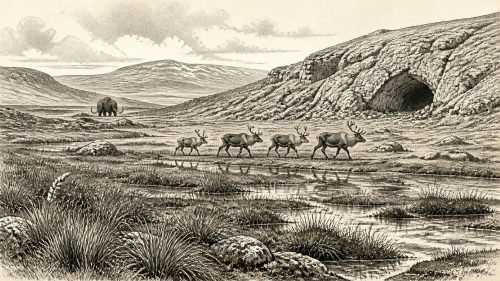
Hyenahall’s Mammoth Archive
Approximately 31,647 BCE, Ireland formed a climatically unstable, partly ice-free frontier during Marine Isotope Stage 3, rather than a recognisable island or society. Derryvree, County Fermanagh, preserves freshwater sediments between tills, indicating cold, open, wet tundra-like habitats before renewed glaciation. Castlepook Cave, County Cork, contains a long accumulated fauna including mammoth, reindeer, giant deer, hyaena and Arctic species, demonstrating ecological links with glacial north-west Europe. A marked reindeer femur, dated about 33,000 years ago, may indicate human butchery, but remains inconclusive. Later ice-sheet expansion eroded evidence. No settlement, polity, agriculture or continuous human occupation can be securely established for Ireland.

Castlepook’s Single Cut
31,646 BCE is a retrospective label, not a datable Irish event, and evidence concerns the wider Late Pleistocene environment. Before the Last Glacial Maximum, parts of Ireland may have remained ice-free amid unstable, open habitats and lower seas. Castlepook Cave in County Cork preserves mixed faunal remains, including mammoth, reindeer, hyena and other cold-adapted species, spanning different periods. A reindeer femur dated roughly 33,000 years ago bears a possible stone-tool cut mark, suggesting hunters may have processed it. However, no associated settlement or tools exist. Castlepook therefore indicates possible intermittent human visits, while demanding cautious interpretation and further scientific research.

Castlepook’s Carnivore Galleries
About 31,645 BCE, a modern label rather than a precise prehistoric date, Ireland lay in the unstable MIS 3 cold stage before the Last Glacial Maximum. Derryvree, County Fermanagh, preserves evidence of open, frost-affected wetland with tundra vegetation. Castlepook Cave, County Cork, yielded mammoth, giant deer, reindeer, bears, wolves, Arctic foxes, lemmings and spotted hyaenas, demonstrating diverse fauna but not a simultaneous community. A cut-marked reindeer femur may indicate transient human butchery, though no secure occupation evidence exists. Ice advances later erased much evidence. The period reveals changing environments and possible visits, not settled population, political history or human occupation.

Maguirebridge’s Calibrated Tundra
Around 31,644 BCE, Ireland’s history is reconstructed from environmental evidence rather than a datable event. Derryvree sediments near Maguiresbridge, calibrated to 36,900–31,700 cal BP, show Fermanagh was temporarily ice-free, with freshwater, tundra-like vegetation and severe seasonal conditions. Castlepook Cave preserves remains of reindeer, mammoth, giant deer and other cold-climate animals, although its deposits represent multiple periods and were disturbed. A possibly cut-marked reindeer bone suggests transient Upper Palaeolithic hunters, but permanent settlement remains unproven. Ireland was approaching wider glaciation, which later erased much evidence. Climatic oscillations and advancing ice, not political or cultural events, define this uncertain deep-prehistoric central horizon.
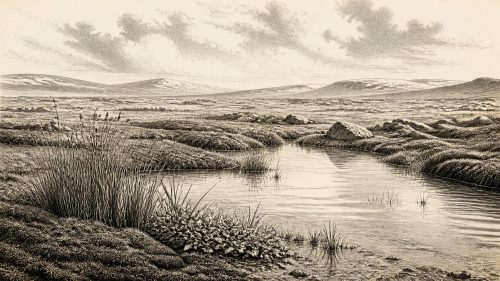
Derryvree’s Bogbean Waters
31,643 BCE is a modern notional date within Marine Isotope Stage 3, not an identifiable Irish event. During this volatile pre-Last Glacial Maximum period, Ireland’s ice, coastlines and habitats changed repeatedly, while lower sea levels sometimes enabled animal movement from Britain. At Derryvree, Fermanagh, freshwater sediments between glacial tills preserve pollen, bogbean, mosses, sedges and cold-adapted insects, indicating open tundra wetland during a broad interval. Castlepook Cave records diverse cold-stage fauna, but its disturbed deposits span millennia. A cut-marked reindeer bone suggests possible Upper Palaeolithic human activity, not settlement. Later glaciation erased much evidence, requiring cautious interpretation in every conclusion.

The Castlepook Femur Problem
Around 31,642 BCE, Ireland lay within the unstable Late Pleistocene, with lowered seas, shifting ice margins and open habitats rather than a fixed island landscape. Castlepook Cave, County Cork, preserves Ireland’s pre-Last Glacial Maximum vertebrate archive, containing mammoth, reindeer, giant deer, bear and spotted hyena remains. Redating demonstrates that its mixed deposits span long periods and cannot document a single year. A reindeer femur bearing a possible stone-tool cut may indicate brief human carcass processing, but lacks archaeological context. No settlement, tools, hearths or social institutions are established. Castlepook reveals ecological links with north-western Europe and uncertainty over earliest visitors.

Mammoths Before the Advance
About 31,641 BCE, Ireland lay within the climatically unstable later Marine Isotope Stage 3. Organic sediments at Derryvree, County Fermanagh, record an ice-free freshwater basin amid open, cold tundra vegetation, including Arctic-alpine fringed sandwort. Southern caves, Castlepook and Shandon, preserve remains of mammoth, giant deer, reindeer and predators, though their dates and deposition require caution. These environments preceded wider glaciation during the Last Glacial Maximum, which erased or buried evidence. No secure evidence confirms human occupation at this date; the earliest indication of human presence is later, around 12,810–12,590 years ago. Ireland’s record therefore documents changing ecosystems, not human communities.
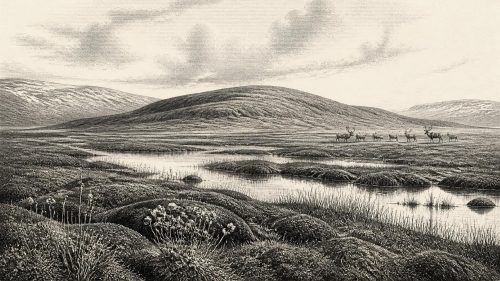
Sedges Beneath a Fermanagh Drumlin
About 31,640 BCE, Ireland lay in a climatically unstable Late Pleistocene interval before maximum glaciation. Organic sediments beneath a Derryvree drumlin in County Fermanagh, dated broadly to 36,900–31,700 calendar years BP, show an ice-free but severe landscape of open tundra, wetlands, sedges, mosses and cold-adapted plants. Southern caves preserve evidence of mammoth, reindeer, giant deer, predators and scavengers, though dates and contexts vary. Advancing ice later erased much evidence. Possible stone-tool butchery marks on a Castlepook reindeer bone suggest human visits, but no secure settlement, tools, hearths, society or culture is demonstrated. Environmental evidence remains firmer than the human record.

Derryvree’s Sedgebound Interval
Circa 31,639 BCE, Ireland was not a historical society but a cold Late Pleistocene landscape subject to rapid climatic change. Derryvree, County Fermanagh, preserves freshwater silts between glacial tills, indicating locally ice-free tundra wetlands with sedges, mosses and cold-adapted insects roughly 36,900–31,700 years BP. Castlepook Cave, County Cork, accumulated bones over millennia, documenting mammoth, giant deer, reindeer, bears, hyenas and later cold fauna. These finds demonstrate changing habitats and connections with north-west Europe, but not settled human communities. A possibly cut-marked reindeer bone may indicate brief human activity, whereas secure evidence dates only to about 12,800 BP. Later ice advanced.

Castlepook’s Open Corridor
31,638 BCE is only a modern nominal date, within climatically volatile Marine Isotope Stage 3, not a recoverable year of Irish history. Ireland experienced shifting coastlines, ice fronts and potential migration routes before maximum glaciation. Derryvree sediments in Fermanagh indicate cold, open, wet tundra conditions between glacial advances. Castlepook Cave's fauna, including mammoth, reindeer, giant deer, predators and Arctic species, demonstrates a varied cold-stage ecosystem. A possibly tool-marked reindeer bone suggests, but cannot prove, brief human activity. No secure evidence supports settlement or continuity. Climatic deterioration later restricted habitats and corridors; securely evidenced human occupation belongs only to postglacial Ireland.

Awbeg’s Reindeer Crossing
Around 33,600 calendar years before present, Ireland experienced unstable Ice Age conditions rather than a single identifiable year. Derryvree sediments in County Fermanagh, sealed between glacial tills, reveal treeless tundra, wetlands, muskeg and cold-adapted vegetation. Castlepook caves in County Cork contain mammoth, reindeer, giant deer, predators and lemmings, demonstrating episodic access by diverse fauna. A marked reindeer femur, dated roughly 33,000 years old, may indicate human butchery, but lacks secure archaeological context. No settlement or social evidence exists. Ireland was an ecologically connected, changing cold landscape; brief human visits remain possible but unproven. Dating ranges prevent precise local reconstruction altogether.

Castlepook’s Earliest Question
Thirty-one thousand six hundred and thirty-six BCE is best treated as an imprecise late MIS 3 interval, not a recoverable Irish calendar year. Derryvree sediments in Fermanagh record cold, treeless freshwater landscapes between glacial advances, while Kerry speleothems show intermittent milder conditions. Altered coastlines, ice margins and sea levels shaped uncertain access to Ireland. Castlepook and other southern caves preserve faunas including reindeer, mammoth and carnivores, although assemblages span long periods and are disturbed. A marked Castlepook reindeer femur may indicate Upper Palaeolithic butchery, but lacks secure context. No settlements, tools, hearths or institutions are evidenced; hunter-gatherer visits remain possible.

The Doneraile Cutmark
31,635 BCE is a modern chronological label for Late Pleistocene Ireland, not a recorded historical year. During climatically unstable Marine Isotope Stage 3, changing ice, sea levels and habitats supported cold-adapted fauna. Castlepook Cave, County Cork, preserved mixed remains including reindeer, mammoth and predators. A reindeer femur, dated broadly around this period, bears a possible stone-tool cutmark, potentially Ireland’s earliest evidence of human activity, though it proves neither hunting nor settlement. Derryvree, County Fermanagh, documents treeless, wet tundra-like conditions. Lower seas altered routes, but land connections remain uncertain. Evidence suggests possible brief human visits, not permanent colonisation nor political institutions.

Fermanagh’s Inter-Till World
At 31,634 BCE, Ireland cannot be described through annual history, but evidence from Marine Isotope Stage 3 reconstructs a fluctuating Ice Age environment. Derryvree, County Fermanagh, preserves freshwater silts between glacial tills, showing that ice-free, treeless tundra and wet muskeg existed during a broadly dated interval encompassing this notional year. Cave records from Kerry indicate episodic milder conditions, while Castlepook, County Cork, documents cold-adapted fauna, including mammoth, reindeer and hyaena. A possibly cut-marked reindeer bone may indicate human carcass processing, but proves neither settlement nor continuity. Lower sea levels enabled changing ecological connections with Europe before later maximum glaciation occurred.

Beneath Maguiresbridge Drumlin
Around 31,633 BCE, Ireland lay in an unstable Late Pleistocene interval before the Last Glacial Maximum. Evidence cannot reconstruct a single year or island-wide landscape, but sediments at Derryvree in Fermanagh record freshwater wetlands between ice advances, supporting tundra-like vegetation and insects. Other sites confirm episodic ice-free conditions. Castlepook Cave in Cork preserves a long-accumulated fauna including mammoth, giant deer, reindeer, predators and smaller cold-adapted animals. A cut-marked reindeer bone may indicate Upper Palaeolithic butchery, but human presence remains unproven without associated tools or settlement evidence. The record depicts environmental change, wildlife and possible transient human access, not named societies.

Castlepook’s Stadial Fauna
Around 31,632 BCE, Ireland lay within a severe, unstable Middle Midlandian climate, but the nominal year cannot identify a specific event. Ice margins, periglacial ground and lowered seas changed over millennia, while faunal links with Britain and Europe remained uncertain. Derryvree in Fermanagh preserves evidence of treeless, waterlogged tundra vegetation and freshwater habitats. Castlepook Cave in Cork contains a time-mixed Late Pleistocene bone archive, including mammoth, giant deer, reindeer, bear, hyaena, wolves and lemmings. These remains indicate open cold-country ecosystems, not a simultaneous community. Direct evidence for human occupation is absent or disputed. Glacial processes shaped landscapes inherited by Ireland.

Rangifer at Doneraile
Around 31,631 BCE, Ireland lay in the unstable later Marine Isotope Stage 3, before the Last Glacial Maximum. Cold, open, largely treeless habitats supported reindeer, mammoth, giant deer, bears and hyaenas, although advancing ice and changing seas made access uncertain. Castlepook Cave near Doneraile preserves a long, disturbed faunal record. A reindeer femur, dated about 33,000 years ago, bears a possible stone-tool butchery mark, suggesting fleeting human activity but not settlement or continuous occupation. Derryvree sediments in Fermanagh record cold tundra wetland conditions between ice advances. Together, these fragmentary archives indicate active landscapes and possible human visitation before widespread glaciation.

Castlepook’s Cave Fauna
Around 31,630 BCE, Ireland lay within an unstable Ice Age interstadial, before the Last Glacial Maximum but amid shifting ice margins, low seas and varied regional conditions. Cave remains at Castlepook, County Cork, document Late Pleistocene fauna including mammoth, reindeer, giant deer, bears, wolves and hyaenas, indicating episodic open, cold-steppe habitats, though not a single contemporaneous ecosystem. Buried sediments at Derryvree, County Fermanagh, reveal treeless periglacial wetlands with grasses, sedges, herbs and mosses. Human occupation remains unproven: a possibly cut-marked reindeer bone may suggest visitors, but lacks secure context. Later glaciation destroyed evidence, leaving changing environments rather than social history.
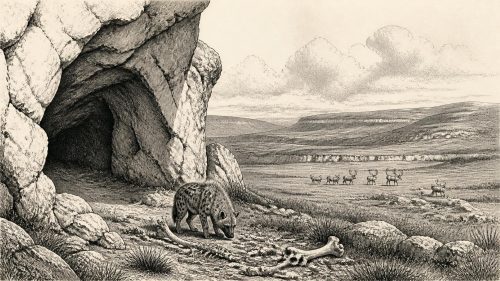
Awbeg’s Hyena Bonehouse
Around 31,629 BCE, Ireland lay in an early, uneven phase of last-glacial ice-sheet growth, with some regions retaining freshwater basins and open periglacial landscapes. Deposits at Derryvree and Greenagho show that parts of Fermanagh remained habitable for cold-adapted ecosystems before later glaciation. Castlepook Cave in County Cork yielded rich Late Pleistocene remains, including mammoth, giant deer, reindeer, bears and spotted hyenas. A roughly 33,000-year-old reindeer bone possibly bears stone-tool damage, suggesting a human visit, but no settlement evidence exists. Lower sea levels may have aided movement, though routes remain unknown. This period represents ecological richness, fragmentary evidence and advancing ice.

Maguirebridge’s Muskeg Pools
Around 31,628 BCE, a modern and necessarily imprecise label, Ireland lay in the fluctuating late Pleistocene MIS 3 interval, before the Last Glacial Maximum. Derryvree, near Maguiresbridge, preserves organic silts between glacial tills, showing an ice-free freshwater mosaic of tundra-like, largely treeless vegetation, insects and wet peaty ground. Castlepook Cave in Cork contains a chronologically mixed assemblage including mammoth, reindeer, giant deer and predators, demonstrating intermittent cold-stage animal communities. A marked reindeer bone may indicate brief Upper Palaeolithic human activity, but remains contested. Evidence cannot establish permanent settlement, routes, social life or events; later ice severely obscured much earlier landscapes.

Derryvree’s Buried Marsh
At the modern date 31,627 BCE, Ireland lay in the climatically unstable later Pleistocene, approaching the Last Glacial Maximum. Evidence is sparse and disrupted by later ice. Buried organic beds at Derryvree, County Fermanagh, indicate an ice-free interval with treeless, cold muskeg of mosses, sedges, herbs, dwarf willow and juniper. Castlepook Cave, County Cork, preserves remains of mammoth, hyaena, reindeer, giant deer and other fauna, indicating varied open habitats and links with wider Europe. A cut-marked reindeer femur may record human carcass processing, but cannot prove permanent settlement. No political, cultural or social history is recoverable; environmental change dominates here.

The Reindeer Limb at Doneraile
31,626 BCE is a modern label within Marine Isotope Stage 3, not a recorded Irish year. Evidence from Derryvree indicates cold freshwater, tundra and steppe-tundra habitats between glacial episodes, while Ireland probably comprised open ground, meltwater, frozen terrain and advancing ice. Castlepook Cave preserves a long, mixed animal record including mammoth, reindeer, giant deer and predators. A reindeer femur, dated about 33,000 years ago, bears possible stone-tool cut marks, suggesting but not proving brief Upper Palaeolithic human activity. No secure settlement, tools, hearths, burials or cultural identity are known. Ireland's past is defined by change, fauna and uncertain human passage.
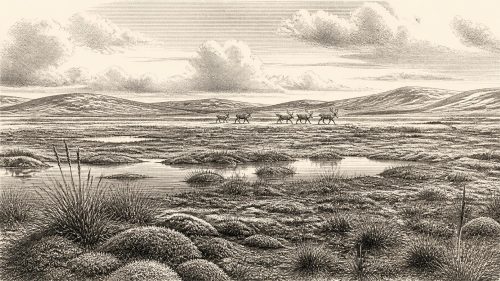
Sedges and Reindeer
31,625 BCE is not a date that can be recovered as a particular Irish year. Nobody on the island used a calendar, wrote an account, named a ruler or recorded a season in terms recognisable today. The number is a modern chronological label: approximately 33,574 years before AD 1950, the conventional “present” used in archaeological dating. At such depth, even radiocarbon results must be calibrated and expressed as probability ranges. The responsible subject is therefore Ireland during a broad Late Pleistocene interval, rather than an invented event on a precise day or year.
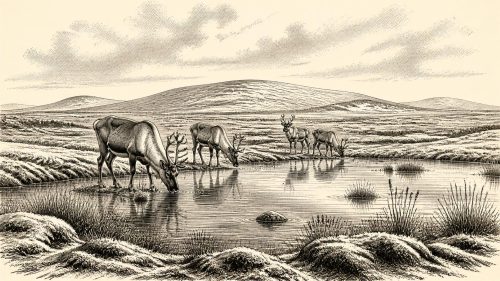
Maguiresbridge and Castlepook
Approximately 31,624 BCE, Ireland lay within the unstable Marine Isotope Stage 3 cold period, not a precisely identifiable historical year. Inter-till deposits at Derryvree, Greenagho and Hollymount in Fermanagh show episodes of ice-free freshwater tundra later overridden by glaciers. Plant and insect remains indicate open, treeless, periglacial environments, while fluctuating sea levels and ice complicated access to the island. Castlepook Cave in County Cork preserves bones of mammoth, reindeer, giant deer, bears, wolves and hyaenas, reflecting intermittent cold-adapted fauna. A possibly cut-marked reindeer bone suggests, but does not prove, Upper Palaeolithic human activity. No institutions or political history are known.

Birm-166’s Tundra Record
31,623 BCE is a label within a resolved Late Pleistocene interval, not an Irish year. Derryvree, County Fermanagh, preserves freshwater sediments between glacial tills, dated to encompass this horizon, indicating ice-free, periglacial tundra wetlands with pools, mosses, sedges and insects. Ireland was approaching, rather than experiencing, the Last Glacial Maximum. Castlepook Cave in north Cork contains cold-stage fauna, including mammoth, reindeer and predators, though deposits are mixed. A marked reindeer femur may indicate human carcass processing, but cannot prove settlement. Together, these sparse archives show fluctuating habitats, faunal connectivity and possible human presence, while excluding precise chronology or social narratives.

BIRM-166 and Castlepook
31,622 BCE is not a datable Irish historical event but an imprecise modern label within Marine Isotope Stage 3. Derryvree, County Fermanagh, records organic freshwater sediments between glacial advances, indicating locally ice-free, treeless wetlands with mosses, sedges and pools. Greenagho and Crag Cave likewise demonstrate fluctuating climates rather than continuous ice cover. Castlepook Cave, County Cork, preserves reindeer, mammoth, horse and carnivore remains, evidencing an open, cold landscape supporting large mammals. A marked reindeer femur may indicate stone-tool butchery by humans about 33,000 BCE, but lacks secure context. Subsequent ice expansion probably erased or buried landscapes and traces of visits.
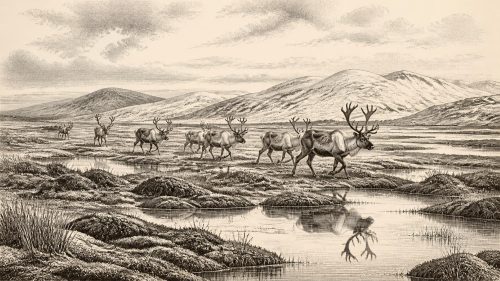
Doneraile’s Reindeer Butchery
Around 31,621 BCE, a modern label within Marine Isotope Stage 3, Ireland experienced an unstable, cold Ice Age environment rather than a documented historical year. Derryvree sediments in Fermanagh record a locally ice-free tundra of wet hollows, sedges and mosses between glacial advances, while Crag Cave calcite demonstrates intermittent milder conditions. Castlepook Cave in Cork preserves mixed remains of mammoth, reindeer, giant deer and predators, indicating links with wider Eurasian fauna. A cut-marked reindeer femur may indicate exceptionally early human carcass processing, but its disturbed context prevents conclusions about settlement. No evidence supports permanent communities, agriculture, politics or named cultures.
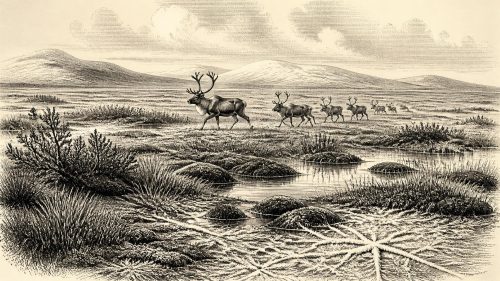
The Derryvree Drumlin Section
31,620 BCE is a modern label for an uncertain interval during Marine Isotope Stage 3, rather than a recorded Irish year. At Derryvree, Fermanagh, organic freshwater sediments between glacial tills indicate a locally ice-free, cold tundra wetland, later overridden by ice. Crag Cave calcite records climatic fluctuations, while lower sea levels altered surrounding routes. Castlepook Cave preserves reindeer, mammoth, giant deer, bear and hyaena remains, demonstrating changing cold-environment fauna, although mixed cave deposits limit precision. A cut-marked reindeer bone suggests possible Upper Palaeolithic visitors, but no secure settlement evidence exists. Ireland was variable, intermittently glaciated and perhaps visited by people.

Castlepook’s Open Hinterland
At the modern reference point 31,619 BCE, Ireland lay within the climatically volatile Late Pleistocene, before final glacial expansion. Parts remained ice-free, though ice, frozen ground and altered coastlines created shifting environments and uncertain access. Derryvree’s deposits record cold, open tundra wetland with grasses, sedges, herbs and freshwater plants. Castlepook Cave preserves diverse fauna, including mammoth, reindeer, giant deer, bear and hyena, accumulated over complex periods. A possibly cut-marked reindeer femur suggests but does not prove human presence. No settlements, tools, institutions or continuous population are evidenced. The period is defined by ecological possibility and glacial transformation, rather than history.

Derryvree’s Alpine Clubmoss
Around 31,618 BCE, Ireland had no recorded history; the date denotes a broad Late Pleistocene interval rather than a specific year. At Derryvree, County Fermanagh, freshwater sediments between glacial tills preserve tundra flora, including dwarf willow, alpine clubmoss and water-milfoil, indicating cold, wet, locally ice-free conditions. Castlepook Cave, County Cork, holds remains of mammoth, giant deer, reindeer and predators, demonstrating periodically suitable habitats, though its bones span many millennia. A marked reindeer femur may indicate human butchery around 33,000 years ago, yet remains disputed. Subsequent ice-sheet expansion destroyed, displaced or buried much evidence, leaving only fragmentary environmental and archaeological traces.
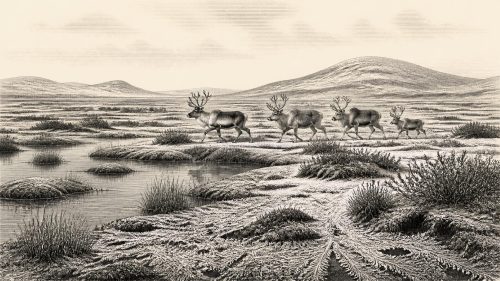
Birm-166 at Derryvree
About 31,617 BCE, Ireland lay within the unstable later Marine Isotope Stage 3, rather than a precisely datable year. At Derryvree, County Fermanagh, organic freshwater sediments between glacial tills demonstrate an ice-free interval with cold, treeless tundra wetland, although they cannot define island-wide conditions. Comparable deposits and Crag Cave calcite confirm intermittent milder phases before major ice-sheet growth. Cave remains, notably at Castlepook, show reindeer, mammoth, hyaena and other mammals connected Ireland to European faunas. A possibly cut-marked reindeer femur suggests, but does not prove, a potential human presence. Evidence supports mobile visitors, not permanent settlement, agriculture, or recorded society.

Stone Mark in the Awbeg
Around 31,616 BCE, Ireland lay within the climatically unstable Marine Isotope Stage 3, before the Last Glacial Maximum. Evidence indicates varied cold environments, including tundra wetlands at Derryvree, County Fermanagh, and open-country ecosystems supporting large mammals. Castlepook Cave in County Cork preserves a time-layered fauna of mammoth, reindeer, giant deer, predators and smaller cold-adapted animals. A deeply incised reindeer femur may bear a stone-tool butchery mark, potentially indicating a brief Upper Palaeolithic human visit. However, its context is disturbed and inconclusive. No evidence supports permanent settlement, society or continuity. The period is chiefly understood through fragmentary environmental and archaeological records.

Derryvree’s Organic Silts
About 31,615 BCE is best treated as a broad interval within Marine Isotope Stage 3, not a precise historical year. At Derryvree, County Fermanagh, organic silts between glacial tills indicate a locally ice-free freshwater wetland sometime around 34,950–29,750 BCE, amid fluctuating cold conditions and advancing ice. Fossils suggest open, tundra-like habitats, while cave deposits document varied fauna including reindeer, mammoth and predators. Ireland’s changing ice, sea levels and routes constrained movement. A marked Castlepook reindeer bone may indicate early human activity, but lacks secure context. No evidence establishes permanent settlement, society or cultural continuity; palaeoenvironmental records remain the principal evidence.

Derryvree’s Treeless Fen
Around 31,614 BCE, Ireland lay within the unstable Late Pleistocene climate of Marine Isotope Stage 3, not a precisely recoverable year. At Derryvree, County Fermanagh, freshwater silts dated broadly to 36,900–31,700 calibrated years BP formed between glacial advances. Their pollen, plants and insects reveal a cold, treeless wetland of sedges, mosses, juniper, pools and tundra-like vegetation. Ireland’s ice cover varied regionally before the later Last Glacial Maximum, while lower sea levels reshaped coasts and routes. Southern caves preserve diverse cold-stage fauna, though dating is complex. Possible human butchery evidence remains uncertain; no contemporary settlements, society or culture are securely documented.

Maguirebridge’s Moss Basin
Around 31,613 BCE, Ireland experienced a fluctuating Ice Age environment during Marine Isotope Stage 3. Derryvree, near Maguiresbridge, preserves freshwater sediments between glacial tills, showing temporary ice-free Fermanagh with treeless tundra, mossy wetlands, grasses, sedges and juniper. Crag Cave records intermittent milder episodes within the wider cold phase. Southern caves, especially Castlepook, demonstrate recurring presence of mammoth, reindeer, giant deer, predators and other cold-adapted animals, although their deposits are not contemporaneous. A possibly cut-marked reindeer bone suggests, but cannot confirm, human activity. Later ice-sheet expansion reshaped Ireland, leaving environmental evidence fragmentary and no secure evidence for settlement, society or trade.
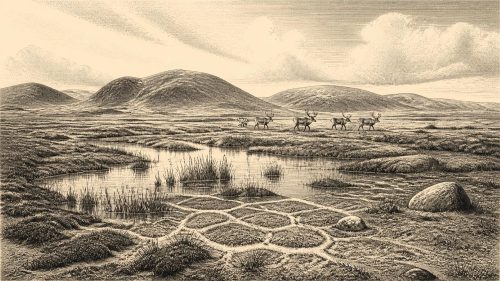
Derryvree’s Inter-Till Fen
Labelled 31,612 BCE, this period cannot be dated to a single Irish year and is understood through environmental evidence. At Derryvree, County Fermanagh, freshwater sediments between glacial tills record an ice-free interval within MIS 3, broadly dated to 36,900–31,700 calibrated BP. Pollen, plants and insects indicate treeless, wet tundra or muskeg under periglacial conditions. Ireland experienced asynchronous ice advances before the glacial maximum. Cave faunas demonstrate that mammoths, reindeer, giant deer, bears and hyaenas reached Ireland during MIS 3, probably via intermittent land connections. No securely evidenced human occupation or society is known; the record documents landscape, fauna and ice.
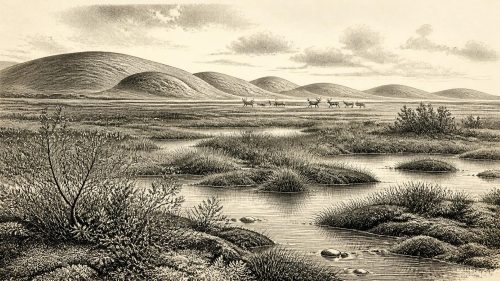
The Derryvree Freshwater Series
31,611 BCE is a modern approximate label for Ireland during Marine Isotope Stage 3, rather than a recoverable historical year. At Derryvree, County Fermanagh, freshwater silts between glacial tills record an interval of cold, non-glacial conditions before later ice expansion. Mosses, sedges, herbs, insects and aquatic plants indicate open, wet tundra with severe winters, not forest or permanent ice. Faunal remains, including reindeer and mammoth, demonstrate intermittent links with wider European ecosystems. Castlepook Cave preserves contested possible cut marks suggesting human activity, but not settlement. Subsequent Last Glacial Maximum ice reshaped Ireland, preserving evidence of a severe, intermittently habitable landscape.

Maguirebridge’s Frostbound Waters
31,610 BCE denotes a Late Pleistocene interval, rather than a datable event. At Derryvree, County Fermanagh, organic freshwater sediments between glacial tills record an ice-free, periglacial wetland during MIS 3, with tundra vegetation, insects and seasonal cold. Other evidence confirms uneven ice-sheet growth before its later maximum. Castlepook Cave, County Cork, preserves remains of mammoth, giant deer, reindeer and predators, although its deposits span multiple periods. A possibly cut-marked reindeer bone suggests a brief Upper Palaeolithic human visit, not settlement. No evidence supports claims about politics, culture, trade or permanent population. Ireland was environmentally dynamic, biologically inhabited and increasingly glaciated.

Maguirebridge’s Fossil Clock
31,609 BCE is a modern label, not a precisely recoverable Irish event. During Marine Isotope Stage 3, Ireland was approaching greater glaciation but was not uniformly ice-covered. At Derryvree, County Fermanagh, organic sediments between tills, radiocarbon dated broadly around this period, preserve evidence of treeless, waterlogged tundra with grasses, sedges, mosses and shallow pools. Castlepook Cave, County Cork, yielded cold-climate fauna including mammoth, reindeer and spotted hyaena, although disturbed cave deposits require caution. A cut-marked reindeer bone may indicate Upper Palaeolithic butchery, not settlement. Sparse, eroded evidence portrays an ecologically connected yet difficult-to-reach Ice Age island with uncertain access routes.

Castlepook’s Mammoth-Steppe
Around 31,608 BCE, Ireland formed a fluctuating Late Pleistocene frontier rather than a uniformly frozen island. Glaciers and open periglacial landscapes varied regionally as climate shifted. At Derryvree, County Fermanagh, freshwater deposits between till sheets preserve evidence of tundra-steppe vegetation, including sedges, herbs, mosses and aquatic plants. Castlepook Cave, County Cork, contains a mixed faunal record of mammoth, reindeer, giant deer, hyena, bear, wolf, Arctic fox and lemmings, reflecting links with wider Europe. A possibly cut-marked reindeer bone suggests brief Upper Palaeolithic human visits, but not settlement. Fragmentary evidence documents climate, water, ice and animal mobility before agriculture or monuments.

Birm-166’s Freshwater World
31,607 BCE is an imprecise modern label within a Late Pleistocene range, not a recoverable Irish date. At Derryvree, County Fermanagh, organic freshwater silts, sealed between glacial tills, record an ice-free Middle Devensian interval before ice expansion. Pollen, plants, mosses and insects reveal cold, treeless, tundra-like wetland and open ground, with pools, sedges, grasses, juniper and herbs. Fragmentary cave fauna elsewhere, Castlepook, indicates northern animals including reindeer, mammoth, giant deer and hyaena, but not a simultaneous community. No secure evidence establishes human settlement; a possibly cut-marked reindeer bone suggests only unconfirmed, fleeting human activity. Derryvree preserves a rare environmental archive.

Calcite, Tundra, and Castlepook
Around 31,606 BCE, Ireland lay within the climatically unstable MIS 3, before the later Last Glacial Maximum. Changing ice margins, lowered seas and uncertain land routes created a variable north-west European landscape. Derryvree sediments in Fermanagh indicate cold, treeless tundra-like wetlands with freshwater pools and seasonal freezing. Castlepook Cave preserves mixed remains of mammoth, deer, reindeer and predators, demonstrating diverse cold-stage fauna, though not a single contemporaneous community. Crag Cave calcite records milder interstadial episodes. A possibly cut-marked Castlepook reindeer bone may indicate brief human activity, but no secure settlement evidence exists. Later glaciation severely damaged Ireland's overall archaeological record.

Mammoth Cave’s Unsettled Signal
Around 31,605 BCE, Ireland had no inhabitants or calendar, and evidence permits only broad reconstruction. During climatically unstable Marine Isotope Stage 3, expanding ice, lower sea levels and altered coastlines created cold, open, regionally variable environments. Derryvree sediments in Fermanagh preserve tundra-like wetland vegetation between glacial deposits. Castlepook Cave in Cork contains MIS 3 fauna, including mammoth, reindeer and predators, accumulated over long periods. A reported cut-marked reindeer femur, dated about 33,000 years ago, may indicate human carcass processing, but insecure context prevents proof of settlement. Later glaciation destroyed much evidence; surviving fragments demonstrate environmental change and plausible human visits.

Derryvree’s Interstadial Basin
31,604 BCE is a modern label for a broad, uncertain Marine Isotope Stage 3 interval, rather than a recoverable historical year. At Derryvree, County Fermanagh, freshwater silts between glacial tills, radiocarbon dated broadly to 36,900–31,700 calibrated years BP, preserve evidence of a treeless, cold periglacial mosaic of pools, sedges, mosses, herbs and insects. Castlepook Cave, County Cork, records varied Ice Age mammals, though disturbed deposits and revised dates limit conclusions. A possibly cut-marked reindeer bone may indicate brief human activity, not settlement. Together, these archives show locally habitable environments between ice advances before renewed glaciation erased much evidence of occupation.

Birm-166’s Freshwater Window
31,603 BCE is not a recoverable Irish historical year but falls within Marine Isotope Stage 3, a climatically unstable Late Pleistocene period. At Derryvree, Fermanagh, freshwater silts and organic beds between two tills show that ice retreated locally, allowing tundra wetlands, pools, sparse vegetation and fauna before renewed glaciation. Greenagho and Crag Cave support episodic ice-free or milder conditions. Southern caves indicate reindeer, mammoth, hyaena and wolves, though dates and deposits are uncertain. A tool-marked reindeer bone from Castlepook may suggest a brief human visit, but cannot demonstrate settlement. Later ice sheets buried or destroyed much evidence, requiring cautious interpretation.

Derryvree’s Sedge-Moss Interval
31,602 BCE is not a datable Irish event but falls within a broad Marine Isotope Stage 3 interval. Derryvree, County Fermanagh, preserves freshwater sediments between glacial tills, indicating open, wet, treeless terrain with sedges, mosses, plants and insects before later ice advance. Crag Cave speleothems show intermittent milder phases, while Castlepook Cave documents varied Pleistocene fauna, though from multiple episodes. A marked reindeer femur may indicate brief Upper Palaeolithic carcass processing, but cannot prove settlement or continuous occupation. Evidence reveals fluctuating regional environments, not an annually defined landscape, society or history; waters, vegetation, animals and ice are attested than people.
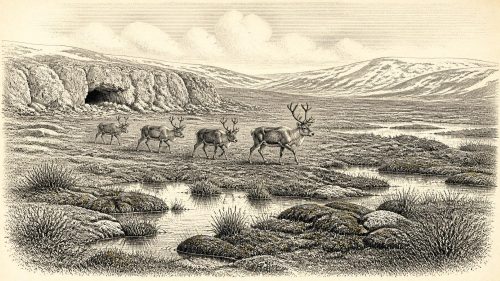
Castlepook’s Unresolved Reindeer
Approximately 31,601 BCE, Ireland lay in an unstable pre-maximum glacial phase, not beneath continuous ice. Evidence from Derryvree’s sediments indicates cold, treeless, waterlogged tundra supporting mosses, sedges, insects and patchy seasonal productivity between glacial advances. Castlepook Cave’s fauna, including mammoth, reindeer, giant deer and predators, demonstrates links with wider north-west European ecosystems, although cave deposits accumulated over long periods. A roughly 33,000-year-old reindeer femur possibly bears a stone-tool cut mark, suggesting brief human carcass processing. However, no secure settlement, tools or associated occupation survives. Changing ice, sea levels and later erosion obscured routes and evidence, leaving possible human presence unresolved.