

1400–1499 CE
Dunamon’s 126 Cows
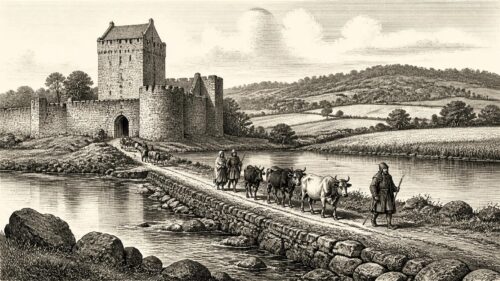
In 1400, Irish annals recorded the capture of Dunamon Castle in Connacht by Mac an Abaidh Ó Conchobair, the death of a Burke, and the release of an Ó Cellaigh captive. Nearby, Grigoir Ó Maelchonaire, a learned heir, was accidentally killed; 126 cows were paid in compensation. Warfare devastated grain and seized horses in Tír Chonaill, while feuds, expulsions and deaths unsettled Ulaid and Breifne. Annals also note uncertain English intervention. Around Longford, the Ó Fearghail foundation of a Dominican priory reflected regional patronage. Collectively, these records reveal competing lordships, cattle-based restitution, agricultural warfare, learned status and uneven English authority.
Caol Uisce Peace
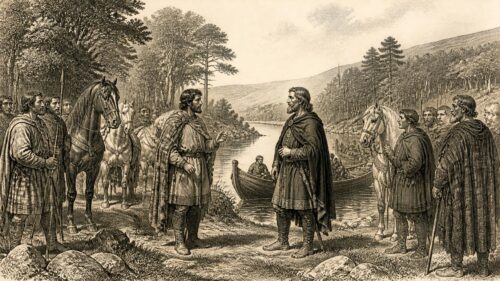
Ireland in 1401 was shaped by competing Gaelic, Anglo-Irish, ecclesiastical and Dublin-based authorities. In Connacht, Thomas Burke’s death produced rival Mac Williams, while Conchobar Anabaidh succeeded in Uí Maine and fighting engulfed Lough Key and Muintir Eolais. Leinster suffered reciprocal devastation between Art Mac Murchadha and Dublin’s forces, alongside a local western plague. Northern politics centred on a peace at Caol Uisce between Niall Óg Ó Néill and Toirdelbach Ó Domhnaill, though annals differ over its date and later violence exposed continuing dynastic tensions. Church and chancery institutions remained influential but geographically limited. The year revealed fragile, locally negotiated power.
Caol Uisce Accord
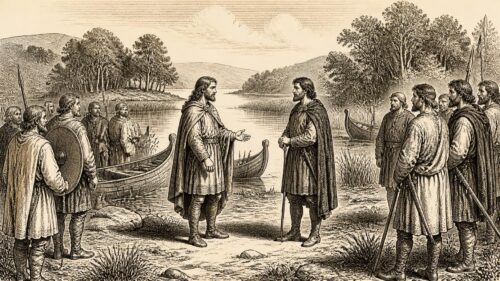
In 1402, Irish politics was characterised by negotiated, contested local authority rather than national unity. At Caol Uisce, Niall Óg Ó Néill of Tyrone made peace with Toirdelbach Ó Domhnaill of Tír Chonaill, whose submission acknowledged northern precedence without ending rivalry. In Connacht, Uilleag and Walter Burke became competing Mac Williams, illustrating divided Burke lordship and its links to Munster conflict. The killing of Louth sheriff John Dowdall and the bloody capture of Carraig Locha Cé exposed insecurity. Quin’s traditional Franciscan foundation reflected Gaelic patronage. Conflicting annal dates require caution, especially concerning Niall Óg’s death, which scholarship places in 1403.
Muirchertach Baccach’s Last Hosting
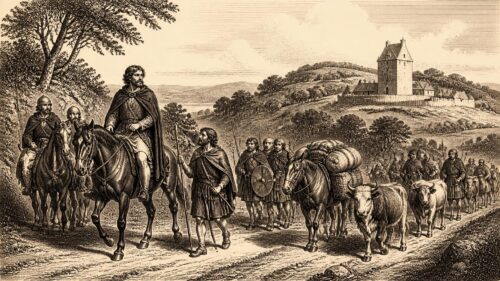
In 1403, Irish annals record shifting alliances, warfare and successions across Connacht, Breifne, Ulster and Munster. Muirchertach Baccach Ó Conchobair of Sligo joined Ó Conchobair Donn in a hosting through central Connacht, subduing Uí Maine and aiding Ulick de Burgh in Clanricarde, before dying that autumn. Uí Maine saw aristocratic deaths alongside killings. Breifne conflict brought deaths, captures and a Ó Raigillig ruler. Northern dynasties changed: Niall Ó Néill and his son died, while Oirgialla and Tyrone gained successors. Disputed annal dates complicate Ulster and Munster events. Records emphasise lordship, patronage, hospitality and religious prestige, while preserving fragmentary, partisan perspectives.
Blackford’s Captured Armour
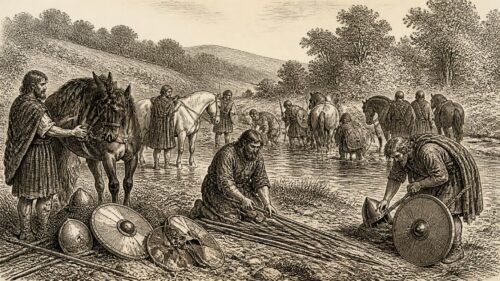
In 1404, Ireland remained politically fragmented between the English lordship, Anglo-Irish magnates and Gaelic rulers. At Blackford in Laigis, Gilla Pátraic Ó Mórdha defeated forces identified as English, capturing horses, weapons and armour. Connacht saw Mac Diarmata succession struggles, regional deaths and warfare, while Domnall Ó Néill claimed Ulster’s kingship amid continuing rivalry. Bishop Tomás Barrett died, Nicholas Fleming was appointed to Armagh, and widespread lectual sickness was reported. Maritime conflict occurred in Munster. The deaths of several ollamhs, or learned masters, highlighted the vulnerability of hereditary cultural institutions. Annals also record household figures, local violence and uncertain chronology throughout.
MacMurrough’s Burning Trail
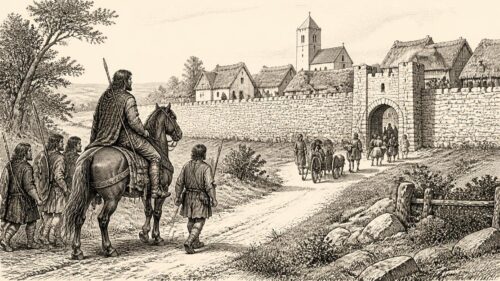
In 1405, Art Mór Mac Murchadha Caomhánach devastated County Wexford and burned Carlow and Tristledermot, demonstrating the vulnerability of English lordship towns and routes in Leinster. His campaign reflected conflicts over land, tribute, jurisdiction and authority, despite earlier interventions by Richard II. Government continued through appointments and James Butler, earl of Ormond’s deputyship, although his death added uncertainty. Elsewhere, warfare over dues in Moylurg killed Tadc Mac Diarmata and prompted succession. Annals also record local feuds, gallowglasses, learned men’s deaths, monastic burials and an early reference to uisce beatha. Ireland remained politically fragmented, culturally sophisticated and shaped by local power.
Cluain Immorrais and Carnfree
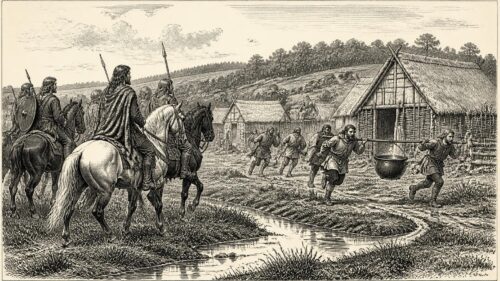
In 1406, Ireland’s fragmented political order was shaped by disease, warfare, ritual and succession. Plague killed several Leinster men eligible for lordship, potentially affecting dynastic calculations. In Offaly, Murchadh Ó Conchobhair Fáilghe defeated a mixed Meath, Connacht and mercenary force at Cluain Immorrais, inflicting heavy losses and capturing the prestigious Buacach Phádraig relic. In Connacht, Toirdhealbhach Óg Ó Conchobhair Donn, joint king for twenty-two years, was killed by rivals and Burke allies, prompting Cathal Ó Conchobhair Donn’s inauguration at Carnfree around year’s end. Dublin retained limited military and civic capacity, while elite deaths and monastic burials underscored lordship’s religious networks.

Callan’s Fallen Patron
In 1407, conflict, succession, learning and subsistence shaped Ireland’s localised political world. Tadhg Ó Cearbhaill of Éile was killed at Callan by Stephen le Scrope’s forces during wider Leinster–Munster struggles; annalists praised him as a leading military protector and patron of poets. In Connacht, rivals contested the kingship, and Cathal Ó Conchobair’s defeat at Cell Achaid brought captures and losses. Archbishop Muirchertach Ó Ceallaigh died at Tuam, remembered for wisdom, charity and learning. Northern captures, raids and internal violence exposed fragile alliances. Very bad weather and cattle losses damaged regional livelihoods, while warfare, church authority and cultural patronage remained intertwined.
Lancaster’s Plague-Struck Return
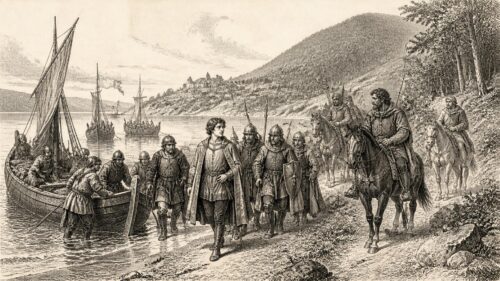
In 1408 Ireland’s political geography remained sharply divided. The English lordship was strongest in and around Dublin, yet its government depended on cooperation from magnates, towns and religious houses, and on money which was chronically scarce. Beyond and across its frontier, Gaelic and Gaelicised lordships pursued their own rivalries, raiding routes and alliances. The year is unusually well illuminated by several annalistic traditions, although they do not all record the same matters. Their entries show an island in which a royal prince could arrive with military purpose, while deaths, cattle-raids, local feuds and new castles continued to shape life far from Dublin.
Roscommon’s Michaelmas Convoy
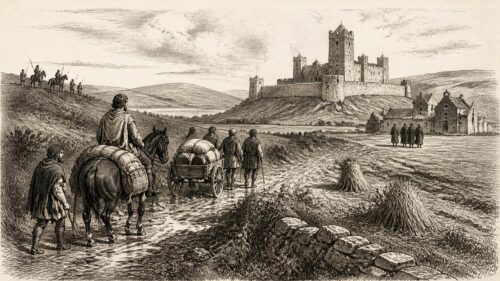
The most sharply dated Irish event of 1409 came in Connacht on the Monday after Michaelmas, the feast of St Michael on 29 September. A relieving force fought its way to the besieged castle of Roscommon with food and stores. The annalists regarded the operation as exceptionally daring. It was not a campaign of a unitary Irish kingdom, nor a clash simply between ‘Irish’ and ‘English’. It was a regional struggle among Gaelic dynasties and their allies, conducted around a formidable castle whose survival depended upon grain, supplies, mounted men and dependable political partnerships.
Domnall Ó Néill’s Captivity
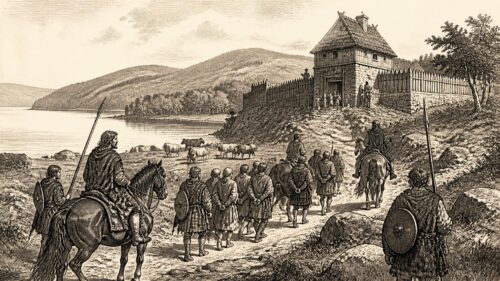
In 1410, Ireland’s political map was not a single kingdom directed from one capital but a field of overlapping lordships, kin-groups, towns and ecclesiastical territories. The year’s most striking recorded episode was the seizure of Domnall Ó Néill, lord of Tír Eógain, by Brian Mac Mathghamhna. Yet the annals also preserve a wider pattern: rulers and heirs dying, castles changing hands, cattle being driven away, a captive rival dying in Munster, and succession being managed amid danger. Taken together, these entries show how authority depended on personal alliances, control of strongpoints, inherited claims and the ability to reward followers.
Raphoe’s Bleeding Crucifix
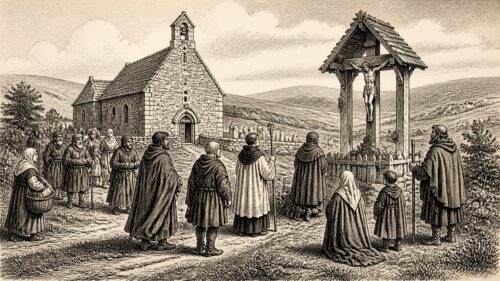
Annals for 1411 portray Ireland as a patchwork of competing lordships, where succession disputes, captivity and violence shaped political life. In Munster, heirs and rivals among the Ó Briains, FitzGeralds, Mac Cárthaighs and Ó Súilleabháins were killed, expelled, blinded or displaced. Ó Conchobhair Fáilghe captured Meath’s sheriff for ransom, illustrating frontier insecurity, while Ó Domhnaill imprisoned Mulmhaire Mac Suibhne amid internal complaints. Annaghdown monastery burned, and church land officers, an historian and Thomond’s master poet died. The annals also report that Raphoe’s crucifix bled and healed illnesses, a medieval miracle claim reflecting devotion, pilgrimage and hopes for relief amid instability.
Trim’s Miraculous Image
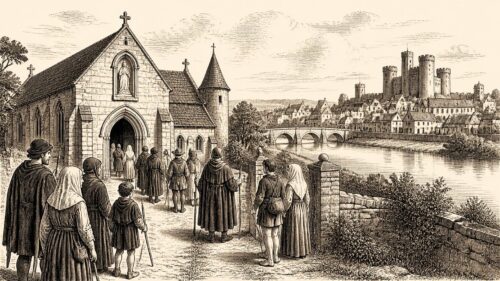
The surviving evidence for 1412 presents Ireland not as a single political unit but as a country of intensely local powers, connected by warfare, kinship, devotion and movement. Annalists recorded raids and counter-raids from the Moy to Fermanagh, the escape of a high-status captive from Dublin, a campaign across Connacht involving Gaelic and Anglo-Irish forces, and reports of miracles at a Marian shrine in Trim. These were not episodes on a national stage directed from one centre. They reveal overlapping lordships, towns and ecclesiastical institutions, each vulnerable to events beyond its own boundaries.
Limerick’s Stone and Timber Fire
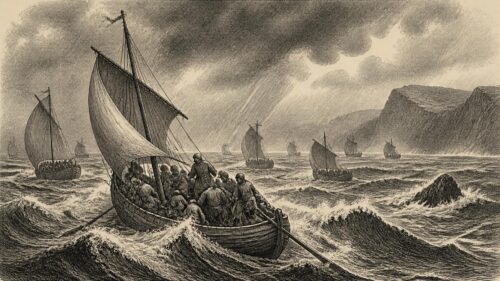
In 1413, Ireland remained politically fragmented, with Gaelic lords, Anglo-Irish interests, towns and churches exercising local power. Limerick suffered a destructive fire attributed by annals to an unnamed woman. Roscommon Castle became the focus of rival military operations, while raids and victories in Meath and Leinster demonstrated continuing frontier warfare. Tuathal Ó Máille’s returning fleet was wrecked near Scotland, causing extensive loss of life. At Lough Conn, violation of church sanctuary led to restitution of land. Annals also recorded lordly deaths, legal learning and Henry V’s accession, portraying a connected yet dangerous society shaped by warfare, religion, trade and reputation.
Cill Echi’s Costly Victory
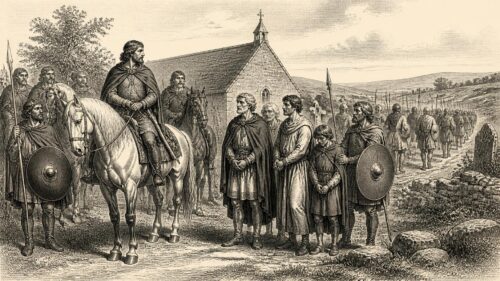
In 1414 Ireland experienced overlapping warfare, political manoeuvre, disaster and disease. Murchad Ó Conchobair and Fergal Ruad Mac Eochagáin defeated English forces from Meath at Cill Echi, killing prominent clergy and nobles and securing ransoms. In Tír Eógain, hostage exchanges restored Domhnall Ó Néill, while Mac Diarmata lordship changed hands. Fighting between Mac Murchadha rulers and Wexford forces brought capture, burning, plunder and further hostages. Sir John Stanley died, John Talbot became lieutenant and arrived late in the year. A candle fire destroyed Sligo’s Dominican monastery; a dean died; plague was reported in Meath and Leinster. Annalistic discrepancies require caution.
Furnival’s Poets and Plunder
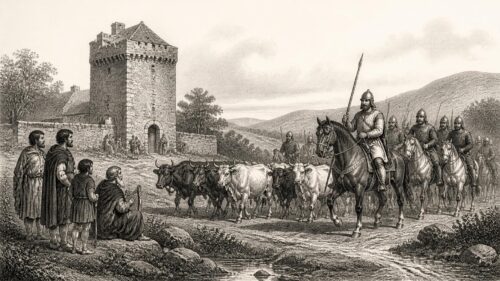
In 1415 Irish annals recorded fragmented connected conflicts across lordship Ireland. John Talbot, Lord Furnival, the king’s lieutenant, campaigned through Leix, Oriel and other districts, seizing a castle, killing or taking livestock, and executing Gerald of Geraldine descent. Chroniclers condemned his plundering of poets and alleged disregard for churches and sanctuaries. In Umhall, rivalry within the O’Malley kindred culminated in Aed O’Malley’s defeat and death, enabling Diarmait to assume the lordship. A January night attack at Cloonshee killed Tomaltach O’Birn and devastated a household. Annals noted clerical deaths, burial, capture, ransom, and cultural commemoration, depicting authority as mobile and coercive.
Wexford’s Hostages, Sligo’s Books
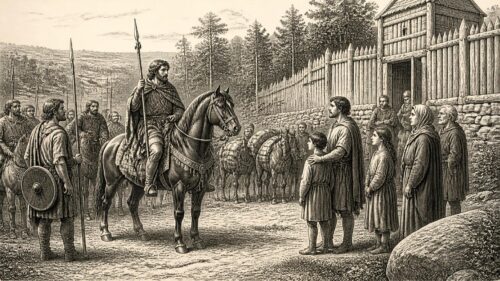
In 1416, Ireland remained divided among Gaelic rulers, Anglo-Irish magnates and the Dublin-centred English lordship. Art Mór MacMurrough defeated Wexford’s English settlers, securing booty and hostages in a peace settlement, while alliances involving Talbots and Butlers complicated ethnic divisions. Annals record his death in 1416, though conflicting evidence places it in 1417, creating uncertainty over succession. Raids, feuds and battles affected Connacht, Breifne and Fermanagh. Friar Brian Mac Donnchadha rebuilt Sligo’s Dominican monastery after fire. Another blaze on Church Island destroyed books, precious objects and instruments, illustrating losses to Gaelic learning. Church offices and legal expertise nevertheless endured amid violence.
Art Mac Murchadha’s Passing
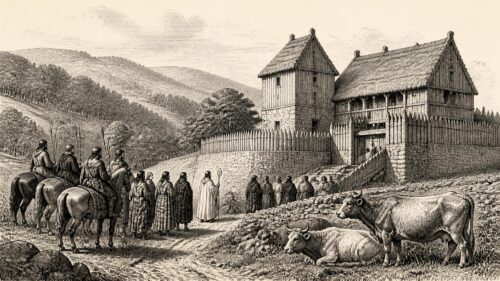
In 1417, the death of Art Mac Murchadha, king of Leinster, ended the career of a Gaelic ruler who had challenged English authority through warfare, negotiation and cross-community alliances. Annals disagree over the date and alleged poisoning, but emphasise his piety, hospitality and power; his son Donnchadh succeeded amid uncertainty after Diarmait Red-hand also died. Elsewhere, John Talbot’s cattle raid demonstrated uneven royal reach. Connacht saw Ruaidhrí Ó Dubhda’s succession, drownings, kin conflicts and hostage settlements. Burnings, killings and ecclesiastical involvement reveal pervasive local violence. Annalistic records also stress penitent deaths, kinship, burial and generosity, showing a fragmented Irish authority.
Roscommon’s Counter-Castle
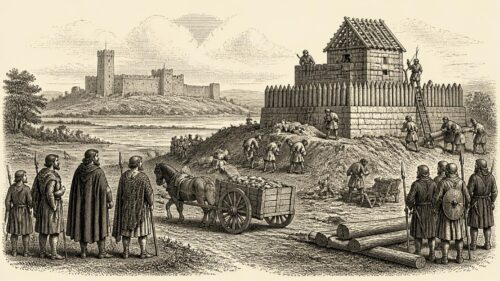
During 1418, Ireland’s fragmented landscape was shaped by dynastic deaths, raids, fortification and scholarship. In Breifne, the deaths of Tigernán Mór Ó Ruairc, his heir Eógan, and East Breifne’s Risderd Ó Raigillig triggered contested successions; Risderd and his household drowned in Lough Sheelin. At Roscommon, Uilliam Ó Cellaig built a castle opposite the stronghold, resisting an Ó Conchobair-led siege. A royal council met at Naas, while Furnival’s raids in Iveagh met resistance and northern conflict involved Ó Domnaill and Ó Néill. Connacht saw cattle raids and violence. Meanwhile, the Great Book of Lecan neared completion, demonstrating scholarly patronage amid warfare.
Murbach Burned
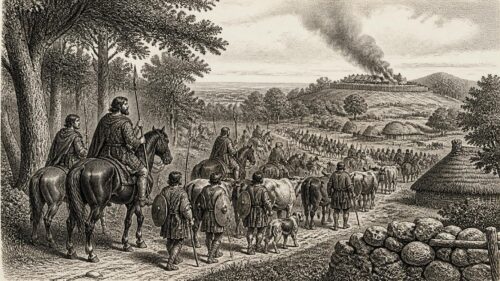
In 1419 Ireland experienced overlapping conflicts rather than a single national crisis. Eóghan Ó Néill, backed by northern allies, expelled Domnall Ó Néill from Tyrone, while Connacht forces burned Murbach and devastated Tírhugh. A major Connacht invasion of Clanricard ended in defeat at Bél Átha Lige, with heavy losses, captures and plunder. English lieutenant John Talbot’s administration seized Leinster’s Donnchadh Mac Murchadha, while Calbach Ó Conchobair escaped captivity. Succession disputes disturbed Breifne. Plague killed the scholar Dauid Ó Maolconaire; an unusually hot summer brought drought but abundant harvests. Deaths of poets, rulers and clerics highlighted patronage, learning and religious life.
Bundrowes and the Trading Ship
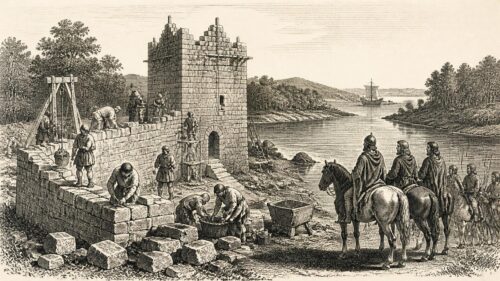
In 1420, Irish political life combined warfare, negotiation, trade and royal administration. Brian Ó Conchobair built Bundrowes Castle beside the Drowes, provoking Ulster opposition and fighting around Assaroe, where Domnall Ó Domhnaill was killed and Niall Garbh escaped aboard a trading ship. Kinship disputes in Connacht brought murders, raids, captivity and settlements secured through lordly protections. Granard Castle was briefly seized, then demolished by Ó Fearghail. Dublin officials collected customs and administered justice and finance. Death notices linked leading families to churches, while violence reached sacred spaces. Annals also recorded wolves killing many people, revealing environmental danger amid political instability.
Loch Melvin’s Night Coup
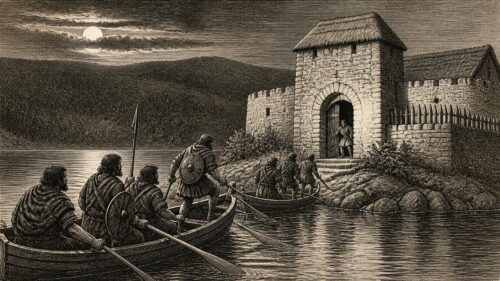
In 1421, Irish annals recorded interlocking conflicts, successions and deaths across Connacht, Breifne, Fermanagh, Offaly, Ulster and Munster. Ruaidhrí Mac Diarmata’s death brought Tomaltach’s contested succession in Moylurg, while Murchadh Ó Conchobhair’s death preceded Calbhach’s accession in Uí Fhailghe. Ó Ruairc, allied with Ó Domhnaill and Mag Uidhir, campaigned destructively against Clann Donnchadha; retaliation damaged Ó Ruairc’s residence before peace followed. Cathal Ó Ruairc seized Inis Caoin on Lough Melvin through garrison betrayal, capturing its lord and castle. Notices also commemorated bishops, nobles, Mór Mumhan, and historian Gilla Riabhach Ó Cléirigh, revealing ideals of hospitality, piety, learning and martial defence.
Youghal’s Ormond–Desmond Indenture
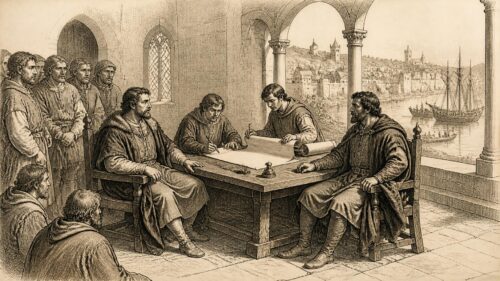
In 1422 Irish politics operated through local lordships, alliances, hostages, land and warfare. At Youghal, Ormond granted Desmond a life interest in 240 acres, securing revenues and services while retaining rights. In Tír Conaill, Toirdhealbhach Ó Domhnaill retired to Assaroe, succeeded by Niall Garbh, whose campaigns asserted authority across Ulster and into Connacht. Eóghan Ó Néill’s ransom and subsequent alliances demonstrated hostage diplomacy’s importance. Offaly’s An Calbhach defeated Meath forces near Trim, amid wider frontier fighting. Raids damaged crops, cattle, homes, churches and learned people. Henry V’s death brought Henry VI’s minority, while regional powers continued negotiating, raiding and fighting.
Ath Seanaigh’s New Castle
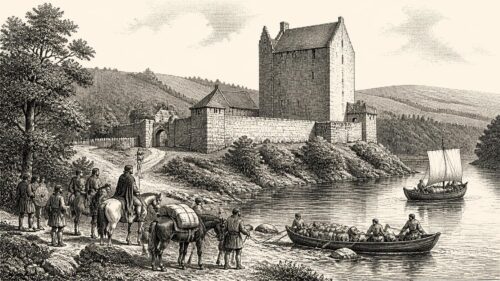
In 1423, Ireland was shaped by competing Gaelic lordships and a weakened English administration. Domnall and Eóghan Ó Néill, with Niall Garbh Ó Domhnaill, led an Ulster coalition through Louth into Meath, defeating forces associated with the king’s deputy and securing tribute and agreements. Niall Garbh also built Ath Seanaigh castle at Ballyshannon, reinforcing his new rule in Tír Chonaill after his father’s death. Dublin government was divided by disputes among Mortimer’s deputies and Richard Talbot. In Connacht, Uilleag de Burgh died, while Uí Maine underwent a violent succession. Clerical and scholarly obituaries reveal intertwined religious, hereditary and political authority.
Trim’s New Lieutenant
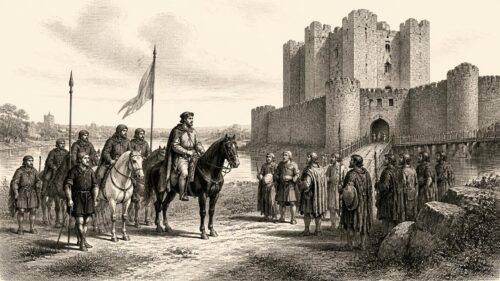
In 1424, Ireland’s political map was defined less by a single national struggle than by a series of overlapping lordships, rival dynasties and negotiated allegiances. The English crown governed most directly from Dublin and its surrounding lordship, but royal office depended upon the cooperation of magnates whose power reached well beyond the formal limits of crown administration. Gaelic rulers, Hiberno-Irish dynasties and English settlers all made and remade local political worlds through warfare, tribute, marriage, submission and the possession of castles.
Mortimer’s Trim Death
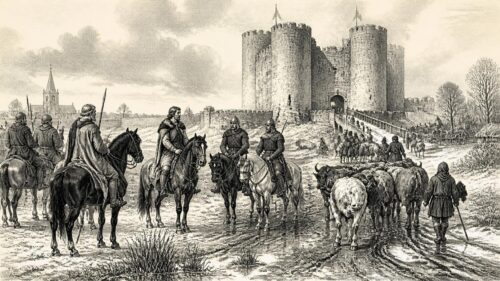
In 1425, Edmund Mortimer, the king’s lieutenant and earl of March and Ulster, died suddenly at Trim while pursuing agreements with northern Gaelic lords. His death undermined a fragile settlement, followed by arrests of visitors and worsening Ulster conflict. James Butler, earl of Ormond, became lieutenant and negotiated written alliances with the Meic Mathghamhna and Éoghan Ó Néill. In Connacht, Toirrdelbach Ruad Ó Conchobair died and Cathal, son of Ruaidrí, succeeded amid violence. Brian Ballach Mac Uí Néill Buidhe was killed at Carrickfergus. Severe winter weather devastated cattle, crops and people, while records showed religious and learned life across Ireland.
Naghtan’s Ransom and Escape
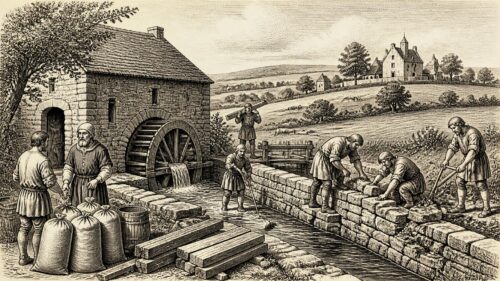
In 1426, Ireland comprised overlapping English, Gaelic and Gaelicised jurisdictions rather than a unified state. Naghtan O'Donnell was ransomed from English captivity by his brother Niall, who provided extensive property and hostages; Turlough O'Donnell subsequently escaped with four fellow hostages. Annals record successions, deaths and kin violence, including O'Brien inauguration, Mac Mahon’s killing, and O'Conor losses. Reconciliation between Owen O'Neill and O'Neill aimed to recover alienated lands. Learned historians, hospitality, penance and plague also feature. Dublin received royal compensation for earlier military service, while an Ormond deed leased Kilkenny mills, demonstrating administrative, economic and seigneurial institutions alongside regional personal power.
Edenderry and the Returning King
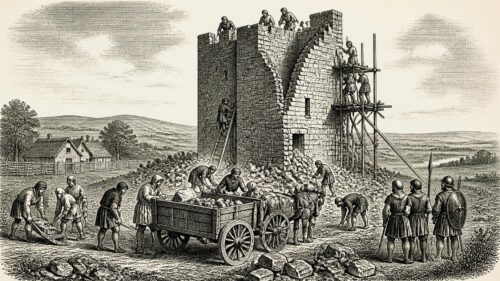
In 1427, Ireland’s fragmented political order was shaped by dynastic rivalry, constrained English administration and local military action. Donnchadh Mac Murchadha, king of Leinster, returned after eight years’ imprisonment in England, challenging his brother Gerald’s authority while receiving English support. Lord Grey briefly assumed the lieutenancy, reliant on local deputies amid fiscal and factional weakness. English or Anglo-Irish forces demolished Edenderry Castle, while an Ulster coalition led by Niall Garbh Ó Domhnaill defeated MacQuillan’s forces, taking prisoners and booty. Annalistic obituaries emphasised penitence, hospitality and charitable guest-houses, demonstrating that reputation, kinship and religious patronage remained central to power and standing.
Kinsale’s Pilgrim Lord
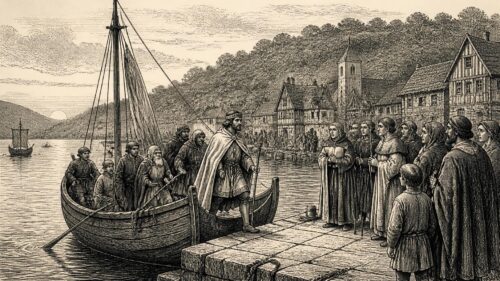
In 1428, Irish annals recorded no single national crisis but interconnected regional events. Aedh Mag Uidhir, a Fermanagh lord returning from pilgrimage to Compostela, died at Kinsale on 11 August and was buried at Cork, illustrating maritime, religious and political links. His death coincided with Maguire dynastic violence, including seizure of his sons’ castle and the killing of Aedh Óg. In Leinster, Donnchadh Mac Murchadha Caomhánach’s ransom, return and cooperation with English authority reflected negotiated power. Deaths of ecclesiastical and local rulers, notably a Mac Conmara chief, reveal hereditary offices, patronage, protection and peace as foundations of Ireland’s diverse lordships.
Aghakilmore’s Field of Defeat
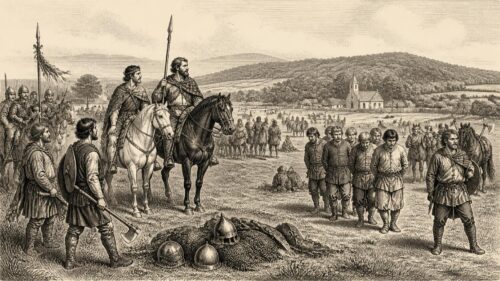
The best-documented Irish event of 1429 was a major defeat at Achadh Cille Móire, now generally identified with Aghakilmore in County Cavan. It was not a battle between two neatly bounded nations. Rather, it grew from the shifting alliances, rival branches and armed followings that shaped lordship in the Breifne borderlands. The annals place it firmly in this year, while their differing emphases also reveal why a single encounter could matter far beyond the field on which it was fought.
Thomas Maguire’s Fermanagh Succession
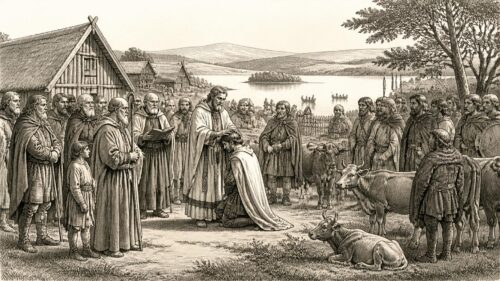
In 1430, Irish political life was marked by warfare, negotiation and succession rather than an island-wide event. Tomás Mág Uidhir died on 13 November after thirty-six years ruling Fermanagh, and his son Tomás Óg succeeded with publicly affirmed support. Eóghan O’Neill raided Oriel and Meath, securing tribute, submissions and a hostage without permanently conquering these territories. In Cork, Kilbrittain castle changed hands amid MacCarthy and Desmond conflict. Raids and rival claims affected Connacht and Breifne, where sanctuary and éraic enabled settlement. Deaths of clerics and legal scholars underline ecclesiastical and learned institutions’ roles in authority, hospitality, memory and social order.
Ballymagauran’s Vengeful Burning
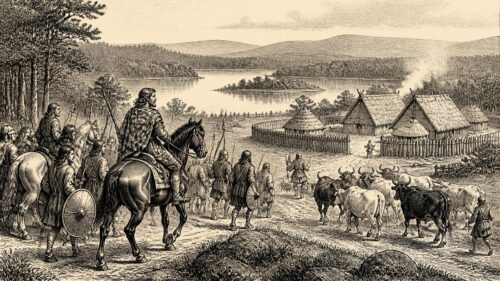
In 1431, Ireland experienced raids, reprisals, dynastic conflict and institutional losses. Sir Thomas Stanley's delayed arrival as royal lieutenant left the English lordship constrained around Dublin, though chancery business continued. After John Maguire was killed in Tullyhaw, Tomás Óg Maguire ravaged the district and burned Ballymagauran. O'Neill, Maguire and O'Reilly devastated MacQuillan territory, while hostage negotiations and O'Donnell rivalries reshaped Ulster. Gaelic and English forces conducted reciprocal raids in Breifne and Leinster. Deaths of bishops, clerics, poets and nobles underscored the fragility of lordship. Warfare damaged crops and homes, yet religious, learned and administrative institutions endured amid mobile local power.
Eóghan’s Stone at Tullaghoge
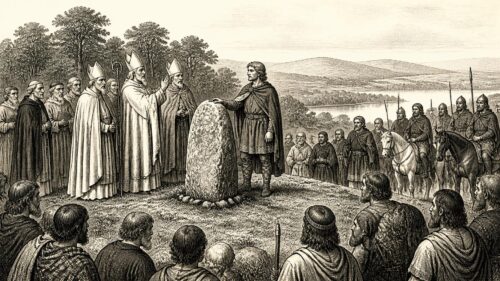
In 1432, Domhnall Bog Ó Néill was killed in Ó Catháin territory, enabling his rival Eóghan, son of Niall Óg, to be inaugurated king of Tír Eóghain at Tullaghoge with clerical and learned support. Eóghan’s alliance with Sligo provoked conflict with Niall Garbh Ó Domhnaill of Tír Conaill, bringing armed diplomacy, Erne crossings, prolonged campaigning, burned settlements and crops. Raids exposed Armagh’s vulnerability, while bishops and learned families remained centres of hospitality, law and memory. Elsewhere, Ormond attacked Éile and Mac Murchadha challenged English power in Leinster. The year revealed fragmented authority, shifting alliances, and legitimacy unable to secure peace.
Ardglass Fire and Quin
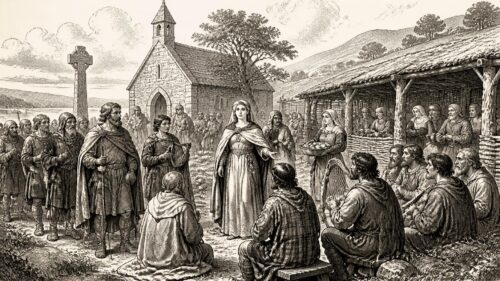
In 1433, regional conflict, diplomacy, famine and patronage shaped Ireland. Eóin Ó Néill, aided by Mac Domhnaill’s Scottish fleet, campaigned against Niall Garbh Ó Domhnaill and MacQuillan in Dufferin, devastating creaghts and burning Ardglass. Negotiations by Niall Garbh’s wife and subordinate rulers halted a proposed attack, while subsequent travel produced peace at Caol Uisce. In Breifne, Mag Raghnaill factional warfare involved paid soldiers. Severe summer famine accompanied notable hospitality by Mag Uidhir and Margaret Ó Cearbhaill. Pope Eugenius IV licensed Franciscan Regular Observance at Quin, reinforcing Mac Conmara patronage and linking local lordship to wider ecclesiastical reform currents across Europe.
Nobber Castle’s Escape
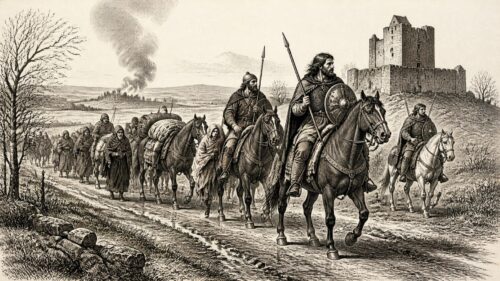
In 1434, Eóghan Ó Néill of Tír Eóghain and Niall Garbh Ó Domhnaill of Tír Chonaill, recently rivals, led a broad Ulster coalition into the English lordship. They exacted tribute at Sradbaile, burned Sliabh Breagh and Oriel, and attacked Nobber Castle. Thomas Stanley’s mounted response allowed Ó Néill’s sons to withdraw safely but trapped Ó Domhnaill’s separated party seeking cattle. His heir Toirdhealbhach and other leaders died, while Niall Garbh was captured, enabling his brother Neachtan to rule. Annals also recorded deaths among churchmen and learned families. Late in the year, severe frost froze major lakes, disrupting life and travel.
Lough Erne’s Iron Crossing
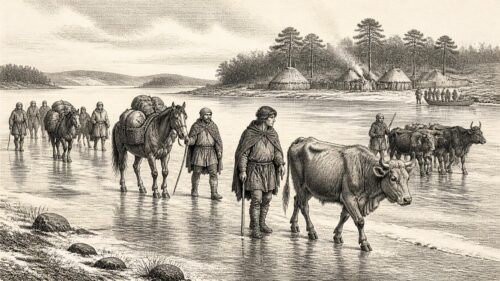
For Ireland, 1435 opened in a landscape temporarily remade by cold. The annals call it an exceptional frost: lakes and rivers were hard enough to be crossed on solid ice. The Annals of Ulster add an unusually vivid detail from Fermanagh. When Eóghan Ó Néill entered the region with an army, the people of Fir Manach moved cattle, horses carrying loads and other portable goods westward across Lough Erne—not in boats, but over the frozen lake. This was not merely a picturesque curiosity. It changed the practical geography of a frontier lordship. Water that normally protected communities, complicated movement and channelled travel became, for a short season, a road.

Kilmainham’s Offaly Victory
In 1436, Ó Conchobhair Fáilghe launched raids against the English lordship, reportedly avenging the captivity of an Ó Domhnaill kinsman. English settlers of Meath, Ó Fearghail allies and the Prior of Kilmainham defeated him, though conflict continued. In Ulster, Niall Ó Néill was killed in a night attack, while Eóghan Ó Néill secured the crannóg of Loch Laoghaire before raiding Tírhugh. Annals also record local deaths and feuds. The deaths of jurist Gilla-Íosa Mac Aodhagáin and historian Geanann Mac Cruitín, alongside a 1436 Dindshenchas manuscript, attest to enduring learned culture amid fragmented, interconnected warfare and lordship across Ireland's political landscape.
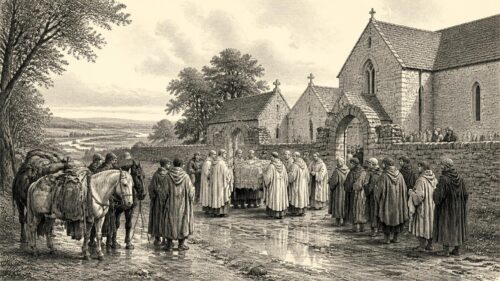
Tuam’s Vacant Crozier
In 1437, Ireland’s annals recorded regional transitions rather than a national event. Seoan Mac Peorais, Archbishop of Tuam, died, opening a contested ecclesiastical vacancy resolved neither quickly nor simply. Gormlaith Ó Duibgeannáin, wife of Brian Mac Aodhagáin, died as an anchorite at Loch Key, linking learned kinship and religious life. Ulster notices named three deaths, while a cautiously dated peace between Niall Garbh Ó Domhnaill and his brother Neachtan reflected strained northern lordship. Farming, trade and uneven royal authority shaped everyday life. News of James I of Scotland’s assassination demonstrated Ireland’s continuing Irish Sea connections across a politically fragmented island.
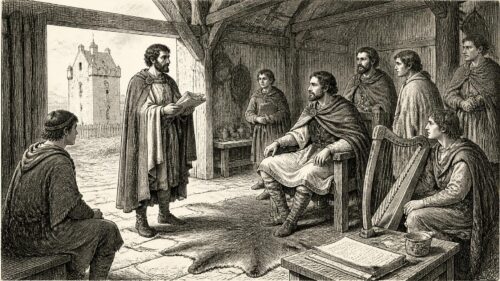
Crawley’s Basel Return
In 1438 Ireland remained divided among Gaelic lordships, Anglo-Irish communities and ecclesiastical jurisdictions, with power shaped by kinship, warfare and office. Archbishop Thomas Crawley died in England returning from the Council of Basel, linking Dublin to Church conflict, while Lionel, Lord Welles, became royal lieutenant. O’Conor Faly fought Meath’s English yet made peace with his brother. Captures, killings and depositions affected Maguires, O’Dowdas, O’Donnells and O’Briens. Deaths of bishops, clerics and heirs from disease disrupted institutions. Prominent jurists, historians and poets also died, demonstrating learned patronage’s continuing public importance. Annals record these crises unevenly rather than a unified national narrative.
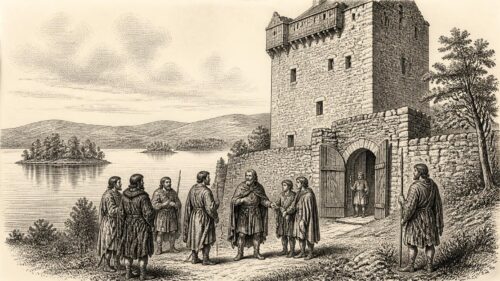
Enniskillen’s Hostage Bargain
In 1439, Irish politics were shaped by local struggles over captives, castles, succession and recognition. Domhnall Ballach Maguire seized Tomás Óg Maguire at Enniskillen, securing his release only through hostages and control of the castle. Niall Garbh Ó Domhnaill died in English captivity, enabling Neachtan’s succession in Tír Chonaill, although sources dispute where he died. Cathal Ó Conchobair’s death triggered competing claims to Connacht’s kingship and warfare. Dublin suffered plague, while lordship changed through Donnchadh Dubh Ó hEadhra’s religious profession. A reported English deputy’s capture further illustrates fragmented authority, negotiated power and connections across Ireland and the Irish Sea alike.

Walter Burke’s September Succession
Annals for 1440 depict regional political and social change rather than an island-wide event. Walter Burke, Mac William Íochtar of Lower Connacht, died of plague in early September and was promptly succeeded by his brother Edmund, illustrating Gaelicised kin-based succession. Neachtan O’Donnell and Owen O’Neill made peace, temporarily easing northern conflict. In Fermanagh, deaths and killings among Maguire kin revealed interconnected lordly households, while Matthew Mac Craith’s replacement as coarb of St Dabeoc showed hereditary ecclesiastical authority. The deaths of historian Duibhgenn Ua Duibhgennáin and lawyer Domnall Ua Breislen underscored learned orders’ political importance. Sources remain fragmentary and cautiously dated.
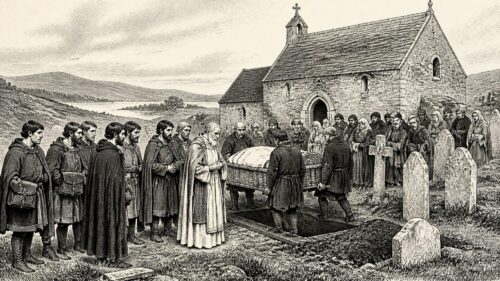
Mailin at Cluain Coirpthe
Annals for 1441 chiefly record deaths that exposed the importance of Ireland’s learned, ecclesiastical and lordly networks. Mailin mac Tanaide Ó Maolconaire, eminent historian and ollamh of Síol Muireadaigh, died in mid-February and was honourably buried at Cluain Coirpthe; other scholars, poets and churchmen also died. Conchobar Mac Donnchada, lord of Tír Oilella and patron of poets, was among them. Regional conflict continued through Mag Samradhain feuding, Maguire raids in Fermanagh, and Mac William Uachtarach’s capture of Ó Madden’s Shannon castle. Ecclesiastical offices linked kin, land and learning, while English administration remained significant chiefly in eastern Ireland during this year.

Castlefin’s Foreign Host
In 1442, James Butler, earl of Ormond, resumed the Irish lieutenancy, governing through fragile alliances rather than centralised power. In the north-west, Énrí and Eóghan Ó Néill secured assistance from the English settlement and compelled Neachtain Ó Domhnaill to cede Castlefin, Cenél Moen and Inis Eógain’s tribute. Other struggles involved Enniskillen, Oriel, Ulster raiding and Wicklow warfare. After Muircheartach Caomhánach’s killing, his father won prisoners and compensation from Wexford. Obituaries recorded lords and clergy, while Ormond rental accounts reveal farming, rents and seigneurial justice. Together, the sources portray a connected, contested Ireland shaped by castles, kinship, tribute, negotiation and authority.

Athlone Castle’s Brief Seizure
In 1443, Muirchertach Ó Cellaigh briefly captured Athlone Castle, a key Shannon crossing, before James Dillon and William Boy Dillon recovered it; William Boy was killed, while Muirchertach received safe conduct. The episode illustrated contested authority and negotiated frontier politics. Annals also record deaths, feuds, raids, restitution and killings among Irish lordships, notably in Oriel, Ulster, Connacht, Ossory and the midlands. Aengus Mac Gilla-Fhinnein, abbot of Lisgoole, died on 17 September. Legal scholars Gilla na Naem Mac Aodhagáin and Hugh Mac Aodhagáin were commemorated. Differing annalistic dates complicate events in Thomond, showing Ireland's connected institutions amid persistent conflict and rivalry.
Aodh Buidhe’s Last Raid
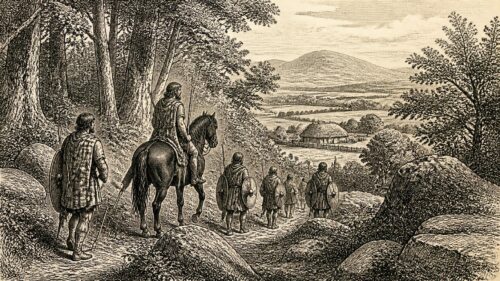
In 1444, Aodh Buidhe O’Neill of Clandeboye died from wounds received raiding Iveagh, prompting Eóghan O’Neill of Tír Eógain to intervene. Clandeboye leaders, allied with the MacQuillans, ambushed and defeated him in Dufferin, taking hostages including his son. Eóghan also compelled Dundalk to pay money and wine, while English government met at Drogheda with limited reach. Thomond suffered a violent Ó Briain succession rupture, including Mathgamain’s blinding and Toirdelbach’s seizure of power. Rome appointed Cormac Mác Shamhradháin bishop of Ardagh, while Trim’s Marian miracle cult, charity, deaths, warfare, and learned patronage reflected Ireland’s interconnected yet fragmented political and religious world.

Sligo’s Rebel Coalition
In 1445, Ireland’s fragmented political order was exposed by the burning of Sligo, attacked by O’Donnell, Maguire and discontented Ó Conchobhair kinsmen opposing Toirdhealbhach Carrach. Dynastic disputes also destabilised Annaly and West Breifne, where contested lordships prompted warfare, division or rival proclamations. Other annals record killings during raiding and travel, revealing pervasive local feud. English authority remained limited: John Talbot’s appointment as lieutenant did not bring immediate control, while Gaelic lords used written diplomacy and ecclesiastical seals. Irish nobles travelled to Santiago, clerics were commemorated, and Athenry’s Dominican friary housed thirty members, demonstrating religious networks amid conflict and political negotiation.

Dunamon’s Northern Guest
In 1446, Neachtan Ó Domhnaill led an army from Tír Chonaill through Breifne and Connacht, where Mac William of Mayo received and escorted him at Dunamon, demonstrating interlordship alliances and negotiated military movement. Connacht suffered Ó Conchobhair dynastic violence, while Clanricarde intervened in Thomond and mediated a Mac Donnchada partition. Ó Conchobhair Fáilghe raided Meath, exposing the English lordship’s vulnerable frontier. Successions, feuds and retaliatory killings affected Ulster and Leinster, including murder within Fenagh church. Annals also commemorated poets, clerics and devotees. Together, these records depict Ireland as interconnected by kinship, routes and ecclesiastical institutions, but fractured among competing lordships.

Furnival’s Prisoner at Trim
In 1447, Ireland’s divided political worlds were linked by conflict, administration, religion and epidemic disease. Domnall Ballach Maguire was killed amid Fermanagh succession rivalry, while Hugh Maguire and Breifne constable Cormac Mac Cába also died. At Trim, Lord Lieutenant John Talbot imprisoned Feidhlimidh Ua Raghallaigh, who later died of plague and was buried in the Franciscan friary. Talbot’s parliament regulated trade, officials, coinage and English dress. Plague caused heavy mortality across several provinces, affecting clergy, lords, lawyers and scholars. Meanwhile, Thomas Óg Maguire rebuilt Aghalurcher church, and an Ó Mórdha lord founded a Franciscan burial house in Laoighis for descendants.
Muckross and the Poet-Master
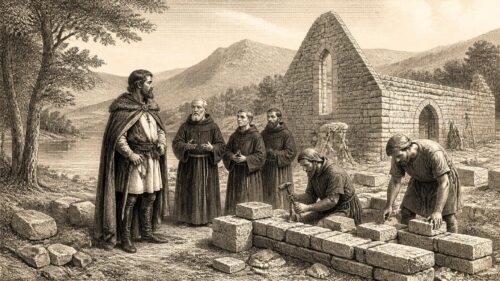
Records for 1448 depict Ireland as a patchwork of lordships, religious houses and learned networks rather than a single national story. A severe plague in Meath caused deaths among laymen, a ruling family and friars. Killings in Leinster and Connacht, alongside changes in regional lordships, reveal persistent rivalry within and between political communities. Bishops, abbots and aristocrats died, while a couple drowned on an Ulster waterway, underlining travel’s hazards. Donal Mac Cárthaigh Mór supported the Observant Franciscan foundation at Muckross. The deaths of poets Tadhg Óg Ó hUiginn and Diarmait Ó Dálaigh highlighted institutions of education, hospitality, patronage and commemoration.
York at Drogheda
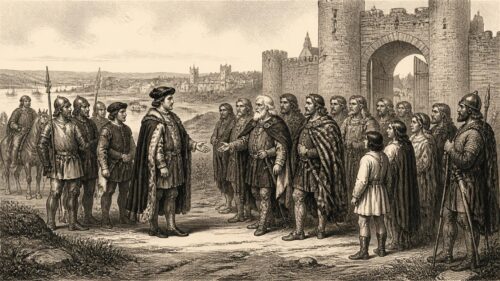
In 1449 Richard, duke of York, arrived in Ireland as Henry VI’s lieutenant, combining royal office with extensive Irish lordships. At Drogheda, he concluded an agreement with Énrí Ó Néill, backed by Eóghan Ó Néill, exchanging military support for protection. York received earls, negotiated hostages from Meath and demonstrated government through personal alliances rather than conquest. Elsewhere, disputed successions destabilised Breifne, while warfare involved Ó Néills, MacQuillans, Scottish connections and Cenél Conaill. Annals also record religious renunciation, dynastic deaths and learned families. The year reveals a plural political landscape, where English administration and Gaelic rulers formed shifting, pragmatic coalitions locally.

Maguire’s Jubilee Pilgrimage
In 1450 Thomas Óg Mág Uidhir, lord of Fermanagh, departed for Rome’s jubilee, demonstrating Gaelic lordship’s international religious connections and dependence on learned patronage. During his absence, Donnchadh Dunchadhach Maguire murdered Cathal Maguire, seized his wealth, and sought wider power; after negotiation, Edmond Maguire captured and mutilated him. Annals also record deaths of Clogher’s Maguire bishop, pilgrims and physician Tadhg Ó Cáiside, illustrating ecclesiastical and hereditary service networks. Elsewhere, Ó Néill raids, alliances and killings, and an Ó Raghallaigh settlement reshaped northern politics. Richard, duke of York, left Ireland in September, appointing Ormond deputy, thereby highlighting Ireland’s multiple political centres.
Margaret of Killeigh
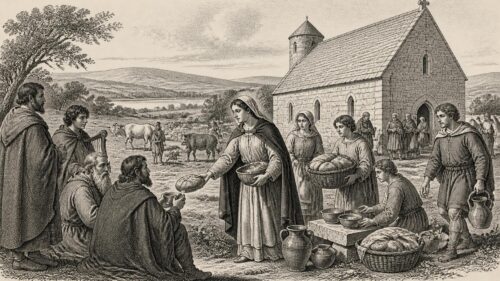
For Ireland, 1451 is not a year dominated by one island-wide campaign or governmental act. Its surviving record is instead a set of sharply local episodes: the death of a renowned midland patron, a fire in a Franciscan friary at Cavan, a return from Rome, murders and hostage agreements, and the building of a castle in Connacht. Read together, they show an Ireland of overlapping lordships rather than a single political community: Gaelic rulers, Anglo-Irish families, religious houses and learned networks all exercised authority in particular places.
The Liffey’s Two-Mile Ebb
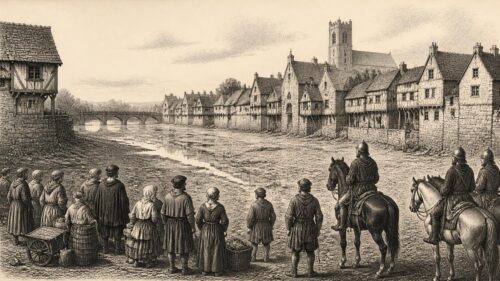
In 1452, Ireland was governed through competing lordships, kinship, warfare and negotiation. Neachtan Ó Domhnaill’s assassination by nephews destabilised Tír Chonaill, enabling Énrí Ó Néill to broker a settlement while gaining territory and tribute. Marriage alliances drew James Butler, fourth earl of Ormond, north to compel Énrí’s reconciliation with his first wife. Fighting in the Fews ended with compensation and peace. Ormond’s rapid circuit across the midlands and north-east secured submissions, payments and prisoners, but he died at Ardee in August. His death weakened settlements. Annals also noted the Liffey’s recession, raids on Teagh-Munna, plague, and deaths among learned families.

Ardglass Fleet and Clones
In 1453, Irish annals record regional struggles rather than a national crisis. At Ardglass, a Dublin fleet pursuing Welsh raiders who had seized the archbishop defeated Henry Mac Néill Buidhe’s Clandeboye force, aided by the Savages; leading Ulster men died and Henry was captured. In Oriel, Hugh Roe MacMahon died and was succeeded by Felim MacMahon, while Donnchadh MacCarthy Reagh’s death brought Diarmaid an Dúna to power in Carbery. Killings, deaths and disputed lordships in Connacht, Bréifne and Tirerrill revealed political dependence on kin, followers, castles and church patronage. The record depicts maritime, localised and interconnected late-medieval society in Ireland.
Inis Castle’s Stone
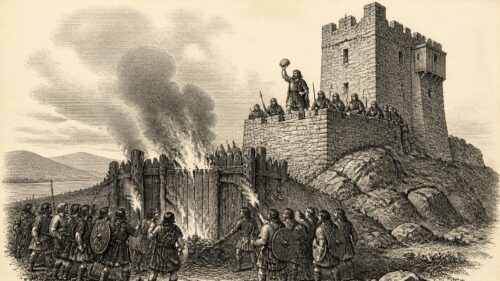
In 1454, Ireland’s fragmented political order was illustrated by conflict, succession and cultural exchange. At Inis Castle in Tír Chonaill, Domhnall O’Donnell killed rival Ruaidhrí O’Donnell with a stone during a siege, securing the lordship temporarily. Annals also record deaths and kin violence among the O’Reillys, Maguires and O’Molloys, alongside contested local successions and cattle raids. Sir Edward FitzEustace’s death led to Thomas fitz Maurice FitzGerald’s election as justiciar in Dublin. Notices commemorate elite women and a notable Fermanagh sermon. Meanwhile, Edmund MacRichard Butler’s manuscript, copied by Gaelic scribes during campaigning, vividly demonstrates interconnected Anglo-Irish patronage, learning, warfare and mobility.
Tullyhogue’s New O’Neill
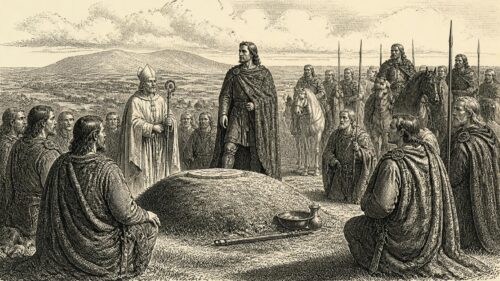
In 1455 Henry O’Neill was inaugurated at Tullyhogue as king over Ulster, backed by allied lords and Armagh’s ecclesiastical leader, although his father remained alive and dynastic conflict persisted. Elsewhere, Philip Maguire’s forces raided east Breifne, burning settlements, killing rivals and capturing a crannog, demonstrating mobile lordly warfare. Annals also recorded deaths among ruling, clerical and learned families, revealing networks of status, hospitality and service. At Navan, Abbot John Bole granted a Pentecost indulgence supporting religious observance and monastic repair. In Connacht, a lord was killed by his own men. These events illustrate Ireland’s multiple, localised and precarious political worlds.
Cúil Mic an Treoin
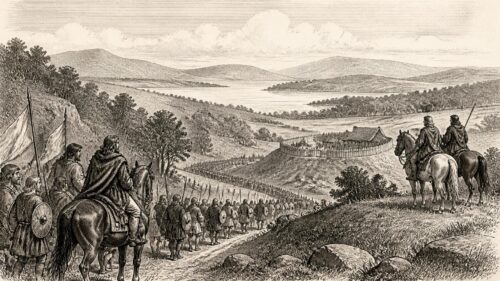
In 1456 Enrí Ó Néill consolidated power in northern Ireland after the death of his father, Eóghan, whom he had displaced as ruler of Tír Eóghain in 1455. Allied with Tomás Óg Mag Uidhir, he invaded Inis Eógain, where Domhnall Ó Domhnaill of Tír Conaill was killed on 28 May and opponents captured. Ó Néill installed Toirdelbach Cairbreach Ó Domhnaill, securing acknowledged superiority rather than annexation. Obituaries from Connacht recorded the deaths of Moylurg’s tanist Fergal Mac Diarmata, his daughter Lasarfina, and John Burke. At Lisgabhail, deaths among teachers and fosterage networks reveal ecclesiastical communities, learning, kinship and women’s roles.
The Gráinne Rout
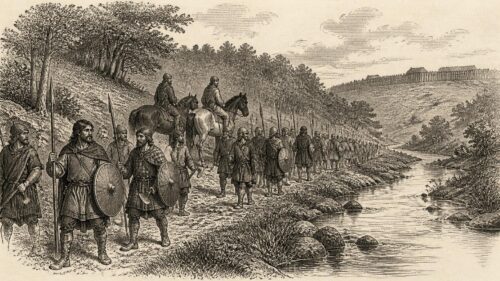
In 1457, the Maguires of Fermanagh pursued campaigns against MacMahon territory in Oriel and O’Rourke lands in Breifne, burning settlements and lordly residences after defenders secured their cattle. Philip Maguire’s raid provoked pursuit and battle, while Thomas Maguire’s meeting with Lochlainn O’Rourke near Ath Conaill ended in a decisive Maguire victory on the Gráinne river, followed by the display of sixteen noble heads. Annals portray these conflicts as contests for livestock, territory, clients and prestige. Deaths among regional elites were recorded. Ecclesiastically, John Bole became archbishop of Armagh, Murrisk friary emerged, and William Sherwood gained, in October, a Bologna doctorate.
Aghavea’s Burning Books
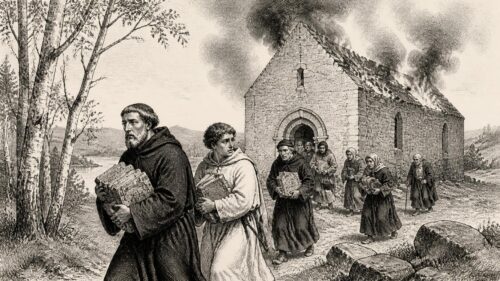
In 1458, Ireland’s overlapping Gaelic, Anglo-Irish and ecclesiastical jurisdictions were reshaped by warfare, deaths and contested authority. Henry Ó Néill, Ó Domhnaill and Mag Uidhir raided Connacht, taking hostages and burning Ó Ruairc’s settlement at Druim-da-thigher. Tomaltach Mac Diarmata, Calbach Mór Ó Conchobair Failghe and Edmund na Féasóige de Búrca died, prompting successions in Moylurg, Offaly and Lower Connacht. Their obituaries emphasised hospitality, patronage and military power. At Aghavea, a church fire destroyed many manuscripts belonging to an ecclesiastical official. Thomas Barrett’s papal provision to Annaghdown provoked resistance, illustrating Rome’s and Dublin’s limited practical reach across the island in practice.

Cloyne’s Medical Lecture
In 1459, Ireland remained divided among lordships, churches, towns and learned families. Thomas FitzGerald, earl of Kildare, defeated and captured Conn O’Connor Faly in Offaly, strengthening Geraldine influence. Raids, burnings and killings in Breifne, Fermanagh and neighbouring territories reflected rivalry, while Toirdelbach Ó Briain’s death opened a transition in Thomond. Richard, duke of York, arrived after his defeat, making Ireland a Yorkist refuge, although Drogheda’s affirmation followed in 1460. Learned culture endured: scholars died, and Cormac Mac Duinnshléibhe completed an Irish medical translation at Cloyne. Ecclesiastical deaths marked the year, whose sources reveal conflict and patronage but little about conditions.
Moyne and the Breifne Rout
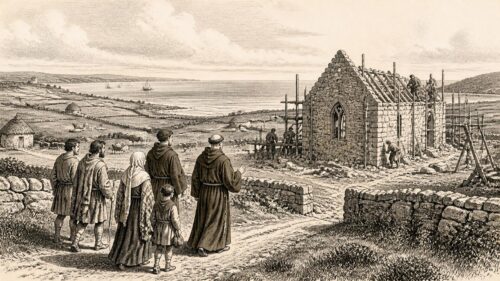
In 1460, Richard of York’s Drogheda parliament affirmed his lieutenancy and declared that Ireland was governed by laws accepted in its own parliament, while regulating defence, finance and local administration. Conflict exposed fragile frontiers: Conn O’Conor Faly defeated lordship forces, and English troops killed John O’Reilly of East Breifne, prompting Cathal O’Reilly’s succession. Captivity and maritime warfare further shaped regional politics. Franciscan patronage and Observant reform expanded through Moyne, Sherkin and Enniscorthy, although foundation dates remain uncertain. The killing of Killaloe’s bishop showed clerical vulnerability. Overall, the year revealed overlapping jurisdictions, military households, contested lordship power and resilient religious networks.

Ceann Maghair’s Broken King
In 1461 Ireland experienced famine, warfare and contested lordship rather than a unified national event. At Ceann Maghair, Aodh Ruadh Ó Domhnaill, aided by the Mac Suibhnes of Fanad, defeated and mutilated Toirdhealbhach Cairbreach Ó Domhnaill, securing recognition as ruler of Tír Chonaill. Connacht saw deaths, captures, ransoms and inauguration rituals amid Ó Conchobair rivalries. Raids devastated districts across the Midlands, Meath and Connacht, worsening the recorded nationwide dearth. Annals also commemorated poets, scholars and clergy, revealing learned and ecclesiastical networks dependent on patronage. English dynastic upheaval brought Edward IV's accession and weakened Butler connection through Ormond's execution and attainder.

Piltown and Monaghan Friary
In 1462, Ireland experienced interconnected conflicts, raiding, lordship and institutional development. Butler forces, supported by English followers, contested Desmond control in the south-east; their defeat at Piltown enabled FitzGerald advances, though maritime captures and parliamentary attainder prolonged the struggle. In Ulster, Henry Ó Néill raided Tír Chonaill, devastating districts amid rivalry with Aodh Ruadh Ó Domhnaill, while killings reflected continuing northern instability. Connacht disputes involved ransoms, rents and cattle seizures. Franciscan friars founded a house at Monaghan, and Thomas Cusin taught law in Armagh. These events demonstrate power exercised through warfare, wealth, patronage, fortified places and learning across medieval Ireland.
Scarlet for Henry O’Neill
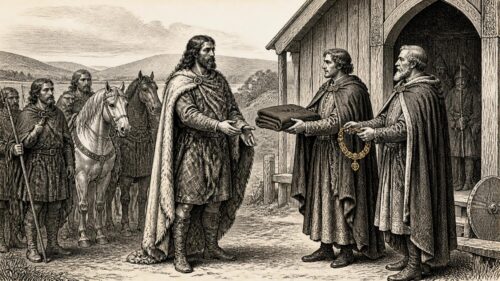
In 1463, Ireland’s political geography was not governed from a single centre. The lordship claimed by Edward IV had institutions, courts, ports and mints, but its effective reach was uneven. Beyond and across the English-controlled districts, Gaelic and Gaelicised dynasties exercised authority through kinship, clientship, tribute, military followings and negotiated alliances. The year’s surviving records are especially rich in such local dealings. They do not describe one national crisis; rather, they reveal an island linked by gifts, cattle-raids, ransoms, church offices, coinage and the movement of armed men.
Youghal’s December College
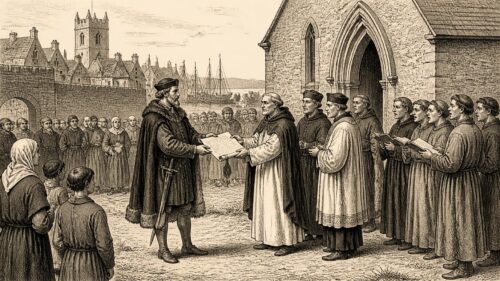
In 1464, Ireland was divided among Gaelic lordships, Anglo-Irish magnates, church jurisdictions and Dublin’s limited English administration. Thomas FitzGerald, earl of Desmond and royal lieutenant, negotiated a treaty in Dublin with Mac William Burke and Ó Domhnaill, while rival officials contested authority. Connacht experienced succession wars, burnings, cattle raids, hostage-taking and gallowglass warfare; similar dynastic violence affected Tír Chonaill, Breifne, Fermanagh and Sliabh Lugha. Illness caused numerous deaths, possibly affecting animals. Devotion remained important through miracles, burials and church offerings. On 27 December, Desmond founded Our Lady’s College at Youghal, a collegiate church supporting worship, music, learning and local administration.

St Brendan’s Unopened Spring
In 1465, Ireland experienced severe frost, snow and delayed spring growth, causing acute scarcity, especially recorded in Connacht. Political instability compounded hardship as Ó Conchobair and Mac Diarmata successions provoked battles, killings, raids and disputed lordships. Elsewhere, family conflict and territorial seizures occurred in Breifne, while dynastic connections and rivalries remained active across Leinster and Ulster. In the English lordship, Earl Desmond governed despite opposition and a proposed replacement, while parliament legislated on security, cultural conformity, maritime regulation and Cork’s finances. Meanwhile, Cormac Láidir MacCárthaig founded Kilcrea Friary, combining Franciscan observance, dynastic commemoration and regional ambition during a troubled year.
Carbury’s Captive Deputy
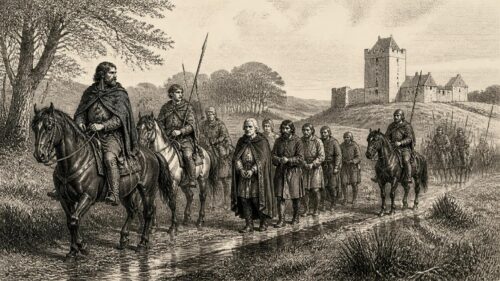
In 1466, Conn Ó Conchobhair Fáilghe defeated the lordship’s Meath and Leinster expedition in Uí Fhailí, capturing Deputy Earl Thomas FitzGerald of Desmond before Dublin men rescued him from Carbury. The defeat enabled raids and strengthened Tadhg Ó Briain of Thomond, who extracted concessions from Desmond and Limerick, but died later that year. Warfare also affected Oriel and Connacht, where rival lordships used alliances, hostages, cattle and tribute to maintain power. Plague struck Dublin, Meath and Leinster, while fire damaged Holy Trinity Abbey on Lough Key. Deaths of rulers, clergy and learned men illustrated Ireland’s precarious, locally negotiated political order.
Worcester’s Dublin Parliament
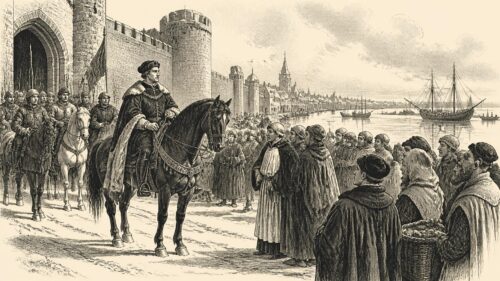
In 1467, John Tiptoft, earl of Worcester, returned as Edward IV’s deputy in Ireland and summoned a Dublin parliament, asserting royal authority within the limited reach of the English lordship. Its programme addressed coastal defence at Lambay, black rents, coinage, church affairs and Meath, while revealing dependence on local cooperation. Desmond’s later execution belonged to 1468, though Worcester’s arrival initiated the crisis. Beyond the Pale, dynastic successions, raids and warfare shaped politics, notably a bloody Connacht battle involving Clanricarde, Ó Ceallaigh and Burke factions. Annals also recorded plague, clerical deaths, learned men and hospitality, illustrating regional institutions and overlapping jurisdictions.

Drogheda’s Fatal Parliament
In 1468, Thomas FitzGerald, earl of Desmond and former deputy of Ireland, was beheaded at Drogheda after arrest by John Tiptoft’s administration, provoking widespread condemnation and retaliatory raids. His execution exposed the fragility of crown authority beyond Dublin and the Pale. Tiptoft’s forces also burned Cavan and its Franciscan monastery. Elsewhere, disputed successions, raids, cattle seizures and warfare convulsed Connacht and Ulster, damaging crops and communities. Annals recorded deaths of lords, churchmen and the historian-poet Torna Ó Maolconaire, emphasising hospitality, learning and religious observance. The year revealed Ireland’s deeply fragmented political order, sustained by often unstable alliances, lordship and coercion.
Claregalway’s Hostage March
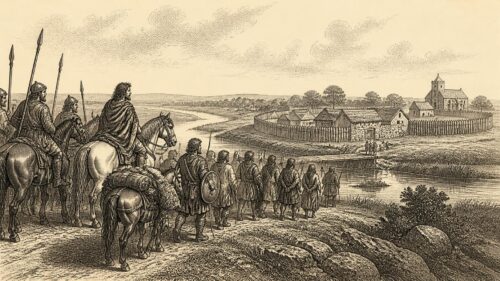
In 1469, Irish annals record struggles for lordship, wealth and security rather than a unified political order. Aodh Ruadh Ó Domhnaill secured hostages in Lower Connacht, allied with the newly installed Mac William Burke, and burned Claregalway and neighbouring territory during a campaign against Clanricarde, partly revenging 1467. Uí Maine faced disputed succession after Aodh Ó Cellaigh’s murder; Maguire kindreds fought destructive raids in Fermanagh; and the Whites expelled the Savages from Lecale. Death notices for a harpist, historian-hosteller and ecclesiastical coarb illuminate cultural institutions. Violence, alliance, kinship, hostages and resources shaped lordship, while ordinary people remained invisible in sources.
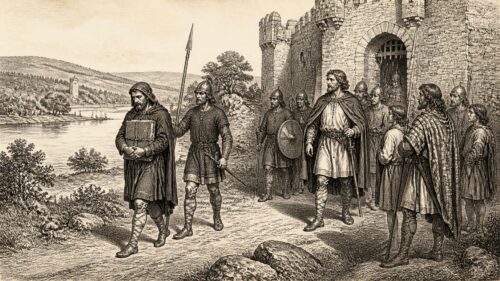
Sligo’s Captive Manuscripts
In 1470, Ireland remained politically fragmented, with the English lordship largely confined to the Pale while Gaelic and Gaelicised dynasties contested power through warfare, alliances, tribute and inauguration. Enrí Ó Néill campaigned in Clandeboye and faced internal rivalry; plague struck Fermanagh amid Maguire succession disputes. Aodh Ruadh Ó Domhnaill captured Sligo Castle, gained Lower Connacht’s submission and recovered Leabhar na hUidre and other dynastic treasures, though his Breifne intervention failed. Thomas FitzGerald became chief governor as parliament addressed local Pale concerns. John Ó Conchobair Kerry founded the Franciscan house at Lislaughtin there, illustrating lordly patronage alongside conflict and cultural prestige.
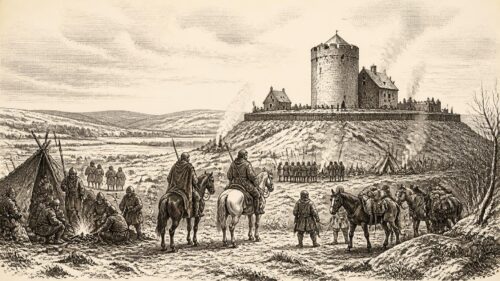
Oghmagh’s Winter Siege
In 1471, Ireland’s competing lordships pursued power through sieges, raids, hostages, alliances and negotiated submissions. Henry O’Neill captured Oghmagh after a winter-long siege, strengthening his son Conn’s position, while northern settlements accompanied continued conflict. In Fermanagh, Thomas Óg Maguire surrendered lordship to his son Edmund, illustrating dynastic succession, patronage and ecclesiastical connections. Connacht saw lineage violence, cattle-raiding and contested castles, while English and Gaelic forces contested frontier regions. Churchmen and learned families remained politically vulnerable yet valued. Annals also recorded unusual weather: damaging spring hail, followed by heat, drought, early crops and abundant nuts, linking security to land and harvest.
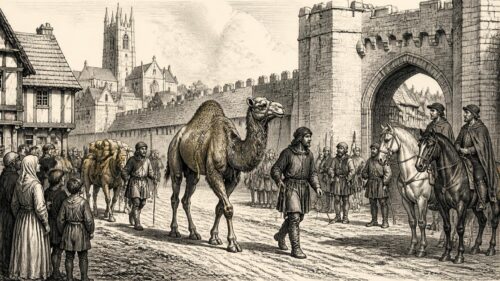
The King’s Yellow Camel
In 1472, Ireland comprised competing Gaelic and Anglo-Irish lordships, while Thomas FitzGerald, earl of Kildare, governed Edward IV’s limited lordship from Dublin. Parliament addressed defence, castles, town property, coinage, trade, religious houses and clerical study, revealing both administrative activity and insecurity in the Pale. Annals record killings, hostage-taking, raids, family struggles and shifting alliances in Ulster, Connacht and Munster, involving Gaelic rulers and Anglo-Irish families alike. Monasteries, pilgrimages and Oxford links connected local society to wider Christian networks. Most strikingly, a yellow camel, probably a royal gift from England, reached Ireland, symbolising international exchange amid fragmented politics across the island.
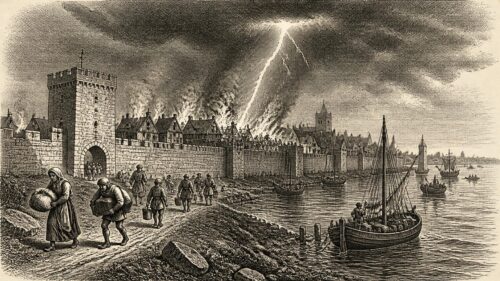
Galway’s Lightning Fire
In 1473, Irish annals recorded Galway's destruction by lightning on 2 June, with major losses, alongside severe cattle mortality in Connacht. Raids, executions, family violence and warfare exposed contested lordships and fragile successions across Connacht, the midlands and Muintir Eolais. Conflicting accounts of fighting there reveal regional perspectives and heavy losses among nobles and commoners. Dublin's court executed Edward Nugent after his seizure by kin. Deaths of rulers, heirs, clergy and legal scholar Brian Mac Aodhagáin marked political and cultural change. An indulgence year, eclipse and marvels demonstrate religious and observational concerns, while commerce, livestock, learning and lordship remained intertwined.
Finola’s Donegal Friary
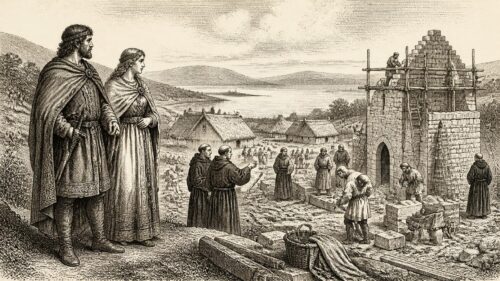
In 1474, Aodh Ruadh Ó Domhnaill and his wife Finola Ó Briain began Donegal’s Franciscan friary, intended as a dynastic mausoleum and declaration of Ó Domhnaill power. Its dating remains uncertain within 1472–74, but annals associate its foundation with 1474. Elsewhere, Ireland remained politically fragmented: Ó Domhnaill fought Ó Neill and Clann Aodha Buidhe; succession, raiding and castle destruction destabilised the midlands; and failed negotiations produced warfare in Connacht and Thomond. Dublin officials feared Scottish intervention. Deaths of bishops and hereditary scholars underline religion’s cultural role. The friary endured as a religious institution amid violence, dynastic competition and weak authority.
O’Donnell’s Long Circuit
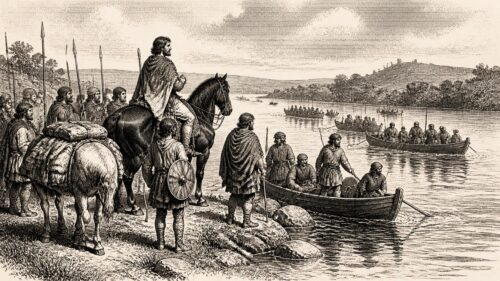
In 1475, Aodh Ruadh O’Donnell of Tír Chonaill led a major circuit through Breifne, Meath, Offaly and Connacht, combining armed pressure, alliance-building and peace-making. His host aided Brian O’Reilly, O’Farrell allies and Connacht friends, devastated parts of Meath, burned Delvin, and crossed the Shannon using local boats. Elsewhere, Réamonn MacMahon was defeated and captured in Oriel, while Henry O’Neill raided Fermanagh. Disputed successions in Annaly, castle transfers in Clanricard, and local battles revealed unstable lordship. Deaths of clerics, rulers and learned men, alongside monastic burials and literary remembrance, illustrate a politically connected, violent yet culturally resilient Ireland in the period.
Bel-Feirste Broken
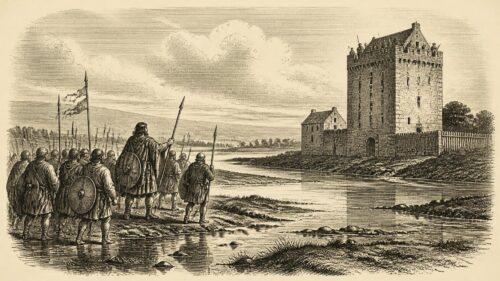
In 1476, Ireland’s competing lordships combined warfare, negotiation and institutional continuity. Henry Ó Néill captured and demolished Bel-Feirste castle, while raiding Oirghialla; Clandeboye survived. Maguire succession in Fermanagh was destabilised by killings and deaths. In Connacht, brief seizures of Roscommon castle exposed fragile authority, whereas Mac William Burke and Aodh Ruadh Ó Domhnaill negotiated a division of Lower Connacht after confrontation. English forces devastated crops, a monastery and settlements in the midlands. Dublin lordship maintained parliamentary, fiscal and legal activity. Annals also recorded prominent poets, clerics and scholars, revealing interconnected political, religious and learned cultures amid violence across the island.
Tírhugh in Ashes
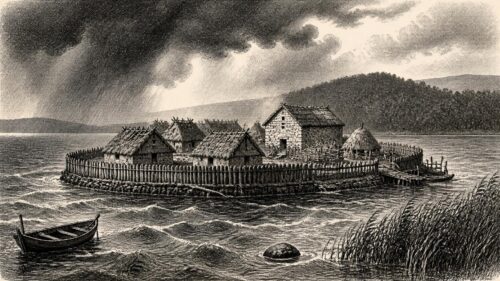
In 1477, annals depict Ireland as a patchwork of contested lordships, where kinship, land, ecclesiastical institutions and armed followings shaped power. In Tír Chonaill, Aodh Ruadh O’Donnell fought Neachtan O’Donnell’s sons, while Énrí O’Neill, supporting the rivals, devastated and burned Tírhugh. Fermanagh saw several Maguire deaths, alongside passing learned erenagh Matthew Ua Luinín and Ailbhe Maguire’s monastic association. Cormac Mac Carthaigh’s capture helped spread war across Munster; other dynastic killings occurred in Connacht and Leinster. A great wind damaged buildings, crannógs and stored produce nationwide. Kildare’s accession belongs to 1478, not 1477, according to contemporary annalistic and modern scholarly evidence.
Assaroe’s Pestilential Ship
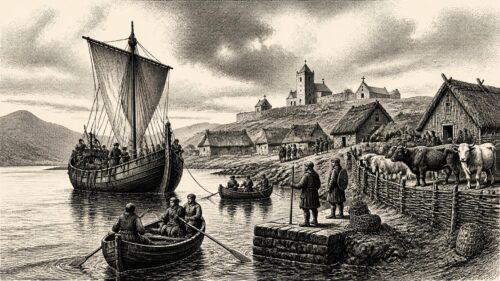
In 1478 Ireland experienced severe disruption from weather, disease and conflict. Annals describe a destructive Epiphany storm that damaged livestock, buildings, churches and Dublin windows, while Cormac MacCarthy was blinded during dynastic strife. A plague reportedly arrived by ship at Assaroe, spreading through north-western Ireland and causing deaths among nobles, clergy and learned families. Thomas FitzGerald’s death brought Gerald, later Gearóid Mór, to the Kildare earldom. In Connacht, contests for Sligo, Moylurg, Roscommon and Machaire Connacht involved sieges, devastation and changing lordships; Annaly saw partition after peace. Together, uneven records depict connected communities vulnerable to maritime disease, warfare and disaster.
Meelick’s Observant Turn
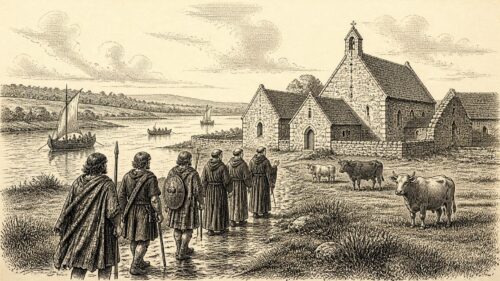
In 1479, Ireland’s diverse political and religious worlds were marked by reform, conflict and administrative adjustment. At Meelick, O’Madden patronage supported a Franciscan Observant renewal, strengthening dynastic commemoration and regional religious links. In Ulster, warfare between Tír Chonaill and Tír Eóghain involved raids, cattle seizures, ransom and hostages, burdening local communities. Obituaries around Lough Erne reveal clergy, artisans and hospitality networks underpinning lordship. In Dublin, Edward IV appointed Gerald FitzGerald, eighth earl of Kildare, deputy lieutenant, acknowledging dependence on local power. Statutes concerning merchants, civic privileges and Gaelic subjects exposed the English lordship’s porous, contested frontiers and commercial regulation alike.
Castlefinn’s Fragile Peace
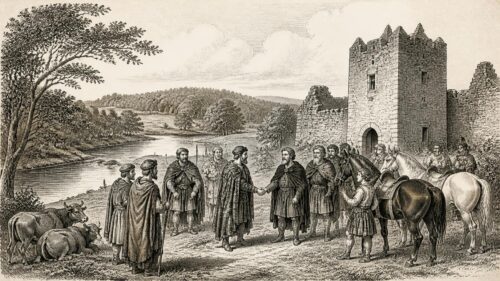
In 1480, Irish annals recorded interconnected conflicts, settlements and deaths across Ulster, Fermanagh and Connacht. Gerald FitzGerald, Earl of Kildare, joined Conn O’Neill’s unsuccessful siege of a rival O’Neill castle, demonstrating both Dublin’s reach and its limits. Raids between Tír Eógain and Tír Chonaill caused burnings, cattle losses and casualties, while O’Donnell dynastic rivalries continued. At Castlefinn, O’Donnell, Conn O’Neill and Neachtan O’Donnell’s sons negotiated peace and appointed Eigneachán O’Donnell tanist. Obituaries for Tomás Óg Maguire, Cathal Óg Mac Maghnusa, poets and teachers emphasised hospitality, religious patronage and learning. Local feuds also involved MacMahons, Maguires, O’Rourkes and de Burgh factions.
Maguire’s Castle Betrayal
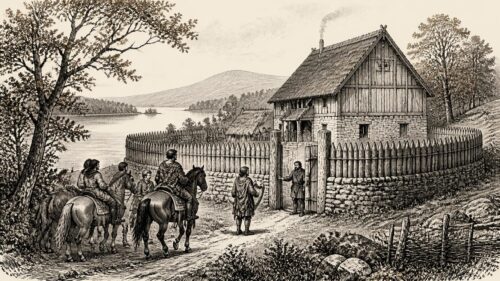
In 1481, Ireland’s annals recorded conflict, patronage and administration across politically fragmented lordships. On 5 October, Toirdelbach Mag Uidhir was treacherously killed by kinsmen in his Fermanagh castle, alongside several companions; his learning, hospitality and bardic generosity were widely mourned. Tír Eógain endured warfare among O’Neill factions, producing raids, killings, captures and the mutilation of Patrick Savage. Other deaths commemorated aristocratic patrons, poets and clerics, demonstrating the importance of learning, pilgrimage and religious institutions. Killings in Wexford reflected local rivalries, while the English lordship’s 1481–82 business addressed lands, castles, church property, revenues and urban privileges, revealing uneven but governmental authority.
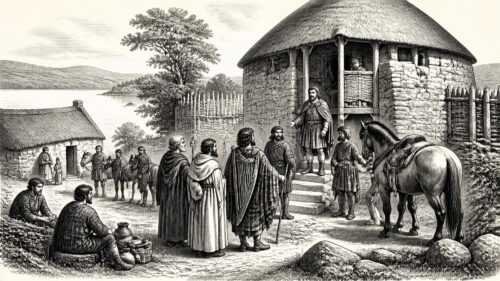
Conn O’Neill’s Bardic Shield
In 1482 Ireland’s events reflected regional lordship, kinship, religion and learning rather than national change. Conn Ó Néill of east Ulster died, renowned as a warrior, protector and patron of Irish and Scottish learned people; Ó Néill violence followed. Feuds among Ó Raghallaigh, Mag Uidhir, Ó hAinligh and families exposed fragility of peace, guarantees and oaths, while alliances crossed Gaelic and Anglo-Irish lines. Annals commemorated scholars and hospitable clergy, revealing learning, guest-houses and devotion as authority. Roland Savage’s appointment and Tadhg Mac Cárthaigh’s papal provision to Ross showed English administrative and ecclesiastical connections, both constrained by local power in practice.
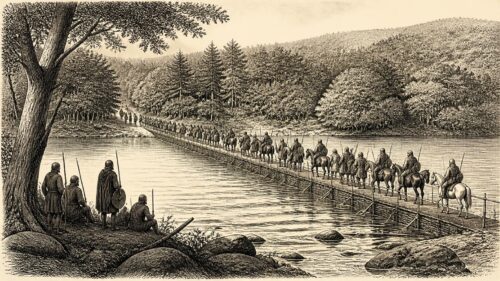
O’Donnell’s Wicker Bridge
In 1483, Conn O’Neill was released from captivity, inaugurated lord of Tír Eógain, and entered a major conflict with Aodh Ruadh O’Donnell. O’Donnell’s coalition, including Clandeboye forces, raided the Dundalk district, burned Traghbhaile and Baile-Lugh-mhaigh, defeated Kildare’s pursuing army, and exacted protection payments. Returning through Tír Eógain, it cleared woodland and built a wicker bridge across the Abhann Mór, escaping pursuit. Other conflicts occurred across Ireland, while bishops and learned hereditary officials died or succeeded. English dynastic change brought Richard III’s accession, but Kildare remained deputy. The annals depict interconnected lordships, warfare, landscape, church institutions, learning, and local livelihoods alike.
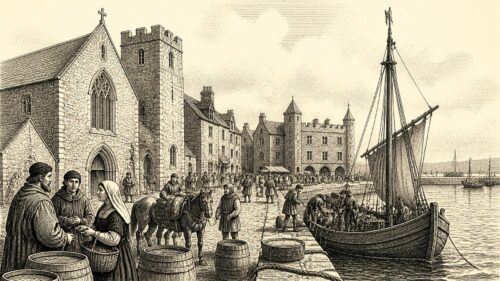
Galway’s Charter, Fermanagh’s Feud
In 1484, Ireland comprised the English lordship, autonomous towns, Anglo-Irish magnates and Gaelic dynasties, each governed through distinct but connected powers. Under Richard III, Gerald FitzGerald, earl of Kildare, dominated Dublin administration, while parliament regulated coinage, revenues, religious property, fortification and urban affairs. Galway strengthened its position when St Nicholas’s became collegiate and Richard granted the town a mayoralty. Elsewhere, insecurity persisted: northern war between O’Neill and O’Donnell coincided with a violent Maguire succession dispute in Fermanagh, involving murder, raids, captives and church attacks. Annals also record deaths, imprisonment and pastoral wealth, revealing fragmented political and social life across Ireland.
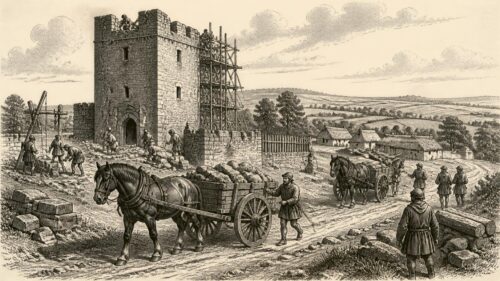
Tulsk Castle and Tudor News
In 1485, Ireland comprised competing lordships, towns and ecclesiastical jurisdictions, while Kildare dominated the English administration. His Trim parliament defended corporate privileges, funded frontier defence, Castledermot’s construction and plague relief, anticipating England’s uncertain succession. Henry VII’s accession after Bosworth altered calculations without immediately displacing Kildare. In Connacht, Uilleag Burke succeeded violently, with annals differing over his campaign and Tulsk Castle’s destruction. Successions, killings and raids reshaped Connacht and Ulster, where O’Neill and O’Donnell forces fought then made peace. Breifne conflicts involved castles, cattle and Kildare’s intervention. Church appointments, chantries, scholarship, hospitality, disease and hardship reveal communities facing persistent insecurity throughout.
Drogheda’s Northern Synod
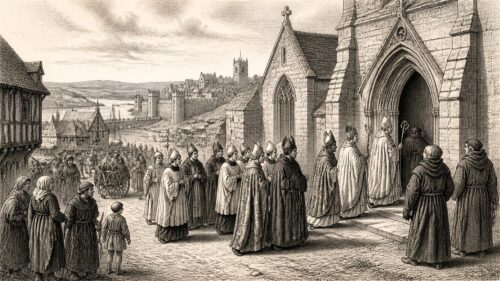
In 1486 Ireland remained politically fragmented, with Kildare dominating the English lordship around Dublin while Gaelic and Anglo-Irish powers contested local authority. Ulster saw raids, killings, captures and burnings among Maguire, MacMahon, Ó Néill and allied groups, including the capture of a castle at Belfast. Connacht experienced disputed kingship, lordship successions and a significant battle involving Aodh Ruadh Ó Domhnaill and Mac William. Archbishop Octavian de Palatio convened a northern synod at Drogheda, while Roland FitzEustace founded an Observant Franciscan friary near Kilcullen. Abundant apples contrasted with severe salt scarcity and high horse prices, linking conflict, markets and everyday life.
Simnel’s Dublin Crown
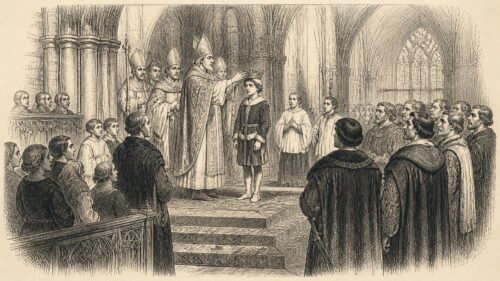
In 1487 Dublin became the base for a Yorkist challenge to Henry VII. Lambert Simnel, presented as Edward, earl of Warwick, was crowned Edward VI at Christ Church, backed by Kildare and elements of the Anglo-Irish clergy and administration. With Lincoln, German mercenaries and approximately 4,000 Irish kerns, the coalition invaded England, but was defeated at Stoke, where many Irishmen, including Thomas FitzGerald, died. Meanwhile, Gaelic lordships endured warfare, killings and contested successions. Severe storms and summer rain damaged buildings and crops. Churches suffered in raids, while poet, historian and legal scholar died. Desmond’s earl was murdered, highlighting FitzGerald instability.
Edgecombe’s Dublin Oath
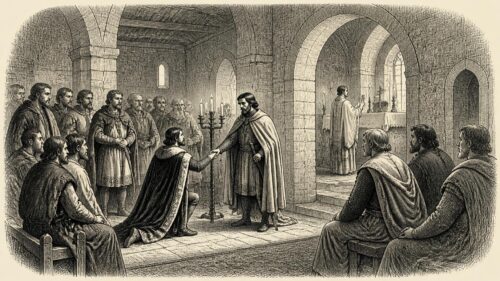
In 1488 Sir Richard Edgecombe secured renewed allegiance to Henry VII after Ireland’s leaders had supported Lambert Simnel. At Kinsale, Waterford, Dublin, Drogheda and Trim, towns and magnates received pardons and swore fealty. Gerald FitzGerald, earl of Kildare, negotiated rather than submitted unconditionally, taking a solemn oath at St Thomas’s while retaining his regional power; royal control was reinforced through Dublin Castle. Beyond the Pale, warfare, succession disputes, hostage-taking and alliances shaped Gaelic and Anglo-Irish lordships. Religious reform flourished at Donegal, while deaths from smallpox, losses among learned figures and destructive weather exposed insecurity. The settlement restored cooperation, not rule.

Belfast Castle, Dublin Streets
In 1489, Ireland experienced a severe epidemic, recorded by the annals among ruling, learned, military and ecclesiastical households, though its precise nature and scale remain unknown. A November royal order demanded Dublin remove refuse, dung and swine, reflecting fears that polluted air caused pestilence and harmed commerce and government. Northern lordships remained violent: Conn Ó Néill raided Ó Catháin territory and seized hostages, while dynastic deaths altered regional politics. After harvest, Aodh Ruadh Ó Domhnaill campaigned eastwards, raided the Route, captured Belfast Castle and reportedly demolished it. Despite disaster and conflict, civic, religious, learned and lordly institutions continued functioning precariously.
Croghan’s Broken Succession
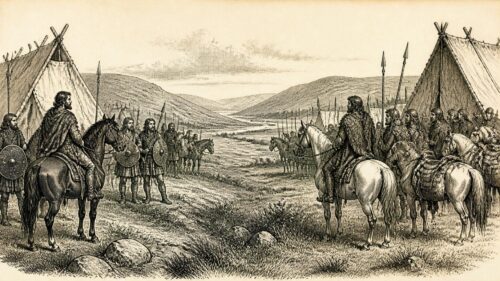
In 1490, Ireland’s fragmented political order was shaped by local warfare, disputed succession and negotiated authority. Feidhlimidh Fionn Ó Conchobhair Ruadh defeated rival kinsmen near Croghan before dying, prompting Ruaidhrí’s election and further instability in Connacht. Raids, cattle seizures and crop destruction burdened communities. In Ulster, Ó Néill factions fought over castles, Aodh Óg Ó Domhnaill seized Ballyshannon, and Conn Ó Néill and Aodh Ruadh Ó Domhnaill maintained an armed stalemate. Henry VII summoned Kildare, whose indispensability reflected Dublin’s limited reach. Papal appointments, learned deaths, maritime links and a cautiously reported earthquake reveal an interconnected, unsettled society across the island.

Kildare’s Harvest Plea
In 1491 Conn Ó Néill of Tír Eógain and Aodh Ruadh Ó Domhnaill of Tír Chonaill sought Gerald FitzGerald, earl of Kildare, to arbitrate their Ulster conflict, but no peace resulted, demonstrating limits to Kildare’s authority. Warfare continued through raids, killings, captivity and contested castles across Ulster, Breifne and borderlands. In east Breifne, John Ua Raghallaigh died, prompting a disputed succession and Kildare’s destructive intervention. Persistent summer and autumn rain ruined Ireland’s grain, particularly in Fermanagh, worsening pressures created by campaigning. Ecclesiastical offices and monasteries remained significant. A post-Christmas wind concluded a year marked by insecurity, authority and environmental hardship.
Fitzsimons’s Famine Year
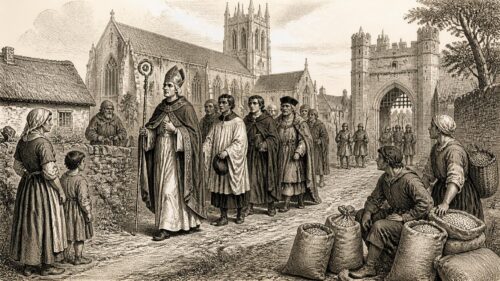
In 1492, Ireland endured famine, disease and conflict amid Henry VII’s attempt to weaken Gerald FitzGerald, earl of Kildare. Suspected because of Yorkist links and Perkin Warbeck’s Cork landing, Kildare was replaced in government by Archbishop Walter Fitzsimons and Sir James Ormond. The changes intensified rivalries across the Pale, Leinster, the midlands and East Breifne, where Gaelic and Anglo-Irish lords fought, raided and contested succession. Poor weather damaged grain before famine; a hot summer and sweating sickness compounded insecurity. Ulster saw truces, killings, imprisonments and raids. Ecclesiastical life continued, while Thaddeus MacCarthy died returning from Rome. Central authority remained fragile.
Glasdromainn’s Rival O’Neills
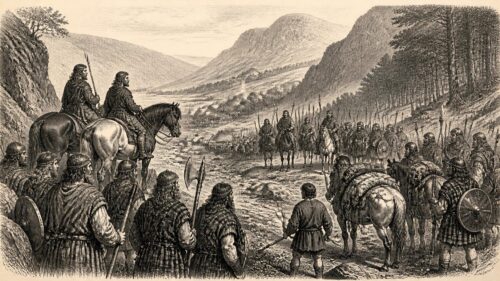
In 1493, Conn Ó Néill’s treacherous killing by his brother Henry Óg triggered a contested succession in Tír Eóghain. Backed respectively by Ó Domhnaill and by Uí Chatháin and Uí Mhealláin, Domhnall Clárach and Henry Óg fought at Glasdromainn, where Henry prevailed, though instability continued. Ó Domhnaill’s later Ulster hosting ravaged territories but won no settlement. Across Ireland, killings, raids, burnings and changes of lordship affected Leinster, Offaly, Breifne and Connacht. Gerald FitzGerald, earl of Kildare, visited Henry VII amid political scrutiny. Annals also recorded deaths of clerics, poets and aristocratic women, revealing cultural ties and piety during the year.
Poynings at Drogheda
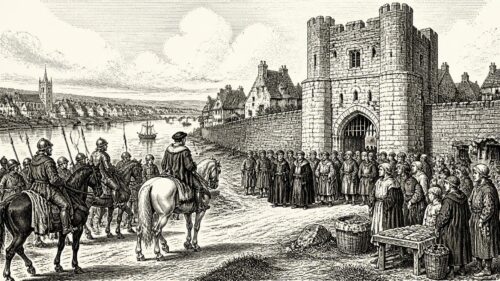
In 1494 Henry VII sent Sir Edward Poynings to Ireland to strengthen Tudor control, counter Yorkist support and reduce reliance on Gerald FitzGerald, earl of Kildare. Landing in October, Poynings led an Ulster expedition, securing submissions from O’Hanlon and Magennis, but relations with Kildare deteriorated. His Drogheda parliament, opened in December and continuing into 1495, began legislation, including the measure later called Poynings’ Law, restricting Irish parliamentary initiative. Elsewhere, regional lordships remained autonomous: dynastic killings, sieges around Sligo, conflicts in Fermanagh and Cavan, raiding and hostage-taking continued. Church, trade and daily life were shaped by warfare, contested authority and insecurity.

Waterford’s Eleven-Day Defence
In 1495, Sir Edward Poynings sought to strengthen Henry VII’s authority in Ireland through the Drogheda parliament, whose measures restricted Irish legislative initiative, while arresting the eighth earl of Kildare; his attainder was reversed later that year. Perkin Warbeck, backed by Desmond and Cork interests, failed after Waterford’s eleven-day land-and-sea defence, preserving a loyal harbour. Elsewhere, Aodh Ruadh Ó Domhnaill’s Scottish alliance and warfare around Sligo, conflicts in Breifne, and lordly rivalries demonstrated fragmented power. Church councils, monasteries, guesthouses, learned families and physicians reveal institutions supporting society. The year exposed Tudor ambitions but confirmed fragmented Irish power across the island.
Kildare’s Howth Landing
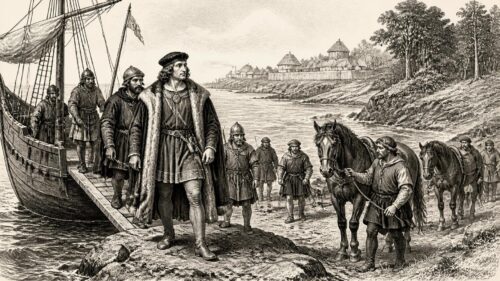
In 1496 Henry VII restored Gerald FitzGerald, eighth earl of Kildare, as lord deputy, ending the immediate crisis of direct Tudor rule. Landing at Howth with royal favour and a new marriage, Kildare accepted conditions including Poynings’ Law, while his heir remained in England. Efforts to dig defensive boundaries around the Pale reflected insecure frontier government. Elsewhere, MacMahon feuds in Oriel, O’Donnell conflicts and regional successions demonstrated fragmented authority. Severe weather destroyed crops and cattle, causing widespread dearth and disrupting husbandry. Annals nevertheless recorded musicians, learned families and religious patrons, revealing cultural prestige amid warfare, political competition and agricultural hardship.

Conn O’Donnell’s Brief Lordship
In 1497, Ireland remained divided among competing Gaelic and Anglo-Irish lordships despite Henry VII’s nominal authority and Kildare’s Dublin administration. Perkin Warbeck briefly landed at Cork but gained no support before departing for Cornwall. In the south-east, Piers Ruadh Butler killed Sir James Ormond, strengthening his territorial position. Conn Ó Domhnaill succeeded in Tír Chonaill in May, yet succession conflict, defeat and invasion brought his death in October. Local peace-making and raiding continued elsewhere. A severe island-wide famine caused hunger, mortality and extraordinary food prices for communities. Religious developments included regulation of Lough Derg pilgrimage and Franciscan reform at Carrickfergus.

Dungannon’s Great Guns
In 1498, Gerald FitzGerald, earl of Kildare and royal deputy, led Gaelic and Anglo-Irish allies to capture Dungannon Castle with artillery, intervening in the violent O’Neill succession struggle. The campaign displayed military capacity but reinforced a factional settlement rather than extending durable Dublin control. Kildare’s restored administration also summoned parliament, pursuing taxation, customs and measures promoting English elite practice. Ireland endured famine and recorded smallpox deaths, including scholar Cathal Óg Mac Maghnusa, compiler of the Annals of Ulster. Conflict in Munster, religious patronage by Margaret Maguire, and scattered annalistic reports reveal interconnected yet locally experienced political, social and cultural life.
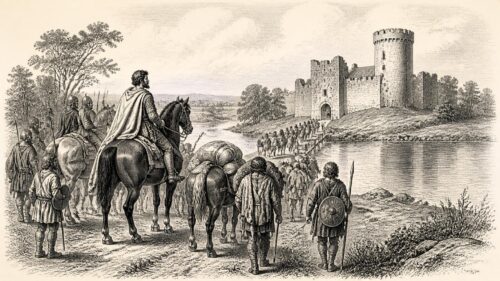
Athleague’s Reversed Conquest
In 1499, Gerald FitzGerald, earl of Kildare and royal deputy, campaigned in Connacht, seizing Athleague, Tulsk, Roscommon and Castlerea, redistributing lordship and hostages among allied factions. Mac William Burke and displaced O’Kelly forces soon recovered Athleague and Tulsk, demonstrating the fragility of imposed authority. Succession and conflict reshaped Moylurg, Tír Chonaill, Fermanagh and Thomond, where O’Donnell raided, negotiated with Kildare and suppressed internal rebellion, while an O’Brien force defeated Butler followers. Annals also record religious and aristocratic hospitality, and Pale parliamentary regulation. Warfare, castles, cattle, hostages, tribute and negotiation repeatedly remade Ireland’s overlapping political order across Ireland’s contested regional frontiers.