

1300–1399 CE

Ballymote’s First Stones
In 1300, construction began at Ballymote Castle in County Sligo, probably under Richard de Burgh, the Red Earl of Ulster and lord of Connacht. The fortress signalled and supported de Burgh influence in contested Corran, though Gaelic and settler powers remained varied and interconnected. Annalistic notices associate deaths in the earl’s household with this period, highlighting succession’s importance, but dating is uncertain. Meanwhile, justiciar John Wogan ordered provisions from Irish ports for Edward I’s Scottish war. Castle-building, royal requisitioning, trade, labour, religious institutions, and local violence reveal Ireland as a politically fragmented yet increasingly interconnected island within wider overseas affairs.
Gilla Íosa’s Last Year
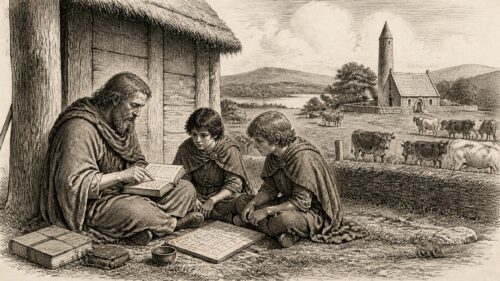
In 1301, Irish annals recorded local conflict, religious deaths and Ireland’s involvement in Edward I’s Scottish campaign. Áed Ó Conchobair and Clann Muirchertaigh raided Mag Cétne, while killings among Muintir Chionaoith and Uí Máel Sechlainn exposed dynastic rivalries. The deaths of Gilla Íosa Mac Fir Bisig, an eminent ollam, Abbess Finnguala of Kilcreevanty, priest Matha Mac Raith and steward Cathal Ó Máel Dúin illuminate Gaelic learning, ecclesiastical leadership and royal administration. Anglo-Irish magnates and forces served in Scotland from late July to November, although the earl of Ulster stayed behind. These fragmentary records reveal interconnected Gaelic and English political worlds.
Domnall Ruad’s Last Winter
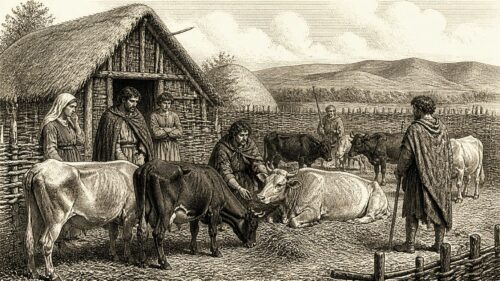
In 1302, Ireland experienced political change, conflict and widespread cattle mortality. Domnall Ruad Mac Carthaig, king of Desmond, died in February after a long reign and was succeeded by his son, Domnall Óc. His Franciscan burial at Cork reflected both dynastic status and penitential religious culture. Donn Carrach Mag Uidir of Fermanagh, several prospective heirs, and leading churchmen also died, creating important vacancies. Raids in Mag Céidne demonstrated continuing competition among Connacht elites. Annals described severe disease among cattle throughout Ireland, threatening rural wealth, food supplies, tribute and lordly power. Chronological differences between sources require caution over some associated events.

De Burgh’s Scottish Muster
In 1303, Ireland contributed significantly to Edward I's Scottish campaign under Richard de Burgh, earl of Ulster, who led an estimated 3,000 Gaelic and Anglo-Irish troops. Their service demonstrated cross-channel aristocratic connections and required continued Irish administration, including replacement of absent officials and financial management. In Tír Conaill, Áed Ó Domnaill killed his brother Toirrdelbach after prolonged conflict, becoming lord amid widespread devastation. Church leadership also changed: Archbishop Nicholas Mac Maoil Íosa of Armagh and Bishop Máel Sechlainn Mac Briain of Elphin died, prompting succession processes. Despite uncertain annalistic dating, records portray Ireland as politically divided yet engaged with Britain.

St Mary’s Abbey Ablaze
In 1304, Dublin suffered an accidental fire that destroyed St Mary’s Abbey, the Dominican house and much of the city, disrupting religious, commercial and administrative life. Chancery rolls covering 1291–1300 were lost, deepening later gaps in Ireland’s records. Justiciar John Wogan struggled to secure Athlone while Irish resources supported Edward I’s Scottish war. Richard de Burgh served in Scotland, but his wife and heir Walter died, altering succession. In Bréifne, Matha Ó Raighilligh was killed with his gallóglaigh, exposing volatile regional lordship. These events reveal interconnected vulnerabilities across medieval Ireland, though evidence offers little detail about ordinary people’s lives directly.
Carbury Castle’s Betrayal
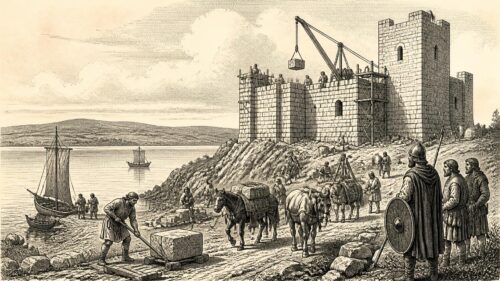
In 1305, Ireland experienced interconnected local conflicts amid divided Gaelic and Anglo-Irish lordships. Piers de Bermingham treacherously killed Muirchertach Ó Conchobair Fhailghe, his brother and leading followers at Carbury Castle, exposing fragility of frontier agreements. Áed Ó Conchobair’s forces defeated Muintir Raighilligh, causing heavy losses, while warfare and killings disturbed Leinster, Desmond and Breifne. Annals also noted early-summer hardship, without specifying its cause. Richard de Burgh built Northburgh Castle on Lough Foyle, strengthening Ulster influence. Meanwhile, royal administration continued through payments, legal inquiries and ecclesiastical property regulation, illustrating Ireland’s patchwork of competing powers across towns, lordships, churches, and royal jurisdictions.
Inis Mac nInill’s King
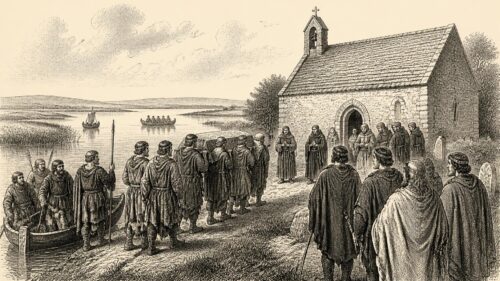
In 1306, Ireland experienced contested succession, warfare and political instability rather than decisive national change. Toirdelbach Ó Briain, king of Thomond, died and was buried at his foundation for friars on Inis Mac nInill, while his son Donnchad succeeded amid opposition. Connacht suffered prolonged conflict between Ó Conchobair rivals, involving raids, cattle seizure, arson and killings. Betrayals and lordship struggles affected Fermanagh, Meath, Leinster and Desmond, where prominent captives and rivals were killed. Annals also record clerical deaths, church damage, maritime trade and fortification. Robert Bruce’s Scottish accession had Irish significance, although no invasion followed. Sources require caution over chronology.
Ahascragh’s Restitution
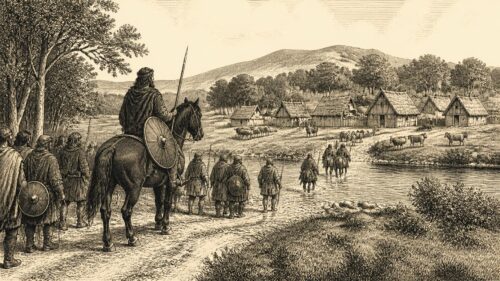
In 1307, Edward II succeeded Edward I as Lord of Ireland, while existing Dublin administration continued under officials including newly appointed Exchequer treasurer Alexander de Bicknor. Richard de Havering received Dublin archbishopric temporalities but was never consecrated, and bishops died at Kilmacduagh and Elphin. At Ahascragh, Donnchad Muimhneach Ó Cellaigh of Uí Maine defeated forces associated with Roscommon, capturing the sheriff and other opponents. Prisoners were released under restitution for an earlier burning attributed to Edmund Butler, before Ó Cellaigh died. Killings among Ó Conchobair claimants underscored Connacht instability. Sources require caution because annalistic chronologies conflict over some recorded events.
Glenmalure and Gaveston
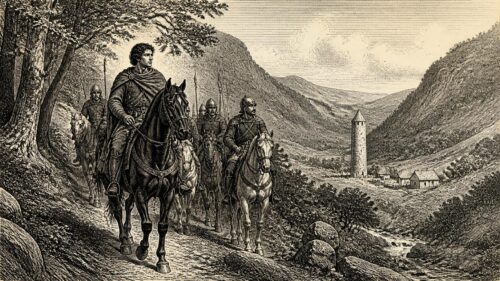
In 1308, John Wogan’s defeat at Glenmalure exposed the vulnerability of royal power near Dublin, although administration continued. Piers Gaveston, Edward II’s controversial favourite, arrived as king’s lieutenant, combining political exile with military responsibility. Later campaigns against Wicklow opponents, including the Ó Byrnes, sought to restore authority through coercion and infrastructure. In Connacht, raids, broken peace agreements and failed hostages involved Ó Conchobair branches, Mac Diarmata, Ó Dubda and Anglo-Irish forces, demonstrating unstable alliances and dynastic violence. Stormy weather damaged people and cattle, while lightning struck Roscommon’s Dominican friary. The year revealed an uneven landscape where powers constrained royal government.
Coill an Chlocháin
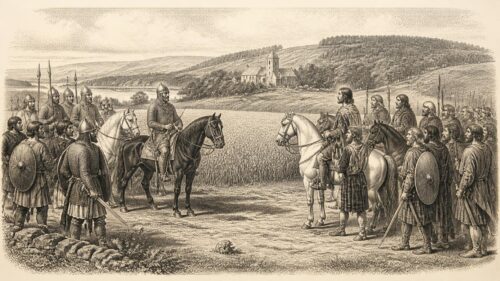
In 1309, Áed mac Éogain Ó Conchobair, king of Connacht, was killed at Coill an Chlocháin by Áed Brefnech, triggering wider conflict among rival dynasties and allies. Elite casualties included legal scholar Gilla na Naem Mac Aodhagáin, illustrating the political importance of learned service. Competing claimants sought submissions, tribute, royal jewels and military support, while raids damaged grain and monasteries served strategic roles. Elsewhere, violence involved Leinster magnates and Thomond rivals; Cathal Ó Conchobair became bishop of Elphin. Roger Mortimer and Joan de Geneville assumed Meath's lordship, while Dublin received murage for bridge-tower repairs, revealing Ireland's interconnected local politics clearly.
Sligo Castle and Aed Brefnech
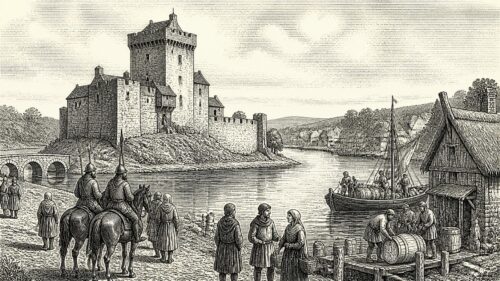
In 1310, Ireland remained politically fragmented despite Edward II’s lordship. At Kilkenny Parliament, John Wogan, Richard de Burgh and church leaders addressed disorder, revealing reliance on powerful magnates. In Connacht, Aed Brefnech Ó Conchobair’s destructive campaign against Mac Diarmata included killings, capture and burning; his allies then sacked Buninna Castle. Aed was subsequently murdered by mercenaries, allegedly bribed by William de Burgh, whose soldiers imposed oppressive quartering. Feidlim Ó Conchobair emerged as king of Connacht. Richard rebuilt Sligo Castle, asserting contested authority. The year also saw scholar Tanaide Ó Maelchonaire’s death, wine landing in Magh Cétné, and violence across Ireland.
Bunratty’s Captured Earl
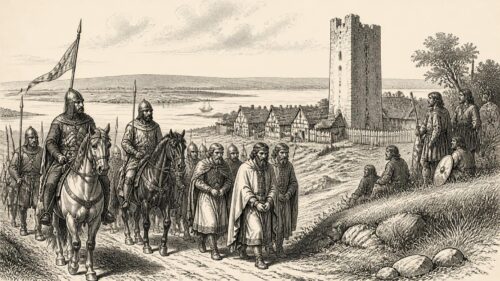
In 1311, conflict at Bunratty in Thomond brought rival Uí Bhriain branches, Richard de Clare, William Liath de Burgh and forces from Connacht and Meath into shifting alliances. Although de Clare’s side suffered heavier losses, it captured de Burgh and northern nobles, briefly altering regional power. Thomond endured further killings, including King Donnchad Ó Briain’s murder, contested succession, hostage agreements and later fighting. Raids also struck the Dublin marches, exposing weak governmental control. Church appointments in Dublin and Armagh revealed competing royal, papal and local interests. Deaths, raids and scarcity heightened insecurity, foreshadowing vulnerabilities later exploited during the Bruce invasion.
Mac Áeda’s Tuam Translation
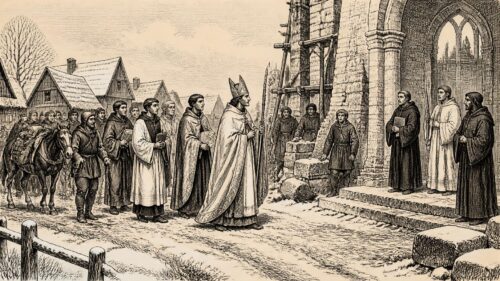
In 1312, ecclesiastical and governmental transitions highlighted tensions within Ireland’s lordship. William de Bermingham’s death created a vacancy at Tuam, where Máel Sechlain Mac Áeda, formerly bishop of Elphin, was formally translated on 19 December, strengthening Gaelic representation in a major metropolitan see. Religious life continued through developments at Boyle and episcopal deaths in Connacht. In Louth, a de Verdon rising defeated royal forces near Ardee, exposing fragile crown authority. Edmund Butler replaced John Wogan as keeper in August and administered Dublin while campaigning in Wicklow. These institutional changes preceded, but did not initiate, the crises of 1315 and afterwards.

Butler’s Dublin Knighthoods
In 1313, Thomond faced a contested O’Brien succession after Diarmait Cléirech Ó Briain died and was buried in the Franciscan habit at Ennis. Donnchad Ó Briain asserted his claim through destructive campaigns in Uaithne and Ara, while Muirchertach Ó Briain entered from Connacht, defeated his rivals and ravaged the Limerick district. Their conflict ended in a territorial partition, though warfare resumed in 1314. Regional struggles involved O’Brien factions, Mac Conmaras and Anglo-Irish magnates, notably Richard de Clare and the de Burghs. In Dublin, acting justiciar Edmund Butler held a feast and knighted thirty men, asserting royal authority amid political instability.

Drumlane and Bannockburn
In 1314, Ireland experienced instability across Gaelic lordships and the English administration rather than a single national turning point. Ruaidhrí Ó Conchobair defeated the O’Reillys at Drumlane, while killings within leading families, including Matha Mac Tigernáin’s murder by his foster-son, exposed contested authority. Bishop Matha Mac Duibne died, and Niall Ó Néill, heir to Cenél nÉogain, was lost. Theobald de Verdon governed the lordship as Edward II sought Irish money and soldiers for war. Robert Bruce’s victory at Bannockburn altered Irish Sea strategy, encouraging later ambitions without causing Edward Bruce’s 1315 invasion. Famine was not attested in Ireland during 1314.
The Larne Landing
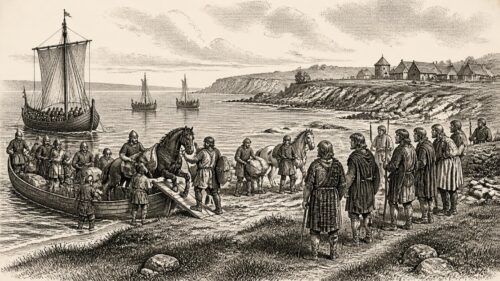
In May 1315 Edward Bruce, brother of Robert Bruce, landed near Larne with a Scottish army, exploiting divisions among Irish rulers, Anglo-Irish magnates and officials. Supported by some Ulster Gaelic lords, he claimed Irish kingship, captured Carrickfergus town and besieged its castle. His forces devastated settlements and supplies, defeated Richard de Burgh at Connor, and advanced into Meath, where opposition faltered amid local rivalries. The invasion also intensified Connacht dynastic conflict. Neither Ireland nor Ulster was unified behind Bruce: Dublin, Trim and Carrickfergus castle remained hostile. Warfare, crop destruction, requisitioning and weather worsened the Great Famine, causing hardship and disorder.
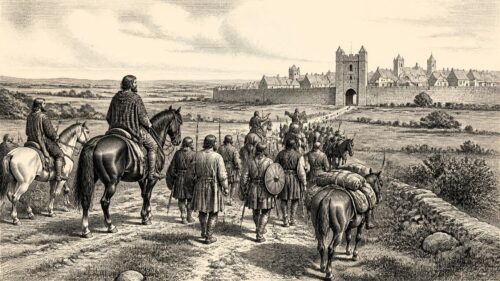
Feidlim’s Athenry Army
In 1316, Ireland endured Scottish invasion, provincial conflict, destructive warfare and famine. Edward Bruce, supported by Ulster allies, claimed kingship but controlled chiefly the former earldom of Ulster; his Leinster raid exposed divisions among Anglo-Irish magnates without establishing rule. In Connacht, Feidlim Ó Conchobair defeated rival Ruaidrí, built a broad coalition and attacked Anglo-Irish lordships. On 10 August, William de Burgh and the Berminghams crushed Feidlim’s army outside Athenry, killing Feidlim and leaders, and destabilising Connacht anew. Meanwhile, famine compounded military devastation. Carrickfergus surrendered to Bruce in September, yet no power secured Ireland: regional rivalries, hunger and contested lordship persisted.
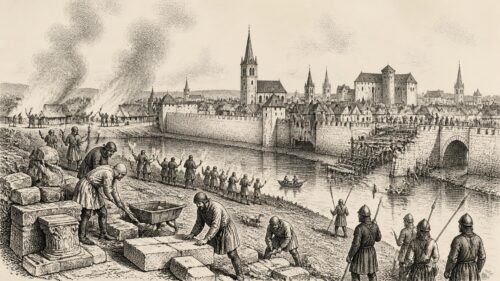
Dublin’s Scorched Suburbs
In 1317, at the height of the Bruce invasion, Robert Bruce joined his brother Edward in Ireland and marched through Meath towards Dublin. Fearing siege, Dublin’s citizens burnt western suburbs, demolished the Liffey bridge and religious buildings for defensive stone, and detained the earl of Ulster. The Bruces bypassed the fortified city, campaigned unsuccessfully in Munster, and retreated north; Robert departed in May. Famine, worsened by military requisitioning, afflicted Ireland amid warfare, dynastic struggles and castle destruction. Connacht changed kings, while learned legal culture suffered a loss. Irish leaders’ Remonstrance to Pope John XXII sought support, but Edward’s kingship endured.

Faughart and Dysert
In 1318, defeats at Dysert O’Dea and Faughart reshaped Ireland without bringing peace. Richard de Clare’s death ended his family’s attempt to dominate Thomond, enabling Gaelic rulers to regain regional control. Edward Bruce’s death near Dundalk ended the Scottish-backed invasion, though it exposed weaknesses within English lordship. Warfare intensified the Great Famine’s effects: requisitioning, ruined crops, disease, disrupted trade and severe weather produced acute hardship. Political alliances crossed Gaelic, settler and Scottish communities, reflecting local interests rather than national divisions. Connacht remained unstable amid dynastic conflict. Alexander de Bicknor arrived as Dublin’s archbishop and justiciar, inheriting a weakened, impoverished lordship.
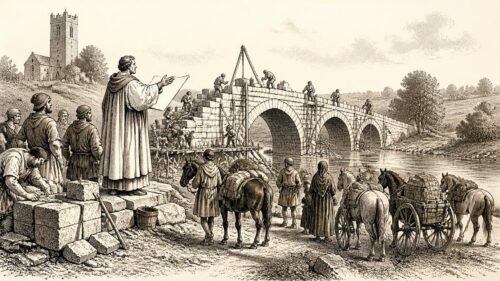
Maurice Jakis’s Liffey Bridge
In 1319, Ireland remained unsettled after Edward Bruce’s defeat, with famine, warfare and administrative disruption still affecting lordships and towns. Maurice Jakis, canon of Kildare, built a stone bridge across the Liffey at Kilcullen, improving travel and encouraging the settlement’s later growth. English officials sought missing financial accounts, reflecting weakened government. In Tyrone, Domhnall Ó Néill was expelled, sheltered in Fermanagh, restored, then lost his heir Brian to enemies. Annals also recorded killings, deaths of Gaelic and Anglo-Irish lords, and several episcopal vacancies. The year combined local reconstruction, ecclesiastical continuity, family feuds and precarious political authority across the island overall.
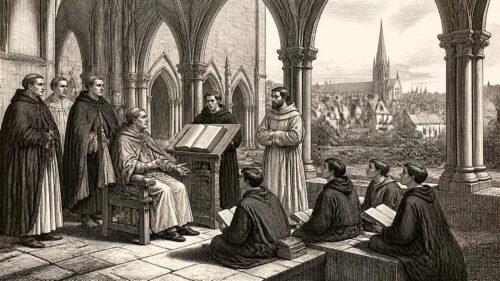
St Patrick’s Studium
In 1320, Ireland showed contrasting efforts at order and continuing conflict after the Bruce invasion. Archbishop Alexander de Bicknor established statutes for a studium generale at St Patrick’s Cathedral, appointing teachers and a chancellor to promote theology and canon law, while strengthening ecclesiastical discipline through synodal measures. Roger Mortimer’s Dublin parliament reaffirmed English statutes, regulated administration and market measures, and named the earl of Kildare deputy justiciar. Elsewhere, authority remained contested: Cathal Ó Conchobair broke peace with Maelruanaid Mac Diarmata, seizing captives and ravaging Connacht; a Connacht claimant was killed; and Munster’s Ó Briain tanist Mathgamain died violently, unsettling succession.
Loch Key’s Cattle Plague
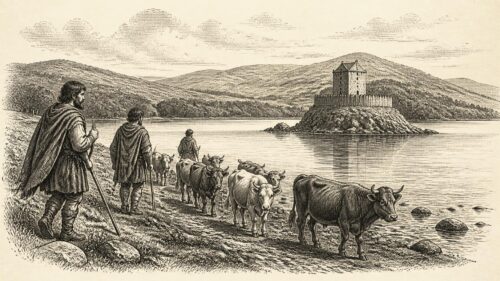
In 1321, Irish annals recorded an unprecedented cattle murrain across Ireland, corroborated in Connacht, Ulster and Munster, where famine was also noted. The disease, of unknown cause, destroyed vital sources of food, labour, wealth and political obligation, exposing fragile recovery after earlier war and subsistence crises. Conflict nevertheless continued: Cathal Ó Conchobair destroyed the Rock of Loch Key and rivals were killed; Oriel endured dynastic mutilation and assassination involving Dundalk; Meath forces defeated Offaly chiefs; and a Munster hosting sought castles and hostages. These events reveal local, interwoven Gaelic and settler politics, but cattle mortality remained the year’s island-wide calamity.
O’Nolan’s Michaelmas Blow
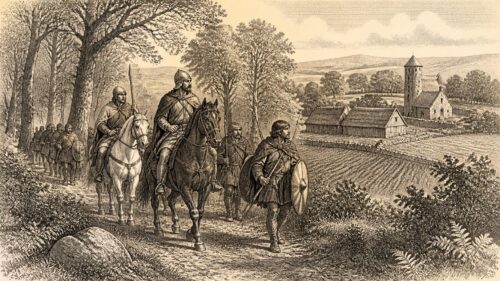
In 1322 Ireland was divided among royal, settler, ecclesiastical and Gaelic powers, while Edward II demanded troops, supplies and revenue for war against Scotland. John de Bermingham organised the Irish levy, leaving William de Bermingham deputy justiciar. On 29 September, O'Nolan forces killed Andrew Bermingham, Nicholas de la Launde and others in the unstable Leinster frontier. Dynastic murders, capture and plunder in Annaly, Connacht and the midlands revealed competition within Gaelic lordships. Obituaries recorded the deaths of Ardagh's bishop and legal scholar Andrias Mag Mailin. Uneven, sometimes misdated annals portray military, political and economic pressures rather than a nationwide crisis.
Darcy’s Irish Commission
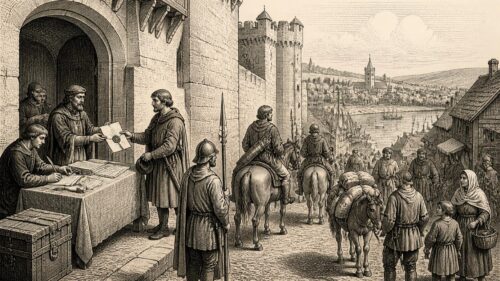
In 1323, Ireland’s importance lay in its connections with wider Plantagenet politics rather than a single decisive event. A Scottish truce cancelled planned paid military service by leading Anglo-Irish magnates, leaving local rivalries intact. Roger Mortimer’s escape from the Tower raised fears for his Irish estates and supporters, prompting Chancellor Roger Outlaw’s warning mission to Edward II. The king appointed John Darcy justiciar in November, although John de Bermingham remained in office until Darcy’s arrival in 1324. Legislation addressed official abuses, requisitioning, trade, fees and pardons. Meanwhile, Cistercian authorities condemned national exclusion in Irish monasteries, revealing ethnic and institutional tensions.

Tír Briúin and Mael Domnaig
In 1324, Connacht experienced a decisive dynastic reversal when Toirrdelbach Ó Conchobair killed Cathal Ó Conchobair in Tír Briúin na Sinna in autumn and was recognised as king. Cathal, ruler since 1318, had long contested power with his rival amid Gaelic and Anglo-Irish pressures. Annála Connacht also recorded the continuing Mael Domnaig cattle murrain throughout Ireland, a severe but undiagnosed epizootic threatening food, farming, transport, wealth and lordship. John Darcy, newly appointed justiciar, administered English-controlled jurisdictions under Edward II, where common law, Dublin ordinances and local usages coexisted. Sparse annalistic evidence portrays political succession and rural vulnerability as closely intertwined.

Lough Laoghaire’s Broken Line
In 1325, Domhnall Ó Néill, king of Tír Eógain, died at Loch Laoghaire, and his son Cú Uladh was murdered by rival kinsmen, precipitating a disputed succession eventually favouring Henry Ó Néill of Clandeboye. Intra-dynastic violence also affected Fermanagh and Thomond. Maurice fitz Thomas FitzGerald’s seizure of Bunratty Castle exposed contested Anglo-Irish authority and required intervention by justiciar John Darcy. Meanwhile, an audit at Westminster uncovered forged Irish exchequer accounts associated with Archbishop Alexander Bicknor, leading to confiscation of his temporal property. Together, these events reveal unstable, personal lordship, constrained royal power, and fragile administration across medieval Ireland at once.
The Red Earl’s Last Summer
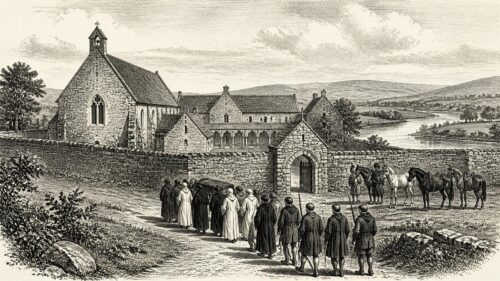
Richard de Burgh, the Red Earl of Ulster and lord of Connacht, died at Athassel on 29 July 1326, ending a powerful four-decade lordship. His fourteen-year-old grandson William inherited vast but vulnerable estates, exposing Ulster and Connacht to guardians, rivals and local conflict. Munster saw fighting between Maurice FitzGerald of Desmond and Arnold le Poer, temporarily restrained by Justiciar John Darcy. Royal administration continued through travelling chancery business and financial enforcement. Local records note Ímar Mag Ragnaill’s killing and the succession at Elphin. Meanwhile, English political crisis unsettled Ireland, making 1326 a pivotal year of insecure lordship and contested authority.
Glendun’s Grain Truce
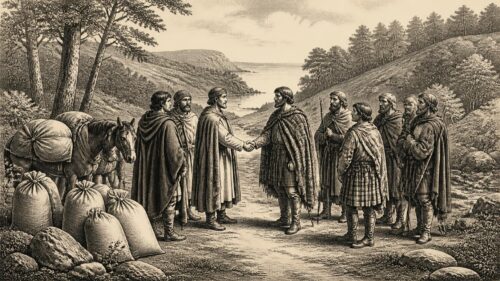
In 1327, Ireland experienced overlapping political, military and social crises amid the accession of Edward III. Thomas FitzGerald, earl of Kildare, became justiciar, but magnates contested royal authority while trade and administration continued. At Glendun, Robert Bruce secured a year’s truce with Ulster, paid for by promised wheat and barley. Domhnall Mac Murchadha was proclaimed king in Leinster before capture by royal officers. Rival Anglo-Irish lords devastated lands during private war, while O’Rourkes and O’Reillys fought over Lough Oughter. A widespread speckled sickness, probably smallpox but diagnostically uncertain, killed people across social ranks alike, disrupting labour, food supplies and lordship.

The Ormond Patent
In 1328 Ireland endured crop damage, illness, destructive winds and scarcity, recorded across annalistic traditions. Political authority remained fragmented: William de Burgh returned to his Ulster inheritance, while royal orders sought to restrain magnates and an attempted Scottish-Irish peace meeting failed. De Burgh, Connacht and Thomond allies suffered defeat against Brian Bán Ó Briain; violence also killed John de Bermingham, earl of Louth. Obituaries reveal losses to legal, ecclesiastical and musical culture, amid church factionalism. On 2 November Edward III created James Butler earl of Ormond, granting Tipperary’s liberty and strengthening royal influence through territorial, judicial and commercial patronage networks.
Braganstown’s Broken Earldom
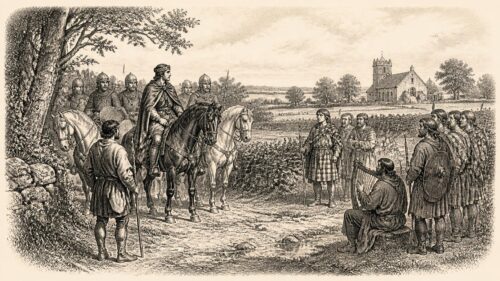
In 1329, John de Bermingham, earl of Louth, was killed at Braganstown near Ardee by Louth’s English gentry, exposing divisions within the lordship rather than an ethnic revolt. His disputed authority, kern’s alleged depredations, and weak local roots fuelled resentment. Parliament in Dublin sought to curb magnate feuds, while rivalries persisted. The killers received pardons, Bermingham’s earldom lapsed, and Mortimer acquired Louth’s liberty. Political conflict also embroiled Bishop Ledrede. Campaigns and killings in Wicklow, the midlands, Breifne and Connacht revealed continuing warfare and shifting alliances. Wet weather delayed harvests, intensifying insecurity across Ireland for tenants, townspeople, and landed communities alike.

Boyne Bridges Washed Away
In 1330, violent storms and flooding devastated parts of Ireland, sweeping away nearly all Boyne bridges, damaging Trim and Drogheda, delaying harvests and raising grain prices. These disruptions hindered trade, travel, government and military movement. Meanwhile, Roger Outlaw’s Kilkenny parliament sought support against Brian Bán Ó Briain in Munster, exposing rival magnates’ uncertain loyalties. Edward III warned the earls of Ulster and Desmond against private warfare, while Adam de Lymbergh became chancellor. Violence afflicted Meath, although Wexford fighting is uncertainly dated. Gilla Ísu Ruad Ó Ragallaig died at Cavan’s Franciscan friary, illustrating the links between Gaelic lordship and religious patronage.

Arklow’s April Stratagem
In 1331, authority in Ireland was asserted, evaded and fought over in several very different places at once. At Dublin, Edward III’s government sent a new justiciar and issued ambitious instructions for reform. In Leinster, raiders captured a royal castle and struck at the estates of the archbishop of Dublin. In Connacht, a lord abandoned secular rule for the monastery just as an army burned through his son’s territory. The surviving records do not create a complete national narrative: they are annals, administrative measures and later compilations, each with its own priorities. Yet together they show a lordship in which royal power remained formidable on paper but insecure beyond the towns, castles and allied lordships that sustained it.
Bunratty and Bermingham’s Gallows
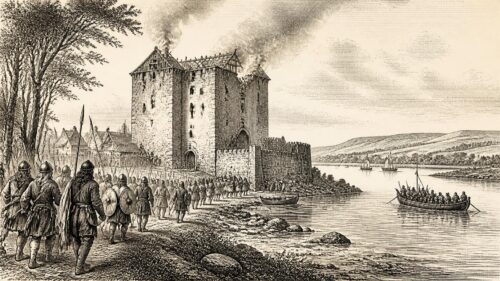
In 1332, Ireland’s lordship faced acute political and social strain. Sir William de Bermingham was executed in Dublin after politically charged conspiracy proceedings, while his son Walter was released. Thomond forces destroyed Bunratty Castle, whereas Anthony de Lucy recovered and garrisoned Arklow. Hostages seized castles at Limerick and Nenagh, exposing fragile authority; civic action restored Limerick. Raids, rivalries and warfare affected Munster, Leinster, Connacht and Ulster. Disease and exceptionally expensive wheat compounded hardship after famine. Edward III’s planned expedition was abandoned for Scotland, weakening government and leading to Lucy’s replacement by John Darcy. Richard FitzRalph’s Oxford chancellorship illustrated Irish connections.
The Fords of Carrickfergus
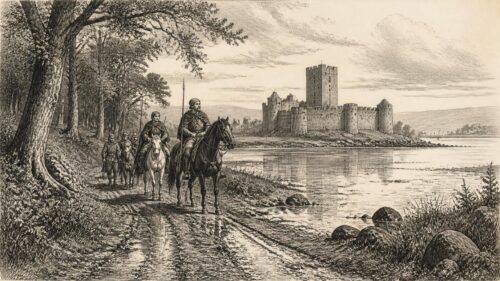
On 6 June 1333, William de Burgh, twenty-year-old earl of Ulster and lord of Connacht, was murdered near Carrickfergus by men associated with Ulster’s settler community. His death, following de Burgh family conflict, deprived vast, fragile lordships of an adult ruler. His widow fled to England with their infant heiress, while royal justice punished some killers but could not restore stability. Annals also record cattle-raiding, noble sureties, official campaigns and violence in Dublin, illustrating insecure aristocratic politics. The murder initiated divisions that later produced the Burke civil war and Mac William lordships, exposing limits of inherited power and English administration.
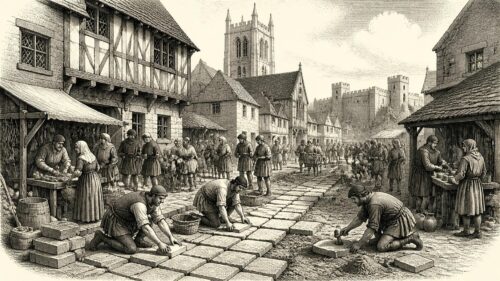
Kilkenny’s First Pavement
In 1334, severe winter weather injured people and livestock and damaged mills, weirs and bridges across Kilkenny’s region. Kilkenny burgesses began the town’s first recorded paving, later supported by a seven-year royal pavage grant. Local lordship remained contested: Thomas Fanyn seized Moytobyr Castle before Earl James Butler imposed temporary custody. Elsewhere, Donnchad Mac Carthaigh captured David de Barry, John de St Aubin was murdered, and a Connacht force of Gaels and settlers secured Munster hostages but burned a church, killing 180 people. Kilkenny also saw raids, erection of a market cross, crusading branding, and Desmond’s knighting campaign in late December.
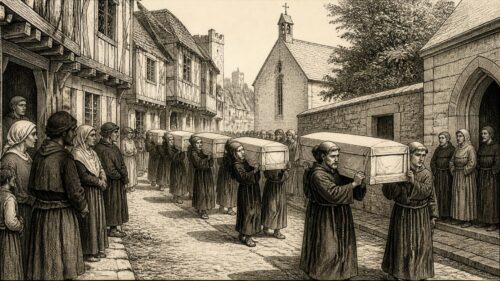
Claregalway’s Broken Parley
In 1335, Ireland was divided among competing Gaelic lordships, settler families, church jurisdictions, towns and royal officials. On 4 May, Lysaght Ó Mórdha’s household killed Sir Raymond le Ercedekne, relatives and allies at a meeting near Claregalway, an exceptional blow memorialised at Kilkenny. Connacht suffered raids, plunder and uneasy reconciliation amid de Burgh fragmentation after 1333. Sir John Darcy mobilised Irish ships, nobles and taxation for Edward III’s Scottish war, raiding Arran and Bute. Local warfare, captures and church disputes continued. Heavy spring snow harmed birds throughout Ireland, while devotional practices and hereditary learning, including physician Gilla-na-nAingel Ó Casaide, persisted.
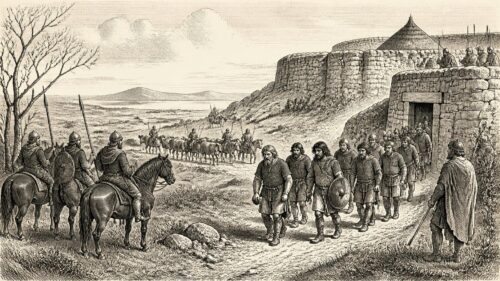
Mac Goisdelb’s Great Castle
In 1336, Connacht remained fragmented after William de Burgh’s murder, as Gaelic and Anglo-Irish lords pursued raids, alliances and territorial advantage. Tomaltach Mac Diarmata of Moylurg died and was buried at Boyle Abbey, succeeded by Conchobar. Forces led by Toirrdelbach Ó Conchobair captured and destroyed Mac Goisdelb’s Great Castle, allowing its mercenary garrison safe departure. Ruaidhri Ó Ceallaigh, king of Uí Maine, was killed, while Toirrdelbach reshaped alliances through marriage. Edmund Mac William de Burgh was expelled. Warfare reached Tír Chonaill. Legal scholar Trinnoit Ó Naan died. Severe snow and frost devastated cattle and winter growth, straining communities across Ireland.
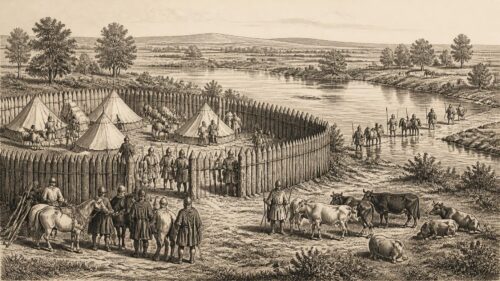
Athleague’s Rival Stronghold
In 1337, Ireland remained politically fragmented, with Anglo-Irish, Gaelic and royal authorities pursuing alliances, rents and warfare. William, son of the Earl of Ulster, reached a rent-based settlement with Brian Bán Ó Briain, while Aodh Reamhar Ó Néill made northern peace. In Connacht, Toirdelbach Ó Conchobair established a military position at Athleague against Edmund Burke, but Clann Cheallaig defeated and captured him. Feuds in Dartry and Breifne brought killings, raids, captivity and succession. Domnall Ruadh Ó Máille and his son were murdered. Dublin received royal governors, while bishops, scholars and poets died, illustrating the interdependence of power, church and learning.
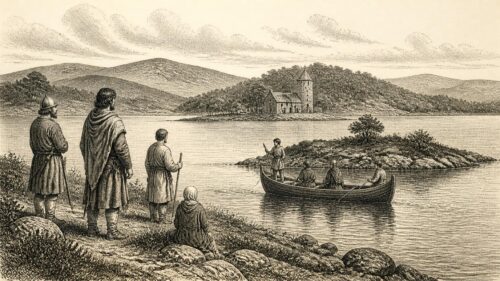
Lough Mask’s Fatal Stone
The most consequential Irish event securely placed in 1338 was the killing of Sir Edmund de Burgh, known in the annals as the son of the Earl of Ulster. He was captured by his kinsman Edmund Albanach de Burgh, had a stone tied about his neck, and was cast into Lough Mask. The stark formula occurs in both the Annals of Connacht and the Annals of Loch Cé. Neither supplies a day or month, and none should be invented; but both place the killing firmly within their annal for 1338.

Snow, Silver and Uí Maine
In 1339, Ireland endured severe frost and snow that damaged livestock and winter crops, while warfare in Meath ruined grainlands and caused famine. Political violence accompanied hardship: Ruaidhrí Ó Cellaigh, king of Uí Maine, was killed, and Toirdhealbhach Ó Conchobhair reshaped Connacht alliances through marriage, repudiation and pressure upon Edmund Albanach Burke. Northern campaigning by Aodh Reamhar Ó Néill brought further deaths, while Tomás Mag Samhradháin was released from captivity. Despite instability, Fergal Muimhneach Ó Duibhgeannáin erected Kilronan church. In Dublin, Edward III’s administration briefly minted silver coinage, thereby linking local society to royal fiscal demands amid wider Anglo-French war.

Ballymote’s Narrow Peace
In 1340, Connacht lordship was contested through dynastic intervention, captivity, raiding and negotiated settlement. Toirdelbach Ó Conchobair installed a ruler in Uí Maine, but resistance killed his appointee; his imprisonment of a nephew provoked Mac Diarmata opposition and a peace at Ballymote. Breifne warfare over cattle killed Domnall Ó Ruairc, while prisoners were exchanged to restore political advantage. Other kin-group killings exposed fragile local rule. Edward III pardoned Edmund Albanach and Reymund de Burgh, seeking accommodation and military service. Cill Rónáin burned, and learned men died. Sources caution against misdating Ulster entries and a supposed Franciscan foundation in later annals.
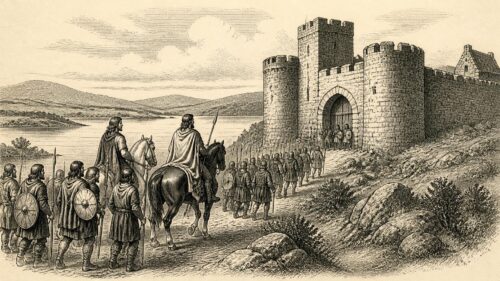
Roscommon Castle Seized
In 1341, Toirrdelbach Ó Conchobair, king of Connacht, captured Roscommon Castle, a royal English fortress, with annals differing over the role of his imprisoned rival Áed. The seizure strengthened him temporarily amid continuing Connacht dynastic conflict. Meanwhile, Edward III’s administration ordered investigations, resumed grants and proposed replacing locally connected officials, provoking resistance from the English of Ireland. Parliaments at Dublin and Kilkenny petitioned the king, defending lands, liberties and consultation while affirming loyalty. Elsewhere, violence and rapid successions marked Meath, Oriel and Connacht. Ecclesiastical deaths reflected institutional continuity. The year exposed fragmented, negotiated authority across overlapping Gaelic and settler societies.
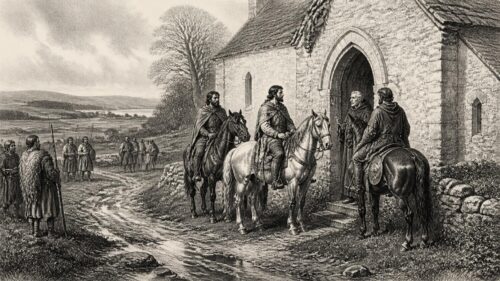
Elphin’s Sheltered King
In 1342, Connacht was convulsed by a dynastic war that displaced King Toirrdelbach Ó Conchobair. Conchobar Mac Diarmata, Edmund Burke and rival Ó Conchobairs formed a coalition, humiliating Toirrdelbach at Elphin, destroying crops, fighting over fords and fortresses, and exploiting captivity and assassination. Aed Ó Conchobair became king, though Toirrdelbach regained power in 1343. Elsewhere, Conchobar Ó Domnaill was murdered in Tír Conaill, while raids caused deaths in Oriel. Dublin government abandoned contested reforms amid local resistance. Annalistic notices also record the deaths of poets, historians and clerics, revealing overlapping political, military, ecclesiastical and learned worlds during the year itself.
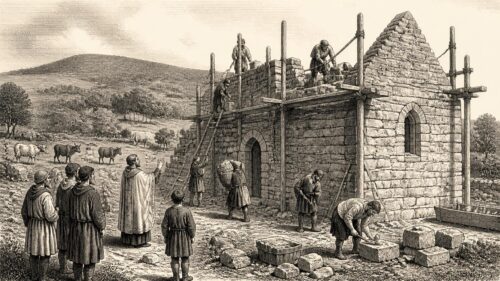
Kilronan’s New Church
In 1343, Ireland saw shifting lordship, violence and religious investment. Toirrdelbach Ó Conchobair regained Connacht and made peace with Conchobar Mac Diarmata, while Clann Feorais and Clann Ricaird crushed Uí Maine, killing eleven Ó Ceallaigh princes. In Thomond, Diarmait Ó Briain briefly succeeded Muirchertach before Brian Bán seized power. In Tír Conaill, Aengus Ó Domhnaill displaced Niall through a broad coalition, granted land to exiles, and defeated his rival’s supporters. Deaths included nobles, churchmen and scholars. Kilronan received a new church, St Mary’s, Kilkenny, a belfry, and Boyle Abbey remained central to Mac Diarmata burials and succession during the year.
Ufford’s Dublin Landing
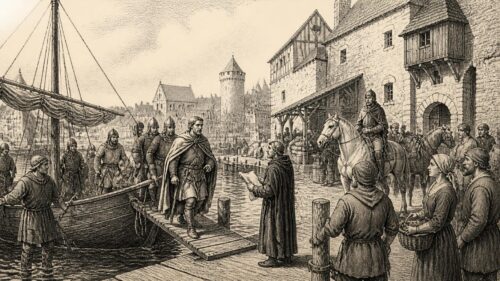
In 1344, Ralph d’Ufford became justiciar of Ireland, landing at Dublin with Maud of Lancaster and pursuing stronger royal oversight of grants, revenues, frontier defence and officials. His inquiries in Cork, administrative changes and Leinster campaign signalled intervention, though not restored island-wide control. Royal military demands also linked Irish magnates to Edward III’s French war. Elsewhere, annals recorded killings, imprisonments and rapid successions among Gaelic lordships in Mide, Airgialla, Breifne, Connacht and Ulster. Church affairs included James Bermingham’s appointment as bishop of Killala. Notices of Finnguala Ó Duibhgeannáin and Cill Rónáin illustrate cultural patronage and the uncertainties of medieval chronology.
Askeaton Under Ufford
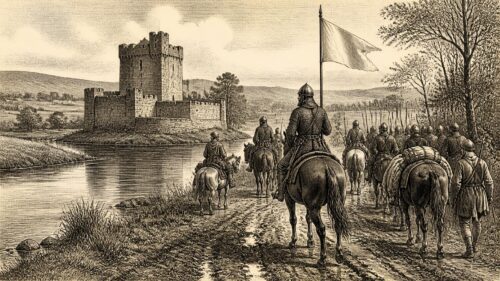
In 1345, the sharpest political struggle in the English lordship of Ireland unfolded not at a frontier ford but across the towns, castles and lordships of Munster. Sir Ralph Ufford, justiciar of Ireland and the king’s chief governor, moved against Maurice fitz Thomas FitzGerald, first earl of Desmond. Their quarrel exposed a basic weakness in royal administration: the Crown needed the co-operation of the great Anglo-Irish magnates, yet Ufford sought to discipline them with an unusually forceful assertion of central authority.
Aghaboe’s Burned Shrine
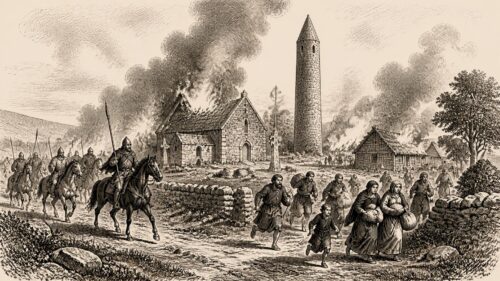
In 1346, Ireland experienced political instability, warfare and dearth following the death of Sir Ralph Ufford, the royal justiciar. Gaelic and settler forces contested Leinster, capturing castles, raiding communities and damaging churches. On 5 May, Diarmaid Mac Giolla Phádraig and an Ó Cearbhaill ally burned Aghaboe, including its church, cemetery and St Canice’s shrine, a religious and communal loss. Wheat prices reflected scarcity, worsened by conflict. Walter de Bermingham became justiciar in May but violence continued, including northern defeats, killings and winter raids. John Clyn’s annals document events, while evidence does not place the Black Death in Ireland before 1348–49.
Nenagh’s Christmas Rising
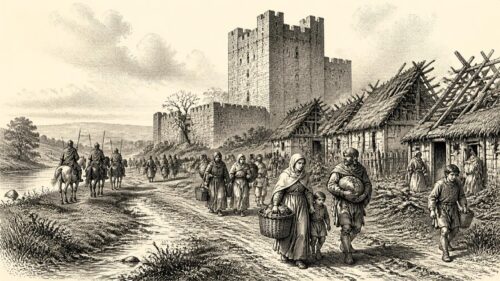
In 1347, Ireland comprised competing lordships, dynasties, church jurisdictions and towns. At Christmas, Domhnall Ó Ceinnéidigh led forces reportedly drawn from several provinces in a devastating assault on Nenagh and Ormond, sparing Nenagh Castle but exposing Butler authority while young Earl James Butler served in France. Annals also record killings, captures and successions across Connacht, Breifne, Ulster, Annaly and the south-east, revealing warfare affecting cultivation. Churches remained active through building, patronage and papal links. Learned figures were commemorated. Although plague spread in Europe, surviving Irish records place its arrival in 1348, making 1347 a year of political crisis before pandemic.

Taughmoling’s Plague Pilgrims
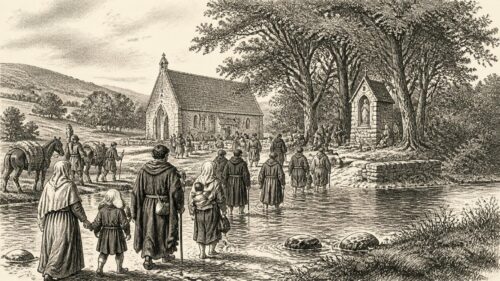
In 1348, pestilence reached Ireland by sea, devastating Dublin and Drogheda from late summer, though its extent elsewhere remains uncertain. John Clyn recorded a fearful pilgrimage by clergy, magnates and ordinary people to St Moling’s water at Taughmoling, seeking spiritual protection amid mass mortality. Meanwhile, Fulk de la Frêne fortified and coerced Ormond tenants around Nenagh, before James Butler received the earldom. Bishop Richard of Ossory gained independence from Dublin’s archbishop. In Connacht, killings, captures and war between kindreds ravaged Moylurg, while learned poets still travelled for patronage. The year combined disease, warfare, lordship, worship and cultural continuity under strain.
Moylurg’s Mortal Year
During 1349, a pestilence remembered as the Black Death became an all-Ireland crisis, although its arrival and mortality cannot be dated or quantified precisely. John Clyn recorded contagion, deaths among clergy and households, pressure on burial and care, and costly imported goods in Kilkenny. Connacht annals reported heavy losses in Moylurg, while warfare, raiding and contested lordship continued across Connacht and elsewhere. Ecclesiastical vacancies exposed institutional vulnerability, though individual causes of death remain uncertain. Clyn's final entries, ending amid violence and epidemic fear, symbolise the fragility of record-keeping. The year strained trade, worship, families and political authority without halting conflict.
Macwilliam’s Connacht Coup
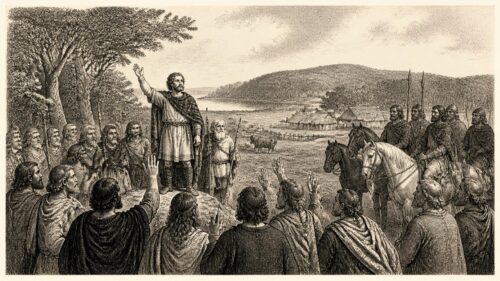
In 1350, plague remained active in Ireland, evidenced by legal notes, vacant Kilkenny holdings and deaths linked cautiously to pestilence, while its impact varied regionally. Connacht underwent a major coup when Sir Edmund Albanach de Burgh, Macwilliam Burke, and leading communities deposed Aed Ó Conchobair and installed another dynastic claimant. Killings and reprisals in Connacht, Moylurg, Breifne and Thomond exposed violent struggles over lordship, land and cattle. English administration nevertheless continued: Justiciar Thomas Rokeby held a Kilkenny council, raised taxation and negotiated service. Chancery, inheritance inquiries, religious leadership and learned culture endured amid demographic loss, insecurity and contested power locally.
Nollaig na Garma
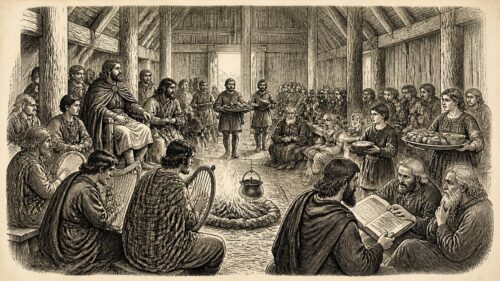
In 1351, Irish politics combined unstable lordship, royal administration, warfare and cultural patronage. Aodh Ó Conchobhair regained Connacht’s kingship through hostages and support, but conflict following Aodh Ó Ruairc’s capture devastated Moylurg. Other deaths and killings reflected continuing regional feuds. Thomas Rokeby’s October ordinances sought to reinforce English law, frontier security, labour regulation and land recovery, revealing the lordship’s weaknesses after plague and war. A Franciscan foundation at Ross Errilly was traditionally dated to this year, though evidence is late. At Christmas, Uilliam Buide Ó Ceallaigh hosted Ireland’s learned classes, using hospitality to proclaim wealth, authority and cultural prestige publicly.
Ballindoon’s Breached Defences
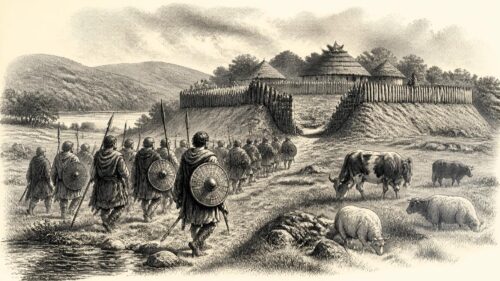
In 1352, annals from Connacht and later Four Masters record violent contests for lordship across Connacht, Breifne and Tír Chonaill. Aodh mac Toirdelbach Ó Conchobair forcibly recovered Connacht’s kingship against Gall and Gael, amid associated killings, and breached Baile an Dúin, destroying cattle and sheep. In Breifne, Aodh Ó Ruairc and his Clann Suibhne gallóglaigh were killed, while further deaths exposed unstable leadership. Aengus Ó Domhnaill’s treacherous killing triggered disputed succession in Tír Chonaill. Notices of captains, nobles and patrons reveal intertwined warfare and cultural support. Recent plague formed the background, but evidence does not establish a 1352 nationwide outbreak.
Kilconnell’s Contested Friary
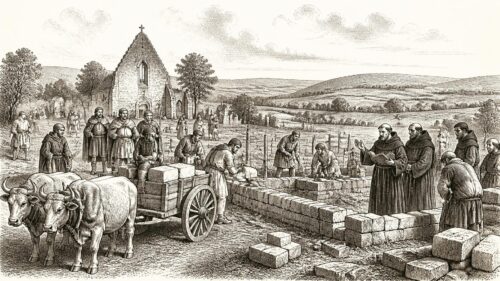
Medieval Ireland in 1353 appears through diverse, sometimes conflicting records. The Four Masters date William Buí Ó Ceallaigh’s Franciscan foundation at Kilconnell to this year, although Franciscan tradition proposes 1414 and surviving fabric reflects later patronage. The friary linked Gaelic lordship, Latin Christianity and local social life. Annals record Áed Ó Conchobair’s deposition in Connacht, other dynastic deaths and killings across the midlands and Ulster, while differing chronologies complicate dating. Pope Innocent VI reportedly settled Armagh and Dublin’s primacy dispute. Youghal received trading privileges in England and Wales. Together, these notices reveal politically fragmented yet religiously and commercially interconnected Ireland.
Mac Murchada Drawn
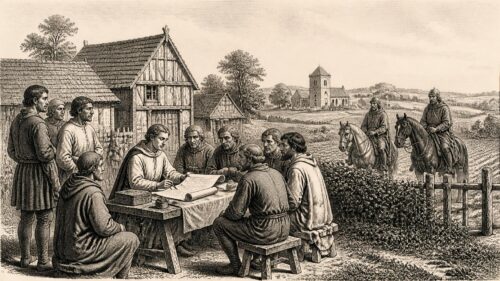
In 1354, Ireland experienced executions, warfare, dynastic killings, deaths and administrative inquiry amid the aftermath of plague. Annals recorded Mac Murchada’s execution by the Galls, followed by wider conflict, while Clann Aedha Buidhe and Dundalk’s Galls heavily defeated Aodh Ó Néill. Local struggles killed rulers in Laois and Connacht, although Domhnall Ó Dubhda succeeded his father in Uí Fhiachrach. Bishops and learned ollamhs also died. Justiciar Thomas de Rokeby governed through courts and inquiries, including valuation of the Pembroke estates at Wexford. Tenant complaints of poverty and high prices reveal hardship. The year demonstrates fragmented authority, cross-community alliances and insecurity.
Desmond’s Dublin Castle
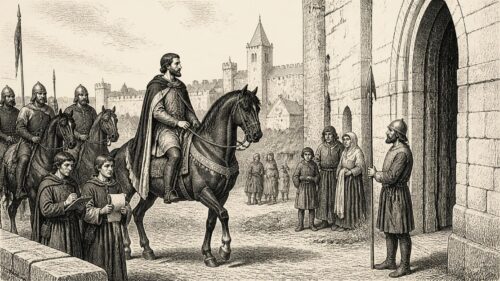
In 1355 Edward III appointed Maurice fitz Thomas FitzGerald, first earl of Desmond, justiciar of Ireland, and he began serving in August. His restoration after earlier conflict with the crown demonstrated royal dependence on powerful Anglo-Irish magnates. Dublin’s institutions could not control a politically fragmented island, where Gaelic and Anglo-Irish lordships exercised overlapping authority. Plague’s recent effects worsened economic and military pressures. Annal-dated reports describe killings, successions and retaliatory warfare in Bréifne, Annaly, Muintir Eolais and Connacht, alongside ecclesiastical and legal continuity. Desmond’s appointment was firmly dated, but annal chronology requires caution. Governance relied on negotiated regional, often violent power.
Baile-Locha-Deacair Reckoning
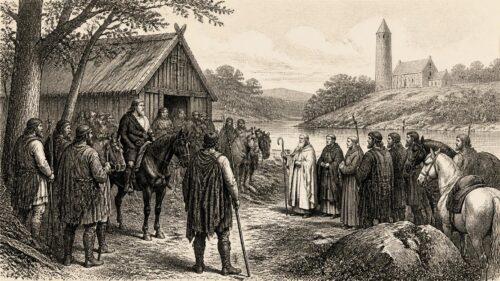
In 1356, Áed son of Toirrdelbach Ó Conchobair was killed at Baile Locha Deacair after allegedly abducting Donnchad Carrach Ó Cellaig’s wife, prompting allied retaliation by Ó Cellaig, Clann an Bhaird and Uí Maine. Áed son of Feidlim claimed full kingship of contested Connacht amid further dynastic deaths. Killings and successions elsewhere, including Tír Chonaill, reflected fragmented lordship. In Dublin, Justiciar Maurice fitz Thomas FitzGerald died, and Gearoidín Tyrrell was publicly executed. The deaths of Armagh’s primate, Clogher’s bishop and relic-keeper Solam Ó Melláin marked ecclesiastical losses. Sources document political violence but cannot establish precise circumstances or wider economic conditions.
Art Mór’s First Year
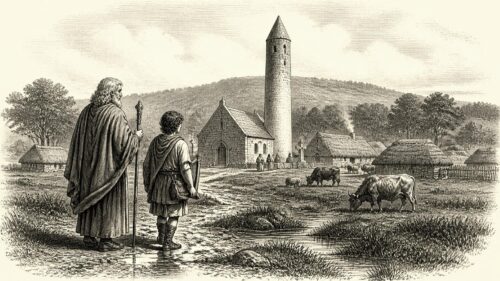
In 1357, Ireland’s surviving records reveal overlapping worlds rather than national unity. Art Mór Mac Murchadha Caomhánach was born amid unstable Leinster alliances linking Gaelic rulers, settler lordships and Dublin government. Royal administration issued commissions and relied on magnates, notably Maurice FitzGerald, Earl of Kildare, whose military resources supported authority. Annals record deaths of rulers, an earl drowned during a crossing, executions, killings and a peace, illustrating contested lordship. They also commemorate scholars, clerics and musicians. An English chronicler reported renewed pestilence devastating Gaelic communities, though its scale remains uncertain. Ireland combined political fragmentation, cultural networks, negotiation, violence and mortality.
Dublin’s Protected Schools
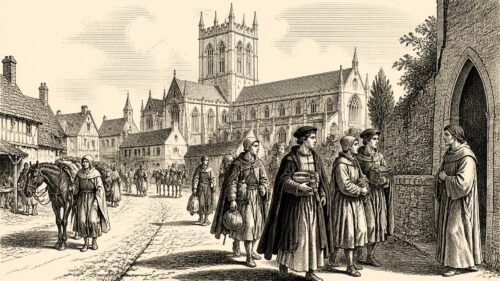
In 1358, Edward III protected masters, scholars and clerks travelling to Dublin, reinforcing the university associated with St Patrick’s Cathedral. The petition exposed poverty, hazardous sea crossings and inadequate educational resources. Annals recorded fragmented politics: Áed Ó Néill defeated Airgialla and Fermanagh forces; Ó Mórdha overcame men identified with Dublin in Leinster; and Clann Cathmhaoil killed Manus Maguire. Bishop Brian Mac Cathmhaoil and Gaelic rulers also died. A Carbury hailstorm illustrated environmental uncertainty, while disease reports cannot be precisely dated. Together, these events reveal contested authority alongside continuing learning, religious institutions, warfare and local seasonal vulnerability across late medieval Ireland.

Cathal Óg at Ballyshannon
In 1359 Cathal Óg Ó Conchobair defeated Cenél Conaill at Ballyshannon, capturing leading men and extending warfare into Tír Chonaill. The battle affected regional lordly networks across Connacht, Donegal and Breifne; the wounded claimant Matha Mag Samradháin later died. Ransom negotiations linked the victory to the transfer of Lebor na hUidre and Leabhar Gearr, demonstrating manuscripts’ political and learned value. In Desmond, Cormac Mac Carthaigh Mór died during a siege, succeeded by Domhnall Óg. Other deaths highlighted contested succession, while eminent judge Aed Mac Aedacáin’s death marked legal learning’s importance. James Butler became chief governor, reflecting Ireland’s divided political authority.

The Six Burnings
For Ireland, 1360 is remembered most clearly through a stark cluster of fires. The Annals of Connacht record “great burnings” at Roscommon, Devenish, Sligo, the monastery of Lisgoole, Fenagh and Drumlease. The entry gives no date within the year, no named commander and no narrative explaining whether these were connected attacks, separate raids, or destruction arising from several local conflicts. That silence matters. It would be unsafe to turn the notice into a single, neatly organised campaign. Yet its geographical reach, from Connacht into Fermanagh and the north-west, makes it an unusually vivid indication of insecurity in a year otherwise known chiefly through deaths, depositions and short notices of violence.

Lionel’s Carlow Exchequer
In 1361, Lionel of Antwerp, Edward III’s son and earl of Ulster, arrived in Ireland as royal lieutenant with troops to reinforce the threatened English lordship. Landing at Dublin in September, he campaigned in Leinster, where Gaelic rulers remained powerful. Irish annals recorded the deceptive seizure and subsequent custodial deaths of Art Mac Murchadha and Domnall Riabach, though details remain uncertain. Lionel transferred the Exchequer to fortified Carlow, creating a forward administrative and financial base without displacing Dublin’s importance. Meanwhile, the widespread epidemic Cluiche an Rí, probably pestis secunda, intensified economic and military pressures, demonstrating the limitations of royal intervention.
Ballintober and the Meath Fires
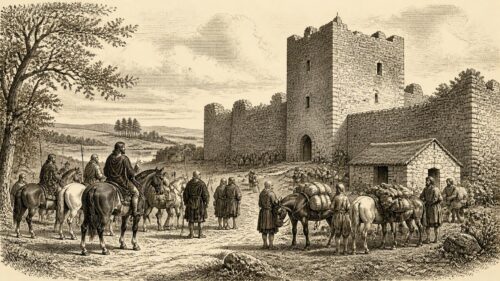
In 1362, Ireland was divided among competing Gaelic and English authorities. Cathal Óg Ó Conchobair and King Aodh of Connacht captured Ballintober Castle, an important former de Burgh stronghold, then led a major raid into Meath, burning churches and causing extensive damage before returning safely. Meanwhile, Lionel of Antwerp held parliament in Dublin, oversaw administration, including the exchequer’s move to Carlow, and received the title duke of Clarence. Cathal Óg later died of plague at Sligo. Annals also recorded deaths among churchmen and learned families, revealing continuing religious, legal and scholarly institutions amid warfare, epidemic and unstable regional power relations.

Dublin’s Guildhall Charter
In 1363, Ireland comprised overlapping political worlds rather than a unified realm. Lionel of Antwerp, Edward III’s lieutenant, received English money, troops and lordship revenues to sustain royal authority, while regulation of purveyance and weights addressed administrative abuses. Dublin remained crucial: Lionel granted civic liberties on 26 September, confirmed by Edward in November, strengthening the Guildhall’s jurisdiction and commercial governance. Elsewhere, annals recorded deaths of Magnus Ó Domhnaill and Áed Mag Uidir, killings, captivity and inter-kindred conflict in Connacht and neighbouring regions. A severe windstorm damaged churches and houses and sank vessels, disrupting communities, trade and transport networks across waterways.
Aodh Reamhar’s Succession
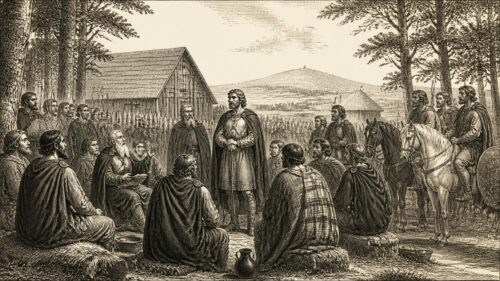
In 1364, Ireland experienced interconnected transitions rather than a single crisis. Aodh Reamhar Ó Néill, influential king of Tír Eoghain, died and was succeeded by Niall Mór, whose position rested on dynastic support and military power. Diarmait Ó Briain of Thomond and several regional lords, heirs, women and learned figures also died, altering local networks. Lionel of Antwerp campaigned in Laois before returning to England; James Butler of Ormond governed temporarily amid tensions between English-born and Irish-born settlers. Annals, some uncertainly dated, record raids, alliances and mercenary warfare in western regions, revealing power sustained through lordship, kinship, resources and learning.
Niall Ó Néill’s Oriel Leaguer
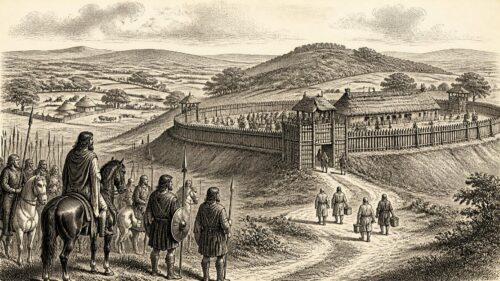
In 1365, Niall Ó Néill, newly king of Tír Eógain, led a coalition into Oriel, besieging Brian Mac Mathghamhna before an unauthorised assault shattered the settlement and killed allies. Dynastic contention also reshaped Connacht, Magh Luirg and East Bréifne, where deaths, accessions, warfare and Cú Chonnacht Ó Raghallaigh’s religious retirement altered lordship. Raids on border communities demonstrated the human cost of rivalry. Ecclesiastical leaders and learned travellers remained active across Irish Sea networks. In the English lordship, Lionel of Antwerp briefly returned England, while Thomond’s rulers submitted diplomatically. The year reveals authority as negotiated through warfare, kinship, religion and accommodation.
Lionel’s Kilkenny Parliament
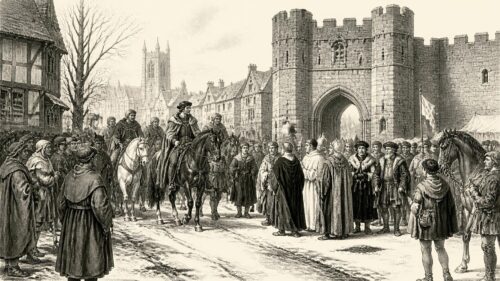
In 1366 Lionel of Antwerp, Edward III’s lieutenant, summoned a parliament at Kilkenny to reinforce the weakening English lordship of Ireland. Its Statutes sought to separate English and Irish inhabitants by restricting intermarriage, fosterage, language, dress, law, ecclesiastical office and cultural exchange. They also regulated warfare, military service, abuses, markets, land, sport and church authority, exposing anxieties about defence and administration. The measures chiefly targeted the lordship rather than Gaelic Ireland and indicate cultural contact rather than achieved control. Contemporary annals record regional conflicts and shifting lordships beyond royal reach. Lionel’s November departure demonstrated the statute’s limits amid Ireland’s diversity.
Traigh Eothuile’s Gallowglass Rout
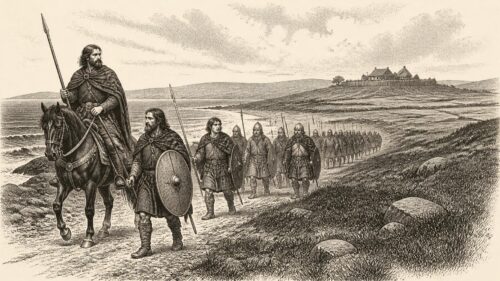
In 1367, fragmented political authority shaped Ireland, as English lordship coexisted with powerful Gaelic and Gaelicised dynasties. Following the 1366 Statutes of Kilkenny and Lionel’s departure, Gerald FitzGerald, earl of Desmond, became justiciar, governing with limited resources. In Connacht and Breifne, Clann Muirchertaigh’s armed movement, the burning of a Mac Diarmata stronghold, and counterattacks demonstrated endemic warfare. At Traigh Eothuile, or Beltra Strand, Domnall Ó Conchobair’s coalition destroyed Tadc Ó Conchobair’s gallowglasses. Dynastic violence also killed Derbail Mac Diarmata. In Breifne, Cú Chonnacht Ó Raigillig relinquished lordship for religious life, while several prominent churchmen and learned figures died that year.
Carbury’s Captive Chancellor
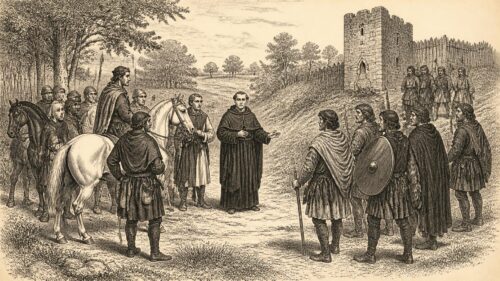
In 1368, Irish authority remained fragmented and precarious. Aed Ó Conchobair, king of Connacht, died at Roscommon and Ruaidri Ó Conchobair succeeded amid partition, contested claims, disease and the killing of Tadc Ó Conchobair, which deepened dynastic hostility. In Oriel, Niall Ó Néill accepted Brian Mac Mathghamhna’s submission, but unauthorised allies attacked and were defeated with heavy losses. In Kildare, Berminghams captured royal chancellor Thomas de Burley and other officials, securing his exchange for an imprisoned kinsman and ransoms. On 17 October, fire destroyed St Mary’s monastic church at Trim. Together, these events show institutions dependent on unstable personal alliances.
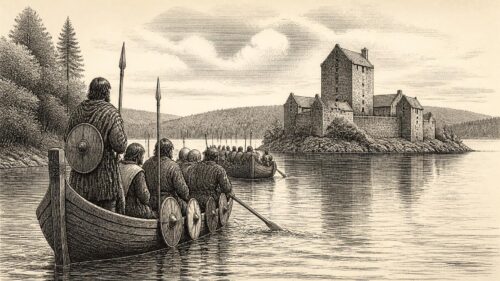
Pilib Maguire’s Lake Rescue
In 1369, Ireland’s contested lordships were shaped by dynastic conflict, royal administration and ecclesiastical change. Pilib Ó Raghallaigh, king of east Breifne, was imprisoned by nephews at Lough Oughter, but his son-in-law, Pilib Maguire of Fermanagh, captured the island castle by boat and restored him. Allied resistance had earlier failed at Blencup. William Windsor arrived as royal lieutenant, summoned a Dublin parliament, and executed Diarmait Mac Murchadha and his designated successor, demonstrating force without securing Leinster. In Thomond, Mathghamhain Ó Briain died and Brian Sreamhach succeeded. Church deaths in Oriel and Breifne underscored political importance. Alliances and waterways shaped power.
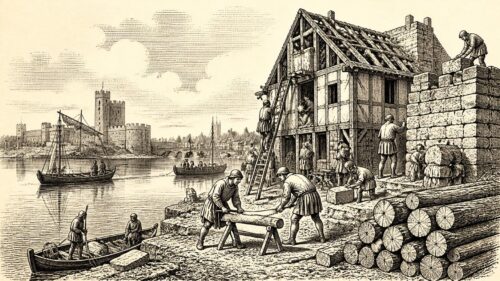
Monasternenagh’s Captured Earl
In 1370, Brian Sreamhach Ó Briain defeated and captured Gerald FitzGerald, earl of Desmond, near Monasternenagh, then pressured Limerick, which was burned and briefly placed under Mac Conmara control. King’s lieutenant William of Windsor secured Desmond’s release, recovered the city and agreed reparations of cattle and timber. His government, hampered by inadequate funds, also faced fighting in Wicklow. Elsewhere, Niall Mór Ó Néill consolidated Tyrone through hostages, land grants, marriage and victory over Brian Mór Mac Mathghamhna. Captures, succession disputes and raids in Breifne and Leinster further demonstrated that Irish power rested on local alliances, coercion, resources and negotiated settlements.
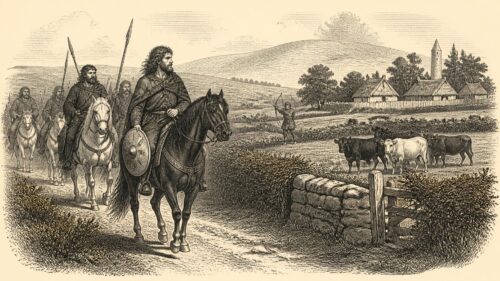
Ormond’s Fateful Arrow
In 1371, Ireland remained politically fragmented, with royal, urban, Anglo-Irish, Gaelic and ecclesiastical authorities competing through law, warfare, patronage and local alliances. Dublin successfully petitioned Edward III against exactions imposed by lieutenant William de Windsor. In Ormond, Murchadh Ó Madden was killed by an exceptional arrow-shot, while Brian Ó Cennétig died amid regional conflict. Tadhg Óg Ó Conchobair was murdered after captivity in Sligo Castle. Annals associate Domhnall Ó Dubhda with capturing north Connacht castles and redistributing land. Archbishop John Ó Gráda died, plague claimed musician Amlaim Mac Senaig, and obituaries stressed hospitality, learning, patronage and genealogical memory across Ireland.

Rindoon and Brian Mór
Records for 1372 reveal Ireland’s overlapping Gaelic, Hiberno-English and royal jurisdictions. Sir William Windsor left the lieutenancy in March, succeeded by Gerald FitzGerald, while Robert Ashton became justiciar in June amid inquiries into Windsor’s administration. Annals commemorate Brian Mór Mac Mathghamhna’s treacherous killing, although sources dispute whether it occurred in 1371 or 1372; his death affected Oriel’s politics. Seoán Mór Ó Dubhagáin, historian to Uí Mhaine, died at Rinn Dúin, where Gaelic scholarship met a former colonial settlement. Deaths, succession, capture and conflict in Connacht and the midlands further demonstrate political, social and religious interdependence, while underscoring annalistic chronology’s limitations.
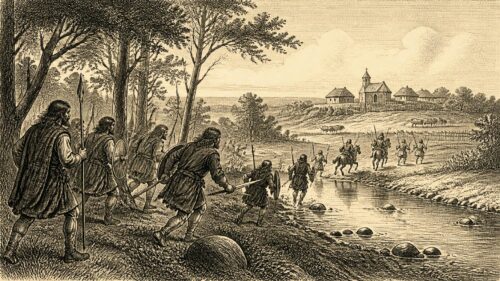
Donnchad Ó Fergail’s Pursuit
In 1373, Irish annals record violence across contested lordships rather than a national campaign. Meath raiders killed Ruaidrí Ó Fergail, his son and followers in Annaly; Donnchad Ó Fergail pursued them, inflicted losses, but was slain by an arrow and his men defeated. Elsewhere, William Dalton and Meath’s sheriff were killed, while Connacht disputes brought treachery, hostage killing and injury. Dynastic murders affected Maguire and de Burgh figures. Deaths of noblewomen, churchmen, historians and poets reveal interconnected elites and learning. A destructive wind damaged churches. These entries portray overlapping Gaelic, settler and administrative powers, with chronology sometimes uncertain in places.

Athlone’s Fatal Escort
In 1374, Ireland was shaped by contested local lordships rather than unified conflict. Cú Choicriche Óg Mac Eochagáin, chief of Cenél Fiachach, was murdered near Athlone while accompanying the Bishop of Meath; his killer was brutally executed. William de Windsor returned as royal lieutenant, but crown authority remained limited. Connacht saw Theobald Burke, Mac William’s heir, killed by Uí Maine, while Annaly warfare claimed Máel Sechnaill Ó Fearghail. Feuds followed disputed killings. Annals also record Niall Ó Néill’s victory over Ulster settlers, though its date is uncertain. Deaths including historian Máel Sechnaill Ruad Ó Duibhgeannáin underline violence and fragmented authority.
Downpatrick’s Fallen Lieutenant
In 1375, Ireland’s fragmented political order was revealed through warfare, succession, negotiation and administration. Niall Ó Néill defeated the English or Anglo-Irish of Downpatrick, killing Sir James of Malahide and others, demonstrating northern Gaelic strength. In Leinster, Donnchad Caemánach Mac Murchada was treacherously killed, opening the way for Art Mór’s later rise. Connacht rivals exchanged Roscommon and Ballintober castles, while Thomas succeeded Sir Edmund Albanach Mac William Burke. Raids, betrayals and kin killings exposed local insecurity. Annals recorded religiously framed deaths and poet Máel Sechlainn Ó Domhnalláin. William de Windsor’s cash-strapped administration operated as Edward III sought support at Westminster.
Annaly’s Burning Reply
In 1376, Sir William Windsor’s recall from Ireland followed resistance to his taxation and administration, as communities defended their customary right to consent. Maurice FitzGerald and then James Butler replaced him, but weakness persisted there. Warfare continued: English forces raided Annaly, whose O’Farrell lord retaliated with destructive incursions; Bran Ó Broin regained Wicklow and Newcastle castles; and northern lords faced captivity and death. Tadhg Ó Ruairc of West Breifne died, succeeded by his brother Tighearnán. Annals also recorded deaths among distinguished Gaelic historians, poets and ollamhs, underscoring the resilience of learned institutions amid fragmented authority, frontier conflict and contested lordship.
Moylurg’s Burned Harvest
In 1377, Ireland’s regional lordships experienced warfare, fortification, religious loss and constitutional change. Clann Cuilein defeated Richard Burke’s Clanricarde force in Thomond, while Ruaidhrí Ó Conchobair overcame an alliance of Mac William Burke and Uí Maine at Roscommon. In Moylurg, war between Mac Diarmata and Ruaidhrí brought killings and the burning of crops and buildings, before peace and compensation. John O’Ferrall built Lissardowlin Castle in Annaly. Assaroe monastery burned, and prominent clerics and lords died. Edward III’s death, Richard II’s succession, and Robert Wikeford’s chancellorship affected Dublin government, whose authority coexisted with powerful local networks and military retinues across Ireland.

Tallaght’s 120 Hobblers
In 1378, Ireland comprised overlapping political worlds rather than a unified national arena. Around Dublin, the English lordship defended Tallaght against O’Byrne pressure with 120 hobblers, compensated raid losses, mobilised tenants, regulated arms, and guarded Carlow during parliament. Exchequer officials collected debts, valued royal lands and administered payments, demonstrating limited but active government in core counties. Annalistic accounts record killings, rival successions and alliances among Burke, Mac Raghnaill, O’Rourke, Maguire and other lordships. Deaths of a bishop in Rome, scholars, poets and legal authorities reveal ecclesiastical and learned networks. Fragmentary sources portray power as military, fiscal, familial, scholarly and local.
Dreach and the Erne Lords
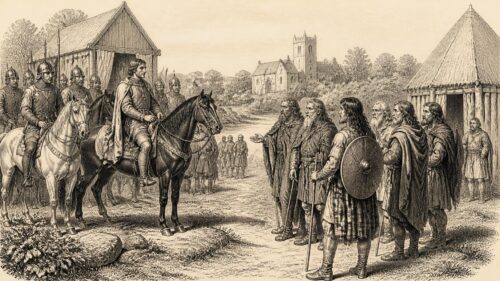
On 31 May 1379, Niall Mór Ó Néill defeated Pilib Mag Uidhir, lord of Fir Manach, and Domnall Ó Néill at Dreach, probably near Kinawley. Annals record serious Maguire losses but not the battle’s course. The victory asserted Ó Néill influence without ending Fir Manach’s power. Subsequent killings, including that of Pilib’s son Cú Chonnacht, exposed fragile lordships and kin rivalries. Notices of Gaelic, English and Hiberno-English elites, marriage alliances, church officers and learned figures reveal a plural political society. Edmund Mortimer’s October appointment as lieutenant foreshadowed intervention, though he arrived only in 1380. Ordinary people's experiences remain largely unrecorded.
Mortimer’s Ulster Reckoning
In 1380 Edmund Mortimer, Richard II’s lieutenant and claimant to Ulster and Connacht, brought military resources and royal authority to Ireland. Gaelic rulers, notably Niall Mór Ó Néill, initially accommodated him, but Mortimer’s treacherous arrest of Art Mág Aonghusa damaged confidence and exposed limits to his influence. Campaigning in Ulster coincided with dynastic killings, territorial conflicts and successions among Gaelic and Anglo-Irish lordships across Ireland. In Dublin, Mortimer summoned parliament, secured clerical taxation for defence, and enforced discriminatory religious admissions rules. Murage at Ardee and ecclesiastical deaths reflect administrative and social continuity. The year demonstrated Ireland’s fragmented, contested political order.
Mortimer Takes Athlone
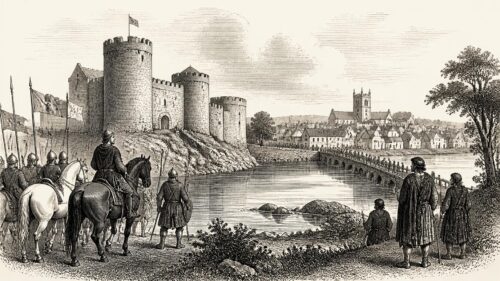
In 1381, Ireland’s political geography was defined less by a single frontier than by a patchwork of competing lordships, castles, family claims and negotiated loyalties. King Richard II was lord of Ireland, but royal government was strongest in and around the Anglo-Irish towns and lordships of the east and south-east. Beyond them, Gaelic rulers, Gaelicised settler dynasties and Crown officers all exercised power in overlapping ways. The year’s clearest focal point was Athlone: a fortified crossing of the Shannon whose possession mattered not merely to the town, but to the balance between Meath and Connacht.
Aghaboe’s Dominican Foundation
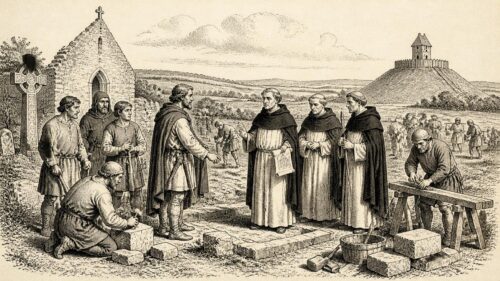
In 1382, Ireland was divided among royal administration, Anglo-Irish magnates and Gaelic rulers. Ruaidhrí Ó Conchobair, king of Connacht, arrested rival chiefs at an assembly, exposing insecure personal power. Raids in Corcomroe and Desmond destroyed homes, crops and lives, while imprisonment claimed members of the Ó Briain dynasty. Deaths, including that of James Butler, earl of Ormond, altered lordly succession. William Tany resumed the Irish chancellorship, maintaining crown government through the great seal. Finghin Mac Giolla Phádraig founded a Dominican friary at Aghaboe, demonstrating enduring religious patronage. Annals also remembered women, clerics, entertainers and heirs, reflecting regional, interconnected medieval society.
Trian Chongail’s Spear Charge
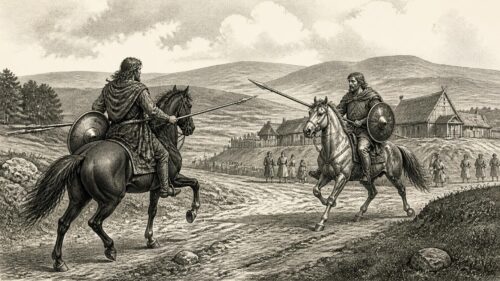
In 1383, fragmented Ireland experienced renewed royal administration, northern warfare and serious disease. Richard II appointed Sir Philip Courtenay lieutenant, who arrived at Waterford in September, while Ralph Cheyne served as chancellor. In Ulster, Niall Mór Ó Néill’s coalition burned and plundered territories associated with English lordship. During the campaign, his son Aodh Óg and Raibilin Savage fatally wounded one another, provoking further killing among the Bissets. Annalists reported widespread plague throughout Ireland, including the death in captivity of Art Magennis. Deaths, killings and successions among secular and religious leaders reveal local instability, while hospitality remained an important lordly ideal.
Carrickfergus and Cruachan
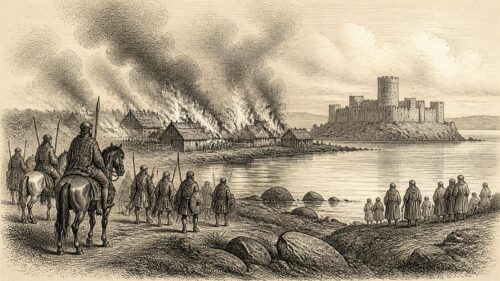
In 1384, Niall Ó Néill burned Carrickfergus, demonstrating Gaelic power against a major crown-held port and castle, though the sources do not show that the fortress fell. In Connacht, Ruaidhrí Ó Conchobair died of plague after a long reign, prompting rival inaugurations and provincial warfare, including attacks on lordly strongholds. Plague and other deaths affected leading families and rulers across Ireland, while feuds caused further killings. Annals also recorded deaths of churchmen and scholars, reflecting enduring learned institutions. Within the lordship, mediation addressed conflict between Ormond and Desmond, and Sir Philip Courtenay appointed Ormond chief governor, illustrating fragmented regional authority.
Togher and the Meath Sheriff
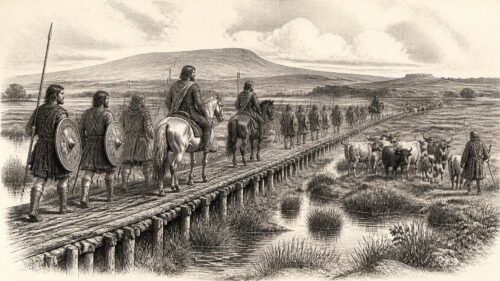
In 1385, Ireland comprised overlapping Gaelic and Anglo-Irish jurisdictions, where warfare shaped authority, movement and livelihoods. Murchadh Ó Conchobair of Uí Fhailghe and Cenél Fiachach defeated the English of Meath at Tóchar Cruacháin Brí Eile, killing the sheriff and many others, though lasting consequences remain unknown. Dublin appointed Alexander de Balscot chancellor, while appeals for Richard II’s intervention and Robert de Vere’s lordship grant exposed administrative weakness. Connacht endured organised burnings, cattle raids, crop destruction, killings, captivity and hostage-taking before a negotiated partition and peace. The year also recorded deaths of notable clerics, rulers, women and scholar Tanaide Ó Maolconaire.

Mac Wattin’s Ruined Orchards
In 1386, Irish annals recorded local conflicts, raids and settlements rather than a single national event. Domnall Ó Conchobair’s coalition devastated Mac Wattin Barrett territory in Tirawley, killing leaders, taking a castle and destroying orchards. Connacht warfare shifted rapidly between raiding, pursuit, victory and negotiated peace among competing dynasties. Art Mór Mac Murchadha defeated the English of Ossory, while Midland feuds involved killings, castle seizures and hostage-taking. Richard II created Robert de Vere duke of Ireland, though he never visited; administration continued through deputies and chancery. Elite deaths and burials also marked status, kinship and lordship across a fragmented island.
Niall Ó Néill’s Scholars’ House
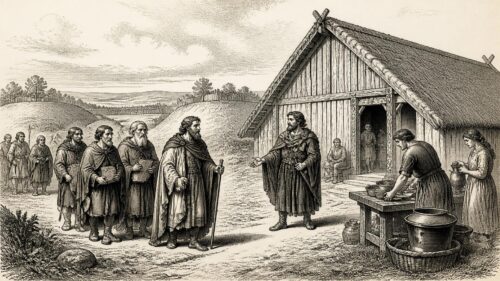
In 1387 Niall Ó Néill junior built a house at Emain Macha to support Ireland’s learned companies, linking Ulster lordship with cultural patronage. The year also saw deaths of chief poet Gofraidh Fionn Ó Dálaigh and historian-scribe Ruaidhri Ó Cianáin, illustrating networks sustained by aristocratic hospitality. Annals record feuding, killings and Nualaith Ó Fearghail’s capture in the Midlands, while Richard Óg de Burgh died in Connacht. In Munster, royal officials mediated discord between Desmond and Ormond. Deaths and marriages reflected ecclesiastical, kinship and Irish Sea connections. Sparse sources nevertheless show authority negotiated through force, patronage, reputation and learning across Ireland.

Galway’s November Fealty
On 5 November 1388, Galway’s burgesses publicly swore fealty to William Burke of Clanricarde, transferring royal local revenues, except customs, and demonstrating preference for regional protection over Richard II’s distant authority. Their bloodless revolt formed part of wider competing jurisdictions. Connacht suffered extensive warfare among O’Conor branches and allied lordships, involving raids, burning of homes and corn, prisoners, hostages and mercenary forces. Conflict also touched Assaroe and north-western territories, while violence killed learned men and a local lord. Fosterage linked Desmond’s heir with an O’Brien household. Despite de Vere’s fall, royal administration issued writs, but lacked effective command in Ireland.
Galway’s Bell and Keys
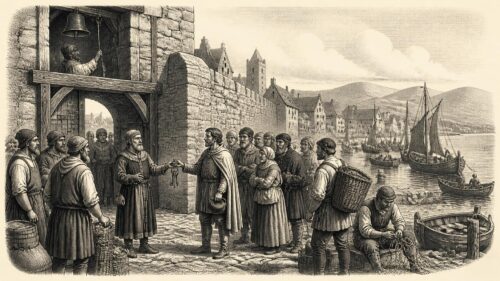
On 10 May 1389, Galway’s bell summoned burgesses and townspeople to surrender the keys of its gates to William Burke, lord of Upper Connacht, excluding royal ministers. Following a 1388 oath of fealty and grants of revenues, the action reflected local insecurity and accommodation, while retention of customs suggested caution. Galway’s choice occurred amid Connacht’s shifting wars, raids, captures, killings and pragmatic settlements, where control of resources shaped power. Annals record contested successions and deaths across Ireland. With government weakened after Robert de Vere’s fall and only later reorganised under John Stanley, authority remained fragmented among towns, lords and communities.

Lough Oughter’s Broken Peace
In 1390, rivalry between Tighearnán Mór Ó Ruairc of West Breifne and Tomás Mór Ó Raghallaigh of East Breifne drew allied kindreds into a great war. Maghnus Ó Ruairc escaped captivity at Lough Oughter but was killed near Lough Scur. Peace followed, secured by concessions, hostages and expulsions, though raids, forced movements and cattle losses continued. Tomás’s death brought Seán Ó Raghallaigh to power. Elsewhere, Kilbarron Castle was demolished, while legal, historical and ecclesiastical figures died. The Book of Ballymote’s late fourteenth-century compilation reflected enduring scholarly patronage. Despite English justiciar Sir John Stanley, regional lords managed conflict and settlement independently.
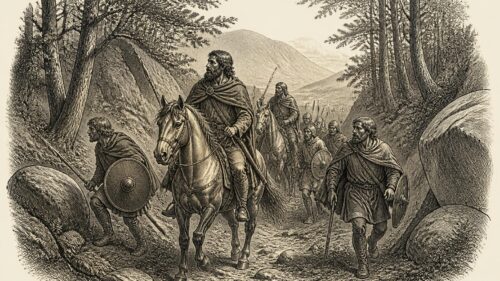
Tigernán’s Pass Ambush
In 1391, Irish annals recorded fragmented but revealing struggles for power. Tigernán Mór Ó Ruairc escaped an ambush at a Breifne pass while travelling to meet John Ó Raighillaigh, defeating attackers despite conflicting accounts of their numbers. Diarmaid Mac Eochagáin, lord of Cenél Fiachach, died in January. Domhnall Óg Mac Carthaigh Mór, king of Desmond, died and was succeeded by his son Tadhg. In Ulster, Mac Gilla-Muire of Uí nDerca-Céin and Ó hAnluain of Oirthir were killed by kinsmen. Poet-scholar Tadhg Ó hUiginn and Bébhinn Ó Maelconaire died. English statutes applied in the Dublin lordship, but Gaelic authority remained decisive.

Niall Ó Néill at Dundalk
In 1392, Ireland experienced local warfare, succession disputes and notable deaths rather than an island-wide turning point. Niall Ó Néill of Tír Eógain led a major expedition against the English around Dundalk, achieving temporary mastery. Northern tensions intensified after Henry Aimhreidh Ó Néill’s death and the capture of his son by Toirdelbach Ó Domhnaill. In Connacht, Ó Conchobair Donn’s army burned Uí Maine, revealing fractured regional alliances. Deaths of Archbishop Grigair Ó Mocháin, the countess of Desmond and other nobles highlighted ecclesiastical and aristocratic networks. English administration remained uncertain as Thomas of Woodstock’s lieutenancy failed and Roger Mortimer was appointed.

Moylurg’s Summer Settlement
In 1393, Moylurg experienced a succession crisis after Aedh Mac Diarmata died and his son Cathal drowned. Maelruanaid Mac Diarmata gained the kingship with Tomaltach Mac Donnchada’s support, defeated Aedh’s sons near Loch Gara, and imprisoned rivals who later escaped. By summer, territorial division and captive exchanges produced a negotiated peace. Elsewhere, deaths among regional lords, clerics, scholars and craftsmen reflected interconnected political and cultural networks. Ferghal Mag Samradain’s death highlighted patronage of learned people. Ó Conchobair Fhailghe founded a Franciscan house at Cill Achaidh, while Richard Northalis became chancellor, pursuing concealed royal debts, revealing diverse local authority across Ireland.

New Ross and the King
In 1394 Richard II landed at Waterford with an expedition, the first reigning English king to visit Ireland since 1210. Seeking to strengthen the weakened lordship, he targeted Leinster, where Art MacMurrough challenged crown authority. MacMurrough burned New Ross, seizing wealth and hostages, while Ormond retaliated by ravaging Leinster. Richard travelled through Kilkenny to Dublin, obtaining meetings, pledges and uncertain submissions rather than decisive control. Parliament and counsel in Dublin underscored reliance on magnates, clergy and towns. Elsewhere, inter-lordship violence, clerical deaths, church destruction and rebuilding, and learned men’s killings revealed a fragmented society. Royal prestige rose, but conflict endured.
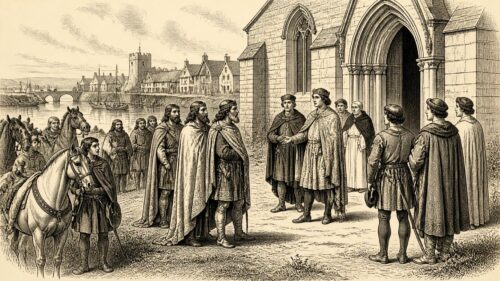
Drogheda’s Uneasy Homage
In 1395 Richard II sought to stabilise Ireland through military pressure, submissions and negotiated service from Gaelic and Anglo-Irish rulers. Art Mac Murchadha accepted loyalty, payment and recognition of inheritance, while Niall Ó Néill and others sought royal protection against rival claims. More than eighty nobles submitted, receiving pardons, offices and knighthoods, but important western and northern lords remained outside the settlement. Raids in Uí Fhailghe and Éile, conflict within the Ó Néills, and succession violence in Fermanagh demonstrated instability. Richard departed in May, leaving Mortimer as representative. Deaths, church burnings and lordships underscored that ceremony had not pacified Ireland.
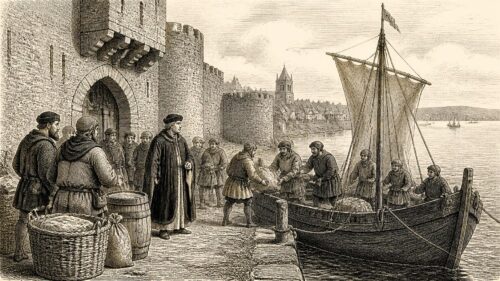
Galway’s Six-Pound Charter
In 1396, Richard II’s charter granted Galway’s provost and burgesses annual election of a sovereign, restricted retail trade to resident burgesses, and extended Drogheda’s liberties, for £6 13s 4d. Building on 1395 murage, it strengthened defence, commerce and civic government, while preserving Roger Mortimer’s seigneurial rights. The charter reflected insecurity in Connacht, where rival dynasties raided, fought and burned Sligo, while O’Tooles defeated English forces in Leinster. Off Aran, Ó Máille raiders drowned when their plunder-laden ship sank. Church life saw Thomas Sparkford appointed to Waterford and Lismore, and scholar-herenagh Matthew Ó Luinín’s death, illustrating enduring ecclesiastical and learned traditions.
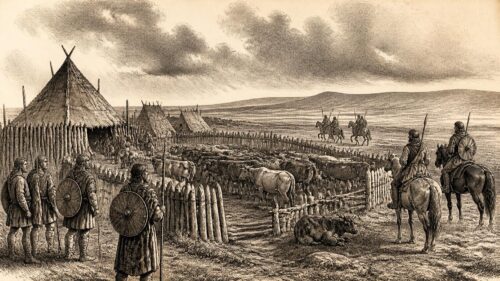
Cenn-eitigh’s Cattle Camp
In 1397, Irish politics centred on rival lordships, notably Connacht’s struggle between Ó Conchobhair Donn and Ó Conchobhair Ruadh. Mac Donnchadha’s cattle-bearing camp at Cenn-eitigh was surprised and destroyed in mid-August, prompting retaliatory raids, new alliances and further gallowglass warfare. Conflict devastated crops, houses and herds amid summer food scarcity and a wet, destructive autumn. In Ulster, Niall Mór Ó Néill died and was succeeded by Niall Óg, who inherited continuing struggles. Roger Mortimer sought authority in Leinster and the midlands, building Finnea castle. Ecclesiastical deaths and journeys to Rome reflected enduring religious connections despite widespread instability across the island.

Roger Mortimer’s Last Campaign
In 1398, the political settlement imposed after Richard II’s first Irish expedition was visibly coming apart. The year’s most consequential firmly dated event was the death on 20 July of Roger Mortimer, earl of March and Ulster, the king’s lieutenant in Ireland. Mortimer was a major lord in his own right, an heir presumptive to the childless Richard II, and the Crown’s foremost military representative in Ireland. His death in a Leinster campaign exposed how limited English authority remained beyond the better-defended lordship towns and lordly estates.
Waterford’s Vanishing King
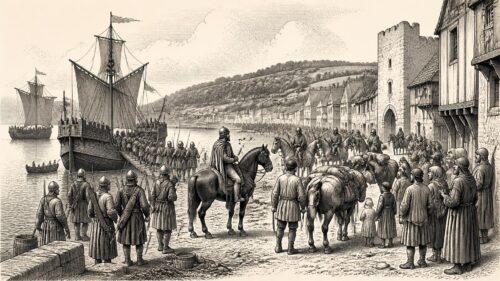
In 1399 Richard II landed at Waterford to subdue Art Mac Murchadha Caomhánach, whose Leinster forces avoided pitched battle, strained royal supplies and prevented a settlement. The expedition exposed the limited reach of English lordship beyond defended centres. While Richard campaigned, conflicts continued in Connacht and Ulster, and John fitz Gerald, earl of Desmond, drowned amid a Munster feud, leaving a minor heir. Annals note deaths of churchmen, rulers and Mac Egan legal scholars. Henry Bolingbroke's English invasion forced Richard’s July departure. Art remained unconquered, and Henry IV’s accession by September ended Richard’s reign, leaving Irish divisions and weakness unresolved.