

32000–31901 BCE

Castlepook Cave Fauna
Around 32,000 BCE, Ireland lay within the Late Pleistocene, before the British–Irish Ice Sheet reached its maximum extent. Lower sea levels altered coasts, but any land connection to Britain or Europe remains uncertain. Conditions varied regionally, though open, cold steppe-tundra supported reindeer, mammoth, giant deer, bears, wolves, Arctic foxes and fauna. Castlepook Cave, County Cork, preserves animal remains and a reindeer bone possibly bearing stone-tool butchery marks. This tentative evidence may indicate human activity, not settlement. Later glaciation destroyed or buried landscapes, complicating interpretation. Evidence of people in Ireland dates to about 10,860–10,640 BCE, leaving this earlier period archaeologically uncertain.

Cut-Marked Reindeer Bone
Castlepook Cave, County Cork, contains a reindeer femur reportedly cut with a stone tool about 31,000 BC, potentially Ireland’s earliest evidence of human activity. The date is approximate, and disturbed cave deposits, lacking associated tools, hearths or settlements, prevent firm conclusions beyond a possible brief hunter visit. During Marine Isotope Stage 3, Ireland was cold, seasonal and variably glaciated, supporting open habitats and fauna including reindeer, mammoth, giant deer, bears, wolves and hyaenas. Low sea levels may have aided access, though routes remain unknown. Later glaciation probably destroyed evidence. The find suggests mobile hunter-gatherers, not permanent occupation, culture or organisation.

Castlepook Reindeer Marks
Approximately 34,000 years ago, Ireland was a cold, unstable Late Pleistocene landscape of open tundra-steppe, changing sea routes and advancing glaciation. Castlepook Cave, County Cork, preserves Ireland’s richest pre-Last Glacial Maximum vertebrate assemblage, accumulated over millennia and disturbed by natural processes and excavation. Its remains include mammoth, giant deer, reindeer, bears, hyaenas and other cold-adapted fauna, demonstrating episodic animal occupation rather than a single ecosystem. A reindeer femur bearing possible stone-tool cut marks may indicate a brief Upper Palaeolithic human visit around 33,000 years ago, but cannot prove settlement. Further research is needed; secure Irish occupation appears much later substantially.

Ice Age Threshold
Around 31,997 BCE, Ireland’s history cannot be reconstructed as a dated event, because no written or securely associated archaeological evidence survives. The period, roughly 34,000 years ago, preceded the Last Glacial Maximum and featured changing, regionally variable environments. Castlepook Cave in County Cork preserves remains of reindeer, mammoth, giant deer, bears, wolves and hyenas, indicating productive open habitats. A reported cut mark on a reindeer femur may represent Upper Palaeolithic butchery, but cannot demonstrate permanent settlement or continuous occupation. No tools, hearths, human remains, political structures or cultural traditions are securely known. Ireland’s possible human presence remains tentative and episodic.
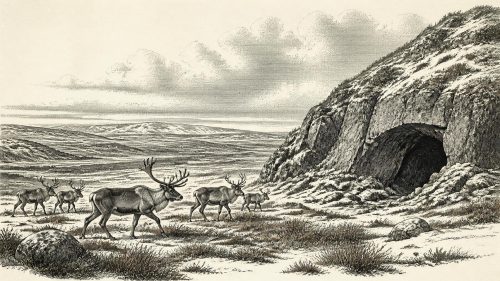
Castlepook’s Cold-Stage Fauna
Circa 31,996 BCE, Ireland formed part of the climatically unstable MIS 3 cold stage, before the Last Glacial Maximum. Lower seas, shifting ice and treeless tundra-steppe environments shaped a landscape intermittently accessible to animals. Castlepook Cave in County Cork preserves bones of mammoth, reindeer, giant deer, bears, wolves, foxes, lemmings and hyaenas, demonstrating a varied cold-stage fauna, although deposits are mixed and cannot reconstruct a single ecosystem. A possibly butchered reindeer bone suggests transient Upper Palaeolithic visitors, but remains unconfirmed without securely stratified tools or settlements. Later glaciation and rising seas impoverished evidence. No settled human history can be inferred.

Cork Reindeer Butchery
Although labelled 31,995 BCE, this period cannot be tied to an Irish event. Around 34,000 years ago, during Marine Isotope Stage 3, Ireland contained cold open landscapes and diverse fauna before the Last Glacial Maximum. Castlepook Cave, County Cork, preserves bones of reindeer, mammoth, giant deer and predators. A reindeer bone reportedly bearing stone-tool butchery marks offers possible evidence of brief Upper Palaeolithic human activity, but not permanent settlement. Deposits, dates and marks remain uncertain because caves were disturbed and later glaciation damaged evidence. No associated tools, hearths or cultural remains establish communities, trade, politics, or continuity with later populations.

Castlepook Reindeer Femur
About 31,994 BCE, Ireland lay in the climatically unstable Late Pleistocene, before the Last Glacial Maximum. Expanding ice had not covered all regions: north-central and southern areas retained exposed ground, while low sea levels reshaped coasts. Castlepook Cave in County Cork preserves fauna including reindeer, mammoth, giant deer, predators and cold-adapted species, indicating open steppe-tundra habitats. A reindeer femur, dated near 31,000 BCE, bears a possible stone-tool butchery mark, but disturbed deposits and absent associated artefacts prevent confirmation of human occupation. Secure Irish human evidence is later. Glacial expansion subsequently shaped terrain, leaving this era ecologically significant yet archaeologically uncertain.

Ireland Before Settlement
Around 31,993 BCE, Ireland was a cold, unstable landscape during the later Last Glacial Period, not a documented human society. Calendar-year precision is impossible: radiocarbon and geological evidence provide only broad, uncertain ranges. Fermanagh deposits indicate open tundra, severe seasons and sparse vegetation, while changing ice and lower seas altered terrain and coastlines. Castlepook Cave preserves diverse Late Pleistocene fauna, including mammoth, giant deer, reindeer, predators and smaller mammals, demonstrating connections with north-west Europe, though not their presence in one year. No securely dated Irish settlement, tools or burials exist from this period. Later glaciation reshaped landscapes and obscured evidence.

Castlepook Reindeer Butchery
About 31,992 BCE, Ireland was entering a severe glacial phase during the later Upper Palaeolithic, although ice extent varied regionally and chronology remains uncertain. Castlepook Cave in north County Cork provides a possible early human trace: a reindeer femur, dated to roughly 33,000 years ago, bears probable stone-tool butchery marks. If confirmed, it indicates brief human presence, not permanent settlement or continuous occupation. Animal remains suggest a cold, open, changing landscape supporting reindeer and other Pleistocene fauna, but deposits span long periods. Later ice, erosion, submerged coastlines and antiquarian excavation have left an exceptionally sparse record, requiring cautious interpretation overall.

Atlantic Ice Sheet Growth
At about 31,991 BCE, Ireland lay within the climatically unstable later Marine Isotope Stage 3, before the Last Glacial Maximum. Growing ice, lower sea levels and changing coastlines transformed habitats and possible access routes, though any land connection with Britain remains uncertain. Castlepook Cave in County Cork preserves key evidence: reindeer, mammoth, giant deer, lemmings, predators and other fauna indicate varied cold open environments. A cut-marked reindeer bone suggests possible Upper Palaeolithic human activity, but cannot prove settlement or continuous occupation. Later glaciation destroyed evidence. Consequently, this period is understood through imprecise dating, cave deposits and reconstruction, not year-specific history.

Castlepook’s Pleistocene Fauna
31,990 BCE is an imprecise modern label for Ireland during Marine Isotope Stage 3, as no annual chronology or written evidence exists. Approaching the Last Glacial Maximum, Ireland experienced worsening, variable cold conditions, altered coastlines and uncertain land connections. Castlepook Cave in County Cork preserves Ireland’s richest pre-glacial vertebrate assemblage, including mammoth, giant deer, reindeer, bear and hyaena, accumulated across millennia. A possibly butchered reindeer bone may indicate a human visit around 33,000 years ago, but remains unconfirmed. No secure settlement or occupation is known. Glaciation and sea-level change destroyed evidence; firm colonisation occurred much later, during the Mesolithic period.

Derryvree’s Tundra Archive
About 31,989 BCE, Ireland lay within Marine Isotope Stage 3, a cold Late Pleistocene interval preceding the last ice sheet’s greatest expansion. Evidence from Fermanagh, notably Derryvree freshwater sediments, indicates locally ice-free, open, treeless tundra or wet muskeg, with sedges, grasses, mosses and pools. Glacial landforms and offshore records show an ice mass developing unevenly, not uniform island-wide cover. Fossils suggest intermittent presence of large mammals, including mammoth and reindeer, but cannot establish contemporaneous communities. Lower sea levels altered coasts and access. No credible evidence demonstrates human occupation. Environmental phase helped create landscapes and conditions encountered by Ireland’s Mesolithic settlers.

Castlepook Reindeer Evidence
Around 34,000 years before 1950, conventionally rendered as 31,988 BCE, Ireland occupied a cold, open and environmentally variable Ice Age setting before the Last Glacial Maximum. Ice extent, vegetation, coastlines and routes from Britain remain uncertain. Castlepook Cave in County Cork preserves important, though poorly excavated and potentially disturbed, faunal remains, including reindeer, mammoth, giant deer, bear, wolves, hyaenas and lemmings. A dated reindeer femur bears a possible stone-tool butchery mark, suggesting early human visitation. However, no associated tools, hearths or settlements confirm occupation. Later glaciation and rising seas obscured evidence; Ireland's Palaeolithic human record remains unresolved and highly tentative.

Castlepook’s Cut-Marked Femur
Around 31,987 BCE, Ireland lay in the later Marine Isotope Stage 3, before the Last Glacial Maximum, amid cold, dry and unstable conditions. Open vegetation, periglacial terrain and expanding ice shaped habitats and preservation. Castlepook Cave, County Cork, preserves Pleistocene fauna, including mammoth, reindeer, giant deer, predators and cold-adapted animals, though deposits may mix different periods. Human occupation remains unproven: a reportedly cut-marked reindeer femur, dated about 33,000 years ago, may indicate brief butchery, not settlement. Later glaciation destroyed or buried evidence. Ireland’s deep history is therefore reconstructed cautiously through caves, bones, dating and glacial geology, without communities or events.

Castlepook’s Mammoth Fauna
Circa 31,986 BCE, Ireland was undergoing environmental transition during Marine Isotope Stage 3, before the Last Glacial Maximum. Evidence from Fermanagh sediments and Kerry speleothems indicates that some regions remained ice-free, though climate, coastlines and access routes changed rapidly. Castlepook Cave in County Cork preserves a diverse cold-stage fauna, including mammoth, reindeer, giant deer, carnivores and Arctic mammals, but its deposits represent long-term ecological change rather than a single date. No secure evidence demonstrates permanent human settlement or polity at this time. Expanding British-Irish ice reshaped landscapes, deposits and habitats, determining conditions faced by later post-glacial colonists in subsequent millennia.
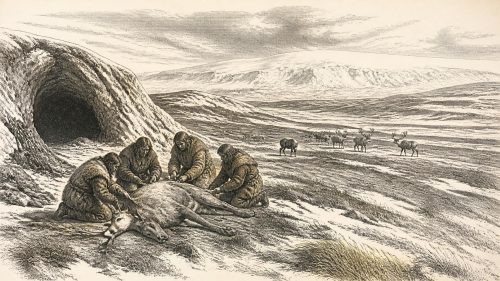
Butchery Marks at Castlepook
Around 31,985 BCE, Ireland lay within the unstable, cold conditions of Marine Isotope Stage 3, with changing ice, sea levels and possible routes from Britain. Glaciation and later inundation destroyed much evidence. Castlepook Cave, County Cork, yielded a reindeer femur reportedly marked by stone-tool butchery, perhaps dating to about 33,000 years ago. If human-made, it indicates a brief Upper Palaeolithic visit, not permanent settlement. Cave fauna, including reindeer, mammoth and predators, reflects cold open habitats but spans different periods. No associated tools, dwellings, art or burials are securely known. Later ice erased traces; human evidence appears near the Pleistocene’s end.

Castlepook Reindeer Cut Mark
About 31,984 BCE, Ireland lay within the Late Pleistocene, as cold, open steppe-tundra environments developed before the Last Glacial Maximum. Ice expansion was uneven, and access from Britain or Europe remains uncertain despite lower sea levels. Castlepook Cave, County Cork, preserves a diverse Marine Isotope Stage 3 fauna, including reindeer, mammoth, giant deer, hyena and Arctic species. A reindeer femur, dated roughly 33,000 years ago, bears a possible stone-tool butchery mark and may represent Ireland’s earliest human trace. However, its disturbed cave context, lacking tools or camps, cannot prove settlement. Advancing ice erased evidence, leaving only a tentative Palaeolithic visitation.

Ice-Age Threshold
About 31,983 BCE, Ireland lay in the later Marine Isotope Stage 3, a cold, variable period before the Last Glacial Maximum, rather than beneath uniform ice. Castlepook Cave in County Cork preserves mixed, imperfectly excavated animal remains including reindeer, mammoth, giant deer, predators and Arctic species, demonstrating an Ice-Age fauna. Revised dating places some bones in this era. Cut marks on a reindeer femur may indicate stone-tool butchery and intermittent human presence around 33,000 years ago, but prove neither settlement nor society. Subsequent glaciation and rising seas obscured evidence; sustained settlement is documented only much later, at Mesolithic Mount Sandel.

Castlepook Hyena Den
Circa 34,000 years before present, Ireland experienced unstable late Ice-Age conditions before the Last Glacial Maximum. Lower seas and shifting ice created a landscape unlike modern Ireland, while later glaciation destroyed evidence. Castlepook Cave, County Cork, preserves Ireland’s richest pre-maximum vertebrate record, including mammoth, giant deer, reindeer, bears, hyena, wolves and cold-adapted smaller mammals. Its deposits represent changing ecosystems, not a single contemporaneous fauna; hyenas accumulated many bones. Human occupation remains unproven. A possibly butchered reindeer bone may indicate a brief visit, but no settlements, tools, burials or cultures are securely known. Environmental change, rather than history, defines this period.

Reindeer Butchery at Castlepook
Castlepook Cave, County Cork, preserves a disturbed Late Pleistocene faunal record including reindeer, mammoth, giant deer and predators. A reindeer femur dated broadly to about 31,000 BC bears a mark interpreted as stone-tool butchery, suggesting a possible Upper Palaeolithic human visit. It cannot establish a dated hunt, permanent settlement or associated culture. Ireland then was a cold, open, environmentally changing landscape with lower sea levels and faunal links to Eurasia before the Last Glacial Maximum. Carnivore activity, water and earlier excavation complicate interpretation. Castlepook therefore offers tentative evidence of early human activity, not an annual historical event or prehistoric society.
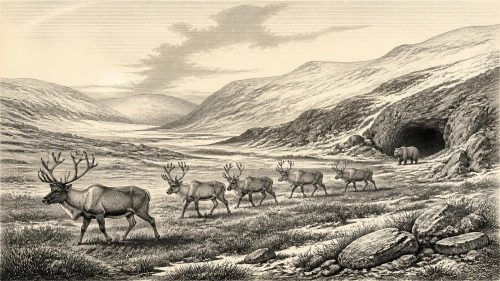
Shandon Cave Fauna
Around 34,000 cal BP, during Marine Isotope Stage 3, Ireland was a climatically variable, partly exposed north-west European landscape before the Last Glacial Maximum. Lower sea levels altered coasts and possible access routes. Cave deposits at Shandon, Waterford, and Castlepook, Cork, preserve remains of mammoth, reindeer, horse, giant deer, bear, wolf and hyaena, indicating productive open habitats, though bones span different periods and disturbed contexts. Ice-sheet growth later transformed landscapes and fauna. No securely dated human occupation exists for this time; disputed cut-mark evidence warrants further investigation. Ireland is best understood as a changing Ice Age environment, not a society.

Reindeer Processing at Castlepook
Around 33,900 cal BP, rather than a precisely knowable year, Ireland experienced the cold, unstable later Marine Isotope Stage 3, before the Last Glacial Maximum. Ice and changing climates shaped landscapes, while later glaciation destroyed much evidence of earlier life. Cave finds record reindeer, hares, lemmings, Arctic foxes and larger mammals; dated red deer confirm habitable areas. Castlepook Cave yielded a reindeer femur, about 33,000 years old, with possible stone-tool cut marks, suggesting human carcass processing. However, no securely dated settlement, artefacts, skeletons or cultural affiliation exists. Any visitors were mobile foragers, but beliefs, society, routes and permanence remain unknown.

Doneraile Reindeer Bone
Around 31,978 BCE, Ireland lay in a cold, changing Pleistocene environment before the Last Glacial Maximum, when expanding ice later reshaped much of the island. Evidence is chiefly geological and faunal, with Castlepook Cave near Doneraile providing a significant but uncertain clue to human presence. A reindeer femur, dated roughly 33,000 years ago, bears a possible butchery mark, suggesting intermittent Upper Palaeolithic visitors rather than settlement. Cave remains reveal open tundra-steppe supporting reindeer, giant deer, predators and Arctic mammals. Poor excavation records and disturbed deposits prevent certainty. No camps, tools, hearths, political institutions or specifically Irish cultural practices are known.
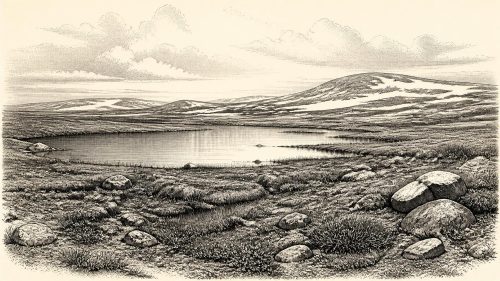
Derryvree Beneath the Till
Around 31,977 BCE, or c. 34,000 cal BP, Ireland was a climatically unstable Late Pleistocene landscape approaching expansion of the last Irish Ice Sheet. Organic lake and freshwater deposits beneath till at Derryvree and Greenagho, County Fermanagh, show that parts of north-central Ireland were ice-free, supporting open tundra and periglacial environments. Offshore evidence indicates later ice advances, chiefly after this period. No archaeological evidence demonstrates human occupation: Palaeolithic and Mesolithic finds cannot be projected backwards. Glacial erosion, redeposition and subsequent sea-level rise hinder preservation. Thus this date records environmental transformation, with advancing ice, water and sediments shaping the future landscape.

Derryvree Ice-Free Interval
Around 31,976 BCE, Ireland had no securely attested human population, settlement or political history. Evidence from Derryvree, County Fermanagh, places the island within a later Marine Isotope Stage 3 ice-free interval, before major expansion of the last Irish Ice Sheet. Freshwater sediments, dated broadly to 36,900–31,700 years before present, indicate cold periglacial conditions and open tundra vegetation of herbs, grasses, sedges and mosses. Fossil records suggest shifting cold-adapted mammal communities, but cannot establish species present locally in that year. Approaching glaciation subsequently reshaped Ireland’s landforms and obscured much earlier evidence. The earliest persuasive human visit occurred over twenty millennia later.

Ice Before History
About 31,975 BCE, Ireland was a cold, unstable Late Pleistocene landscape during Marine Isotope Stage 3, before maximum glaciation. Expanding ice, changing seas and open tundra-steppe created varied environments rather than a uniformly frozen island. Cave evidence, especially from Castlepook, County Cork, records reindeer, mammoth, giant deer, bears, wolves, hyaenas and other fauna. A reindeer bone bearing a possible stone-tool cut mark, dated broadly near 31,000 BCE, offers potentially Ireland’s earliest human trace. It suggests brief Upper Palaeolithic visits, not permanent settlement. No associated tools, hearths, dwellings, communities or practices are known. Ice and rising seas may have destroyed evidence.

Castlepook Reindeer Incision
Around 31,974 BCE, Ireland was entering an unstable, increasingly severe phase of the last glacial cycle, though conditions varied regionally and cannot be reconstructed for a single year. Ice had not yet reached its maximum extent, but landscapes, coastlines and routes of access were changing as sea levels fell. Cave finds show cold, open environments supporting reindeer, bears, mammoth and other fauna. At Castlepook Cave, County Cork, a reindeer femur possibly cut with a stone tool, dated about 33,000 years ago, may represent Ireland’s earliest human activity. It proves neither settlement nor hunting. Later glaciation obscured evidence; occupation came post-glacially.

Castlepook’s Marked Reindeer Femur
Around 31,973 BCE, Ireland was part of a climatically unstable, open Ice Age landscape, with changing coastlines, ice conditions and access routes. Cave faunas show that reindeer, mammoths, giant deer, bears, wolves, hyaenas and smaller cold-adapted animals occupied the island intermittently. At Castlepook Cave, County Cork, a reindeer femur bears a deep mark possibly made by a stone tool during butchery, potentially indicating an early human visit. However, disturbed deposits, uncertain dating and absence of associated tools, hearths or settlements prevent confirmation of occupation. The find prompts further research into Ireland’s earliest, fragile evidence of human presence in deep prehistory.

Marine Isotope Stage Three
Around 31,972 BCE, approximately 33,900 cal BP, Ireland lay in the later Marine Isotope Stage 3, as climate deteriorated before the Last Glacial Maximum. Lower sea levels altered coasts and potential connections with Britain and Europe, while open tundra-steppe supported diverse Ice Age fauna. Castlepook Cave preserves remains including mammoth, giant deer, reindeer, hyaena and Arctic fox, though redeposition and revised dating prevent precise reconstruction. No securely dated human site exists from this period. Possible cut marks on a Castlepook reindeer bone may indicate an early visit, but remain unconfirmed. Later glaciation destroyed or obscured much evidence, leaving caves archives.

Ice-Age Ireland
Around 33,900 years ago, Ireland lay within a cold, unstable Late Pleistocene landscape, with regionally variable ice cover preceding the Last Glacial Maximum. Lower sea levels altered coastlines and potential animal routes. Open tundra-steppe habitats supported mammoth, giant deer, reindeer, bears and predators, evidenced especially at Castlepook Cave, County Cork. A cut-marked reindeer femur there provides limited evidence that Upper Palaeolithic hunters may briefly have visited or crossed Ireland. It does not demonstrate settlement, population continuity, polities or cultural practices. Subsequent ice expansion destroyed or obscured much evidence, leaving caves as selective archives. Post-glacial Mesolithic settlement occurred many millennia later.
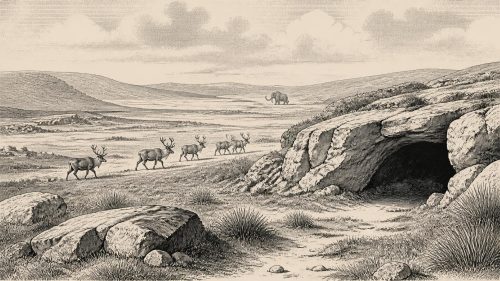
Castlepook Cave Deposits
About 31,970 BCE, Ireland lay in the unstable later Marine Isotope Stage 3, with advancing but uneven ice cover, lower sea levels and changing routes for animals. Castlepook Cave, County Cork, preserves over 2,000 vertebrate remains, including mammoth, reindeer, giant deer, bear and hyaena, indicating open, varied cold-climate habitats. Cave processes, water disturbance and old excavations complicate interpretation, however. No dated human settlement, tools or burial belongs to this period. A possibly butchered reindeer bone suggests a tentative Upper Palaeolithic visit, but requires further testing. Later glaciation destroyed much evidence; future dating, DNA and offshore research may refine Ireland’s history.

Castlepook’s Glacial Fauna
31,969 BCE is a modern label rather than a recoverable Irish historical date, belonging to later Marine Isotope Stage 3 before the Last Glacial Maximum. Ireland experienced fluctuating cold conditions, regional ice growth and open habitats. Castlepook Cave, County Cork, preserves over 2,000 bones accumulated across millennia, including mammoth, reindeer, giant deer, bear and hyena, demonstrating complex Ice Age ecosystems. Its disturbed reindeer femur may bear stone-tool marks and suggest an early human visit, but remains unconfirmed. No securely dated settlements, occupations or cultural practices establish people in Ireland then. Later glaciation and dating uncertainties limit conclusions about human activity.

Fermanagh Subglacial Organics
Around 31,968 BCE, Ireland lay in the climatically unstable Late Pleistocene, before the Last Glacial Maximum and without evidence permitting calendar-year reconstruction. Greenagho deposits indicate that parts of north-central Ireland remained ice-free until roughly 34,000 years ago, although ice, coastlines and sea levels were changing. Later glaciation created many familiar landforms. Castlepook Cave preserves evidence of diverse cold-climate fauna, including mammoth, reindeer, giant deer, bear and hyena, but accumulated remains cannot define a single moment. No secure human settlement is known. A possibly tool-marked reindeer bone suggests an uncertain brief visit. Ireland was a dynamic, ecologically connected, increasingly glaciated landscape.

Castlepook Faunal Assemblage
At roughly 31,967 BCE, Ireland was a climatically unstable Late Pleistocene landscape approaching expanded glaciation, rather than uniformly ice-covered. Lower sea levels reshaped coasts and connections with Britain, though no specific land route or migration can be demonstrated. Castlepook Cave, County Cork, preserves Ireland’s richest pre-Last Glacial Maximum vertebrate assemblage, including reindeer, mammoth, giant deer, hyena, wolf, Arctic fox and lemmings. Its bones accumulated over long periods and reflect carnivore activity as well as natural processes. A marked reindeer femur may indicate early human butchery, but remains unconfirmed. Evidence supports intermittent fauna and possible human visits, not permanent occupation then.

Before the Ice Maximum
Around 31,966 BCE, Ireland lay in the unstable later Marine Isotope Stage 3, before the fullest advance of the Last Glacial Maximum. Sea levels were lower, coastlines and possible routes changed, and expanding ice later destroyed much evidence. Southern caves, especially Castlepook, preserve remains of reindeer, mammoth, giant deer, bears and hyaenas, indicating cold, open mosaic habitats. A cut-marked reindeer femur, dated about 33,000 years ago, may record an early hunter visit, but lacks archaeological context or settlement evidence. No peoples, polities, beliefs or permanent communities can be identified. Knowledge relies on radiocarbon dating, faunal analysis, stratigraphy and ice-sheet reconstruction.

Crag Cave Calcite Growth
Around 31,965 BCE, a retrospective and imprecise date, Ireland lay within the climatically unstable Upper Palaeolithic. It was not yet uniformly covered by the later maximum ice sheet: Fermanagh sediments and calcite growth at Crag Cave indicate local ice-free or intermittently unfrozen ground, although regional glaciation was advancing. Lower sea levels altered coastlines without guaranteeing land access. Open steppe-tundra supported fauna including reindeer, giant deer, mammoth and hyaena, though cave deposits are complex. No secure human settlement is known. A possibly cut-marked reindeer bone suggests brief human visitation, but not occupation. This glacial era shaped Ireland’s terrain and remains uncertain.

Castlepook Reindeer Toolmarks
Around 31,964 BCE, Ireland lay on Europe’s north-western fringe during Marine Isotope Stage 3, before the Last Glacial Maximum. Castlepook Cave in County Cork preserved remains of mammoth, reindeer, giant deer, bear and hyaena, demonstrating intermittent Late Pleistocene ecological connections despite uncertain routes across changing seas and ice. A reindeer femur reportedly dated about 31,000 BCE bears marks potentially made by stone tools, suggesting human carcass processing. However, mixed cave deposits and absent associated artefacts prevent confirmation. Open steppe-tundra supported diverse fauna, but advancing ice later erased evidence. The human presence remains unproven, while climate and shifting coastlines governed survival.

Derryvree Interstadial Deposits
Approximately 34,000 calendar years ago, Ireland lay in the unstable later Marine Isotope Stage 3, before the Last Glacial Maximum. Derryvree and Greenagho deposits show intervals without overriding ice in north-central Ireland, although conditions varied regionally. Periglacial terrain, local or expanding glaciers, lower sea levels and episodic milder phases shaped the landscape. Cave faunas document mammoth, giant deer, reindeer, horse, predators and other animals, indicating open, shifting habitats and links with north-west Europe. No secure evidence demonstrates people in Ireland then; the earliest accepted sign of human activity is much later, from butchered bear bone dated about 12,700 cal BP.
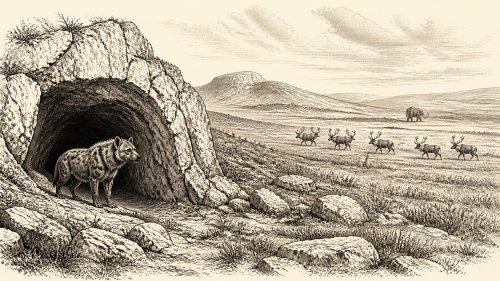
Herb-Rich Tundra
Around 31,962 BCE, Ireland lay in the climatically unstable Late Pleistocene, before the Last Glacial Maximum, when much of the island may still have been ice-free. Open herb-rich tundra, grassland and sparse shrubs supported mammoth, giant deer, reindeer, bear, wolf, Arctic fox, lemmings and hyaena. Castlepook Cave, County Cork, preserves crucial but complex faunal evidence, accumulated and disturbed over long periods. A possibly stone-tool-marked reindeer bone suggests fleeting Upper Palaeolithic human activity, but does not prove settlement. Lower sea levels altered geography, while advancing ice later destroyed records. Ireland’s history at this time is therefore chiefly environmental, fragmentary and uncertain.

Castlepook’s Marked Bone
31,961 BCE is an imprecise label for a Late Pleistocene MIS 3 interval, when Ireland experienced cold conditions and advancing ice preceding the Last Glacial Maximum. Geological and cave-faunal evidence, especially from Castlepook Cave, records mammals including cold-adapted and open-country species, though deposits span long periods and were imperfectly excavated. A reportedly cut-marked reindeer bone may indicate human activity around 33,000 years ago, but lacks secure context and remains under investigation. No contemporary settlement, tools, hearths or cultural assemblage is known. Later bear-bone evidence confirms human presence only about 10,800–10,500 BCE. Ireland’s period remains an environmentally documented, uncertain human prehistory.

Exposed Celtic Sea Shelf
Around 31,960 BCE, Ireland was a cold, glaciated Late Pleistocene landscape, though not uniformly ice-covered. Lower sea levels exposed surrounding shelf lands, but changing channels, ice and difficult terrain still impeded access. Castlepook Cave in County Cork preserves important, imperfectly excavated animal remains, including mammoth, reindeer, giant deer, bear and hyaena, indicating open habitats and diverse fauna accumulated over long periods. A cut-marked reindeer bone may record butchery by Upper Palaeolithic visitors, potentially Ireland’s earliest human trace. However, no tools, hearths or settlements confirm occupation. Later glaciation and disturbed cave deposits limit interpretation; Ireland remains an intermittently habitable Ice-Age frontier.

Mammoth Cave Fauna
Around 31,959 BCE, Ireland was an unstable Late Pleistocene landscape, not a recorded society. Before the Last Glacial Maximum, exposed areas may have supported open steppe and tundra vegetation and fauna. Castlepook, or Mammoth Cave, County Cork, contains bones of mammoth, reindeer, giant deer, bears, wolves, foxes and hyaenas, although its disturbed deposits represent long periods rather than a single moment. A cut-marked reindeer femur may indicate human butchery about 33,000 years ago, but remains contested and lacks context. It cannot prove settlement, culture or routes of arrival. Glaciation, sea-level change and poor preservation leave human presence uncertain, pending research.

Cork Animal Processing
31,958 BCE is a modern notional date within the unstable Late Pleistocene, not a precisely identifiable Irish year. County Cork’s Castlepook Cave offers potentially significant evidence: a reindeer femur, dated around 31,000 BCE, bears a deep mark possibly made by a stone tool during butchery. Poor antiquarian excavation records and alternative causes of bone damage require caution. Cave fauna, including reindeer, mammoth, giant deer, bear and hyaena, demonstrates a changing, animal-rich landscape before maximum glaciation. Human visits, routes and occupation remain unproven. Later ice and rising seas obscured evidence. Renewed investigation may clarify whether Castlepook records Ireland’s earliest human presence.

Carden’s Reindeer Cut Mark
Ireland around 31,957 BCE lay within Marine Isotope Stage 3, a cold, changing Late Pleistocene period lacking written history or proven settlement. Castlepook Cave in County Cork yielded reindeer and other cold-stage fauna. A marked reindeer femur, interpreted as stone-tool butchery, may indicate brief human presence, but lacks securely associated tools or occupation evidence. Radiocarbon dates require calibration and cannot establish an exact year. Cave deposits were disturbed, while later glaciers erased or rearranged much evidence. Growing ice eventually covered Ireland at the Last Glacial Maximum. The find suggests possible early, discontinuous contact, but future excavation and dating remain necessary.

Castlepook’s Reindeer Bone
Around 31,956 BCE, Ireland lay within the variable cold conditions of Marine Isotope Stage 3, before the Last Glacial Maximum. Its landscapes included tundra-like open vegetation, periglacial environments and regionally uncertain ice cover, while lower seas did not guarantee human access. Castlepook Cave in County Cork preserves Ireland’s pre-maximum vertebrate assemblage, including mammoth, reindeer, giant deer, hyaena and predators. A possibly cut-marked reindeer bone, dated near 33,000 years ago, may indicate brief human activity, but remains unconfirmed and cannot establish settlement. No secure Palaeolithic habitation, tools, burials or art date to this period. Evidence instead depicts changing environments and fauna.
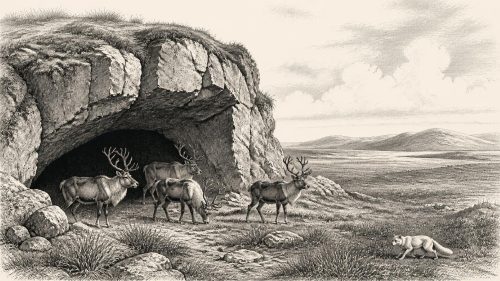
British-Irish Ice Sheet Expansion
Around 31,955 BCE, Ireland was an unstable Late Pleistocene landscape approaching major glaciation, not a documented historical society. Castlepook Cave, County Cork, preserves important MIS 3 animal remains, including mammoth, reindeer, giant deer, predators and cold-adapted species. A reportedly stone-tool-marked reindeer femur, dated broadly around 33,000 years ago, suggests a possible fleeting human presence, but cannot establish settlement or a specific event. Disturbed deposits, uncertain dating and carnivore activity require caution. As the British–Irish Ice Sheet expanded, changing climates, sea levels and routes shaped animal movement. Future excavation, dating, taphonomic study and ancient-DNA research may clarify Ireland’s earliest human evidence.

Ruth Carden’s Reassessment
31,954 BCE is a notional date within MIS 3, not a recorded Irish year. Ireland then comprised volatile Late Pleistocene environments supporting cold-adapted fauna, including reindeer, mammoth, giant deer and carnivores, before the Last Glacial Maximum. Castlepook Cave, County Cork, provides a possible earliest human trace: a reindeer femur with a mark plausibly made by a stone tool during butchery. Poorly recorded early excavations, disturbed cave deposits and uncertain dating prevent stronger conclusions about settlement, hunting or access routes. No evidence supports communities, culture or politics. Later glaciation obscured evidence; secure sustained settlement begins only in the Mesolithic millennia later.

Carden’s Reindeer Femur
Around 31,953 BCE, Ireland lay within the climatically unstable later Ice Age, approaching expanded glaciation. Evidence from Castlepook, or Mammoth, Cave in County Cork confirms a diverse Marine Isotope Stage 3 fauna, including reindeer, mammoth, giant deer, bears, wolves and Arctic species. A reindeer femur, dated about 33,000 years ago, has a possible stone-tool butchery mark, perhaps indicating Ireland's earliest human activity. However, disturbed cave deposits and lack of associated tools or habitation prevent conclusions about settlement. Ice later damaged much archaeological evidence. No local polities, warfare, art or culture can be established; human presence remains possible, fleeting and uncertain.

Southern Irish Raised Beaches
Around 31,952 BCE, Ireland lay in the unstable Late Pleistocene climate of Marine Isotope Stage 3, as the British–Irish Ice Sheet expanded. Southern raised-beach and marine deposits reveal shifting relative sea levels, while Castlepook Cave in County Cork preserves remains of mammoth, reindeer, giant deer, bears, wolves, hyaenas and fauna, indicating varied open, cold habitats. Cave deposits are disturbed and span long periods, limiting precision. A reportedly cut-marked reindeer bone, dated near 33,000 years ago, suggests possible Upper Palaeolithic visitation, but lacks secure context. Settlement remains unproven. This date represents ecological richness and uncertain human possibility before later glacial maximum.

Southern Ice-Free Ground
Around 31,951 BCE, Ireland lay in the Late Pleistocene, before the Last Glacial Maximum, experiencing increasingly cold, unstable conditions rather than uniform ice cover. Southern areas may initially have remained ice-free, while changing sea levels and ice margins altered connections with Britain and Europe. Cave fauna, particularly from Castlepook, demonstrates reindeer, mammoth, hyaena, bears, wolves and other cold-adapted animals during this broad period. A marked reindeer bone may indicate brief Upper Palaeolithic butchery, but cannot prove settlement or continuous occupation. Glacial erosion, drowned landscapes and disturbed cave deposits explain the sparse record, leaving environmental change as the clearest documented development.

Before Maximum Ice
Around 31,950 BCE, Ireland lay within the Midlandian cold stage of the Late Pleistocene, before the Last Glacial Maximum. Its treeless, periglacial landscapes comprised tundra, grasses, sedges, dwarf shrubs, unstable rivers and frost-shattered ground, while lowered seas altered coastlines without necessarily providing easy land routes. Cave deposits, especially Castlepook in Cork, preserve evidence of mammoth, reindeer, giant deer, predators and Arctic-adapted mammals, though accumulated remains cannot reconstruct one ecosystem. A possibly cut-marked reindeer bone, dated near 33,000 years ago, may indicate human butchery. Yet no settlement, tools, hearths or continuous occupation are established. It represents environmental change and tentative presence.
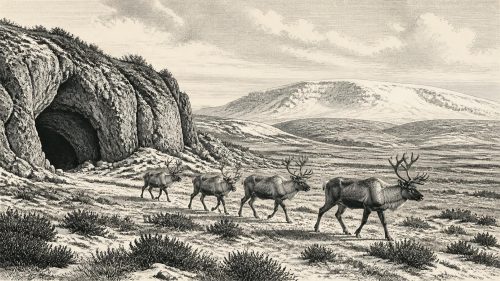
Crag Cave Interstadial
Around 31,949 BCE, Ireland lay in the climatically unstable Late Pleistocene, approaching maximum glaciation but retaining intermittently ice-free terrain in the south. Crag Cave speleothems indicate changing conditions, while lower sea levels reshaped coasts. Castlepook Cave’s mixed deposits preserve cold-adapted fauna, including reindeer, mammoth, lemmings, predators and giant deer, suggesting open steppe-tundra habitats. A possibly butchered reindeer bone dated about 33,000 years ago offers tentative evidence of human visitation, not settlement. No contemporary Irish tools, hearths, burials or communities are securely known. Environmental change, cave evidence and uncertainty therefore define this remote period, preceding later proven Upper Palaeolithic occupation there.
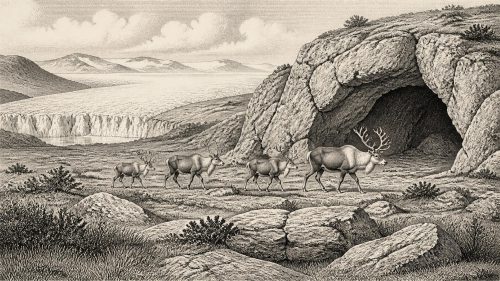
Before the Ice Peak
Around 31,948 BCE, Ireland lay within the climatically unstable Late Pleistocene, before the Last Glacial Maximum. Ice growth was substantial but regionally uncertain, while lower sea levels transformed coastlines without guaranteeing easy land connections. Geological landforms, offshore sediments and caves preserve fragmentary evidence of glaciation and changing fauna, including mammoth, reindeer, giant deer, bear and hyena. Later ice erosion and sea-level rise destroyed or submerged much evidence. No securely dated human artefacts, occupations or communities are known; possible transient visits remain unproven. Agriculture, villages, politics, trade and ritual belong to later periods. Ireland’s significance lies in its glacially reshaped environment.

Ice and Uncertainty
31,947 BCE is an approximate modern label for later Pleistocene Ireland, not a witnessed year. During Marine Isotope Stage 3, cooling fostered uneven ice growth, though much of Ireland may still have contained exposed grassland, rivers, caves and changing coasts before the Last Glacial Maximum. Glacial erosion explains the scarcity of archaeological evidence. Castlepook Cave preserves remains of mammoth, reindeer, giant deer, predators and other cold-adapted fauna, accumulated across different periods. A possibly stone-tool-marked reindeer bone, dated around 33,000 years ago, may indicate a brief human visit, not settlement. Ireland’s evidence chiefly records environmental transformation, while human activity remains uncertain.
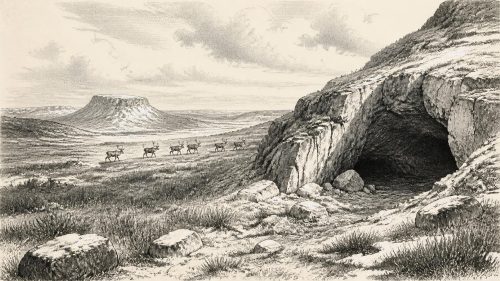
Greenagho Ice-Free Deposits
About 34,000 years before present, Ireland experienced cold, unstable Marine Isotope Stage 3 conditions as the British–Irish Ice Sheet began expanding. Deposits at Derryvree and Greenagho indicate north-central areas remained ice-free until roughly this period, although local glaciers and periglacial processes occurred. Open tundra-like habitats supported reindeer, giant deer, spotted hyaenas, bears and other fauna, evidenced especially at Castlepook Cave. A marked reindeer bone may indicate brief Upper Palaeolithic butchery, but cannot prove permanent human occupation. No settled communities or political institutions are evidenced. Changing coastlines, glaciation and disturbed deposits obscure evidence, leaving animal life and possible mobile human visits.
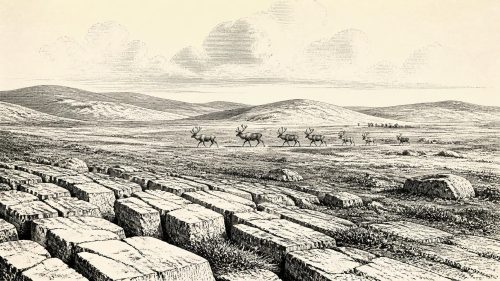
Glacial Erosion Legacy
About 31,945 BCE is a retrospective label, not a dateable Irish event; evidence concerns the climatically variable later Ice Age before the Last Glacial Maximum. Expanding ice and later erosion destroyed or disturbed much evidence, explaining Ireland’s sparse Palaeolithic record. Southern caves, particularly Castlepook, preserve bones accumulated over millennia, documenting mammoths, giant deer, reindeer, bears, hyenas and other cold-adapted fauna. A possibly tool-marked reindeer bone may indicate a brief human visit, but lacks secure context or supporting artefacts and cannot demonstrate settlement. Environmental change later transformed habitats. Subsequent recolonisation produced Palaeolithic and Mesolithic evidence, without proving continuity from earlier visitors.

Mammoth Cave Assemblage
At 31,944 BCE, Ireland was entering a prolonged cold phase, although the extent of advancing ice remains uncertain and the island was not necessarily wholly glaciated. Lower sea levels altered coastlines, but no secure land route is known. Castlepook, or Mammoth, Cave in County Cork preserves Ireland’s richest pre-Last Glacial Maximum vertebrate assemblage, including mammoth, reindeer, giant deer, predators and lemmings, accumulated across many millennia rather than one moment. These animals indicate changing open steppe-tundra environments. Human presence is unproven: possible butcher marks require confirmation, while secure evidence dates only to about 12,800 years ago. Later ice obscured earlier evidence.

IntCal Calibration Curve
31,943 BCE is a modern label within a broad late-Pleistocene range, not a datable Irish year. Radiocarbon calibration, geological evidence and disturbed deposits require caution. During Marine Isotope Stage 3, Ireland had cold, open habitats, changing coastlines and advancing ice, but was not uniformly ice-covered. Castlepook Cave in County Cork preserves rich fauna, including mammoth, reindeer, giant deer, bear and hyaena, though remains accumulated over long periods and do not prove human hunting. A cut-marked reindeer bone suggests possible early visitation, yet secure Palaeolithic settlement evidence remains absent. Ice erosion explains sparse records; future discoveries may clarify Ireland’s changing landscape.

Castlepook Cave Mammals
Around 31,942 BCE, Ireland experienced a cold, unstable Late Pleistocene climate before the Last Glacial Maximum, with ice coverage varying regionally and open tundra-like habitats in ice-free areas. Castlepook Cave, County Cork, preserves a time-layered fauna including mammoth, reindeer, giant deer, bears, wolves, hyaenas and lemmings, demonstrating ecological connections with north-west Europe. Cave deposits cannot reconstruct a single moment, and earlier dating requires reassessment. Human occupation at this date remains unproven: a possible cut-marked reindeer bone needs further testing. Secure evidence of people in Ireland is far later, during the Younger Dryas. No societies, settlements or events can be identified.

Spotted Hyaena at Castlepook
Labelled 31,941 BCE, this period represents approximately 33,900 years before present, during the climatically unstable Late Pleistocene. Ireland was not yet wholly ice-covered, but cold, seasonal tundra-steppe supported animals including reindeer, mammoth, giant deer, lemmings, wolves and rare spotted hyaenas. Castlepook Cave, County Cork, preserves disturbed remains from repeated episodes, demonstrating ecological links with north-west Europe. A reportedly cut-marked, dated reindeer femur may indicate human butchery and brief Upper Palaeolithic visits, but cannot prove settlement or continuity. No contemporary Irish camps, tools, hearths, burials, monuments or cultural evidence are securely known. Later ice expansion profoundly reshaped landscapes and obscured evidence.

Courtmacsherry Coastal Deposits
Around 31,940 BCE, Ireland lay within the climatically unstable Late Pleistocene, before the Last Glacial Maximum and peak British–Irish Ice Sheet expansion. Lower sea levels altered coastlines, while later glaciation reshaped landscapes and destroyed much earlier evidence. Southern coastal deposits, including those at Courtmacsherry, confirm pre-maximum landscapes survived beneath later tills. Cave assemblages, notably at Castlepook, preserve reindeer, deer and other cold-stage fauna, indicating open grazing environments. A possibly butchered reindeer bone may suggest a brief human visit around 33,000 years ago, but remains unconfirmed. Secure evidence of human occupation appears much later, with substantial settlement beginning in the Mesolithic.

Uneven Ice-Sheet Advance
Around 31,939 BCE, Ireland was experiencing unstable Late Pleistocene conditions near the expansion of the last Irish Ice Sheet, rather than a single uniformly glaciated landscape. Glacial, sedimentary and cave evidence indicates cold open habitats supporting reindeer, mammoth, giant deer, bears, wolves, Arctic foxes, lemmings and hyaenas, especially in southern caves. Castlepook Cave's dated reindeer femur, possibly cut-marked by a stone tool, raises the prospect of brief Upper Palaeolithic human activity. Nevertheless, disturbed deposits and absent tools, hearths or settlements preclude proof of permanent occupation. No social, cultural or political reconstruction is justified. Secure Irish settlement appears after 8000 BCE.

Ulster Pollen And Beetles
31,938 BCE is a modern label for an imprecisely dated phase of late Marine Isotope Stage 3, not an identifiable Irish event. Ireland experienced unstable, cold conditions before maximum glaciation, with open grassland, sedges, dwarf shrubs and marked seasonality indicated by Ulster pollen and beetles. Castlepook Cave preserves a diverse fauna, including reindeer, mammoth, bear, giant deer and hyaena, showing changing animal access despite uncertain routes. A cut-marked reindeer bone may indicate Upper Palaeolithic butchery and brief human visits. However, no associated camp or tools prove settlement. The period chiefly reveals a changing Ice Age landscape and rare, precarious evidence.

Periglacial Shrub Tundra
About 31,937 BCE, Ireland was a cold, open and environmentally unstable landscape in the later Last Glacial Period, approaching maximum glaciation. Lower sea levels altered coastlines and may have eased animal movement from Britain and Europe. Castlepook Cave, County Cork, preserves remains of reindeer, mammoth, giant deer, predators and other fauna, though deposits span different times. A reindeer bone reportedly bearing stone-tool butchery marks may indicate human passage around 33,000 years ago, but cannot prove permanent occupation. Later ice erosion and inundation destroyed evidence. No society, culture, trade or institutions can be inferred; sustained settlement is documented from the Mesolithic.
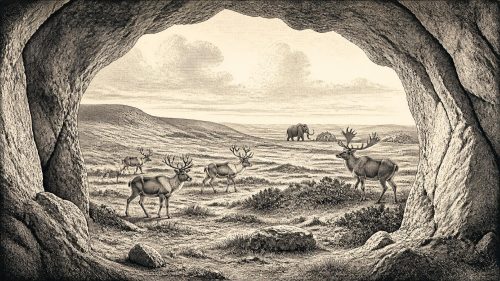
Castlepook’s Putative Toolmark
31,936 BCE is a modern label for a late Pleistocene period, not a datable Irish event. Ireland lay in a cold, unstable landscape before the Last Glacial Maximum, as expanding ice and changing sea levels reshaped routes, habitats and surviving evidence. Southern caves, particularly Castlepook in County Cork, preserve remains of mammoth, reindeer, giant deer, bears, foxes, hyaenas and other fauna, though deposits span long periods and were disturbed. No secure human settlement is known. A possibly tool-marked reindeer bone, dated near 33,000 years ago, may indicate brief human activity, but requires confirmation. Glacial erosion explains Ireland's scant surviving evidence.
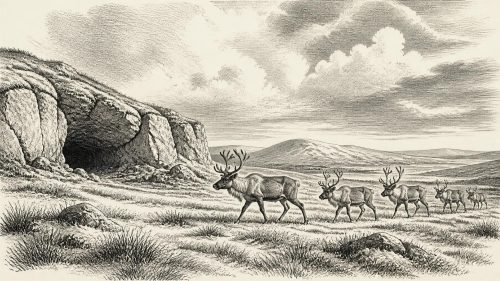
Approaching Last Glacial Maximum
31,935 BCE is not a precisely recoverable Irish date but falls within Marine Isotope Stage 3, a fluctuating cold period preceding the Last Glacial Maximum. Ireland supported open steppe-tundra environments, coastlines and diverse Ice-Age fauna. Castlepook Cave, County Cork, preserves bones of mammoth, giant deer, reindeer, hyena and animals, although its long-accumulated deposits cannot establish contemporaneous species or human activity. A reported stone-tool cut mark on a reindeer femur suggests a possible early Upper Palaeolithic visit, but not permanent settlement. No evidence supports farming, polities, warfare or symbolic culture. Approaching glaciation subsequently transformed landscapes and obscured much potential archaeological evidence.

Ruth Carden’s Cut Mark
31,934 BCE is a modern label for Late Pleistocene Ireland, not a date for a documented event. During unstable MIS 3 conditions, Ireland was probably partly ice-free, with cold open habitats, altered coastlines and increasingly severe glaciation approaching. Castlepook Cave in County Cork preserves fauna, including reindeer, mammoth, bear, wolf and hyaena, accumulated across long periods. A reindeer femur reportedly bears a stone-tool butchery mark dated about 33,000 BCE, offering tentative evidence of a human visit. Disturbed deposits and lacking associated artefacts prevent claims of settlement. No direct evidence supports Irish society, culture or occupation; dating and excavation are required.

Ireland at the Ice Margin
31,933 BCE is an artificial label for a period near the onset of the last Irish Ice Sheet's expansion, rather than a datable event. Ireland experienced uneven cooling, changing coastlines and glaciated landscapes, while maximum ice extent followed later. Buried sediments in Fermanagh indicate areas remained ice-free until roughly 34,000 years ago. Castlepook Cave, Cork, preserves remains of mammoth, giant deer, reindeer, bear, hyaena and Ice Age animals, demonstrating open habitats and food webs. A possibly butchered reindeer bone suggests, but does not prove, human visits. No evidence establishes settlement, society or political history; environmental change dominates the fragile record.

Cave Sediment Chronologies
Around 31,932 BCE, Ireland lay in a cold, unstable pre-Last Glacial Maximum environment as the British–Irish Ice Sheet expanded. Precise annual dating is impossible; evidence derives from radiocarbon-dated cave fauna and reconstructions. Castlepook Cave, County Cork, preserved remains including mammoth, reindeer, giant deer, bear, wolf, Arctic fox, lemmings and hyaena, indicating intermittently habitable open terrain. A reindeer bone may bear stone-tool marks and date to about 33,000 years ago, suggesting a possible human visit. However, disturbed old collections and uncertain context prevent proof of occupation. Later glaciation erased much evidence, while modern re-dating and excavation continue refining Ireland's Palaeolithic record.

Early Animal Butchery
At roughly 31,931 BCE, Ireland lay in the climatically unstable Late Pleistocene, before the maximum extent of the last British–Irish Ice Sheet. Its cold, changing landscapes probably included open grassland, tundra, bare ground and restricted woodland, supporting mammals such as reindeer, mammoth, giant deer, bears, wolves, hyaenas and Arctic foxes. Castlepook Cave, County Cork, preserves crucial but imperfect faunal evidence. A reindeer femur reportedly bears a stone-tool cut mark, suggesting possible human butchery around 31,000 BCE. However, disturbed old deposits and the absence of settlements preclude claims of permanent occupation. Later glaciation and rising seas obscured sites; research remains necessary.
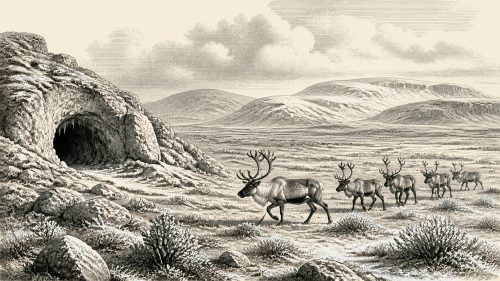
Castlepook’s Ambiguous Toolmark
Around 31,930 BCE, Ireland was a cold, unstable Late Pleistocene landscape before maximum glaciation, with altered coasts and water separating it from Britain. Castlepook Cave in County Cork preserves fauna dating broadly to Marine Isotope Stage 3, including reindeer, mammoth, giant deer, predators and cold-adapted species, indicating open tundra or steppe environments. A reindeer femur reportedly bearing stone-tool cut marks may signal brief Upper Palaeolithic human activity, but excavation methods, mixed deposits, carnivore disturbance and uncertain dating prevent conclusions. No tools, hearths, homes or occupation layers prove settlement. The evidence suggests animals occupied southern Ireland; people may have visited intermittently.

Derryvree Organic Silts
31,929 BCE is a modern label for a Late Pleistocene phase, not a recoverable Irish year. During Marine Isotope Stage 3, Ireland experienced cold, unstable conditions before the Last Glacial Maximum, with fluctuating ice margins, sea levels and landscapes. Organic silts at Derryvree, County Fermanagh, dated broadly to 36,900–31,700 cal BP, indicate locally ice-free intervals and treeless wet vegetation. Cave deposits, including Castlepook, show cold-stage mammals occurred during the wider period, though not necessarily then. No securely dated human evidence exists. Later glaciation erased much evidence; surviving sediments, landforms and fauna provide an incomplete environmental record of developing Irish glaciation.

Midlandian Glacial Stage
Around 31,928 BCE, Ireland lay in the Midlandian glacial stage, before the Last Glacial Maximum. Cold, unstable conditions created open grassland, periglacial erosion, altered rivers and lower sea levels, while expanding ice increasingly reshaped landscapes. Later glaciation destroyed much evidence, making caves crucial archives. Castlepook Cave in County Cork preserves remains of mammoth, giant deer, reindeer, predators and small cold-adapted mammals, demonstrating a varied fauna. A possibly tool-marked reindeer bone may indicate fleeting Upper Palaeolithic human contact, but cannot prove settlement. No associated tools, hearths, dwellings or social record survive. Ireland was a marginal, changing environment, not a human homeland.

Derryvree Freshwater Sequence
Around 31,927 BCE, Ireland lay in Marine Isotope Stage 3, before major Last Glacial Maximum ice expansion. Derryvree sediments in County Fermanagh, dated broadly to 36,900–31,700 years before present, preserve evidence of ice-free but intensely cold tundra terrain. Similar deposits indicate exposed north-central ground until about 34,000 years ago, before advancing ice transformed habitats. Cave remains demonstrate diverse Pleistocene fauna, although dates and associations require caution. No securely dated human settlement or community is known. A possibly butchered reindeer bone from Castlepook may indicate an early visit, but remains unconfirmed. The record principally documents environmental change, not conventional human history.

Cave Bone Taphonomy
Ireland around 31,926 BCE cannot be reconstructed as a calendar-year history. During later Marine Isotope Stage 3, before the Last Glacial Maximum, a cold, unstable landscape faced expanding and regionally variable ice. Cave deposits, particularly at Castlepook, preserve sparse evidence of mammoth, reindeer, giant deer, bears and hyaenas, indicating intermittently habitable open environments. A marked reindeer femur may record human butchery about 33,000 years ago, but remains contested and proves neither settlement nor continuous occupation. Disturbed early excavations complicate interpretation. No secure evidence exists for communities, artefacts, farming, politics, religion or art. Sustained settlement appears after deglaciation, around 8000 BCE.

Carden’s Castlepook Interpretation
At the notional date of 31,925 BCE, Ireland lay in a cold, unstable Late Pleistocene environment preceding maximum glaciation. Open steppe, shifting coastlines, glaciers and periglacial conditions supported intermittent fauna including reindeer, mammoth, giant deer, bears, wolves, Arctic foxes and hyaenas. Castlepook Cave, County Cork, contains a reindeer femur, roughly 33,000 years old, possibly cut by a stone tool during butchery. If confirmed, this suggests transient human presence, not permanent settlement or a defined culture. Cave disturbance, incomplete early excavation, glacial erosion and drowned landscapes limit interpretation. Secure settlement appears only in Mesolithic, after deglaciation, around early eighth millennium BCE.

The Castlepook Femur
Around 33,900 years ago, Ireland was a cold, changing Late Pleistocene landscape, with lower sea levels, open vegetation and advancing ice sheets. Castlepook Cave, County Cork, preserves Ireland’s richest assemblage of vertebrate remains from this period, including mammoth, giant deer, reindeer, bear and hyaena. Its deposits accumulated over millennia and cannot reconstruct a single ecosystem or event. A reindeer femur reportedly bearing a stone-tool cut mark suggests possible human butchery around 31,000 BC. However, no associated tools, hearths, dwellings or human remains confirm settlement. Ireland’s earliest possible human activity therefore remains fragmentary, while later glaciation erased or buried much evidence.

Castlepook’s Reindeer Horizon
31,923 BCE is an approximate modern label within Marine Isotope Stage 3, not a datable Irish event. Castlepook Cave in north Cork preserves disturbed pre-Last Glacial Maximum faunal remains, including reindeer, bears, wolves, Arctic foxes, lemmings, giant deer, mammoths and hyaenas. These animals indicate a fluctuating, open, cold environment rather than permanent ice cover. A reindeer femur dated to 31,000 BCE may bear a stone-tool butchery mark, potentially Ireland’s earliest human evidence. However, no associated tools, hearths or settlement survive, and the mark remains contested. The evidence suggests possible hunter-gatherer visits, not proven occupation, during a landscape transformed by glaciation.

Castlepook’s Hyena Galleries
About 33,900 calibrated years before present, Ireland experienced unstable MIS 3 conditions, with fluctuating ice, sea levels and open steppe-tundra habitats. Castlepook Cave, County Cork, preserves fauna including mammoth, reindeer, giant deer, hyaena, wolf and Arctic fox, although disturbed deposits and revised dates demand caution. Evidence indicates a cold-adapted animal community and carnivore activity, not a single contemporaneous landscape. A cut-marked reindeer femur plausibly suggests Upper Palaeolithic visitors butchered game, but cannot prove settlement. No associated tools, hearths or human remains exist. Later glaciation destroyed or buried evidence, leaving caves as fragile archives of possible early human presence in Ireland.

Castlepook’s Reindeer Country
Around 34,000 calibrated years BP, Ireland experienced severe climatic change before the Last Glacial Maximum. Cold open grassland, steppe and tundra supported diverse mammals, documented chiefly at Castlepook Cave, County Cork. Its disturbed, long-lived deposits contain reindeer, bears, wolves, arctic foxes, mammoths, giant deer and Ireland’s only spotted-hyaena remains, but do not represent one moment. A reindeer bone possibly cut by tools suggests human contact around 33,000 years ago, yet lacks secure context. No hearths, tools, settlements or burials confirm permanent occupation. Expanding ice later erased landscapes and deposits, leaving Castlepook crucial evidence for pre-glacial environments but unresolved human history.
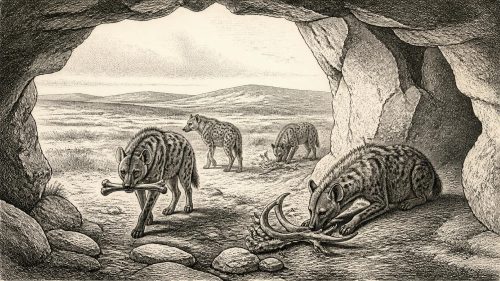
Hyaena Land, Castlepook
Castlepook Cave near Doneraile, County Cork, preserves a disturbed, important Late Pleistocene animal archive rather than evidence for a dated event in 31,920 BCE. Fossils, individually dated across approximately 45,700–19,950 years ago, include mammoth, giant deer, reindeer, bear, spotted hyaena, wolf, Arctic fox and lemmings. Gnawed bones indicate repeated hyaena use, not a local fauna. Revised dating suggests giant deer and hyaenas may have vanished locally before 40,000 years ago. A reindeer femur possibly bearing butchery marks suggests an early Upper Palaeolithic human visit, but proves neither settlement nor community. These changing landscapes supported habitats before ice-sheet advance erased evidence.
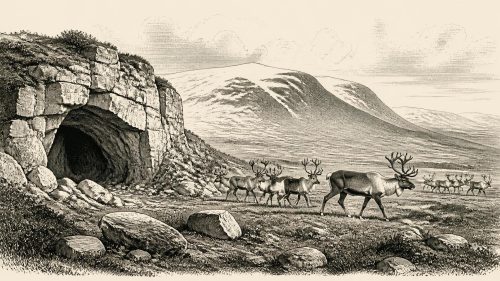
The Cut-Marked Reindeer
31,919 BCE is a modern label for a Late Pleistocene period, not a recoverable Irish historical year. Before the Last Glacial Maximum, deposits in Fermanagh indicate that some Irish landscapes were intermittently ice-free, although conditions varied regionally. Castlepook Cave in County Cork preserves a chronologically mixed fauna including reindeer, mammoth, giant deer, hyaena and other cold-stage animals, demonstrating habitable environments. A cut-marked reindeer femur may indicate human butchery around 33,000 BCE, but disturbed deposits, alternative explanations and absent artefacts prevent confirmation. Later glaciation created a vast gap; securely dated human activity appears only over twenty millennia later in County Clare.
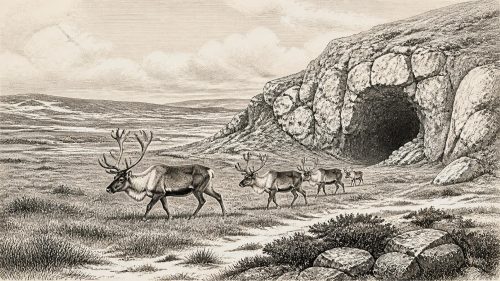
Reindeer at Doneraile
About 31,918 BCE, Ireland lay within the later Last Glacial Period, as climate deteriorated before the Last Glacial Maximum. Castlepook Cave near Doneraile, County Cork, preserves remains of reindeer, mammoth, hyaena and other cold-adapted fauna, demonstrating repeated animal presence rather than one contemporaneous landscape. A reindeer femur bearing probable stone-tool butchery marks, dated to roughly 33,000 years ago, may indicate Ireland's earliest human visit. However, disturbed cave deposits and limited evidence preclude claims of settlement. Lower sea levels may have facilitated movement, though routes remain uncertain. Expanding ice later transformed this exposed, seasonal frontier. Research may revise this fragile picture.

Castlepook Cave Assemblage
Castlepook Cave near Doneraile, County Cork, preserves a Pleistocene archive from Marine Isotope Stage 3, around 34,000 years ago, before the Last Glacial Maximum. Ireland then experienced cold, unstable conditions, yet retained open tundra, grassland and sheltered habitats supporting mammoth, reindeer, giant deer, bear, wolf, Arctic fox, lemmings and hyaena. Cave processes, predators and poorly recorded early excavations limit interpretation. A dated reindeer bone may bear stone-tool cut marks, suggesting an exceptionally early human encounter, but cannot demonstrate settlement. No communities, structures or cultural traditions are evidenced. The assemblage instead reveals a pre-glacial landscape and unresolved possibility of human presence.

The Doneraile Tundra
Around 31,916 BCE, Ireland lay in the unstable, pre-Last Glacial Maximum conditions of Marine Isotope Stage 3, not beneath uniform ice. Open, treeless habitats in southern Ireland supported cold-adapted fauna. Castlepook Cave near Doneraile preserves Ireland’s richest pre-maximum vertebrate assemblage, including mammoth, reindeer, giant deer, hyaena, wolves and Arctic foxes, although its bones accumulated across long periods and contexts are disturbed. Redating confirms several animals lived during MIS 3. A possibly cut-marked reindeer femur suggests human butchery, but no secure tools, hearths or settlement evidence exists. Thus Castlepook documents an Ice Age ecosystem while human presence remains plausible yet unproven.

Castlepook’s Marked Reindeer Femur Revisited
At roughly 31,915 BCE, Ireland lay within the unstable Late Pleistocene, before maximum glaciation, with open cold landscapes supporting diverse mammals. Castlepook Cave, County Cork, preserves bones of reindeer, mammoth, giant deer, predators and smaller cold-adapted species, although its deposits combine material from different periods and processes. A marked reindeer femur, approximately 33,000 radiocarbon years old, may record stone-tool butchery and potentially very early human activity. Yet it cannot prove settlement, population or social life. Ireland lacks securely contemporary human remains, tools, camps or ritual evidence. Subsequent ice advance destroyed much surviving evidence, leaving Castlepook a vital but uncertain archive.

Doneraile’s Mammoth Cave
Around 31,914 BCE, Ireland lay within the climatically unstable Marine Isotope Stage 3, before the Last Glacial Maximum. Castlepook Cave near Doneraile preserves Ireland’s richest vertebrate evidence from this period: mammoth, reindeer, giant deer, bear, spotted hyaena, wolf, Arctic fox, hare and lemmings, indicating cold, open steppe-tundra habitats. Cave deposits were accumulated and disturbed by water, animals and excavation, limiting interpretation. Revised radiocarbon dating supports an older MIS 3 fauna. Cut-like marks on a reindeer femur plausibly indicate Upper Palaeolithic butchery, but cannot prove settlement, population continuity, culture or social organisation. Castlepook nevertheless demonstrates human visits within European ecological connections.

Doneraile’s Reindeer Cutmark
Labelled 31,913 BCE, this period cannot be treated as an observable calendar year, but lies within late Marine Isotope Stage 3, before the Last Glacial Maximum. Ireland was a cold, unstable mosaic of open vegetation, with advancing yet regionally variable ice. Castlepook Cave, County Cork, preserves crucial fossil evidence, including reindeer, mammoth, giant deer and predators, accumulated across different episodes. A reindeer femur reportedly bearing a stone-tool cut mark may indicate early human butchery, but remains unconfirmed and cannot prove settlement. Secure evidence places humans in Ireland only during the terminal Pleistocene. The era chiefly represents ecological change preceding glaciation.

Elephant Hall Bone Sands
About 33,900 calendar years before 1950, Ireland’s history is reconstructed from cave deposits rather than dated events. Castlepook Cave, County Cork, preserves a mixed Late Pleistocene bone archive accumulated over millennia, containing mammoth, reindeer, giant deer, bears, hyaenas, wolves, Arctic foxes and lemmings. These remains indicate cold, open MIS 3 environments and functioning food webs, not a single community. A marked reindeer femur, dated roughly 33,000 years ago, may record human butchery, but cannot prove settlement, identity or continuity. Approaching the Last Glacial Maximum, advancing ice transformed landscapes and obscured earlier evidence. Further excavation and dating may clarify human presence.

Castlepook’s Mammoth Assemblage
31,911 BCE is not a securely identifiable Irish event but an approximate modern label for about 33.9 thousand calibrated years BP, during cold, unstable Marine Isotope Stage 3. Ireland was approaching major glaciation, with changing sea levels, exposed shelf, open vegetation and uncertain routes from Britain. Castlepook Cave in County Cork preserves important, mixed deposits of mammoth, reindeer, lemmings, predators and other fauna, although species did not necessarily coexist. A reportedly cut-marked reindeer bone may indicate human contact, but no secure settlement, tools or hearths confirm occupation. Ice and later seas destroyed much evidence, leaving Castlepook an unresolved ecological archive.

Castlepook’s MIS 3 Fauna
Circa 31,910 BCE, Ireland lay within the climatically unstable Marine Isotope Stage 3, when ice, coastlines and animal habitats changed substantially. Castlepook Cave, County Cork, preserves Ireland’s richest late-Pleistocene vertebrate archive, including mammoth, reindeer, giant deer, bear and hyaena, though its disturbed, time-averaged deposits cannot date species to one moment. Revised radiocarbon evidence suggests some animals vanished locally before 40,000 calibrated years ago. A marked reindeer bone, possibly butchered around 33,000 years ago, may indicate early human activity, but remains unconfirmed. No secure settlements, tools or social evidence exist. The period reveals an Ice Age ecosystem and uncertain human presence.

Greenagho’s Mosses
About 31,909 BCE, Ireland lay in the later Marine Isotope Stage 3, approaching but preceding extensive Last Glacial Maximum ice cover. Greenagho deposits in County Fermanagh indicate cold, open, largely treeless ground with mosses, sedges and freshwater hollows. Castlepook Cave, County Cork, preserves a time-mixed faunal collection including mammoth, giant deer, reindeer, hyaena, bear, wolves, foxes, hares and lemmings, evidencing changing cold-country ecosystems rather than one moment. Lower seas may have permitted intermittent animal movement, though no certain land bridge is known. A possibly butchered reindeer bone suggests, but cannot prove, early human visitation. No communities or culture are evidenced.

Derryvree’s Tundra Pools
31,908 BCE is a nominal point within a late Middle Midlandian interval, not a documented Irish event. Freshwater sediments at Derryvree, County Fermanagh, show that ice-free areas supported treeless tundra wetlands, pools, mosses, grasses and sedges amid severe climatic conditions before ice-sheet expansion. Cave remains at Castlepook, County Cork, attest to cold-adapted fauna, including mammoth, reindeer and predators, though disturbed contexts limit interpretation. Possible human butchery evidence remains unconfirmed and cannot demonstrate settlement. Ireland's geography, ice cover and access routes varied regionally. The period is best understood as an ecological frontier shaped by fluctuating climate, mobile fauna and encroaching ice.

The Castlepook Question
Around 34,000 calendar years ago, corresponding to 31,907 BCE, Ireland lay within the climatically unstable Late Pleistocene MIS 3. Lower sea levels and variable ice margins created changing landscapes, not a fixed land bridge or wholly glaciated island. Derryvree sediments in Fermanagh indicate open, periglacial tundra supporting cold-adapted vegetation and animals. Castlepook Cave in Cork preserves Ireland’s richest Pleistocene fauna, including mammoth, reindeer, hyaena, bear and lemmings, though old excavations complicate interpretation. A reindeer femur possibly marked by a stone tool may indicate a human visit, but cannot demonstrate settlement. Subsequent glaciation obscured evidence; Castlepook remains an unresolved archaeological question.

Muskeg Beneath Fermanagh
Around 31,906 BCE, Ireland has no annual historical record; the date represents a broad Late Pleistocene, Marine Isotope Stage 3 horizon. Derryvree, County Fermanagh, preserves organic silts between tills, showing locally ice-free, treeless tundra-like wetlands supporting plants, insects and freshwater pools. Castlepook Cave, County Cork, contains accumulated remains of mammoth, reindeer, giant deer, hyaena and other cold-adapted mammals, although their dates and associations vary. A possibly cut-marked reindeer bone may indicate an early human visit, not settlement. No political, cultural or economic history is demonstrable. As the British-Irish Ice Sheet expanded, glaciers later erased much evidence, leaving rare ecological archives.

Elephant Hall’s Mammoth Bone
Around 31,905 BCE, Ireland was a variable Late Pleistocene landscape, not a place with recoverable annual history. Derryvree, County Fermanagh, preserves freshwater deposits indicating treeless, periglacial tundra during MIS 3, although dates remain broad and local. Castlepook Cave in County Cork yielded mammoth, reindeer, giant deer, bear, wolf, Arctic fox, hyaena and lemming remains, demonstrating links with north-west European cold-stage fauna. Redating complicates earlier conclusions. A cut-marked reindeer bone may indicate brief Upper Palaeolithic butchery, but no secure occupation evidence exists. These fragments suggest occasional human visitation, not continuous settlement, before later glaciation and post-glacial colonisation in the archaeological record.

Derryvree’s Periglacial Waters
Although 31,904 BCE cannot denote a precisely known Irish year, it falls within unstable Marine Isotope Stage 3. Derryvree, County Fermanagh, preserves freshwater organic deposits dated broadly to 36,900–31,700 cal BP, indicating cold, open periglacial environments with wetlands, tundra plants and insects. Ireland was not yet wholly ice-covered, but was moving towards major glaciation. Cave remains show varied mammals, though their dates and locations remain uncertain. No settled human population is securely demonstrated; a possibly butchered reindeer bone suggests only a tentative Upper Palaeolithic visit. Evidence supports changing landscapes, animal movement and freshwater life, not precise events, routes or societies.

Hyaena Hall’s Open Country
31,903 BCE is not a securely identifiable Irish year but falls within climatically unstable Marine Isotope Stage 3. Ireland’s changing ice, exposed shelves and open, cold habitats intermittently supported mammals, although later glaciation erased much evidence. Castlepook Cave, County Cork, preserves Ireland’s richest relevant faunal archive, including mammoth, reindeer, giant deer and spotted hyaena, but its disturbed, long accumulated deposits cannot prove contemporaneity or date species precisely to this year. A possibly cut-marked reindeer bone suggests an unconfirmed early human encounter. No settlements, societies or economies are evidenced. The period is understood through fragmented animal remains, cave processes, climatic change.

Bogbean Beneath the Tills
About 31,902 BCE cannot be treated as a precise Irish historical year: evidence belongs broadly to Marine Isotope Stage 3, within the later Middle Midlandian. Ireland experienced severe, variable glacial conditions before the ice sheet’s maximum. Derryvree deposits in Fermanagh indicate local ice-free wet tundra, with sparse treeless vegetation, while Castlepook Cave in Cork preserves remains of reindeer, mammoth, giant deer, hyaena and other cold-adapted animals. Lower sea levels altered geography but did not ensure permanent land access. A possibly butchered reindeer bone suggests episodic Upper Palaeolithic visitation, yet remains unconfirmed. No secure evidence supports settlement, institutions, warfare or occupation.

Castlepook and Derryvree
Circa 31,901 BCE, Ireland was a cold, seasonally varied Late Pleistocene landscape, not yet wholly covered by the expanding British-Irish Ice Sheet. Derryvree sediments in Fermanagh record open, treeless wetland vegetation, freshwater pools and cold-adapted insects during an ice-free interval, though dates remain broad. Castlepook Cave in Cork preserves mixed remains of mammoth, reindeer, giant deer, hyaena, wolf, Arctic fox and other fauna, accumulated over extended periods and partly modified by carnivores. A possibly butchered reindeer bone suggests fleeting human activity, but no secure settlement evidence exists. Together, the sites document environmental change, ecological connectivity and fragmentary survival of evidence.